From Research to Practice:
Training in Sexual and
Reproductive Health Research
Dr.Ayat AbuAgla
Organizers
• Geneva Foundation for Medical Education and
  Research (WHO Collaborating Centre in Education and
  Research in Human Reproduction)
• UNDP/UNFPA/WHO/World Bank Special Program for
  Research, Development and Research Training in Human
  Reproduction, Department of Reproductive Health and
  Research; Family and Community Health Cluster
  (WHO/RHR)
• Réseau en Afrique francophone pour la
  télémédecine (RAFT), HUG (Geneva University Hospitals)
• Oxford University (UK)
• Boston University (USA)
• Parma University (Italy)
• San Rafaelle (Italy)
The course aims

• To provide a cadre of health
  practitioners in different countries
  with knowledge, skills and
  competencies in SRH as well as
  research.
The course aims
• Participants will learn from first hand
  health experiences in day to day
  demands and through longer term
  challenges in the field of sexual and
  reproductive health and research.
Course Objectives

• To contribute to greater sharing of competence
  and knowledge between health workers in
  developing countries, local and international
  health and training institutions.
Course Objectives
• To provide access to education and learning by
  establishing a distance learning program to
  professionals.
Course Objectives
• To provide skills in research methodology.

• To create a network between health
  professionals of different horizons and training
  and research institutions for the exchange of
  knowledge and information.
Course Content

• The course content is designed to
  address a wider range of
  contemporary reproductive and
  sexual health problems as well as
  research in this field with a particular
  focus on developing countries.
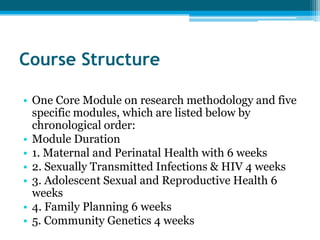
Course Structure

• One Core Module on research methodology and five
  specific modules, which are listed below by
  chronological order:
• Module Duration
• 1. Maternal and Perinatal Health with 6 weeks
• 2. Sexually Transmitted Infections & HIV 4 weeks
• 3. Adolescent Sexual and Reproductive Health 6
  weeks
• 4. Family Planning 6 weeks
• 5. Community Genetics 4 weeks
Course Structure
• The Core Module is integrated within specific
  modules. The lectures/ presentations,
  supplementary study materials are provided in
  electronic format.
Course Duration


• May-October 2012 6 months distance
  learning
• June 2013 One week Intensive
  training in WHO Geneva
Study materials

• In an online course, learning is
  student’s responsibility – he /she
  needs self-discipline and self-
  directed time management skills
  in-order to be successful.
Learning Methods

• Combination of the following teaching styles and
  technologies:
• On-line presentations.
• Individual mentoring & follow-up
• Live on-line interaction with peers, tutors &
  mentors
• Evaluation by mentor and coordinators
Learning Methods
• 2. Intensive Training Course in Geneva: The
  students with high score and with a relevant
  research project will be invited to participate in
  an extensive training which will be organized in
  WHO Head Quarters in Geneva. This will give
  these students the opportunity to work more on
  their research projects and to get in contact with
  WHO and other partners resource persons.
Assignment

• Each module will contain main lectures
  /presentations
• course provides access to a large number of
  guidelines related to each specific module that
  can be downloaded. From this point of view this
  course is one of richest in the world.
Final Evaluation and Certification

• At the end of the course students are required to
  produce a research protocol / paper, using the
  knowledge acquired from this course.

• Students have also the possibility to introduce a
  tutor of their choice for their research project.
  The tutor can be from student’s country, from a
  research entity, university or an organization.
• Facebook
• http://en-gb.facebook.com/pages/Training-in-
  Sexual-and-Reproductive-Health-Research-
  2011/189269171109136
• Skype
• http://www.skype.com/intl/en/download/skype
  /windows/
Admission Procedures


• The following documents are required to process
  the admission:
• Completed application form
• Curriculum vitae, including sections on: current
  and previous positions; responsibilities in
  research, teaching and clinical work; the
  institution currently employed; a list of
  publications (if available)
• Certified copy of the university diploma/s
Admission Procedures

• letter of motivation
• An outline of the scientific paper that will be
  completed/written up as part of the exams
• official attestation confirming proficiency in the
  English language
• Two letters of reference
• if possible, an introduction by the candidate's
  Head of Department stating her/his current role
  and future involvement in the country's National
  Reproductive Health Program.
Costs


• The tuition fee is CHF 500 per participant.
Application Submission Deadline

• 15 April 2012


• The application form is available on:
• http://www.gfmer.ch/SRH-Course-2011/
Questions
Goodluck

GFMER - RCRU Orientation session 28 3-2012

  • 1.
    From Research toPractice: Training in Sexual and Reproductive Health Research Dr.Ayat AbuAgla
  • 2.
    Organizers • Geneva Foundationfor Medical Education and Research (WHO Collaborating Centre in Education and Research in Human Reproduction) • UNDP/UNFPA/WHO/World Bank Special Program for Research, Development and Research Training in Human Reproduction, Department of Reproductive Health and Research; Family and Community Health Cluster (WHO/RHR) • Réseau en Afrique francophone pour la télémédecine (RAFT), HUG (Geneva University Hospitals) • Oxford University (UK) • Boston University (USA) • Parma University (Italy) • San Rafaelle (Italy)
  • 3.
    The course aims •To provide a cadre of health practitioners in different countries with knowledge, skills and competencies in SRH as well as research.
  • 4.
    The course aims •Participants will learn from first hand health experiences in day to day demands and through longer term challenges in the field of sexual and reproductive health and research.
  • 5.
    Course Objectives • Tocontribute to greater sharing of competence and knowledge between health workers in developing countries, local and international health and training institutions.
  • 6.
    Course Objectives • Toprovide access to education and learning by establishing a distance learning program to professionals.
  • 7.
    Course Objectives • Toprovide skills in research methodology. • To create a network between health professionals of different horizons and training and research institutions for the exchange of knowledge and information.
  • 8.
    Course Content • Thecourse content is designed to address a wider range of contemporary reproductive and sexual health problems as well as research in this field with a particular focus on developing countries.
  • 9.
    Course Structure • OneCore Module on research methodology and five specific modules, which are listed below by chronological order: • Module Duration • 1. Maternal and Perinatal Health with 6 weeks • 2. Sexually Transmitted Infections & HIV 4 weeks • 3. Adolescent Sexual and Reproductive Health 6 weeks • 4. Family Planning 6 weeks • 5. Community Genetics 4 weeks
  • 10.
    Course Structure • TheCore Module is integrated within specific modules. The lectures/ presentations, supplementary study materials are provided in electronic format.
  • 11.
    Course Duration • May-October2012 6 months distance learning • June 2013 One week Intensive training in WHO Geneva
  • 12.
    Study materials • Inan online course, learning is student’s responsibility – he /she needs self-discipline and self- directed time management skills in-order to be successful.
  • 13.
    Learning Methods • Combinationof the following teaching styles and technologies: • On-line presentations. • Individual mentoring & follow-up • Live on-line interaction with peers, tutors & mentors • Evaluation by mentor and coordinators
  • 14.
    Learning Methods • 2.Intensive Training Course in Geneva: The students with high score and with a relevant research project will be invited to participate in an extensive training which will be organized in WHO Head Quarters in Geneva. This will give these students the opportunity to work more on their research projects and to get in contact with WHO and other partners resource persons.
  • 15.
    Assignment • Each modulewill contain main lectures /presentations • course provides access to a large number of guidelines related to each specific module that can be downloaded. From this point of view this course is one of richest in the world.
  • 16.
    Final Evaluation andCertification • At the end of the course students are required to produce a research protocol / paper, using the knowledge acquired from this course. • Students have also the possibility to introduce a tutor of their choice for their research project. The tutor can be from student’s country, from a research entity, university or an organization.
  • 17.
    • Facebook • http://en-gb.facebook.com/pages/Training-in- Sexual-and-Reproductive-Health-Research- 2011/189269171109136 • Skype • http://www.skype.com/intl/en/download/skype /windows/
  • 18.
    Admission Procedures • Thefollowing documents are required to process the admission: • Completed application form • Curriculum vitae, including sections on: current and previous positions; responsibilities in research, teaching and clinical work; the institution currently employed; a list of publications (if available) • Certified copy of the university diploma/s
  • 19.
    Admission Procedures • letterof motivation • An outline of the scientific paper that will be completed/written up as part of the exams • official attestation confirming proficiency in the English language • Two letters of reference • if possible, an introduction by the candidate's Head of Department stating her/his current role and future involvement in the country's National Reproductive Health Program.
  • 20.
    Costs • The tuitionfee is CHF 500 per participant.
  • 21.
    Application Submission Deadline •15 April 2012 • The application form is available on: • http://www.gfmer.ch/SRH-Course-2011/
  • 22.
  • 23.