

ECLAMPSIA
   in Sudan
Geneva Foundation for Medical
   Education and Research
     GFMER Sudan 2012
       Forum No: ( 1 )
Name of presenter
Name                    Position                    Institution
Dr/ SAMI MAHMOUD        Obstetrician/Gynecologist   Reproductive Health Care
                                                    Centre


       Name of contributors
Name                    Position                    Institution
Dr/ MAJDI SABAHELZAIN   Pharmacist/ MSc. Public     University of Medical
                        and Tropical Health         Sciences and Technology
Content of the presentation

• Definition of Pre-eclampsia
• Diagnosis of Pre-eclampsia
• Importance of Pre-
  eclampsia
• Risk Factors for Pre-
  eclampsia
• Incidence in Sudan
• Management and
Definition

    Appearance of seizures in a
    patient (often with pre-
    existing pre-eclampsia)

                 #
    In 20%, BP can be normal
    Can occur before, during or
    after delivery
       1/3 are post-delivery
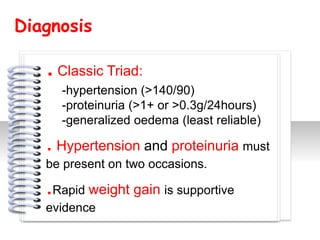
Diagnosis

   . Classic Triad:
     -hypertension (>140/90)
     -proteinuria (>1+ or >0.3g/24hours)
     -generalized oedema (least reliable)

   . Hypertension and proteinuria must
                      #

   be present on two occasions.

   .Rapid weight gain is supportive
   evidence
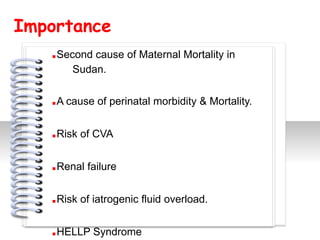
Importance
   .Second cause of Maternal Mortality in
       Sudan.

   .A cause of perinatal morbidity & Mortality.
   .Risk of CVA        #

   .Renal failure
   .Risk of iatrogenic fluid overload.
   .HELLP Syndrome
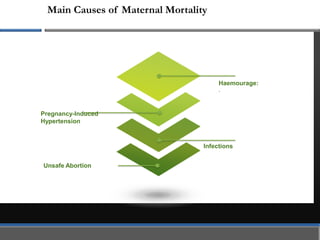
Main Causes of Maternal Mortality

Qualitative Research Techniques - The four parts of Qualitative Research Techniques are:


                                                               Haemourage:
                                                               .


          Pregnancy-Induced
          Hypertension


                                                          Infections


           Unsafe Abortion
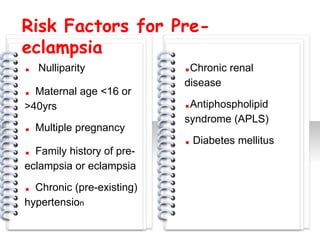
Risk Factors for Pre-
eclampsia
. Nulliparity              .Chronic renal
                           disease
. Maternal age <16 or
>40yrs                     .Antiphospholipid
                           syndrome (APLS)
. Multiple pregnancy
                           . Diabetes mellitus
          #


                                     #
. Family history of pre-
eclampsia or eclampsia

. Chronic (pre-existing)
hypertension
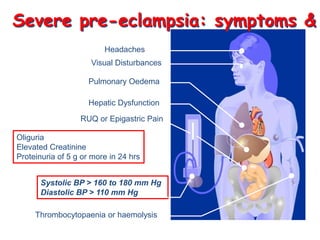
Severe pre-eclampsia: symptoms &
                         Headaches
                     Visual Disturbances

                    Pulmonary Oedema

                    Hepatic Dysfunction

                  RUQ or Epigastric Pain

Oliguria
Elevated Creatinine
Proteinuria of 5 g or more in 24 hrs


       Systolic BP > 160 to 180 mm Hg
       Diastolic BP > 110 mm Hg

     Thrombocytopaenia or haemolysis
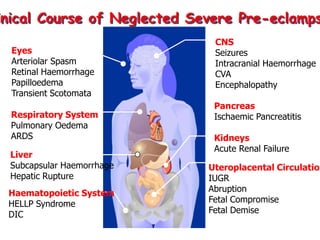
inical Course of Neglected Severe Pre-eclamps
                              CNS
  Eyes                        Seizures
  Arteriolar Spasm            Intracranial Haemorrhage
  Retinal Haemorrhage         CVA
  Papilloedema                Encephalopathy
  Transient Scotomata
                              Pancreas
  Respiratory System          Ischaemic Pancreatitis
  Pulmonary Oedema
  ARDS                        Kidneys
                              Acute Renal Failure
 Liver
 Subcapsular Haemorrhage     Uteroplacental Circulation
 Hepatic Rupture             IUGR
 Haematopoietic System       Abruption
 HELLP Syndrome              Fetal Compromise
 DIC                         Fetal Demise
Aetiology

   .Uncertain
     - cerebral oedema,
     ischaemia are possible
             #
     causes.
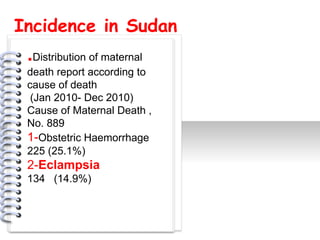
Incidence in Sudan
 .Distribution of maternal
 death report according to
 cause of death
  (Jan 2010- Dec 2010)
 Cause of Maternal Death ,
 No. 889
 1-Obstetric Haemorrhage
             #


 225 (25.1%)
 2-Eclampsia
 134 (14.9%)
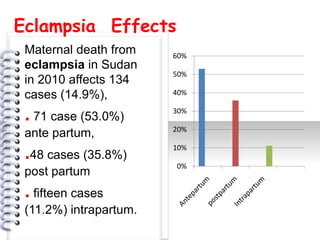
Eclampsia Effects
 Maternal death from    60%
 eclampsia in Sudan
                        50%
 in 2010 affects 134
 cases (14.9%),         40%


 . 71 case (53.0%)      30%

                        20%
 ante partum,
           #


                        10%
 .48 cases (35.8%)      0%
 post partum
 . fifteen cases
 (11.2%) intrapartum.
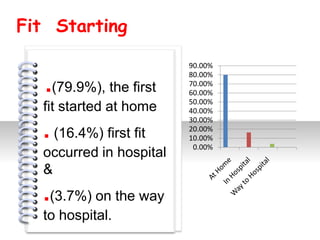
Fit Starting

                         90.00%
                         80.00%
   .(79.9%), the first   70.00%
                         60.00%
                         50.00%
  fit started at home    40.00%
                         30.00%
  . (16.4%) first fit    20.00%
                         10.00%
           #


                          0.00%
  occurred in hospital
  &
  .(3.7%) on the way
  to hospital.
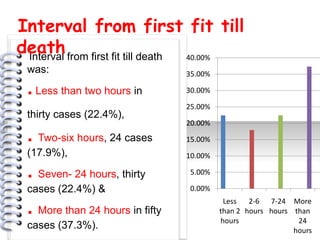
Interval from first fit till
death from first fit till death 40.00%
 Interval
 was:                            35.00%

 . Less than two hours in        30.00%

                                 25.00%
 thirty cases (22.4%),
                                 20.00%
 . Two-six hours, 24 cases       15.00%
              #


 (17.9%),                        10.00%

 . Seven- 24 hours, thirty        5.00%

 cases (22.4%) &                  0.00%
                                           Less   2-6 7-24 More
 . More than 24 hours in fifty            than 2 hours hours than
                                          hours               24
 cases (37.3%).                                              hours
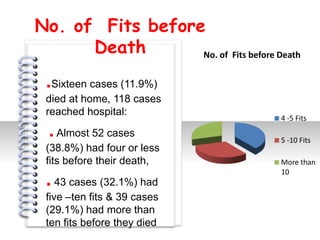
No. of Fits before
      Death       No. of Fits before Death


 .Sixteen cases (11.9%)
 died at home, 118 cases
 reached hospital:
                                      4 -5 Fits
  . Almost 52 cases
            #


                                      5 -10 Fits
 (38.8%) had four or less
 fits before their death,             More than
                                      10
 . 43 cases (32.1%) had
 five –ten fits & 39 cases
 (29.1%) had more than
 ten fits before they died
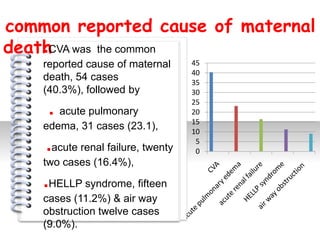
common reported cause of maternal
deathCVA was the common
    .
    reported cause of maternal     45
                                   40
    death, 54 cases                35
    (40.3%), followed by           30
                                   25
     . acute pulmonary             20
                                   15
    edema, 31 cases (23.1),        10
              #


    .acute renal failure, twenty    5
                                    0
    two cases (16.4%),

    .HELLP syndrome, fifteen
    cases (11.2%) & air way
    obstruction twelve cases
    (9.0%).
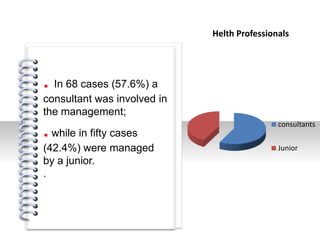
Helth Professionals


. In 68 cases (57.6%) a
consultant was involved in
the management;
                                             consultants
. while in fifty cases
            #


(42.4%) were managed                         Junior
by a junior.
.
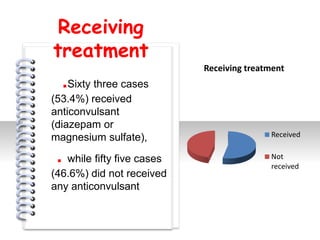
Receiving
treatment
                            Receiving treatment
  .Sixty three cases
(53.4%) received
anticonvulsant
(diazepam or
magnesium sulfate),                        Received
         #


 . while fifty five cases                  Not
                                           received
(46.6%) did not received
any anticonvulsant
Management
   1.   CALL FOR HELP +++++
   2.   EMPHASISE IMPORTANCE OF BASIC
        ABCs
   3.   ā€˜A’ – airway can’t be inserted during a fit
   4.   ā€˜C’ – includes x2 large bore cannulae
   5.   Initiate unit – ā€˜Eclampsia protocol’


                          #
   6.   DO NOT NURSE IN THE DARK!!
   7.   Give loading dose MgSO4
   8.   Foley catheter/fluid balance
   9.   Keep NBM
Management
   •Antihypertensive ( Labetalol
   , Hydralazine , Methyl Dopa &
   Nifedipine)

   •Magnesium sulphate

                    #
Prevention
   • Reducing maternal death from
     Eclampsia:-
   • Availing of magnesium sulfate.
   • Availing of Hydralazine.

                  #
   • Training of care providers on
     magnesium sulfate use &
     monitoring side effects.
22 August 2012   Ian Donald Symposium   23
Thank
You


22 August 2012   Ian Donald School   24

Eclampsia in Sudan

  • 1.
    ECLAMPSIA in Sudan Geneva Foundation for Medical Education and Research GFMER Sudan 2012 Forum No: ( 1 )
  • 2.
    Name of presenter Name Position Institution Dr/ SAMI MAHMOUD Obstetrician/Gynecologist Reproductive Health Care Centre Name of contributors Name Position Institution Dr/ MAJDI SABAHELZAIN Pharmacist/ MSc. Public University of Medical and Tropical Health Sciences and Technology
  • 3.
    Content of thepresentation • Definition of Pre-eclampsia • Diagnosis of Pre-eclampsia • Importance of Pre- eclampsia • Risk Factors for Pre- eclampsia • Incidence in Sudan • Management and
  • 4.
    Definition Appearance of seizures in a patient (often with pre- existing pre-eclampsia) # In 20%, BP can be normal Can occur before, during or after delivery 1/3 are post-delivery
  • 5.
    Diagnosis . Classic Triad: -hypertension (>140/90) -proteinuria (>1+ or >0.3g/24hours) -generalized oedema (least reliable) . Hypertension and proteinuria must # be present on two occasions. .Rapid weight gain is supportive evidence
  • 6.
    Importance .Second cause of Maternal Mortality in Sudan. .A cause of perinatal morbidity & Mortality. .Risk of CVA # .Renal failure .Risk of iatrogenic fluid overload. .HELLP Syndrome
  • 7.
    Main Causes ofMaternal Mortality Qualitative Research Techniques - The four parts of Qualitative Research Techniques are: Haemourage: . Pregnancy-Induced Hypertension Infections Unsafe Abortion
  • 8.
    Risk Factors forPre- eclampsia . Nulliparity .Chronic renal disease . Maternal age <16 or >40yrs .Antiphospholipid syndrome (APLS) . Multiple pregnancy . Diabetes mellitus # # . Family history of pre- eclampsia or eclampsia . Chronic (pre-existing) hypertension
  • 9.
    Severe pre-eclampsia: symptoms& Headaches Visual Disturbances Pulmonary Oedema Hepatic Dysfunction RUQ or Epigastric Pain Oliguria Elevated Creatinine Proteinuria of 5 g or more in 24 hrs Systolic BP > 160 to 180 mm Hg Diastolic BP > 110 mm Hg Thrombocytopaenia or haemolysis
  • 10.
    inical Course ofNeglected Severe Pre-eclamps CNS Eyes Seizures Arteriolar Spasm Intracranial Haemorrhage Retinal Haemorrhage CVA Papilloedema Encephalopathy Transient Scotomata Pancreas Respiratory System Ischaemic Pancreatitis Pulmonary Oedema ARDS Kidneys Acute Renal Failure Liver Subcapsular Haemorrhage Uteroplacental Circulation Hepatic Rupture IUGR Haematopoietic System Abruption HELLP Syndrome Fetal Compromise DIC Fetal Demise
  • 11.
    Aetiology .Uncertain - cerebral oedema, ischaemia are possible # causes.
  • 12.
    Incidence in Sudan .Distribution of maternal death report according to cause of death (Jan 2010- Dec 2010) Cause of Maternal Death , No. 889 1-Obstetric Haemorrhage # 225 (25.1%) 2-Eclampsia 134 (14.9%)
  • 13.
    Eclampsia Effects Maternaldeath from 60% eclampsia in Sudan 50% in 2010 affects 134 cases (14.9%), 40% . 71 case (53.0%) 30% 20% ante partum, # 10% .48 cases (35.8%) 0% post partum . fifteen cases (11.2%) intrapartum.
  • 14.
    Fit Starting 90.00% 80.00% .(79.9%), the first 70.00% 60.00% 50.00% fit started at home 40.00% 30.00% . (16.4%) first fit 20.00% 10.00% # 0.00% occurred in hospital & .(3.7%) on the way to hospital.
  • 15.
    Interval from firstfit till death from first fit till death 40.00% Interval was: 35.00% . Less than two hours in 30.00% 25.00% thirty cases (22.4%), 20.00% . Two-six hours, 24 cases 15.00% # (17.9%), 10.00% . Seven- 24 hours, thirty 5.00% cases (22.4%) & 0.00% Less 2-6 7-24 More . More than 24 hours in fifty than 2 hours hours than hours 24 cases (37.3%). hours
  • 16.
    No. of Fitsbefore Death No. of Fits before Death .Sixteen cases (11.9%) died at home, 118 cases reached hospital: 4 -5 Fits . Almost 52 cases # 5 -10 Fits (38.8%) had four or less fits before their death, More than 10 . 43 cases (32.1%) had five –ten fits & 39 cases (29.1%) had more than ten fits before they died
  • 17.
    common reported causeof maternal deathCVA was the common . reported cause of maternal 45 40 death, 54 cases 35 (40.3%), followed by 30 25 . acute pulmonary 20 15 edema, 31 cases (23.1), 10 # .acute renal failure, twenty 5 0 two cases (16.4%), .HELLP syndrome, fifteen cases (11.2%) & air way obstruction twelve cases (9.0%).
  • 18.
    Helth Professionals . In68 cases (57.6%) a consultant was involved in the management; consultants . while in fifty cases # (42.4%) were managed Junior by a junior. .
  • 19.
    Receiving treatment Receiving treatment .Sixty three cases (53.4%) received anticonvulsant (diazepam or magnesium sulfate), Received # . while fifty five cases Not received (46.6%) did not received any anticonvulsant
  • 20.
    Management 1. CALL FOR HELP +++++ 2. EMPHASISE IMPORTANCE OF BASIC ABCs 3. ā€˜A’ – airway can’t be inserted during a fit 4. ā€˜C’ – includes x2 large bore cannulae 5. Initiate unit – ā€˜Eclampsia protocol’ # 6. DO NOT NURSE IN THE DARK!! 7. Give loading dose MgSO4 8. Foley catheter/fluid balance 9. Keep NBM
  • 21.
    Management •Antihypertensive ( Labetalol , Hydralazine , Methyl Dopa & Nifedipine) •Magnesium sulphate #
  • 22.
    Prevention • Reducing maternal death from Eclampsia:- • Availing of magnesium sulfate. • Availing of Hydralazine. # • Training of care providers on magnesium sulfate use & monitoring side effects.
  • 23.
    22 August 2012 Ian Donald Symposium 23
  • 24.
    Thank You 22 August 2012 Ian Donald School 24