MATERNAL NEAR MISS IN SUDAN


  Geneva Foundation for Medical Education and Research
  GFMER Sudan 2012
  Forum No: ( 1 )
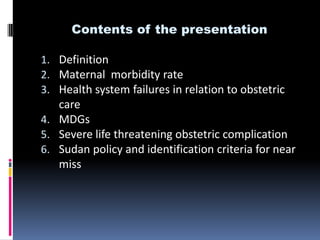
Name of presenters
Name          Position                        Institution
Aida Ahmed    Head, Department Obstetrics &   UMST
              Gynaecology Nursing
Amal Khalil   Coordinator, Reproductive & Child UMST
              Health Research Unit


       Name of contributors
Name          Position                        Institution
Aida Ahmed    Head, Department Obstetrics &   UMST
              Gynaecology Nursing
Amal Khalil   Coordinator, Reproductive & Child UMST
              Health Research Unit
Contents of the presentation

1. Definition
2. Maternal morbidity rate
3. Health system failures in relation to obstetric
   care
4. MDGs
5. Severe life threatening obstetric complication
6. Sudan policy and identification criteria for near
   miss
Maternal Near Miss is:

 a    severe life threatening obstetric complication
necessitating an urgent medical intervention in order to
prevent likely death of the mother.

 any pregnant or recently delivered woman, in whom
immediate survival is threatened and who survives by chance
or because of the hospital care she received.

 Women who experienced and survived a severe health
condition during pregnancy, childbirth or postpartum are
considered as near miss or severe acute maternal morbidity
(SAMM) cases.
Why maternal near miss?


        two decades ago.
   In low maternal mortality
            settings

        morbidity useful
  indicator of obstetric care


  in recent years analyzing near
        miss/SAMM cases
   understanding health system
             failures in
     relation to obstetric care
Why maternal
                   near miss?


 Near miss/SAMM cases share many characteristics
with maternal deaths and can directly inform on
obstacles that had to be overcome after the onset of an
acute complication.
 Corrective actions for identified problems can be
taken to reduce related mortality and long-term
morbidity.
Moreover, countries are increasingly adopting policies that
encourage births in institutions. Instruments must therefore,
be available to assess the quality of care within the
institutions. Routine assessments of maternal near miss
cases will help answer that need.
It is expected that the implementation of the
maternal near miss process provide an important
contribution to assessing and improving quality of
obstetric care and to the reduction of maternal
deaths.
The advantages


 The care of critically ill women will be analyzed, not only
deaths. This is important given the emphasis that emergency
obstetric care is currently receiving, and allows for monitoring
the quality of these programs.
 A proportion of women with life-threatening conditions
survive. They can be interviewed and areas of breakdown in
the health system can be identified.
 Indicators of maternal near miss and maternal deaths as
exemplified in can allow for comparison between institutions
and countries and changes over time.
maternal morbidity rate


Medical complications in a woman
           caused by
  pregnancy , labor , or delivery
severe life threatening
                  obstetric complication
 Obstetric Haemorrhage
 Eclampsia
 Sepsis
 Pulmonary embolism
 Ruptured uterus
 Anemia related conditions & Heart Failure
 Abortion
 Malaria
 Anesthesia
 Amniotic fluid embolism
 ruptured ectopic pregnancy
 Fever and convulsions
Jaundice
5th MDG


          is calling
for improving maternal health
        World wide.
Sudan policy and identification
    criteria for near miss
Health system failures in
relation to obstetric care
Maternal near-miss in a rural hospital in Sudan


 The first report of maternal near-miss in Sudan
 Medical files of pregnant women and who
  delivered recently at Kassala Maternity
  Hospital from January 2008 to December 2010
  were studied.
Results

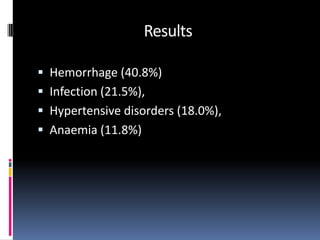
 Hemorrhage (40.8%)
 Infection (21.5%),
 Hypertensive disorders (18.0%),
 Anaemia (11.8%)
Conclusion

 high frequency of maternal morbidity and
 mortality at the level of this facility. Therefore
 maternal health policy needs to be concerned
 not only with averting the loss of life, but also
 with preventing or ameliorating maternal-
 near miss events (hemorrhage, infections,
 hypertension and anemia) at all care levels
 including primary level.
Qualitative Study


Determinants of maternal morbidity and
mortality in post conflict areas.
Aim

 to   gain in-depth understanding of the
  interacting determinants behind maternal
  mortality
 to investigate the methods of survival of
  maternal near miss in crises without
  professional health care.
Method

 Qualitative study design using Critical Incident
  Technique [CIT].
 11 near miss events.
 Interviews were conducted with husbands,
  mothers, in laws, sisters, midwives of the
  deceased and in case of survival the maternal
  near misses.
Results

 Socio-demographic: education, family, age at
  marriage, poverty
 Cultural: perceptions about pregnancy and
  delivery
 Health facilities: willingness to pay,
  unacceptability
 Conflict/ post conflict: fear, insecurity, weak
  infrastructure, lack of transportation.
Their stories…


         Maternal Near Miss PPH
A house-wife & mother of four children
started her story “It happened 5 years ago.
First of all I had pain in my tummy/belly. I
sent my mother to the village midwife. I
never deliver by a traditional birth
attendant ever. The VMW examined me &
said this is labour! We waited for 2 hours
but the baby didn’t come& after 3 hours
the baby came. I delivered & the bleeding
started & the placenta didn’t come out”.
She was rolling in pain, bleeding and started to get
weak and restless. By then her husband decided to take
her to Renk. It was the rainy season autumn; he went
to fetch a car. Luckily he found a pickup truck
immediately that charged a ridiculous amount of
money SDG100. It was a long and bumpy trip on the
dirt road to Renk taking them 4 hours to reach the
hospital from their village Gabarona.
The minute she entered the maternity ward safely
delivered the placenta. She was discharged after a
week diagnosed as having Malaria and was on
medication.
 Later on they moved to Renk where she went to
antenatal care/ follow up and delivered her children at
the hospital.
THANKS

Maternal near miss

  • 1.
    MATERNAL NEAR MISSIN SUDAN Geneva Foundation for Medical Education and Research GFMER Sudan 2012 Forum No: ( 1 )
  • 2.
    Name of presenters Name Position Institution Aida Ahmed Head, Department Obstetrics & UMST Gynaecology Nursing Amal Khalil Coordinator, Reproductive & Child UMST Health Research Unit Name of contributors Name Position Institution Aida Ahmed Head, Department Obstetrics & UMST Gynaecology Nursing Amal Khalil Coordinator, Reproductive & Child UMST Health Research Unit
  • 3.
    Contents of thepresentation 1. Definition 2. Maternal morbidity rate 3. Health system failures in relation to obstetric care 4. MDGs 5. Severe life threatening obstetric complication 6. Sudan policy and identification criteria for near miss
  • 4.
    Maternal Near Missis:  a severe life threatening obstetric complication necessitating an urgent medical intervention in order to prevent likely death of the mother.  any pregnant or recently delivered woman, in whom immediate survival is threatened and who survives by chance or because of the hospital care she received.  Women who experienced and survived a severe health condition during pregnancy, childbirth or postpartum are considered as near miss or severe acute maternal morbidity (SAMM) cases.
  • 5.
    Why maternal nearmiss? two decades ago. In low maternal mortality settings morbidity useful indicator of obstetric care in recent years analyzing near miss/SAMM cases understanding health system failures in relation to obstetric care
  • 6.
    Why maternal near miss?  Near miss/SAMM cases share many characteristics with maternal deaths and can directly inform on obstacles that had to be overcome after the onset of an acute complication.  Corrective actions for identified problems can be taken to reduce related mortality and long-term morbidity.
  • 7.
    Moreover, countries areincreasingly adopting policies that encourage births in institutions. Instruments must therefore, be available to assess the quality of care within the institutions. Routine assessments of maternal near miss cases will help answer that need.
  • 8.
    It is expectedthat the implementation of the maternal near miss process provide an important contribution to assessing and improving quality of obstetric care and to the reduction of maternal deaths.
  • 9.
    The advantages  Thecare of critically ill women will be analyzed, not only deaths. This is important given the emphasis that emergency obstetric care is currently receiving, and allows for monitoring the quality of these programs.  A proportion of women with life-threatening conditions survive. They can be interviewed and areas of breakdown in the health system can be identified.  Indicators of maternal near miss and maternal deaths as exemplified in can allow for comparison between institutions and countries and changes over time.
  • 10.
    maternal morbidity rate Medicalcomplications in a woman caused by pregnancy , labor , or delivery
  • 11.
    severe life threatening obstetric complication  Obstetric Haemorrhage  Eclampsia  Sepsis  Pulmonary embolism  Ruptured uterus  Anemia related conditions & Heart Failure  Abortion  Malaria  Anesthesia  Amniotic fluid embolism  ruptured ectopic pregnancy  Fever and convulsions Jaundice
  • 12.
    5th MDG is calling for improving maternal health World wide.
  • 13.
    Sudan policy andidentification criteria for near miss
  • 14.
    Health system failuresin relation to obstetric care
  • 15.
    Maternal near-miss ina rural hospital in Sudan  The first report of maternal near-miss in Sudan  Medical files of pregnant women and who delivered recently at Kassala Maternity Hospital from January 2008 to December 2010 were studied.
  • 16.
    Results  Hemorrhage (40.8%) Infection (21.5%),  Hypertensive disorders (18.0%),  Anaemia (11.8%)
  • 17.
    Conclusion  high frequencyof maternal morbidity and mortality at the level of this facility. Therefore maternal health policy needs to be concerned not only with averting the loss of life, but also with preventing or ameliorating maternal- near miss events (hemorrhage, infections, hypertension and anemia) at all care levels including primary level.
  • 18.
    Qualitative Study Determinants ofmaternal morbidity and mortality in post conflict areas.
  • 19.
    Aim  to gain in-depth understanding of the interacting determinants behind maternal mortality  to investigate the methods of survival of maternal near miss in crises without professional health care.
  • 20.
    Method  Qualitative studydesign using Critical Incident Technique [CIT].  11 near miss events.  Interviews were conducted with husbands, mothers, in laws, sisters, midwives of the deceased and in case of survival the maternal near misses.
  • 21.
    Results  Socio-demographic: education,family, age at marriage, poverty  Cultural: perceptions about pregnancy and delivery  Health facilities: willingness to pay, unacceptability  Conflict/ post conflict: fear, insecurity, weak infrastructure, lack of transportation.
  • 22.
    Their stories… Maternal Near Miss PPH
  • 23.
    A house-wife &mother of four children started her story “It happened 5 years ago. First of all I had pain in my tummy/belly. I sent my mother to the village midwife. I never deliver by a traditional birth attendant ever. The VMW examined me & said this is labour! We waited for 2 hours but the baby didn’t come& after 3 hours the baby came. I delivered & the bleeding started & the placenta didn’t come out”.
  • 24.
    She was rollingin pain, bleeding and started to get weak and restless. By then her husband decided to take her to Renk. It was the rainy season autumn; he went to fetch a car. Luckily he found a pickup truck immediately that charged a ridiculous amount of money SDG100. It was a long and bumpy trip on the dirt road to Renk taking them 4 hours to reach the hospital from their village Gabarona. The minute she entered the maternity ward safely delivered the placenta. She was discharged after a week diagnosed as having Malaria and was on medication. Later on they moved to Renk where she went to antenatal care/ follow up and delivered her children at the hospital.
  • 25.