The Earliest Human
Societies
to 2500 BCE
HI 101 Origins of Civilization
Study Questions:
• How did humans evolve and where did they migrate?
• What were the key features of Paleolithic Society?
• How did the Agricultural Revolution develop and how did it
effect human society?
• How did growing social hierarchies increase the complexity
of humans society in the Neolithic Period?
Prehistory
• Human history before the invention of writing & the
keeping of written records (about or circa (ca.) 3,500
BCE)
• Lasted over 10 million years!
• Hominids: immediate ancestors of Humans appeared
ca. 10 million plus years ago in Africa
• Hominids—species family that contains Humans,
chimpanzees, gorillas, and orangutans
Prehistory
• Four Key Elements:
1. Ancestors of Humans appeared in Africa
2. Homo Sapiens (our species of Hominids or “Modern
Humans”) appeared ca. 200.000 BCE
3. Homo Sapiens migrated out of Africa
4. Humans began to invent culture—or modify the
environment to fit their needs & transmit culture to future
generations
• Culture: ways of living built up by a group
and passed on from one generation to
another, including behavior, material
things, ideas, institutions, and
religion. The combination of speech and
material invention was necessary for the
development of human culture.
PreEvolution and Migration
•Early Hominids:
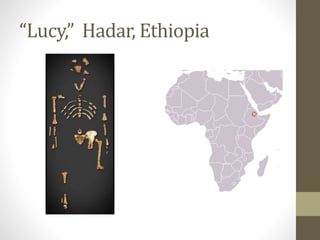
• Australopithecus (“Lucy”)
• Homo habilis
• Homo erectus
• Homo sapiens
AFRICA: Modern Human Beginnings
• Australopithecus
• Oldest bipedal
hominid found
• 3.2 Million Years Old
• Walked upright
• Carried & used
tools—led to larger
brains
• Evolved into Homo
Habilis
“Lucy,” Hadar, Ethiopia
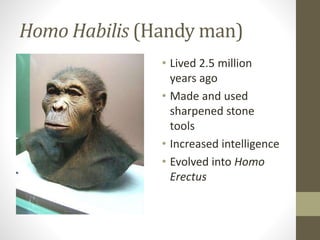
Homo Habilis (Handy man)
• Lived 2.5 million
years ago
• Made and used
sharpened stone
tools
• Increased intelligence
• Evolved into Homo
Erectus
Homo Erectus (upright human)
• 2 million years ago
• Improved tool-
making skills
• Better hunting
• Increased vocal
ability, mobility
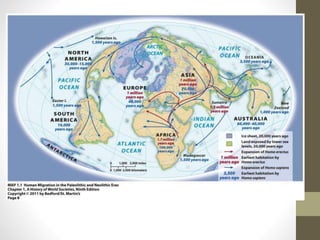
• migrated out of east
Africa to Eurasia
Homo Sapiens (Thinking
Humans)
•Emerged in East Africa
•Larger brains
•Better language ability
•Migrated across Africa to Eurasia
• Interbred with and replaced Homo
Erectus—colonized the globe
Why are Big Brains Important?
• Language=social organization
• Better for attracting a mate & passing big brains onto
later generations
• Make better weapons—fish hooks, harpoons, snares,
traps
• Get more food!
• Bigger brains need more energy and require more
food
Human Migration &
Differentiation
• Pre-Historic Man
• Migrated throughout the world by raft or
crossing land formations
• Racial Differentiation
“Racial” Differentiation
• If we all started in Africa, then why do we look so
different?
• Migrating groups became isolated & mated within the
same group
• Environment and breeding led to differences in skin and
hair color, eye and body shape
• Created different cultural practices
• The term “race” and “racial” categories were developed
in the 1700s in Europe
• HUMANS ARE ALL MEMBERS OF THE SAME SPECIES!
Prehistory
There are 2 important time periods in Pre-history
1. Paleolithic: 250,000-9,000 BCE
2. Neolithic: ca. 9000 BCE
Paleolithic Society
250,000-9,000 BCE
• Humans completely dependent on their environment
• Foraged for food—mostly plants, fish, seafood, small animals
• Hunted some large game with spears and bows
• Art & Culture:
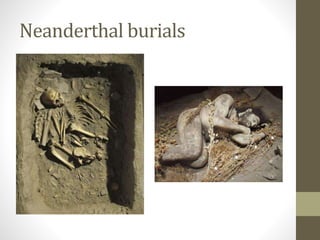
• Evidence suggest body ornamentation, ceremonial burials,
paintings, decorations, musical instruments, & expressions of
self-identity
• Spirituality:
• Careful burials suggest belief in afterlife
• Animism: everything around them had a spirit
Neanderthal burials
Neolithic Era, ca. 9000 BCE
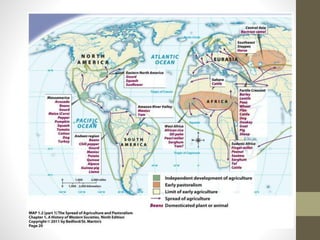
• Development of Agriculture—Humans became independent
of nature
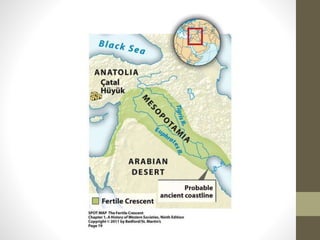
• Agricultural Revolution: Began in “Fertile
Crescent” of Mesopotamia
• Planting of seeds
• Domestication of animals
• Increased human population
• More settled lifestyle—permanent housing, food storage
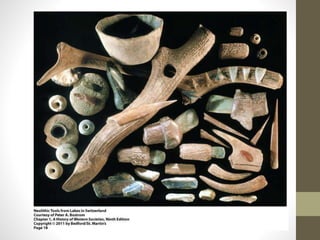
• Specialized labor—tool makers, Pot makers, home builders, etc.
Social Hierarchy & Slavery
• Stored food—
• Valuable
• Source of conflict
• Required more complex rules—led to formation of power structures
• People with power became elites in society who controlled
resources
• Needed force to maintain power
• Eventually bought the labor of others or other people
• Allowed for rise of Priestly class—responsible for rituals to
ensure good harvest
Development of Trade
Networks
• Settled societies began to trade goods with one another

1 earliest human societies

  • 1.
    The Earliest Human Societies to2500 BCE HI 101 Origins of Civilization
  • 2.
    Study Questions: • Howdid humans evolve and where did they migrate? • What were the key features of Paleolithic Society? • How did the Agricultural Revolution develop and how did it effect human society? • How did growing social hierarchies increase the complexity of humans society in the Neolithic Period?
  • 3.
    Prehistory • Human historybefore the invention of writing & the keeping of written records (about or circa (ca.) 3,500 BCE) • Lasted over 10 million years! • Hominids: immediate ancestors of Humans appeared ca. 10 million plus years ago in Africa • Hominids—species family that contains Humans, chimpanzees, gorillas, and orangutans
  • 4.
    Prehistory • Four KeyElements: 1. Ancestors of Humans appeared in Africa 2. Homo Sapiens (our species of Hominids or “Modern Humans”) appeared ca. 200.000 BCE 3. Homo Sapiens migrated out of Africa 4. Humans began to invent culture—or modify the environment to fit their needs & transmit culture to future generations
  • 5.
    • Culture: waysof living built up by a group and passed on from one generation to another, including behavior, material things, ideas, institutions, and religion. The combination of speech and material invention was necessary for the development of human culture.
  • 6.
    PreEvolution and Migration •EarlyHominids: • Australopithecus (“Lucy”) • Homo habilis • Homo erectus • Homo sapiens
  • 7.
    AFRICA: Modern HumanBeginnings • Australopithecus • Oldest bipedal hominid found • 3.2 Million Years Old • Walked upright • Carried & used tools—led to larger brains • Evolved into Homo Habilis
  • 8.
  • 9.
    Homo Habilis (Handyman) • Lived 2.5 million years ago • Made and used sharpened stone tools • Increased intelligence • Evolved into Homo Erectus
  • 10.
    Homo Erectus (uprighthuman) • 2 million years ago • Improved tool- making skills • Better hunting • Increased vocal ability, mobility • migrated out of east Africa to Eurasia
  • 11.
    Homo Sapiens (Thinking Humans) •Emergedin East Africa •Larger brains •Better language ability •Migrated across Africa to Eurasia • Interbred with and replaced Homo Erectus—colonized the globe
  • 12.
    Why are BigBrains Important? • Language=social organization • Better for attracting a mate & passing big brains onto later generations • Make better weapons—fish hooks, harpoons, snares, traps • Get more food! • Bigger brains need more energy and require more food
  • 13.
    Human Migration & Differentiation •Pre-Historic Man • Migrated throughout the world by raft or crossing land formations • Racial Differentiation
  • 15.
    “Racial” Differentiation • Ifwe all started in Africa, then why do we look so different? • Migrating groups became isolated & mated within the same group • Environment and breeding led to differences in skin and hair color, eye and body shape • Created different cultural practices • The term “race” and “racial” categories were developed in the 1700s in Europe • HUMANS ARE ALL MEMBERS OF THE SAME SPECIES!
  • 16.
    Prehistory There are 2important time periods in Pre-history 1. Paleolithic: 250,000-9,000 BCE 2. Neolithic: ca. 9000 BCE
  • 17.
    Paleolithic Society 250,000-9,000 BCE •Humans completely dependent on their environment • Foraged for food—mostly plants, fish, seafood, small animals • Hunted some large game with spears and bows • Art & Culture: • Evidence suggest body ornamentation, ceremonial burials, paintings, decorations, musical instruments, & expressions of self-identity • Spirituality: • Careful burials suggest belief in afterlife • Animism: everything around them had a spirit
  • 21.
  • 22.
    Neolithic Era, ca.9000 BCE • Development of Agriculture—Humans became independent of nature • Agricultural Revolution: Began in “Fertile Crescent” of Mesopotamia • Planting of seeds • Domestication of animals • Increased human population • More settled lifestyle—permanent housing, food storage • Specialized labor—tool makers, Pot makers, home builders, etc.
  • 26.
    Social Hierarchy &Slavery • Stored food— • Valuable • Source of conflict • Required more complex rules—led to formation of power structures • People with power became elites in society who controlled resources • Needed force to maintain power • Eventually bought the labor of others or other people • Allowed for rise of Priestly class—responsible for rituals to ensure good harvest
  • 27.
    Development of Trade Networks •Settled societies began to trade goods with one another

Editor's Notes

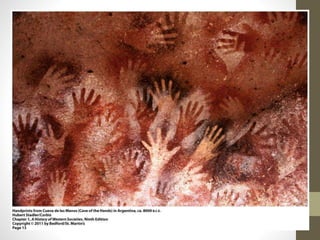
  • #19 Finger Marks / Handprints (p. 13)   1. What kinds of behavior and thinking engaged in by humans today might have led to the production of the ancient finger marks and handprints pictured? (Answer: The child’s finger marks and the hand prints suggest play and art, perhaps like finger painting today. They also point to a sense of self-identity; a statement that “I was here.” As the text suggests, it is possible that the handprints were part of an adolescent initiation of a type we would call “religious” today.)   2. These paintings were both discovered deep within caves. What common human traits might have led Paleolithic men and women to penetrate far into cave systems? (Answer: Curiosity and/or a sense of awe could have led these people to explore these caves.   3. These images survived because they were hidden and protected from the elements. Conditions of humidity and temperature in the caves would also have contributed to their preservation. Taking this into consideration, do you think that making art was common or uncommon among Paleolithic peoples? Consider what kinds of materials might have been used in art, and which were perishable. (Answer: Many of the materials which could have been used in art, such as wood, animal hides, bark, and reeds, would have decomposed long ago. It is probable that Paleolithic humans were making much art that has left no trace. )
  • #20 Finger Marks / Handprints (p. 13)   1. What kinds of behavior and thinking engaged in by humans today might have led to the production of the ancient finger marks and handprints pictured? (Answer: The child’s finger marks and the hand prints suggest play and art, perhaps like finger painting today. They also point to a sense of self-identity; a statement that “I was here.” As the text suggests, it is possible that the handprints were part of an adolescent initiation of a type we would call “religious” today.)   2. These paintings were both discovered deep within caves. What common human traits might have led Paleolithic men and women to penetrate far into cave systems? (Answer: Curiosity and/or a sense of awe could have led these people to explore these caves.   3. These images survived because they were hidden and protected from the elements. Conditions of humidity and temperature in the caves would also have contributed to their preservation. Taking this into consideration, do you think that making art was common or uncommon among Paleolithic peoples? Consider what kinds of materials might have been used in art, and which were perishable. (Answer: Many of the materials which could have been used in art, such as wood, animal hides, bark, and reeds, would have decomposed long ago. It is probable that Paleolithic humans were making much art that has left no trace. )
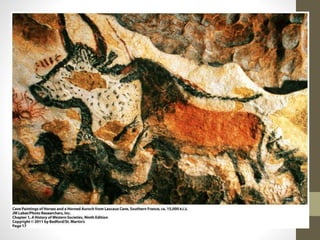
  • #21 Cave Paintings of Horses and a Horned Auroch (p. 17)   1. Why might the artist have been particularly interested in horses and aurochs (wild ancestors of cattle)? (Answer: These were pre-agricultural societies that depended on hunting and gathering for food. These animals were a food source, and may have been revered for their critical importance for daily survival. )   2. The painting includes at least two different pigments. What does this suggest about the artist’s knowledge of his or her environment? (Answer: Hunter-gatherer groups that have existed in recent times have an extraordinarily detailed knowledge of the plants, animals, and minerals of their environment and these things’ possible uses. The artist’s knowledge of different pigments probably reflected such knowledge. )   3. Is it possible to determine or make a good guess about what these paintings meant to the artist? (Answer: This is really a question for open discussion. On the one hand scholars have argued by analogy with modern hunter-gatherer groups that these paintings might have been part of some ritual magic intended to ensure a successful hunt. On the other, we don’t know for sure if this analogy holds up. The paintings could have been part of other types of religious ritual or magic, or they could have been “art for art’s sake.” )
  • #26 Neolithic Tools from Lakes in Switzerland (p. 18)   1. What kinds of activities do the tools indicate these Neolithic people were engaged in? (Answer: Awls – making clothing or shelter from animal hides. Arrow Heads – hunting and/or warfare. Chisels and Axes – carpentry/woodworking. Spindles – making thread, yarn, or rope out of plant fiber. Sickle Blades – harvesting domesticated and/or wild grains. )   2. The people who made and used these tools lived by lakes. Why might a lake have been a particularly favorable place to establish a permanent settlement, even before the advent of agriculture? (Answer: Some scholars hypothesize that many of the earliest permanent human settlements (as opposed to temporary camps) depended on fishing and/or shellfish gathering for survival.)   3. The implements pictured appear to be made from bone, stone, and possibly clay. What perishable materials might tools, clothing, utensils, etc. also have been made from? (Answer: We know relatively little about the Paleolithic and Neolithic toolkits because these ancient humans must have used wood, rushes and plant fibers, animal bladders, hides, and other perishable materials for many implements. Except for a very few items preserved in swamps or freezing environments, these tools have not survived. )