The Origin  of Humans Ms. Susan M. Pojer Horace Greeley HS  Chappaqua, NY
Theories on prehistory and early man constantly change as new evidence comes to light.    - Louis Leakey, British    paleoanthropologist The First Humans
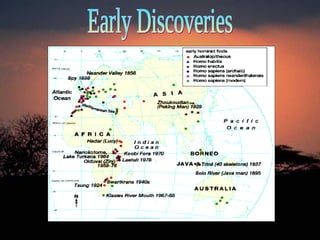
Early Discoveries
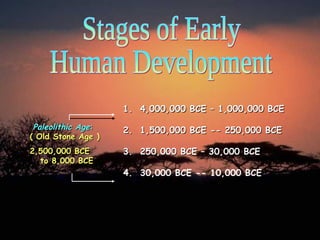
Stages of Early Human Development 1.  4,000,000 BCE – 1,000,000 BCE 2.  1,500,000 BCE -- 250,000 BCE 3.  250,000 BCE – 30,000 BCE 4.  30,000 BCE -- 10,000 BCE Paleolithic Age : ( Old Stone Age ) 2,500,000 BCE    to 8,000 BCE
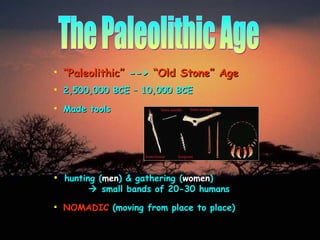
The Paleolithic Age “ Paleolithic”  -->  “Old Stone” Age 2,500,000 BCE – 10,000 BCE hunting ( men ) & gathering ( women )      small bands of 20-30 humans NOMADIC  (moving from place to place) Made tools
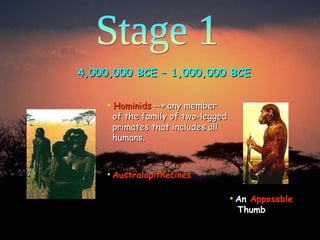
Stage 1 4,000,000 BCE – 1,000,000 BCE Hominids  --> any member   of the family of two-legged   primates that includes all   humans. Australopithecines An  Apposable    Thumb
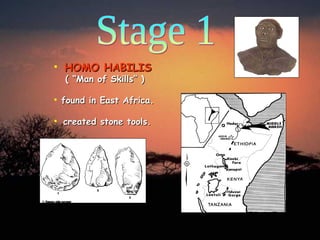
Stage 1 HOMO HABILIS   ( “Man of Skills” ) found in East Africa. created stone tools.
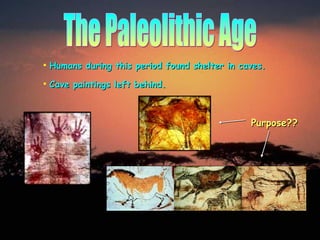
The Paleolithic Age Humans during this period found shelter in caves. Cave paintings left behind.  Purpose??
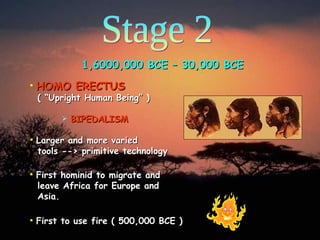
Stage 2 1,6000,000 BCE – 30,000 BCE HOMO ERECTUS    ( “Upright Human Being” ) Larger and more varied    tools --> primitive technology First hominid to migrate and   leave Africa for Europe and   Asia. First to use fire ( 500,000 BCE ) BIPEDALISM
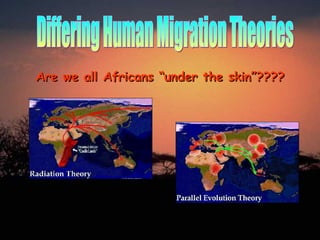
Differing Human Migration Theories Are we all Africans “under the skin”????
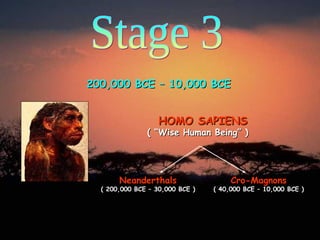
Stage 3 200,000 BCE – 10,000 BCE HOMO SAPIENS   ( “Wise Human Being” ) Neanderthals ( 200,000 BCE – 30,000 BCE ) Cro-Magnons ( 40,000 BCE – 10,000 BCE )
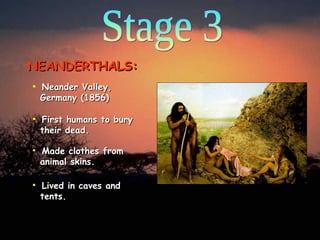
Stage 3 NEANDERTHALS: Neander Valley,    Germany (1856) First humans to bury   their dead. Made clothes from   animal skins. Lived in caves and   tents.
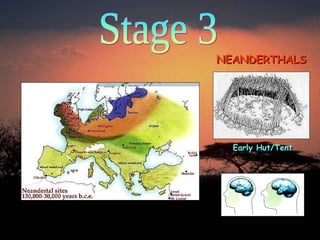
Stage 3 NEANDERTHALS Early Hut/Tent
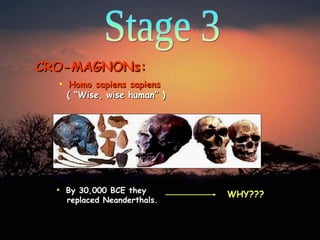
Stage 3 CRO-MAGNONs: Homo sapiens sapiens   ( “Wise, wise human” ) By 30,000 BCE they   replaced Neanderthals. WHY???
Homo sapiens sapiens in Europe
The Last Ice Age 70,000 BCE – 10,000 BCE
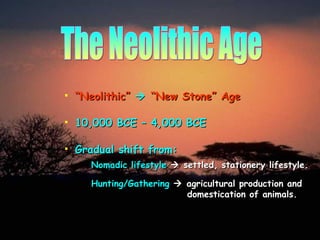
The Neolithic Age “ Neolithic”      “New Stone” Age 10,000 BCE – 4,000 BCE Gradual shift from: Nomadic lifestyle     settled, stationery lifestyle. Hunting/Gathering    agricultural production and   domestication of animals.
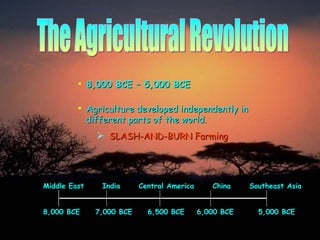
The Agricultural Revolution 8,000 BCE – 5,000 BCE Agriculture developed independently in   different parts of the world. SLASH-AND-BURN Farming Middle East  India  Central America  China  Southeast Asia 8,000 BCE  7,000 BCE  6,500 BCE  6,000 BCE  5,000 BCE
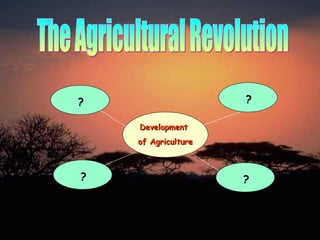
The Agricultural Revolution Development  of Agriculture ? ? ? ?
The Agricultural Revolution Why do you think the development of agriculture occurred around the same time in several different places?
The Agricultural Revolution Why do some archaeologists believe that women were the first farmers?
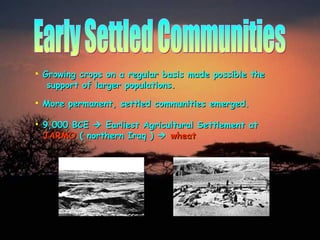
Early Settled Communities Growing crops on a regular basis made possible the    support of larger populations. More permanent, settled communities emerged. 9,000 BCE    Earliest Agricultural Settlement at     JARMO   ( northern Iraq )     wheat
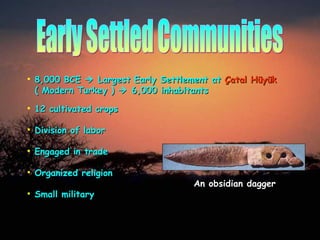
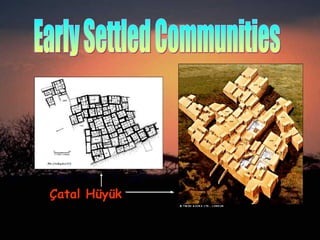
Early Settled Communities 8,000 BCE    Largest Early Settlement at   Ç atal H ü yük     ( Modern Turkey )    6,000 inhabitants Division of labor Engaged in trade Organized religion Small military 12 cultivated crops An obsidian dagger
Early Settled Communities Çatal Hüyük
The Agricultural Revolution What role did the food supply play in shaping the nomadic life of hunter-gatherers and the settled life of the farmers?
Why is the  "Neolithic Revolution"  a turning point  in human history??
What is the next step in the  development of human settlements??
CIVILIZATIONS !! CITIES !
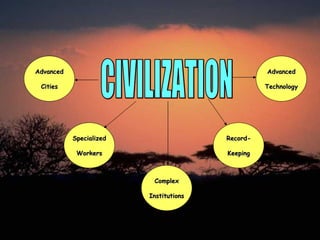
What are the characteristics of a civilization??
Advanced Cities CIVILIZATION Specialized Workers Complex Institutions Record- Keeping Advanced Technology

Origin of humans

  • 1.
    The Origin of Humans Ms. Susan M. Pojer Horace Greeley HS Chappaqua, NY
  • 2.
    Theories on prehistoryand early man constantly change as new evidence comes to light. - Louis Leakey, British paleoanthropologist The First Humans
  • 3.
  • 4.
    Stages of EarlyHuman Development 1. 4,000,000 BCE – 1,000,000 BCE 2. 1,500,000 BCE -- 250,000 BCE 3. 250,000 BCE – 30,000 BCE 4. 30,000 BCE -- 10,000 BCE Paleolithic Age : ( Old Stone Age ) 2,500,000 BCE to 8,000 BCE
  • 5.
    The Paleolithic Age“ Paleolithic” --> “Old Stone” Age 2,500,000 BCE – 10,000 BCE hunting ( men ) & gathering ( women )  small bands of 20-30 humans NOMADIC (moving from place to place) Made tools
  • 6.
    Stage 1 4,000,000BCE – 1,000,000 BCE Hominids --> any member of the family of two-legged primates that includes all humans. Australopithecines An Apposable Thumb
  • 7.
    Stage 1 HOMOHABILIS ( “Man of Skills” ) found in East Africa. created stone tools.
  • 8.
    The Paleolithic AgeHumans during this period found shelter in caves. Cave paintings left behind. Purpose??
  • 9.
    Stage 2 1,6000,000BCE – 30,000 BCE HOMO ERECTUS ( “Upright Human Being” ) Larger and more varied tools --> primitive technology First hominid to migrate and leave Africa for Europe and Asia. First to use fire ( 500,000 BCE ) BIPEDALISM
  • 10.
    Differing Human MigrationTheories Are we all Africans “under the skin”????
  • 11.
    Stage 3 200,000BCE – 10,000 BCE HOMO SAPIENS ( “Wise Human Being” ) Neanderthals ( 200,000 BCE – 30,000 BCE ) Cro-Magnons ( 40,000 BCE – 10,000 BCE )
  • 12.
    Stage 3 NEANDERTHALS:Neander Valley, Germany (1856) First humans to bury their dead. Made clothes from animal skins. Lived in caves and tents.
  • 13.
    Stage 3 NEANDERTHALSEarly Hut/Tent
  • 14.
    Stage 3 CRO-MAGNONs:Homo sapiens sapiens ( “Wise, wise human” ) By 30,000 BCE they replaced Neanderthals. WHY???
  • 15.
  • 16.
    The Last IceAge 70,000 BCE – 10,000 BCE
  • 17.
    The Neolithic Age“ Neolithic”  “New Stone” Age 10,000 BCE – 4,000 BCE Gradual shift from: Nomadic lifestyle  settled, stationery lifestyle. Hunting/Gathering  agricultural production and domestication of animals.
  • 18.
    The Agricultural Revolution8,000 BCE – 5,000 BCE Agriculture developed independently in different parts of the world. SLASH-AND-BURN Farming Middle East India Central America China Southeast Asia 8,000 BCE 7,000 BCE 6,500 BCE 6,000 BCE 5,000 BCE
  • 19.
    The Agricultural RevolutionDevelopment of Agriculture ? ? ? ?
  • 20.
    The Agricultural RevolutionWhy do you think the development of agriculture occurred around the same time in several different places?
  • 21.
    The Agricultural RevolutionWhy do some archaeologists believe that women were the first farmers?
  • 22.
    Early Settled CommunitiesGrowing crops on a regular basis made possible the support of larger populations. More permanent, settled communities emerged. 9,000 BCE  Earliest Agricultural Settlement at JARMO ( northern Iraq )  wheat
  • 23.
    Early Settled Communities8,000 BCE  Largest Early Settlement at Ç atal H ü yük ( Modern Turkey )  6,000 inhabitants Division of labor Engaged in trade Organized religion Small military 12 cultivated crops An obsidian dagger
  • 24.
  • 25.
    The Agricultural RevolutionWhat role did the food supply play in shaping the nomadic life of hunter-gatherers and the settled life of the farmers?
  • 26.
    Why is the "Neolithic Revolution" a turning point in human history??
  • 27.
    What is thenext step in the development of human settlements??
  • 28.
  • 29.
    What are thecharacteristics of a civilization??
  • 30.
    Advanced Cities CIVILIZATIONSpecialized Workers Complex Institutions Record- Keeping Advanced Technology