The Earliest Humans Where did we come from?
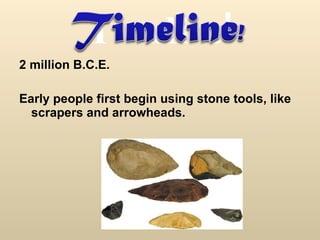
Timeline! 2 million B.C.E.  Early people first begin using stone tools, like scrapers and arrowheads.
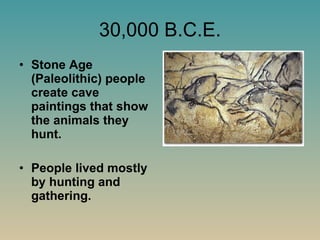
30,000 B.C.E. Stone Age (Paleolithic) people create cave paintings that show the animals they hunt. People lived mostly by hunting and gathering.
 
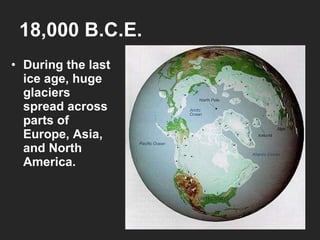
18,000 B.C.E. During the last ice age, huge glaciers spread across parts of Europe, Asia, and North America.
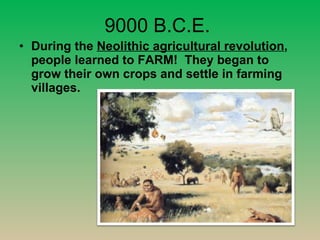
9000 B.C.E. During the  Neolithic agricultural revolution , people learned to FARM!  They began to grow their own crops and settle in farming villages.
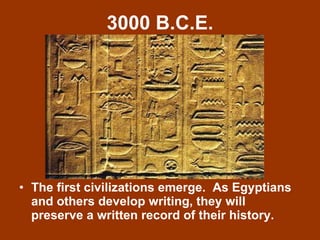
3000 B.C.E. The first civilizations emerge.  As Egyptians and others develop writing, they will preserve a written record of their history.
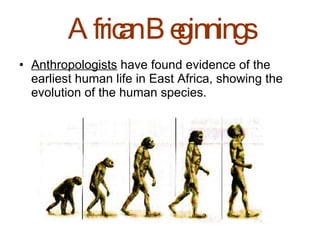
African Beginnings Anthropologists  have found evidence of the earliest human life in East Africa, showing the evolution of the human species.
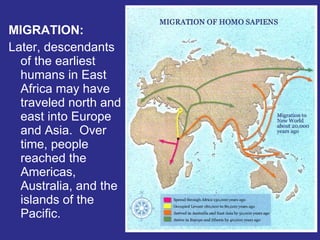
MIGRATION: Later, descendants of the earliest humans in East Africa may have traveled north and east into Europe and Asia.  Over time, people reached the Americas, Australia, and the islands of the Pacific.
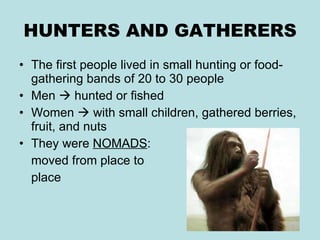
HUNTERS AND GATHERERS The first people lived in small hunting or food-gathering bands of 20 to 30 people Men    hunted or fished Women    with small children, gathered berries, fruit, and nuts They were  NOMADS :  moved from place to  place
And then there was  agriculture (farming)… This was a HUGE breakthrough! People learned to  farm How did they learn? No one knows for sure Food-gathering women may have noticed that seeds grew into plants each year Differences in soil, may have stayed near good soil and found they could harvest crops
Effects of Agriculture: Domesticating animals Better health for humans More free time… Growth in population Permanent settlements Interactions among settlements (trade, warfare, technological exchanges)
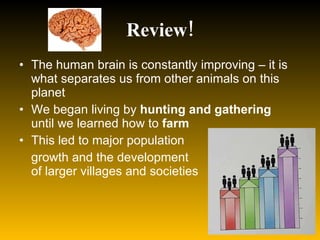
Review! The human brain is constantly improving – it is what separates us from other animals on this planet We began living by  hunting and gathering  until we learned how to  farm This led to major population  growth and the development  of larger villages and societies
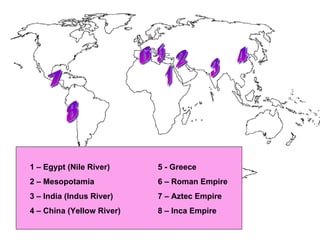
So where were these first civilizatons?
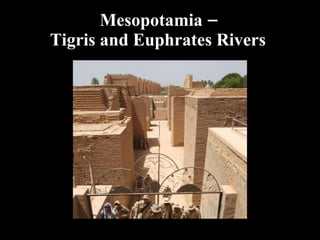
Mesopotamia –  Tigris and Euphrates Rivers
Egypt – Nile River
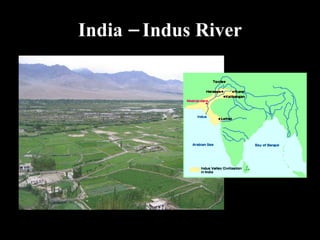
India – Indus River
China – Yellow River
Greece
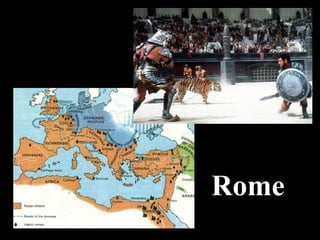
Rome
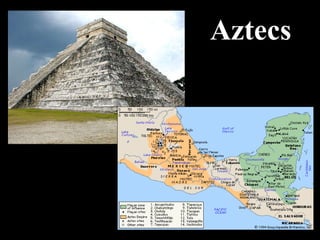
Aztecs
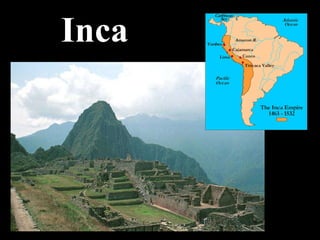
Inca
1 2 3 4 1 – Egypt (Nile River) 5 - Greece 2 – Mesopotamia  6 – Roman Empire 3 – India (Indus River) 7 – Aztec Empire 4 – China (Yellow River) 8 – Inca Empire 5 6 7 8

Introduction to Ancient Civilizations

  • 1.
    The Earliest HumansWhere did we come from?
  • 2.
    Timeline! 2 millionB.C.E. Early people first begin using stone tools, like scrapers and arrowheads.
  • 3.
    30,000 B.C.E. StoneAge (Paleolithic) people create cave paintings that show the animals they hunt. People lived mostly by hunting and gathering.
  • 4.
  • 5.
    18,000 B.C.E. Duringthe last ice age, huge glaciers spread across parts of Europe, Asia, and North America.
  • 6.
    9000 B.C.E. Duringthe Neolithic agricultural revolution , people learned to FARM! They began to grow their own crops and settle in farming villages.
  • 7.
    3000 B.C.E. Thefirst civilizations emerge. As Egyptians and others develop writing, they will preserve a written record of their history.
  • 8.
    African Beginnings Anthropologists have found evidence of the earliest human life in East Africa, showing the evolution of the human species.
  • 9.
    MIGRATION: Later, descendantsof the earliest humans in East Africa may have traveled north and east into Europe and Asia. Over time, people reached the Americas, Australia, and the islands of the Pacific.
  • 10.
    HUNTERS AND GATHERERSThe first people lived in small hunting or food-gathering bands of 20 to 30 people Men  hunted or fished Women  with small children, gathered berries, fruit, and nuts They were NOMADS : moved from place to place
  • 11.
    And then therewas agriculture (farming)… This was a HUGE breakthrough! People learned to farm How did they learn? No one knows for sure Food-gathering women may have noticed that seeds grew into plants each year Differences in soil, may have stayed near good soil and found they could harvest crops
  • 12.
    Effects of Agriculture:Domesticating animals Better health for humans More free time… Growth in population Permanent settlements Interactions among settlements (trade, warfare, technological exchanges)
  • 13.
    Review! The humanbrain is constantly improving – it is what separates us from other animals on this planet We began living by hunting and gathering until we learned how to farm This led to major population growth and the development of larger villages and societies
  • 14.
    So where werethese first civilizatons?
  • 15.
    Mesopotamia – Tigris and Euphrates Rivers
  • 16.
  • 17.
  • 18.
  • 19.
  • 20.
  • 21.
  • 22.
  • 23.
    1 2 34 1 – Egypt (Nile River) 5 - Greece 2 – Mesopotamia 6 – Roman Empire 3 – India (Indus River) 7 – Aztec Empire 4 – China (Yellow River) 8 – Inca Empire 5 6 7 8