
Do Now: If History is the study of the past…  then what is Pre-History?   “ It is now clear that long before the invention of  writing , human beings made a place for their species in the natural world and laid the social, economic, and cultural foundations on which their successors built increasingly complex societies.”  Bentley p.8
The Origin of Humans
Theories on prehistory and early man constantly change as new evidence comes to light.     - Louis Leakey, British    archaeologist The First Humans
Cornell Notes
Australopithecus Hominids   --> any member   of the family of two-legged   primates that includes all   humans. 4,000,000 BCE – 1,000,000 BCE
"Lucy"  3.5 Million Years old 40% of her bones were found – most complete and best preserved skeleton on any early ancestor.  Small brain: size of a grapefruit Short, hairy, limited in intelligence but walked upright, had  opposable  thumbs, and communicated verbally
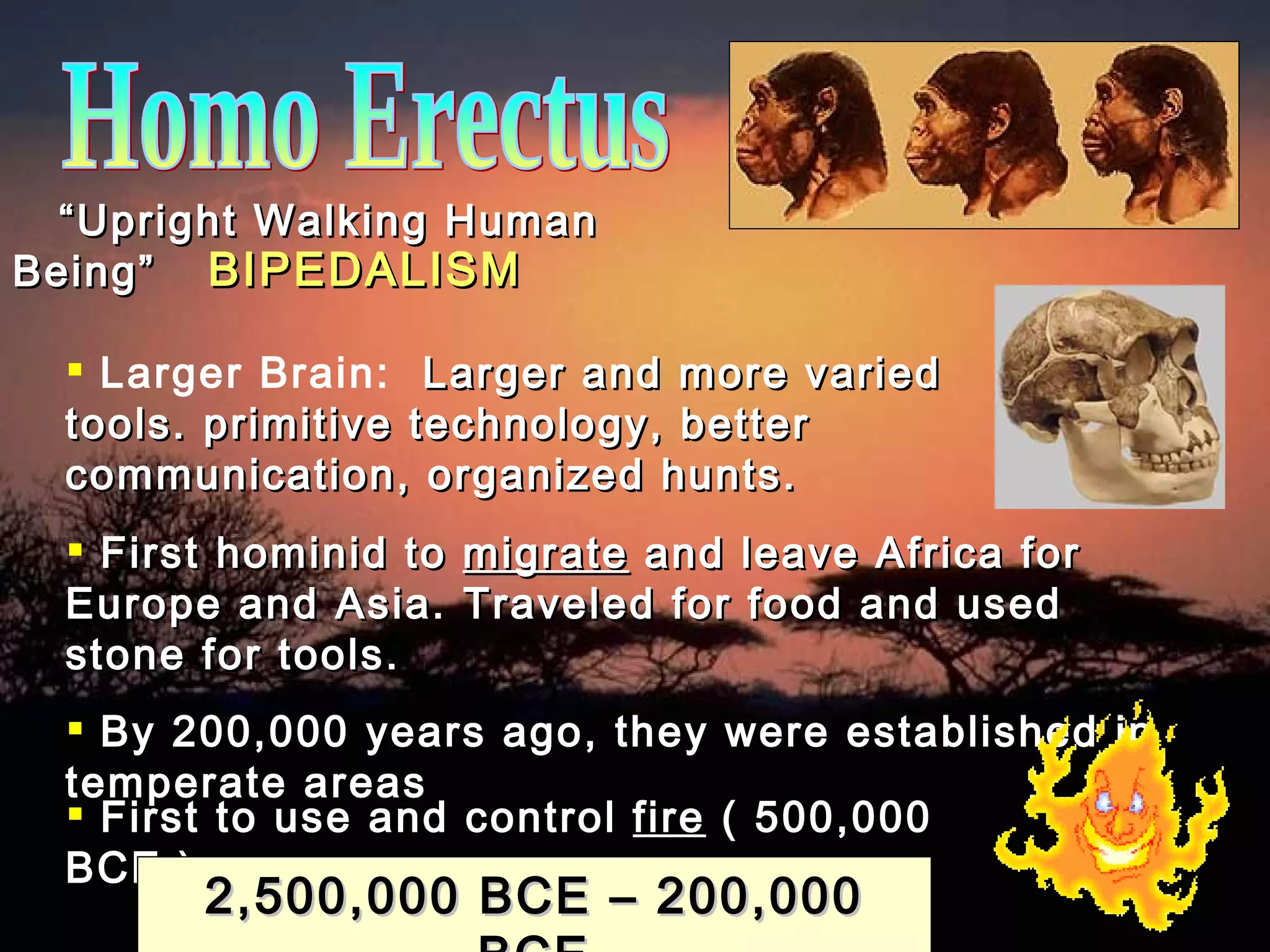
Homo Erectus “ Upright Walking Human Being” Larger Brain:  Larger and more varied tools. primitive technology, better communication, organized hunts. First hominid to  migrate  and leave Africa for Europe and Asia. Traveled for food and used stone for tools. By 200,000 years ago, they were established in temperate areas First to use and control  fire  ( 500,000 BCE ) BIPEDALISM 2,500,000 BCE – 200,000 BCE
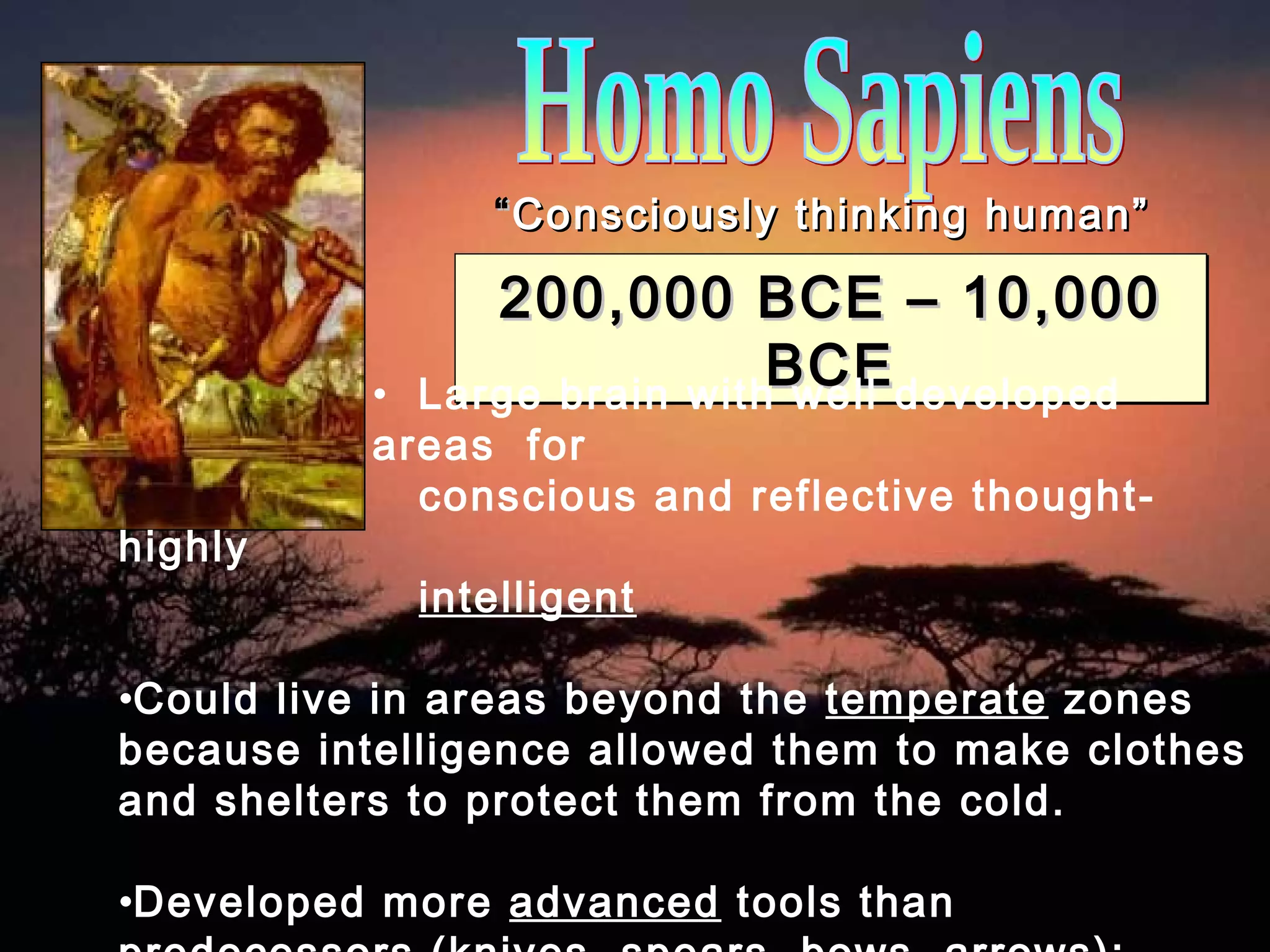
Homo Sapiens 200,000 BCE – 10,000 BCE “ Consciously thinking human” Large brain with well developed areas  for    conscious and reflective thought-highly      intelligent Could live in areas beyond the  temperate  zones because intelligence allowed them to make clothes and shelters to protect them from the cold. Developed more  advanced  tools than predecessors (knives, spears, bows, arrows); made shelters of wood, bones, and animal skins
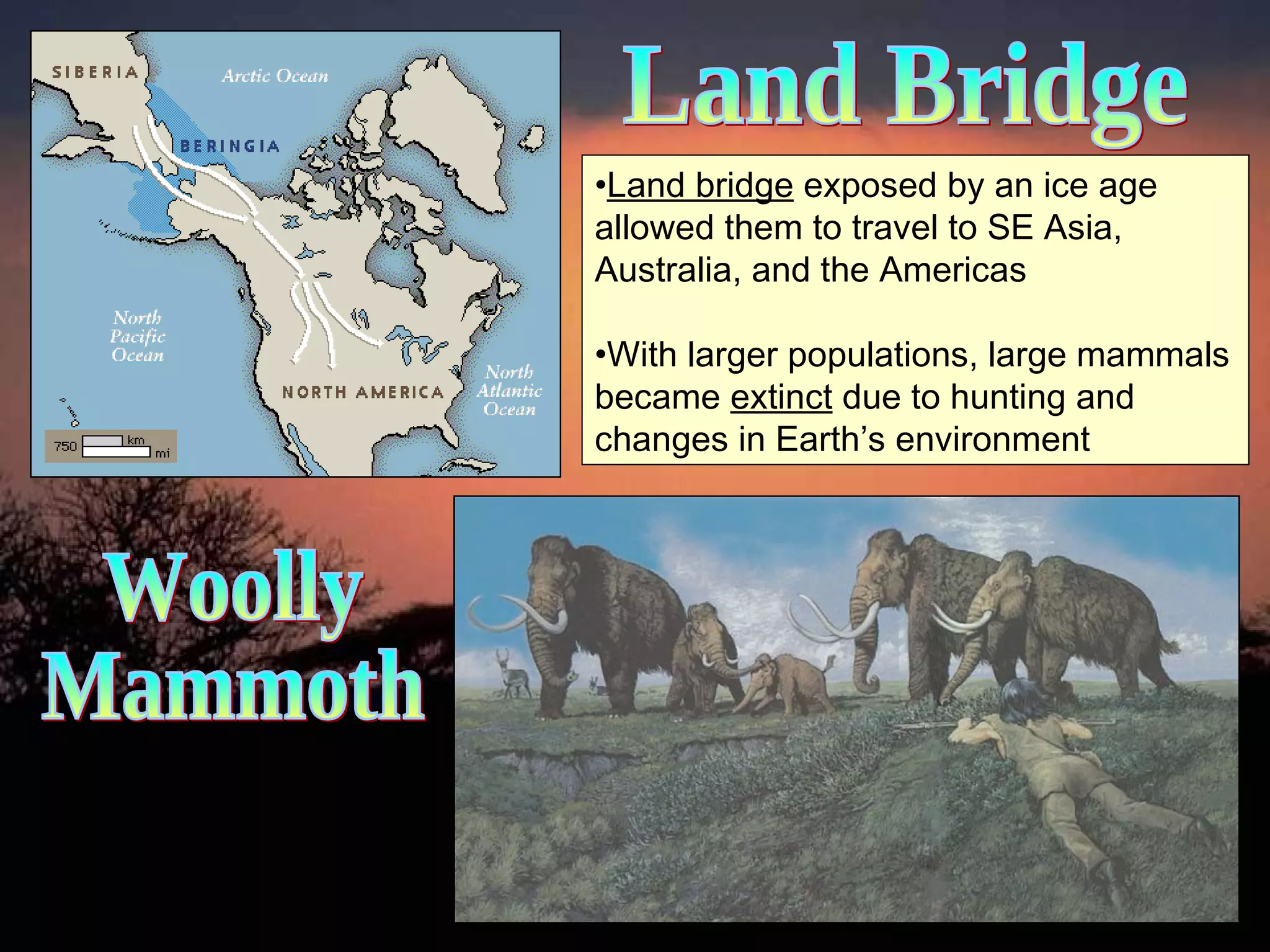
Land bridge  exposed by an ice age allowed them to travel to SE Asia, Australia, and the Americas With larger populations, large mammals became  extinct  due to hunting and changes in Earth’s environment  Land Bridge Woolly  Mammoth
Castaway Scene One: How does Tom Hanks’ Character finally succeed?  What skills did he need to acquire? Describe his reaction?  Why was it so important to him? Scene Two: How has he adapted to his environment?  What skills has he developed?  Why did it take him so long to take this action?
Humans evolved over a long period time and developed more advanced brains, which allowed them to spread out in the world and adapt their environments to suit their needs.  Summary 4,000,000 BCE – 1,000,000 BCE 2,500,000 BCE – 200,000 BCE 200,000 BCE – 10,000 BCE Australopithecus Homo Erectus Homo Sapiens
Spread of Human Populations
The Paleolithic Age “ Paleolithic” --> “ Old Stone ” Age Hunting (men) & gathering (women) --> small bands of 20-30 humans NOMADIC (moving from place to place) 2,500,000 BCE – 10,000 BCE
Economy and Society Hunting and gathering: no private  property  or social distinctions based on wealth due to mobility Possessed some small items carried during migrations Social distinctions based on age, strength, courage, intelligence, personality Gender  equality because both contributed to survival What role did men and women play in a Hunter-Gatherer society?
Economy and Society Small  bands  with agreements with neighboring bands on territories, marriage partners Systematic hunting using special tools, tactics Permanent  settlements were established in areas with abundant food resources (grains, fish)
Neander Valley, Germany First fully modern human beings-physically and mentally First humans to bury their dead.  Burial  sites with rituals (Shanidar-covered bodies with flowers) Sites where items left with bodies may indicate belief in  afterlife Neanderthal Man
Made clothes from animal skins. Lived in  caves  and  tents. Neanderthal Man Early Hut/Tent
Neanderthal Man
Cro-Magnon Man Homo sapiens sapiens  (“Wise, wise human” ) First Human beings of the fully modern type – Direct descendant of modern day humans By 30,000 BCE they   replaced Neanderthals. WHY???
Humans during this period found shelter in caves. Cave paintings were left behind  Interested in fashion and art Cro-Magnon Man
What do these paintings tell us about Paleolithic Culture? Cave Paintings
Depictions of animals and humans; possibly to gain control over animals they were hunting by capturing their spirits Made paints and brushes from natural materials – shows higher order thinking  Small sculpture of women with exaggerated sexual features, showing interest in  fertility Venus Figurines
Paleolithic peoples lived in small nomadic bands with few class distinctions, and had an interest in art and simple spiritual beliefs.  Summary Homo Sapiens Neanderthals ( 200,000 BCE – 30,000 BCE ) Cro-Magnons ( 40,000 BCE – 10,000 BCE ) Homo Sapien Sapien (40,000 BCE-Present )
Homo sapiens sapiens in Europe
The Last Ice Age 70,000 BCE – 10,000 BCE

Origins Of Man Mine

  • 1.
    Do Now: IfHistory is the study of the past… then what is Pre-History? “ It is now clear that long before the invention of writing , human beings made a place for their species in the natural world and laid the social, economic, and cultural foundations on which their successors built increasingly complex societies.” Bentley p.8
  • 2.
  • 3.
    Theories on prehistoryand early man constantly change as new evidence comes to light. - Louis Leakey, British archaeologist The First Humans
  • 4.
  • 5.
    Australopithecus Hominids --> any member of the family of two-legged primates that includes all humans. 4,000,000 BCE – 1,000,000 BCE
  • 6.
    "Lucy" 3.5Million Years old 40% of her bones were found – most complete and best preserved skeleton on any early ancestor. Small brain: size of a grapefruit Short, hairy, limited in intelligence but walked upright, had opposable thumbs, and communicated verbally
  • 7.
    Homo Erectus “Upright Walking Human Being” Larger Brain: Larger and more varied tools. primitive technology, better communication, organized hunts. First hominid to migrate and leave Africa for Europe and Asia. Traveled for food and used stone for tools. By 200,000 years ago, they were established in temperate areas First to use and control fire ( 500,000 BCE ) BIPEDALISM 2,500,000 BCE – 200,000 BCE
  • 8.
    Homo Sapiens 200,000BCE – 10,000 BCE “ Consciously thinking human” Large brain with well developed areas for conscious and reflective thought-highly intelligent Could live in areas beyond the temperate zones because intelligence allowed them to make clothes and shelters to protect them from the cold. Developed more advanced tools than predecessors (knives, spears, bows, arrows); made shelters of wood, bones, and animal skins
  • 9.
    Land bridge exposed by an ice age allowed them to travel to SE Asia, Australia, and the Americas With larger populations, large mammals became extinct due to hunting and changes in Earth’s environment Land Bridge Woolly Mammoth
  • 10.
    Castaway Scene One:How does Tom Hanks’ Character finally succeed? What skills did he need to acquire? Describe his reaction? Why was it so important to him? Scene Two: How has he adapted to his environment? What skills has he developed? Why did it take him so long to take this action?
  • 11.
    Humans evolved overa long period time and developed more advanced brains, which allowed them to spread out in the world and adapt their environments to suit their needs. Summary 4,000,000 BCE – 1,000,000 BCE 2,500,000 BCE – 200,000 BCE 200,000 BCE – 10,000 BCE Australopithecus Homo Erectus Homo Sapiens
  • 12.
    Spread of HumanPopulations
  • 13.
    The Paleolithic Age“ Paleolithic” --> “ Old Stone ” Age Hunting (men) & gathering (women) --> small bands of 20-30 humans NOMADIC (moving from place to place) 2,500,000 BCE – 10,000 BCE
  • 14.
    Economy and SocietyHunting and gathering: no private property or social distinctions based on wealth due to mobility Possessed some small items carried during migrations Social distinctions based on age, strength, courage, intelligence, personality Gender equality because both contributed to survival What role did men and women play in a Hunter-Gatherer society?
  • 15.
    Economy and SocietySmall bands with agreements with neighboring bands on territories, marriage partners Systematic hunting using special tools, tactics Permanent settlements were established in areas with abundant food resources (grains, fish)
  • 16.
    Neander Valley, GermanyFirst fully modern human beings-physically and mentally First humans to bury their dead. Burial sites with rituals (Shanidar-covered bodies with flowers) Sites where items left with bodies may indicate belief in afterlife Neanderthal Man
  • 17.
    Made clothes fromanimal skins. Lived in caves and tents. Neanderthal Man Early Hut/Tent
  • 18.
  • 19.
    Cro-Magnon Man Homosapiens sapiens (“Wise, wise human” ) First Human beings of the fully modern type – Direct descendant of modern day humans By 30,000 BCE they replaced Neanderthals. WHY???
  • 20.
    Humans during thisperiod found shelter in caves. Cave paintings were left behind Interested in fashion and art Cro-Magnon Man
  • 21.
    What do thesepaintings tell us about Paleolithic Culture? Cave Paintings
  • 22.
    Depictions of animalsand humans; possibly to gain control over animals they were hunting by capturing their spirits Made paints and brushes from natural materials – shows higher order thinking Small sculpture of women with exaggerated sexual features, showing interest in fertility Venus Figurines
  • 23.
    Paleolithic peoples livedin small nomadic bands with few class distinctions, and had an interest in art and simple spiritual beliefs. Summary Homo Sapiens Neanderthals ( 200,000 BCE – 30,000 BCE ) Cro-Magnons ( 40,000 BCE – 10,000 BCE ) Homo Sapien Sapien (40,000 BCE-Present )
  • 24.
  • 25.
    The Last IceAge 70,000 BCE – 10,000 BCE