Origins of Man and Early Societies By Dr. Jennifer Levin-Goldberg
Migration 1.Where did early man come from in an evolutionary perspective? 2. How did people all over the world get to where they are? 3. How did early man go from nomadic primitive life to a modern technological industry?
Down  With Geico! Where did early man come from in an evolutionary perspective? How did people all over the world get to where they are? 3. How did early man go from nomadic primitive life to a modern technological industry? Turn to your partner Mindset
Your Ideas
Theories on prehistory and early man constantly change as new evidence comes to light.    - Louis Leakey, British    paleoanthropologist The First Humans
Early Discoveries
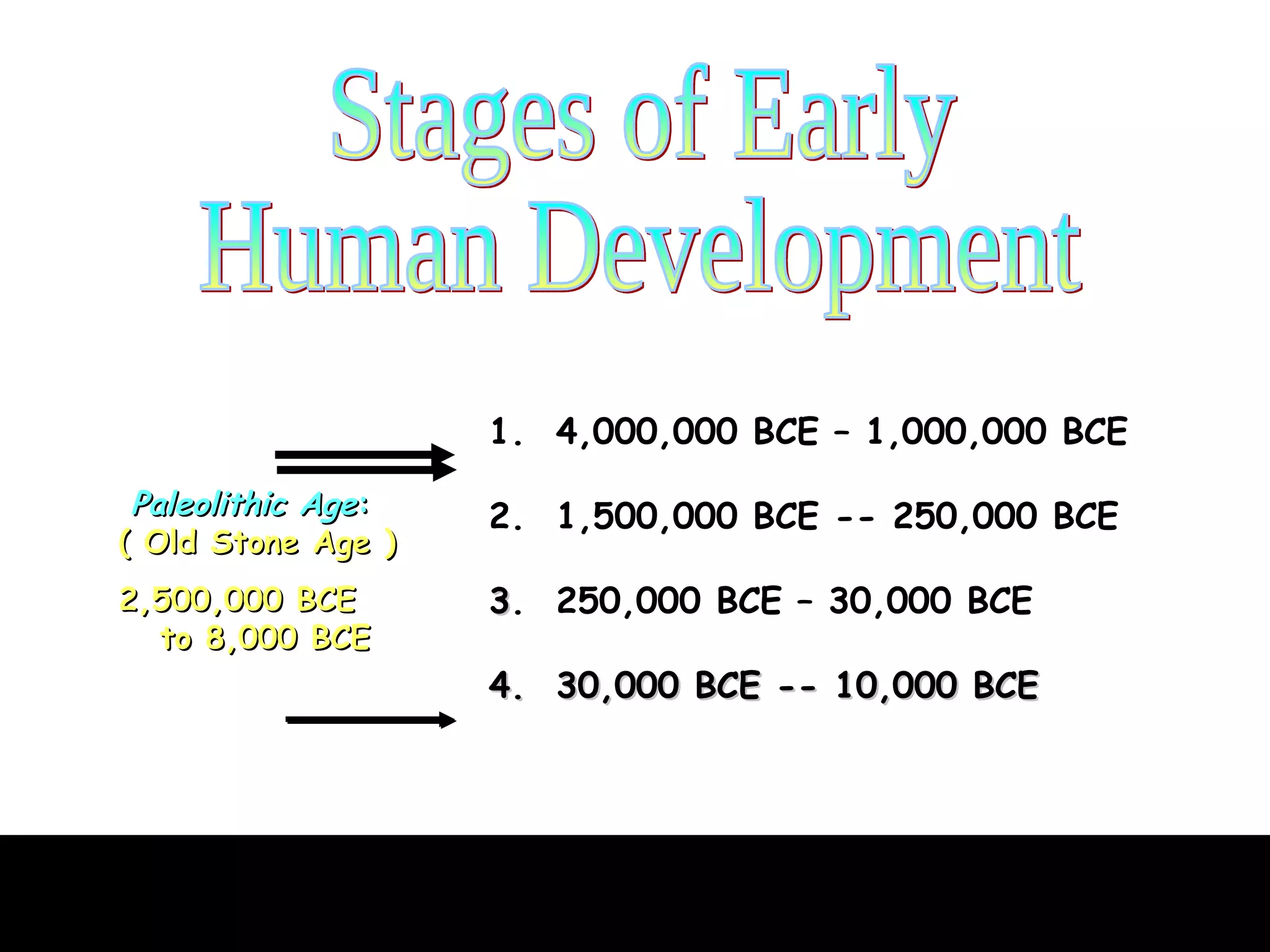
Stages of Early Human Development 1.  4,000,000 BCE – 1,000,000 BCE 2.  1,500,000 BCE -- 250,000 BCE 3 .  250,000 BCE – 30,000 BCE 4.  30,000 BCE -- 10,000 BCE Paleolithic Age : ( Old Stone Age ) 2,500,000 BCE    to 8,000 BCE
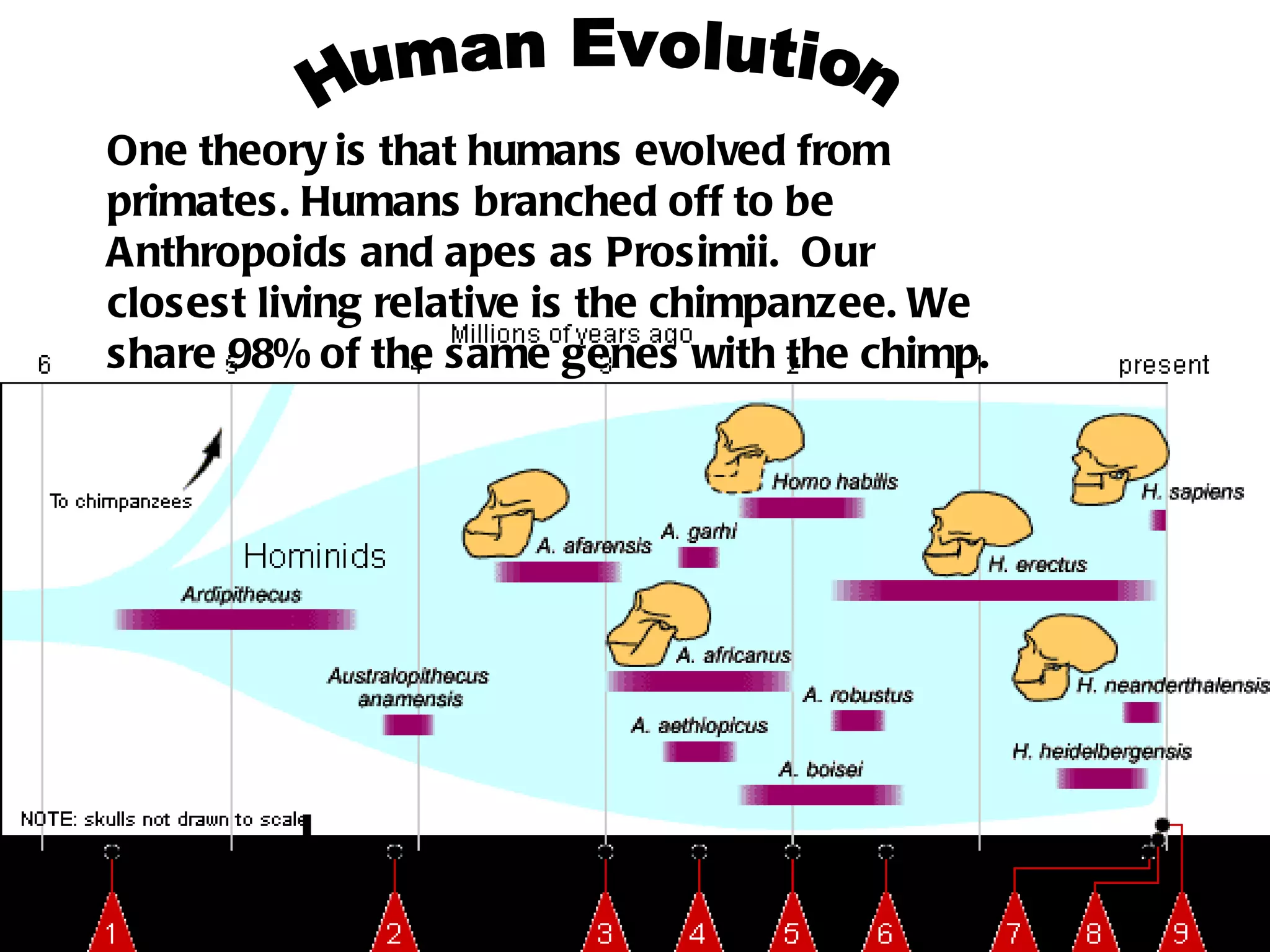
Primates Human Evolution One theory is that humans evolved from primates. Humans branched off to be Anthropoids and apes as Prosimii.  Our closest living relative is the chimpanzee. We share 98% of the same genes with the chimp.
 
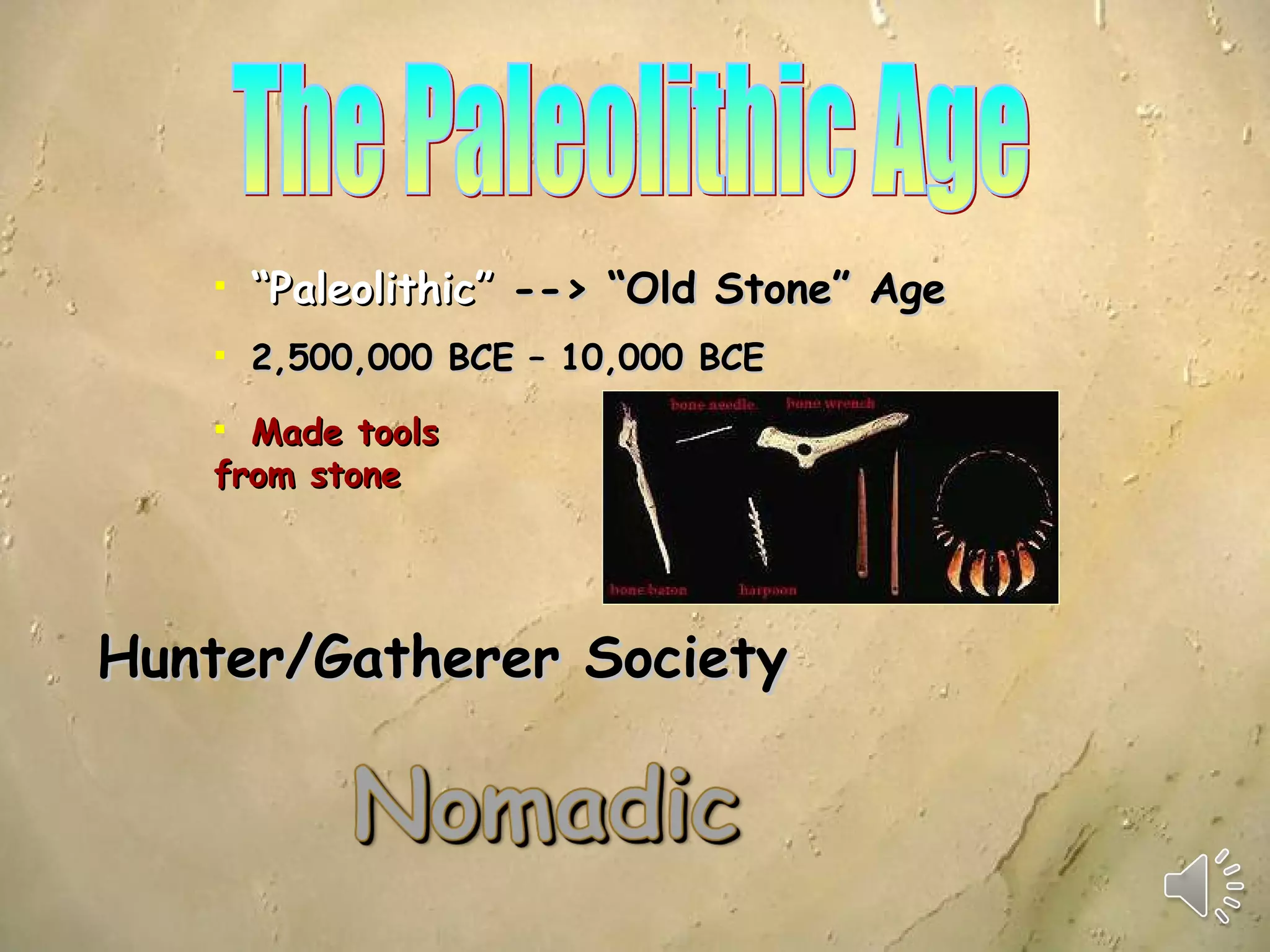
The Paleolithic Age “ Paleolithic”   --> “Old Stone” Age 2,500,000 BCE – 10,000 BCE Hunter/Gatherer Society Made tools from stone
Stage 1 4,000,000 BCE – 1,000,000 BCE
Australopithecus Afarensis: Lucy The first, most complete Australopithecus afarenis skeleton found was located in Hadar, Ethiopia by Dr. Johanson. He found a knee joint, validating that the creature was bipedal; walking upright making the remains a hominid.  Hadar, Ethiopia Dr. Johanson
Laetoli Footprints Found in Laetoli, Tanzania. The hominid that created it was  Australopithecus Afarensis .
Ardipithecus Ramidus The oldest known ancestor to modern day humans and is considered the missing link between apes and humans.  Known as  Ardi.
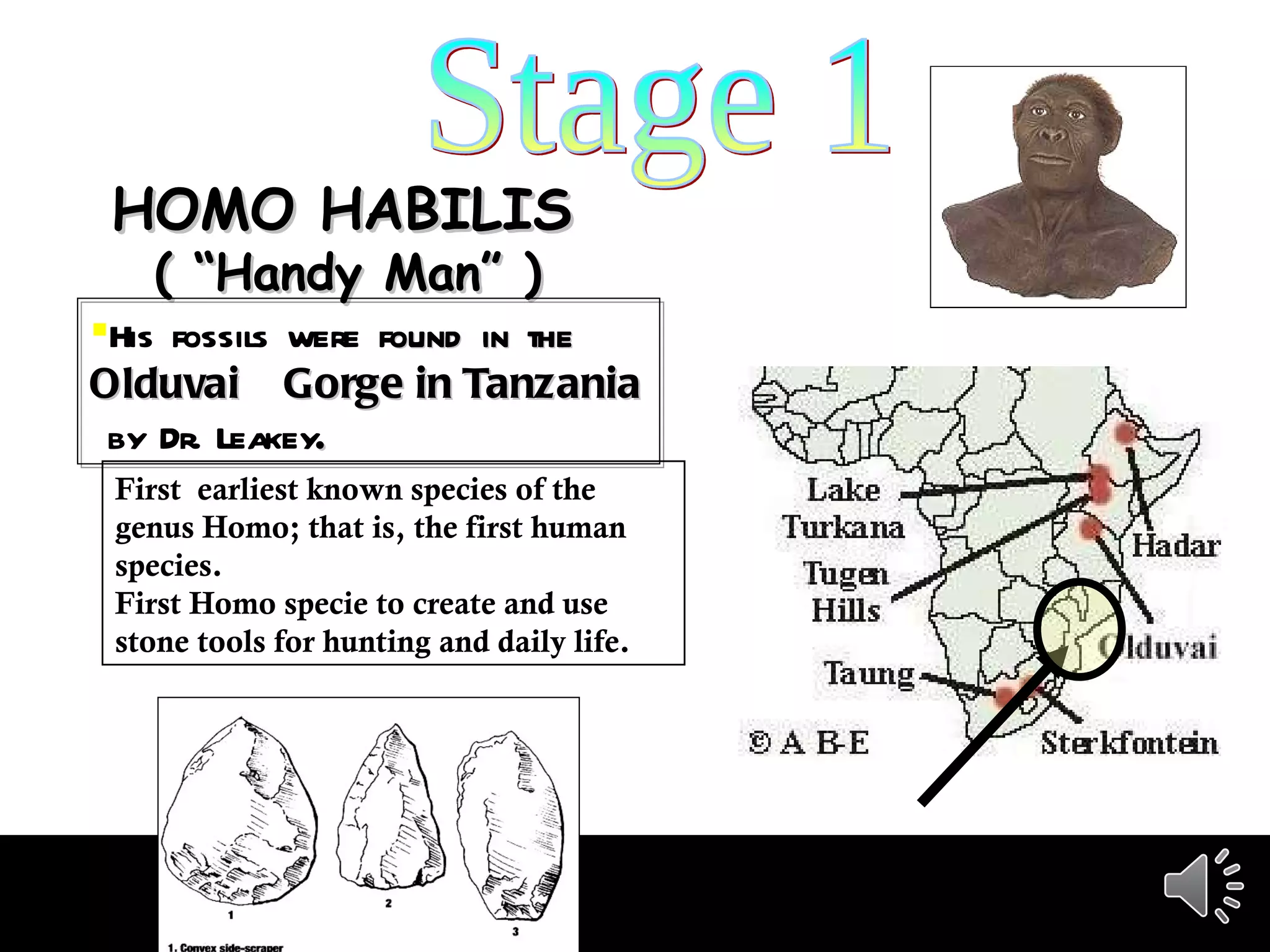
Stage 1 HOMO HABILIS   ( “Handy Man” ) His fossils were f ound in the  Olduvai  Gorge in Tanzania   by Dr. Leakey . First  earliest known species of the genus Homo; that is, the first human species.  First Homo specie to create and use stone tools for hunting and daily life.
The Paleolithic Age Humans during this period found shelter in caves. Cave paintings left behind.   Purpose??
The three themes found in cave art were animals, signs, and human representations. The most common were animals, in particular, the horse and the least  depicted were human representations.
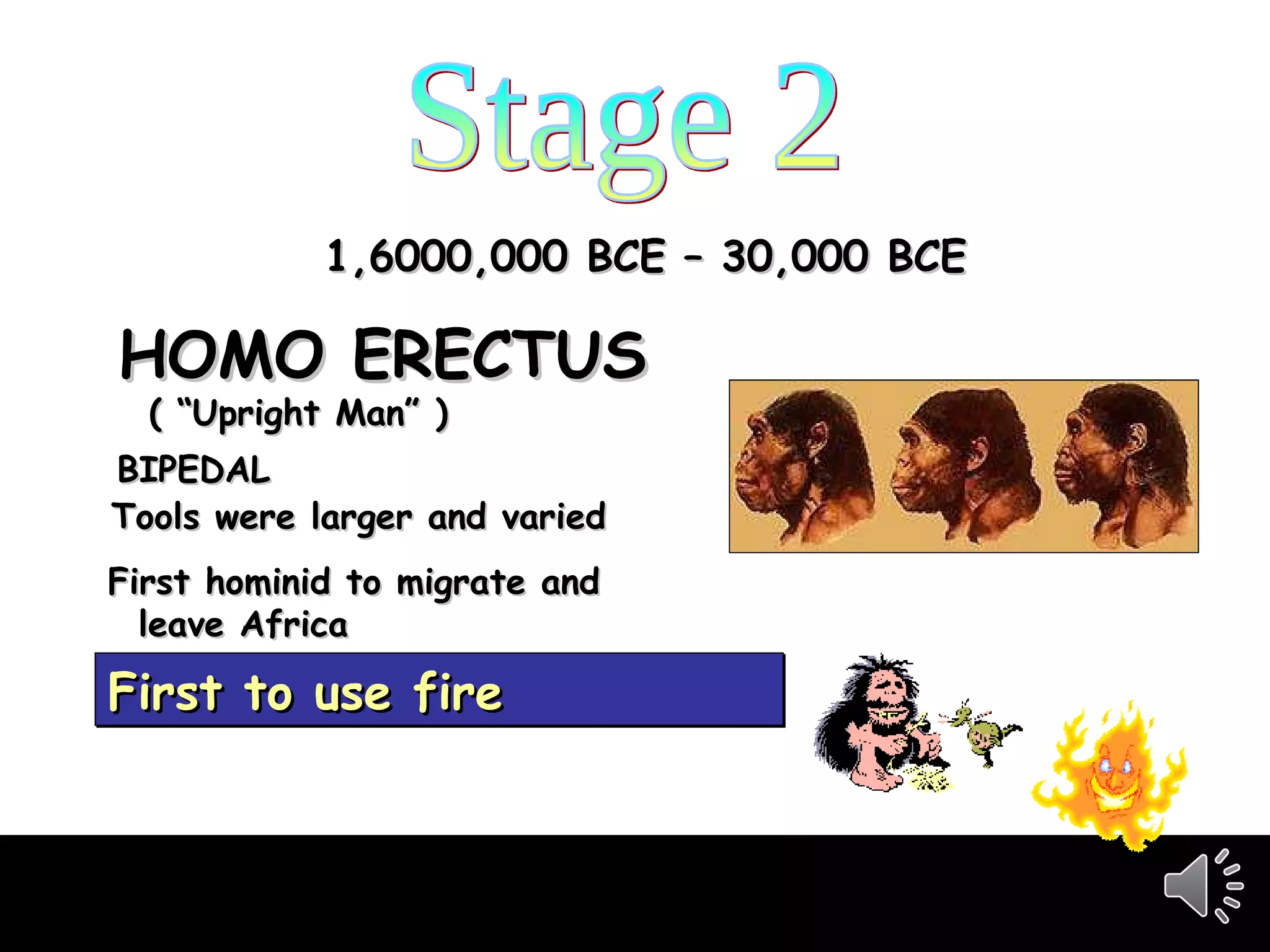
Stage 2 1,6000,000 BCE – 30,000 BCE HOMO ERECTUS    ( “Upright Man” ) Tools were larger and varied First hominid to migrate and   leave Africa First to use fire  BIPEDAL
Their skeletons are larger unlike Australopithecus afarensis and built more like our own.  They were carnivores.   Their brain size doubled, making their brains much larger. Scientists find a correlation between brain size and body size. According to the research, the larger the brain, the bigger the body.
The most famous Homo Erectus fossil was found in a cave in Zhoukoudian, China and became known as Peking Man.
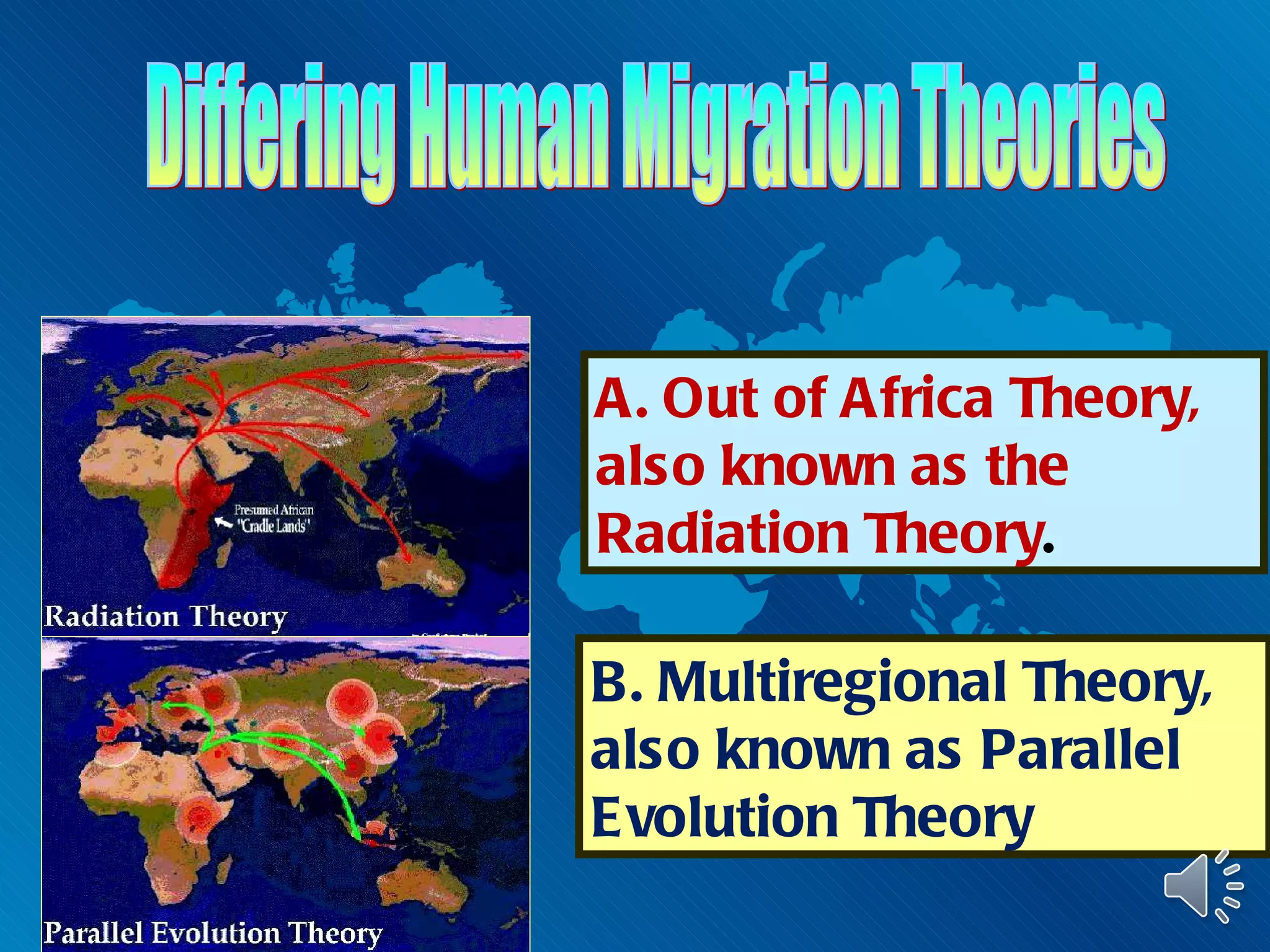
Differing Human Migration Theories A. Out of Africa Theory, also known as the Radiation Theory .  B. Multiregional Theory, also known as Parallel Evolution Theory
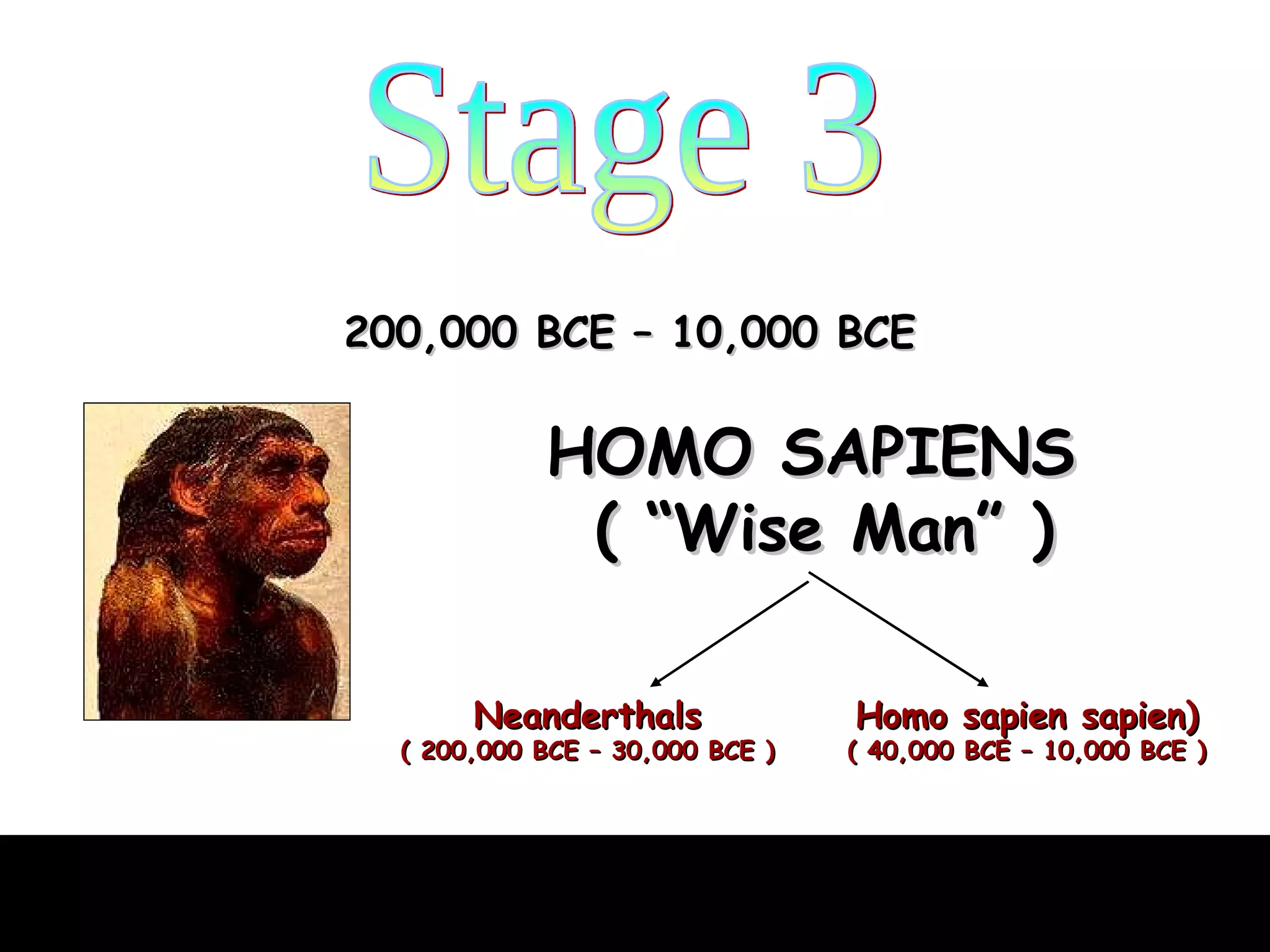
Stage 3 200,000 BCE – 10,000 BCE HOMO SAPIENS   ( “Wise Man” ) Neanderthals ( 200,000 BCE – 30,000 BCE ) Homo sapien sapien) ( 40,000 BCE – 10,000 BCE )
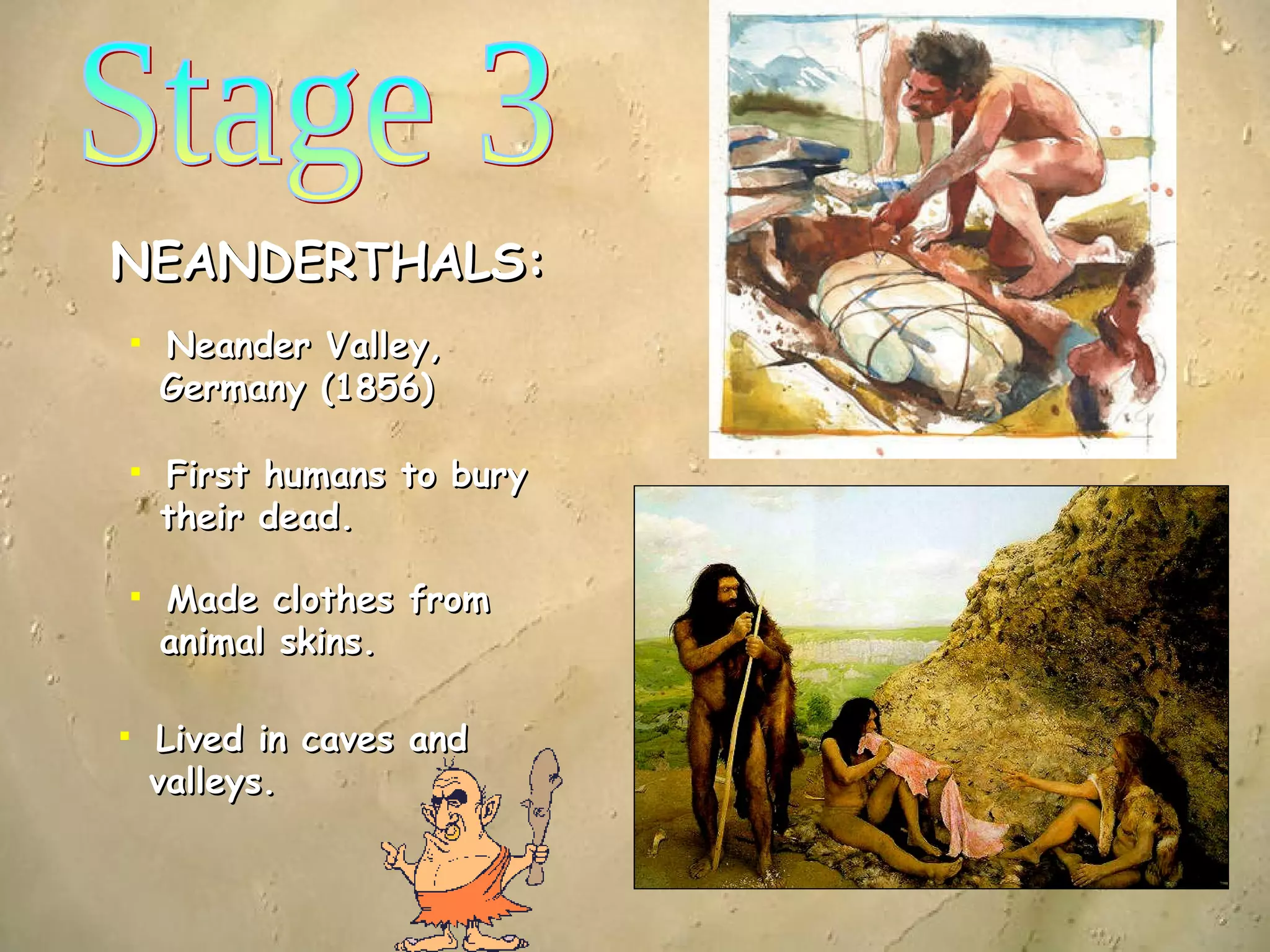
Stage 3 NEANDERTHALS: Neander Valley,    Germany (1856) First humans to bury   their dead. Made clothes from   animal skins. Lived in caves and   valleys.
They didn’t go far from their homes. They hunted and lived in small groups. Their weapons were used to impale animals up close. Communication was key in hunting because they had to work as a team.  They had the ability to use complex speech. Instead of painting on cave walls they painted their faces.
Stage 3 NEANDERTHALS
Stage 3 Homo sapien sapiens, a.k.a. Cro-Magnon Man   ( “Wise, wise human” ) By 30,000 BCE they   replaced Neanderthals. WHY???
Homo sapien sapiens lived on top of hillsides.  Hunted from a distance due to advanced weaponry. They were better at obtaining resources.  They painted on cave walls demonstrating that they were thinking symbolically. They too buried their dead. Potentially saw Neanderthals as mates.
Homo sapien sapiens settlements Their migration pattern. How were they able to cross over though? The Bering Strait
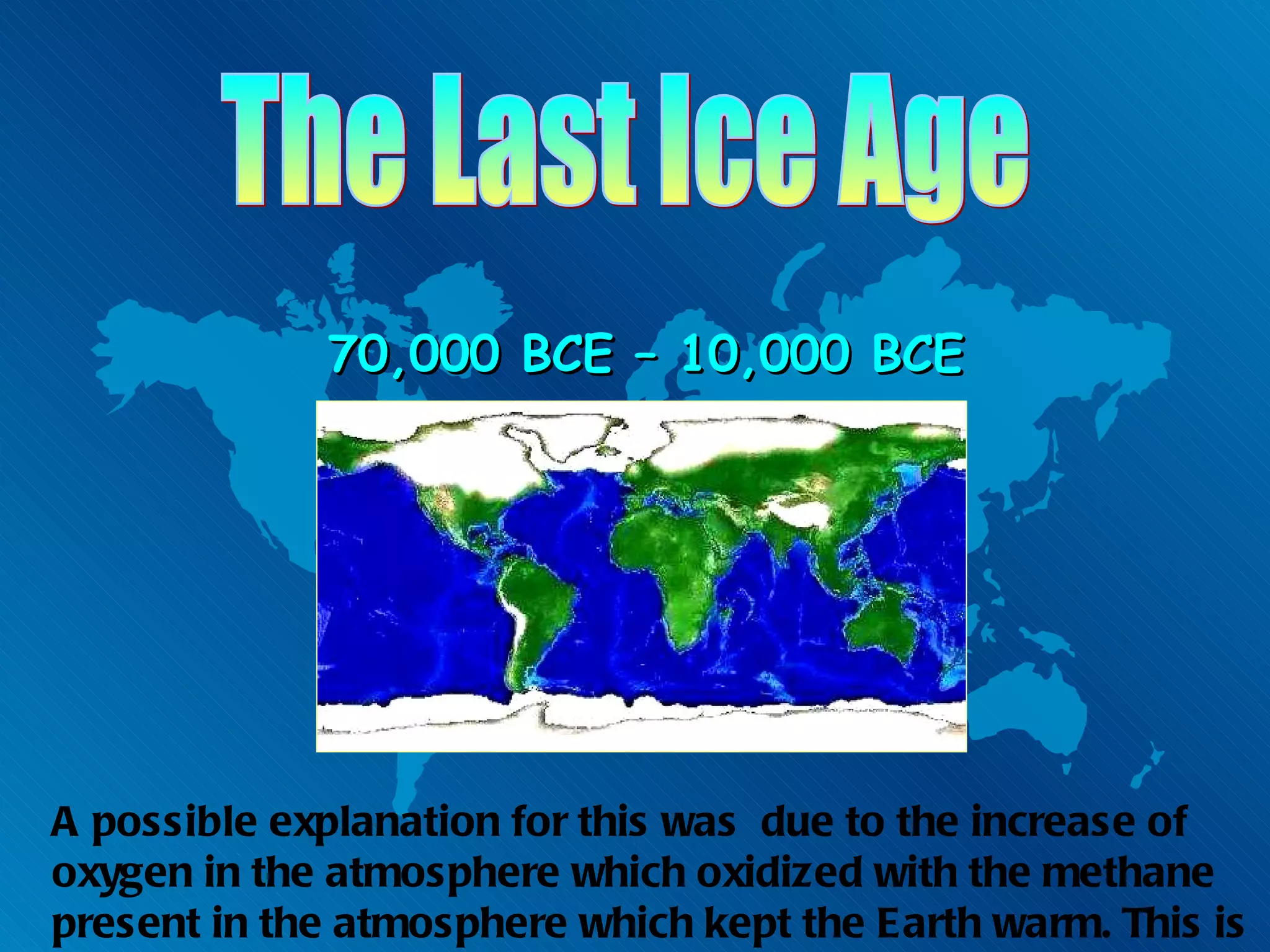
The Last Ice Age 70,000 BCE – 10,000 BCE A possible explanation for this was  due to the increase of oxygen in the atmosphere which oxidized with the methane present in the atmosphere which kept the Earth warm. This is known as the Great Oxidation Event.
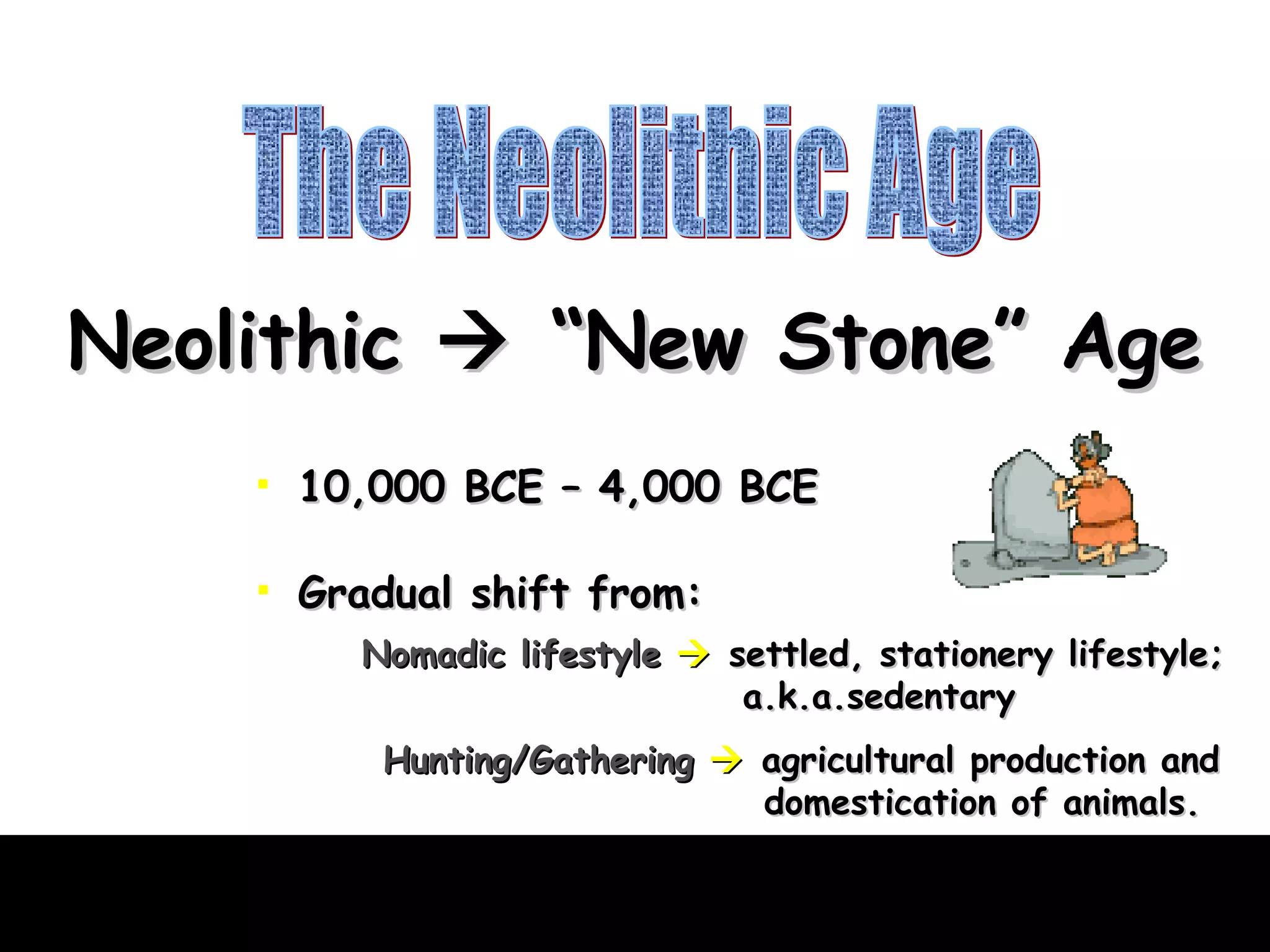
The Neolithic Age Neolithic    “New Stone” Age 10,000 BCE – 4,000 BCE Gradual shift from: Nomadic lifestyle      settled, stationery lifestyle;  a.k.a.sedentary Hunting/Gathering      agricultural production and   domestication of animals.
The hunter-gatherer exploits the environment; the agriculturalist modifies it.
vClicker
Is agriculture essential to the development of a civilization? Explain your response. How did Homo sapiens go from nomadic cultures to an agricultural society? What impact do you think agriculture had upon Homo sapiens’ society?  Agricultural Revolution Mindset
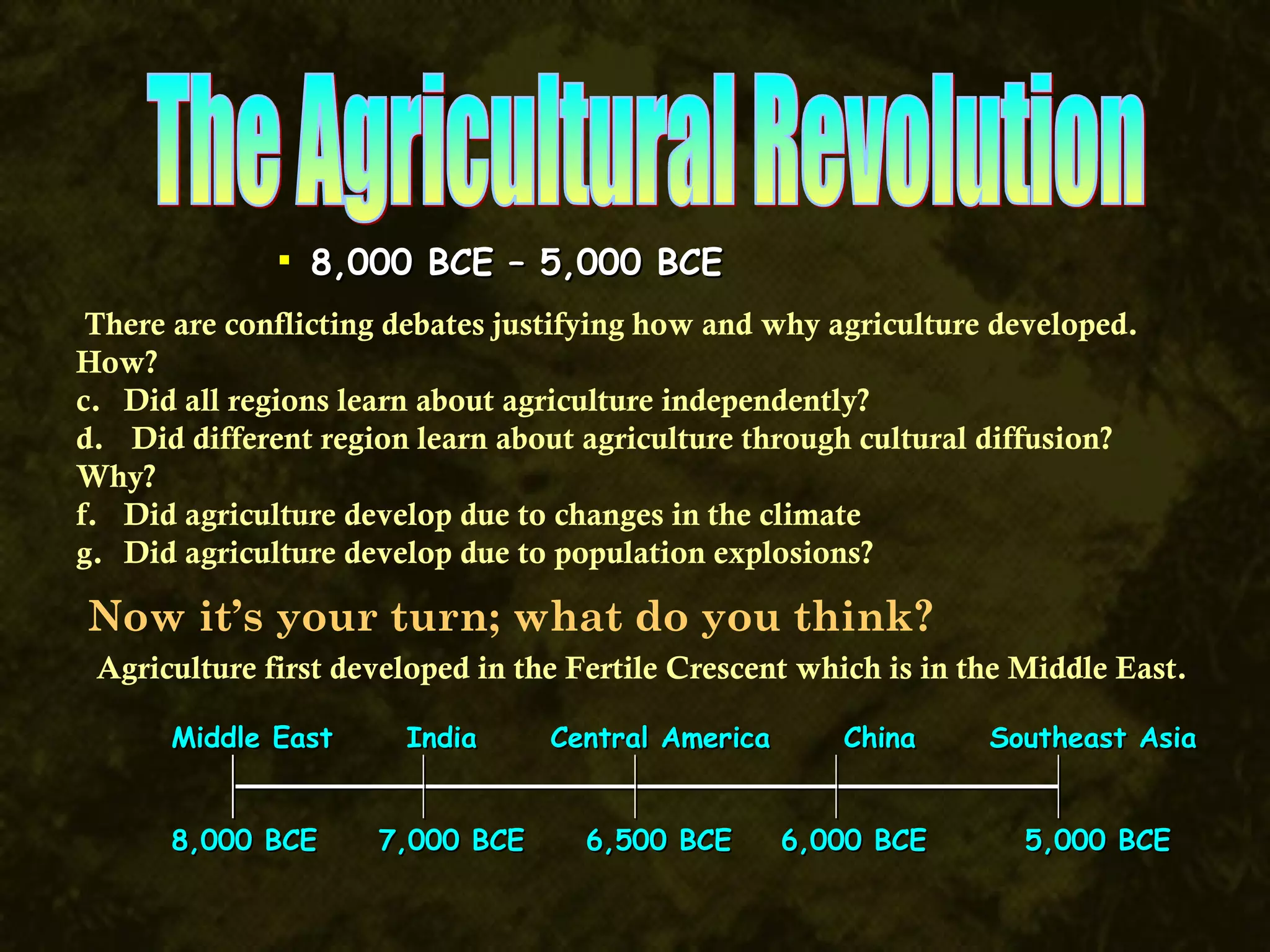
The Agricultural Revolution 8,000 BCE – 5,000 BCE There are conflicting debates justifying how and why agriculture developed. How? Did all regions learn about agriculture independently?  Did different region learn about agriculture through cultural diffusion? Why? Did agriculture develop due to changes in the climate  Did agriculture develop due to population explosions? Middle East  India  Central America  China  Southeast Asia 8,000 BCE  7,000 BCE  6,500 BCE  6,000 BCE  5,000 BCE Now it’s your turn; what do you think? Agriculture first developed in the Fertile Crescent which is in the Middle East.
The Agricultural Revolution Why do some archaeologists believe that women were the first farmers?
Since men did the hunting and females were responsible for the food gathering, women learned how to plant seeds, as well as process and prepare the food.  You Go Girl!
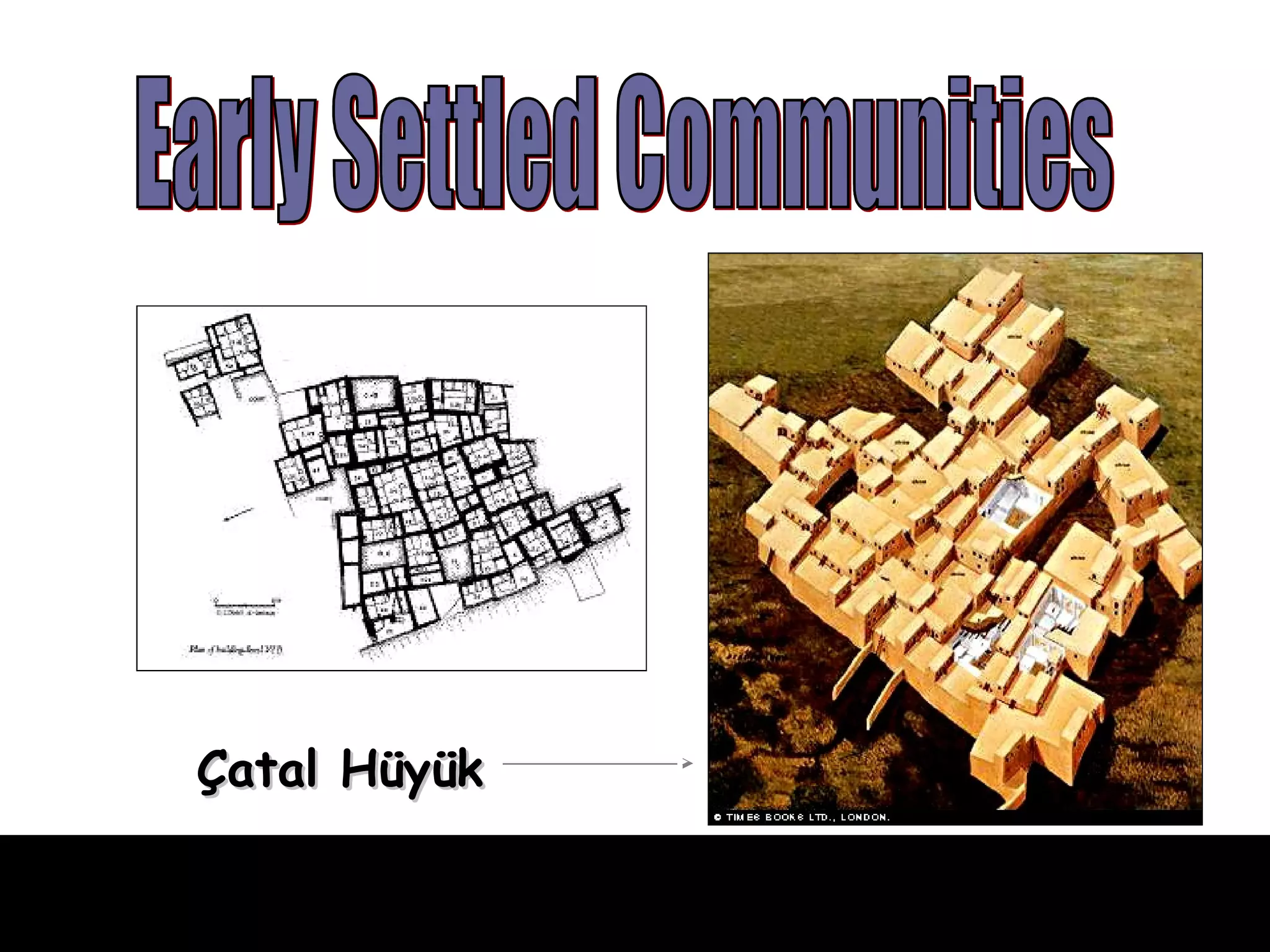
Early Settled Communities Growing crops on a regular basis made possible the    support of larger populations. More permanent, settled communities emerged. The first towns were Jericho in Israel and the largest was in Catal Huyuk (modern day Turkey).
Early Settled Communities Çatal Hüyük
Agricultural communities had high birth rates
Early farmers had to learn to domesticate wild grains. Why? Click to hear answer
What is the next step in the  development of human settlements??
CIVILIZATIONS !! CITIES !
Cities could form due to a sedentary lifestyle. This, in turn, created specializations, which resulted in wealth,  which would lead to social classes, including poverty.
What are the characteristics of a civilization??
Advanced Cities CIVILIZATION Specialized Workers Complex Institutions Record- Keeping Advanced Technology Which gave rise  to social classes Government Military Education Legal system Art Religion
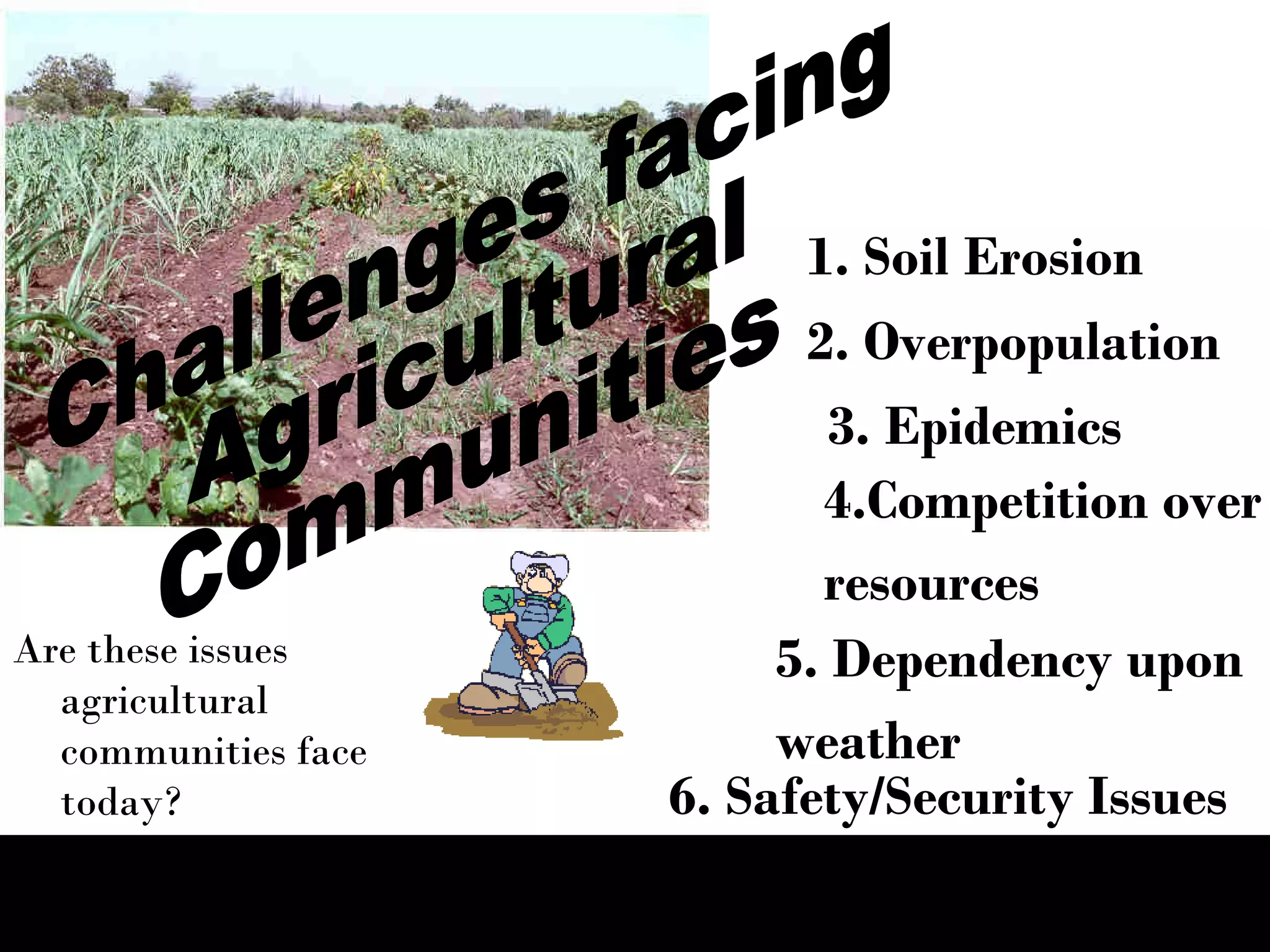
Challenges facing  Agricultural  Communities 1. Soil Erosion 2. Overpopulation 3. Epidemics 4.Competition over  resources 5. Dependency upon  weather 6. Safety/Security Issues Are these issues agricultural communities face today?
Why do you think so many  civilizations arose in river  valley's? Click to hear answer
Do you want to play a game?
Get in 3 equal groups   I will ask each group a question by showing  a clue on the Power Point. You and your group will discuss what you think the answer is. If you get it correct, your group earns 1 point. If your group gets it wrong, it is up for grabs. If you answer it incorrectly, you do not lose any points.  I will only accept the first answer your group says so make sure you are all in agreement on the answer. Good luck!  
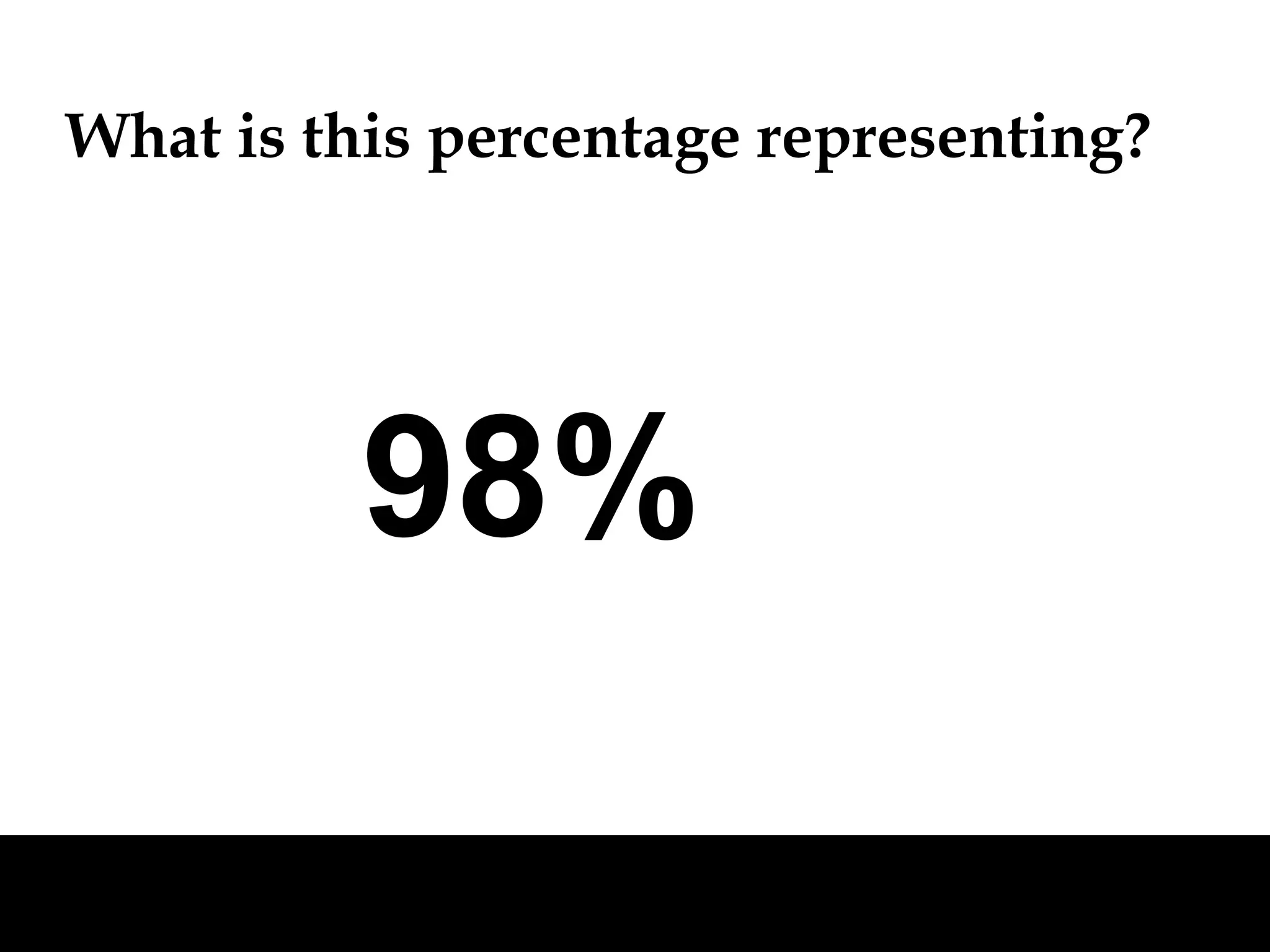
98% What is this percentage representing?
The answer is not bipedalism
What type of life or society did early man practice?
What link is this to early man? What animal is this?
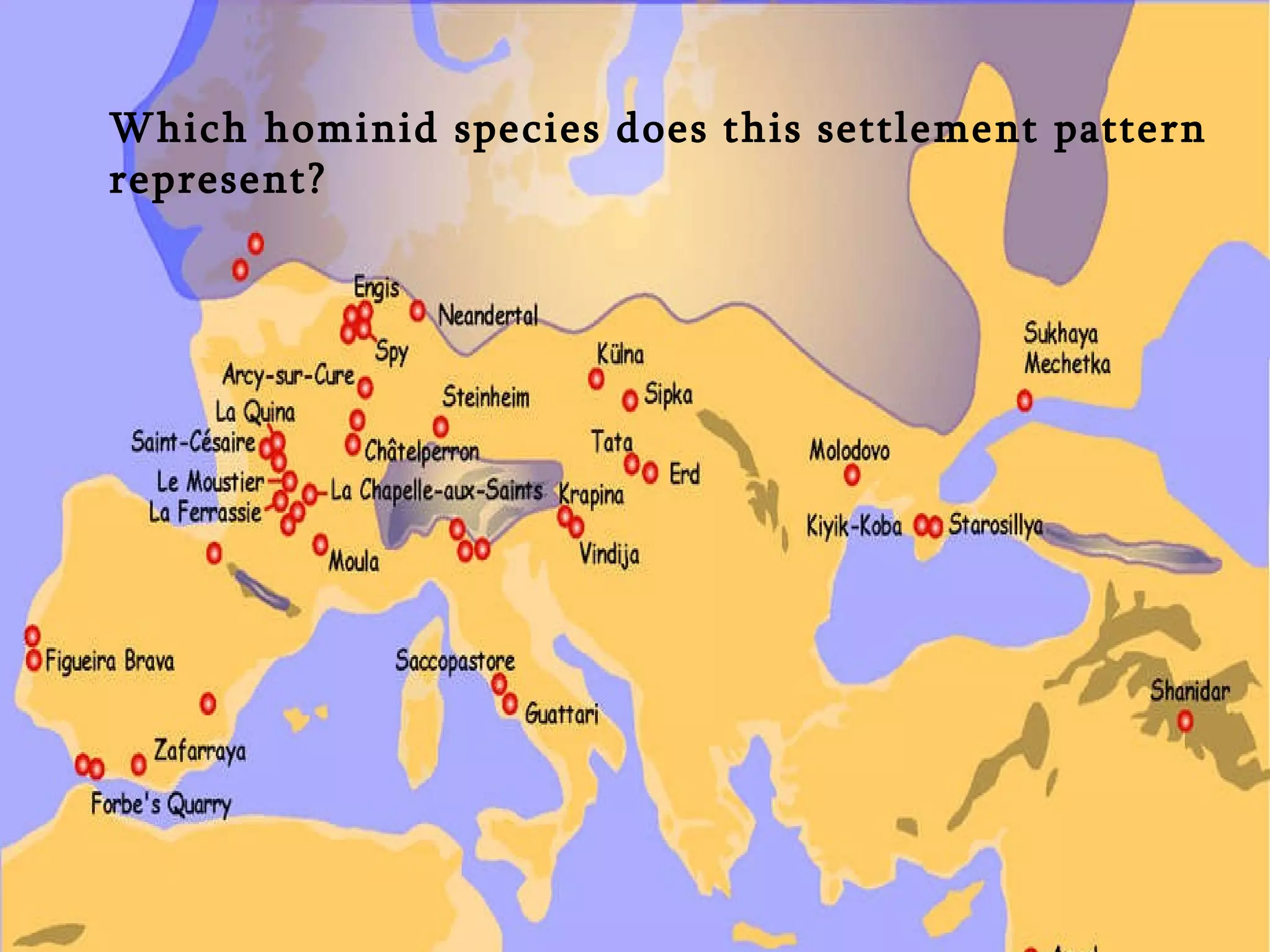
Which hominid species does this settlement pattern  represent?
This hominid specie was the first to use stone tools
What dating method would you use  if you found an artifact in its ash?
We’re starting from here! Which theory is this?
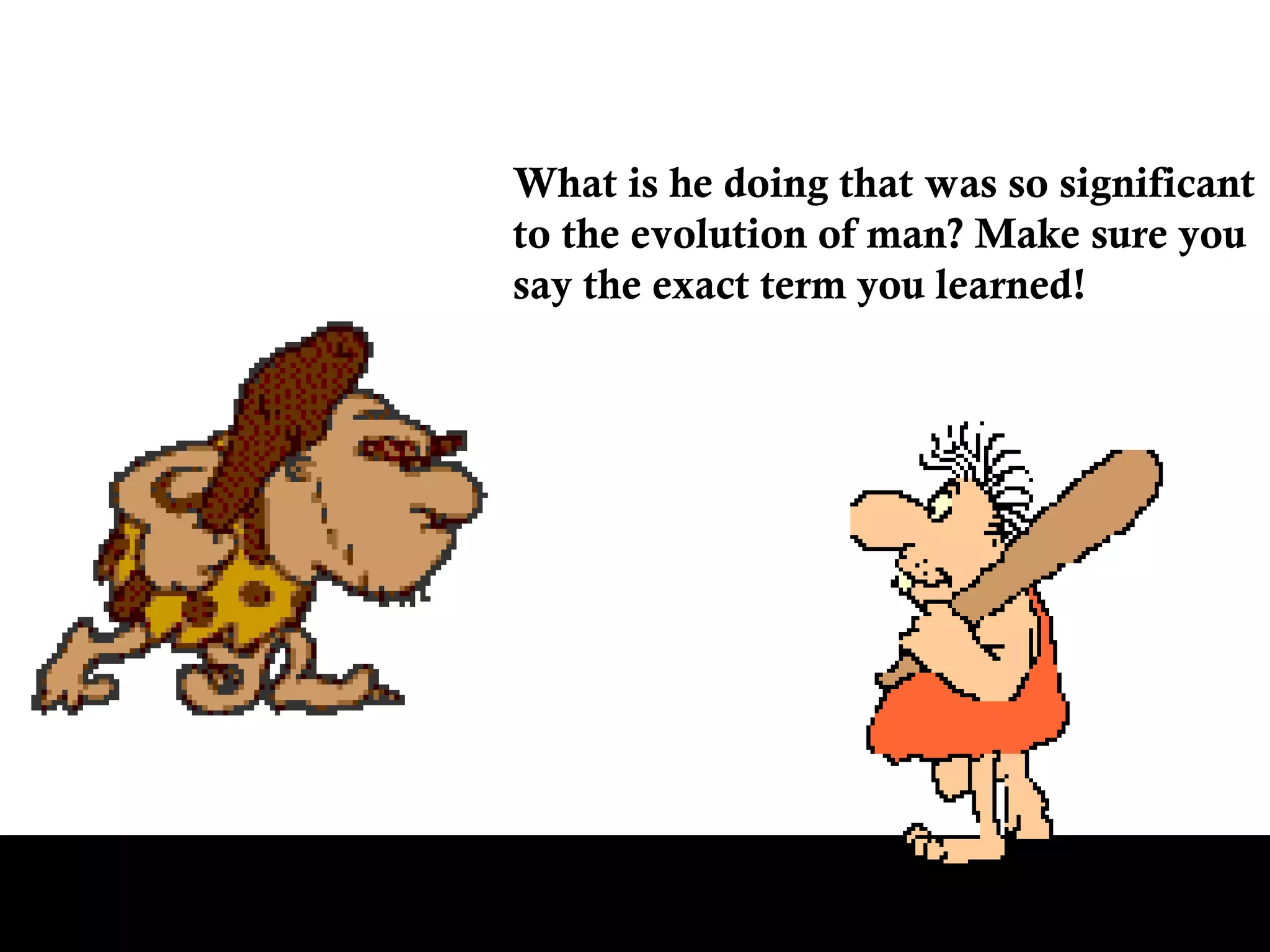
What is he doing that was so significant to the evolution of man? Make sure you  say the exact term you learned!
My name is Lucy. What  species am I?
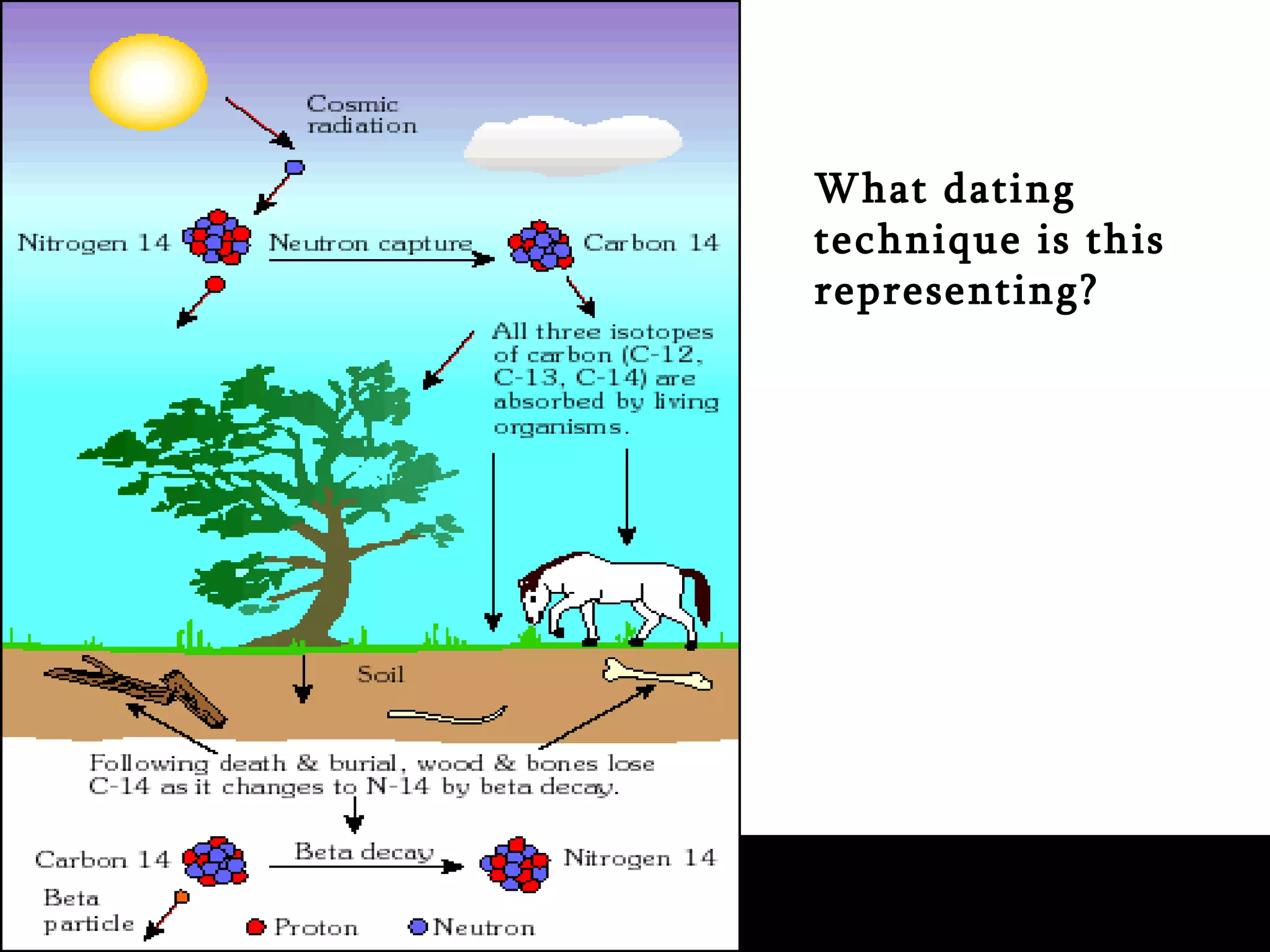
What dating technique is this representing?
This hominid specie could hunt its prey from a further distance using spears.
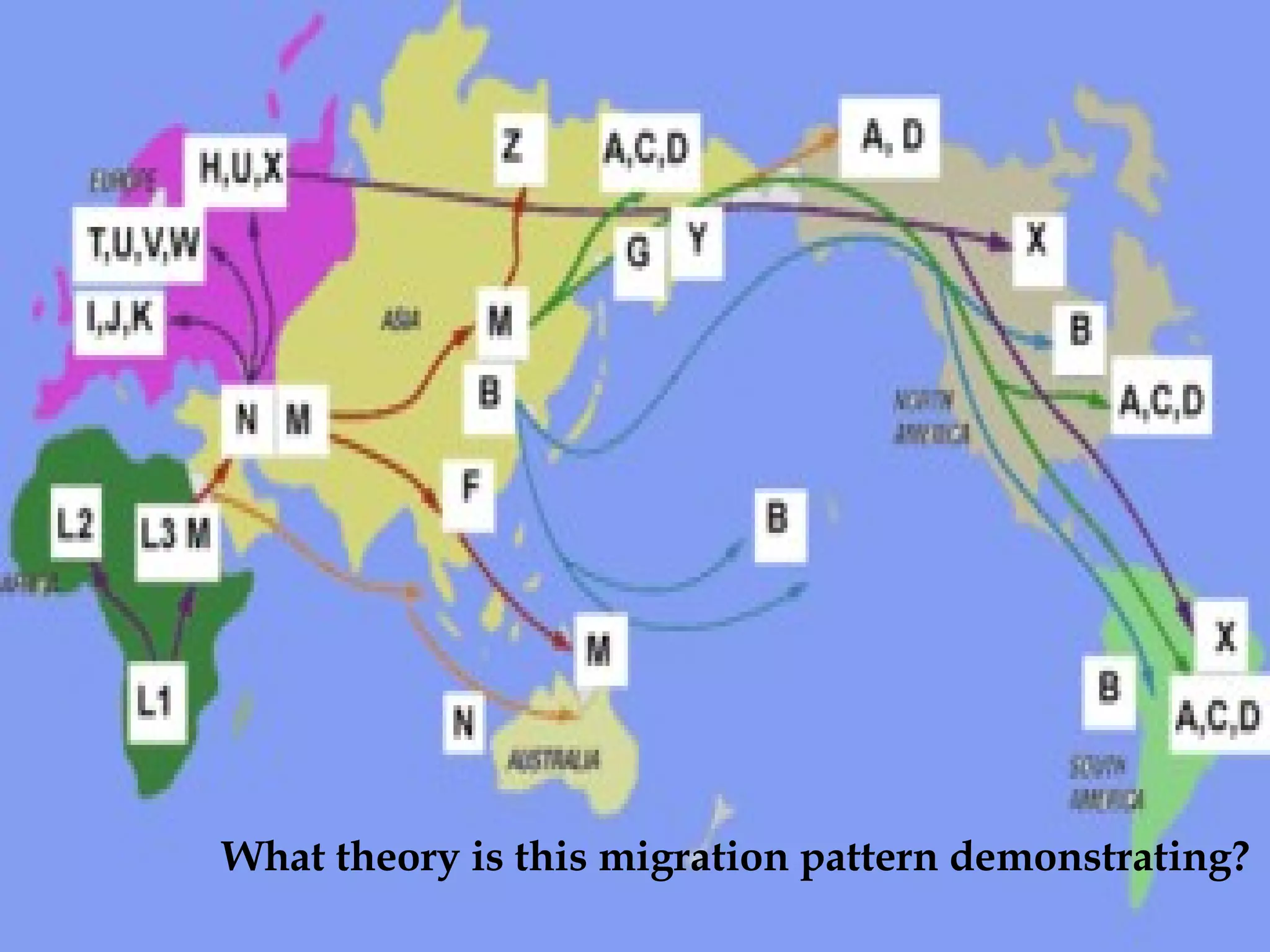
What theory is this migration pattern demonstrating?
I was the first hominid to leave Africa?
What is the term that refers to any member of the family of two-legged primates that includes all humans.
Which hominid species became extinct once Homo sapien sapiens  arrived on the scene?
Too much of this in the atmosphere may have caused what event?
Australopithecus afarensis Which hominid specie came before Australopithecus afarensis and is considered the “missing link”?
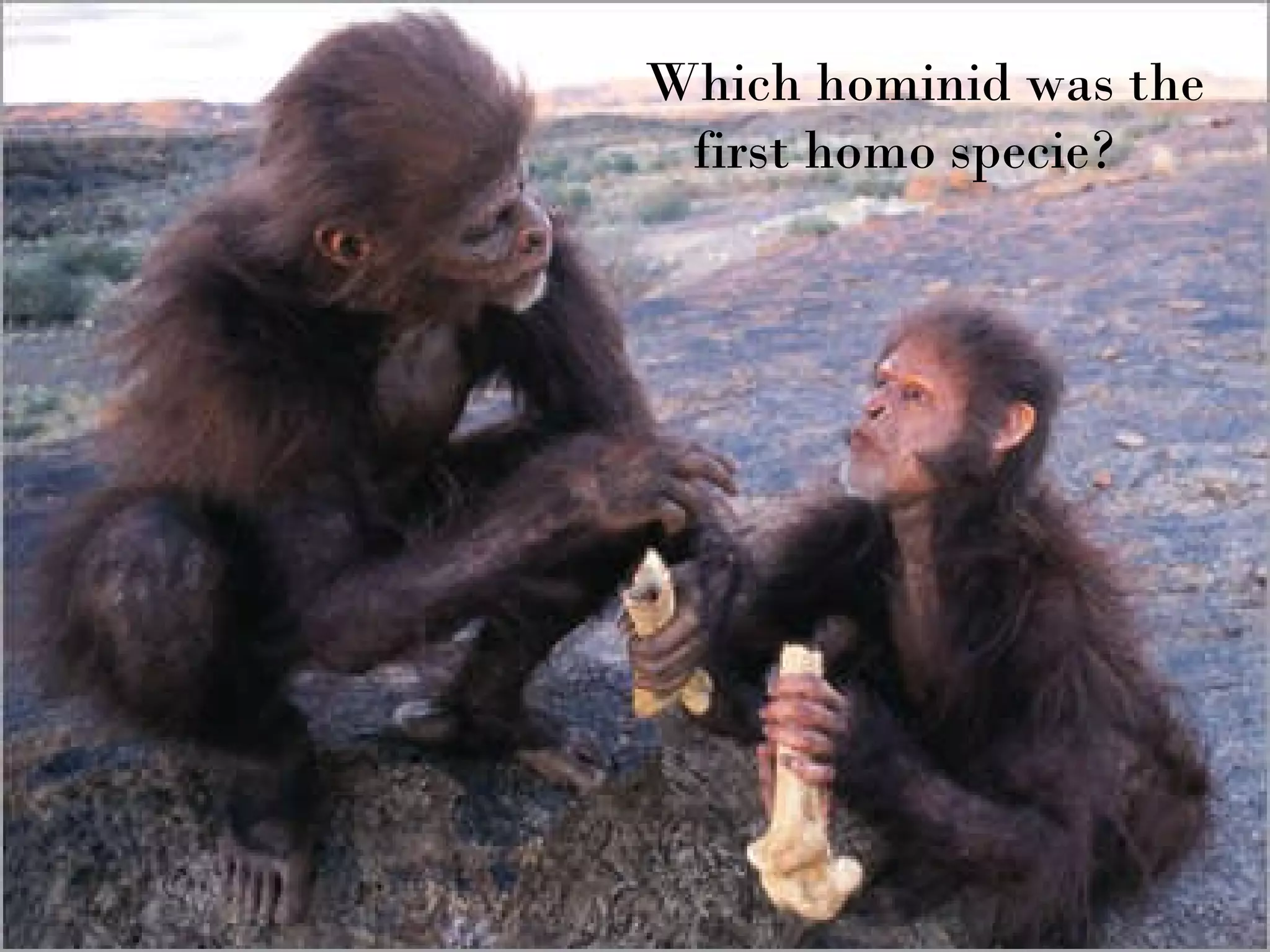
Which hominid was the first homo specie?
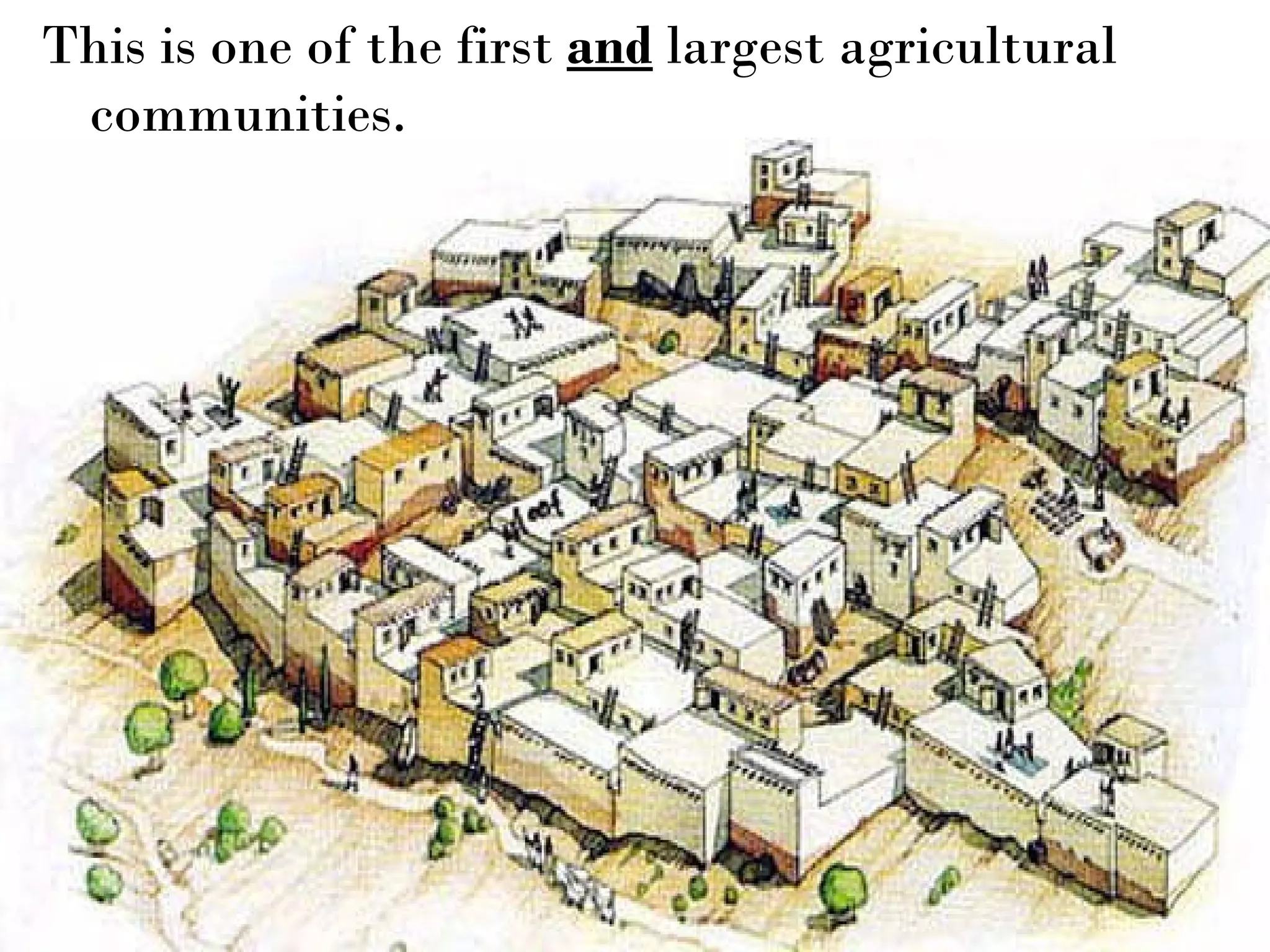
This is one of the first  and  largest agricultural communities.
Which hominid species evolved into modern man?
Which type of society had high birth rates?
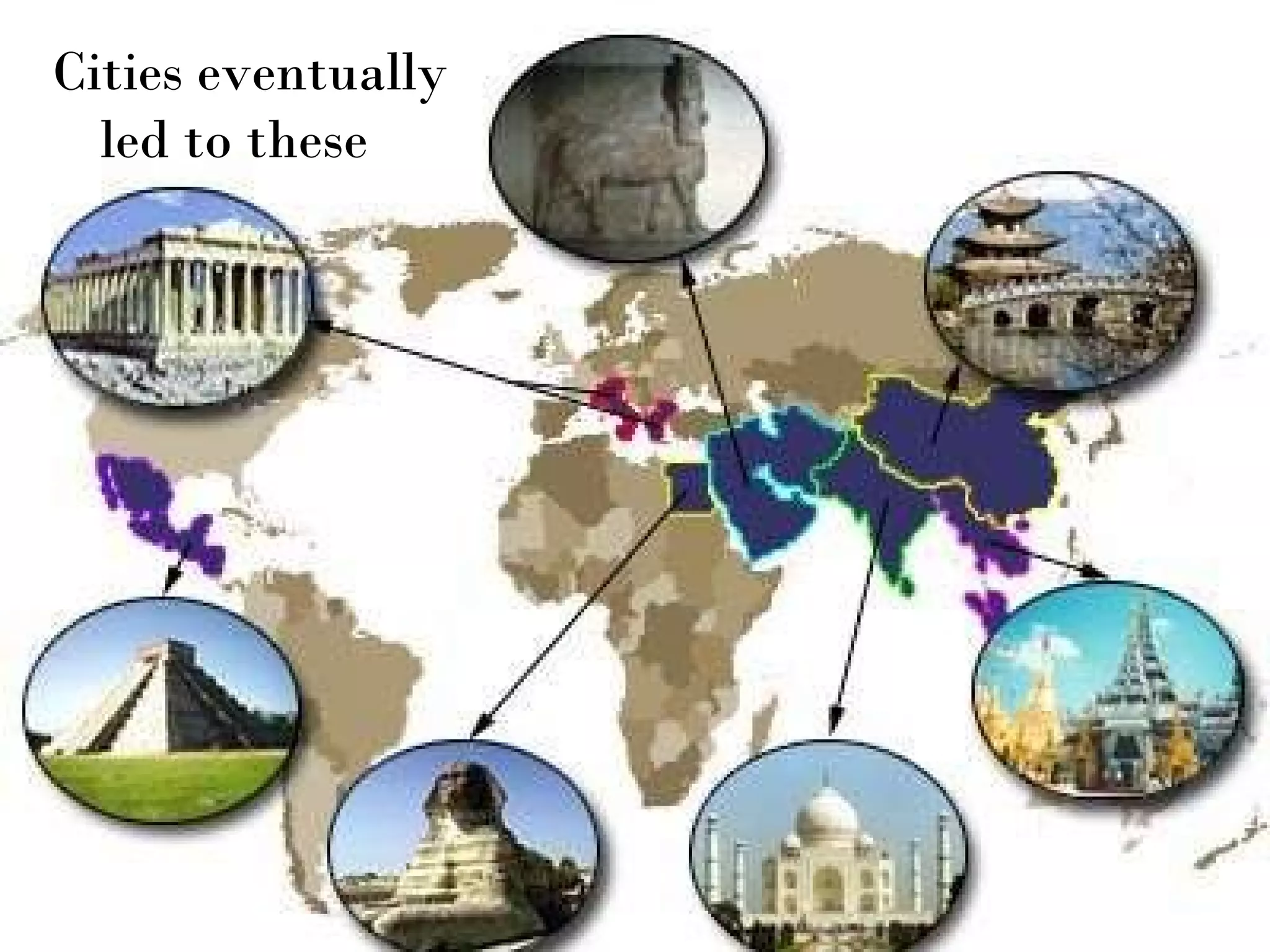
Cities eventually led to these
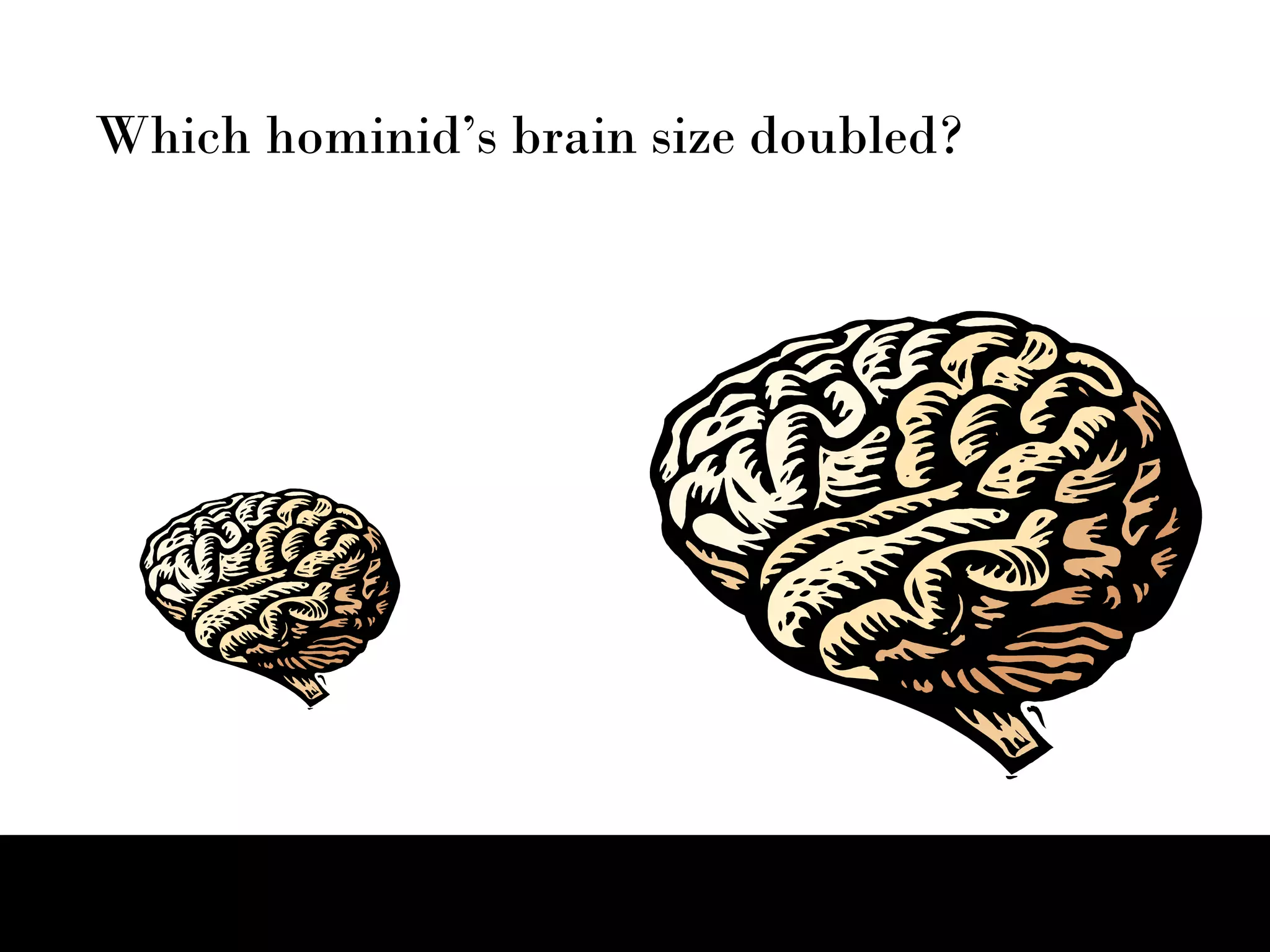
Which hominid’s brain size doubled?
Agricultural communities developed from a more stationary lifestyle instead of a nomadic one. What is another word for this stationary lifestyle?
We're Finished! Who won?
Assessment time!
Next Section
What is the difference between a refugee and an internally displaced person?  What does it mean to immigrate?  What dies it mean to emigrate? What causes people to become an immigrant? What causes people to become an emigrant?  Migration Mindset
Push and Pull Factors Push Migration Factors of Migration: Conditions that drive people to leave their homes.  Examples: Land scarcity, political and/or religious persecution, civil strife or revolutions, unsafe, poverty, lack of services, lack of modernization and infrastructure, and lack of jobs.
Pull Factors of Migration: Conditions that attract people to a new area. Examples: religious and political freedom or ideologies, industry, jobs, available land, modernization,  available services and infrastructure like education, health care, government services, safety.  Turn to your partner
Let’s do an activity!
I will say a factor and you will have to identify which factor it is an example of according to a movement. If it is a Push factor , you will have to do 3 Jumping jacks. If it is a Pull factor , you will have to do 3 calf raises. If it is both a Push and Pull factor , you will have to do 3 squats. Here we go!  
WAR
 
Climate/Weather
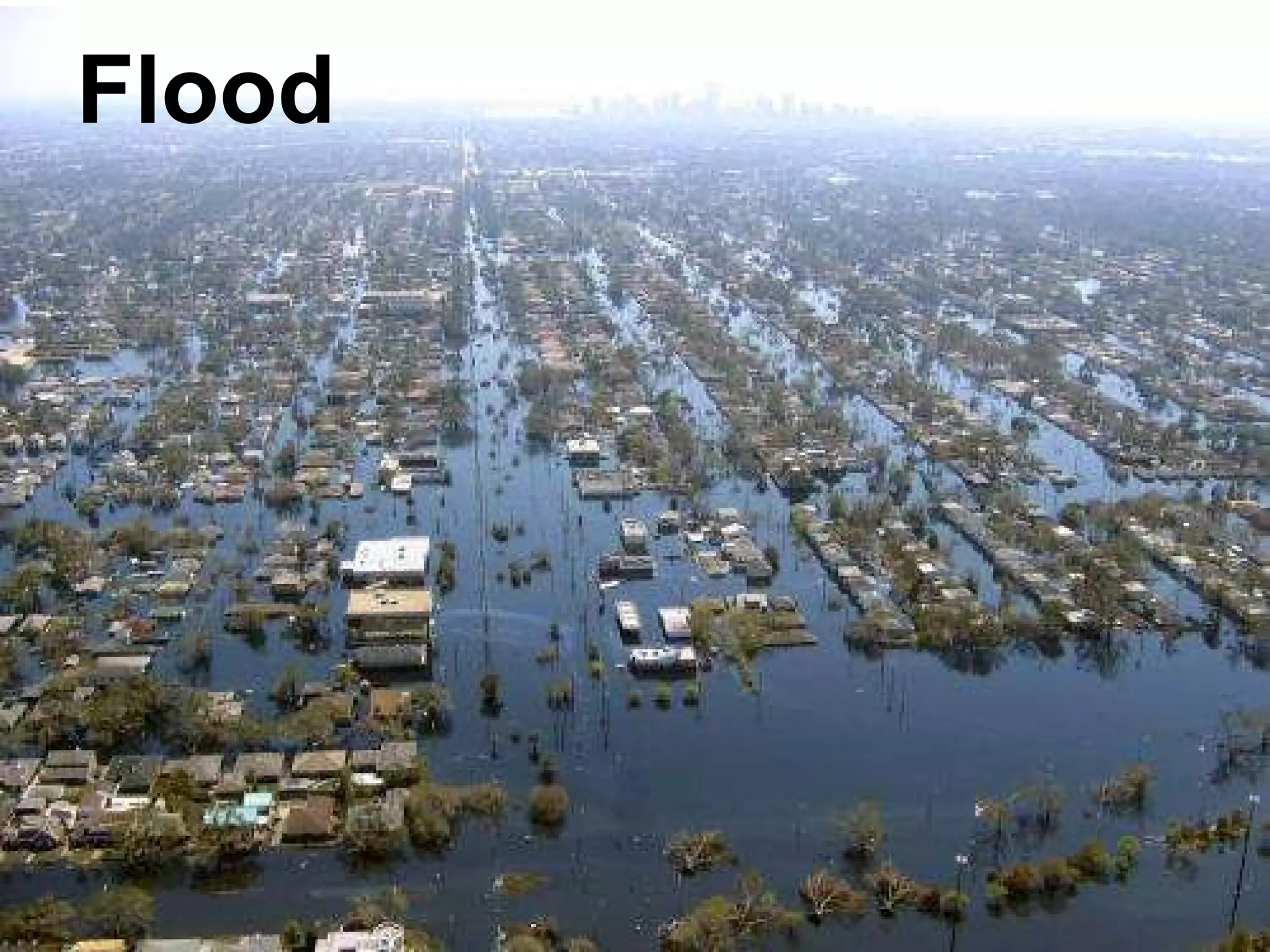
Flood
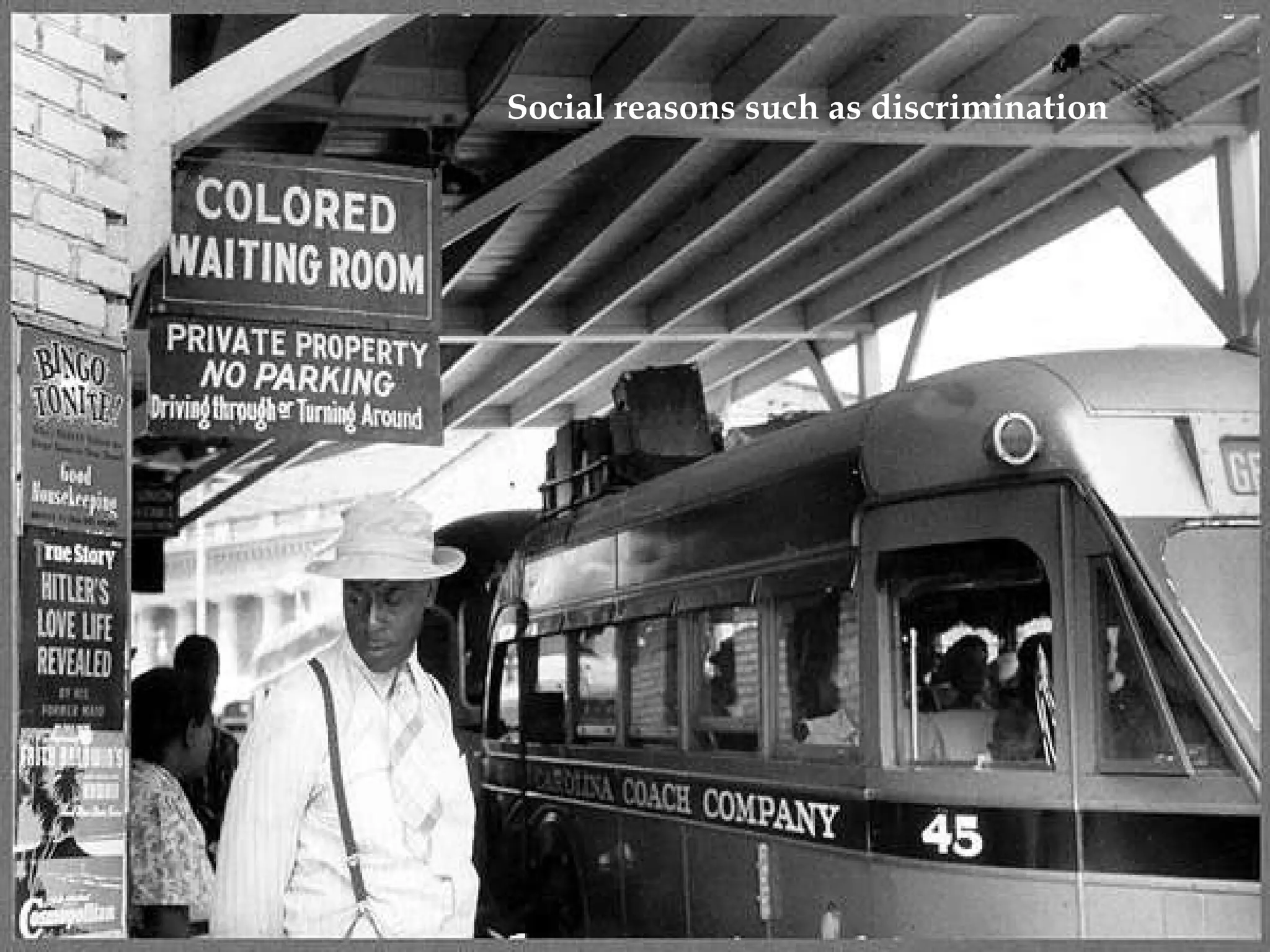
Social reasons such as discrimination
Civil strife, warfare, and genocide
Family
Available Land
Poverty
Modernization
Religious Freedom
 
Available medical services
Soil Erosion
 
What were the push and/or pull factors of early man’s migration?
Internally Displaced Person (IDP) A person that is forced to flee their home from persecution, due to political, religious, military or other problem  and remains in their country just in another place for safety.  Still a push factor.
Refugee - someone that is forced to flee their home from persecution, due to political, religious, military or other problem  and leaves their country for safety reasons.  Turn to partner
Assessment Time

Early Man

  • 1.
    Origins of Manand Early Societies By Dr. Jennifer Levin-Goldberg
  • 2.
    Migration 1.Where didearly man come from in an evolutionary perspective? 2. How did people all over the world get to where they are? 3. How did early man go from nomadic primitive life to a modern technological industry?
  • 3.
    Down WithGeico! Where did early man come from in an evolutionary perspective? How did people all over the world get to where they are? 3. How did early man go from nomadic primitive life to a modern technological industry? Turn to your partner Mindset
  • 4.
  • 5.
    Theories on prehistoryand early man constantly change as new evidence comes to light. - Louis Leakey, British paleoanthropologist The First Humans
  • 6.
  • 7.
    Stages of EarlyHuman Development 1. 4,000,000 BCE – 1,000,000 BCE 2. 1,500,000 BCE -- 250,000 BCE 3 . 250,000 BCE – 30,000 BCE 4. 30,000 BCE -- 10,000 BCE Paleolithic Age : ( Old Stone Age ) 2,500,000 BCE to 8,000 BCE
  • 8.
    Primates Human EvolutionOne theory is that humans evolved from primates. Humans branched off to be Anthropoids and apes as Prosimii. Our closest living relative is the chimpanzee. We share 98% of the same genes with the chimp.
  • 9.
  • 10.
    The Paleolithic Age“ Paleolithic” --> “Old Stone” Age 2,500,000 BCE – 10,000 BCE Hunter/Gatherer Society Made tools from stone
  • 11.
    Stage 1 4,000,000BCE – 1,000,000 BCE
  • 12.
    Australopithecus Afarensis: LucyThe first, most complete Australopithecus afarenis skeleton found was located in Hadar, Ethiopia by Dr. Johanson. He found a knee joint, validating that the creature was bipedal; walking upright making the remains a hominid. Hadar, Ethiopia Dr. Johanson
  • 13.
    Laetoli Footprints Foundin Laetoli, Tanzania. The hominid that created it was Australopithecus Afarensis .
  • 14.
    Ardipithecus Ramidus Theoldest known ancestor to modern day humans and is considered the missing link between apes and humans. Known as Ardi.
  • 15.
    Stage 1 HOMOHABILIS ( “Handy Man” ) His fossils were f ound in the Olduvai Gorge in Tanzania by Dr. Leakey . First earliest known species of the genus Homo; that is, the first human species. First Homo specie to create and use stone tools for hunting and daily life.
  • 16.
    The Paleolithic AgeHumans during this period found shelter in caves. Cave paintings left behind. Purpose??
  • 17.
    The three themesfound in cave art were animals, signs, and human representations. The most common were animals, in particular, the horse and the least depicted were human representations.
  • 18.
    Stage 2 1,6000,000BCE – 30,000 BCE HOMO ERECTUS ( “Upright Man” ) Tools were larger and varied First hominid to migrate and leave Africa First to use fire BIPEDAL
  • 19.
    Their skeletons arelarger unlike Australopithecus afarensis and built more like our own. They were carnivores. Their brain size doubled, making their brains much larger. Scientists find a correlation between brain size and body size. According to the research, the larger the brain, the bigger the body.
  • 20.
    The most famousHomo Erectus fossil was found in a cave in Zhoukoudian, China and became known as Peking Man.
  • 21.
    Differing Human MigrationTheories A. Out of Africa Theory, also known as the Radiation Theory . B. Multiregional Theory, also known as Parallel Evolution Theory
  • 22.
    Stage 3 200,000BCE – 10,000 BCE HOMO SAPIENS ( “Wise Man” ) Neanderthals ( 200,000 BCE – 30,000 BCE ) Homo sapien sapien) ( 40,000 BCE – 10,000 BCE )
  • 23.
    Stage 3 NEANDERTHALS:Neander Valley, Germany (1856) First humans to bury their dead. Made clothes from animal skins. Lived in caves and valleys.
  • 24.
    They didn’t gofar from their homes. They hunted and lived in small groups. Their weapons were used to impale animals up close. Communication was key in hunting because they had to work as a team. They had the ability to use complex speech. Instead of painting on cave walls they painted their faces.
  • 25.
  • 26.
    Stage 3 Homosapien sapiens, a.k.a. Cro-Magnon Man ( “Wise, wise human” ) By 30,000 BCE they replaced Neanderthals. WHY???
  • 27.
    Homo sapien sapienslived on top of hillsides. Hunted from a distance due to advanced weaponry. They were better at obtaining resources. They painted on cave walls demonstrating that they were thinking symbolically. They too buried their dead. Potentially saw Neanderthals as mates.
  • 28.
    Homo sapien sapienssettlements Their migration pattern. How were they able to cross over though? The Bering Strait
  • 29.
    The Last IceAge 70,000 BCE – 10,000 BCE A possible explanation for this was due to the increase of oxygen in the atmosphere which oxidized with the methane present in the atmosphere which kept the Earth warm. This is known as the Great Oxidation Event.
  • 30.
    The Neolithic AgeNeolithic  “New Stone” Age 10,000 BCE – 4,000 BCE Gradual shift from: Nomadic lifestyle  settled, stationery lifestyle; a.k.a.sedentary Hunting/Gathering  agricultural production and domestication of animals.
  • 31.
    The hunter-gatherer exploitsthe environment; the agriculturalist modifies it.
  • 32.
  • 33.
    Is agriculture essentialto the development of a civilization? Explain your response. How did Homo sapiens go from nomadic cultures to an agricultural society? What impact do you think agriculture had upon Homo sapiens’ society? Agricultural Revolution Mindset
  • 34.
    The Agricultural Revolution8,000 BCE – 5,000 BCE There are conflicting debates justifying how and why agriculture developed. How? Did all regions learn about agriculture independently? Did different region learn about agriculture through cultural diffusion? Why? Did agriculture develop due to changes in the climate Did agriculture develop due to population explosions? Middle East India Central America China Southeast Asia 8,000 BCE 7,000 BCE 6,500 BCE 6,000 BCE 5,000 BCE Now it’s your turn; what do you think? Agriculture first developed in the Fertile Crescent which is in the Middle East.
  • 35.
    The Agricultural RevolutionWhy do some archaeologists believe that women were the first farmers?
  • 36.
    Since men didthe hunting and females were responsible for the food gathering, women learned how to plant seeds, as well as process and prepare the food. You Go Girl!
  • 37.
    Early Settled CommunitiesGrowing crops on a regular basis made possible the support of larger populations. More permanent, settled communities emerged. The first towns were Jericho in Israel and the largest was in Catal Huyuk (modern day Turkey).
  • 38.
  • 39.
  • 40.
    Early farmers hadto learn to domesticate wild grains. Why? Click to hear answer
  • 41.
    What is thenext step in the development of human settlements??
  • 42.
  • 43.
    Cities could formdue to a sedentary lifestyle. This, in turn, created specializations, which resulted in wealth, which would lead to social classes, including poverty.
  • 44.
    What are thecharacteristics of a civilization??
  • 45.
    Advanced Cities CIVILIZATIONSpecialized Workers Complex Institutions Record- Keeping Advanced Technology Which gave rise to social classes Government Military Education Legal system Art Religion
  • 46.
    Challenges facing Agricultural Communities 1. Soil Erosion 2. Overpopulation 3. Epidemics 4.Competition over resources 5. Dependency upon weather 6. Safety/Security Issues Are these issues agricultural communities face today?
  • 47.
    Why do youthink so many civilizations arose in river valley's? Click to hear answer
  • 48.
    Do you wantto play a game?
  • 49.
    Get in 3equal groups I will ask each group a question by showing a clue on the Power Point. You and your group will discuss what you think the answer is. If you get it correct, your group earns 1 point. If your group gets it wrong, it is up for grabs. If you answer it incorrectly, you do not lose any points. I will only accept the first answer your group says so make sure you are all in agreement on the answer. Good luck! 
  • 50.
    98% What isthis percentage representing?
  • 51.
    The answer isnot bipedalism
  • 52.
    What type oflife or society did early man practice?
  • 53.
    What link isthis to early man? What animal is this?
  • 54.
    Which hominid speciesdoes this settlement pattern represent?
  • 55.
    This hominid speciewas the first to use stone tools
  • 56.
    What dating methodwould you use if you found an artifact in its ash?
  • 57.
    We’re starting fromhere! Which theory is this?
  • 58.
    What is hedoing that was so significant to the evolution of man? Make sure you say the exact term you learned!
  • 59.
    My name isLucy. What species am I?
  • 60.
    What dating techniqueis this representing?
  • 61.
    This hominid speciecould hunt its prey from a further distance using spears.
  • 62.
    What theory isthis migration pattern demonstrating?
  • 63.
    I was thefirst hominid to leave Africa?
  • 64.
    What is theterm that refers to any member of the family of two-legged primates that includes all humans.
  • 65.
    Which hominid speciesbecame extinct once Homo sapien sapiens arrived on the scene?
  • 66.
    Too much ofthis in the atmosphere may have caused what event?
  • 67.
    Australopithecus afarensis Whichhominid specie came before Australopithecus afarensis and is considered the “missing link”?
  • 68.
    Which hominid wasthe first homo specie?
  • 69.
    This is oneof the first and largest agricultural communities.
  • 70.
    Which hominid speciesevolved into modern man?
  • 71.
    Which type ofsociety had high birth rates?
  • 72.
  • 73.
  • 74.
    Agricultural communities developedfrom a more stationary lifestyle instead of a nomadic one. What is another word for this stationary lifestyle?
  • 75.
  • 76.
  • 77.
  • 78.
    What is thedifference between a refugee and an internally displaced person? What does it mean to immigrate? What dies it mean to emigrate? What causes people to become an immigrant? What causes people to become an emigrant? Migration Mindset
  • 79.
    Push and PullFactors Push Migration Factors of Migration: Conditions that drive people to leave their homes. Examples: Land scarcity, political and/or religious persecution, civil strife or revolutions, unsafe, poverty, lack of services, lack of modernization and infrastructure, and lack of jobs.
  • 80.
    Pull Factors ofMigration: Conditions that attract people to a new area. Examples: religious and political freedom or ideologies, industry, jobs, available land, modernization, available services and infrastructure like education, health care, government services, safety. Turn to your partner
  • 81.
    Let’s do anactivity!
  • 82.
    I will saya factor and you will have to identify which factor it is an example of according to a movement. If it is a Push factor , you will have to do 3 Jumping jacks. If it is a Pull factor , you will have to do 3 calf raises. If it is both a Push and Pull factor , you will have to do 3 squats. Here we go! 
  • 83.
  • 84.
  • 85.
  • 86.
  • 87.
    Social reasons suchas discrimination
  • 88.
  • 89.
  • 90.
  • 91.
  • 92.
  • 93.
  • 94.
  • 95.
  • 96.
  • 97.
  • 98.
    What were thepush and/or pull factors of early man’s migration?
  • 99.
    Internally Displaced Person(IDP) A person that is forced to flee their home from persecution, due to political, religious, military or other problem and remains in their country just in another place for safety. Still a push factor.
  • 100.
    Refugee - someonethat is forced to flee their home from persecution, due to political, religious, military or other problem and leaves their country for safety reasons. Turn to partner
  • 101.

Editor's Notes

  • #11  hunting (men) & gathering (women)  small bands of 20-30 humans. Hunter gatherer societies have low birth rates because their subsistence limits how many children can be born based upon how many resources are available to sustain their population which, in turn, stabilizes their population.  NOMADIC (moving from
  • #12 Hominids --> any member of the family of two-legged primates that includes all humans. Australopithecines first to thought to be bipedal. An Opposable Thumb is another reason hominids became bipedal-making it easy to grasp objects. Apes are not bipedal because their big toe is divergent making it useful for grasping; however, the human toe is aligned, which assists in propelling the body forward to facilitate balance. An ape’s pelvic girdle is also anatomically shaped in an way that is not conducive for walking.
  • #14 In Laetoli, Tanzania, hominid footprints were found validating early bipedalism (walking upright on two feet). Archeologists know this because the toe is aligned with the other toes and there are 2 arches on the print, resembling what a human footprint looks like barefoot. These prints were preserved due to a volcano in the area that erupted and covered the footprints. The hominid that created these prints was an Australopithecus Afarensis.
  • #15 The oldest known ancestor to modern day humans and is considered the missing link between apes and humans is Ardipithicus Ramidus. These fossils were found in Ethipoia as well. This ancestor had a small brain (only a little larger than a chimpanzee) and was bipedal (although, unlike Lucy, couldn’t walk or run on two legs for long distances; however, was a quadruped by climbing trees (like a chimpanzee.
  • #16 First earliest known species of the genus Homo; that is, the first human species. This specie had a much larger brain than Australopithecus afarensis which helped explain how this specie created stone tools for hunting and daily life.
  • #19 Larger and more varied tools --> primitive technology, making hunting more systematic. First hominid to migrate and leave Africa for Europe and Asia.  First to use fire ( 500,000 BCE ). Now they could cook their food which decreased food born diseases. This enabled them to move in search of food instead of relying on just one area.
  • #22 A. Out of Africa Theory, also known as the Radiation Theory. Modern man evolved from one local population in Africa and migrated from there, spreading out all over the world. B. Multiregional Theory. Also known as Parallel Evolution Theory. Hominids evolved slowly from the migration of Homo Erectus into modern man from several specific regions. These populations spread their genes into the areas by breeding, causing the gene pool to become larger.
  • #25 They didn’t go far from their homes, limiting their resources. They hunted and lived in small groups making communication imperative. Their weapons were used to impale animals; therefore, to kill them, they had to approach the animal and get very close. This was dangerous and probably caused injuries and even fatalities. Communication was key in hunting because they had to work as a team. They had the ability to use complex speech; however, their sentences were probably basic. Instead of painting on cave walls they painted their faces.
  • #28 Homo sapien sapiens lived on top of hillsides so they can see from above for hunting. Their weapons were spears that they threw from afar with accuracy allowing them to hunt from a distance. They didn’t have as many people hunting because they didn’t need to which made communication not as important due to being more solitary. They were better at obtaining resources. They painted on cave walls demonstrating that they were thinking symbolically. Potentially saw Neanderthals as mates. They too buried their dead.
  • #37 Since men did the hunting and females were responsible for the food gathering, most of the important contributions were probably made by women, such as how to plant rather than gather seeds, as well as how to process and produce the food. Without these contributions, the earliest societies would not have succeeded.
  • #40 There was a shift now in birth rates. Agricultural communities had high birth rates because they needed more children in order to increase labor supply for farming. Also, the environment was conducive for more child bearing due to the absence of nomadic wandering from settling in one area and food supply.
  • #41 Because the human jaw, teeth, and digestive tract cannot anatomically eat grain because it is rough so they technologically found ways to process the grain for human consumption.
  • #44 Cities could form due to a sedentary lifestyle, meaning people could stay in one place, due to the production of food in one area and having the capacity to store it. This made is no longer necessary to travel for your food source. This, in turn, created specializations because people would specialize in making pottery to store the food and making the tools to farm with, and so forth. This then created wealth, which would lead to social classes, including poverty.
  • #48 It Provided a constant source of water for human consumption and farming, especially rich soil deposits from flooding
  • #51 The percent of our genes that match our closest living relative, the chimpanzee
  • #52 Laetoli footprints
  • #53 Hunter gatherer societies
  • #54 Closest relative to man is the chimpanzee
  • #55 Homo neanderthalis
  • #56 Homo habilis
  • #57 Potassium-argon dating
  • #58 Out of Africa
  • #59 Bipedalsim
  • #60 Australopithecus afarensis
  • #61 Radiocarbon or Carbon 14
  • #62 Homo sapien sapien
  • #63 Multiregional Theory
  • #64 Homo erectus
  • #65 hominid
  • #66 Homo neanderthalis
  • #67 Ice Age
  • #68 Ardipithecus ramidus
  • #69 Homo habilis
  • #70 Catal Huyuk
  • #71 Homo sapien sapien
  • #72 Agricultural
  • #73 civilizations
  • #74 Homo erectus
  • #75 sedentary
  • #81 Review/summarize
  • #84 Push factor
  • #85 Pull factor
  • #86 Both. I left PA because of the weather; however, I could leave AZ if I think it is too hot.
  • #88 Push factor
  • #89 Push factor
  • #90 Both Push and Pull
  • #91 Pull factor
  • #92 Push factor
  • #93 Pull factor
  • #94 Pull factor
  • #95 Push factor
  • #96 Pull factor
  • #97 Push
  • #98 Pull factor
  • #101 Review/summarize