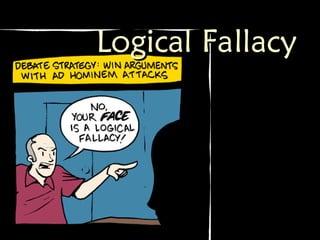
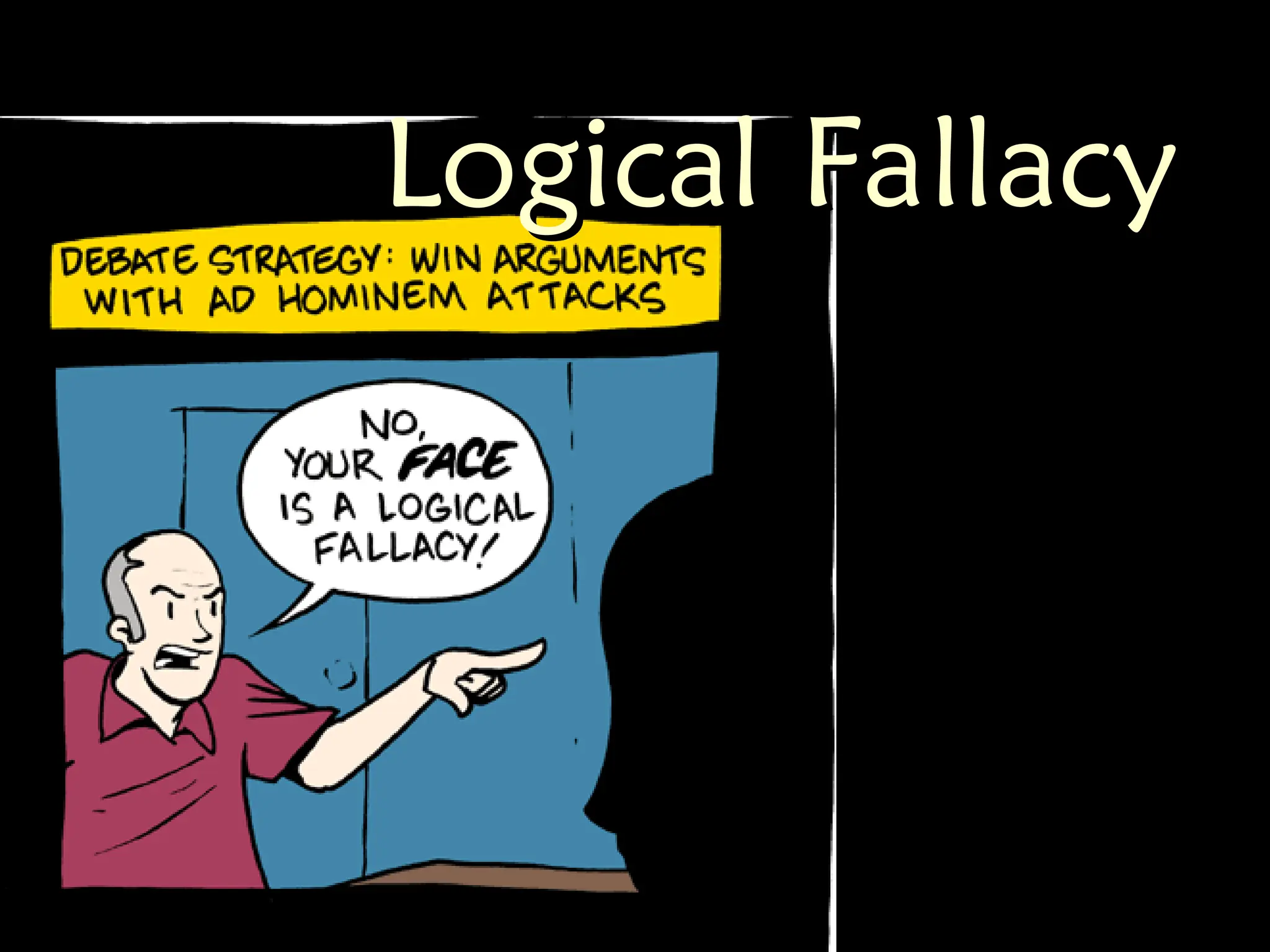
Logical Fallacy
Logical Fallacy
Logical Fallacy
Logical Fallacy
 A
A logical fallacy
logical fallacy – or
– or fallacy
fallacy for short – is
for short – is
an argument that contains a mistake in
reasoning.
reasoning.
 Logical fallacies are often used to
Logical fallacies are often used to
strengthen an argument, but if the reader
detects them the argument can backfire,
and damage the writer’s credibility.
Origins
Origins
 The word “fallacy” derives from the
The word “fallacy” derives from the
Latin word
Latin word fallere
fallere meaning, “to
meaning, “to
deceive, to trip, to lead into error or to
trick.” The word also derives from the
Greek
Greek phelos,
phelos, meaning “deceitful.”
meaning “deceitful.”
www.sun-design.com/talitha/fallacies.htm
Why study logical fallacies?
 It is important to develop logical fallacy detection skills in your own writing, as well as others’.
It is important to develop logical fallacy detection skills in your own writing, as well as others’.
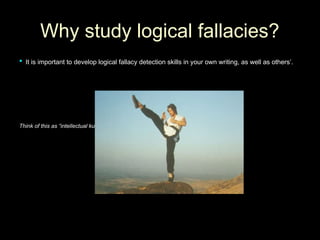
Think of this as “intellectual kung-fu: the art of intellectual self defense.”
Think of this as “intellectual kung-fu: the art of intellectual self defense.” (Logical Fallacies Handlist)
(Logical Fallacies Handlist)
Logical Fallacy
Logical Fallacy
 Fallacies of relevance
Fallacies of relevance are mistakes in
are mistakes in
reasoning that occur because the premises
are
are logically irrelevant
logically irrelevant to the conclusion.
to the conclusion.
 Fallacies of insufficient evidence
Fallacies of insufficient evidence are
are
mistakes in reasoning that occur because
the premises, though logically relevant to
the conclusion,
the conclusion, fail to provide sufficient
fail to provide sufficient
evidence
evidence to support the conclusion.
to support the conclusion.
The Concept of Relevance
 A statement is
A statement is relevant
relevant to another when
to another when it
it
provides at least some evidence or reason
for thinking that the second statement is true
or false.
or false.
 A statement can be either
A statement can be either
– Positively relevant
Positively relevant
– Negatively relevant
Negatively relevant
– Logically irrelevant
Logically irrelevant
Positive Relevance
Positive Relevance
 A statement is
A statement is positively relevant
positively relevant to another
to another
statement if it counts
statement if it counts in favor of
in favor of that statement.
that statement.
– Labradors are dogs. Dogs are domestic
Labradors are dogs. Dogs are domestic
animals, So Labradors are domestic animals.
– Most SLSU students live off-campus. Annie is
Most SLSU students live off-campus. Annie is
an SLSU student. So probably Annie lives off-
campus.
campus.
– Chris is a woman. Therefore, Chris enjoys
Chris is a woman. Therefore, Chris enjoys
knitting.
knitting.
 Each of the premises is positively relevant to the
Each of the premises is positively relevant to the
conclusion.
conclusion.
Negative Relevance
Negative Relevance
 A statement is
A statement is negatively relevant
negatively relevant to another
to another
if it counts
if it counts against
against that statement.
that statement.
– Marty is a high- school senior. So Marty likely
Marty is a high- school senior. So Marty likely
has a Ph.D.
has a Ph.D.
– Althea is two years old. So Althea probably
Althea is two years old. So Althea probably
goes to college.
goes to college.
Logical Irrelevance
Logical Irrelevance
 A statement is
A statement is logically irrelevant
logically irrelevant to
to
another statement if it counts
another statement if it counts neither for
neither for
nor against
nor against that statement.
that statement.
– The earth revolves around the sun. Therefore,
The earth revolves around the sun. Therefore,
marijuana should be legalized.
– Last night I dreamed that the Yankees will win
Last night I dreamed that the Yankees will win
the pennant. Therefore, the Yankees will win
the pennant.
the pennant.
1.
1. Non sequitur
Non sequitur
-This term means "it does not follow."
This term means "it does not follow."
-an illogical statement,
an illogical statement,
-one that seems to draw a conclusion not
one that seems to draw a conclusion not
supported by the premises.
Example:
Example:
"I wore a red shirt yesterday, and I aced my
exam today. Therefore, wearing a red shirt
causes good grades."
1. Education is the only way to combat
unemployment.
unemployment.
(many educated people are unemployed)
2. My essay will get a good grade because I put
a lot of effort into it.
(the speaker may not write well, however much
effort he or she expends)
3.
3. Premise 1: All poets are writers.
Premise 2: Some writers are journalists.
Conclusion: Therefore, some poets have
journalism degrees.
2. Appeal to Authority
(
(argumentum ad verecundiam
argumentum ad verecundiam)
)
-
-Inappropriate appeals to authority are
Inappropriate appeals to authority are
very popular in advertising; they
depend upon the substitution of a
famous name for a serious argument.
Ex.
Ex.
famous actor promoting a specific diet as the
healthiest way to lose weight, despite having no
nutritional expertise, is an appeal to authority.
Appeal to Authority
Appeal to Authority
Drink Vichy water; Paris Hilton does.
Drink Vichy water; Paris Hilton does.
Explanation:
Explanation:
(Ms. Hilton may enjoy foul, expensive, or
even toxic water)
even toxic water)
“I read a book by a nutritionist who says all
carbs are bad. That's why I avoid them
completely.”
3.
3. Hasty Generalizations
Hasty Generalizations
 This is the chief error in reasoning! – a type of
This is the chief error in reasoning! – a type of
inductive reasoning – conclusions made through
insufficient evidence
 This fallacy occurs when an arguer draws a
This fallacy occurs when an arguer draws a
general conclusion from a sample that is either
biased or too small.
 A
A biased
biased sample is one that is not representative of the
sample is one that is not representative of the
target population.
target population.
 The target population
The target population is the group of people or things that
is the group of people or things that
the generalization is about.
 Hasty generalizations can often lead to false
Hasty generalizations can often lead to false stereotypes
stereotypes.
.
3.
3. Hasty Generalizations Ex.
Hasty Generalizations Ex.
 The last two mass murderers were from Michigan.
The last two mass murderers were from Michigan.
Obviously, people from Michigan are dangerous.
 "I met two rude people from that town, so everyone
"I met two rude people from that town, so everyone
from that town must be rude."
 "A few politicians are corrupt, therefore all politicians
"A few politicians are corrupt, therefore all politicians
are corrupt."
are corrupt."
 "My uncle smoked and lived to be 90, so smoking
"My uncle smoked and lived to be 90, so smoking
can't be that bad for you."
 "I tried one brand of instant noodles, and I didn't like it,
"I tried one brand of instant noodles, and I didn't like it,
so all instant noodles must be bad."
3.
3. Hasty Generalizations Ex.
Hasty Generalizations Ex.
 Example:
Example: Some friends from California are staying
Some friends from California are staying
with us. They drive like maniacs, speeding, passing
on the right, running red lights. I guess people from
California are really irresponsible drivers.
– Corrected:
Corrected: Our friends from California speed, pass on the
Our friends from California speed, pass on the
right, and run red lights. I guess my friends are really
irresponsible drivers.
 "My roommate said her philosophy class was hard, and
"My roommate said her philosophy class was hard, and
the one I'm in is hard, too. All philosophy classes must be
hard!"
hard!"
4. Appeal to Ignorance
Definition
Definition: In the appeal to ignorance, the arguer basically says, "Look,
: In the appeal to ignorance, the arguer basically says, "Look,
there's no conclusive evidence on the issue at hand. Therefore, you
should accept my conclusion on this issue."
This fallacy is committed when the proposition relies only on the fact that it
has never been proven false. It is an argument based on
has never been proven false. It is an argument based on lack of
lack of proof.
proof.
Other names: Argumentum ad Ignorantiam
Other names: Argumentum ad Ignorantiam
Example
Example: "People have been trying for centuries to prove that God
: "People have been trying for centuries to prove that God
exists. But no one has yet been able to prove it. Therefore, God does not
exist."
exist."
Here's an opposing argument that commits the same fallacy:
"People have been trying for years to prove that God does not exist. But
"People have been trying for years to prove that God does not exist. But
no one has yet been able to prove it. Therefore, God exists."
– In each case, the arguer tries to use the lack of evidence as support
In each case, the arguer tries to use the lack of evidence as support
4. Appeal to Ignorance
 Assuming a person is guilty because
they haven't proven their innocence.
 A celebrity defendant is acquitted of a crime,
but the public disagrees with the verdict. A
commentator defends the celebrity: “The
prosecution couldn't prove guilt beyond a
reasonable doubt, so it's been definitively
proven that this person is innocent.
5. Personal Attack (
5. Personal Attack (Ad Hominem
Ad Hominem)
)
 -
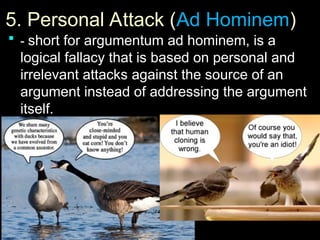
- short for argumentum ad hominem, is a
logical fallacy that is based on personal and
irrelevant attacks against the source of an
argument instead of addressing the argument
itself.
5. Personal Attack (
5. Personal Attack (Ad Hominem
Ad Hominem)
)
 There are five main types of ad
hominem:
1. Abusive
2. Circumstantial
3. Tu quoque
4. Guilt by association
5. Poisoning the well.
5. Personal Attack (
5. Personal Attack (Ad Hominem
Ad Hominem)
)
1. Abusive - It occurs when someone makes an
abusive attack towards someone by criticizing their
attributes such as character, background, morals,
physical appearance, or hobbies. In other words, it’s an
attempt to discredit an argument by insulting the arguer.
-name calling/damning the source
Its logical form goes as:
Person A makes argument X.
Person A is an idiot.
Therefore, argument X is false.
5. Personal Attack (
5. Personal Attack (Ad Hominem
Ad Hominem)
)
2. Circumstantial - also known as “appeal to
motive”, arises when someone says that since a
certain claim must be predisposed by the arguer’s
personal circumstances, it is, therefore, invalid.
For Example
Kate: “Since our student council currently consists
mostly of boys, I think it would be good if we get more
girls in it and make it more balanced.”
Jim: “You only say that because you are a girl yourself,
so your opinion doesn’t matter.”
5. Personal Attack (
5. Personal Attack (Ad Hominem
Ad Hominem)
)
3. Tu quoque - Also called the appeal to hypocrisy, tu quoque
(Latin for “you too”) is based on the claim that a person’s argument
must be invalid because their past actions or words are not
consistent with it.
For Example
Mary: “You should quit smoking, it has been proven many times
how dangerous it is.”
Elise: “Well, you smoke yourself, so you can’t actually believe that.”
Doctor:
Doctor: You should quit smoking.
You should quit smoking.
Patient:
Patient: Look who’s talking! I’ll quit when you quit.
Look who’s talking! I’ll quit when you quit.
Parent:
Parent: I don’t want you to smoke marajuana.
I don’t want you to smoke marajuana.
Son:
Son: But you told me that you did when you
But you told me that you did when you were my age.
were my age.
5. Personal Attack (
5. Personal Attack (Ad Hominem
Ad Hominem)
)
4. Guilt by association in which someone is
discredited due to their supposed association with
something negative.
For Example
Jonah: “I’m a vegetarian because vegetarianism has
been proven to have many health benefits over diets
containing meat.”
Anna: “Didn’t you know that Hitler was a vegetarian
too? You must be like him.”
“Stalin was an atheist and an evil man. Therefore, all
atheists must be evil.”
5. Personal Attack (
5. Personal Attack (Ad Hominem
Ad Hominem)
)
5. Poisoning the well - a fallacy that arises
when negative information about someone is
presented preemptively in order to discredit or
ridicule following claims made by that person.
It is also known as a smear tactic
For Example
Carol: “I’m going on a date tonight with Jack.”
Katherine: “Really? I heard a rumor that he might be a pathological
liar; you shouldn’t believe anything he says.”
“My opponent is incompetent as a politician and, quite frankly, as a
man. Therefore, we have all the reasons to simply dismiss the
arguments he will make today.”
6.
6. Appeal to Force
(Argumentum Ad Baculum or the "Might-
Makes-Right" Fallacy) scare tactics
 -
- This argument uses force, the threat of
force, or some other unpleasant backlash to
make the audience accept a conclusion. It
commonly appears as a last resort when
evidence or rational arguments fail to
convince a reader.
 Here are some real-life examples:
Bullying, Intimidation in the workplace, Political pressure,
Parental coercion, Blackmail, Threats of violence, Using
authority to coerce
6.
6. Appeal to Force
1. "If you don't finish your homework,
you're grounded."
2.
2. Melvin:
Melvin: Boss, why do I have to work
Boss, why do I have to work
weekends when nobody else in the company
does?
does?
Boss:
Boss: Am I sensing insubordination? I can find
Am I sensing insubordination? I can find
another employee very quickly, thanks to
Craigslist, you know.
7.
7. Appeal to Emotion
(Argumentum Ad Misericordiam, literally,
"argument from pity”)
 An arguer attempts to evoke feelings of pity or
An arguer attempts to evoke feelings of pity or
compassion, when such feelings are not logically
relevant to the arguer’s conclusion.
– Student to professor:
Student to professor: I know I missed half your classes and
I know I missed half your classes and
failed all my exams, but I had a really tough semester. First
my pet boa constrictor died. Then my girlfriend told me she
wants a sex-change operation. With all I went through this
semester, I don’t think I really deserved an F. Any chance you
might cut me some slack and change my grade?
– Parent to football coach:
Parent to football coach: I admit that my son Billy can’t run,
I admit that my son Billy can’t run,
pass, kick, catch, block or tackle, but he deserved to make
the football team. If he doesn’t make the team, he’s going to
be an emotional wreck, and he may even drop out of school.
BUT ….
BUT ….
 What about these arguments?
What about these arguments?
Mother to daughter: Nana was asking about you the other
day. She’s so lonely and depressed since Grandpa
passed away, and her Alzheimer’s seems to get worse
every day. She’s done so much for you over the years.
Don’t you think you should pay her a visit?
High school softball coach: Girls, this state championship
is the biggest game of your lives. This is what you’ve
been working for all year. Your parents are counting on
you, your school is counting on you, and your
community is counting on you. Make them proud! Play
like the champions you are!
Here the emotional appeals are appropriate and relevant
to the arguers’ purposes; hence no fallacy is committed.
8.
8. Appeal to the Popular (Argumentum Ad Populum)
bandwagon approach
 -
- The idea presented is
 acceptable because
 a lot of people accept it.
 An argument plays on a person’s
An argument plays on a person’s
desire to be popular, accepted,
or valued, rather than appealing to
logically relevant reasons or evidence
logically relevant reasons or evidence.
a)
a) Most (or a select group of) people believe or do X.
Most (or a select group of) people believe or do X.
b)
b) Therefore, you should believe or do X.
Therefore, you should believe or do X.
Examples:
Examples:
– All the really cool kids in your fraternity smoke
All the really cool kids in your fraternity smoke
cigarettes. Therefore, you should, too.
BUT ….
BUT ….
 All the villagers I’ve talked say that the water
All the villagers I’ve talked say that the water
is safe to drink. Therefore, the water
probably is safe to drink.
 Lots of my friends recommend the Back
Lots of my friends recommend the Back
Street Deli, so it’s probably a good place to
eat.
eat.
 In these bandwagon appeals, the premises
In these bandwagon appeals, the premises
are relevant to the conclusion, so
are relevant to the conclusion, so the
the
arguments are not fallacious.
9.
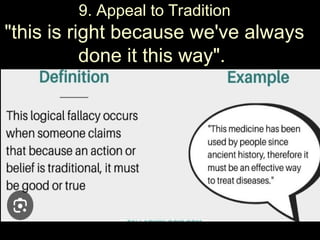
9. Appeal to Tradition
"this is right because we've always
done it this way".
9. Appeal to tradition
1.
1. "My family has always been lawyers, so I
"My family has always been lawyers, so I
must become a lawyer too."
2.
2. "The death penalty has always been a
"The death penalty has always been a
punishment for heinous crimes, so it's
acceptable."
acceptable."
3.
3. “
“Drinking boiling hot water (and never cold
Drinking boiling hot water (and never cold
water) is always healthy because Chinese
people have done it for thousands of years."
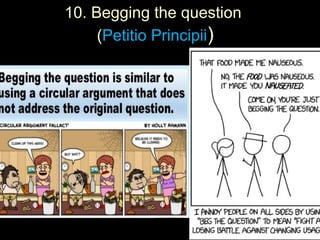
Begging the Question
 An arguer states or assumes as a premise the very
An arguer states or assumes as a premise the very
thing he or she is trying to prove as a conclusion.
 Two common ways to beg the question
Two common ways to beg the question
– Restating the conclusion in slightly different words.
Restating the conclusion in slightly different words.
Capital punishment is morally wrong because it is ethically
impermissible to inflict death as punishment for a crime.
– Circular reasoning
Circular reasoning
B: God wrote the bible.
N: How do you know?
N: How do you know?
B: Because it says so in the Bible and what the Bible says
is true.
is true.
N: How to you know what the Bible says is true?
B: Because God wrote the Bible.
10.
10. Begging the question
(Petitio Principii)
10.
10. Begging the question
(Petitio Principii)
 I am the boss because what I say goes!
 The book is a bestseller because it sold the most
copies.
 We’re innocent because the report says we did
no wrong.
 Water bottles are bad for the environment
because they're bad for nature.
 Capitalism is good because the free market is
good.
11.
11. Faulty Cause And Effect
(post hoc, ergo propter hoc) false cause
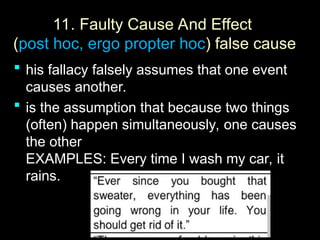
 his fallacy falsely assumes that one event
causes another.
 is the assumption that because two things
(often) happen simultaneously, one causes
the other
EXAMPLES: Every time I wash my car, it
rains.
11. Faulty cause and effect
1.
1. "My car broke down the day after I filled the tank with
"My car broke down the day after I filled the tank with
gas. Therefore, the gas caused the breakdown."
2.
2. "I ate pizza and then got a cold, so pizza causes
"I ate pizza and then got a cold, so pizza causes
colds."
colds."
3.
3. "Every time I wash my car, it rains. Therefore,
"Every time I wash my car, it rains. Therefore,
washing my car causes it to rain."
4.
4. "Kids who play violent video games are more likely to
"Kids who play violent video games are more likely to
be violent. Therefore, violent video games cause
violence."
violence."
12.
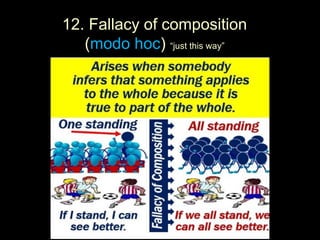
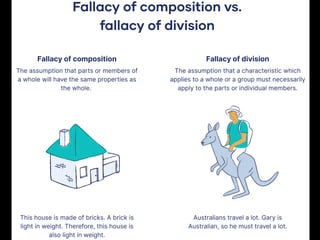
12. Fallacy of composition
(modo hoc) “just this way”
12. Fallacy of composition
1. If one brick is rectangular, the whole wall is rectangular.
2. If every atom in a penny is colorless, then a penny is
colorless.
3.
3. A domestic cat likes to be petted so a tiger would, too.
It’s just a cat.
4.
4. I travelled to Bali and met some really unfriendly people.
I now think Balinese people are unfriendly and wouldn’t go
back.
5. a flock of birds will be quiet
One bird may be quiet and graceful as it flies overhead, but a flock of 200 birds would be noisy and chaotic.
13.
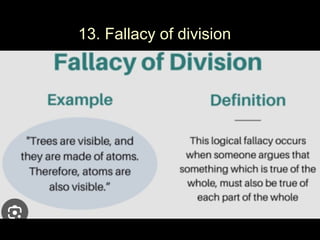
13. Fallacy of division
Fallacy of division
Fallacy of division
1. "This car is expensive, so each of its parts must also
be expensive.“
2. The second grade in Jefferson Elementary eats a lot of
ice cream.
Carlos is a second-grader in Jefferson Elementary.
Therefore, Carlos eats a lot of ice cream
3. "That is a very heavy book, so each page must be
heavy.“
4. "This is a delicious cake, so every ingredient must be
delicious."

IPHP-lesson-10-Logical-Fallacy and relevance.ppt

  • 1.
  • 2.
    Logical Fallacy Logical Fallacy A A logical fallacy logical fallacy – or – or fallacy fallacy for short – is for short – is an argument that contains a mistake in an argument that contains a mistake in reasoning. reasoning.  Logical fallacies are often used to Logical fallacies are often used to strengthen an argument, but if the reader strengthen an argument, but if the reader detects them the argument can backfire, detects them the argument can backfire, and damage the writer’s credibility. and damage the writer’s credibility.
  • 3.
    Origins Origins  The word“fallacy” derives from the The word “fallacy” derives from the Latin word Latin word fallere fallere meaning, “to meaning, “to deceive, to trip, to lead into error or to deceive, to trip, to lead into error or to trick.” The word also derives from the trick.” The word also derives from the Greek Greek phelos, phelos, meaning “deceitful.” meaning “deceitful.” www.sun-design.com/talitha/fallacies.htm www.sun-design.com/talitha/fallacies.htm
  • 4.
    Why study logicalfallacies? Why study logical fallacies?  It is important to develop logical fallacy detection skills in your own writing, as well as others’. It is important to develop logical fallacy detection skills in your own writing, as well as others’. Think of this as “intellectual kung-fu: the art of intellectual self defense.” Think of this as “intellectual kung-fu: the art of intellectual self defense.” (Logical Fallacies Handlist) (Logical Fallacies Handlist)
  • 5.
    Logical Fallacy Logical Fallacy Fallacies of relevance Fallacies of relevance are mistakes in are mistakes in reasoning that occur because the premises reasoning that occur because the premises are are logically irrelevant logically irrelevant to the conclusion. to the conclusion.  Fallacies of insufficient evidence Fallacies of insufficient evidence are are mistakes in reasoning that occur because mistakes in reasoning that occur because the premises, though logically relevant to the premises, though logically relevant to the conclusion, the conclusion, fail to provide sufficient fail to provide sufficient evidence evidence to support the conclusion. to support the conclusion.
  • 6.
    The Concept ofRelevance The Concept of Relevance  A statement is A statement is relevant relevant to another when to another when it it provides at least some evidence or reason provides at least some evidence or reason for thinking that the second statement is true for thinking that the second statement is true or false. or false.  A statement can be either A statement can be either – Positively relevant Positively relevant – Negatively relevant Negatively relevant – Logically irrelevant Logically irrelevant
  • 7.
    Positive Relevance Positive Relevance A statement is A statement is positively relevant positively relevant to another to another statement if it counts statement if it counts in favor of in favor of that statement. that statement. – Labradors are dogs. Dogs are domestic Labradors are dogs. Dogs are domestic animals, So Labradors are domestic animals. animals, So Labradors are domestic animals. – Most SLSU students live off-campus. Annie is Most SLSU students live off-campus. Annie is an SLSU student. So probably Annie lives off- an SLSU student. So probably Annie lives off- campus. campus. – Chris is a woman. Therefore, Chris enjoys Chris is a woman. Therefore, Chris enjoys knitting. knitting.  Each of the premises is positively relevant to the Each of the premises is positively relevant to the conclusion. conclusion.
  • 8.
    Negative Relevance Negative Relevance A statement is A statement is negatively relevant negatively relevant to another to another if it counts if it counts against against that statement. that statement. – Marty is a high- school senior. So Marty likely Marty is a high- school senior. So Marty likely has a Ph.D. has a Ph.D. – Althea is two years old. So Althea probably Althea is two years old. So Althea probably goes to college. goes to college.
  • 9.
    Logical Irrelevance Logical Irrelevance A statement is A statement is logically irrelevant logically irrelevant to to another statement if it counts another statement if it counts neither for neither for nor against nor against that statement. that statement. – The earth revolves around the sun. Therefore, The earth revolves around the sun. Therefore, marijuana should be legalized. marijuana should be legalized. – Last night I dreamed that the Yankees will win Last night I dreamed that the Yankees will win the pennant. Therefore, the Yankees will win the pennant. Therefore, the Yankees will win the pennant. the pennant.
  • 10.
    1. 1. Non sequitur Nonsequitur -This term means "it does not follow." This term means "it does not follow." -an illogical statement, an illogical statement, -one that seems to draw a conclusion not one that seems to draw a conclusion not supported by the premises. supported by the premises. Example: Example: "I wore a red shirt yesterday, and I aced my "I wore a red shirt yesterday, and I aced my exam today. Therefore, wearing a red shirt exam today. Therefore, wearing a red shirt causes good grades." causes good grades."
  • 11.
    1. Education isthe only way to combat 1. Education is the only way to combat unemployment. unemployment. (many educated people are unemployed) (many educated people are unemployed) 2. My essay will get a good grade because I put 2. My essay will get a good grade because I put a lot of effort into it. a lot of effort into it. (the speaker may not write well, however much (the speaker may not write well, however much effort he or she expends) effort he or she expends) 3. 3. Premise 1: All poets are writers. Premise 2: Some writers are journalists. Conclusion: Therefore, some poets have journalism degrees.
  • 12.
    2. Appeal toAuthority 2. Appeal to Authority ( (argumentum ad verecundiam argumentum ad verecundiam) ) - -Inappropriate appeals to authority are Inappropriate appeals to authority are very popular in advertising; they very popular in advertising; they depend upon the substitution of a depend upon the substitution of a famous name for a serious argument. famous name for a serious argument. Ex. Ex. famous actor promoting a specific diet as the healthiest way to lose weight, despite having no nutritional expertise, is an appeal to authority.
  • 13.
    Appeal to Authority Appealto Authority Drink Vichy water; Paris Hilton does. Drink Vichy water; Paris Hilton does. Explanation: Explanation: (Ms. Hilton may enjoy foul, expensive, or (Ms. Hilton may enjoy foul, expensive, or even toxic water) even toxic water) “I read a book by a nutritionist who says all carbs are bad. That's why I avoid them completely.”
  • 14.
    3. 3. Hasty Generalizations HastyGeneralizations  This is the chief error in reasoning! – a type of This is the chief error in reasoning! – a type of inductive reasoning – conclusions made through inductive reasoning – conclusions made through insufficient evidence insufficient evidence  This fallacy occurs when an arguer draws a This fallacy occurs when an arguer draws a general conclusion from a sample that is either general conclusion from a sample that is either biased or too small. biased or too small.  A A biased biased sample is one that is not representative of the sample is one that is not representative of the target population. target population.  The target population The target population is the group of people or things that is the group of people or things that the generalization is about. the generalization is about.  Hasty generalizations can often lead to false Hasty generalizations can often lead to false stereotypes stereotypes. .
  • 15.
    3. 3. Hasty GeneralizationsEx. Hasty Generalizations Ex.  The last two mass murderers were from Michigan. The last two mass murderers were from Michigan. Obviously, people from Michigan are dangerous. Obviously, people from Michigan are dangerous.  "I met two rude people from that town, so everyone "I met two rude people from that town, so everyone from that town must be rude." from that town must be rude."  "A few politicians are corrupt, therefore all politicians "A few politicians are corrupt, therefore all politicians are corrupt." are corrupt."  "My uncle smoked and lived to be 90, so smoking "My uncle smoked and lived to be 90, so smoking can't be that bad for you." can't be that bad for you."  "I tried one brand of instant noodles, and I didn't like it, "I tried one brand of instant noodles, and I didn't like it, so all instant noodles must be bad." so all instant noodles must be bad."
  • 16.
    3. 3. Hasty GeneralizationsEx. Hasty Generalizations Ex.  Example: Example: Some friends from California are staying Some friends from California are staying with us. They drive like maniacs, speeding, passing with us. They drive like maniacs, speeding, passing on the right, running red lights. I guess people from on the right, running red lights. I guess people from California are really irresponsible drivers. California are really irresponsible drivers. – Corrected: Corrected: Our friends from California speed, pass on the Our friends from California speed, pass on the right, and run red lights. I guess my friends are really right, and run red lights. I guess my friends are really irresponsible drivers. irresponsible drivers.  "My roommate said her philosophy class was hard, and "My roommate said her philosophy class was hard, and the one I'm in is hard, too. All philosophy classes must be the one I'm in is hard, too. All philosophy classes must be hard!" hard!"
  • 17.
    4. Appeal toIgnorance 4. Appeal to Ignorance Definition Definition: In the appeal to ignorance, the arguer basically says, "Look, : In the appeal to ignorance, the arguer basically says, "Look, there's no conclusive evidence on the issue at hand. Therefore, you there's no conclusive evidence on the issue at hand. Therefore, you should accept my conclusion on this issue." should accept my conclusion on this issue." This fallacy is committed when the proposition relies only on the fact that it This fallacy is committed when the proposition relies only on the fact that it has never been proven false. It is an argument based on has never been proven false. It is an argument based on lack of lack of proof. proof. Other names: Argumentum ad Ignorantiam Other names: Argumentum ad Ignorantiam Example Example: "People have been trying for centuries to prove that God : "People have been trying for centuries to prove that God exists. But no one has yet been able to prove it. Therefore, God does not exists. But no one has yet been able to prove it. Therefore, God does not exist." exist." Here's an opposing argument that commits the same fallacy: Here's an opposing argument that commits the same fallacy: "People have been trying for years to prove that God does not exist. But "People have been trying for years to prove that God does not exist. But no one has yet been able to prove it. Therefore, God exists." no one has yet been able to prove it. Therefore, God exists." – In each case, the arguer tries to use the lack of evidence as support In each case, the arguer tries to use the lack of evidence as support
  • 18.
    4. Appeal toIgnorance 4. Appeal to Ignorance  Assuming a person is guilty because they haven't proven their innocence.  A celebrity defendant is acquitted of a crime, but the public disagrees with the verdict. A commentator defends the celebrity: “The prosecution couldn't prove guilt beyond a reasonable doubt, so it's been definitively proven that this person is innocent.
  • 19.
    5. Personal Attack( 5. Personal Attack (Ad Hominem Ad Hominem) )  - - short for argumentum ad hominem, is a logical fallacy that is based on personal and irrelevant attacks against the source of an argument instead of addressing the argument itself.
  • 20.
    5. Personal Attack( 5. Personal Attack (Ad Hominem Ad Hominem) )  There are five main types of ad hominem: 1. Abusive 2. Circumstantial 3. Tu quoque 4. Guilt by association 5. Poisoning the well.
  • 21.
    5. Personal Attack( 5. Personal Attack (Ad Hominem Ad Hominem) ) 1. Abusive - It occurs when someone makes an abusive attack towards someone by criticizing their attributes such as character, background, morals, physical appearance, or hobbies. In other words, it’s an attempt to discredit an argument by insulting the arguer. -name calling/damning the source Its logical form goes as: Person A makes argument X. Person A is an idiot. Therefore, argument X is false.
  • 22.
    5. Personal Attack( 5. Personal Attack (Ad Hominem Ad Hominem) ) 2. Circumstantial - also known as “appeal to motive”, arises when someone says that since a certain claim must be predisposed by the arguer’s personal circumstances, it is, therefore, invalid. For Example Kate: “Since our student council currently consists mostly of boys, I think it would be good if we get more girls in it and make it more balanced.” Jim: “You only say that because you are a girl yourself, so your opinion doesn’t matter.”
  • 23.
    5. Personal Attack( 5. Personal Attack (Ad Hominem Ad Hominem) ) 3. Tu quoque - Also called the appeal to hypocrisy, tu quoque (Latin for “you too”) is based on the claim that a person’s argument must be invalid because their past actions or words are not consistent with it. For Example Mary: “You should quit smoking, it has been proven many times how dangerous it is.” Elise: “Well, you smoke yourself, so you can’t actually believe that.” Doctor: Doctor: You should quit smoking. You should quit smoking. Patient: Patient: Look who’s talking! I’ll quit when you quit. Look who’s talking! I’ll quit when you quit. Parent: Parent: I don’t want you to smoke marajuana. I don’t want you to smoke marajuana. Son: Son: But you told me that you did when you But you told me that you did when you were my age. were my age.
  • 24.
    5. Personal Attack( 5. Personal Attack (Ad Hominem Ad Hominem) ) 4. Guilt by association in which someone is discredited due to their supposed association with something negative. For Example Jonah: “I’m a vegetarian because vegetarianism has been proven to have many health benefits over diets containing meat.” Anna: “Didn’t you know that Hitler was a vegetarian too? You must be like him.” “Stalin was an atheist and an evil man. Therefore, all atheists must be evil.”
  • 25.
    5. Personal Attack( 5. Personal Attack (Ad Hominem Ad Hominem) ) 5. Poisoning the well - a fallacy that arises when negative information about someone is presented preemptively in order to discredit or ridicule following claims made by that person. It is also known as a smear tactic For Example Carol: “I’m going on a date tonight with Jack.” Katherine: “Really? I heard a rumor that he might be a pathological liar; you shouldn’t believe anything he says.” “My opponent is incompetent as a politician and, quite frankly, as a man. Therefore, we have all the reasons to simply dismiss the arguments he will make today.”
  • 26.
    6. 6. Appeal toForce (Argumentum Ad Baculum or the "Might- Makes-Right" Fallacy) scare tactics  - - This argument uses force, the threat of force, or some other unpleasant backlash to make the audience accept a conclusion. It commonly appears as a last resort when evidence or rational arguments fail to convince a reader.  Here are some real-life examples: Bullying, Intimidation in the workplace, Political pressure, Parental coercion, Blackmail, Threats of violence, Using authority to coerce
  • 27.
    6. 6. Appeal toForce 1. "If you don't finish your homework, you're grounded." 2. 2. Melvin: Melvin: Boss, why do I have to work Boss, why do I have to work weekends when nobody else in the company weekends when nobody else in the company does? does? Boss: Boss: Am I sensing insubordination? I can find Am I sensing insubordination? I can find another employee very quickly, thanks to another employee very quickly, thanks to Craigslist, you know. Craigslist, you know.
  • 29.
    7. 7. Appeal toEmotion (Argumentum Ad Misericordiam, literally, "argument from pity”)  An arguer attempts to evoke feelings of pity or An arguer attempts to evoke feelings of pity or compassion, when such feelings are not logically compassion, when such feelings are not logically relevant to the arguer’s conclusion. relevant to the arguer’s conclusion. – Student to professor: Student to professor: I know I missed half your classes and I know I missed half your classes and failed all my exams, but I had a really tough semester. First failed all my exams, but I had a really tough semester. First my pet boa constrictor died. Then my girlfriend told me she my pet boa constrictor died. Then my girlfriend told me she wants a sex-change operation. With all I went through this wants a sex-change operation. With all I went through this semester, I don’t think I really deserved an F. Any chance you semester, I don’t think I really deserved an F. Any chance you might cut me some slack and change my grade? might cut me some slack and change my grade? – Parent to football coach: Parent to football coach: I admit that my son Billy can’t run, I admit that my son Billy can’t run, pass, kick, catch, block or tackle, but he deserved to make pass, kick, catch, block or tackle, but he deserved to make the football team. If he doesn’t make the team, he’s going to the football team. If he doesn’t make the team, he’s going to be an emotional wreck, and he may even drop out of school. be an emotional wreck, and he may even drop out of school.
  • 30.
    BUT …. BUT …. What about these arguments? What about these arguments? Mother to daughter: Nana was asking about you the other Mother to daughter: Nana was asking about you the other day. She’s so lonely and depressed since Grandpa day. She’s so lonely and depressed since Grandpa passed away, and her Alzheimer’s seems to get worse passed away, and her Alzheimer’s seems to get worse every day. She’s done so much for you over the years. every day. She’s done so much for you over the years. Don’t you think you should pay her a visit? Don’t you think you should pay her a visit? High school softball coach: Girls, this state championship High school softball coach: Girls, this state championship is the biggest game of your lives. This is what you’ve is the biggest game of your lives. This is what you’ve been working for all year. Your parents are counting on been working for all year. Your parents are counting on you, your school is counting on you, and your you, your school is counting on you, and your community is counting on you. Make them proud! Play community is counting on you. Make them proud! Play like the champions you are! like the champions you are! Here the emotional appeals are appropriate and relevant Here the emotional appeals are appropriate and relevant to the arguers’ purposes; hence no fallacy is committed. to the arguers’ purposes; hence no fallacy is committed.
  • 31.
    8. 8. Appeal tothe Popular (Argumentum Ad Populum) bandwagon approach  - - The idea presented is  acceptable because  a lot of people accept it.  An argument plays on a person’s An argument plays on a person’s desire to be popular, accepted, desire to be popular, accepted, or valued, rather than appealing to or valued, rather than appealing to logically relevant reasons or evidence logically relevant reasons or evidence. a) a) Most (or a select group of) people believe or do X. Most (or a select group of) people believe or do X. b) b) Therefore, you should believe or do X. Therefore, you should believe or do X. Examples: Examples: – All the really cool kids in your fraternity smoke All the really cool kids in your fraternity smoke cigarettes. Therefore, you should, too. cigarettes. Therefore, you should, too.
  • 32.
    BUT …. BUT …. All the villagers I’ve talked say that the water All the villagers I’ve talked say that the water is safe to drink. Therefore, the water is safe to drink. Therefore, the water probably is safe to drink. probably is safe to drink.  Lots of my friends recommend the Back Lots of my friends recommend the Back Street Deli, so it’s probably a good place to Street Deli, so it’s probably a good place to eat. eat.  In these bandwagon appeals, the premises In these bandwagon appeals, the premises are relevant to the conclusion, so are relevant to the conclusion, so the the arguments are not fallacious. arguments are not fallacious.
  • 33.
    9. 9. Appeal toTradition "this is right because we've always done it this way".
  • 34.
    9. Appeal totradition 9. Appeal to tradition 1. 1. "My family has always been lawyers, so I "My family has always been lawyers, so I must become a lawyer too." must become a lawyer too." 2. 2. "The death penalty has always been a "The death penalty has always been a punishment for heinous crimes, so it's punishment for heinous crimes, so it's acceptable." acceptable." 3. 3. “ “Drinking boiling hot water (and never cold Drinking boiling hot water (and never cold water) is always healthy because Chinese water) is always healthy because Chinese people have done it for thousands of years." people have done it for thousands of years."
  • 35.
    Begging the Question An arguer states or assumes as a premise the very An arguer states or assumes as a premise the very thing he or she is trying to prove as a conclusion. thing he or she is trying to prove as a conclusion.  Two common ways to beg the question Two common ways to beg the question – Restating the conclusion in slightly different words. Restating the conclusion in slightly different words. Capital punishment is morally wrong because it is ethically Capital punishment is morally wrong because it is ethically impermissible to inflict death as punishment for a crime. impermissible to inflict death as punishment for a crime. – Circular reasoning Circular reasoning B: God wrote the bible. B: God wrote the bible. N: How do you know? N: How do you know? B: Because it says so in the Bible and what the Bible says B: Because it says so in the Bible and what the Bible says is true. is true. N: How to you know what the Bible says is true? N: How to you know what the Bible says is true? B: Because God wrote the Bible. B: Because God wrote the Bible.
  • 36.
    10. 10. Begging thequestion (Petitio Principii)
  • 37.
    10. 10. Begging thequestion (Petitio Principii)  I am the boss because what I say goes!  The book is a bestseller because it sold the most copies.  We’re innocent because the report says we did no wrong.  Water bottles are bad for the environment because they're bad for nature.  Capitalism is good because the free market is good.
  • 38.
    11. 11. Faulty CauseAnd Effect (post hoc, ergo propter hoc) false cause  his fallacy falsely assumes that one event causes another.  is the assumption that because two things (often) happen simultaneously, one causes the other EXAMPLES: Every time I wash my car, it rains.
  • 39.
    11. Faulty causeand effect 11. Faulty cause and effect 1. 1. "My car broke down the day after I filled the tank with "My car broke down the day after I filled the tank with gas. Therefore, the gas caused the breakdown." gas. Therefore, the gas caused the breakdown." 2. 2. "I ate pizza and then got a cold, so pizza causes "I ate pizza and then got a cold, so pizza causes colds." colds." 3. 3. "Every time I wash my car, it rains. Therefore, "Every time I wash my car, it rains. Therefore, washing my car causes it to rain." washing my car causes it to rain." 4. 4. "Kids who play violent video games are more likely to "Kids who play violent video games are more likely to be violent. Therefore, violent video games cause be violent. Therefore, violent video games cause violence." violence."
  • 40.
    12. 12. Fallacy ofcomposition (modo hoc) “just this way”
  • 41.
    12. Fallacy ofcomposition 12. Fallacy of composition 1. If one brick is rectangular, the whole wall is rectangular. 2. If every atom in a penny is colorless, then a penny is colorless. 3. 3. A domestic cat likes to be petted so a tiger would, too. It’s just a cat. 4. 4. I travelled to Bali and met some really unfriendly people. I now think Balinese people are unfriendly and wouldn’t go back. 5. a flock of birds will be quiet One bird may be quiet and graceful as it flies overhead, but a flock of 200 birds would be noisy and chaotic. One bird may be quiet and graceful as it flies overhead, but a flock of 200 birds would be noisy and chaotic.
  • 43.
  • 44.
    Fallacy of division Fallacyof division 1. "This car is expensive, so each of its parts must also be expensive.“ 2. The second grade in Jefferson Elementary eats a lot of ice cream. Carlos is a second-grader in Jefferson Elementary. Therefore, Carlos eats a lot of ice cream 3. "That is a very heavy book, so each page must be heavy.“ 4. "This is a delicious cake, so every ingredient must be delicious."

Editor's Notes

  • #14 Bias - systematic patterns of deviation from norm or rationality in judgment. It is a tendency to think in a way that is not objective or impartial, often leading to errors in decision-making and problem-solving. This can manifest as presenting facts and arguments in a way that favors one side over another, potentially misleading the audience or clouding their judgment.