9.0 Normalization
DBMS
Bishal
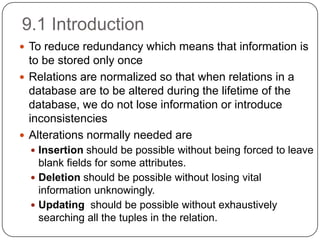
9.1 Introduction
 To reduce redundancy which means that information is
to be stored only once
 Relations are normalized so that when relations in a
database are to be altered during the lifetime of the
database, we do not lose information or introduce
inconsistencies
 Alterations normally needed are
 Insertion should be possible without being forced to leave
blank fields for some attributes.
 Deletion should be possible without losing vital
information unknowingly.
 Updating should be possible without exhaustively
searching all the tuples in the relation.
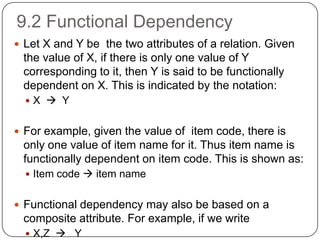
9.2 Functional Dependency
 Let X and Y be the two attributes of a relation. Given
the value of X, if there is only one value of Y
corresponding to it, then Y is said to be functionally
dependent on X. This is indicated by the notation:
 X  Y
 For example, given the value of item code, there is
only one value of item name for it. Thus item name is
functionally dependent on item code. This is shown as:
 Item code  item name
 Functional dependency may also be based on a
composite attribute. For example, if we write
 X,Z  Y
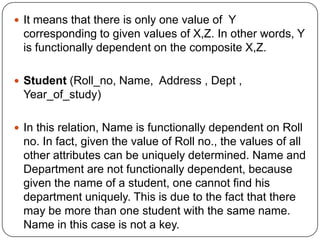
 It means that there is only one value of Y
corresponding to given values of X,Z. In other words, Y
is functionally dependent on the composite X,Z.
 Student (Roll_no, Name, Address , Dept ,
Year_of_study)
 In this relation, Name is functionally dependent on Roll
no. In fact, given the value of Roll no., the values of all
other attributes can be uniquely determined. Name and
Department are not functionally dependent, because
given the name of a student, one cannot find his
department uniquely. This is due to the fact that there
may be more than one student with the same name.
Name in this case is not a key.
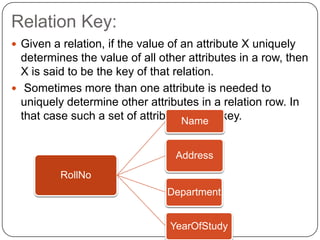
Relation Key:
 Given a relation, if the value of an attribute X uniquely
determines the value of all other attributes in a row, then
X is said to be the key of that relation.
 Sometimes more than one attribute is needed to
uniquely determine other attributes in a relation row. In
that case such a set of attributes is the key.
RollNo
Name
Address
Department
YearOfStudy
9.3 Anomalies in a Database
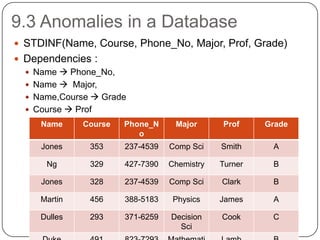
 STDINF(Name, Course, Phone_No, Major, Prof, Grade)
 Dependencies :
 Name  Phone_No,
 Name  Major,
 Name,Course  Grade
 Course  Prof
Name Course Phone_N
o
Major Prof Grade
Jones 353 237-4539 Comp Sci Smith A
Ng 329 427-7390 Chemistry Turner B
Jones 328 237-4539 Comp Sci Clark B
Martin 456 388-5183 Physics James A
Dulles 293 371-6259 Decision
Sci
Cook C
9.3 Anomalies in a Database
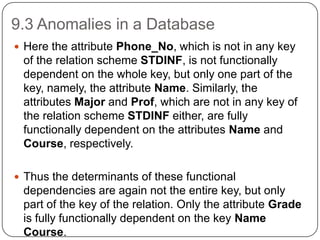
 Here the attribute Phone_No, which is not in any key
of the relation scheme STDINF, is not functionally
dependent on the whole key, but only one part of the
key, namely, the attribute Name. Similarly, the
attributes Major and Prof, which are not in any key of
the relation scheme STDINF either, are fully
functionally dependent on the attributes Name and
Course, respectively.
 Thus the determinants of these functional
dependencies are again not the entire key, but only
part of the key of the relation. Only the attribute Grade
is fully functionally dependent on the key Name
Course.
Redundancy
 The aim of the database system is to reduce
redundancy, meaning that information is to be stored
only once. Storing information several times leads to the
waste of storage space and an increase in the total size
of the data stored.
 Updates to the database with such redundancies have
the potential of becoming inconsistent as explained
below. In the relation of table, the Major and
Phone_No. of a student are stored several times in the
database: once for each course that is or was taken by
a student.
Update Anomalies
 Multiple copies of the same fact may lead to update
anomalies or inconsistencies when an update is
made, and only some of the multiple copies are
updated. Thus, a change in the Phone_No. of Jones
must be made, for consistency, in all tuples pertaining
to the student Jones. If one of the three tuples is not
changed to reflect the new Phone_No. of Jones, there
will be an inconsistency in the data.
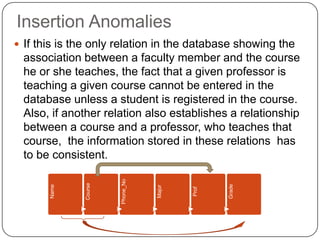
Insertion Anomalies
 If this is the only relation in the database showing the
association between a faculty member and the course
he or she teaches, the fact that a given professor is
teaching a given course cannot be entered in the
database unless a student is registered in the course.
Also, if another relation also establishes a relationship
between a course and a professor, who teaches that
course, the information stored in these relations has
to be consistent.
Name
Course
Phone_No
Major
Prof
Grade
Deletion Anomalies
 If the only student registered in a given course
discontinues the course, the information as to which
professor is offering the course will be lost, if this is the
only relation in the database showing the association
between a faculty member and the course she or he
teaches. If another relation in the database also
establishes the relationship between a course and a
professor, who teaches that course, the deletion of the
last tuple in STDINF for a given course will not cause the
information about the course's teacher to be lost.
 The problems of database inconsistency and redundancy
of data are similar to the problems that exist in the
hierarchical and network models. These problems are
addressed in the network model by the introduction of
virtual fields and in the hierarchical model by the
Decomposition
 The decomposition of a relation scheme R = (A1
,A2,...,An) is its replacement by a set of relation
schemes {R1,R2,...,Rm} such that R1 ≤ R for 1 ≤ i ≤
m and R1 ∪ R2 ∪ Rm = R
 A relation scheme R can be decomposed into a
collection of relation schemes { R1,R2,R3..., Rm } to
eliminate some of the anomalities contained in the
original relation R. Here the relation schemes R1 (1 ≤
i ≤ m) are subsets of R and the intersection of R1 ∩
Rj for i≠ j need not be empty. Furthermore, the union
of Rj (1 ≤ i ≤ m) is equal to R, i.e. R=R1 R2... Rm
Decomposition
 STUDENT_ INFO (Name, Phone_No, Major)
 TRANSCRIPT (Name, Course, Grade)
 TEACHER (Course, Prof)
 STUDENT_ INFO (Name, Phone_No, Major)
 The first relation scheme gives the phone number and the major of each student, and
such information will be stored only once for each student. Any change in the phone
number will thus require a change in only one tuple of this relation.
 TRANSCRIPT (Name, Course, Grade)
 The second relation scheme stores the grade of each student in each course that the
student is or was enrolled in. The third relation scheme records the teacher of each
course. One of the disadvantages of replacing the original relation scheme STDINF
with the three relation schemes is that the retrieval of certain information requires a
natural join operation to be performed. For instance, to find the majors of a student
who obtained a grade of A in course 353 requires a join to be performed:
(STUDENT_INFO |x| TRANSCRIPT). The same information could be derived from
the original relation STDINF by selection and projection.
Decomposition
 When we replace the original scheme STDINF with the
relation schemes STUDENT_INFO, TRANSCRIPT
and TEACHER, the consistency and referential
integrity constraints have to be enforced. The
referential integrity enforcement implies that if a tuple
in the relation TRANSCRIPT exists, such as (Jones,
353,in prog), a tuple must exist in STUDENT_INFO
with Name = Jones and furthermore, a tuple must exist
in STUDENT_INFO with Course = 353. The attribute
Name, which forms part of the key of the relation
TRANSCRIPT, is a key of the relation
STUDENT_INFO. Such an attribute (or a group of
attributes), which establishes a relationship between
specific tuples (of the same or two distinct relations), is
called a foreign key. Notice that the attribute Course in
relation TRANSCRIPT is also a foreign key, since it is
Decomposition
 the decomposition of STDINF into the relation
schemes STUDENT (Name, Phone_No, Major, Grade)
and COURSE (Course, Prof.) is a bad decomposition
for the following reasons:
 1. Redundancy and update anomaly, because the
data for the attributes Phone_no and Major are
repeated.
 2. Loss of information, because we lose the fact that a
student has a given grade in a particular list.
Database Normalization
 Database normalization is the process of removing
redundant data from your tables in to improve storage
efficiency, data integrity, and scalability.
 In the relational model, methods exist for quantifying
how efficient a database is. These classifications are
called normal forms (or NF), and there are
algorithms for converting a given database between
them.
 Normalization generally involves splitting existing
tables into multiple ones, which must be re-joined or
linked each time a query is issued.
History
 Edgar F. Codd first proposed the process of
normalization and what came to be known as the
1st normal form in his paper A Relational Model
of Data for Large Shared Data Banks Codd
stated:
“There is, in fact, a very simple elimination
procedure which we shall call normalization.
Through decomposition nonsimple domains are
replaced by ‘domains whose elements are
atomic (nondecomposable) values.’”
Normal Form
 Edgar F. Codd originally established three normal
forms: 1NF, 2NF and 3NF. There are now others that
are generally accepted, but 3NF is widely considered
to be sufficient for most applications. Most tables
when reaching 3NF are also in BCNF (Boyce-Codd
Normal Form).

09.01 normalization

  • 1.
  • 2.
    9.1 Introduction  Toreduce redundancy which means that information is to be stored only once  Relations are normalized so that when relations in a database are to be altered during the lifetime of the database, we do not lose information or introduce inconsistencies  Alterations normally needed are  Insertion should be possible without being forced to leave blank fields for some attributes.  Deletion should be possible without losing vital information unknowingly.  Updating should be possible without exhaustively searching all the tuples in the relation.
  • 3.
    9.2 Functional Dependency Let X and Y be the two attributes of a relation. Given the value of X, if there is only one value of Y corresponding to it, then Y is said to be functionally dependent on X. This is indicated by the notation:  X  Y  For example, given the value of item code, there is only one value of item name for it. Thus item name is functionally dependent on item code. This is shown as:  Item code  item name  Functional dependency may also be based on a composite attribute. For example, if we write  X,Z  Y
  • 4.
     It meansthat there is only one value of Y corresponding to given values of X,Z. In other words, Y is functionally dependent on the composite X,Z.  Student (Roll_no, Name, Address , Dept , Year_of_study)  In this relation, Name is functionally dependent on Roll no. In fact, given the value of Roll no., the values of all other attributes can be uniquely determined. Name and Department are not functionally dependent, because given the name of a student, one cannot find his department uniquely. This is due to the fact that there may be more than one student with the same name. Name in this case is not a key.
  • 5.
    Relation Key:  Givena relation, if the value of an attribute X uniquely determines the value of all other attributes in a row, then X is said to be the key of that relation.  Sometimes more than one attribute is needed to uniquely determine other attributes in a relation row. In that case such a set of attributes is the key. RollNo Name Address Department YearOfStudy
  • 6.
    9.3 Anomalies ina Database  STDINF(Name, Course, Phone_No, Major, Prof, Grade)  Dependencies :  Name  Phone_No,  Name  Major,  Name,Course  Grade  Course  Prof Name Course Phone_N o Major Prof Grade Jones 353 237-4539 Comp Sci Smith A Ng 329 427-7390 Chemistry Turner B Jones 328 237-4539 Comp Sci Clark B Martin 456 388-5183 Physics James A Dulles 293 371-6259 Decision Sci Cook C
  • 7.
    9.3 Anomalies ina Database  Here the attribute Phone_No, which is not in any key of the relation scheme STDINF, is not functionally dependent on the whole key, but only one part of the key, namely, the attribute Name. Similarly, the attributes Major and Prof, which are not in any key of the relation scheme STDINF either, are fully functionally dependent on the attributes Name and Course, respectively.  Thus the determinants of these functional dependencies are again not the entire key, but only part of the key of the relation. Only the attribute Grade is fully functionally dependent on the key Name Course.
  • 8.
    Redundancy  The aimof the database system is to reduce redundancy, meaning that information is to be stored only once. Storing information several times leads to the waste of storage space and an increase in the total size of the data stored.  Updates to the database with such redundancies have the potential of becoming inconsistent as explained below. In the relation of table, the Major and Phone_No. of a student are stored several times in the database: once for each course that is or was taken by a student.
  • 9.
    Update Anomalies  Multiplecopies of the same fact may lead to update anomalies or inconsistencies when an update is made, and only some of the multiple copies are updated. Thus, a change in the Phone_No. of Jones must be made, for consistency, in all tuples pertaining to the student Jones. If one of the three tuples is not changed to reflect the new Phone_No. of Jones, there will be an inconsistency in the data.
  • 10.
    Insertion Anomalies  Ifthis is the only relation in the database showing the association between a faculty member and the course he or she teaches, the fact that a given professor is teaching a given course cannot be entered in the database unless a student is registered in the course. Also, if another relation also establishes a relationship between a course and a professor, who teaches that course, the information stored in these relations has to be consistent. Name Course Phone_No Major Prof Grade
  • 11.
    Deletion Anomalies  Ifthe only student registered in a given course discontinues the course, the information as to which professor is offering the course will be lost, if this is the only relation in the database showing the association between a faculty member and the course she or he teaches. If another relation in the database also establishes the relationship between a course and a professor, who teaches that course, the deletion of the last tuple in STDINF for a given course will not cause the information about the course's teacher to be lost.  The problems of database inconsistency and redundancy of data are similar to the problems that exist in the hierarchical and network models. These problems are addressed in the network model by the introduction of virtual fields and in the hierarchical model by the
  • 12.
    Decomposition  The decompositionof a relation scheme R = (A1 ,A2,...,An) is its replacement by a set of relation schemes {R1,R2,...,Rm} such that R1 ≤ R for 1 ≤ i ≤ m and R1 ∪ R2 ∪ Rm = R  A relation scheme R can be decomposed into a collection of relation schemes { R1,R2,R3..., Rm } to eliminate some of the anomalities contained in the original relation R. Here the relation schemes R1 (1 ≤ i ≤ m) are subsets of R and the intersection of R1 ∩ Rj for i≠ j need not be empty. Furthermore, the union of Rj (1 ≤ i ≤ m) is equal to R, i.e. R=R1 R2... Rm
  • 13.
    Decomposition  STUDENT_ INFO(Name, Phone_No, Major)  TRANSCRIPT (Name, Course, Grade)  TEACHER (Course, Prof)  STUDENT_ INFO (Name, Phone_No, Major)  The first relation scheme gives the phone number and the major of each student, and such information will be stored only once for each student. Any change in the phone number will thus require a change in only one tuple of this relation.  TRANSCRIPT (Name, Course, Grade)  The second relation scheme stores the grade of each student in each course that the student is or was enrolled in. The third relation scheme records the teacher of each course. One of the disadvantages of replacing the original relation scheme STDINF with the three relation schemes is that the retrieval of certain information requires a natural join operation to be performed. For instance, to find the majors of a student who obtained a grade of A in course 353 requires a join to be performed: (STUDENT_INFO |x| TRANSCRIPT). The same information could be derived from the original relation STDINF by selection and projection.
  • 14.
    Decomposition  When wereplace the original scheme STDINF with the relation schemes STUDENT_INFO, TRANSCRIPT and TEACHER, the consistency and referential integrity constraints have to be enforced. The referential integrity enforcement implies that if a tuple in the relation TRANSCRIPT exists, such as (Jones, 353,in prog), a tuple must exist in STUDENT_INFO with Name = Jones and furthermore, a tuple must exist in STUDENT_INFO with Course = 353. The attribute Name, which forms part of the key of the relation TRANSCRIPT, is a key of the relation STUDENT_INFO. Such an attribute (or a group of attributes), which establishes a relationship between specific tuples (of the same or two distinct relations), is called a foreign key. Notice that the attribute Course in relation TRANSCRIPT is also a foreign key, since it is
  • 15.
    Decomposition  the decompositionof STDINF into the relation schemes STUDENT (Name, Phone_No, Major, Grade) and COURSE (Course, Prof.) is a bad decomposition for the following reasons:  1. Redundancy and update anomaly, because the data for the attributes Phone_no and Major are repeated.  2. Loss of information, because we lose the fact that a student has a given grade in a particular list.
  • 16.
    Database Normalization  Databasenormalization is the process of removing redundant data from your tables in to improve storage efficiency, data integrity, and scalability.  In the relational model, methods exist for quantifying how efficient a database is. These classifications are called normal forms (or NF), and there are algorithms for converting a given database between them.  Normalization generally involves splitting existing tables into multiple ones, which must be re-joined or linked each time a query is issued.
  • 17.
    History  Edgar F.Codd first proposed the process of normalization and what came to be known as the 1st normal form in his paper A Relational Model of Data for Large Shared Data Banks Codd stated: “There is, in fact, a very simple elimination procedure which we shall call normalization. Through decomposition nonsimple domains are replaced by ‘domains whose elements are atomic (nondecomposable) values.’”
  • 18.
    Normal Form  EdgarF. Codd originally established three normal forms: 1NF, 2NF and 3NF. There are now others that are generally accepted, but 3NF is widely considered to be sufficient for most applications. Most tables when reaching 3NF are also in BCNF (Boyce-Codd Normal Form).