Er. Nawaraj Bhandari
Topic 5 & 6
The Relational Model
Do not confuse relations with
relationships in ER models
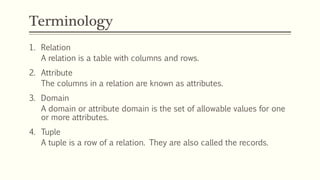
Terminology
1. Relation
A relation is a table with columns and rows.
2. Attribute
The columns in a relation are known as attributes.
3. Domain
A domain or attribute domain is the set of allowable values for one
or more attributes.
4. Tuple
A tuple is a row of a relation. They are also called the records.
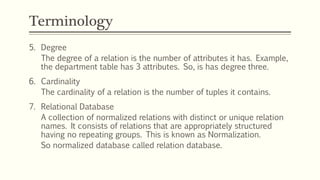
Terminology
5. Degree
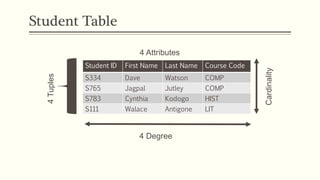
The degree of a relation is the number of attributes it has. Example,
the department table has 3 attributes. So, is has degree three.
6. Cardinality
The cardinality of a relation is the number of tuples it contains.
7. Relational Database
A collection of normalized relations with distinct or unique relation
names. It consists of relations that are appropriately structured
having no repeating groups. This is known as Normalization.
So normalized database called relation database.
Student Table
Student ID First Name Last Name Course Code
S334 Dave Watson COMP
S765 Jagpal Jutley COMP
S783 Cynthia Kodogo HIST
S111 Walace Antigone LIT
4Tuples
4 Degree
Cardinality
4 Attributes
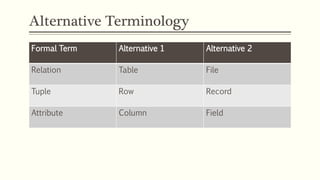
Alternative Terminology
Formal Term Alternative 1 Alternative 2
Relation Table File
Tuple Row Record
Attribute Column Field
Relational Keys
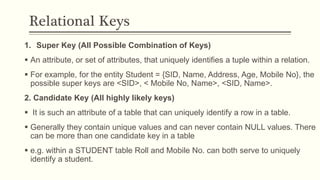
1. Super Key (All Possible Combination of Keys)
 An attribute, or set of attributes, that uniquely identifies a tuple within a relation.
 For example, for the entity Student = {SID, Name, Address, Age, Mobile No}, the
possible super keys are <SID>, < Mobile No, Name>, <SID, Name>.
2. Candidate Key (All highly likely keys)
 It is such an attribute of a table that can uniquely identify a row in a table.
 Generally they contain unique values and can never contain NULL values. There
can be more than one candidate key in a table
 e.g. within a STUDENT table Roll and Mobile No. can both serve to uniquely
identify a student.
Relational Keys
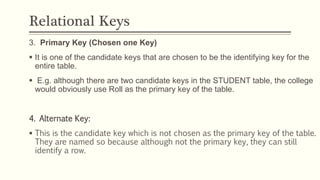
3. Primary Key (Chosen one Key)
 It is one of the candidate keys that are chosen to be the identifying key for the
entire table.
 E.g. although there are two candidate keys in the STUDENT table, the college
would obviously use Roll as the primary key of the table.
4. Alternate Key:
 This is the candidate key which is not chosen as the primary key of the table.
They are named so because although not the primary key, they can still
identify a row.
Relational Keys
5. Composite Key:
 Sometimes one key is not enough to uniquely identify a row. E.g. in a single
class Roll is enough to find a student, but in the entire school, merely
searching by the Roll is not enough, because there could be 10 classes in the
school and each one of them may contain a certain roll no 5.
 To uniquely identify the student we have to say something like “class VII, roll
no 5”. So, a combination of two or more attributes is combined to create a
unique combination of values, such as Class + Roll.
Relational Keys
6. Foreign Key:
 Sometimes we may have to work with an attribute that does not have a
primary key of its own.
 To identify its rows, we have to use the primary attribute of a related table.
Such a copy of another related table’s primary key is called foreign key.
Background to Relational Model
 Proposed by E.F. Codd in 1970 in his seminal paper “A relational
model of data for large shared data banks”
 In the relational model of a database, all data is represented in terms
of tuples, grouped into relations.
 A database organized in terms of the relational model is a relational
database.
 The purpose of the relational model is to provide a declarative
method for specifying data and queries : users directly state what
information they want from database and let the database
management system software take care of describing data structures
for storing the data.
RDBMS
 A relational database management system (RDBMS) is a database
management system (DBMS) that is based on the relational model as
introduced by E.F. Codd.
 Dominates the market in databases
 Many popular databases currently in use are based on the relational
database model. e.g. Oracle, MySQL, Microsoft SQL Server, etc.
 Second generation of DBMSs
 The first generation of database technology started in the 60's and
continued into the 70's.
Relational Model
 In the relational model, all data must be stored in relations (tables)
 Each relation consists of rows and columns.
 Each relation must have a header and body.
 The header is simply the list of columns in the relation.
 The body is the set of data that actually populates the relation,
organized into rows.
 You can extrapolate that the junction of one column and one row will
result in a unique value - this value is called a tuple.
Relational Model
 The another major characteristic of the relational model is the usage
of keys.
 These are specially designated columns within a relation, used to
order data or relate data to other relations.
 One of the most important keys is the primary key, which is used to
uniquely identify each row of data.
 To make querying for data easier, most relational databases go
further and physically order the data by the primary key.
 Foreign keys relate data in one relation to the primary key of another
relation.
Properties of a Relation
 It has a name which is unique within the relational schema. e.g.
department_name column should not contain values other than
department's name.
 Each cell of a relation contains exactly one value.
 Each attribute has a name.
 Each tuple is unique.
 The order of attributes is insignificant.
 The order of tuples is insignificant.
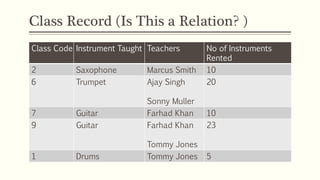
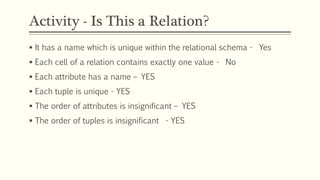
Class Record (Is This a Relation? )
Class Code Instrument Taught Teachers No of Instruments
Rented
2 Saxophone Marcus Smith 10
6 Trumpet Ajay Singh
Sonny Muller
20
7 Guitar Farhad Khan 10
9 Guitar Farhad Khan
Tommy Jones
23
1 Drums Tommy Jones 5
Activity - Is This a Relation?
 It has a name which is unique within the relational schema - Yes
 Each cell of a relation contains exactly one value - No
 Each attribute has a name – YES
 Each tuple is unique - YES
 The order of attributes is insignificant – YES
 The order of tuples is insignificant - YES
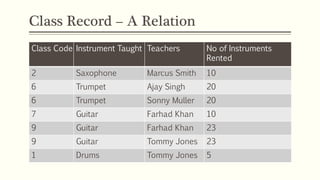
Class Record – A Relation
Class Code Instrument Taught Teachers No of Instruments
Rented
2 Saxophone Marcus Smith 10
6 Trumpet Ajay Singh 20
6 Trumpet Sonny Muller 20
7 Guitar Farhad Khan 10
9 Guitar Farhad Khan 23
9 Guitar Tommy Jones 23
1 Drums Tommy Jones 5
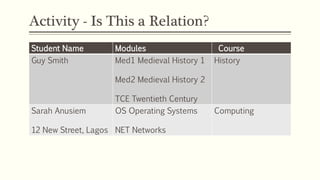
Activity - Is This a Relation?
Student Name Modules Course
Guy Smith Med1 Medieval History 1
Med2 Medieval History 2
TCE Twentieth Century
History
Sarah Anusiem
12 New Street, Lagos
OS Operating Systems
NET Networks
Computing
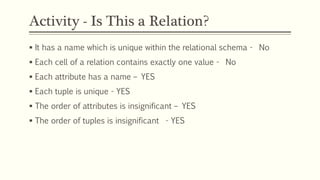
Activity - Is This a Relation?
 It has a name which is unique within the relational schema - No
 Each cell of a relation contains exactly one value - No
 Each attribute has a name – YES
 Each tuple is unique - YES
 The order of attributes is insignificant – YES
 The order of tuples is insignificant - YES
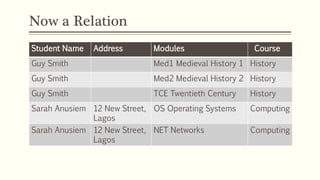
Now a Relation
Student Name Address Modules Course
Guy Smith Med1 Medieval History 1 History
Guy Smith Med2 Medieval History 2 History
Guy Smith TCE Twentieth Century History
Sarah Anusiem 12 New Street,
Lagos
OS Operating Systems Computing
Sarah Anusiem 12 New Street,
Lagos
NET Networks Computing
Problem in Previous Solution
 There are a lot of repetition for example the name, address and
course.
 In order to overcome the problem of repetition, the relation is split.
This should result in reducing repletion to a minimum.
 Only certain attributes are repeated and these are foreign keys that
are linking the data in one relation with the data in another.
Normalization
 This process of moving from data that is not in a relational form, to a
relation is known as normalization.
 It is the process of organizing data to minimize redundancy.
 In normalization, we divide the database table in two or more tables
and create a relationship between them.
Relational Integrity Constraints
 Relational integrity constraints are used to ensure accuracy and
consistency of data in a relational database.
 It refers to the different rules that exist within the model to make sure
that it is made of relations.
 Types
1. Null integrity
2. Entity integrity
3. Referential integrity
4. General constraints
1. Null Integrity
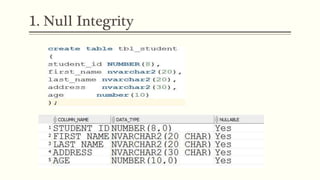
 A Null rule is a rule defined on a column that allows or disallows a
null (the absence of a value) in that column.
 Nulls represent values of an attribute that are unknown. Note that this
does NOT mean blank or zero.
 Since null means unknown, it is NOT possible to say that an attribute
with a value of null is equal to another attribute with a value of null.
1. Null Integrity
1. Null Integrity
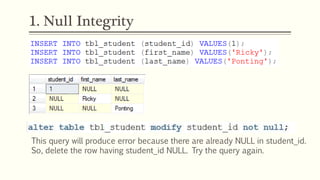
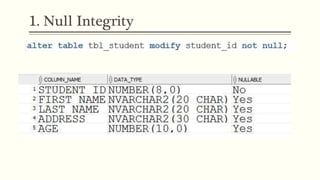
This query will produce error because there are already NULL in student_id.
So, delete the row having student_id NULL. Try the query again.
1. Null Integrity
2. Entity Integrity
 This rule is about making sure that each tuple (or row) in a relation is
unique.
 Entity integrity is an integrity rule which states that every table must
have a primary key and that the column or columns chosen to be the
primary key should be unique and not null.
 Why an attribute that is a primary key cannot not be null? Why would
this potentially violate uniqueness?
 Answer: A null value, being unknown, might be the same as the value
in the primary key of another tuple.
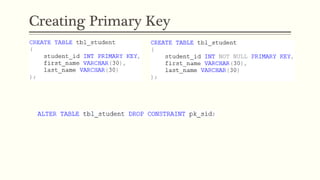
Creating Primary Key
3. Referential Integrity
 The referential integrity constraint is specified between two relations
and is used to maintain the consistency among tuples in the two
relations.
 Referential integrity means if a foreign key is pointing to a record in
another table, then that record must exist.
 If the foreign key points to a record that doesn't exist, referential
integrity is broken.
 It also includes the techniques known as cascading update and
cascading delete, which ensure that changes made to the linked table
are reflected in the primary table.
4. General Constraints (Business Rules )
 Customized rules specified by the users or database administrators.
 It is also called as a business rule which is a statement that defines or
constrains some aspect of the business. It is intended to control the
behavior of the business.
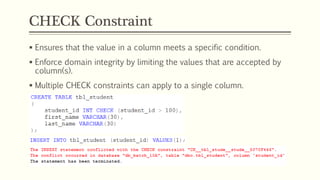
 E.g.: age>=18 && age<=60
 It is implemented using CHECK Constraint.
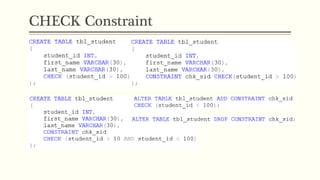
CHECK Constraint
 Ensures that the value in a column meets a specific condition.
 Enforce domain integrity by limiting the values that are accepted by
column(s).
 Multiple CHECK constraints can apply to a single column.
CHECK Constraint
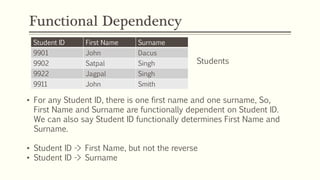
Functional Dependency
Student ID First Name Surname
9901 John Dacus
9902 Satpal Singh
9922 Jagpal Singh
9911 John Smith
Students
• For any Student ID, there is one first name and one surname, So,
First Name and Surname are functionally dependent on Student ID.
We can also say Student ID functionally determines First Name and
Surname.
• Student ID -> First Name, but not the reverse
• Student ID -> Surname
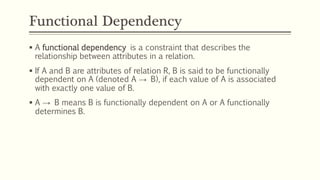
Functional Dependency
 A functional dependency is a constraint that describes the
relationship between attributes in a relation.
 If A and B are attributes of relation R, B is said to be functionally
dependent on A (denoted A → B), if each value of A is associated
with exactly one value of B.
 A → B means B is functionally dependent on A or A functionally
determines B.
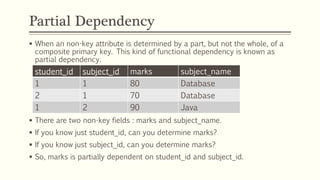
Partial Dependency
 When an non-key attribute is determined by a part, but not the whole, of a
composite primary key. This kind of functional dependency is known as
partial dependency.
 There are two non-key fields : marks and subject_name.
 If you know just student_id, can you determine marks?
 If you know just subject_id, can you determine marks?
 So, marks is partially dependent on student_id and subject_id.
student_id subject_id marks subject_name
1 1 80 Database
2 1 70 Database
1 2 90 Java
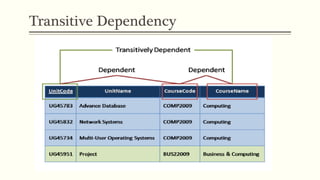
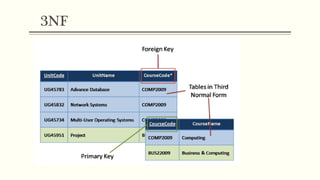
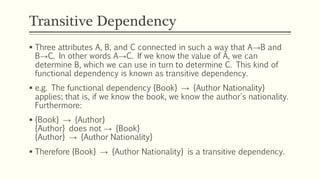
Transitive Dependency
 Three attributes A, B, and C connected in such a way that A→B and
B→C. In other words A→C. If we know the value of A, we can
determine B, which we can use in turn to determine C. This kind of
functional dependency is known as transitive dependency.
 e.g. The functional dependency {Book} → {Author Nationality}
applies; that is, if we know the book, we know the author's nationality.
Furthermore:
 {Book} → {Author}
{Author} does not → {Book}
{Author} → {Author Nationality}
 Therefore {Book} → {Author Nationality} is a transitive dependency.
Transitive Dependency
3NF
Anomalies
1. Insert Anomalies
2. Update Anomalies
3. Delete Anomalies
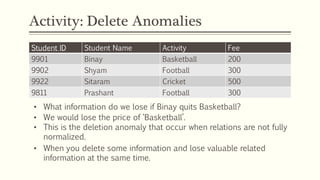
Activity: Delete Anomalies
Student ID Student Name Activity Fee
9901 Binay Basketball 200
9902 Shyam Football 300
9922 Sitaram Cricket 500
9811 Prashant Football 300
• What information do we lose if Binay quits Basketball?
• We would lose the price of ‘Basketball’.
• This is the deletion anomaly that occur when relations are not fully
normalized.
• When you delete some information and lose valuable related
information at the same time.
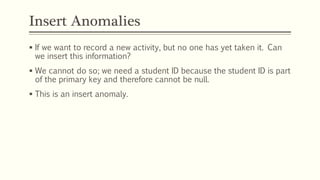
Insert Anomalies
 If we want to record a new activity, but no one has yet taken it. Can
we insert this information?
 We cannot do so; we need a student ID because the student ID is part
of the primary key and therefore cannot be null.
 This is an insert anomaly.
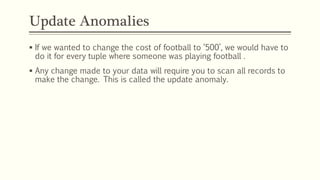
Update Anomalies
 If we wanted to change the cost of football to ‘500’, we would have to
do it for every tuple where someone was playing football .
 Any change made to your data will require you to scan all records to
make the change. This is called the update anomaly.
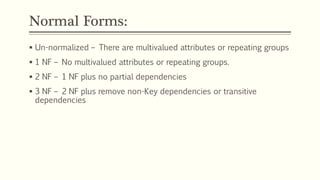
Normal Forms:
 Un-normalized – There are multivalued attributes or repeating groups
 1 NF – No multivalued attributes or repeating groups.
 2 NF – 1 NF plus no partial dependencies
 3 NF – 2 NF plus remove non-Key dependencies or transitive
dependencies
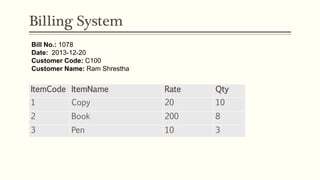
Billing System
Bill No.: 1078
Date: 2013-12-20
Customer Code: C100
Customer Name: Ram Shrestha
ItemCode ItemName Rate Qty
1 Copy 20 10
2 Book 200 8
3 Pen 10 3
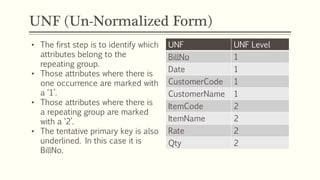
UNF (Un-Normalized Form)
• The first step is to identify which
attributes belong to the
repeating group.
• Those attributes where there is
one occurrence are marked with
a ‘1’.
• Those attributes where there is
a repeating group are marked
with a ‘2’.
• The tentative primary key is also
underlined. In this case it is
BillNo.
UNF UNF Level
BillNo 1
Date 1
CustomerCode 1
CustomerName 1
ItemCode 2
ItemName 2
Rate 2
Qty 2
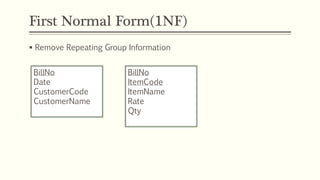
First Normal Form(1NF)
 Remove Repeating Group Information
BillNo
Date
CustomerCode
CustomerName
BillNo
ItemCode
ItemName
Rate
Qty
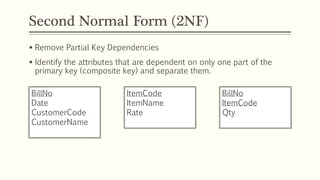
Second Normal Form (2NF)
 Remove Partial Key Dependencies
 Identify the attributes that are dependent on only one part of the
primary key (composite key) and separate them.
BillNo
Date
CustomerCode
CustomerName
BillNo
ItemCode
Qty
ItemCode
ItemName
Rate
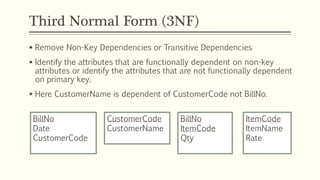
Third Normal Form (3NF)
 Remove Non-Key Dependencies or Transitive Dependencies
 Identify the attributes that are functionally dependent on non-key
attributes or identify the attributes that are not functionally dependent
on primary key.
 Here CustomerName is dependent of CustomerCode not BillNo.
BillNo
Date
CustomerCode
BillNo
ItemCode
Qty
ItemCode
ItemName
Rate
CustomerCode
CustomerName
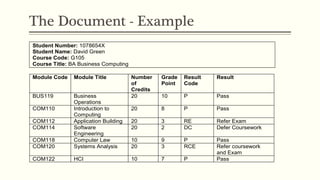
The Document - Example
Student Number: 1078654X
Student Name: David Green
Course Code: G105
Course Title: BA Business Computing
Module Code Module Title Number
of
Credits
Grade
Point
Result
Code
Result
BUS119 Business
Operations
20 10 P Pass
COM110 Introduction to
Computing
20 8 P Pass
COM112 Application Building 20 3 RE Refer Exam
COM114 Software
Engineering
20 2 DC Defer Coursework
COM118 Computer Law 10 9 P Pass
COM120 Systems Analysis 20 3 RCE Refer coursework
and Exam
COM122 HCI 10 7 P Pass
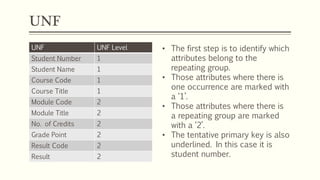
UNF
• The first step is to identify which
attributes belong to the
repeating group.
• Those attributes where there is
one occurrence are marked with
a ‘1’.
• Those attributes where there is
a repeating group are marked
with a ‘2’.
• The tentative primary key is also
underlined. In this case it is
student number.
UNF UNF Level
Student Number 1
Student Name 1
Course Code 1
Course Title 1
Module Code 2
Module Title 2
No. of Credits 2
Grade Point 2
Result Code 2
Result 2
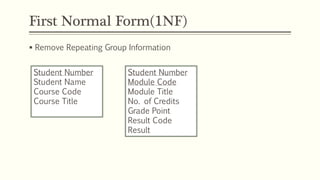
First Normal Form(1NF)
 Remove Repeating Group Information
Student Number
Student Name
Course Code
Course Title
Student Number
Module Code
Module Title
No. of Credits
Grade Point
Result Code
Result
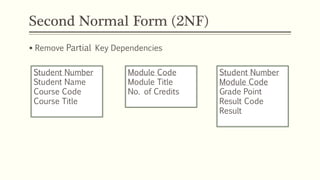
Second Normal Form (2NF)
 Remove Partial Key Dependencies
Student Number
Student Name
Course Code
Course Title
Module Code
Module Title
No. of Credits
Student Number
Module Code
Grade Point
Result Code
Result
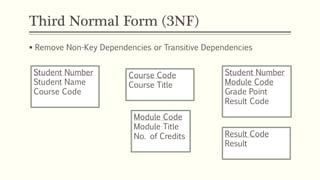
Third Normal Form (3NF)
 Remove Non-Key Dependencies or Transitive Dependencies
Student Number
Student Name
Course Code
Module Code
Module Title
No. of Credits
Student Number
Module Code
Grade Point
Result Code
Course Code
Course Title
Result Code
Result
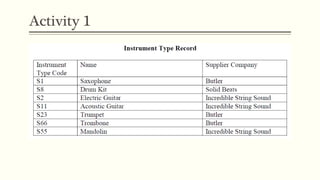
Activity 1
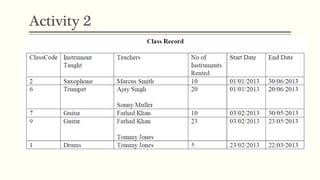
Activity 2
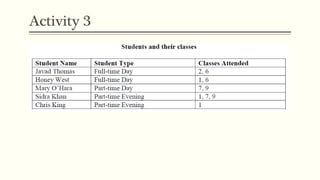
Activity 3
History – Practical Developments - 1
 System R. Developed by IBM's San Jose laboratory in late 1970s and
involved some of the key people in the early development of
databases, such as Codd and Boyce.
 System R was the first implementation of SQL.
 Development of commercial database systems DB2; SQL/DS; Oracle
 Other aspects are transaction management, concurrency control,
recovery techniques, query optimization, data security, data integrity,
user interfaces.
 It was also the first system to demonstrate that a relational database
management system could provide good transaction processing
performance.
History – Practical Developments - 2
 INGRES. Developed by University of California in late 1970s
 INGRES stands for Interactive Graphics Retrieval System.
 It was used to investigate the concepts of the relational model.
 It is a commercially supported, open-source SQL relational database
management system.
 Ingres spawned a number of commercial database applications,
including Sybase, Microsoft SQL Server.
 Postgres (Post Ingres), a project which started in the mid-1980s, later
evolved into PostgreSQL.
History - Practical Developments - 3
 Peterlee Relational Test Vehicle(PRTV). Developed at IBM UK in 1976
 It was the first relational database to be able to handle large volumes
of data in term of both rows and columns.
 It was a relational query system with powerful query facilities, but very
limited update facility and no simultaneous multiuser facility.
ANY QUESTIONS?
References
 http://rdbms.opengrass.net/2_Database%20Design/2.2_Normalisati
on/2.2.4_1NF%20Repeating%20Attributes.html
 http://rdbms.opengrass.net/2_Database%20Design/2.2_Normalisati
on/2.2.5_2NF-Partial%20Dependancy.html
 http://rdbms.opengrass.net/2_Database%20Design/2.2_Normalisati
on/2.2.6_3NF-Transitive%20Dependency.html
 http://en.wikipedia.org/wiki/Integrity_constraints
 http://www.jkinfoline.com/functional-dependency.html
 http://jcsites.juniata.edu/faculty/rhodes/dbms/funcdep.htm

The Relational Model

  • 1.
    Er. Nawaraj Bhandari Topic5 & 6 The Relational Model
  • 2.
    Do not confuserelations with relationships in ER models
  • 3.
    Terminology 1. Relation A relationis a table with columns and rows. 2. Attribute The columns in a relation are known as attributes. 3. Domain A domain or attribute domain is the set of allowable values for one or more attributes. 4. Tuple A tuple is a row of a relation. They are also called the records.
  • 4.
    Terminology 5. Degree The degreeof a relation is the number of attributes it has. Example, the department table has 3 attributes. So, is has degree three. 6. Cardinality The cardinality of a relation is the number of tuples it contains. 7. Relational Database A collection of normalized relations with distinct or unique relation names. It consists of relations that are appropriately structured having no repeating groups. This is known as Normalization. So normalized database called relation database.
  • 5.
    Student Table Student IDFirst Name Last Name Course Code S334 Dave Watson COMP S765 Jagpal Jutley COMP S783 Cynthia Kodogo HIST S111 Walace Antigone LIT 4Tuples 4 Degree Cardinality 4 Attributes
  • 6.
    Alternative Terminology Formal TermAlternative 1 Alternative 2 Relation Table File Tuple Row Record Attribute Column Field
  • 7.
    Relational Keys 1. SuperKey (All Possible Combination of Keys)  An attribute, or set of attributes, that uniquely identifies a tuple within a relation.  For example, for the entity Student = {SID, Name, Address, Age, Mobile No}, the possible super keys are <SID>, < Mobile No, Name>, <SID, Name>. 2. Candidate Key (All highly likely keys)  It is such an attribute of a table that can uniquely identify a row in a table.  Generally they contain unique values and can never contain NULL values. There can be more than one candidate key in a table  e.g. within a STUDENT table Roll and Mobile No. can both serve to uniquely identify a student.
  • 8.
    Relational Keys 3. PrimaryKey (Chosen one Key)  It is one of the candidate keys that are chosen to be the identifying key for the entire table.  E.g. although there are two candidate keys in the STUDENT table, the college would obviously use Roll as the primary key of the table. 4. Alternate Key:  This is the candidate key which is not chosen as the primary key of the table. They are named so because although not the primary key, they can still identify a row.
  • 9.
    Relational Keys 5. CompositeKey:  Sometimes one key is not enough to uniquely identify a row. E.g. in a single class Roll is enough to find a student, but in the entire school, merely searching by the Roll is not enough, because there could be 10 classes in the school and each one of them may contain a certain roll no 5.  To uniquely identify the student we have to say something like “class VII, roll no 5”. So, a combination of two or more attributes is combined to create a unique combination of values, such as Class + Roll.
  • 10.
    Relational Keys 6. ForeignKey:  Sometimes we may have to work with an attribute that does not have a primary key of its own.  To identify its rows, we have to use the primary attribute of a related table. Such a copy of another related table’s primary key is called foreign key.
  • 11.
    Background to RelationalModel  Proposed by E.F. Codd in 1970 in his seminal paper “A relational model of data for large shared data banks”  In the relational model of a database, all data is represented in terms of tuples, grouped into relations.  A database organized in terms of the relational model is a relational database.  The purpose of the relational model is to provide a declarative method for specifying data and queries : users directly state what information they want from database and let the database management system software take care of describing data structures for storing the data.
  • 12.
    RDBMS  A relationaldatabase management system (RDBMS) is a database management system (DBMS) that is based on the relational model as introduced by E.F. Codd.  Dominates the market in databases  Many popular databases currently in use are based on the relational database model. e.g. Oracle, MySQL, Microsoft SQL Server, etc.  Second generation of DBMSs  The first generation of database technology started in the 60's and continued into the 70's.
  • 13.
    Relational Model  Inthe relational model, all data must be stored in relations (tables)  Each relation consists of rows and columns.  Each relation must have a header and body.  The header is simply the list of columns in the relation.  The body is the set of data that actually populates the relation, organized into rows.  You can extrapolate that the junction of one column and one row will result in a unique value - this value is called a tuple.
  • 14.
    Relational Model  Theanother major characteristic of the relational model is the usage of keys.  These are specially designated columns within a relation, used to order data or relate data to other relations.  One of the most important keys is the primary key, which is used to uniquely identify each row of data.  To make querying for data easier, most relational databases go further and physically order the data by the primary key.  Foreign keys relate data in one relation to the primary key of another relation.
  • 15.
    Properties of aRelation  It has a name which is unique within the relational schema. e.g. department_name column should not contain values other than department's name.  Each cell of a relation contains exactly one value.  Each attribute has a name.  Each tuple is unique.  The order of attributes is insignificant.  The order of tuples is insignificant.
  • 16.
    Class Record (IsThis a Relation? ) Class Code Instrument Taught Teachers No of Instruments Rented 2 Saxophone Marcus Smith 10 6 Trumpet Ajay Singh Sonny Muller 20 7 Guitar Farhad Khan 10 9 Guitar Farhad Khan Tommy Jones 23 1 Drums Tommy Jones 5
  • 17.
    Activity - IsThis a Relation?  It has a name which is unique within the relational schema - Yes  Each cell of a relation contains exactly one value - No  Each attribute has a name – YES  Each tuple is unique - YES  The order of attributes is insignificant – YES  The order of tuples is insignificant - YES
  • 18.
    Class Record –A Relation Class Code Instrument Taught Teachers No of Instruments Rented 2 Saxophone Marcus Smith 10 6 Trumpet Ajay Singh 20 6 Trumpet Sonny Muller 20 7 Guitar Farhad Khan 10 9 Guitar Farhad Khan 23 9 Guitar Tommy Jones 23 1 Drums Tommy Jones 5
  • 19.
    Activity - IsThis a Relation? Student Name Modules Course Guy Smith Med1 Medieval History 1 Med2 Medieval History 2 TCE Twentieth Century History Sarah Anusiem 12 New Street, Lagos OS Operating Systems NET Networks Computing
  • 20.
    Activity - IsThis a Relation?  It has a name which is unique within the relational schema - No  Each cell of a relation contains exactly one value - No  Each attribute has a name – YES  Each tuple is unique - YES  The order of attributes is insignificant – YES  The order of tuples is insignificant - YES
  • 21.
    Now a Relation StudentName Address Modules Course Guy Smith Med1 Medieval History 1 History Guy Smith Med2 Medieval History 2 History Guy Smith TCE Twentieth Century History Sarah Anusiem 12 New Street, Lagos OS Operating Systems Computing Sarah Anusiem 12 New Street, Lagos NET Networks Computing
  • 22.
    Problem in PreviousSolution  There are a lot of repetition for example the name, address and course.  In order to overcome the problem of repetition, the relation is split. This should result in reducing repletion to a minimum.  Only certain attributes are repeated and these are foreign keys that are linking the data in one relation with the data in another.
  • 23.
    Normalization  This processof moving from data that is not in a relational form, to a relation is known as normalization.  It is the process of organizing data to minimize redundancy.  In normalization, we divide the database table in two or more tables and create a relationship between them.
  • 24.
    Relational Integrity Constraints Relational integrity constraints are used to ensure accuracy and consistency of data in a relational database.  It refers to the different rules that exist within the model to make sure that it is made of relations.  Types 1. Null integrity 2. Entity integrity 3. Referential integrity 4. General constraints
  • 25.
    1. Null Integrity A Null rule is a rule defined on a column that allows or disallows a null (the absence of a value) in that column.  Nulls represent values of an attribute that are unknown. Note that this does NOT mean blank or zero.  Since null means unknown, it is NOT possible to say that an attribute with a value of null is equal to another attribute with a value of null.
  • 26.
  • 27.
    1. Null Integrity Thisquery will produce error because there are already NULL in student_id. So, delete the row having student_id NULL. Try the query again.
  • 28.
  • 29.
    2. Entity Integrity This rule is about making sure that each tuple (or row) in a relation is unique.  Entity integrity is an integrity rule which states that every table must have a primary key and that the column or columns chosen to be the primary key should be unique and not null.  Why an attribute that is a primary key cannot not be null? Why would this potentially violate uniqueness?  Answer: A null value, being unknown, might be the same as the value in the primary key of another tuple.
  • 30.
  • 31.
    3. Referential Integrity The referential integrity constraint is specified between two relations and is used to maintain the consistency among tuples in the two relations.  Referential integrity means if a foreign key is pointing to a record in another table, then that record must exist.  If the foreign key points to a record that doesn't exist, referential integrity is broken.  It also includes the techniques known as cascading update and cascading delete, which ensure that changes made to the linked table are reflected in the primary table.
  • 32.
    4. General Constraints(Business Rules )  Customized rules specified by the users or database administrators.  It is also called as a business rule which is a statement that defines or constrains some aspect of the business. It is intended to control the behavior of the business.  E.g.: age>=18 && age<=60  It is implemented using CHECK Constraint.
  • 33.
    CHECK Constraint  Ensuresthat the value in a column meets a specific condition.  Enforce domain integrity by limiting the values that are accepted by column(s).  Multiple CHECK constraints can apply to a single column.
  • 34.
  • 35.
    Functional Dependency Student IDFirst Name Surname 9901 John Dacus 9902 Satpal Singh 9922 Jagpal Singh 9911 John Smith Students • For any Student ID, there is one first name and one surname, So, First Name and Surname are functionally dependent on Student ID. We can also say Student ID functionally determines First Name and Surname. • Student ID -> First Name, but not the reverse • Student ID -> Surname
  • 36.
    Functional Dependency  Afunctional dependency is a constraint that describes the relationship between attributes in a relation.  If A and B are attributes of relation R, B is said to be functionally dependent on A (denoted A → B), if each value of A is associated with exactly one value of B.  A → B means B is functionally dependent on A or A functionally determines B.
  • 37.
    Partial Dependency  Whenan non-key attribute is determined by a part, but not the whole, of a composite primary key. This kind of functional dependency is known as partial dependency.  There are two non-key fields : marks and subject_name.  If you know just student_id, can you determine marks?  If you know just subject_id, can you determine marks?  So, marks is partially dependent on student_id and subject_id. student_id subject_id marks subject_name 1 1 80 Database 2 1 70 Database 1 2 90 Java
  • 38.
    Transitive Dependency  Threeattributes A, B, and C connected in such a way that A→B and B→C. In other words A→C. If we know the value of A, we can determine B, which we can use in turn to determine C. This kind of functional dependency is known as transitive dependency.  e.g. The functional dependency {Book} → {Author Nationality} applies; that is, if we know the book, we know the author's nationality. Furthermore:  {Book} → {Author} {Author} does not → {Book} {Author} → {Author Nationality}  Therefore {Book} → {Author Nationality} is a transitive dependency.
  • 39.
  • 40.
  • 41.
    Anomalies 1. Insert Anomalies 2.Update Anomalies 3. Delete Anomalies
  • 42.
    Activity: Delete Anomalies StudentID Student Name Activity Fee 9901 Binay Basketball 200 9902 Shyam Football 300 9922 Sitaram Cricket 500 9811 Prashant Football 300 • What information do we lose if Binay quits Basketball? • We would lose the price of ‘Basketball’. • This is the deletion anomaly that occur when relations are not fully normalized. • When you delete some information and lose valuable related information at the same time.
  • 43.
    Insert Anomalies  Ifwe want to record a new activity, but no one has yet taken it. Can we insert this information?  We cannot do so; we need a student ID because the student ID is part of the primary key and therefore cannot be null.  This is an insert anomaly.
  • 44.
    Update Anomalies  Ifwe wanted to change the cost of football to ‘500’, we would have to do it for every tuple where someone was playing football .  Any change made to your data will require you to scan all records to make the change. This is called the update anomaly.
  • 45.
    Normal Forms:  Un-normalized– There are multivalued attributes or repeating groups  1 NF – No multivalued attributes or repeating groups.  2 NF – 1 NF plus no partial dependencies  3 NF – 2 NF plus remove non-Key dependencies or transitive dependencies
  • 46.
    Billing System Bill No.:1078 Date: 2013-12-20 Customer Code: C100 Customer Name: Ram Shrestha ItemCode ItemName Rate Qty 1 Copy 20 10 2 Book 200 8 3 Pen 10 3
  • 47.
    UNF (Un-Normalized Form) •The first step is to identify which attributes belong to the repeating group. • Those attributes where there is one occurrence are marked with a ‘1’. • Those attributes where there is a repeating group are marked with a ‘2’. • The tentative primary key is also underlined. In this case it is BillNo. UNF UNF Level BillNo 1 Date 1 CustomerCode 1 CustomerName 1 ItemCode 2 ItemName 2 Rate 2 Qty 2
  • 48.
    First Normal Form(1NF) Remove Repeating Group Information BillNo Date CustomerCode CustomerName BillNo ItemCode ItemName Rate Qty
  • 49.
    Second Normal Form(2NF)  Remove Partial Key Dependencies  Identify the attributes that are dependent on only one part of the primary key (composite key) and separate them. BillNo Date CustomerCode CustomerName BillNo ItemCode Qty ItemCode ItemName Rate
  • 50.
    Third Normal Form(3NF)  Remove Non-Key Dependencies or Transitive Dependencies  Identify the attributes that are functionally dependent on non-key attributes or identify the attributes that are not functionally dependent on primary key.  Here CustomerName is dependent of CustomerCode not BillNo. BillNo Date CustomerCode BillNo ItemCode Qty ItemCode ItemName Rate CustomerCode CustomerName
  • 51.
    The Document -Example Student Number: 1078654X Student Name: David Green Course Code: G105 Course Title: BA Business Computing Module Code Module Title Number of Credits Grade Point Result Code Result BUS119 Business Operations 20 10 P Pass COM110 Introduction to Computing 20 8 P Pass COM112 Application Building 20 3 RE Refer Exam COM114 Software Engineering 20 2 DC Defer Coursework COM118 Computer Law 10 9 P Pass COM120 Systems Analysis 20 3 RCE Refer coursework and Exam COM122 HCI 10 7 P Pass
  • 52.
    UNF • The firststep is to identify which attributes belong to the repeating group. • Those attributes where there is one occurrence are marked with a ‘1’. • Those attributes where there is a repeating group are marked with a ‘2’. • The tentative primary key is also underlined. In this case it is student number. UNF UNF Level Student Number 1 Student Name 1 Course Code 1 Course Title 1 Module Code 2 Module Title 2 No. of Credits 2 Grade Point 2 Result Code 2 Result 2
  • 53.
    First Normal Form(1NF) Remove Repeating Group Information Student Number Student Name Course Code Course Title Student Number Module Code Module Title No. of Credits Grade Point Result Code Result
  • 54.
    Second Normal Form(2NF)  Remove Partial Key Dependencies Student Number Student Name Course Code Course Title Module Code Module Title No. of Credits Student Number Module Code Grade Point Result Code Result
  • 55.
    Third Normal Form(3NF)  Remove Non-Key Dependencies or Transitive Dependencies Student Number Student Name Course Code Module Code Module Title No. of Credits Student Number Module Code Grade Point Result Code Course Code Course Title Result Code Result
  • 56.
  • 57.
  • 58.
  • 59.
    History – PracticalDevelopments - 1  System R. Developed by IBM's San Jose laboratory in late 1970s and involved some of the key people in the early development of databases, such as Codd and Boyce.  System R was the first implementation of SQL.  Development of commercial database systems DB2; SQL/DS; Oracle  Other aspects are transaction management, concurrency control, recovery techniques, query optimization, data security, data integrity, user interfaces.  It was also the first system to demonstrate that a relational database management system could provide good transaction processing performance.
  • 60.
    History – PracticalDevelopments - 2  INGRES. Developed by University of California in late 1970s  INGRES stands for Interactive Graphics Retrieval System.  It was used to investigate the concepts of the relational model.  It is a commercially supported, open-source SQL relational database management system.  Ingres spawned a number of commercial database applications, including Sybase, Microsoft SQL Server.  Postgres (Post Ingres), a project which started in the mid-1980s, later evolved into PostgreSQL.
  • 61.
    History - PracticalDevelopments - 3  Peterlee Relational Test Vehicle(PRTV). Developed at IBM UK in 1976  It was the first relational database to be able to handle large volumes of data in term of both rows and columns.  It was a relational query system with powerful query facilities, but very limited update facility and no simultaneous multiuser facility.
  • 62.
  • 63.
    References  http://rdbms.opengrass.net/2_Database%20Design/2.2_Normalisati on/2.2.4_1NF%20Repeating%20Attributes.html  http://rdbms.opengrass.net/2_Database%20Design/2.2_Normalisati on/2.2.5_2NF-Partial%20Dependancy.html http://rdbms.opengrass.net/2_Database%20Design/2.2_Normalisati on/2.2.6_3NF-Transitive%20Dependency.html  http://en.wikipedia.org/wiki/Integrity_constraints  http://www.jkinfoline.com/functional-dependency.html  http://jcsites.juniata.edu/faculty/rhodes/dbms/funcdep.htm

Editor's Notes

  • #2 Best Example Link for ER Modelling: http://www.tutorialspoint.com/dbms/er_model_basic_concepts.htm
  • #13 https://www.ibm.com/developerworks/community/blogs/fredho66/entry/the_3rd_generation_of_database_technology_part_i52?lang=en
  • #14 http://www.techopedia.com/definition/24559/relational-model-database
  • #15 http://www.techopedia.com/definition/24559/relational-model-database
  • #24 Redundancy: Unnecessary duplication of data in database.
  • #39 A → B means A functionally determines B.
  • #40 A → B means A functionally determines B.
  • #41 A → B means A functionally determines B.
  • #42 Anomalies: Deviation or departure from the normal or common order, form, or rule. One that is peculiar, irregular, abnormal, or difficult to classify.
  • #60 They used to play something called the 'Query Game' to workout how to express queries as simply as possible. This led to the development of SQL. There were also commercial implementations of System R and commercial spin-offs.