School of Computing
Science and Engineering
Program: B.TECH
Course Code:E2UC302B
Course Name: Database Management
System
Recommended Books
Text books
 Abraham Silberschatz, Henry F. Korth and S. Sudarshan- “Database System
Concepts”, Fourth Edition, McGraw-Hill, 2002.
Reference Book
 Ramez Elmasri and Shamkant B. Navathe, “Fundamental Database Systems”,
Third Edition, Pearson Education, 2003.
 Raghu Ramakrishnan, “Database Management System”, Tata McGraw- Hill
Publishing Company, 2003.
 Hector Garcia–Molina, Jeffrey D.Ullman and Jennifer Widom- “Database System
Implementation”- Pearson Education- 2000
 Peter Rob and Corlos Coronel- “Database System, Design, Implementation and
Management”, Thompson Learning Course Technology- Fifth edition, 2003
Additional online materials
 Coursera - https://www.coursera.org/learn/database-management
 NPTEL- https://nptel.ac.in/courses/106/105/106105175/
 https://www.coursera.org/learn/research-methods
 https://www.coursera.org/browse/physical-science-and-engineering/research-
methods
Program Name: B.TECH Program Code: E2UC302B
School of Computing Science and Engineering
Course Code :E2UC302B Course Name: DBMS
Functional Dependency
Program Name: B.TECH Program Code: E2UC302B
School of Computing Science and Engineering
Course Code :E2UC302B Course Name: DBMS
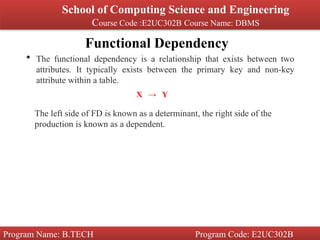
 The functional dependency is a relationship that exists between two
attributes. It typically exists between the primary key and non-key
attribute within a table.
X → Y
The left side of FD is known as a determinant, the right side of the
production is known as a dependent.
Functional Dependency: Example
Program Name: B.TECH Program Code: E2UC302B
School of Computing Science and Engineering
Course Code :E2UC302B Course Name: DBMS
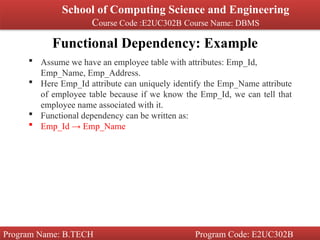
 Assume we have an employee table with attributes: Emp_Id,
Emp_Name, Emp_Address.
 Here Emp_Id attribute can uniquely identify the Emp_Name attribute
of employee table because if we know the Emp_Id, we can tell that
employee name associated with it.
 Functional dependency can be written as:
 Emp_Id → Emp_Name
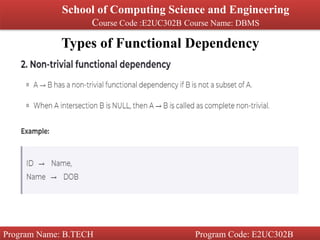
Types of Functional Dependency
Program Name: B.TECH Program Code: E2UC302B
School of Computing Science and Engineering
Course Code :E2UC302B Course Name: DBMS
Types of Functional Dependency
Program Name: B.TECH Program Code: E2UC302B
School of Computing Science and Engineering
Course Code :E2UC302B Course Name: DBMS
Inference Rule
Program Name: B.TECH Program Code: E2UC302B
School of Computing Science and Engineering
Course Code :E2UC302B Course Name: DBMS
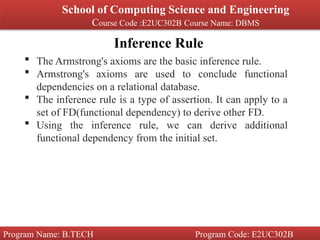
 The Armstrong's axioms are the basic inference rule.
 Armstrong's axioms are used to conclude functional
dependencies on a relational database.
 The inference rule is a type of assertion. It can apply to a
set of FD(functional dependency) to derive other FD.
 Using the inference rule, we can derive additional
functional dependency from the initial set.
Inference Rule
Program Name: B.TECH Program Code: E2UC302B
School of Computing Science and Engineering
Course Code :E2UC302B Course Name: DBMS
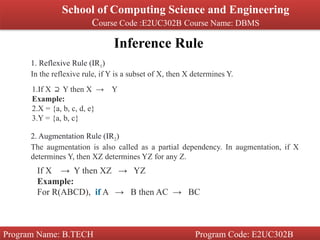
2. Augmentation Rule (IR2)
The augmentation is also called as a partial dependency. In augmentation, if X
determines Y, then XZ determines YZ for any Z.
1. Reflexive Rule (IR1)
In the reflexive rule, if Y is a subset of X, then X determines Y.
1.If X Y then X → Y
⊇
Example:
2.X = {a, b, c, d, e}
3.Y = {a, b, c}
If X → Y then XZ → YZ
Example:
For R(ABCD), if A → B then AC → BC
Inference Rule
Program Name: B.TECH Program Code: E2UC302B
School of Computing Science and Engineering
Course Code :E2UC302B Course Name: DBMS
3. Transitive Rule (IR3)
In the transitive rule, if X determines Y and Y determine Z, then X must
also determine Z.
1.If X → Y and Y → Z then X → Z
4. Union Rule (IR4)
Union rule says, if X determines Y and X determines Z, then X must also
determine Y and Z.
2.If X → Y and X → Z then X → YZ
1. X → Y (given)
2. X → Z (given)
3. X → XY (using IR2 on 1 by augmentation with X. Where XX = X)
4. XY → YZ (using IR2 on 2 by augmentation with Y)
5. X → YZ (using IR3 on 3 and 4)
Inference Rule
Program Name: B.TECH Program Code: E2UC302B
School of Computing Science and Engineering
Course Code :E2UC302B Course Name: DBMS
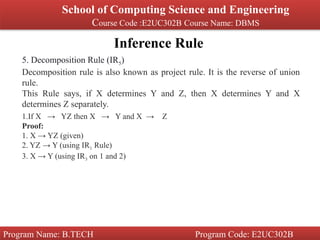
5. Decomposition Rule (IR5)
Decomposition rule is also known as project rule. It is the reverse of union
rule.
This Rule says, if X determines Y and Z, then X determines Y and X
determines Z separately.
1.If X → YZ then X → Y and X → Z
Proof:
1. X → YZ (given)
2. YZ → Y (using IR1 Rule)
3. X → Y (using IR3 on 1 and 2)
Inference Rule
Program Name: B.TECH Program Code: E2UC302B
School of Computing Science and Engineering
Course Code :E2UC302B Course Name: DBMS
6. Pseudo transitive Rule (IR6)
In Pseudo transitive Rule, if X determines Y and YZ determines W, then XZ
determines W.
1.If X → Y and YZ → W then XZ → W
Proof:
1. X → Y (given)
2. WY → Z (given)
3. WX → WY (using IR2 on 1 by augmenting with W)
4. WX → Z (using IR3 on 3 and 2)
Normalization
Program Name: B.TECH Program Code: E2UC302B
School of Computing Science and Engineering
Course Code :E2UC302B Course Name: DBMS
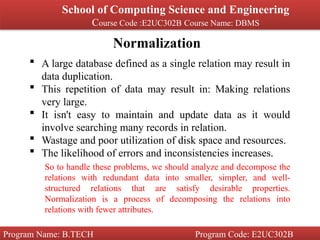
 A large database defined as a single relation may result in
data duplication.
 This repetition of data may result in: Making relations
very large.
 It isn't easy to maintain and update data as it would
involve searching many records in relation.
 Wastage and poor utilization of disk space and resources.
 The likelihood of errors and inconsistencies increases.
So to handle these problems, we should analyze and decompose the
relations with redundant data into smaller, simpler, and well-
structured relations that are satisfy desirable properties.
Normalization is a process of decomposing the relations into
relations with fewer attributes.
Program Name: B.TECH Program Code: E2UC302B
School of Computing Science and Engineering
Course Code :E2UC302B Course Name: DBMS
What is Normalization?
 Normalization is the process of organizing the data in the
database.
 Normalization is used to minimize the redundancy from a
relation or set of relations.
 It is also used to eliminate undesirable characteristics like
Insertion, Update, and Deletion Anomalies.
 Normalization divides the larger table into smaller and links
them using relationships.
 The normal form is used to reduce redundancy from the database
table.
Program Name: B.TECH Program Code: E2UC302B
School of Computing Science and Engineering
Course Code :E2UC302B Course Name: DBMS
Why do we need Normalization?
 The main reason for normalizing the relations is removing these
anomalies.
 Failure to eliminate anomalies leads to data redundancy and can
cause data integrity and other problems as the database grows.
Normalization consists of a series of guidelines that helps to
guide you in creating a good database structure.
Duration 18:10
Loaded: 6.97%
Program Name: B.TECH Program Code: E2UC302B
School of Computing Science and Engineering
Course Code :E2UC302B Course Name: DBMS
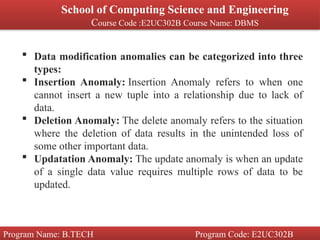
 Data modification anomalies can be categorized into three
types:
 Insertion Anomaly: Insertion Anomaly refers to when one
cannot insert a new tuple into a relationship due to lack of
data.
 Deletion Anomaly: The delete anomaly refers to the situation
where the deletion of data results in the unintended loss of
some other important data.
 Updatation Anomaly: The update anomaly is when an update
of a single data value requires multiple rows of data to be
updated.
Types of Normal Forms:
Program Name: B.TECH Program Code: E2UC302B
School of Computing Science and Engineering
Course Code :E2UC302B Course Name: DBMS
Types of Normal Form
School of Computing Science and Engineering
Course Code : E2UC302B Course Name: DBMS
Program Name: B.TECH Program Code: E2UC302B
School of Computing Science and Engineering
Course Code : E2UC302B Course Name: DBMS
Program Name: B.TECH Program Code: E2UC302B
 Advantages of Normalization
 Normalization helps to minimize data redundancy.
 Greater overall database organization.
 Data consistency within the database.
 Much more flexible database design.
 Enforces the concept of relational integrity.
 Disadvantages of Normalization
 You cannot start building the database before knowing what the user needs.
 The performance degrades when normalizing the relations to higher normal
forms, i.e., 4NF, 5NF.
 It is very time-consuming and difficult to normalize relations of a higher
degree.
 Careless decomposition may lead to a bad database design, leading to
serious problems.
First Normal Form
School of Computing Science and Engineering
Course Code : E2UC302B Course Name: DBMS
Program Name: B.TECH Program Code: E2UC302B
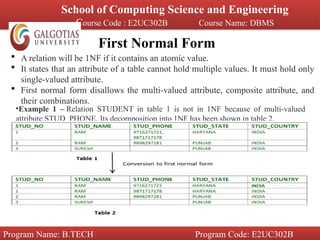
 A relation will be 1NF if it contains an atomic value.
 It states that an attribute of a table cannot hold multiple values. It must hold only
single-valued attribute.
 First normal form disallows the multi-valued attribute, composite attribute, and
their combinations.
•Example 1 – Relation STUDENT in table 1 is not in 1NF because of multi-valued
attribute STUD_PHONE. Its decomposition into 1NF has been shown in table 2.
First Normal Form
School of Computing Science and Engineering
Course Code : E2UC302B Course Name: DBMS
Program Name: B.TECH Program Code: E2UC302B
Second Normal Form
School of Computing Science and Engineering
Course Code : E2UC302B Course Name: DBMS
Program Name: B.TECH Program Code: E2UC302B
 In the 2NF, relational must be in 1NF.
 In the second normal form, all non-key attributes are fully functional dependent on the
primary key
 Example: Let's assume, a school can store the data of teachers and the subjects they
teach. In a school, a teacher can teach more than one subject.
School of Computing Science and Engineering
Course Code : E2UC302B Course Name: DBMS
Program Name: B.TECH Program Code: E2UC302B
Third Normal Form
School of Computing Science and Engineering
Course Code : E2UC302B Course Name: DBMS
Program Name: B.TECH Program Code: E2UC302B
 A relation will be in 3NF if it is in 2NF and not contain any transitive
partial dependency.
 3NF is used to reduce the data duplication. It is also used to achieve the
data integrity.
 If there is no transitive dependency for non-prime attributes, then the
relation must be in third normal form.
 A relation is in third normal form if it holds atleast one of the following
conditions for every non-trivial function dependency X → Y.
 X is a super key.
 Y is a prime attribute, i.e., each element of Y is part of some candidate
key.
School of Computing Science and Engineering
Course Code : E2UC302B Course Name: DBMS
Program Name: B.TECH Program Code: E2UC302B
Super key in the table above:
1.{EMP_ID}, {EMP_ID, EMP_NAME}, {EMP_ID, EMP_NAME, EMP_ZIP}....so on
Candidate key: {EMP_ID}
Non-prime attributes: In the given table, all attributes except EMP_ID are non-prime.
 Here, EMP_STATE & EMP_CITY dependent on EMP_ZIP and EMP_ZIP dependent on
EMP_ID. The non-prime attributes (EMP_STATE, EMP_CITY) transitively dependent on super
key(EMP_ID). It violates the rule of third normal form.
 That's why we need to move the EMP_CITY and EMP_STATE to the new <EMPLOYEE_ZIP>
table, with EMP_ZIP as a Primary key.
School of Computing Science and Engineering
Course Code : E2UC302B Course Name: DBMS
Program Name: B.TECH Program Code: E2UC302B
BCNF
School of Computing Science and Engineering
Course Code : E2UC302B Course Name: DBMS
Program Name: B.TECH Program Code: E2UC302B
 Boyce Codd normal form (BCNF)
 BCNF is the advance version of 3NF. It is stricter than 3NF.
 A table is in BCNF if every functional dependency X → Y, X is the
super key of the table.
 For BCNF, the table should be in 3NF, and for every FD, LHS is super
key.
 Example: Let's assume there is a company where employees work in
more than one department.
School of Computing Science and Engineering
Course Code : E2UC302B Course Name: DBMS
Program Name: B.TECH Program Code: E2UC302B
Candidate key: {EMP-ID, EMP-DEPT}
 The table is not in BCNF because neither EMP_DEPT nor EMP_ID alone are keys.
 To convert the given table into BCNF, we decompose it into three tables:
School of Computing Science and Engineering
Course Code : E2UC302B Course Name: DBMS
Program Name: B.TECH Program Code: E2UC302B
School of Computing Science and Engineering
Course Code : E2UC302B Course Name: DBMS
Program Name: B.TECH Program Code: E2UC302B
Functional dependencies:
1.EMP_ID → EMP_COUNTRY
2.EMP_DEPT → {DEPT_TYPE, EMP_DEPT_NO}
Candidate keys:
For the first table: EMP_ID
For the second table: EMP_DEPT
For the third table: {EMP_ID, EMP_DEPT}
Now, this is in BCNF because left side part of both the functional dependencies
is a key.
School of Computing Science and Engineering
Course Code : E2UC302B Course Name: DBMS
Program Name: B.TECH Program Code: E2UC302B
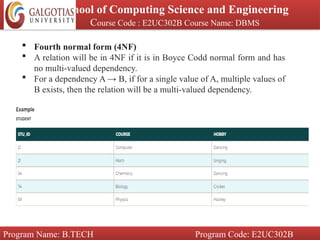
 Fourth normal form (4NF)
 A relation will be in 4NF if it is in Boyce Codd normal form and has
no multi-valued dependency.
 For a dependency A → B, if for a single value of A, multiple values of
B exists, then the relation will be a multi-valued dependency.
School of Computing Science and Engineering
Course Code : E2UC302B Course Name: DBMS
Program Name: B.TECH Program Code: E2UC302B
The given STUDENT table is in 3NF, but the COURSE and HOBBY are
two independent entity. Hence, there is no relationship between COURSE
and HOBBY.
In the STUDENT relation, a student with STU_ID, 21 contains two
courses, Computer and Math and two hobbies, Dancing and Singing. So
there is a Multi-valued dependency on STU_ID, which leads to unnecessary
repetition of data.
So to make the above table into 4NF, we can decompose it into two tables:
School of Computing Science and Engineering
Course Code : E2UC302B Course Name: DBMS
Program Name: B.TECH Program Code: E2UC302B
School of Computing Science and Engineering
Course Code : E2UC302B Course Name: DBMS
Program Name: B.TECH Program Code: E2UC302B
Fifth Normal Form
 A relation is in 5NF if it is in 4NF and not contains any
join dependency and joining should be lossless.
 5NF is satisfied when all the tables are broken into as
many tables as possible in order to avoid redundancy.
 5NF is also known as Project-join normal form (PJ/NF).
School of Computing Science and Engineering
Course Code : E2UC302B Course Name: DBMS
Program Name: B.TECH Program Code: E2UC302B
Fifth Normal Form
 In the above table, John takes both Computer and Math class for Semester 1 but he
doesn't take Math class for Semester 2. In this case, combination of all these fields
required to identify a valid data.
 Suppose we add a new Semester as Semester 3 but do not know about the subject
and who will be taking that subject so we leave Lecturer and Subject as NULL.
But all three columns together acts as a primary key, so we can't leave other two
columns blank.
 So to make the above table into 5NF, we can decompose it into three relations P1,
P2 & P3:
Loaded: 9.17%
School of Computing Science and Engineering
Course Code : E2UC302B Course Name: DBMS
Program Name: B.TECH Program Code: E2UC302B
Loaded: 9.17%
School of Computing Science and Engineering
Course Code : E2UC302B Course Name: DBMS
Program Name: B.TECH Program Code: E2UC302B
Relational Decomposition
Loaded: 9.17%
 When a relation in the relational model is not in appropriate normal form then the
decomposition of a relation is required.
 In a database, it breaks the table into multiple tables.
 If the relation has no proper decomposition, then it may lead to problems like loss
of information.
 Decomposition is used to eliminate some of the problems of bad design like
anomalies, inconsistencies, and redundancy.
School of Computing Science and Engineering
Course Code : E2UC302B Course Name: DBMS
Program Name: B.TECH Program Code: E2UC302B
Loaded: 9.17%
 Lossless Decomposition
 If the information is not lost from the relation that is decomposed, then the
decomposition will be lossless.
 The lossless decomposition guarantees that the join of relations will result in the
same relation as it was decomposed.
 The relation is said to be lossless decomposition if natural joins of all the
decomposition give the original relation.
School of Computing Science and Engineering
Course Code : E2UC302B Course Name: DBMS
Program Name: B.TECH Program Code: E2UC302B
Loaded: 9.17%
School of Computing Science and Engineering
Course Code : E2UC302B Course Name: DBMS
Program Name: B.TECH Program Code: E2UC302B
Loaded: 9.17%
 Dependency Preserving
 It is an important constraint of the database.
 In the dependency preservation, at least one decomposed table must
satisfy every dependency.
 If a relation R is decomposed into relation R1 and R2, then the
dependencies of R either must be a part of R1 or R2 or must be
derivable from the combination of functional dependencies of R1
and R2.
 For example, suppose there is a relation R (A, B, C, D) with
functional dependency set (A->BC). The relational R is decomposed
into R1(ABC) and R2(AD) which is dependency preserving because
FD A->BC is a part of relation R1(ABC).
School of Computing Science and Engineering
Course Code : E2UC302B Course Name: DBMS
Program Name: B.TECH Program Code: E2UC302B
Loaded: 9.17%
 Multivalued Dependency
 Multivalued dependency occurs when two attributes in a table are
independent of each other but, both depend on a third attribute.
 A multivalued dependency consists of at least two attributes that are
dependent on a third attribute that's why it always requires at least three
attributes.
 Example: Suppose there is a bike manufacturer company which
produces two colors(white and black) of each model every year.
School of Computing Science and Engineering
Course Code : E2UC302B Course Name: DBMS
Program Name: B.TECH Program Code: E2UC302B
Loaded: 9.17%
 Here columns COLOR and MANUF_YEAR are dependent on
BIKE_MODEL and independent of each other.
 In this case, these two columns can be called as multivalued dependent
on BIKE_MODEL. The representation of these dependencies is shown
below:
 BIKE_MODEL → → MANUF_YEAR
 BIKE_MODEL → → COLOR
 This can be read as "BIKE_MODEL multidetermined MANUF_YEAR"
and "BIKE_MODEL multidetermined COLOR".
School of Computing Science and Engineering
Course Code : E2UC302B Course Name: DBMS
Program Name: B.TECH Program Code: E2UC302B
Loaded: 9.17%
 Join Dependency
 Join decomposition is a further generalization of Multivalued
dependencies.
 If the join of R1 and R2 over C is equal to relation R, then we can say
that a join dependency (JD) exists.
 Where R1 and R2 are the decompositions R1(A, B, C) and R2(C, D)
of a given relations R (A, B, C, D).
 Alternatively, R1 and R2 are a lossless decomposition of R.
 A JD {R1, R2,..., Rn} is said to hold over a relation R if R1, R2,.....,
⋈
Rn is a lossless-join decomposition.
 The *(A, B, C, D), (C, D) will be a JD of R if the join of join's
attribute is equal to the relation R.
 Here, *(R1, R2, R3) is used to indicate that relation R1, R2, R3 and
so on are a JD of R.
normalaization in database management system

normalaization in database management system

  • 1.
    School of Computing Scienceand Engineering Program: B.TECH Course Code:E2UC302B Course Name: Database Management System
  • 2.
    Recommended Books Text books Abraham Silberschatz, Henry F. Korth and S. Sudarshan- “Database System Concepts”, Fourth Edition, McGraw-Hill, 2002. Reference Book  Ramez Elmasri and Shamkant B. Navathe, “Fundamental Database Systems”, Third Edition, Pearson Education, 2003.  Raghu Ramakrishnan, “Database Management System”, Tata McGraw- Hill Publishing Company, 2003.  Hector Garcia–Molina, Jeffrey D.Ullman and Jennifer Widom- “Database System Implementation”- Pearson Education- 2000  Peter Rob and Corlos Coronel- “Database System, Design, Implementation and Management”, Thompson Learning Course Technology- Fifth edition, 2003 Additional online materials  Coursera - https://www.coursera.org/learn/database-management  NPTEL- https://nptel.ac.in/courses/106/105/106105175/  https://www.coursera.org/learn/research-methods  https://www.coursera.org/browse/physical-science-and-engineering/research- methods Program Name: B.TECH Program Code: E2UC302B School of Computing Science and Engineering Course Code :E2UC302B Course Name: DBMS
  • 3.
    Functional Dependency Program Name:B.TECH Program Code: E2UC302B School of Computing Science and Engineering Course Code :E2UC302B Course Name: DBMS  The functional dependency is a relationship that exists between two attributes. It typically exists between the primary key and non-key attribute within a table. X → Y The left side of FD is known as a determinant, the right side of the production is known as a dependent.
  • 4.
    Functional Dependency: Example ProgramName: B.TECH Program Code: E2UC302B School of Computing Science and Engineering Course Code :E2UC302B Course Name: DBMS  Assume we have an employee table with attributes: Emp_Id, Emp_Name, Emp_Address.  Here Emp_Id attribute can uniquely identify the Emp_Name attribute of employee table because if we know the Emp_Id, we can tell that employee name associated with it.  Functional dependency can be written as:  Emp_Id → Emp_Name
  • 5.
    Types of FunctionalDependency Program Name: B.TECH Program Code: E2UC302B School of Computing Science and Engineering Course Code :E2UC302B Course Name: DBMS
  • 6.
    Types of FunctionalDependency Program Name: B.TECH Program Code: E2UC302B School of Computing Science and Engineering Course Code :E2UC302B Course Name: DBMS
  • 7.
    Inference Rule Program Name:B.TECH Program Code: E2UC302B School of Computing Science and Engineering Course Code :E2UC302B Course Name: DBMS  The Armstrong's axioms are the basic inference rule.  Armstrong's axioms are used to conclude functional dependencies on a relational database.  The inference rule is a type of assertion. It can apply to a set of FD(functional dependency) to derive other FD.  Using the inference rule, we can derive additional functional dependency from the initial set.
  • 8.
    Inference Rule Program Name:B.TECH Program Code: E2UC302B School of Computing Science and Engineering Course Code :E2UC302B Course Name: DBMS 2. Augmentation Rule (IR2) The augmentation is also called as a partial dependency. In augmentation, if X determines Y, then XZ determines YZ for any Z. 1. Reflexive Rule (IR1) In the reflexive rule, if Y is a subset of X, then X determines Y. 1.If X Y then X → Y ⊇ Example: 2.X = {a, b, c, d, e} 3.Y = {a, b, c} If X → Y then XZ → YZ Example: For R(ABCD), if A → B then AC → BC
  • 9.
    Inference Rule Program Name:B.TECH Program Code: E2UC302B School of Computing Science and Engineering Course Code :E2UC302B Course Name: DBMS 3. Transitive Rule (IR3) In the transitive rule, if X determines Y and Y determine Z, then X must also determine Z. 1.If X → Y and Y → Z then X → Z 4. Union Rule (IR4) Union rule says, if X determines Y and X determines Z, then X must also determine Y and Z. 2.If X → Y and X → Z then X → YZ 1. X → Y (given) 2. X → Z (given) 3. X → XY (using IR2 on 1 by augmentation with X. Where XX = X) 4. XY → YZ (using IR2 on 2 by augmentation with Y) 5. X → YZ (using IR3 on 3 and 4)
  • 10.
    Inference Rule Program Name:B.TECH Program Code: E2UC302B School of Computing Science and Engineering Course Code :E2UC302B Course Name: DBMS 5. Decomposition Rule (IR5) Decomposition rule is also known as project rule. It is the reverse of union rule. This Rule says, if X determines Y and Z, then X determines Y and X determines Z separately. 1.If X → YZ then X → Y and X → Z Proof: 1. X → YZ (given) 2. YZ → Y (using IR1 Rule) 3. X → Y (using IR3 on 1 and 2)
  • 11.
    Inference Rule Program Name:B.TECH Program Code: E2UC302B School of Computing Science and Engineering Course Code :E2UC302B Course Name: DBMS 6. Pseudo transitive Rule (IR6) In Pseudo transitive Rule, if X determines Y and YZ determines W, then XZ determines W. 1.If X → Y and YZ → W then XZ → W Proof: 1. X → Y (given) 2. WY → Z (given) 3. WX → WY (using IR2 on 1 by augmenting with W) 4. WX → Z (using IR3 on 3 and 2)
  • 12.
    Normalization Program Name: B.TECHProgram Code: E2UC302B School of Computing Science and Engineering Course Code :E2UC302B Course Name: DBMS  A large database defined as a single relation may result in data duplication.  This repetition of data may result in: Making relations very large.  It isn't easy to maintain and update data as it would involve searching many records in relation.  Wastage and poor utilization of disk space and resources.  The likelihood of errors and inconsistencies increases. So to handle these problems, we should analyze and decompose the relations with redundant data into smaller, simpler, and well- structured relations that are satisfy desirable properties. Normalization is a process of decomposing the relations into relations with fewer attributes.
  • 13.
    Program Name: B.TECHProgram Code: E2UC302B School of Computing Science and Engineering Course Code :E2UC302B Course Name: DBMS What is Normalization?  Normalization is the process of organizing the data in the database.  Normalization is used to minimize the redundancy from a relation or set of relations.  It is also used to eliminate undesirable characteristics like Insertion, Update, and Deletion Anomalies.  Normalization divides the larger table into smaller and links them using relationships.  The normal form is used to reduce redundancy from the database table.
  • 14.
    Program Name: B.TECHProgram Code: E2UC302B School of Computing Science and Engineering Course Code :E2UC302B Course Name: DBMS Why do we need Normalization?  The main reason for normalizing the relations is removing these anomalies.  Failure to eliminate anomalies leads to data redundancy and can cause data integrity and other problems as the database grows. Normalization consists of a series of guidelines that helps to guide you in creating a good database structure. Duration 18:10 Loaded: 6.97%
  • 15.
    Program Name: B.TECHProgram Code: E2UC302B School of Computing Science and Engineering Course Code :E2UC302B Course Name: DBMS  Data modification anomalies can be categorized into three types:  Insertion Anomaly: Insertion Anomaly refers to when one cannot insert a new tuple into a relationship due to lack of data.  Deletion Anomaly: The delete anomaly refers to the situation where the deletion of data results in the unintended loss of some other important data.  Updatation Anomaly: The update anomaly is when an update of a single data value requires multiple rows of data to be updated.
  • 16.
    Types of NormalForms: Program Name: B.TECH Program Code: E2UC302B School of Computing Science and Engineering Course Code :E2UC302B Course Name: DBMS
  • 17.
    Types of NormalForm School of Computing Science and Engineering Course Code : E2UC302B Course Name: DBMS Program Name: B.TECH Program Code: E2UC302B
  • 18.
    School of ComputingScience and Engineering Course Code : E2UC302B Course Name: DBMS Program Name: B.TECH Program Code: E2UC302B  Advantages of Normalization  Normalization helps to minimize data redundancy.  Greater overall database organization.  Data consistency within the database.  Much more flexible database design.  Enforces the concept of relational integrity.  Disadvantages of Normalization  You cannot start building the database before knowing what the user needs.  The performance degrades when normalizing the relations to higher normal forms, i.e., 4NF, 5NF.  It is very time-consuming and difficult to normalize relations of a higher degree.  Careless decomposition may lead to a bad database design, leading to serious problems.
  • 19.
    First Normal Form Schoolof Computing Science and Engineering Course Code : E2UC302B Course Name: DBMS Program Name: B.TECH Program Code: E2UC302B  A relation will be 1NF if it contains an atomic value.  It states that an attribute of a table cannot hold multiple values. It must hold only single-valued attribute.  First normal form disallows the multi-valued attribute, composite attribute, and their combinations. •Example 1 – Relation STUDENT in table 1 is not in 1NF because of multi-valued attribute STUD_PHONE. Its decomposition into 1NF has been shown in table 2.
  • 20.
    First Normal Form Schoolof Computing Science and Engineering Course Code : E2UC302B Course Name: DBMS Program Name: B.TECH Program Code: E2UC302B
  • 21.
    Second Normal Form Schoolof Computing Science and Engineering Course Code : E2UC302B Course Name: DBMS Program Name: B.TECH Program Code: E2UC302B  In the 2NF, relational must be in 1NF.  In the second normal form, all non-key attributes are fully functional dependent on the primary key  Example: Let's assume, a school can store the data of teachers and the subjects they teach. In a school, a teacher can teach more than one subject.
  • 22.
    School of ComputingScience and Engineering Course Code : E2UC302B Course Name: DBMS Program Name: B.TECH Program Code: E2UC302B
  • 23.
    Third Normal Form Schoolof Computing Science and Engineering Course Code : E2UC302B Course Name: DBMS Program Name: B.TECH Program Code: E2UC302B  A relation will be in 3NF if it is in 2NF and not contain any transitive partial dependency.  3NF is used to reduce the data duplication. It is also used to achieve the data integrity.  If there is no transitive dependency for non-prime attributes, then the relation must be in third normal form.  A relation is in third normal form if it holds atleast one of the following conditions for every non-trivial function dependency X → Y.  X is a super key.  Y is a prime attribute, i.e., each element of Y is part of some candidate key.
  • 24.
    School of ComputingScience and Engineering Course Code : E2UC302B Course Name: DBMS Program Name: B.TECH Program Code: E2UC302B Super key in the table above: 1.{EMP_ID}, {EMP_ID, EMP_NAME}, {EMP_ID, EMP_NAME, EMP_ZIP}....so on Candidate key: {EMP_ID} Non-prime attributes: In the given table, all attributes except EMP_ID are non-prime.  Here, EMP_STATE & EMP_CITY dependent on EMP_ZIP and EMP_ZIP dependent on EMP_ID. The non-prime attributes (EMP_STATE, EMP_CITY) transitively dependent on super key(EMP_ID). It violates the rule of third normal form.  That's why we need to move the EMP_CITY and EMP_STATE to the new <EMPLOYEE_ZIP> table, with EMP_ZIP as a Primary key.
  • 25.
    School of ComputingScience and Engineering Course Code : E2UC302B Course Name: DBMS Program Name: B.TECH Program Code: E2UC302B
  • 26.
    BCNF School of ComputingScience and Engineering Course Code : E2UC302B Course Name: DBMS Program Name: B.TECH Program Code: E2UC302B  Boyce Codd normal form (BCNF)  BCNF is the advance version of 3NF. It is stricter than 3NF.  A table is in BCNF if every functional dependency X → Y, X is the super key of the table.  For BCNF, the table should be in 3NF, and for every FD, LHS is super key.  Example: Let's assume there is a company where employees work in more than one department.
  • 27.
    School of ComputingScience and Engineering Course Code : E2UC302B Course Name: DBMS Program Name: B.TECH Program Code: E2UC302B Candidate key: {EMP-ID, EMP-DEPT}  The table is not in BCNF because neither EMP_DEPT nor EMP_ID alone are keys.  To convert the given table into BCNF, we decompose it into three tables:
  • 28.
    School of ComputingScience and Engineering Course Code : E2UC302B Course Name: DBMS Program Name: B.TECH Program Code: E2UC302B
  • 29.
    School of ComputingScience and Engineering Course Code : E2UC302B Course Name: DBMS Program Name: B.TECH Program Code: E2UC302B Functional dependencies: 1.EMP_ID → EMP_COUNTRY 2.EMP_DEPT → {DEPT_TYPE, EMP_DEPT_NO} Candidate keys: For the first table: EMP_ID For the second table: EMP_DEPT For the third table: {EMP_ID, EMP_DEPT} Now, this is in BCNF because left side part of both the functional dependencies is a key.
  • 30.
    School of ComputingScience and Engineering Course Code : E2UC302B Course Name: DBMS Program Name: B.TECH Program Code: E2UC302B  Fourth normal form (4NF)  A relation will be in 4NF if it is in Boyce Codd normal form and has no multi-valued dependency.  For a dependency A → B, if for a single value of A, multiple values of B exists, then the relation will be a multi-valued dependency.
  • 31.
    School of ComputingScience and Engineering Course Code : E2UC302B Course Name: DBMS Program Name: B.TECH Program Code: E2UC302B The given STUDENT table is in 3NF, but the COURSE and HOBBY are two independent entity. Hence, there is no relationship between COURSE and HOBBY. In the STUDENT relation, a student with STU_ID, 21 contains two courses, Computer and Math and two hobbies, Dancing and Singing. So there is a Multi-valued dependency on STU_ID, which leads to unnecessary repetition of data. So to make the above table into 4NF, we can decompose it into two tables:
  • 32.
    School of ComputingScience and Engineering Course Code : E2UC302B Course Name: DBMS Program Name: B.TECH Program Code: E2UC302B
  • 33.
    School of ComputingScience and Engineering Course Code : E2UC302B Course Name: DBMS Program Name: B.TECH Program Code: E2UC302B Fifth Normal Form  A relation is in 5NF if it is in 4NF and not contains any join dependency and joining should be lossless.  5NF is satisfied when all the tables are broken into as many tables as possible in order to avoid redundancy.  5NF is also known as Project-join normal form (PJ/NF).
  • 34.
    School of ComputingScience and Engineering Course Code : E2UC302B Course Name: DBMS Program Name: B.TECH Program Code: E2UC302B Fifth Normal Form  In the above table, John takes both Computer and Math class for Semester 1 but he doesn't take Math class for Semester 2. In this case, combination of all these fields required to identify a valid data.  Suppose we add a new Semester as Semester 3 but do not know about the subject and who will be taking that subject so we leave Lecturer and Subject as NULL. But all three columns together acts as a primary key, so we can't leave other two columns blank.  So to make the above table into 5NF, we can decompose it into three relations P1, P2 & P3: Loaded: 9.17%
  • 35.
    School of ComputingScience and Engineering Course Code : E2UC302B Course Name: DBMS Program Name: B.TECH Program Code: E2UC302B Loaded: 9.17%
  • 36.
    School of ComputingScience and Engineering Course Code : E2UC302B Course Name: DBMS Program Name: B.TECH Program Code: E2UC302B Relational Decomposition Loaded: 9.17%  When a relation in the relational model is not in appropriate normal form then the decomposition of a relation is required.  In a database, it breaks the table into multiple tables.  If the relation has no proper decomposition, then it may lead to problems like loss of information.  Decomposition is used to eliminate some of the problems of bad design like anomalies, inconsistencies, and redundancy.
  • 37.
    School of ComputingScience and Engineering Course Code : E2UC302B Course Name: DBMS Program Name: B.TECH Program Code: E2UC302B Loaded: 9.17%  Lossless Decomposition  If the information is not lost from the relation that is decomposed, then the decomposition will be lossless.  The lossless decomposition guarantees that the join of relations will result in the same relation as it was decomposed.  The relation is said to be lossless decomposition if natural joins of all the decomposition give the original relation.
  • 38.
    School of ComputingScience and Engineering Course Code : E2UC302B Course Name: DBMS Program Name: B.TECH Program Code: E2UC302B Loaded: 9.17%
  • 39.
    School of ComputingScience and Engineering Course Code : E2UC302B Course Name: DBMS Program Name: B.TECH Program Code: E2UC302B Loaded: 9.17%  Dependency Preserving  It is an important constraint of the database.  In the dependency preservation, at least one decomposed table must satisfy every dependency.  If a relation R is decomposed into relation R1 and R2, then the dependencies of R either must be a part of R1 or R2 or must be derivable from the combination of functional dependencies of R1 and R2.  For example, suppose there is a relation R (A, B, C, D) with functional dependency set (A->BC). The relational R is decomposed into R1(ABC) and R2(AD) which is dependency preserving because FD A->BC is a part of relation R1(ABC).
  • 40.
    School of ComputingScience and Engineering Course Code : E2UC302B Course Name: DBMS Program Name: B.TECH Program Code: E2UC302B Loaded: 9.17%  Multivalued Dependency  Multivalued dependency occurs when two attributes in a table are independent of each other but, both depend on a third attribute.  A multivalued dependency consists of at least two attributes that are dependent on a third attribute that's why it always requires at least three attributes.  Example: Suppose there is a bike manufacturer company which produces two colors(white and black) of each model every year.
  • 41.
    School of ComputingScience and Engineering Course Code : E2UC302B Course Name: DBMS Program Name: B.TECH Program Code: E2UC302B Loaded: 9.17%  Here columns COLOR and MANUF_YEAR are dependent on BIKE_MODEL and independent of each other.  In this case, these two columns can be called as multivalued dependent on BIKE_MODEL. The representation of these dependencies is shown below:  BIKE_MODEL → → MANUF_YEAR  BIKE_MODEL → → COLOR  This can be read as "BIKE_MODEL multidetermined MANUF_YEAR" and "BIKE_MODEL multidetermined COLOR".
  • 42.
    School of ComputingScience and Engineering Course Code : E2UC302B Course Name: DBMS Program Name: B.TECH Program Code: E2UC302B Loaded: 9.17%  Join Dependency  Join decomposition is a further generalization of Multivalued dependencies.  If the join of R1 and R2 over C is equal to relation R, then we can say that a join dependency (JD) exists.  Where R1 and R2 are the decompositions R1(A, B, C) and R2(C, D) of a given relations R (A, B, C, D).  Alternatively, R1 and R2 are a lossless decomposition of R.  A JD {R1, R2,..., Rn} is said to hold over a relation R if R1, R2,....., ⋈ Rn is a lossless-join decomposition.  The *(A, B, C, D), (C, D) will be a JD of R if the join of join's attribute is equal to the relation R.  Here, *(R1, R2, R3) is used to indicate that relation R1, R2, R3 and so on are a JD of R.