Scheduling and Controls of Project ManufacturingMohamed El-Mehalawi, Ph.D, PMPSenior Project Controls ManagerFaithful+Gould
The Presentation is not available on the Conference DVD.If you like a copy send me an email I will send you a link to it.Mohamed.el-mehalawi@fgould.comor pick up my card.
About the AuthorI loveKISSKeep It Simple, Smart
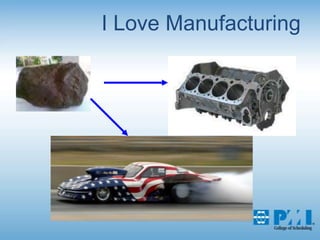
I Love Manufacturing
I Love Project ManagementThere is no exact science that is applied to get project management results.It depends on personal traits: CreativityProblem solvingCommunicationOne mile long – one inch deep !
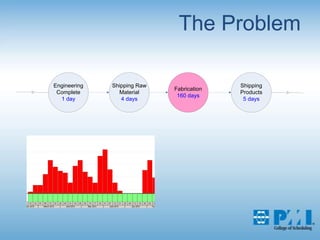
The Problem
Manufacturing ManagementManagement of manufacturing is based until today on two environments:Mass production and assembly lineJob-shop manufacturingI am suggesting a third method calledProject Manufacturing
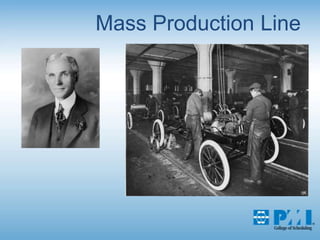
Mass Production Line
Mass Production LineVideos
Mass Production:DefinitionMass production is the production of large amounts of standardized products on production lines. It was popularized by Henry Ford in the early 20th Century, notably in his Ford Model T. It was reinvented by Toyota in the 1950s.
Production Line:DefinitionA Production Line is a manufacturing process in which interchangeable parts are added to a product in a sequential manner to create an end product.
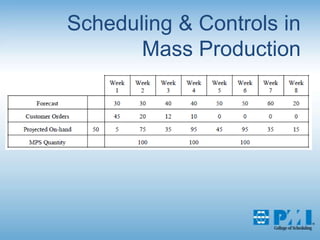
Scheduling & Controls in Mass Production Push/Pull production schedulingFord focused on the Push systemPush the material into the lineToyota focused more on the Pull systemProducts at the end of the line generate signal to push material into the line.
Scheduling & Controls in Mass Production
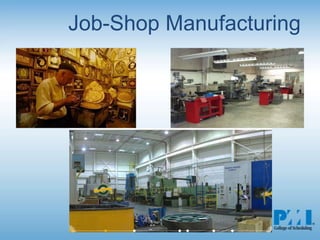
Job-Shop Manufacturing
Job-Shop ManufacturingDefinitionThe job shop scheduling problem (JSP) is a traditional decision making problem that is encountered in:Low volume–high variety manufacturing systemsJob-shop scheduling is dedicated tolow volume repetitiveproducts manufacturingJob-Shop is a good strategy for make-to-order not for unique and temporaryengineer-to-order products.
Scheduling and Controls in Job-Shop ManufacturingThere are thousands of algorithms based on mathematical methods to resolve the job-shop scheduling problems.The “Goal” or TOC by Eliyahu Goldratt gave a common-sense methodology for the job-shop problem.CPM is not the best methodology for job-shop scheduling
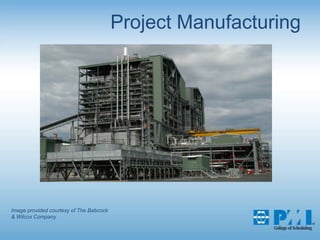
Project ManufacturingImage provided courtesy of The Babcock & Wilcox Company
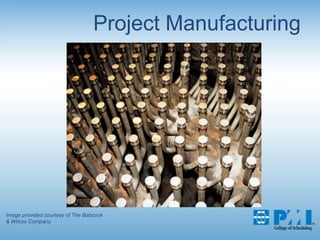
Project Manufacturing
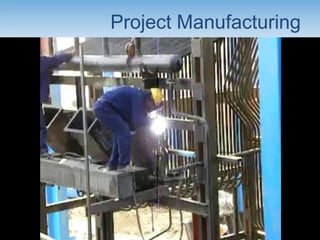
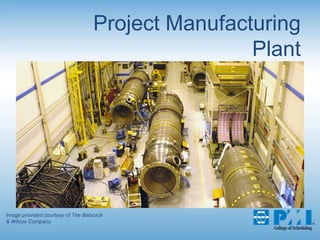
Project Manufacturing:DefinitionProject manufacturing is dedicated to producing or assembling one unit of each unique product. Although it is a manufacturing environment, it follows the project definition of being temporary and unique.
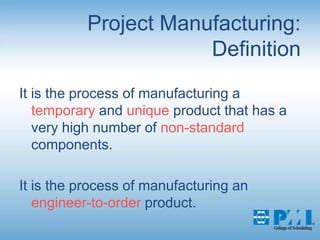
Project Manufacturing:DefinitionIt is the process of manufacturing a temporary and unique product that has a very high number of non-standard components.It is the process of manufacturing an engineer-to-order product.
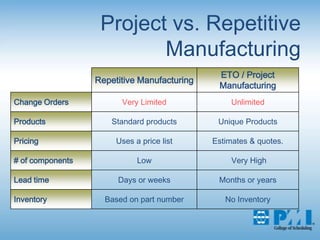
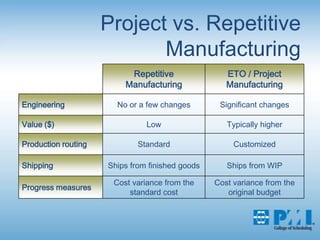
Project vs. Repetitive Manufacturing
Presentation OverviewThis presentation is focused on the scheduling and controls of project manufacturing using critical path method (CPM).Project manufacturing plantBenefitsProject manufacturing scheduling Automating the scheduleAutomating schedule updatesUtilizing enterprise scheduling system to manage resourcesImplementation results
Project Manufacturing PlantImage provided courtesy of The Babcock & Wilcox Company
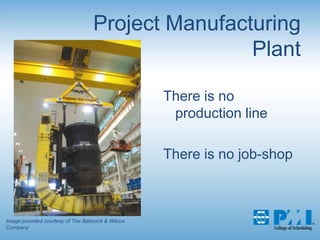
Project Manufacturing PlantThere is no production lineThere is no job-shopImage provided courtesy of The Babcock & Wilcox Company
Management in Project Manufacturing PlantThe majority of project manufacturing shops in the US use manufacturing management based on job-shop.They utilize machine loading, master scheduling, process improvements, and quality assurance exactly like mass production plants.
CPM in Project ManufacturingObjectives of this study or the benefits of using CPM in scheduling project manufacturing:Providing a project-based methodology to a project-based process.Integrating the fabrication phase of the project with the rest of the project schedule.Will come back to these later.
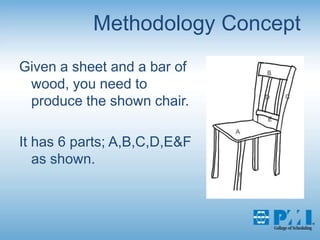
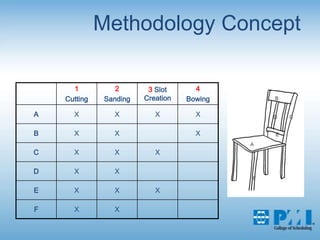
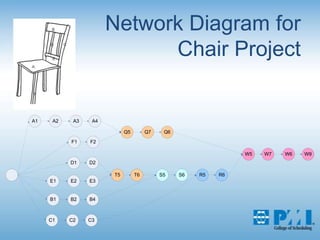
Methodology ConceptGiven a sheet and a bar of wood, you need to produce the shown chair. It has 6 parts; A,B,C,D,E&F as shown.
Methodology Concept
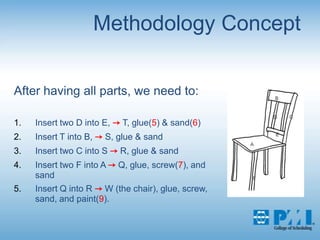
Methodology ConceptAfter having all parts, we need to:Insert two D into E, -> T, glue(5) & sand(6)Insert T into B, -> S, glue & sandInsert two C into S -> R, glue & sandInsert two F into A -> Q, glue, screw(7), and sandInsert Q into R -> W (the chair), glue, screw, sand, and paint(9).
Network Diagram for Chair Project
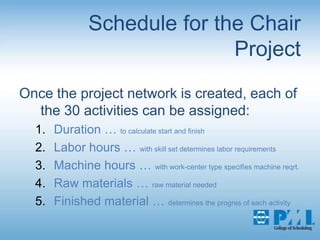
Schedule for the Chair ProjectOnce the project network is created, each of the 30 activities can be assigned:Duration … to calculate start and finishLabor hours … with skill set determines labor requirementsMachine hours … with work-center type specifies machine reqrt.Raw materials … raw material neededFinished material … determines the progres of each activity
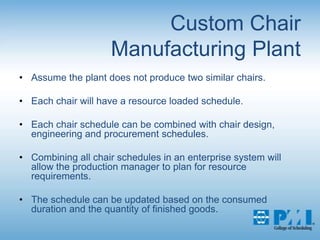
Custom Chair Manufacturing PlantAssume the plant does not produce two similar chairs.Each chair will have a resource loaded schedule.Each chair schedule can be combined with chair design, engineering and procurement schedules.Combining all chair schedules in an enterprise system will allow the production manager to plan for resource requirements. The schedule can be updated based on the consumed duration and the quantity of finished goods.
Automating Schedule CreationThe first manual implementation was on products that had about 1000 part numbers. This generated more than 5000 activities. Production planners complained about having to create schedules for new products while updating the schedules of active products (projects).
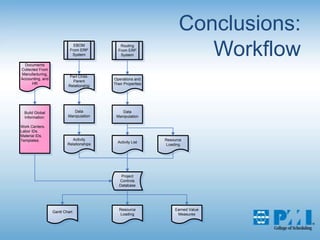
Automating Schedule CreationAny plant that deals with these large projects always has:An ERP systemAn engineering bill-of-material system (BOM)A part routing systemA manufacturing execution systemUsually the last three systems dump the information into the first system.The idea of automating the creation of the project/product schedule depends on the last three systems.
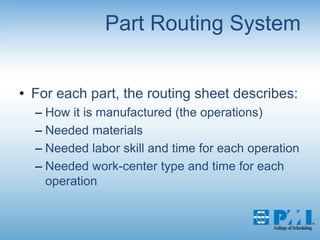
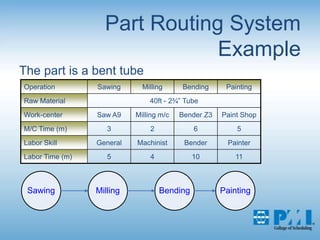
Part Routing SystemFor each part, the routing sheet describes:How it is manufactured (the operations)Needed materialsNeeded labor skill and time for each operationNeeded work-center type and time for each operation
Part Routing System ExampleThe part is a bent tube
Part Routing Can Generate Local SchedulesA resource loaded schedule for each part number is generated.The relationships between different local schedules are missing.The BOM provides those relationships.
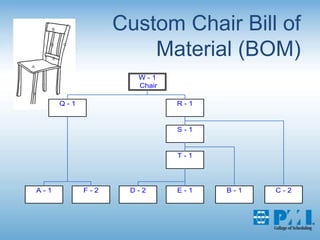
Custom Chair Bill of Material (BOM)
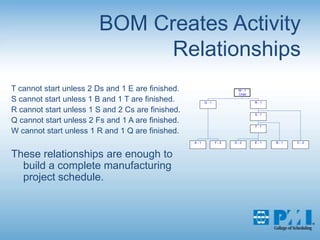
BOM Creates Activity RelationshipsT cannot start unless 2 Ds and 1 E are finished.S cannot start unless 1 B and 1 T are finished.R cannot start unless 1 S and 2 Cs are finished.Q cannot start unless 2 Fs and 1 A are finished.W cannot start unless 1 R and 1 Q are finished.These relationships are enough to build a complete manufacturing project schedule.
The Automation of Schedule GenerationIf:Product routing BOMAre available in any electronic format, then the full resource loaded schedule can easily be generated automatically.
Manufacturing Execution Systems (MES)They are information systems used to manage and manipulate data in factory floors.Different technologies are used to distribute schedule information and to collect actual production information from plant floor.Barcode, Magnetic Cards, Smart Card, RF are examples.
Automating Schedule UpdatesMES provide real time information for each activity:StartFinishLabor hours chargedMachine hours chargedNumber of units finishedDumping this information into the schedule, we get an updated schedule that reflects the exact status of the project.
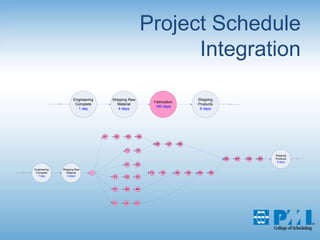
Project Schedule Integration
Project Schedule IntegrationIt gives the project manager better control over the fabrication phase of the project.Any changes in engineering dates will be dynamically conveyed to the manufacturing schedule.If the project uses CPM and the fabrication uses job-shop, then there will be a disconnection in project controls.
Resource ManagementThe manufacturing plant will have multiple concurrent projects.Concurrent projects share the same resourcesConstrained resource allocation to multiple projects is the hardest mathematical problem in project management.
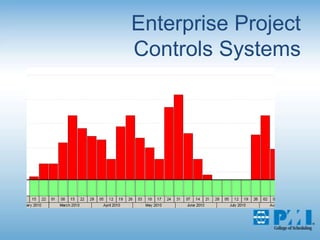
Enterprise Project Controls SystemsEnterprise project controls systems combine the requirements on each single resource from all active projects.Few resources are over allocated and few are under allocated. If we leave the resource leveling to be automated based on a heuristic or mathematical method, it will be a mess.
Enterprise Project Controls Systems
Resolving Resource ConflictsThe plant might have 500 resources. If we try to schedule projects and pay attention to these resources, the number of production planners needed will be prohibitive.If we insert hard activity relationships to represent these resources, then all resources will be under-allocated.
Resolving Resource Conflicts: From PracticeWe used this system in a plant for three months trying to resolve conflicts of all resources. The implementation team was working with the production planners.We found that we only have 3 resources that are always over-allocated (bottlenecks).We manually scheduled all active projects around these three resources. No conflicts arise from other resources.
Conclusions: Workflow
Conclusions:Goals AchievedWith a simple system, we achieved the implementation of our two goals:Project schedule integration specially for EPC projectsPlanning and controls of production within a project manufacturing plant.
Conclusions:Benefits to the PlantPlant customers (project owners) like this system because it keeps them informed on the status of their project. Engineering departments become informed about the effects of their schedule on manufacturing schedule.Changes are handled in the plant easier than handling them using a job-shop strategy
Conclusions:Success StoryMy first implementation was at a plant that used to update the schedule monthly. After implementation, I asked them to update it weekly and they agreed without any resistance because the automation of schedule creation saved them a lot of time. After a few months they came back to me and requested to update the schedule daily. That proves the applicability of the system in planning and controls in project manufacturing plants.
The Presentation is not available on the Conference DVD.If you like a copy send me an email I will send you a link to it.Mohamed.el-mehalawi@fgould.comor pick my card up
Thank YouFor Attending!

Project Manufacturing

  • 2.
    Scheduling and Controlsof Project ManufacturingMohamed El-Mehalawi, Ph.D, PMPSenior Project Controls ManagerFaithful+Gould
  • 3.
    The Presentation isnot available on the Conference DVD.If you like a copy send me an email I will send you a link to it.Mohamed.el-mehalawi@fgould.comor pick up my card.
  • 4.
    About the AuthorIloveKISSKeep It Simple, Smart
  • 5.
  • 6.
    I Love ProjectManagementThere is no exact science that is applied to get project management results.It depends on personal traits: CreativityProblem solvingCommunicationOne mile long – one inch deep !
  • 7.
  • 8.
    Manufacturing ManagementManagement ofmanufacturing is based until today on two environments:Mass production and assembly lineJob-shop manufacturingI am suggesting a third method calledProject Manufacturing
  • 9.
  • 10.
  • 11.
    Mass Production:DefinitionMass productionis the production of large amounts of standardized products on production lines. It was popularized by Henry Ford in the early 20th Century, notably in his Ford Model T. It was reinvented by Toyota in the 1950s.
  • 12.
    Production Line:DefinitionA ProductionLine is a manufacturing process in which interchangeable parts are added to a product in a sequential manner to create an end product.
  • 13.
    Scheduling & Controlsin Mass Production Push/Pull production schedulingFord focused on the Push systemPush the material into the lineToyota focused more on the Pull systemProducts at the end of the line generate signal to push material into the line.
  • 14.
    Scheduling & Controlsin Mass Production
  • 15.
  • 16.
  • 17.
    Job-Shop ManufacturingDefinitionThe jobshop scheduling problem (JSP) is a traditional decision making problem that is encountered in:Low volume–high variety manufacturing systemsJob-shop scheduling is dedicated tolow volume repetitiveproducts manufacturingJob-Shop is a good strategy for make-to-order not for unique and temporaryengineer-to-order products.
  • 18.
    Scheduling and Controlsin Job-Shop ManufacturingThere are thousands of algorithms based on mathematical methods to resolve the job-shop scheduling problems.The “Goal” or TOC by Eliyahu Goldratt gave a common-sense methodology for the job-shop problem.CPM is not the best methodology for job-shop scheduling
  • 19.
    Project ManufacturingImage providedcourtesy of The Babcock & Wilcox Company
  • 20.
    Project ManufacturingImage providedcourtesy of The Babcock & Wilcox Company
  • 21.
  • 22.
    Project Manufacturing:DefinitionProject manufacturingis dedicated to producing or assembling one unit of each unique product. Although it is a manufacturing environment, it follows the project definition of being temporary and unique.
  • 23.
    Project Manufacturing:DefinitionIt isthe process of manufacturing a temporary and unique product that has a very high number of non-standard components.It is the process of manufacturing an engineer-to-order product.
  • 24.
  • 25.
  • 26.
    Presentation OverviewThis presentationis focused on the scheduling and controls of project manufacturing using critical path method (CPM).Project manufacturing plantBenefitsProject manufacturing scheduling Automating the scheduleAutomating schedule updatesUtilizing enterprise scheduling system to manage resourcesImplementation results
  • 27.
    Project Manufacturing PlantImageprovided courtesy of The Babcock & Wilcox Company
  • 28.
    Project Manufacturing PlantThereis no production lineThere is no job-shopImage provided courtesy of The Babcock & Wilcox Company
  • 29.
    Management in ProjectManufacturing PlantThe majority of project manufacturing shops in the US use manufacturing management based on job-shop.They utilize machine loading, master scheduling, process improvements, and quality assurance exactly like mass production plants.
  • 30.
    CPM in ProjectManufacturingObjectives of this study or the benefits of using CPM in scheduling project manufacturing:Providing a project-based methodology to a project-based process.Integrating the fabrication phase of the project with the rest of the project schedule.Will come back to these later.
  • 31.
    Methodology ConceptGiven asheet and a bar of wood, you need to produce the shown chair. It has 6 parts; A,B,C,D,E&F as shown.
  • 32.
  • 33.
    Methodology ConceptAfter havingall parts, we need to:Insert two D into E, -> T, glue(5) & sand(6)Insert T into B, -> S, glue & sandInsert two C into S -> R, glue & sandInsert two F into A -> Q, glue, screw(7), and sandInsert Q into R -> W (the chair), glue, screw, sand, and paint(9).
  • 34.
    Network Diagram forChair Project
  • 35.
    Schedule for theChair ProjectOnce the project network is created, each of the 30 activities can be assigned:Duration … to calculate start and finishLabor hours … with skill set determines labor requirementsMachine hours … with work-center type specifies machine reqrt.Raw materials … raw material neededFinished material … determines the progres of each activity
  • 36.
    Custom Chair ManufacturingPlantAssume the plant does not produce two similar chairs.Each chair will have a resource loaded schedule.Each chair schedule can be combined with chair design, engineering and procurement schedules.Combining all chair schedules in an enterprise system will allow the production manager to plan for resource requirements. The schedule can be updated based on the consumed duration and the quantity of finished goods.
  • 37.
    Automating Schedule CreationThefirst manual implementation was on products that had about 1000 part numbers. This generated more than 5000 activities. Production planners complained about having to create schedules for new products while updating the schedules of active products (projects).
  • 38.
    Automating Schedule CreationAnyplant that deals with these large projects always has:An ERP systemAn engineering bill-of-material system (BOM)A part routing systemA manufacturing execution systemUsually the last three systems dump the information into the first system.The idea of automating the creation of the project/product schedule depends on the last three systems.
  • 39.
    Part Routing SystemForeach part, the routing sheet describes:How it is manufactured (the operations)Needed materialsNeeded labor skill and time for each operationNeeded work-center type and time for each operation
  • 40.
    Part Routing SystemExampleThe part is a bent tube
  • 41.
    Part Routing CanGenerate Local SchedulesA resource loaded schedule for each part number is generated.The relationships between different local schedules are missing.The BOM provides those relationships.
  • 42.
    Custom Chair Billof Material (BOM)
  • 43.
    BOM Creates ActivityRelationshipsT cannot start unless 2 Ds and 1 E are finished.S cannot start unless 1 B and 1 T are finished.R cannot start unless 1 S and 2 Cs are finished.Q cannot start unless 2 Fs and 1 A are finished.W cannot start unless 1 R and 1 Q are finished.These relationships are enough to build a complete manufacturing project schedule.
  • 44.
    The Automation ofSchedule GenerationIf:Product routing BOMAre available in any electronic format, then the full resource loaded schedule can easily be generated automatically.
  • 45.
    Manufacturing Execution Systems(MES)They are information systems used to manage and manipulate data in factory floors.Different technologies are used to distribute schedule information and to collect actual production information from plant floor.Barcode, Magnetic Cards, Smart Card, RF are examples.
  • 46.
    Automating Schedule UpdatesMESprovide real time information for each activity:StartFinishLabor hours chargedMachine hours chargedNumber of units finishedDumping this information into the schedule, we get an updated schedule that reflects the exact status of the project.
  • 47.
  • 48.
    Project Schedule IntegrationItgives the project manager better control over the fabrication phase of the project.Any changes in engineering dates will be dynamically conveyed to the manufacturing schedule.If the project uses CPM and the fabrication uses job-shop, then there will be a disconnection in project controls.
  • 49.
    Resource ManagementThe manufacturingplant will have multiple concurrent projects.Concurrent projects share the same resourcesConstrained resource allocation to multiple projects is the hardest mathematical problem in project management.
  • 50.
    Enterprise Project ControlsSystemsEnterprise project controls systems combine the requirements on each single resource from all active projects.Few resources are over allocated and few are under allocated. If we leave the resource leveling to be automated based on a heuristic or mathematical method, it will be a mess.
  • 51.
  • 52.
    Resolving Resource ConflictsTheplant might have 500 resources. If we try to schedule projects and pay attention to these resources, the number of production planners needed will be prohibitive.If we insert hard activity relationships to represent these resources, then all resources will be under-allocated.
  • 53.
    Resolving Resource Conflicts:From PracticeWe used this system in a plant for three months trying to resolve conflicts of all resources. The implementation team was working with the production planners.We found that we only have 3 resources that are always over-allocated (bottlenecks).We manually scheduled all active projects around these three resources. No conflicts arise from other resources.
  • 54.
  • 55.
    Conclusions:Goals AchievedWith asimple system, we achieved the implementation of our two goals:Project schedule integration specially for EPC projectsPlanning and controls of production within a project manufacturing plant.
  • 56.
    Conclusions:Benefits to thePlantPlant customers (project owners) like this system because it keeps them informed on the status of their project. Engineering departments become informed about the effects of their schedule on manufacturing schedule.Changes are handled in the plant easier than handling them using a job-shop strategy
  • 57.
    Conclusions:Success StoryMy firstimplementation was at a plant that used to update the schedule monthly. After implementation, I asked them to update it weekly and they agreed without any resistance because the automation of schedule creation saved them a lot of time. After a few months they came back to me and requested to update the schedule daily. That proves the applicability of the system in planning and controls in project manufacturing plants.
  • 58.
    The Presentation isnot available on the Conference DVD.If you like a copy send me an email I will send you a link to it.Mohamed.el-mehalawi@fgould.comor pick my card up
  • 59.