Suez Canal University – Faculty of Computers & Informatics - Cisco Local Academy
Network Fundamentals
Abdelkhalik Elsaid Mousa
abdu.elsaid@yahoo.com
http://abdelkhalik.staff.scuegypt.edu.eg/
Suez Canal University – Faculty of Computers & Informatics - Cisco Local Academy
IEEE - Standards
• The first LAN in the world was the original version of Ethernet.
• The first Ethernet standard (802.3) was published in 1980.
• Ethernet is the predominant LAN technology in use today.
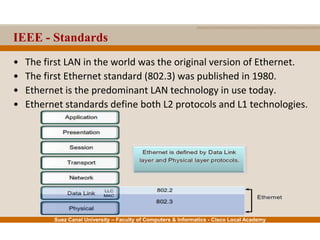
• Ethernet standards define both L2 protocols and L1 technologies.
Suez Canal University – Faculty of Computers & Informatics - Cisco Local Academy
Ethernet- L1 and L2
Suez Canal University – Faculty of Computers & Informatics - Cisco Local Academy
Logical Link Control – Connecting to the upper layers
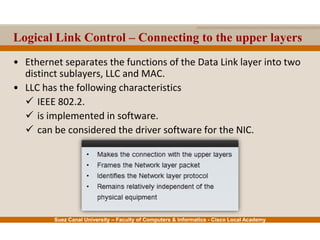
• Ethernet separates the functions of the Data Link layer into two
distinct sublayers, LLC and MAC.
• LLC has the following characteristics
 IEEE 802.2.
 is implemented in software.
 can be considered the driver software for the NIC.
Suez Canal University – Faculty of Computers & Informatics - Cisco Local Academy
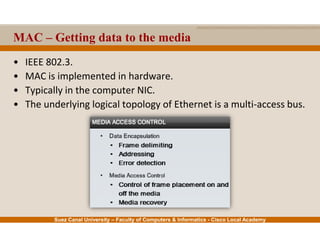
MAC – Getting data to the media
• IEEE 802.3.
• MAC is implemented in hardware.
• Typically in the computer NIC.
• The underlying logical topology of Ethernet is a multi-access bus.
Suez Canal University – Faculty of Computers & Informatics - Cisco Local Academy
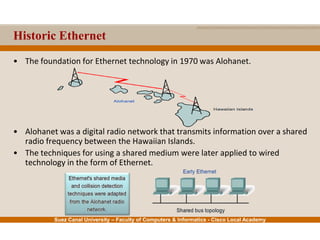
Historic Ethernet
• The foundation for Ethernet technology in 1970 was Alohanet.
• Alohanet was a digital radio network that transmits information over a shared
radio frequency between the Hawaiian Islands.
• The techniques for using a shared medium were later applied to wired
technology in the form of Ethernet.
Suez Canal University – Faculty of Computers & Informatics - Cisco Local Academy
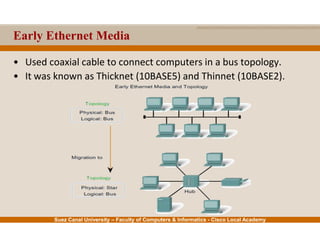
Early Ethernet Media
• Used coaxial cable to connect computers in a bus topology.
• It was known as Thicknet (10BASE5) and Thinnet (10BASE2).
Suez Canal University – Faculty of Computers & Informatics - Cisco Local Academy
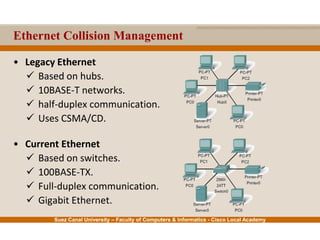
Ethernet Collision Management
• Legacy Ethernet
 Based on hubs.
 10BASE-T networks.
 half-duplex communication.
 Uses CSMA/CD.
• Current Ethernet
 Based on switches.
 100BASE-TX.
 Full-duplex communication.
 Gigabit Ethernet.
Suez Canal University – Faculty of Computers & Informatics - Cisco Local Academy
The Frame – Encapsulating the packet
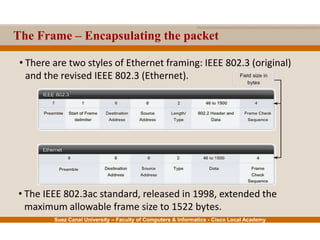
• There are two styles of Ethernet framing: IEEE 802.3 (original)
and the revised IEEE 802.3 (Ethernet).
• The IEEE 802.3ac standard, released in 1998, extended the
maximum allowable frame size to 1522 bytes.
Suez Canal University – Faculty of Computers & Informatics - Cisco Local Academy
The Ethernet MAC
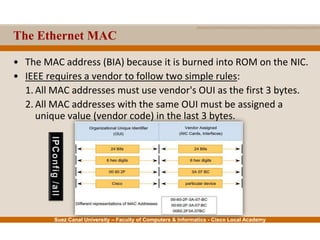
• The MAC address (BIA) because it is burned into ROM on the NIC.
• IEEE requires a vendor to follow two simple rules:
1. All MAC addresses must use vendor's OUI as the first 3 bytes.
2. All MAC addresses with the same OUI must be assigned a
unique value (vendor code) in the last 3 bytes.
Suez Canal University – Faculty of Computers & Informatics - Cisco Local Academy
The Ethernet MAC
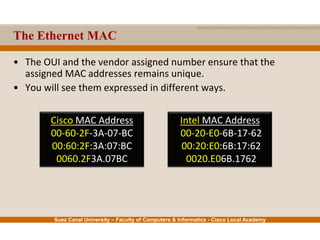
• The OUI and the vendor assigned number ensure that the
assigned MAC addresses remains unique.
• You will see them expressed in different ways.
Cisco MAC Address
00-60-2F-3A-07-BC
00:60:2F:3A:07:BC
0060.2F3A.07BC
Intel MAC Address
00-20-E0-6B-17-62
00:20:E0:6B:17:62
0020.E06B.1762
Suez Canal University – Faculty of Computers & Informatics - Cisco Local Academy
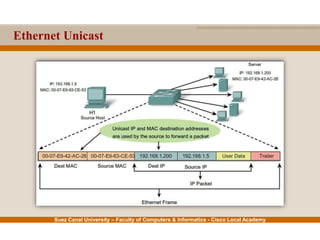
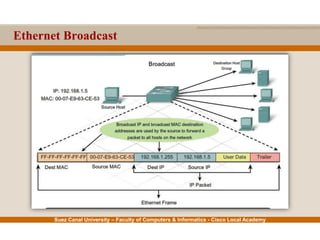
Another layer of Addressing
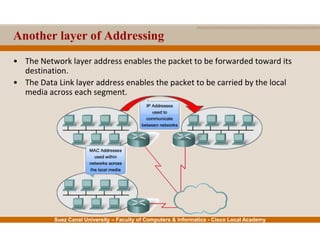
• The Network layer address enables the packet to be forwarded toward its
destination.
• The Data Link layer address enables the packet to be carried by the local
media across each segment.
Suez Canal University – Faculty of Computers & Informatics - Cisco Local Academy
Ethernet Unicast
Suez Canal University – Faculty of Computers & Informatics - Cisco Local Academy
Ethernet Broadcast
Suez Canal University – Faculty of Computers & Informatics - Cisco Local Academy
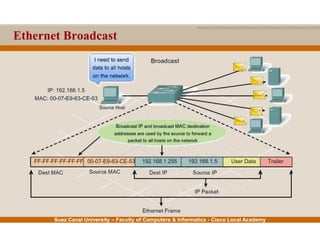
Ethernet Broadcast
Suez Canal University – Faculty of Computers & Informatics - Cisco Local Academy
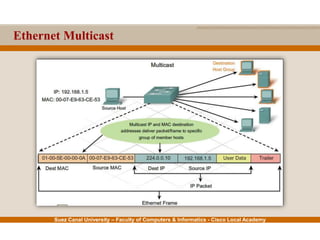
Ethernet Multicast
Suez Canal University – Faculty of Computers & Informatics - Cisco Local Academy
Ethernet Multicast
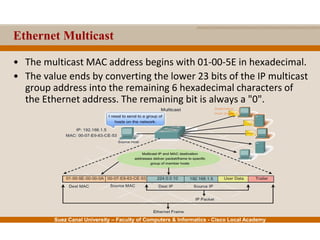
• The multicast MAC address begins with 01-00-5E in hexadecimal.
• The value ends by converting the lower 23 bits of the IP multicast
group address into the remaining 6 hexadecimal characters of
the Ethernet address. The remaining bit is always a "0".
Suez Canal University – Faculty of Computers & Informatics - Cisco Local Academy
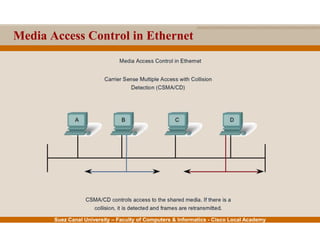
Media Access Control in Ethernet
Suez Canal University – Faculty of Computers & Informatics - Cisco Local Academy
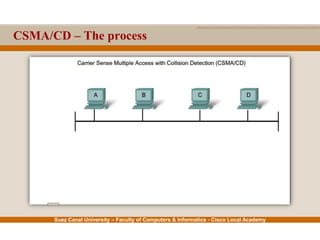
CSMA/CD – The process
Suez Canal University – Faculty of Computers & Informatics - Cisco Local Academy
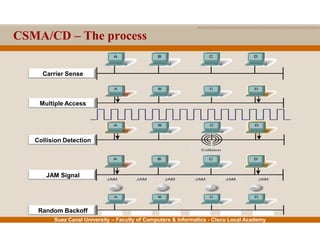
CSMA/CD – The process
Carrier Sense
Multiple Access
Collision Detection
JAM Signal
Random Backoff
Suez Canal University – Faculty of Computers & Informatics - Cisco Local Academy
CSMA/CD – The process
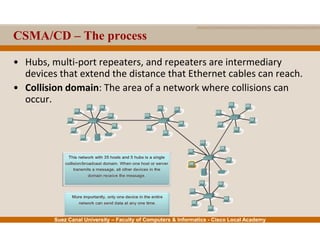
• Hubs, multi-port repeaters, and repeaters are intermediary
devices that extend the distance that Ethernet cables can reach.
• Collision domain: The area of a network where collisions can
occur.
Suez Canal University – Faculty of Computers & Informatics - Cisco Local Academy
Ethernet Timing
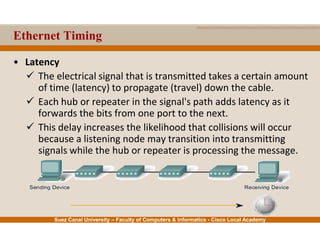
• Latency
 The electrical signal that is transmitted takes a certain amount
of time (latency) to propagate (travel) down the cable.
 Each hub or repeater in the signal's path adds latency as it
forwards the bits from one port to the next.
 This delay increases the likelihood that collisions will occur
because a listening node may transition into transmitting
signals while the hub or repeater is processing the message.
Suez Canal University – Faculty of Computers & Informatics - Cisco Local Academy
Ethernet Timing
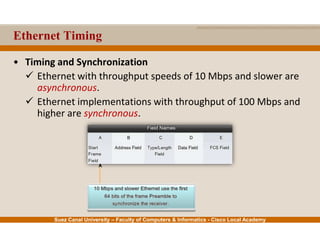
• Timing and Synchronization
 Ethernet with throughput speeds of 10 Mbps and slower are
asynchronous.
 Ethernet implementations with throughput of 100 Mbps and
higher are synchronous.
Suez Canal University – Faculty of Computers & Informatics - Cisco Local Academy
Ethernet Timing
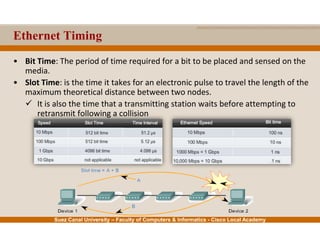
• Bit Time: The period of time required for a bit to be placed and sensed on the
media.
• Slot Time: is the time it takes for an electronic pulse to travel the length of the
maximum theoretical distance between two nodes.
 It is also the time that a transmitting station waits before attempting to
retransmit following a collision
Suez Canal University – Faculty of Computers & Informatics - Cisco Local Academy
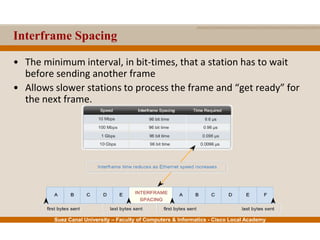
Interframe Spacing
• The minimum interval, in bit-times, that a station has to wait
before sending another frame
• Allows slower stations to process the frame and “get ready” for
the next frame.
Suez Canal University – Faculty of Computers & Informatics - Cisco Local Academy
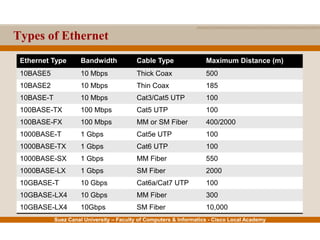
Types of Ethernet
Ethernet Type Bandwidth Cable Type Maximum Distance (m)
10BASE5 10 Mbps Thick Coax 500
10BASE2 10 Mbps Thin Coax 185
10BASE-T 10 Mbps Cat3/Cat5 UTP 100
100BASE-TX 100 Mbps Cat5 UTP 100
100BASE-FX 100 Mbps MM or SM Fiber 400/2000
1000BASE-T 1 Gbps Cat5e UTP 100
1000BASE-TX 1 Gbps Cat6 UTP 100
1000BASE-SX 1 Gbps MM Fiber 550
1000BASE-LX 1 Gbps SM Fiber 2000
10GBASE-T 10 Gbps Cat6a/Cat7 UTP 100
10GBASE-LX4 10 Gbps MM Fiber 300
10GBASE-LX4 10Gbps SM Fiber 10,000
Suez Canal University – Faculty of Computers & Informatics - Cisco Local Academy
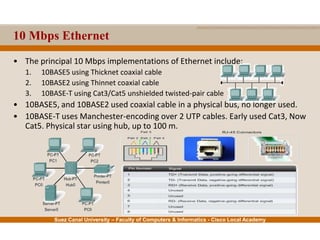
10 Mbps Ethernet
• The principal 10 Mbps implementations of Ethernet include:
1. 10BASE5 using Thicknet coaxial cable
2. 10BASE2 using Thinnet coaxial cable
3. 10BASE-T using Cat3/Cat5 unshielded twisted-pair cable
• 10BASE5, and 10BASE2 used coaxial cable in a physical bus, no longer used.
• 10BASE-T uses Manchester-encoding over 2 UTP cables. Early used Cat3, Now
Cat5. Physical star using hub, up to 100 m.
Suez Canal University – Faculty of Computers & Informatics - Cisco Local Academy
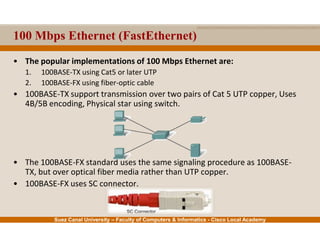
100 Mbps Ethernet (FastEthernet)
• The popular implementations of 100 Mbps Ethernet are:
1. 100BASE-TX using Cat5 or later UTP
2. 100BASE-FX using fiber-optic cable
• 100BASE-TX support transmission over two pairs of Cat 5 UTP copper, Uses
4B/5B encoding, Physical star using switch.
• The 100BASE-FX standard uses the same signaling procedure as 100BASE-
TX, but over optical fiber media rather than UTP copper.
• 100BASE-FX uses SC connector.
Suez Canal University – Faculty of Computers & Informatics - Cisco Local Academy
1000 Mbps Ethernet (GigabitEthernet)
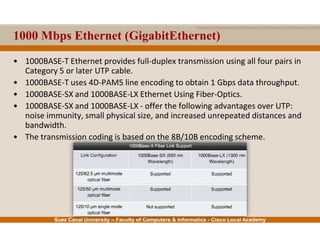
• 1000BASE-T Ethernet provides full-duplex transmission using all four pairs in
Category 5 or later UTP cable.
• 1000BASE-T uses 4D-PAM5 line encoding to obtain 1 Gbps data throughput.
• 1000BASE-SX and 1000BASE-LX Ethernet Using Fiber-Optics.
• 1000BASE-SX and 1000BASE-LX - offer the following advantages over UTP:
noise immunity, small physical size, and increased unrepeated distances and
bandwidth.
• The transmission coding is based on the 8B/10B encoding scheme.
Suez Canal University – Faculty of Computers & Informatics - Cisco Local Academy
Ethernet – Future Options
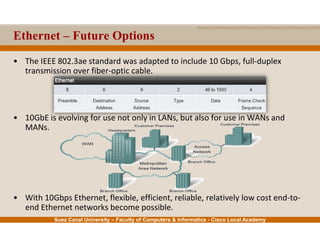
• The IEEE 802.3ae standard was adapted to include 10 Gbps, full-duplex
transmission over fiber-optic cable.
• 10GbE is evolving for use not only in LANs, but also for use in WANs and
MANs.
• With 10Gbps Ethernet, flexible, efficient, reliable, relatively low cost end-to-
end Ethernet networks become possible.
Suez Canal University – Faculty of Computers & Informatics - Cisco Local Academy
Layer 1 Devices
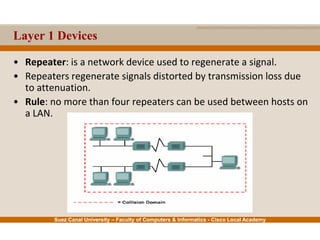
• Repeater: is a network device used to regenerate a signal.
• Repeaters regenerate signals distorted by transmission loss due
to attenuation.
• Rule: no more than four repeaters can be used between hosts on
a LAN.
Suez Canal University – Faculty of Computers & Informatics - Cisco Local Academy
Layer 1 Devices
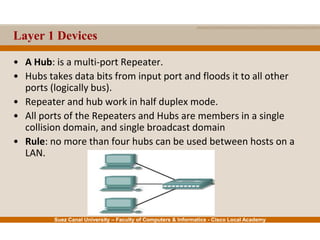
• A Hub: is a multi-port Repeater.
• Hubs takes data bits from input port and floods it to all other
ports (logically bus).
• Repeater and hub work in half duplex mode.
• All ports of the Repeaters and Hubs are members in a single
collision domain, and single broadcast domain
• Rule: no more than four hubs can be used between hosts on a
LAN.
Suez Canal University – Faculty of Computers & Informatics - Cisco Local Academy
Layer 2 devices
• A layer 2 device is a device that understand MAC, for example:
• NIC (Network Interface Card)
• Bridge:
 address learning
 forwarding decisions are based on software
 bridge is used for LAN segmentation
 max. 16 port.
• Switch:
a multi-port bridge up to 256 port
forwarding decisions are based on hardware ASIC
faster than bridge
Suez Canal University – Faculty of Computers & Informatics - Cisco Local Academy

Network Fundamentals: Ch9 - Ethernet

  • 1.
    Suez Canal University– Faculty of Computers & Informatics - Cisco Local Academy Network Fundamentals Abdelkhalik Elsaid Mousa abdu.elsaid@yahoo.com http://abdelkhalik.staff.scuegypt.edu.eg/
  • 2.
    Suez Canal University– Faculty of Computers & Informatics - Cisco Local Academy IEEE - Standards • The first LAN in the world was the original version of Ethernet. • The first Ethernet standard (802.3) was published in 1980. • Ethernet is the predominant LAN technology in use today. • Ethernet standards define both L2 protocols and L1 technologies.
  • 3.
    Suez Canal University– Faculty of Computers & Informatics - Cisco Local Academy Ethernet- L1 and L2
  • 4.
    Suez Canal University– Faculty of Computers & Informatics - Cisco Local Academy Logical Link Control – Connecting to the upper layers • Ethernet separates the functions of the Data Link layer into two distinct sublayers, LLC and MAC. • LLC has the following characteristics  IEEE 802.2.  is implemented in software.  can be considered the driver software for the NIC.
  • 5.
    Suez Canal University– Faculty of Computers & Informatics - Cisco Local Academy MAC – Getting data to the media • IEEE 802.3. • MAC is implemented in hardware. • Typically in the computer NIC. • The underlying logical topology of Ethernet is a multi-access bus.
  • 6.
    Suez Canal University– Faculty of Computers & Informatics - Cisco Local Academy Historic Ethernet • The foundation for Ethernet technology in 1970 was Alohanet. • Alohanet was a digital radio network that transmits information over a shared radio frequency between the Hawaiian Islands. • The techniques for using a shared medium were later applied to wired technology in the form of Ethernet.
  • 7.
    Suez Canal University– Faculty of Computers & Informatics - Cisco Local Academy Early Ethernet Media • Used coaxial cable to connect computers in a bus topology. • It was known as Thicknet (10BASE5) and Thinnet (10BASE2).
  • 8.
    Suez Canal University– Faculty of Computers & Informatics - Cisco Local Academy Ethernet Collision Management • Legacy Ethernet  Based on hubs.  10BASE-T networks.  half-duplex communication.  Uses CSMA/CD. • Current Ethernet  Based on switches.  100BASE-TX.  Full-duplex communication.  Gigabit Ethernet.
  • 9.
    Suez Canal University– Faculty of Computers & Informatics - Cisco Local Academy The Frame – Encapsulating the packet • There are two styles of Ethernet framing: IEEE 802.3 (original) and the revised IEEE 802.3 (Ethernet). • The IEEE 802.3ac standard, released in 1998, extended the maximum allowable frame size to 1522 bytes.
  • 10.
    Suez Canal University– Faculty of Computers & Informatics - Cisco Local Academy The Ethernet MAC • The MAC address (BIA) because it is burned into ROM on the NIC. • IEEE requires a vendor to follow two simple rules: 1. All MAC addresses must use vendor's OUI as the first 3 bytes. 2. All MAC addresses with the same OUI must be assigned a unique value (vendor code) in the last 3 bytes.
  • 11.
    Suez Canal University– Faculty of Computers & Informatics - Cisco Local Academy The Ethernet MAC • The OUI and the vendor assigned number ensure that the assigned MAC addresses remains unique. • You will see them expressed in different ways. Cisco MAC Address 00-60-2F-3A-07-BC 00:60:2F:3A:07:BC 0060.2F3A.07BC Intel MAC Address 00-20-E0-6B-17-62 00:20:E0:6B:17:62 0020.E06B.1762
  • 12.
    Suez Canal University– Faculty of Computers & Informatics - Cisco Local Academy Another layer of Addressing • The Network layer address enables the packet to be forwarded toward its destination. • The Data Link layer address enables the packet to be carried by the local media across each segment.
  • 13.
    Suez Canal University– Faculty of Computers & Informatics - Cisco Local Academy Ethernet Unicast
  • 14.
    Suez Canal University– Faculty of Computers & Informatics - Cisco Local Academy Ethernet Broadcast
  • 15.
    Suez Canal University– Faculty of Computers & Informatics - Cisco Local Academy Ethernet Broadcast
  • 16.
    Suez Canal University– Faculty of Computers & Informatics - Cisco Local Academy Ethernet Multicast
  • 17.
    Suez Canal University– Faculty of Computers & Informatics - Cisco Local Academy Ethernet Multicast • The multicast MAC address begins with 01-00-5E in hexadecimal. • The value ends by converting the lower 23 bits of the IP multicast group address into the remaining 6 hexadecimal characters of the Ethernet address. The remaining bit is always a "0".
  • 18.
    Suez Canal University– Faculty of Computers & Informatics - Cisco Local Academy Media Access Control in Ethernet
  • 19.
    Suez Canal University– Faculty of Computers & Informatics - Cisco Local Academy CSMA/CD – The process
  • 20.
    Suez Canal University– Faculty of Computers & Informatics - Cisco Local Academy CSMA/CD – The process Carrier Sense Multiple Access Collision Detection JAM Signal Random Backoff
  • 21.
    Suez Canal University– Faculty of Computers & Informatics - Cisco Local Academy CSMA/CD – The process • Hubs, multi-port repeaters, and repeaters are intermediary devices that extend the distance that Ethernet cables can reach. • Collision domain: The area of a network where collisions can occur.
  • 22.
    Suez Canal University– Faculty of Computers & Informatics - Cisco Local Academy Ethernet Timing • Latency  The electrical signal that is transmitted takes a certain amount of time (latency) to propagate (travel) down the cable.  Each hub or repeater in the signal's path adds latency as it forwards the bits from one port to the next.  This delay increases the likelihood that collisions will occur because a listening node may transition into transmitting signals while the hub or repeater is processing the message.
  • 23.
    Suez Canal University– Faculty of Computers & Informatics - Cisco Local Academy Ethernet Timing • Timing and Synchronization  Ethernet with throughput speeds of 10 Mbps and slower are asynchronous.  Ethernet implementations with throughput of 100 Mbps and higher are synchronous.
  • 24.
    Suez Canal University– Faculty of Computers & Informatics - Cisco Local Academy Ethernet Timing • Bit Time: The period of time required for a bit to be placed and sensed on the media. • Slot Time: is the time it takes for an electronic pulse to travel the length of the maximum theoretical distance between two nodes.  It is also the time that a transmitting station waits before attempting to retransmit following a collision
  • 25.
    Suez Canal University– Faculty of Computers & Informatics - Cisco Local Academy Interframe Spacing • The minimum interval, in bit-times, that a station has to wait before sending another frame • Allows slower stations to process the frame and “get ready” for the next frame.
  • 26.
    Suez Canal University– Faculty of Computers & Informatics - Cisco Local Academy Types of Ethernet Ethernet Type Bandwidth Cable Type Maximum Distance (m) 10BASE5 10 Mbps Thick Coax 500 10BASE2 10 Mbps Thin Coax 185 10BASE-T 10 Mbps Cat3/Cat5 UTP 100 100BASE-TX 100 Mbps Cat5 UTP 100 100BASE-FX 100 Mbps MM or SM Fiber 400/2000 1000BASE-T 1 Gbps Cat5e UTP 100 1000BASE-TX 1 Gbps Cat6 UTP 100 1000BASE-SX 1 Gbps MM Fiber 550 1000BASE-LX 1 Gbps SM Fiber 2000 10GBASE-T 10 Gbps Cat6a/Cat7 UTP 100 10GBASE-LX4 10 Gbps MM Fiber 300 10GBASE-LX4 10Gbps SM Fiber 10,000
  • 27.
    Suez Canal University– Faculty of Computers & Informatics - Cisco Local Academy 10 Mbps Ethernet • The principal 10 Mbps implementations of Ethernet include: 1. 10BASE5 using Thicknet coaxial cable 2. 10BASE2 using Thinnet coaxial cable 3. 10BASE-T using Cat3/Cat5 unshielded twisted-pair cable • 10BASE5, and 10BASE2 used coaxial cable in a physical bus, no longer used. • 10BASE-T uses Manchester-encoding over 2 UTP cables. Early used Cat3, Now Cat5. Physical star using hub, up to 100 m.
  • 28.
    Suez Canal University– Faculty of Computers & Informatics - Cisco Local Academy 100 Mbps Ethernet (FastEthernet) • The popular implementations of 100 Mbps Ethernet are: 1. 100BASE-TX using Cat5 or later UTP 2. 100BASE-FX using fiber-optic cable • 100BASE-TX support transmission over two pairs of Cat 5 UTP copper, Uses 4B/5B encoding, Physical star using switch. • The 100BASE-FX standard uses the same signaling procedure as 100BASE- TX, but over optical fiber media rather than UTP copper. • 100BASE-FX uses SC connector.
  • 29.
    Suez Canal University– Faculty of Computers & Informatics - Cisco Local Academy 1000 Mbps Ethernet (GigabitEthernet) • 1000BASE-T Ethernet provides full-duplex transmission using all four pairs in Category 5 or later UTP cable. • 1000BASE-T uses 4D-PAM5 line encoding to obtain 1 Gbps data throughput. • 1000BASE-SX and 1000BASE-LX Ethernet Using Fiber-Optics. • 1000BASE-SX and 1000BASE-LX - offer the following advantages over UTP: noise immunity, small physical size, and increased unrepeated distances and bandwidth. • The transmission coding is based on the 8B/10B encoding scheme.
  • 30.
    Suez Canal University– Faculty of Computers & Informatics - Cisco Local Academy Ethernet – Future Options • The IEEE 802.3ae standard was adapted to include 10 Gbps, full-duplex transmission over fiber-optic cable. • 10GbE is evolving for use not only in LANs, but also for use in WANs and MANs. • With 10Gbps Ethernet, flexible, efficient, reliable, relatively low cost end-to- end Ethernet networks become possible.
  • 31.
    Suez Canal University– Faculty of Computers & Informatics - Cisco Local Academy Layer 1 Devices • Repeater: is a network device used to regenerate a signal. • Repeaters regenerate signals distorted by transmission loss due to attenuation. • Rule: no more than four repeaters can be used between hosts on a LAN.
  • 32.
    Suez Canal University– Faculty of Computers & Informatics - Cisco Local Academy Layer 1 Devices • A Hub: is a multi-port Repeater. • Hubs takes data bits from input port and floods it to all other ports (logically bus). • Repeater and hub work in half duplex mode. • All ports of the Repeaters and Hubs are members in a single collision domain, and single broadcast domain • Rule: no more than four hubs can be used between hosts on a LAN.
  • 33.
    Suez Canal University– Faculty of Computers & Informatics - Cisco Local Academy Layer 2 devices • A layer 2 device is a device that understand MAC, for example: • NIC (Network Interface Card) • Bridge:  address learning  forwarding decisions are based on software  bridge is used for LAN segmentation  max. 16 port. • Switch: a multi-port bridge up to 256 port forwarding decisions are based on hardware ASIC faster than bridge
  • 34.
    Suez Canal University– Faculty of Computers & Informatics - Cisco Local Academy