Suez Canal University – Faculty of Computers & Informatics - Cisco Local Academy
Network Fundamentals
Abdelkhalik Elsaid Mosa
abdu.elsaid@yahoo.com
abdelkhalik.staff.scuegypt.edu.eg
Suez Canal University – Faculty of Computers & Informatics - Cisco Local Academy
Introduction
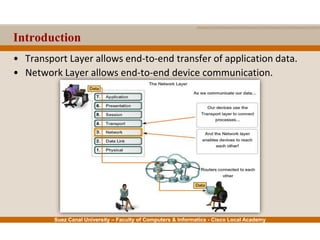
• Transport Layer allows end-to-end transfer of application data.
• Network Layer allows end-to-end device communication.
Suez Canal University – Faculty of Computers & Informatics - Cisco Local Academy
Network Layer – Communication from host to host
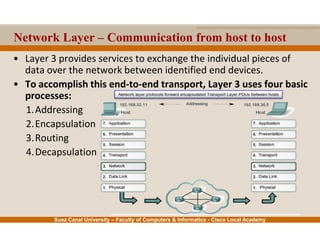
• Layer 3 provides services to exchange the individual pieces of
data over the network between identified end devices.
• To accomplish this end-to-end transport, Layer 3 uses four basic
processes:
1.Addressing
2.Encapsulation
3.Routing
4.Decapsulation
Suez Canal University – Faculty of Computers & Informatics - Cisco Local Academy
Network Layer Protocols
• Routed Protocols: carry user data
1. Internet Protocol version 4(IP v4), IP v6.
2. Novell Internetwork Packet Exchange (IPX).
3. AppleTalk.
4. Connectionless Network Service (CLNS/DECNet).
• Routing Protocols: direct packet to destination
1. RIP, BGP “application layer Protocols”
2. IGRP, EIGRP
3. OSPF
4. IS-IS
• Other supporting protocols
1. ICMP
2. ARP
Suez Canal University – Faculty of Computers & Informatics - Cisco Local Academy
IP v4 Characteristics
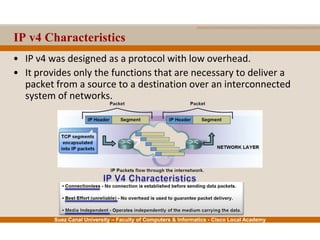
• IP v4 was designed as a protocol with low overhead.
• It provides only the functions that are necessary to deliver a
packet from a source to a destination over an interconnected
system of networks.
Suez Canal University – Faculty of Computers & Informatics - Cisco Local Academy
Connectionless
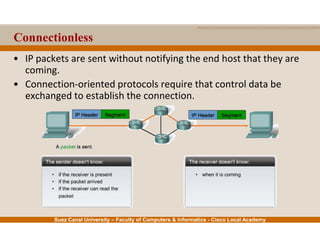
• IP packets are sent without notifying the end host that they are
coming.
• Connection-oriented protocols require that control data be
exchanged to establish the connection.
Suez Canal University – Faculty of Computers & Informatics - Cisco Local Academy
Best effort «Unreliable»
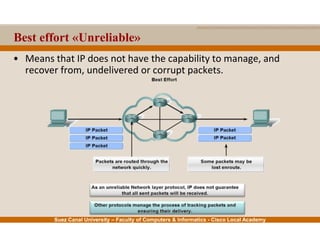
• Means that IP does not have the capability to manage, and
recover from, undelivered or corrupt packets.
Suez Canal University – Faculty of Computers & Informatics - Cisco Local Academy
Media Independent
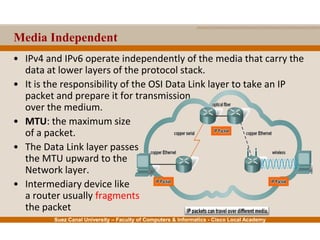
• IPv4 and IPv6 operate independently of the media that carry the
data at lower layers of the protocol stack.
• It is the responsibility of the OSI Data Link layer to take an IP
packet and prepare it for transmission
over the medium.
• MTU: the maximum size
of a packet.
• The Data Link layer passes
the MTU upward to the
Network layer.
• Intermediary device like
a router usually fragments
the packet
Suez Canal University – Faculty of Computers & Informatics - Cisco Local Academy
IP v4 Packet Header
Suez Canal University – Faculty of Computers & Informatics - Cisco Local Academy
IP v4 Packet Header
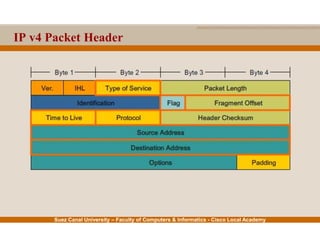
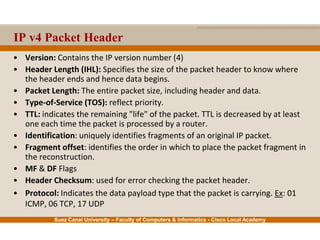
• Version: Contains the IP version number (4)
• Header Length (IHL): Specifies the size of the packet header to know where
the header ends and hence data begins.
• Packet Length: The entire packet size, including header and data.
• Type-of-Service (TOS): reflect priority.
• TTL: indicates the remaining "life" of the packet. TTL is decreased by at least
one each time the packet is processed by a router.
• Identification: uniquely identifies fragments of an original IP packet.
• Fragment offset: identifies the order in which to place the packet fragment in
the reconstruction.
• MF & DF Flags
• Header Checksum: used for error checking the packet header.
• Protocol: Indicates the data payload type that the packet is carrying. Ex: 01
ICMP, 06 TCP, 17 UDP
Suez Canal University – Faculty of Computers & Informatics - Cisco Local Academy
IP Fragmentation
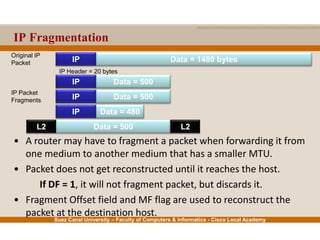
• A router may have to fragment a packet when forwarding it from
one medium to another medium that has a smaller MTU.
• Packet does not get reconstructed until it reaches the host.
If DF = 1, it will not fragment packet, but discards it.
• Fragment Offset field and MF flag are used to reconstruct the
packet at the destination host.
Data = 1480 bytesIP
Data = 500IP
Data = 480IP
IP Packet
Fragments
Original IP
Packet
IP Header = 20 bytes
Data = 500IP
Data = 500L2 L2
Suez Canal University – Faculty of Computers & Informatics - Cisco Local Academy
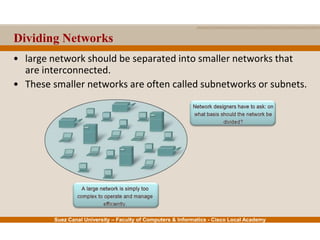
Dividing Networks
• large network should be separated into smaller networks that
are interconnected.
• These smaller networks are often called subnetworks or subnets.
Suez Canal University – Faculty of Computers & Informatics - Cisco Local Academy
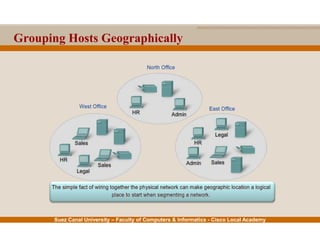
Grouping Hosts Geographically
Suez Canal University – Faculty of Computers & Informatics - Cisco Local Academy
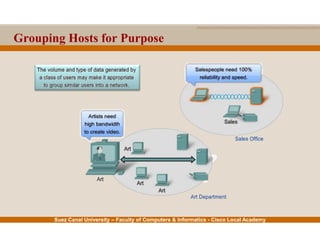
Grouping Hosts for Purpose
Suez Canal University – Faculty of Computers & Informatics - Cisco Local Academy
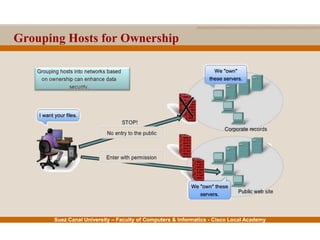
Grouping Hosts for Ownership
Suez Canal University – Faculty of Computers & Informatics - Cisco Local Academy
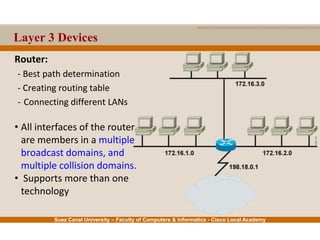
Layer 3 Devices
Router:
- Best path determination
- Creating routing table
- Connecting different LANs
• All interfaces of the router
are members in a multiple
broadcast domains, and
multiple collision domains.
• Supports more than one
technology
Suez Canal University – Faculty of Computers & Informatics - Cisco Local Academy
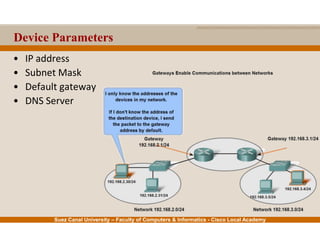
Device Parameters
• IP address
• Subnet Mask
• Default gateway
• DNS Server
Suez Canal University – Faculty of Computers & Informatics - Cisco Local Academy
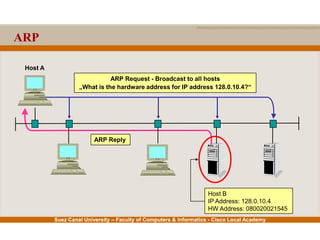
ARP
SIEMENS
NIXDORF
SIEMENS
NIXDORF
Host A
Host B
IP Address: 128.0.10.4
HW Address: 080020021545
ARP Reply
ARP Request - Broadcast to all hosts
„What is the hardware address for IP address 128.0.10.4?“
SIEMENS
NIXDORF
Suez Canal University – Faculty of Computers & Informatics - Cisco Local Academy

Network Fundamentals: Ch5 - Network Layer

  • 1.
    Suez Canal University– Faculty of Computers & Informatics - Cisco Local Academy Network Fundamentals Abdelkhalik Elsaid Mosa abdu.elsaid@yahoo.com abdelkhalik.staff.scuegypt.edu.eg
  • 2.
    Suez Canal University– Faculty of Computers & Informatics - Cisco Local Academy Introduction • Transport Layer allows end-to-end transfer of application data. • Network Layer allows end-to-end device communication.
  • 3.
    Suez Canal University– Faculty of Computers & Informatics - Cisco Local Academy Network Layer – Communication from host to host • Layer 3 provides services to exchange the individual pieces of data over the network between identified end devices. • To accomplish this end-to-end transport, Layer 3 uses four basic processes: 1.Addressing 2.Encapsulation 3.Routing 4.Decapsulation
  • 4.
    Suez Canal University– Faculty of Computers & Informatics - Cisco Local Academy Network Layer Protocols • Routed Protocols: carry user data 1. Internet Protocol version 4(IP v4), IP v6. 2. Novell Internetwork Packet Exchange (IPX). 3. AppleTalk. 4. Connectionless Network Service (CLNS/DECNet). • Routing Protocols: direct packet to destination 1. RIP, BGP “application layer Protocols” 2. IGRP, EIGRP 3. OSPF 4. IS-IS • Other supporting protocols 1. ICMP 2. ARP
  • 5.
    Suez Canal University– Faculty of Computers & Informatics - Cisco Local Academy IP v4 Characteristics • IP v4 was designed as a protocol with low overhead. • It provides only the functions that are necessary to deliver a packet from a source to a destination over an interconnected system of networks.
  • 6.
    Suez Canal University– Faculty of Computers & Informatics - Cisco Local Academy Connectionless • IP packets are sent without notifying the end host that they are coming. • Connection-oriented protocols require that control data be exchanged to establish the connection.
  • 7.
    Suez Canal University– Faculty of Computers & Informatics - Cisco Local Academy Best effort «Unreliable» • Means that IP does not have the capability to manage, and recover from, undelivered or corrupt packets.
  • 8.
    Suez Canal University– Faculty of Computers & Informatics - Cisco Local Academy Media Independent • IPv4 and IPv6 operate independently of the media that carry the data at lower layers of the protocol stack. • It is the responsibility of the OSI Data Link layer to take an IP packet and prepare it for transmission over the medium. • MTU: the maximum size of a packet. • The Data Link layer passes the MTU upward to the Network layer. • Intermediary device like a router usually fragments the packet
  • 9.
    Suez Canal University– Faculty of Computers & Informatics - Cisco Local Academy IP v4 Packet Header
  • 10.
    Suez Canal University– Faculty of Computers & Informatics - Cisco Local Academy IP v4 Packet Header • Version: Contains the IP version number (4) • Header Length (IHL): Specifies the size of the packet header to know where the header ends and hence data begins. • Packet Length: The entire packet size, including header and data. • Type-of-Service (TOS): reflect priority. • TTL: indicates the remaining "life" of the packet. TTL is decreased by at least one each time the packet is processed by a router. • Identification: uniquely identifies fragments of an original IP packet. • Fragment offset: identifies the order in which to place the packet fragment in the reconstruction. • MF & DF Flags • Header Checksum: used for error checking the packet header. • Protocol: Indicates the data payload type that the packet is carrying. Ex: 01 ICMP, 06 TCP, 17 UDP
  • 11.
    Suez Canal University– Faculty of Computers & Informatics - Cisco Local Academy IP Fragmentation • A router may have to fragment a packet when forwarding it from one medium to another medium that has a smaller MTU. • Packet does not get reconstructed until it reaches the host. If DF = 1, it will not fragment packet, but discards it. • Fragment Offset field and MF flag are used to reconstruct the packet at the destination host. Data = 1480 bytesIP Data = 500IP Data = 480IP IP Packet Fragments Original IP Packet IP Header = 20 bytes Data = 500IP Data = 500L2 L2
  • 12.
    Suez Canal University– Faculty of Computers & Informatics - Cisco Local Academy Dividing Networks • large network should be separated into smaller networks that are interconnected. • These smaller networks are often called subnetworks or subnets.
  • 13.
    Suez Canal University– Faculty of Computers & Informatics - Cisco Local Academy Grouping Hosts Geographically
  • 14.
    Suez Canal University– Faculty of Computers & Informatics - Cisco Local Academy Grouping Hosts for Purpose
  • 15.
    Suez Canal University– Faculty of Computers & Informatics - Cisco Local Academy Grouping Hosts for Ownership
  • 16.
    Suez Canal University– Faculty of Computers & Informatics - Cisco Local Academy Layer 3 Devices Router: - Best path determination - Creating routing table - Connecting different LANs • All interfaces of the router are members in a multiple broadcast domains, and multiple collision domains. • Supports more than one technology
  • 17.
    Suez Canal University– Faculty of Computers & Informatics - Cisco Local Academy Device Parameters • IP address • Subnet Mask • Default gateway • DNS Server
  • 18.
    Suez Canal University– Faculty of Computers & Informatics - Cisco Local Academy ARP SIEMENS NIXDORF SIEMENS NIXDORF Host A Host B IP Address: 128.0.10.4 HW Address: 080020021545 ARP Reply ARP Request - Broadcast to all hosts „What is the hardware address for IP address 128.0.10.4?“ SIEMENS NIXDORF
  • 19.
    Suez Canal University– Faculty of Computers & Informatics - Cisco Local Academy