Suez Canal University – Faculty of Computers & Informatics - Cisco Local Academy
Network Fundamentals
Abdelkhalik Elsaid Mosa
abdu.elsaid@yahoo.com
http://abdelkhalik.staff.scuegypt.edu.eg/
Last Update: 20-07-2011
Suez Canal University – Faculty of Computers & Informatics - Cisco Local Academy
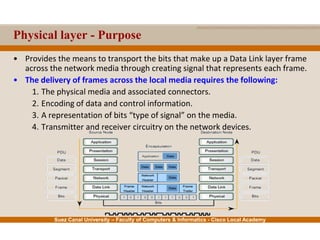
Physical layer - Purpose
• Provides the means to transport the bits that make up a Data Link layer frame
across the network media through creating signal that represents each frame.
• The delivery of frames across the local media requires the following:
1. The physical media and associated connectors.
2. Encoding of data and control information.
3. A representation of bits “type of signal” on the media.
4. Transmitter and receiver circuitry on the network devices.
Suez Canal University – Faculty of Computers & Informatics - Cisco Local Academy
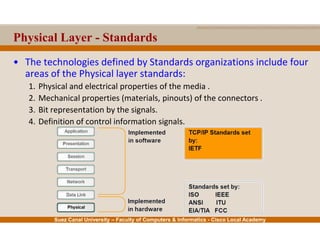
Physical Layer - Standards
• The technologies defined by Standards organizations include four
areas of the Physical layer standards:
1. Physical and electrical properties of the media .
2. Mechanical properties (materials, pinouts) of the connectors .
3. Bit representation by the signals.
4. Definition of control information signals.
Suez Canal University – Faculty of Computers & Informatics - Cisco Local Academy
Physical Layer – Fundamental Principles
• The three fundamental functions of the Physical layer are:
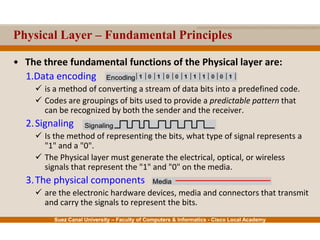
1.Data encoding
 is a method of converting a stream of data bits into a predefined code.
 Codes are groupings of bits used to provide a predictable pattern that
can be recognized by both the sender and the receiver.
2.Signaling
 Is the method of representing the bits, what type of signal represents a
"1" and a "0".
 The Physical layer must generate the electrical, optical, or wireless
signals that represent the "1" and "0" on the media.
3.The physical components
 are the electronic hardware devices, media and connectors that transmit
and carry the signals to represent the bits.
Suez Canal University – Faculty of Computers & Informatics - Cisco Local Academy
Encoding – Grouping Bits
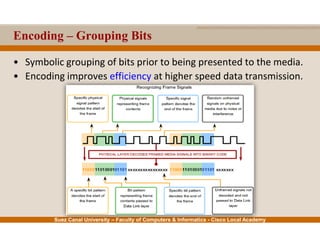
• Symbolic grouping of bits prior to being presented to the media.
• Encoding improves efficiency at higher speed data transmission.
Suez Canal University – Faculty of Computers & Informatics - Cisco Local Academy
Encoding – Grouping Bits
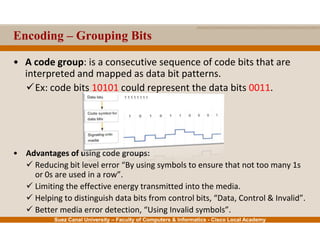
• A code group: is a consecutive sequence of code bits that are
interpreted and mapped as data bit patterns.
Ex: code bits 10101 could represent the data bits 0011.
• Advantages of using code groups:
 Reducing bit level error “By using symbols to ensure that not too many 1s
or 0s are used in a row”.
 Limiting the effective energy transmitted into the media.
 Helping to distinguish data bits from control bits, “Data, Control & Invalid”.
 Better media error detection, “Using Invalid symbols”.
Suez Canal University – Faculty of Computers & Informatics - Cisco Local Academy
4B/5B code symbols
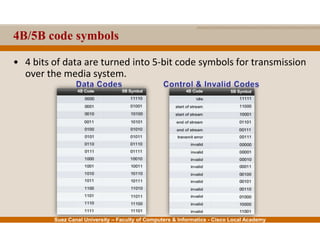
• 4 bits of data are turned into 5-bit code symbols for transmission
over the media system.
Suez Canal University – Faculty of Computers & Informatics - Cisco Local Academy
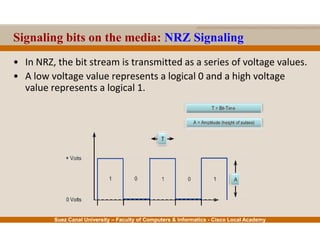
Signaling bits on the media: NRZ Signaling
• In NRZ, the bit stream is transmitted as a series of voltage values.
• A low voltage value represents a logical 0 and a high voltage
value represents a logical 1.
Suez Canal University – Faculty of Computers & Informatics - Cisco Local Academy
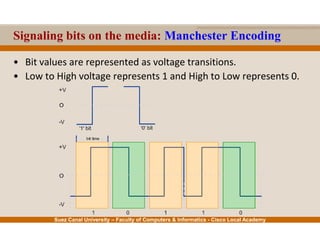
Signaling bits on the media: Manchester Encoding
• Bit values are represented as voltage transitions.
• Low to High voltage represents 1 and High to Low represents 0.
Suez Canal University – Faculty of Computers & Informatics - Cisco Local Academy
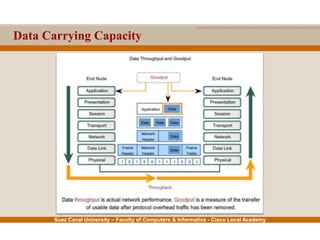
Data Carrying Capacity
• Data Transfer can be measured in 3 ways:
1. Bandwidth (Theoretical): The capacity of a medium to carry
data in a given amount of time.
Usually measured in kbps or Mbps.
2. Throughput (Practical): is the measure of the transfer of bits
across the media over a given period of time.
Throughput <= Bandwidth.
 Number of devices affect the throughput.
3. Goodput (Qualitative): is the measure of usable data
transferred over a given period of time.
Application level throughput.
Goodput = Throughput - traffic overhead for establishing sessions,
acknowledgements, and encapsulation.
Suez Canal University – Faculty of Computers & Informatics - Cisco Local Academy
Data Carrying Capacity
Suez Canal University – Faculty of Computers & Informatics - Cisco Local Academy
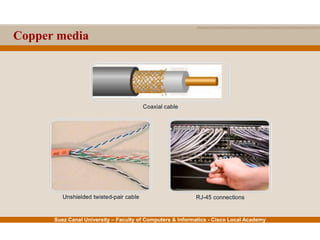
Copper media
Suez Canal University – Faculty of Computers & Informatics - Cisco Local Academy
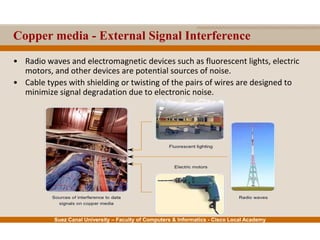
Copper media - External Signal Interference
• Radio waves and electromagnetic devices such as fluorescent lights, electric
motors, and other devices are potential sources of noise.
• Cable types with shielding or twisting of the pairs of wires are designed to
minimize signal degradation due to electronic noise.
Suez Canal University – Faculty of Computers & Informatics - Cisco Local Academy
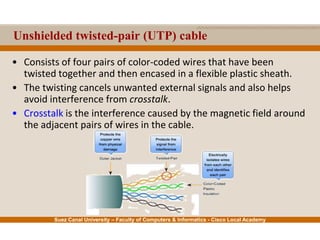
Unshielded twisted-pair (UTP) cable
• Consists of four pairs of color-coded wires that have been
twisted together and then encased in a flexible plastic sheath.
• The twisting cancels unwanted external signals and also helps
avoid interference from crosstalk.
• Crosstalk is the interference caused by the magnetic field around
the adjacent pairs of wires in the cable.
Suez Canal University – Faculty of Computers & Informatics - Cisco Local Academy
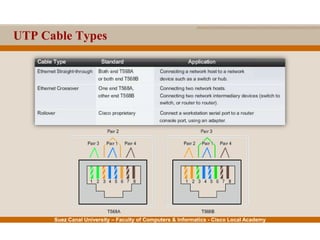
UTP Cable Types
Suez Canal University – Faculty of Computers & Informatics - Cisco Local Academy
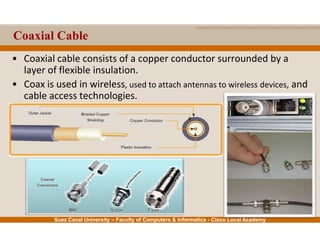
Coaxial Cable
• Coaxial cable consists of a copper conductor surrounded by a
layer of flexible insulation.
• Coax is used in wireless, used to attach antennas to wireless devices, and
cable access technologies.
Suez Canal University – Faculty of Computers & Informatics - Cisco Local Academy
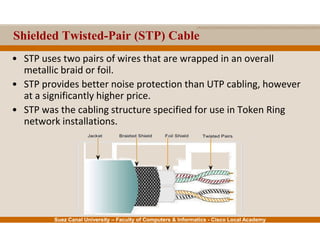
Shielded Twisted-Pair (STP) Cable
• STP uses two pairs of wires that are wrapped in an overall
metallic braid or foil.
• STP provides better noise protection than UTP cabling, however
at a significantly higher price.
• STP was the cabling structure specified for use in Token Ring
network installations.
Suez Canal University – Faculty of Computers & Informatics - Cisco Local Academy
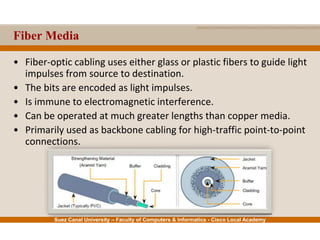
Fiber Media
• Fiber-optic cabling uses either glass or plastic fibers to guide light
impulses from source to destination.
• The bits are encoded as light impulses.
• Is immune to electromagnetic interference.
• Can be operated at much greater lengths than copper media.
• Primarily used as backbone cabling for high-traffic point-to-point
connections.
Suez Canal University – Faculty of Computers & Informatics - Cisco Local Academy
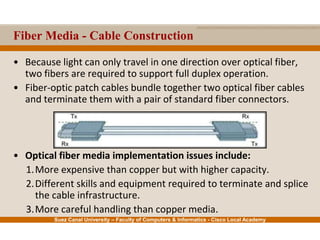
Fiber Media - Cable Construction
• Because light can only travel in one direction over optical fiber,
two fibers are required to support full duplex operation.
• Fiber-optic patch cables bundle together two optical fiber cables
and terminate them with a pair of standard fiber connectors.
• Optical fiber media implementation issues include:
1.More expensive than copper but with higher capacity.
2.Different skills and equipment required to terminate and splice
the cable infrastructure.
3.More careful handling than copper media.
Suez Canal University – Faculty of Computers & Informatics - Cisco Local Academy
Generating and Detecting the Optical Signal
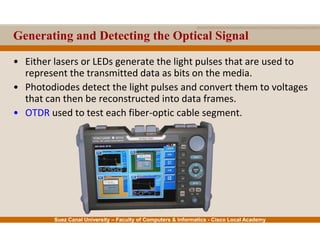
• Either lasers or LEDs generate the light pulses that are used to
represent the transmitted data as bits on the media.
• Photodiodes detect the light pulses and convert them to voltages
that can then be reconstructed into data frames.
• OTDR used to test each fiber-optic cable segment.
Suez Canal University – Faculty of Computers & Informatics - Cisco Local Academy
Single-mode Fiber Cable
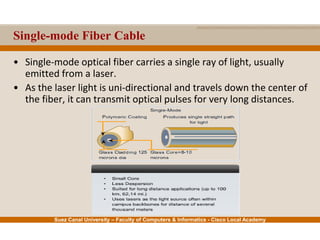
• Single-mode optical fiber carries a single ray of light, usually
emitted from a laser.
• As the laser light is uni-directional and travels down the center of
the fiber, it can transmit optical pulses for very long distances.
Suez Canal University – Faculty of Computers & Informatics - Cisco Local Academy
Multi-mode Fiber Cable
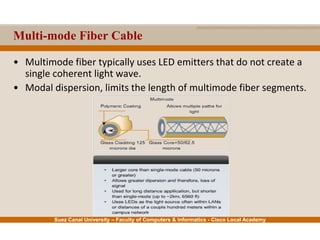
• Multimode fiber typically uses LED emitters that do not create a
single coherent light wave.
• Modal dispersion, limits the length of multimode fiber segments.
Suez Canal University – Faculty of Computers & Informatics - Cisco Local Academy
Wireless media
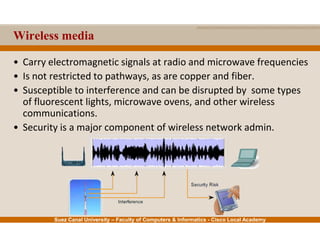
• Carry electromagnetic signals at radio and microwave frequencies
• Is not restricted to pathways, as are copper and fiber.
• Susceptible to interference and can be disrupted by some types
of fluorescent lights, microwave ovens, and other wireless
communications.
• Security is a major component of wireless network admin.
Suez Canal University – Faculty of Computers & Informatics - Cisco Local Academy
Types of Wireless Networks
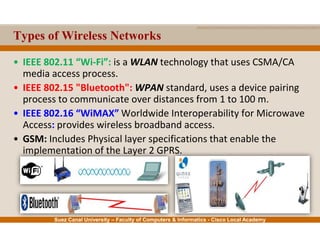
• IEEE 802.11 “Wi-Fi”: is a WLAN technology that uses CSMA/CA
media access process.
• IEEE 802.15 "Bluetooth": WPAN standard, uses a device pairing
process to communicate over distances from 1 to 100 m.
• IEEE 802.16 “WiMAX” Worldwide Interoperability for Microwave
Access: provides wireless broadband access.
• GSM: Includes Physical layer specifications that enable the
implementation of the Layer 2 GPRS.
Suez Canal University – Faculty of Computers & Informatics - Cisco Local Academy
The Wireless LAN
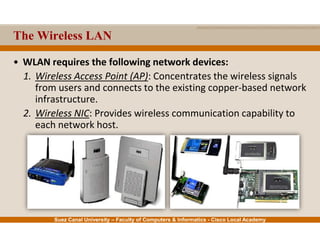
• WLAN requires the following network devices:
1. Wireless Access Point (AP): Concentrates the wireless signals
from users and connects to the existing copper-based network
infrastructure.
2. Wireless NIC: Provides wireless communication capability to
each network host.
Suez Canal University – Faculty of Computers & Informatics - Cisco Local Academy
WLAN Standards include
1.IEEE 802.11a: Operates in the 5 GHz frequency.
• Speed up to 54 Mbps.
• Smaller coverage area and less effective at penetrating buildings.
• Not interoperable with the 802.11b and 802.11g.
2. IEEE 802.11b: Operates in the 2.4 GHz frequency.
• Speed up to 11 Mbps.
• Have a longer range and are better able to penetrate building structures
than devices based on 802.11a.
3. IEEE 802.11g: Operates in the 2.4 GHz frequency.
• Speed up to 54 Mbps.
4. IEEE 802.11n: The newest, defines frequency of 2.4 GHz or 5 GHz.
• The typical expected data rates are 100 Mbps to 210 Mbps with a
distance range of up to 70 meters.
Suez Canal University – Faculty of Computers & Informatics - Cisco Local Academy
Media Connectors - Common Copper Media Connectors
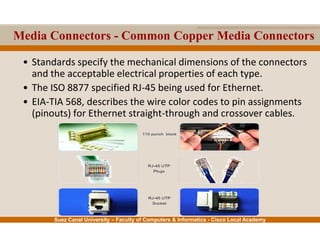
• Standards specify the mechanical dimensions of the connectors
and the acceptable electrical properties of each type.
• The ISO 8877 specified RJ-45 being used for Ethernet.
• EIA-TIA 568, describes the wire color codes to pin assignments
(pinouts) for Ethernet straight-through and crossover cables.
Suez Canal University – Faculty of Computers & Informatics - Cisco Local Academy
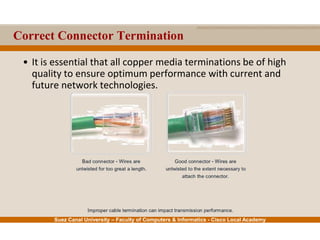
Correct Connector Termination
• It is essential that all copper media terminations be of high
quality to ensure optimum performance with current and
future network technologies.
Suez Canal University – Faculty of Computers & Informatics - Cisco Local Academy
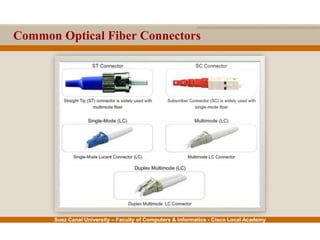
Common Optical Fiber Connectors
Suez Canal University – Faculty of Computers & Informatics - Cisco Local Academy
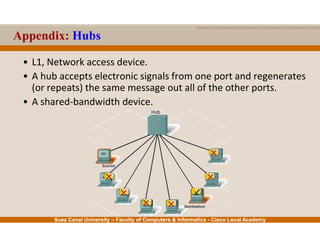
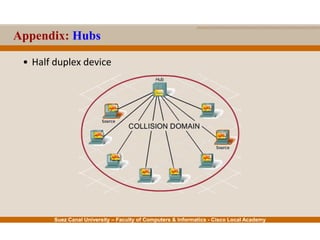
Appendix: Hubs
• L1, Network access device.
• A hub accepts electronic signals from one port and regenerates
(or repeats) the same message out all of the other ports.
• A shared-bandwidth device.
Suez Canal University – Faculty of Computers & Informatics - Cisco Local Academy
Appendix: Hubs
• Half duplex device
Suez Canal University – Faculty of Computers & Informatics - Cisco Local Academy
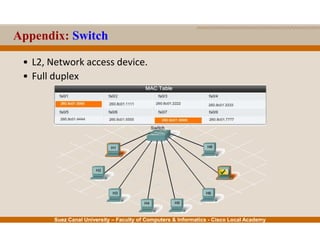
Appendix: Switch
• L2, Network access device.
• Full duplex

Network Fundamentals: Ch8 - Physical Layer

  • 1.
    Suez Canal University– Faculty of Computers & Informatics - Cisco Local Academy Network Fundamentals Abdelkhalik Elsaid Mosa abdu.elsaid@yahoo.com http://abdelkhalik.staff.scuegypt.edu.eg/ Last Update: 20-07-2011
  • 2.
    Suez Canal University– Faculty of Computers & Informatics - Cisco Local Academy Physical layer - Purpose • Provides the means to transport the bits that make up a Data Link layer frame across the network media through creating signal that represents each frame. • The delivery of frames across the local media requires the following: 1. The physical media and associated connectors. 2. Encoding of data and control information. 3. A representation of bits “type of signal” on the media. 4. Transmitter and receiver circuitry on the network devices.
  • 3.
    Suez Canal University– Faculty of Computers & Informatics - Cisco Local Academy Physical Layer - Standards • The technologies defined by Standards organizations include four areas of the Physical layer standards: 1. Physical and electrical properties of the media . 2. Mechanical properties (materials, pinouts) of the connectors . 3. Bit representation by the signals. 4. Definition of control information signals.
  • 4.
    Suez Canal University– Faculty of Computers & Informatics - Cisco Local Academy Physical Layer – Fundamental Principles • The three fundamental functions of the Physical layer are: 1.Data encoding  is a method of converting a stream of data bits into a predefined code.  Codes are groupings of bits used to provide a predictable pattern that can be recognized by both the sender and the receiver. 2.Signaling  Is the method of representing the bits, what type of signal represents a "1" and a "0".  The Physical layer must generate the electrical, optical, or wireless signals that represent the "1" and "0" on the media. 3.The physical components  are the electronic hardware devices, media and connectors that transmit and carry the signals to represent the bits.
  • 5.
    Suez Canal University– Faculty of Computers & Informatics - Cisco Local Academy Encoding – Grouping Bits • Symbolic grouping of bits prior to being presented to the media. • Encoding improves efficiency at higher speed data transmission.
  • 6.
    Suez Canal University– Faculty of Computers & Informatics - Cisco Local Academy Encoding – Grouping Bits • A code group: is a consecutive sequence of code bits that are interpreted and mapped as data bit patterns. Ex: code bits 10101 could represent the data bits 0011. • Advantages of using code groups:  Reducing bit level error “By using symbols to ensure that not too many 1s or 0s are used in a row”.  Limiting the effective energy transmitted into the media.  Helping to distinguish data bits from control bits, “Data, Control & Invalid”.  Better media error detection, “Using Invalid symbols”.
  • 7.
    Suez Canal University– Faculty of Computers & Informatics - Cisco Local Academy 4B/5B code symbols • 4 bits of data are turned into 5-bit code symbols for transmission over the media system.
  • 8.
    Suez Canal University– Faculty of Computers & Informatics - Cisco Local Academy Signaling bits on the media: NRZ Signaling • In NRZ, the bit stream is transmitted as a series of voltage values. • A low voltage value represents a logical 0 and a high voltage value represents a logical 1.
  • 9.
    Suez Canal University– Faculty of Computers & Informatics - Cisco Local Academy Signaling bits on the media: Manchester Encoding • Bit values are represented as voltage transitions. • Low to High voltage represents 1 and High to Low represents 0.
  • 10.
    Suez Canal University– Faculty of Computers & Informatics - Cisco Local Academy Data Carrying Capacity • Data Transfer can be measured in 3 ways: 1. Bandwidth (Theoretical): The capacity of a medium to carry data in a given amount of time. Usually measured in kbps or Mbps. 2. Throughput (Practical): is the measure of the transfer of bits across the media over a given period of time. Throughput <= Bandwidth.  Number of devices affect the throughput. 3. Goodput (Qualitative): is the measure of usable data transferred over a given period of time. Application level throughput. Goodput = Throughput - traffic overhead for establishing sessions, acknowledgements, and encapsulation.
  • 11.
    Suez Canal University– Faculty of Computers & Informatics - Cisco Local Academy Data Carrying Capacity
  • 12.
    Suez Canal University– Faculty of Computers & Informatics - Cisco Local Academy Copper media
  • 13.
    Suez Canal University– Faculty of Computers & Informatics - Cisco Local Academy Copper media - External Signal Interference • Radio waves and electromagnetic devices such as fluorescent lights, electric motors, and other devices are potential sources of noise. • Cable types with shielding or twisting of the pairs of wires are designed to minimize signal degradation due to electronic noise.
  • 14.
    Suez Canal University– Faculty of Computers & Informatics - Cisco Local Academy Unshielded twisted-pair (UTP) cable • Consists of four pairs of color-coded wires that have been twisted together and then encased in a flexible plastic sheath. • The twisting cancels unwanted external signals and also helps avoid interference from crosstalk. • Crosstalk is the interference caused by the magnetic field around the adjacent pairs of wires in the cable.
  • 15.
    Suez Canal University– Faculty of Computers & Informatics - Cisco Local Academy UTP Cable Types
  • 16.
    Suez Canal University– Faculty of Computers & Informatics - Cisco Local Academy Coaxial Cable • Coaxial cable consists of a copper conductor surrounded by a layer of flexible insulation. • Coax is used in wireless, used to attach antennas to wireless devices, and cable access technologies.
  • 17.
    Suez Canal University– Faculty of Computers & Informatics - Cisco Local Academy Shielded Twisted-Pair (STP) Cable • STP uses two pairs of wires that are wrapped in an overall metallic braid or foil. • STP provides better noise protection than UTP cabling, however at a significantly higher price. • STP was the cabling structure specified for use in Token Ring network installations.
  • 18.
    Suez Canal University– Faculty of Computers & Informatics - Cisco Local Academy Fiber Media • Fiber-optic cabling uses either glass or plastic fibers to guide light impulses from source to destination. • The bits are encoded as light impulses. • Is immune to electromagnetic interference. • Can be operated at much greater lengths than copper media. • Primarily used as backbone cabling for high-traffic point-to-point connections.
  • 19.
    Suez Canal University– Faculty of Computers & Informatics - Cisco Local Academy Fiber Media - Cable Construction • Because light can only travel in one direction over optical fiber, two fibers are required to support full duplex operation. • Fiber-optic patch cables bundle together two optical fiber cables and terminate them with a pair of standard fiber connectors. • Optical fiber media implementation issues include: 1.More expensive than copper but with higher capacity. 2.Different skills and equipment required to terminate and splice the cable infrastructure. 3.More careful handling than copper media.
  • 20.
    Suez Canal University– Faculty of Computers & Informatics - Cisco Local Academy Generating and Detecting the Optical Signal • Either lasers or LEDs generate the light pulses that are used to represent the transmitted data as bits on the media. • Photodiodes detect the light pulses and convert them to voltages that can then be reconstructed into data frames. • OTDR used to test each fiber-optic cable segment.
  • 21.
    Suez Canal University– Faculty of Computers & Informatics - Cisco Local Academy Single-mode Fiber Cable • Single-mode optical fiber carries a single ray of light, usually emitted from a laser. • As the laser light is uni-directional and travels down the center of the fiber, it can transmit optical pulses for very long distances.
  • 22.
    Suez Canal University– Faculty of Computers & Informatics - Cisco Local Academy Multi-mode Fiber Cable • Multimode fiber typically uses LED emitters that do not create a single coherent light wave. • Modal dispersion, limits the length of multimode fiber segments.
  • 23.
    Suez Canal University– Faculty of Computers & Informatics - Cisco Local Academy Wireless media • Carry electromagnetic signals at radio and microwave frequencies • Is not restricted to pathways, as are copper and fiber. • Susceptible to interference and can be disrupted by some types of fluorescent lights, microwave ovens, and other wireless communications. • Security is a major component of wireless network admin.
  • 24.
    Suez Canal University– Faculty of Computers & Informatics - Cisco Local Academy Types of Wireless Networks • IEEE 802.11 “Wi-Fi”: is a WLAN technology that uses CSMA/CA media access process. • IEEE 802.15 "Bluetooth": WPAN standard, uses a device pairing process to communicate over distances from 1 to 100 m. • IEEE 802.16 “WiMAX” Worldwide Interoperability for Microwave Access: provides wireless broadband access. • GSM: Includes Physical layer specifications that enable the implementation of the Layer 2 GPRS.
  • 25.
    Suez Canal University– Faculty of Computers & Informatics - Cisco Local Academy The Wireless LAN • WLAN requires the following network devices: 1. Wireless Access Point (AP): Concentrates the wireless signals from users and connects to the existing copper-based network infrastructure. 2. Wireless NIC: Provides wireless communication capability to each network host.
  • 26.
    Suez Canal University– Faculty of Computers & Informatics - Cisco Local Academy WLAN Standards include 1.IEEE 802.11a: Operates in the 5 GHz frequency. • Speed up to 54 Mbps. • Smaller coverage area and less effective at penetrating buildings. • Not interoperable with the 802.11b and 802.11g. 2. IEEE 802.11b: Operates in the 2.4 GHz frequency. • Speed up to 11 Mbps. • Have a longer range and are better able to penetrate building structures than devices based on 802.11a. 3. IEEE 802.11g: Operates in the 2.4 GHz frequency. • Speed up to 54 Mbps. 4. IEEE 802.11n: The newest, defines frequency of 2.4 GHz or 5 GHz. • The typical expected data rates are 100 Mbps to 210 Mbps with a distance range of up to 70 meters.
  • 27.
    Suez Canal University– Faculty of Computers & Informatics - Cisco Local Academy Media Connectors - Common Copper Media Connectors • Standards specify the mechanical dimensions of the connectors and the acceptable electrical properties of each type. • The ISO 8877 specified RJ-45 being used for Ethernet. • EIA-TIA 568, describes the wire color codes to pin assignments (pinouts) for Ethernet straight-through and crossover cables.
  • 28.
    Suez Canal University– Faculty of Computers & Informatics - Cisco Local Academy Correct Connector Termination • It is essential that all copper media terminations be of high quality to ensure optimum performance with current and future network technologies.
  • 29.
    Suez Canal University– Faculty of Computers & Informatics - Cisco Local Academy Common Optical Fiber Connectors
  • 30.
    Suez Canal University– Faculty of Computers & Informatics - Cisco Local Academy
  • 31.
    Suez Canal University– Faculty of Computers & Informatics - Cisco Local Academy Appendix: Hubs • L1, Network access device. • A hub accepts electronic signals from one port and regenerates (or repeats) the same message out all of the other ports. • A shared-bandwidth device.
  • 32.
    Suez Canal University– Faculty of Computers & Informatics - Cisco Local Academy Appendix: Hubs • Half duplex device
  • 33.
    Suez Canal University– Faculty of Computers & Informatics - Cisco Local Academy Appendix: Switch • L2, Network access device. • Full duplex