NETWORK MEDIA AND
DATA TRANSMISSIONS
PRESENTED BY:
CLAISSE NERIEL L. MARTINEZ
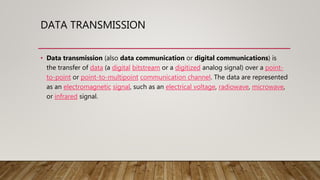
DATA TRANSMISSION
• Data transmission (also data communication or digital communications) is
the transfer of data (a digital bitstream or a digitized analog signal) over a point-
to-point or point-to-multipoint communication channel. The data are represented
as an electromagnetic signal, such as an electrical voltage, radiowave, microwave,
or infrared signal.
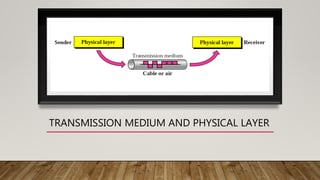
TRANSMISSION MEDIUM AND PHYSICAL LAYER
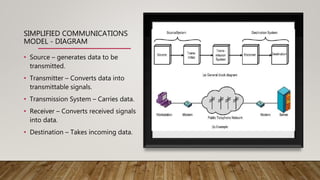
SIMPLIFIED COMMUNICATIONS
MODEL - DIAGRAM
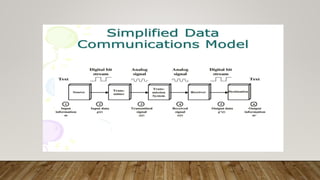
• Source – generates data to be
transmitted.
• Transmitter – Converts data into
transmittable signals.
• Transmission System – Carries data.
• Receiver – Converts received signals
into data.
• Destination – Takes incoming data.
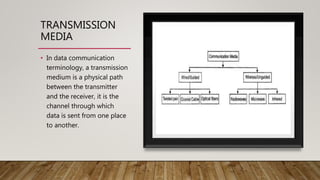
TRANSMISSION
MEDIA
• In data communication
terminology, a transmission
medium is a physical path
between the transmitter
and the receiver, it is the
channel through which
data is sent from one place
to another.
GUIDED/ WIRED MEDIA
• It is also referred to as Wired or Bounded transmission media.
Signals being transmitted are directed and confined in a narrow
pathway by using physical links.
Features:
• High Speed
• Secure
• Used for comparatively shorter distances
TYPES OF GUIDED/ WIRED MEDIA
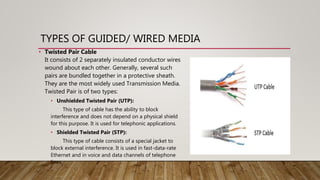
• Twisted Pair Cable
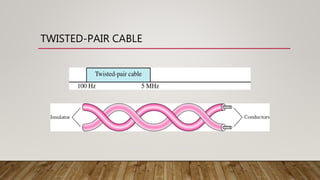
It consists of 2 separately insulated conductor wires
wound about each other. Generally, several such
pairs are bundled together in a protective sheath.
They are the most widely used Transmission Media.
Twisted Pair is of two types:
• Unshielded Twisted Pair (UTP):
This type of cable has the ability to block
interference and does not depend on a physical shield
for this purpose. It is used for telephonic applications.
• Shielded Twisted Pair (STP):
This type of cable consists of a special jacket to
block external interference. It is used in fast-data-rate
Ethernet and in voice and data channels of telephone
lines.
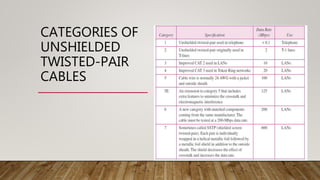
TWISTED-PAIR CABLE
CATEGORIES OF
UNSHIELDED
TWISTED-PAIR
CABLES
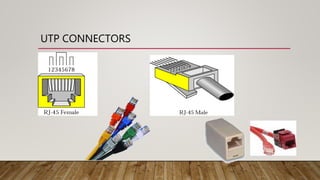
UTP CONNECTORS
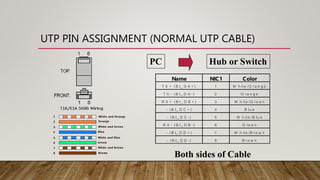
Name NIC1 Color
T X + (B I_ D A +) 1 W h ite /O ra n g e
T X - (B I_ D A -) 2 O ra n g e
R X + (B I_ D B +) 3 W h ite /G re e n
- (B I_ D C +) 4 B lu e
- (B I_ D C -) 5 W h ite /B lu e
R X - (B I_ D B -) 6 G re e n
- (B I_ D D +) 7 W h ite /B ro w n
- (B I_ D D -) 8 B ro w n
Both sides of Cable
PC Hub or Switch
UTP PIN ASSIGNMENT (NORMAL UTP CABLE)
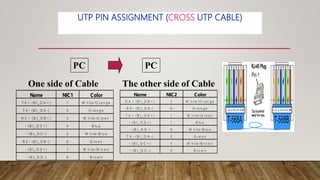
UTP PIN ASSIGNMENT (CROSS UTP CABLE)
Name NIC1 Color
T X + (B I_ D A +) 1 W h ite /O ra n ge
T X - (B I_ D A -) 2 O ra n ge
R X + (B I_ D B +) 3 W h ite /G re e n
- (B I_ D C +) 4 B lu e
- (B I_ D C -) 5 W h ite /B lu e
R X - (B I_ D B -) 6 G re e n
- (B I_ D D +) 7 W h ite /B ro w n
- (B I_ D D -) 8 B ro w n
One side of Cable
Name NIC2 Color
R X + (B I_ D B +) 3 W h ite /O ra n ge
R X - (B I_ D B -) 6 O ra n ge
T X + (B I_ D A +) 1 W h ite /G re e n
- (B I_ D D +) 7 B lu e
- (B I_ D D -) 8 W h ite /B lu e
T X - (B I_ D A -) 2 G re e n
- (B I_ D C +) 4 W h ite /B ro w n
- (B I_ D C -) 5 B ro w n
The other side of Cable
PC PC
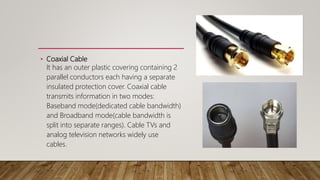
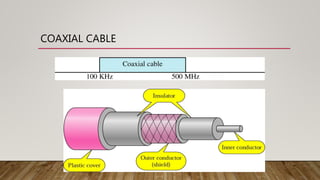
• Coaxial Cable
It has an outer plastic covering containing 2
parallel conductors each having a separate
insulated protection cover. Coaxial cable
transmits information in two modes:
Baseband mode(dedicated cable bandwidth)
and Broadband mode(cable bandwidth is
split into separate ranges). Cable TVs and
analog television networks widely use
cables.
COAXIAL CABLE
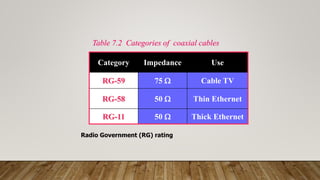
Table 7.2 Categories of coaxial cables
Category Impedance Use
RG-59 75 W Cable TV
RG-58 50 W Thin Ethernet
RG-11 50 W Thick Ethernet
Radio Government (RG) rating
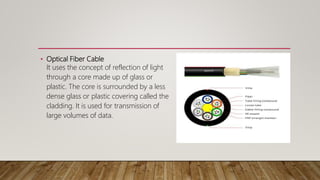
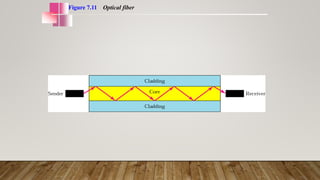
• Optical Fiber Cable
It uses the concept of reflection of light
through a core made up of glass or
plastic. The core is surrounded by a less
dense glass or plastic covering called the
cladding. It is used for transmission of
large volumes of data.
Figure 7.11 Optical fiber
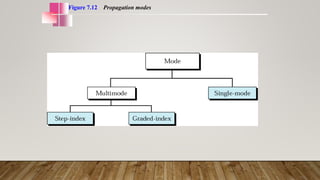
Figure 7.12 Propagation modes
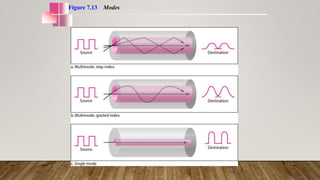
Figure 7.13 Modes
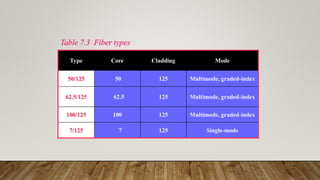
Table 7.3 Fiber types
Type Core Cladding Mode
50/125 50 125 Multimode, graded-index
62.5/125 62.5 125 Multimode, graded-index
100/125 100 125 Multimode, graded-index
7/125 7 125 Single-mode
UNGUIDED/WIRELESS MEDIA
• It is also referred to as Wireless or Unbounded transmission media. No physical
medium is required for the transmission of electromagnetic signals.
Features:
• Signal is broadcasted through air
• Less Secure
• Used for larger distances
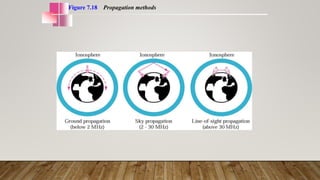
Figure 7.18 Propagation methods
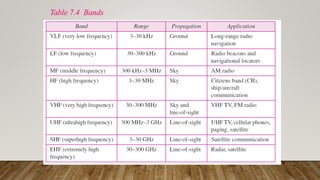
Table 7.4 Bands
TYPES OF GUIDED/
WIRED MEDIA
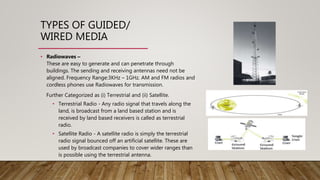
• Radiowaves –
These are easy to generate and can penetrate through
buildings. The sending and receiving antennas need not be
aligned. Frequency Range:3KHz – 1GHz. AM and FM radios and
cordless phones use Radiowaves for transmission.
Further Categorized as (i) Terrestrial and (ii) Satellite.
• Terrestrial Radio - Any radio signal that travels along the
land, is broadcast from a land based station and is
received by land based receivers is called as terrestrial
radio.
• Satellite Radio - A satellite radio is simply the terrestrial
radio signal bounced off an artificial satellite. These are
used by broadcast companies to cover wider ranges than
is possible using the terrestrial antenna.
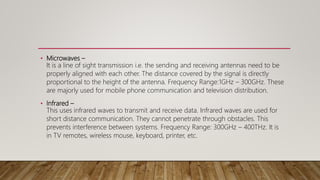
• Microwaves –
It is a line of sight transmission i.e. the sending and receiving antennas need to be
properly aligned with each other. The distance covered by the signal is directly
proportional to the height of the antenna. Frequency Range:1GHz – 300GHz. These
are majorly used for mobile phone communication and television distribution.
• Infrared –
This uses infrared waves to transmit and receive data. Infrared waves are used for
short distance communication. They cannot penetrate through obstacles. This
prevents interference between systems. Frequency Range: 300GHz – 400THz. It is
in TV remotes, wireless mouse, keyboard, printer, etc.
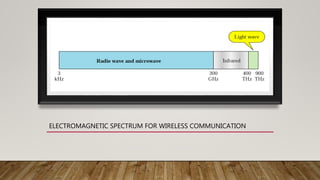
ELECTROMAGNETIC SPECTRUM FOR WIRELESS COMMUNICATION
NETWORK
INTERFACE
CARD (NIC)
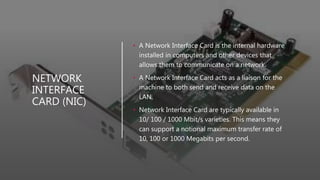
• A Network Interface Card is the internal hardware
installed in computers and other devices that
allows them to communicate on a network.
• A Network Interface Card acts as a liaison for the
machine to both send and receive data on the
LAN.
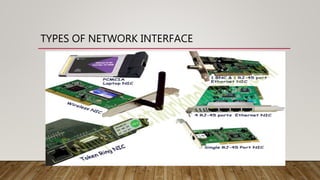
• Network Interface Card are typically available in
10/ 100 / 1000 Mbit/s varieties. This means they
can support a notional maximum transfer rate of
10, 100 or 1000 Megabits per second.
NETWORK
INTERFACE
CARD (NIC)
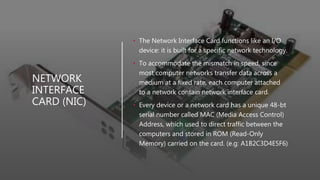
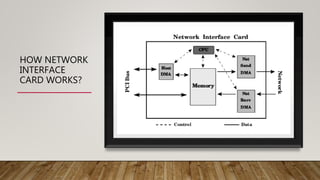
• The Network Interface Card functions like an I/O
device: it is built for a specific network technology.
• To accommodate the mismatch in speed, since
most computer networks transfer data across a
medium at a fixed rate, each computer attached
to a network contain network interface card.
• Every device or a network card has a unique 48-bt
serial number called MAC (Media Access Control)
Address, which used to direct traffic between the
computers and stored in ROM (Read-Only
Memory) carried on the card. (e.g: A1B2C3D4E5F6)
HOW NETWORK
INTERFACE
CARD WORKS?
TYPES OF NETWORK INTERFACE
Reference:
• https://en.wikipedia.org/wiki/Data_transmission
• https://slideplayer.com/slide/7906227/
• https://www.geeksforgeeks.org/types-transmission-media/
• https://www.quora.com/What-is-terrestrial-radio
• https://www.slideshare.net/sourabh4u07/network-interface-card

Network Media and Data Transmission

  • 1.
    NETWORK MEDIA AND DATATRANSMISSIONS PRESENTED BY: CLAISSE NERIEL L. MARTINEZ
  • 2.
    DATA TRANSMISSION • Datatransmission (also data communication or digital communications) is the transfer of data (a digital bitstream or a digitized analog signal) over a point- to-point or point-to-multipoint communication channel. The data are represented as an electromagnetic signal, such as an electrical voltage, radiowave, microwave, or infrared signal.
  • 3.
  • 4.
    SIMPLIFIED COMMUNICATIONS MODEL -DIAGRAM • Source – generates data to be transmitted. • Transmitter – Converts data into transmittable signals. • Transmission System – Carries data. • Receiver – Converts received signals into data. • Destination – Takes incoming data.
  • 6.
    TRANSMISSION MEDIA • In datacommunication terminology, a transmission medium is a physical path between the transmitter and the receiver, it is the channel through which data is sent from one place to another.
  • 7.
    GUIDED/ WIRED MEDIA •It is also referred to as Wired or Bounded transmission media. Signals being transmitted are directed and confined in a narrow pathway by using physical links. Features: • High Speed • Secure • Used for comparatively shorter distances
  • 8.
    TYPES OF GUIDED/WIRED MEDIA • Twisted Pair Cable It consists of 2 separately insulated conductor wires wound about each other. Generally, several such pairs are bundled together in a protective sheath. They are the most widely used Transmission Media. Twisted Pair is of two types: • Unshielded Twisted Pair (UTP): This type of cable has the ability to block interference and does not depend on a physical shield for this purpose. It is used for telephonic applications. • Shielded Twisted Pair (STP): This type of cable consists of a special jacket to block external interference. It is used in fast-data-rate Ethernet and in voice and data channels of telephone lines.
  • 9.
  • 10.
  • 11.
  • 12.
    Name NIC1 Color TX + (B I_ D A +) 1 W h ite /O ra n g e T X - (B I_ D A -) 2 O ra n g e R X + (B I_ D B +) 3 W h ite /G re e n - (B I_ D C +) 4 B lu e - (B I_ D C -) 5 W h ite /B lu e R X - (B I_ D B -) 6 G re e n - (B I_ D D +) 7 W h ite /B ro w n - (B I_ D D -) 8 B ro w n Both sides of Cable PC Hub or Switch UTP PIN ASSIGNMENT (NORMAL UTP CABLE)
  • 13.
    UTP PIN ASSIGNMENT(CROSS UTP CABLE) Name NIC1 Color T X + (B I_ D A +) 1 W h ite /O ra n ge T X - (B I_ D A -) 2 O ra n ge R X + (B I_ D B +) 3 W h ite /G re e n - (B I_ D C +) 4 B lu e - (B I_ D C -) 5 W h ite /B lu e R X - (B I_ D B -) 6 G re e n - (B I_ D D +) 7 W h ite /B ro w n - (B I_ D D -) 8 B ro w n One side of Cable Name NIC2 Color R X + (B I_ D B +) 3 W h ite /O ra n ge R X - (B I_ D B -) 6 O ra n ge T X + (B I_ D A +) 1 W h ite /G re e n - (B I_ D D +) 7 B lu e - (B I_ D D -) 8 W h ite /B lu e T X - (B I_ D A -) 2 G re e n - (B I_ D C +) 4 W h ite /B ro w n - (B I_ D C -) 5 B ro w n The other side of Cable PC PC
  • 14.
    • Coaxial Cable Ithas an outer plastic covering containing 2 parallel conductors each having a separate insulated protection cover. Coaxial cable transmits information in two modes: Baseband mode(dedicated cable bandwidth) and Broadband mode(cable bandwidth is split into separate ranges). Cable TVs and analog television networks widely use cables.
  • 15.
  • 16.
    Table 7.2 Categoriesof coaxial cables Category Impedance Use RG-59 75 W Cable TV RG-58 50 W Thin Ethernet RG-11 50 W Thick Ethernet Radio Government (RG) rating
  • 17.
    • Optical FiberCable It uses the concept of reflection of light through a core made up of glass or plastic. The core is surrounded by a less dense glass or plastic covering called the cladding. It is used for transmission of large volumes of data.
  • 18.
  • 19.
  • 20.
  • 21.
    Table 7.3 Fibertypes Type Core Cladding Mode 50/125 50 125 Multimode, graded-index 62.5/125 62.5 125 Multimode, graded-index 100/125 100 125 Multimode, graded-index 7/125 7 125 Single-mode
  • 22.
    UNGUIDED/WIRELESS MEDIA • Itis also referred to as Wireless or Unbounded transmission media. No physical medium is required for the transmission of electromagnetic signals. Features: • Signal is broadcasted through air • Less Secure • Used for larger distances
  • 23.
  • 24.
  • 25.
    TYPES OF GUIDED/ WIREDMEDIA • Radiowaves – These are easy to generate and can penetrate through buildings. The sending and receiving antennas need not be aligned. Frequency Range:3KHz – 1GHz. AM and FM radios and cordless phones use Radiowaves for transmission. Further Categorized as (i) Terrestrial and (ii) Satellite. • Terrestrial Radio - Any radio signal that travels along the land, is broadcast from a land based station and is received by land based receivers is called as terrestrial radio. • Satellite Radio - A satellite radio is simply the terrestrial radio signal bounced off an artificial satellite. These are used by broadcast companies to cover wider ranges than is possible using the terrestrial antenna.
  • 26.
    • Microwaves – Itis a line of sight transmission i.e. the sending and receiving antennas need to be properly aligned with each other. The distance covered by the signal is directly proportional to the height of the antenna. Frequency Range:1GHz – 300GHz. These are majorly used for mobile phone communication and television distribution. • Infrared – This uses infrared waves to transmit and receive data. Infrared waves are used for short distance communication. They cannot penetrate through obstacles. This prevents interference between systems. Frequency Range: 300GHz – 400THz. It is in TV remotes, wireless mouse, keyboard, printer, etc.
  • 27.
    ELECTROMAGNETIC SPECTRUM FORWIRELESS COMMUNICATION
  • 28.
    NETWORK INTERFACE CARD (NIC) • ANetwork Interface Card is the internal hardware installed in computers and other devices that allows them to communicate on a network. • A Network Interface Card acts as a liaison for the machine to both send and receive data on the LAN. • Network Interface Card are typically available in 10/ 100 / 1000 Mbit/s varieties. This means they can support a notional maximum transfer rate of 10, 100 or 1000 Megabits per second.
  • 29.
    NETWORK INTERFACE CARD (NIC) • TheNetwork Interface Card functions like an I/O device: it is built for a specific network technology. • To accommodate the mismatch in speed, since most computer networks transfer data across a medium at a fixed rate, each computer attached to a network contain network interface card. • Every device or a network card has a unique 48-bt serial number called MAC (Media Access Control) Address, which used to direct traffic between the computers and stored in ROM (Read-Only Memory) carried on the card. (e.g: A1B2C3D4E5F6)
  • 30.
  • 31.
  • 32.
    Reference: • https://en.wikipedia.org/wiki/Data_transmission • https://slideplayer.com/slide/7906227/ •https://www.geeksforgeeks.org/types-transmission-media/ • https://www.quora.com/What-is-terrestrial-radio • https://www.slideshare.net/sourabh4u07/network-interface-card