HUMAN RESOURCES MANAGEMENT Lecture Notes for Business Introduction Fahmy Radhi
HUMAN RESOURCES MANAGEMENT Set of Organizational activities directed at attracting, developing, and maintaining an effective workforce The process of acquiring, training, terminating, developing, and properly using the human resources in an organization
The HRM Process Human Resource Planning: Forecasting Demand Supply and Job Analysis Staffing the Organization: Recruitment, Selecting, and Orientation Developing the Workforce: Training and Performance Appraisal Compensation and Benefit: Wages and Salaries, Incentive and Benefit Program
Human Resource Planning Job Analysis – determining the tasks, the skills, abilities and responsibilities needed to perform the job Job Description – a statement about a job’s duties  Job Specification – A statement of the human qualification needed to perform a job
Human Resource Planning Forecasting the demand  -  estimating the personnel needs of organization Forecasting the supply of labour: Internal Supply External Supply Matching Demand with Supply
 
Recruiting Recruitment – Steps taken to staff an organization with the best qualified people Sources: Internal recruiting External recruiting from worker unions, university, employment agencies
Selection and Orientation Selection – evaluating and choosing the candidates. Selection Process: application form, Tests, and Interview Orientation – A procedure for providing new employees with basic background information about the firm
Training and Development Training – supplying the skills, knowledge, and attitudes needed by employees to improve their abilities to perform their job On-the Job Training Off-the Job Training Development – preparing someone for the new and greater challenges and more demanding job
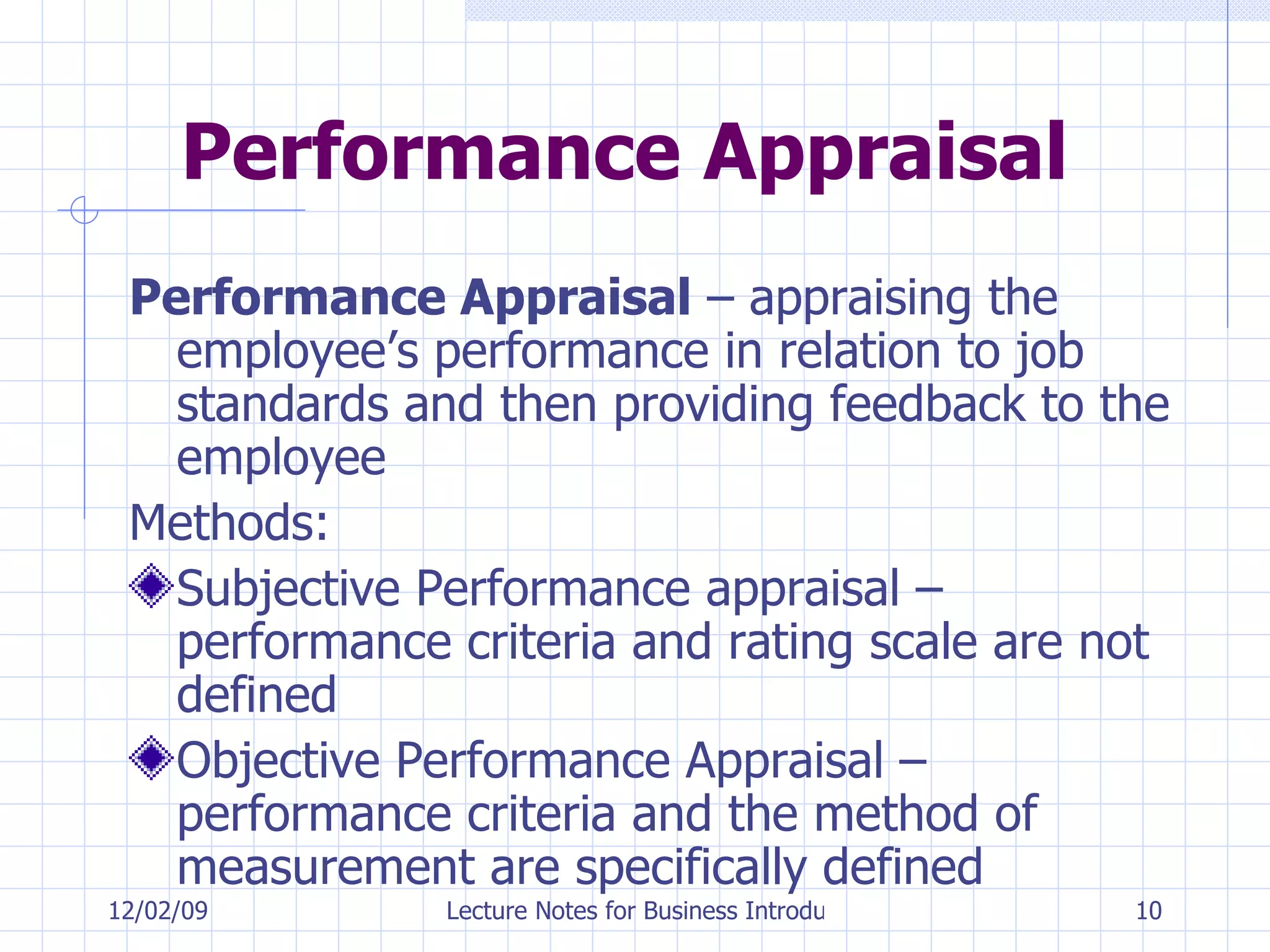
Performance Appraisal Performance Appraisal  – appraising the employee’s performance in relation to job standards and then providing feedback to the employee Methods: Subjective Performance appraisal – performance criteria and rating scale are not defined Objective Performance Appraisal – performance criteria and the method of measurement are specifically defined
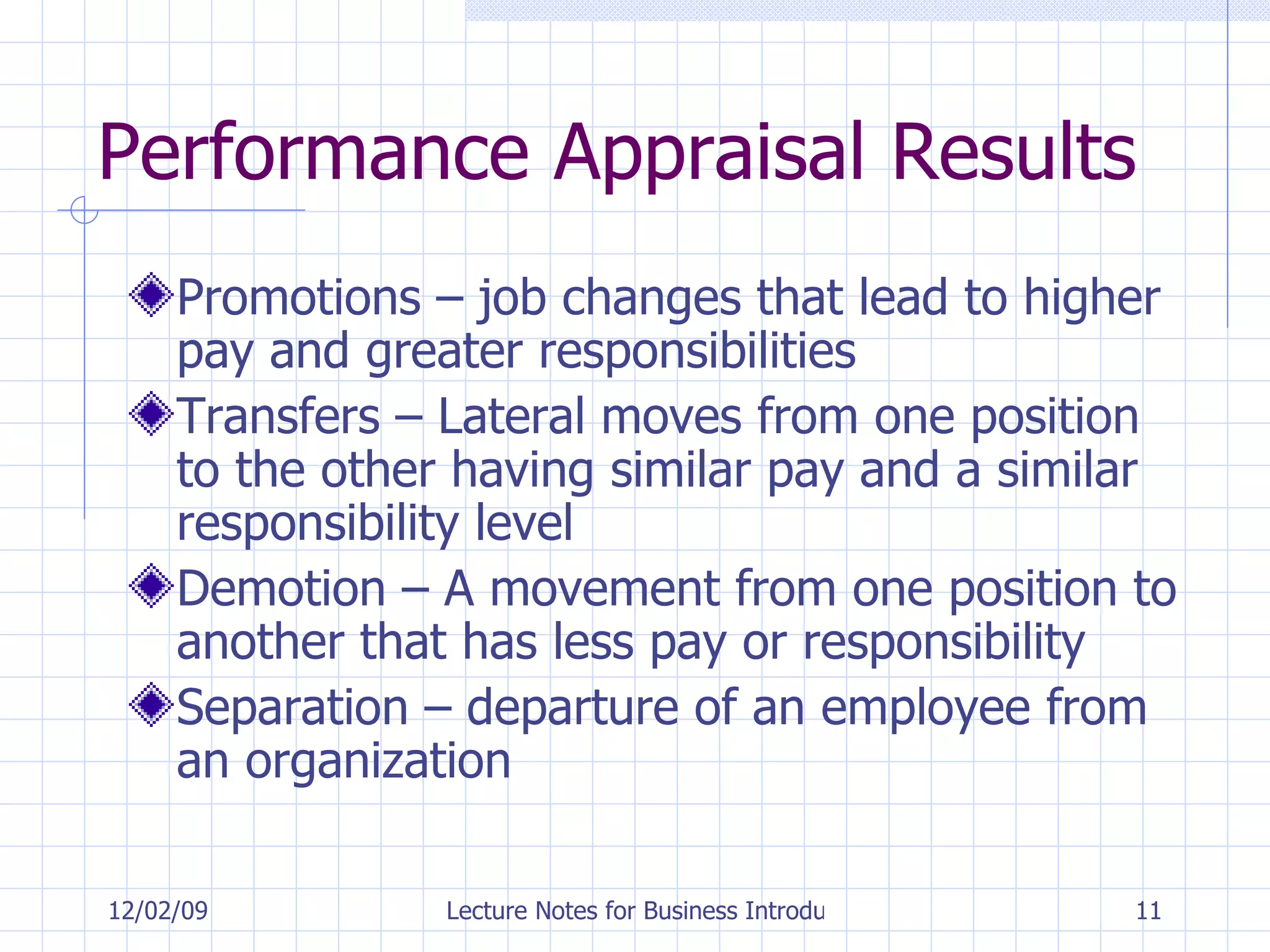
Performance Appraisal Results Promotions – job changes that lead to higher pay and greater responsibilities Transfers – Lateral moves from one position to the other having similar pay and a similar responsibility level Demotion – A movement from one position to another that has less pay or responsibility Separation – departure of an employee from an organization
Compensation Compensation  – determining an employee’s performance initial wages, making changes to wages, and offering accompanying benefits Types: Direct Compensation – an employee’s base pay and performance base pay Indirect compensation – protection programs, private protection, and other benefits Wages – Compensation based on time worked and number of units produced
Motivating Motivation  – the way drives or needs direct a person’s behavior toward a specific goals Motivation Theories: Classical Theory Behavior  Theory Contemporary Theories: Maslow’s Hierarchy Model, Theories X an Y, Two-Factor Theory, Expectancy Theory and Equity Theory
Maslow’s Needs Hierarchy Five needs arranged in a hierarchy: Physiological Needs - biological need Security  Needs – to be financially secure and protected against job loss Social Needs – to belong and to interact with other people Esteem Need – the need for self-respect and for respect from other Self-Actualization Need – the need to use and display one’s full range competence  
 
McGregor’s Theory X and Theory Y Theory X  employees dislike work, responsibility, and accountability and  employees must be closely directed and controlled to be motivated Theory Y want to be challenge like to display creativity highly motivated to perform well if given some freedom to direct or manage their own behavior

06-Human Resource Management

  • 1.
    HUMAN RESOURCES MANAGEMENTLecture Notes for Business Introduction Fahmy Radhi
  • 2.
    HUMAN RESOURCES MANAGEMENTSet of Organizational activities directed at attracting, developing, and maintaining an effective workforce The process of acquiring, training, terminating, developing, and properly using the human resources in an organization
  • 3.
    The HRM ProcessHuman Resource Planning: Forecasting Demand Supply and Job Analysis Staffing the Organization: Recruitment, Selecting, and Orientation Developing the Workforce: Training and Performance Appraisal Compensation and Benefit: Wages and Salaries, Incentive and Benefit Program
  • 4.
    Human Resource PlanningJob Analysis – determining the tasks, the skills, abilities and responsibilities needed to perform the job Job Description – a statement about a job’s duties Job Specification – A statement of the human qualification needed to perform a job
  • 5.
    Human Resource PlanningForecasting the demand - estimating the personnel needs of organization Forecasting the supply of labour: Internal Supply External Supply Matching Demand with Supply
  • 6.
  • 7.
    Recruiting Recruitment –Steps taken to staff an organization with the best qualified people Sources: Internal recruiting External recruiting from worker unions, university, employment agencies
  • 8.
    Selection and OrientationSelection – evaluating and choosing the candidates. Selection Process: application form, Tests, and Interview Orientation – A procedure for providing new employees with basic background information about the firm
  • 9.
    Training and DevelopmentTraining – supplying the skills, knowledge, and attitudes needed by employees to improve their abilities to perform their job On-the Job Training Off-the Job Training Development – preparing someone for the new and greater challenges and more demanding job
  • 10.
    Performance Appraisal PerformanceAppraisal – appraising the employee’s performance in relation to job standards and then providing feedback to the employee Methods: Subjective Performance appraisal – performance criteria and rating scale are not defined Objective Performance Appraisal – performance criteria and the method of measurement are specifically defined
  • 11.
    Performance Appraisal ResultsPromotions – job changes that lead to higher pay and greater responsibilities Transfers – Lateral moves from one position to the other having similar pay and a similar responsibility level Demotion – A movement from one position to another that has less pay or responsibility Separation – departure of an employee from an organization
  • 12.
    Compensation Compensation – determining an employee’s performance initial wages, making changes to wages, and offering accompanying benefits Types: Direct Compensation – an employee’s base pay and performance base pay Indirect compensation – protection programs, private protection, and other benefits Wages – Compensation based on time worked and number of units produced
  • 13.
    Motivating Motivation – the way drives or needs direct a person’s behavior toward a specific goals Motivation Theories: Classical Theory Behavior Theory Contemporary Theories: Maslow’s Hierarchy Model, Theories X an Y, Two-Factor Theory, Expectancy Theory and Equity Theory
  • 14.
    Maslow’s Needs HierarchyFive needs arranged in a hierarchy: Physiological Needs - biological need Security Needs – to be financially secure and protected against job loss Social Needs – to belong and to interact with other people Esteem Need – the need for self-respect and for respect from other Self-Actualization Need – the need to use and display one’s full range competence  
  • 15.
  • 16.
    McGregor’s Theory Xand Theory Y Theory X employees dislike work, responsibility, and accountability and employees must be closely directed and controlled to be motivated Theory Y want to be challenge like to display creativity highly motivated to perform well if given some freedom to direct or manage their own behavior