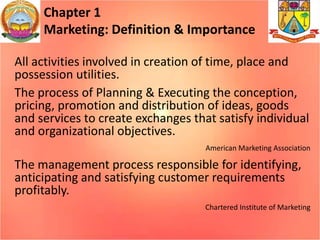

Chapter 1
Marketing: Definition & Importance
All activities involved in creation of time, place and
possession utilities.
The process of Planning & Executing the conception,
pricing, promotion and distribution of ideas, goods
and services to create exchanges that satisfy individual
and organizational objectives.
American Marketing Association
The management process responsible for identifying,
anticipating and satisfying customer requirements
profitably.
Chartered Institute of Marketing
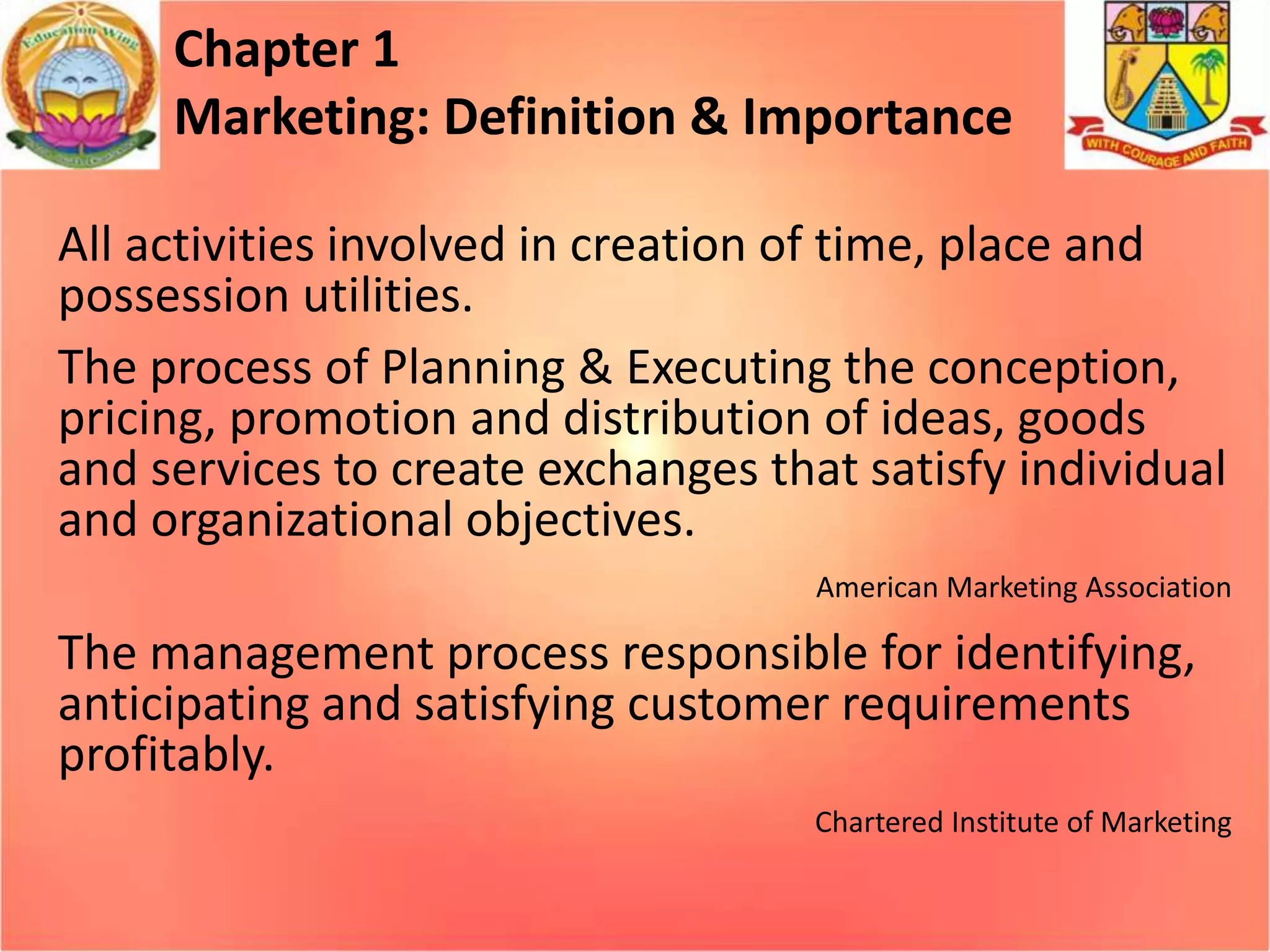
Chapter 1
Marketing: Definition & Importance
- Market vs Marketing
Market is an arrangement to provide an opportunity to exchange goods.
Marketing is sum total of all those activities that are related to flow of goods
from production to consumption.
- Marketing, Selling & Merchandizing
Marketing is a broader concept which is driven from customer’s demand.
Selling is one part of marketing which deals with persuading customers to
buy products that are available with seller.
Merchandizing refers to the process offering a variety of products to a retail
consumer in a manner which stimulates demand.
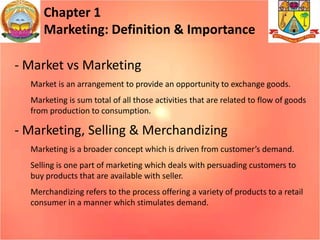
Chapter 1
Marketing: Definition & Importance
IMPORTANCE OF MARKETING
1. Marketing helps to achieve, maintain and raise
the standards of living
2. Marketing Increases employment opportunities
3. Marketing increases national income
4. Helps maintain economic stability &
development
5. Link between producer & consumer
Chapter 1
Marketing: Definition & Importance
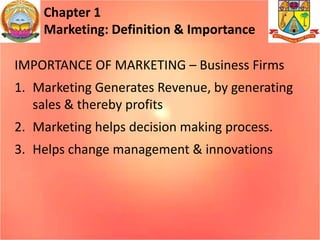
IMPORTANCE OF MARKETING – Business Firms
1. Marketing Generates Revenue, by generating
sales & thereby profits
2. Marketing helps decision making process.
3. Helps change management & innovations
Chapter 2
Marketing Concepts
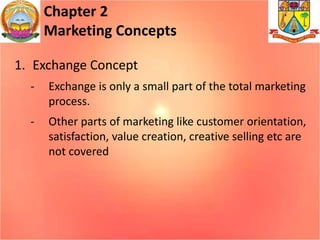
1. Exchange Concept
- Exchange is only a small part of the total marketing
process.
- Other parts of marketing like customer orientation,
satisfaction, value creation, creative selling etc are
not covered
Chapter 2
Marketing Concepts
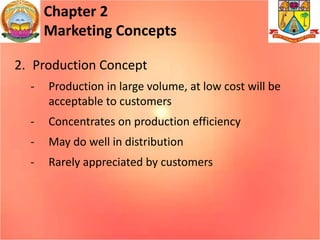
2. Production Concept
- Production in large volume, at low cost will be
acceptable to customers
- Concentrates on production efficiency
- May do well in distribution
- Rarely appreciated by customers
Chapter 2
Marketing Concepts
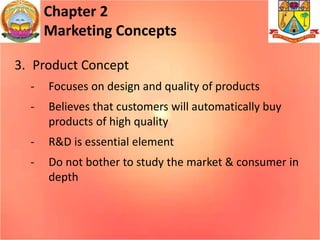
3. Product Concept
- Focuses on design and quality of products
- Believes that customers will automatically buy
products of high quality
- R&D is essential element
- Do not bother to study the market & consumer in
depth
Chapter 2
Marketing Concepts
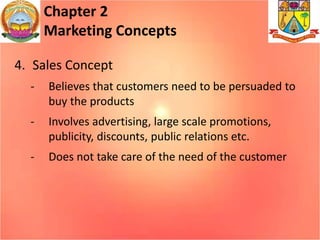
4. Sales Concept
- Believes that customers need to be persuaded to
buy the products
- Involves advertising, large scale promotions,
publicity, discounts, public relations etc.
- Does not take care of the need of the customer
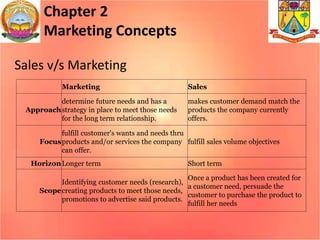
Marketing Sales
Approach
determine future needs and has a
strategy in place to meet those needs
for the long term relationship.
makes customer demand match the
products the company currently
offers.
Focus
fulfill customer's wants and needs thru
products and/or services the company
can offer.
fulfill sales volume objectives
HorizonLonger term Short term
Scope
Identifying customer needs (research),
creating products to meet those needs,
promotions to advertise said products.
Once a product has been created for
a customer need, persuade the
customer to purchase the product to
fulfill her needs
Chapter 2
Marketing Concepts
Sales v/s Marketing
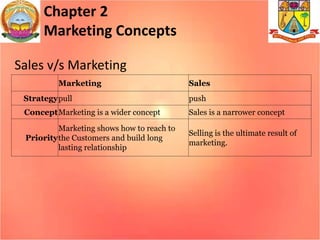
Chapter 2
Marketing Concepts
Sales v/s Marketing
Marketing Sales
Strategypull push
ConceptMarketing is a wider concept Sales is a narrower concept
Priority
Marketing shows how to reach to
the Customers and build long
lasting relationship
Selling is the ultimate result of
marketing.
Chapter 2
Marketing Concepts
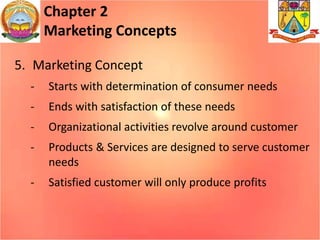
5. Marketing Concept
- Starts with determination of consumer needs
- Ends with satisfaction of these needs
- Organizational activities revolve around customer
- Products & Services are designed to serve customer
needs
- Satisfied customer will only produce profits
Chapter 3
Marketing Management Tasks
1. Conversional Marketing
- Used during negative demand
- Customer dislikes the product
- May even pay to avoid the product
- It is a rare condition
Chapter 3
Marketing Management Tasks
2. Stimulation Marketing
- Used during No demand
- Customer is indifferent to the product
- Task of converting no-demand into positive demand
- Connect the product with existing need
- Create environment where need is felt
Chapter 3
Marketing Management Tasks
3. Developmental Marketing
- Used during Latent demand
- Consumers share need for something which does not
exist
- Opportunity for Marketer to develop a product
Chapter 3
Marketing Management Tasks
4. Remarketing
- Used during fading demand
- Consumers find either no use for the product or better
alternatives in the market
- Marketers recreate the demand
Chapter 3
Marketing Management Tasks
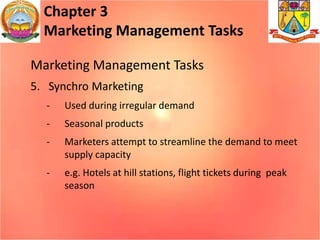
5. Synchro Marketing
- Used during irregular demand
- Seasonal products
- Marketers attempt to streamline the demand to meet
supply capacity
- e.g. Hotels at hill stations, flight tickets during peak
season
Chapter 3
Marketing Management Tasks
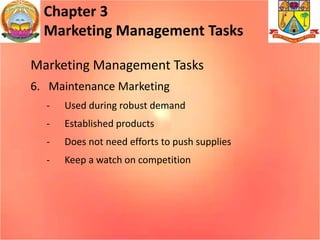
6. Maintenance Marketing
- Used during robust demand
- Established products
- Does not need efforts to push supplies
- Keep a watch on competition
Chapter 3
Marketing Management Tasks
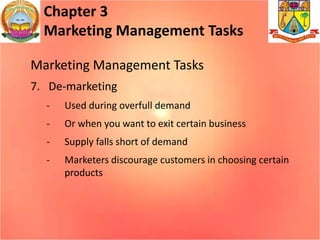
7. De-marketing
- Used during overfull demand
- Or when you want to exit certain business
- Supply falls short of demand
- Marketers discourage customers in choosing certain
products
Chapter 3
Marketing Management Tasks
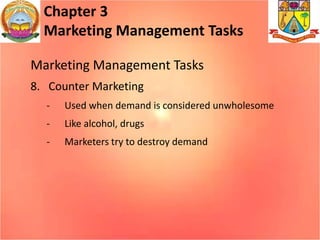
8. Counter Marketing
- Used when demand is considered unwholesome
- Like alcohol, drugs
- Marketers try to destroy demand
Thank you

Marketing management ppt

  • 1.
    Chapter 1 Marketing: Definition& Importance All activities involved in creation of time, place and possession utilities. The process of Planning & Executing the conception, pricing, promotion and distribution of ideas, goods and services to create exchanges that satisfy individual and organizational objectives. American Marketing Association The management process responsible for identifying, anticipating and satisfying customer requirements profitably. Chartered Institute of Marketing
  • 2.
    Chapter 1 Marketing: Definition& Importance - Market vs Marketing Market is an arrangement to provide an opportunity to exchange goods. Marketing is sum total of all those activities that are related to flow of goods from production to consumption. - Marketing, Selling & Merchandizing Marketing is a broader concept which is driven from customer’s demand. Selling is one part of marketing which deals with persuading customers to buy products that are available with seller. Merchandizing refers to the process offering a variety of products to a retail consumer in a manner which stimulates demand.
  • 3.
    Chapter 1 Marketing: Definition& Importance IMPORTANCE OF MARKETING 1. Marketing helps to achieve, maintain and raise the standards of living 2. Marketing Increases employment opportunities 3. Marketing increases national income 4. Helps maintain economic stability & development 5. Link between producer & consumer
  • 4.
    Chapter 1 Marketing: Definition& Importance IMPORTANCE OF MARKETING – Business Firms 1. Marketing Generates Revenue, by generating sales & thereby profits 2. Marketing helps decision making process. 3. Helps change management & innovations
  • 5.
    Chapter 2 Marketing Concepts 1.Exchange Concept - Exchange is only a small part of the total marketing process. - Other parts of marketing like customer orientation, satisfaction, value creation, creative selling etc are not covered
  • 6.
    Chapter 2 Marketing Concepts 2.Production Concept - Production in large volume, at low cost will be acceptable to customers - Concentrates on production efficiency - May do well in distribution - Rarely appreciated by customers
  • 7.
    Chapter 2 Marketing Concepts 3.Product Concept - Focuses on design and quality of products - Believes that customers will automatically buy products of high quality - R&D is essential element - Do not bother to study the market & consumer in depth
  • 8.
    Chapter 2 Marketing Concepts 4.Sales Concept - Believes that customers need to be persuaded to buy the products - Involves advertising, large scale promotions, publicity, discounts, public relations etc. - Does not take care of the need of the customer
  • 9.
    Marketing Sales Approach determine futureneeds and has a strategy in place to meet those needs for the long term relationship. makes customer demand match the products the company currently offers. Focus fulfill customer's wants and needs thru products and/or services the company can offer. fulfill sales volume objectives HorizonLonger term Short term Scope Identifying customer needs (research), creating products to meet those needs, promotions to advertise said products. Once a product has been created for a customer need, persuade the customer to purchase the product to fulfill her needs Chapter 2 Marketing Concepts Sales v/s Marketing
  • 10.
    Chapter 2 Marketing Concepts Salesv/s Marketing Marketing Sales Strategypull push ConceptMarketing is a wider concept Sales is a narrower concept Priority Marketing shows how to reach to the Customers and build long lasting relationship Selling is the ultimate result of marketing.
  • 11.
    Chapter 2 Marketing Concepts 5.Marketing Concept - Starts with determination of consumer needs - Ends with satisfaction of these needs - Organizational activities revolve around customer - Products & Services are designed to serve customer needs - Satisfied customer will only produce profits
  • 12.
    Chapter 3 Marketing ManagementTasks Marketing Management Tasks 1. Conversional Marketing - Used during negative demand - Customer dislikes the product - May even pay to avoid the product - It is a rare condition
  • 13.
    Chapter 3 Marketing ManagementTasks Marketing Management Tasks 2. Stimulation Marketing - Used during No demand - Customer is indifferent to the product - Task of converting no-demand into positive demand - Connect the product with existing need - Create environment where need is felt
  • 14.
    Chapter 3 Marketing ManagementTasks Marketing Management Tasks 3. Developmental Marketing - Used during Latent demand - Consumers share need for something which does not exist - Opportunity for Marketer to develop a product
  • 15.
    Chapter 3 Marketing ManagementTasks Marketing Management Tasks 4. Remarketing - Used during fading demand - Consumers find either no use for the product or better alternatives in the market - Marketers recreate the demand
  • 16.
    Chapter 3 Marketing ManagementTasks Marketing Management Tasks 5. Synchro Marketing - Used during irregular demand - Seasonal products - Marketers attempt to streamline the demand to meet supply capacity - e.g. Hotels at hill stations, flight tickets during peak season
  • 17.
    Chapter 3 Marketing ManagementTasks Marketing Management Tasks 6. Maintenance Marketing - Used during robust demand - Established products - Does not need efforts to push supplies - Keep a watch on competition
  • 18.
    Chapter 3 Marketing ManagementTasks Marketing Management Tasks 7. De-marketing - Used during overfull demand - Or when you want to exit certain business - Supply falls short of demand - Marketers discourage customers in choosing certain products
  • 19.
    Chapter 3 Marketing ManagementTasks Marketing Management Tasks 8. Counter Marketing - Used when demand is considered unwholesome - Like alcohol, drugs - Marketers try to destroy demand
  • 20.