




New Product Development Strategy
You can download this presentation at: www.studyMarketing.org Visit  www.studyMarketing.org   for more presentations on Marketing, Strategy, Innovation, and Branding
Key Steps in  New Product Development
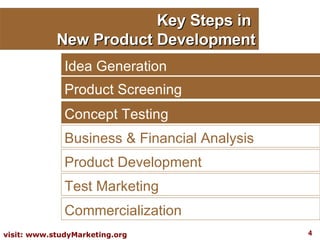
Key Steps in  New Product Development Idea Generation Product Screening Concept Testing Business & Financial Analysis Product Development Test Marketing Commercialization
Idea Generation Idea generation is a continuous, systematic search for new product opportunities. It involves delineating sources of new ideas and methods for generating them.
Methods for Generating Ideas  Dimensional Analysis  lists all of the physical characteristics of a product type. Having obtained such a list, creativity can be triggered by asking questions such as: "Why is the product this way?“,  "How could the product be changed?"  or "'What would happen if one or more of the characteristics were removed?"
Problem Analysis  is a   need-assessment technique designed to develop an inventory of  consumer problems  in a particular product or service category and to serve as a basis for new product or service ideas.
Benefit Structure Analysis   determines what specific benefits and characteristics are desired by consumers within a particular product or service category and  identifies perceived deficiencies in what is currently provided.
Scenario Analysis   identifies  opportunities by capitalizing on projected future environments and associated consumer needs.
Product Screening After the firm identifies potential products, it must screen them. In product screening, poor, unsuitable, or otherwise unattractive ideas  are weeded out from further actions.
Today, many companies use a new-product screening checklist for preliminary evaluation.  In it, firms list the new-product attributes considered most important and compare each idea with those attributes.  The checklist is standardized and allows ideas to be compared.
Concept testing presents the consumer with a proposed product and measures attitudes and intentions at this early stage of development. Concept Testing
Concept testing is a quick and inexpensive way of measuring consumer enthusiasm. It asks potential consumers to react to a picture, written   statement, or oral description of a  product. This enables a firm to determine initial attitudes prior to expensive, time-consuming prototype development.
Business and financial analysis for the remaining product concepts is much more detailed than product screening.  Business & Financial Analysis
Factors considered in business analysis stage :  Demand projections  Cost projections  Competition  Required investment  Profitability
Product development converts a product idea into a physical form and identifies a basic marketing strategy.  Product Development
It involves product construction, packaging, branding, product positioning, and usage testing.
Test marketing involves placing a product for sale in one or more selected areas and observing its actual performance under the proposed marketing plan.  Test Marketing
The purpose is to evaluate the product and pretest marketing efforts in a real setting prior to a full-scale introduction.
Rather than inquire about intentions, test marketing allows actual consumer behavior to be observed. The firm can also learn about competitive reactions and the response of channel members.
After testing is completed, the firm is ready to introduce the product to its full target market.  This is commercialization  and corresponds to the introductory stage of the product life cycle.
Commercialization involves implementing a total marketing plan and full production.
Key Success Factors  in New Product Development
An investigation of new product practices in 700 firms by Booz-Allen & Hamilton identified  the existence of common characteristics  in companies that were successful at product innovation
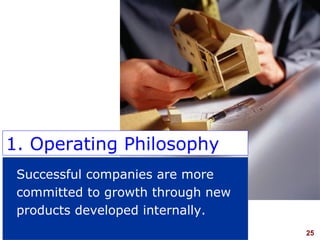
Successful companies are more committed to growth through new products developed internally.  1. Operating Philosophy
They are more likely to have had a formal new product process in place for a longer period of time than unsuccessful companies.   They are more likely to have a strategic plan that includes a certain portion of company growth from new products.
Successful companies are more likely to house the new product organization in R&D or engineering and are more likely to allow the marketing and R&D functions to have greater influence on the new product process.  2. Organizational Structure
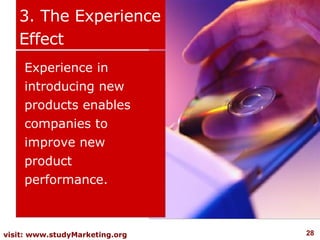
Experience in introducing new products enables companies to improve new product performance.  3. The Experience Effect
New product development costs conform to the experience curve: The more you do something, the more efficient you become at doing it. This experience advantage stems from the acquisition of a knowledge of the market and of the steps required to develop a new product.
Successful companies appear not only to select a management style appropriate to immediate new product development needs but also to revise and tailor that approach to changing new product opportunities  4. Management Style
An empirical research by  Robert Cooper  found three key factors that distinguish winning projects from the losers
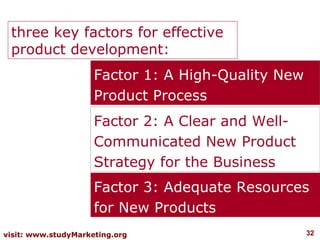
Factor 1: A High-Quality New Product Process Factor 2: A Clear and Well-Communicated New Product Strategy for the Business Factor 3: Adequate Resources for New Products three key factors three key factors for effective product development:
Factor 1: A High-Quality New Product Process Some of these  success factors  that top performers build into their new product processes include:  emphasizing the up-front predevelopment homework;  building in the voice of the customer throughout
Factor 1: A High-Quality New Product Process demanding sharp, early product definition having tough Go/Kill decision points where projects really do get killed  and highlighting quality of execution throughout
there are clear goals or objectives for the business's total new product effort; for example, what percentage of sales or profits new products will contribute to the business Factor 2: A Clear and Well-Communicated New Product Strategy for the Business
there are clearly defined arenas—specified areas of strategic focus, such   as products, markets, or technologies—to give direction to the business's total new product effort
the role of new products in achieving the business's goals and the new   product strategy for the business are clearly communicated to all who need to know
In top-performing businesses, senior management has devoted the necessary resources—people and money, marketing and technical—to achieve the business's new product objectives Factor 3: Adequate Resources for New Products
R&D budgets are adequate—judged to be sufficient in light of the business's new product objectives
the necessary people are in place and have their time freed up for new products.
Source of Reference: Robert Cooper,  Winning at New Products: Accelerating the Process from Idea to Launch,  Perseus Books Group.

New Product Development Strategy

  • 1.
  • 2.
    You can downloadthis presentation at: www.studyMarketing.org Visit www.studyMarketing.org for more presentations on Marketing, Strategy, Innovation, and Branding
  • 3.
    Key Steps in New Product Development
  • 4.
    Key Steps in New Product Development Idea Generation Product Screening Concept Testing Business & Financial Analysis Product Development Test Marketing Commercialization
  • 5.
    Idea Generation Ideageneration is a continuous, systematic search for new product opportunities. It involves delineating sources of new ideas and methods for generating them.
  • 6.
    Methods for GeneratingIdeas Dimensional Analysis lists all of the physical characteristics of a product type. Having obtained such a list, creativity can be triggered by asking questions such as: "Why is the product this way?“, "How could the product be changed?" or "'What would happen if one or more of the characteristics were removed?"
  • 7.
    Problem Analysis is a need-assessment technique designed to develop an inventory of consumer problems in a particular product or service category and to serve as a basis for new product or service ideas.
  • 8.
    Benefit Structure Analysis determines what specific benefits and characteristics are desired by consumers within a particular product or service category and identifies perceived deficiencies in what is currently provided.
  • 9.
    Scenario Analysis identifies opportunities by capitalizing on projected future environments and associated consumer needs.
  • 10.
    Product Screening Afterthe firm identifies potential products, it must screen them. In product screening, poor, unsuitable, or otherwise unattractive ideas are weeded out from further actions.
  • 11.
    Today, many companiesuse a new-product screening checklist for preliminary evaluation. In it, firms list the new-product attributes considered most important and compare each idea with those attributes. The checklist is standardized and allows ideas to be compared.
  • 12.
    Concept testing presentsthe consumer with a proposed product and measures attitudes and intentions at this early stage of development. Concept Testing
  • 13.
    Concept testing isa quick and inexpensive way of measuring consumer enthusiasm. It asks potential consumers to react to a picture, written statement, or oral description of a product. This enables a firm to determine initial attitudes prior to expensive, time-consuming prototype development.
  • 14.
    Business and financialanalysis for the remaining product concepts is much more detailed than product screening. Business & Financial Analysis
  • 15.
    Factors considered inbusiness analysis stage : Demand projections Cost projections Competition Required investment Profitability
  • 16.
    Product development convertsa product idea into a physical form and identifies a basic marketing strategy. Product Development
  • 17.
    It involves productconstruction, packaging, branding, product positioning, and usage testing.
  • 18.
    Test marketing involvesplacing a product for sale in one or more selected areas and observing its actual performance under the proposed marketing plan. Test Marketing
  • 19.
    The purpose isto evaluate the product and pretest marketing efforts in a real setting prior to a full-scale introduction.
  • 20.
    Rather than inquireabout intentions, test marketing allows actual consumer behavior to be observed. The firm can also learn about competitive reactions and the response of channel members.
  • 21.
    After testing iscompleted, the firm is ready to introduce the product to its full target market. This is commercialization and corresponds to the introductory stage of the product life cycle.
  • 22.
    Commercialization involves implementinga total marketing plan and full production.
  • 23.
    Key Success Factors in New Product Development
  • 24.
    An investigation ofnew product practices in 700 firms by Booz-Allen & Hamilton identified the existence of common characteristics in companies that were successful at product innovation
  • 25.
    Successful companies aremore committed to growth through new products developed internally. 1. Operating Philosophy
  • 26.
    They are morelikely to have had a formal new product process in place for a longer period of time than unsuccessful companies. They are more likely to have a strategic plan that includes a certain portion of company growth from new products.
  • 27.
    Successful companies aremore likely to house the new product organization in R&D or engineering and are more likely to allow the marketing and R&D functions to have greater influence on the new product process. 2. Organizational Structure
  • 28.
    Experience in introducingnew products enables companies to improve new product performance. 3. The Experience Effect
  • 29.
    New product developmentcosts conform to the experience curve: The more you do something, the more efficient you become at doing it. This experience advantage stems from the acquisition of a knowledge of the market and of the steps required to develop a new product.
  • 30.
    Successful companies appearnot only to select a management style appropriate to immediate new product development needs but also to revise and tailor that approach to changing new product opportunities 4. Management Style
  • 31.
    An empirical researchby Robert Cooper found three key factors that distinguish winning projects from the losers
  • 32.
    Factor 1: AHigh-Quality New Product Process Factor 2: A Clear and Well-Communicated New Product Strategy for the Business Factor 3: Adequate Resources for New Products three key factors three key factors for effective product development:
  • 33.
    Factor 1: AHigh-Quality New Product Process Some of these success factors that top performers build into their new product processes include: emphasizing the up-front predevelopment homework; building in the voice of the customer throughout
  • 34.
    Factor 1: AHigh-Quality New Product Process demanding sharp, early product definition having tough Go/Kill decision points where projects really do get killed and highlighting quality of execution throughout
  • 35.
    there are cleargoals or objectives for the business's total new product effort; for example, what percentage of sales or profits new products will contribute to the business Factor 2: A Clear and Well-Communicated New Product Strategy for the Business
  • 36.
    there are clearlydefined arenas—specified areas of strategic focus, such as products, markets, or technologies—to give direction to the business's total new product effort
  • 37.
    the role ofnew products in achieving the business's goals and the new product strategy for the business are clearly communicated to all who need to know
  • 38.
    In top-performing businesses,senior management has devoted the necessary resources—people and money, marketing and technical—to achieve the business's new product objectives Factor 3: Adequate Resources for New Products
  • 39.
    R&D budgets areadequate—judged to be sufficient in light of the business's new product objectives
  • 40.
    the necessary peopleare in place and have their time freed up for new products.
  • 41.
    Source of Reference:Robert Cooper, Winning at New Products: Accelerating the Process from Idea to Launch, Perseus Books Group.