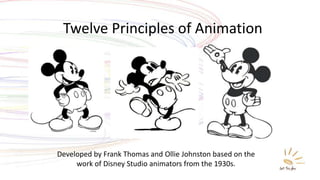
Twelve Principles of Animation
Developed by Frank Thomas and Ollie Johnston based on the
work of Disney Studio animators from the 1930s.
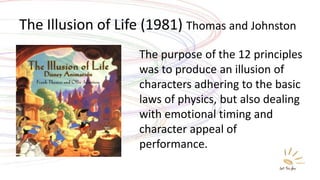
The Illusion of Life (1981) Thomas and Johnston
The purpose of the 12 principles
was to produce an illusion of
characters adhering to the basic
laws of physics, but also dealing
with emotional timing and
character appeal of
performance.
1. Squash and Stretch
The most important principle is
“squash and stretch,” the purpose
of which is to give a sense of
weight and flexibility to drawn
objects. It can be applied to simple
objects, like a bouncing ball, or
more complex constructions, like
the musculature of a human face.
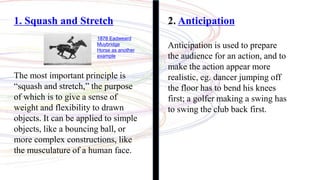
1878 Eadweard
Muybridge
Horse as another
example
2. Anticipation
Anticipation is used to prepare
the audience for an action, and to
make the action appear more
realistic, eg. dancer jumping off
the floor has to bend his knees
first; a golfer making a swing has
to swing the club back first.
3. STAGING
The mise-en-scene should clearly
communicate the attitude, mood,
reaction or idea of the character
as it relates to the story and
continuity of the narrative. Long,
medium, or close up shots, and
camera angles also helps tell the
story.
4. POSE TO POSE
“Pose to Pose” is planned out
and charted with key drawings
done at intervals throughout
the scene. Size, volumes, and
proportions are controlled this
way, as is the action.
(“Straight ahead animation”
starts at the first drawing and
works drawing to drawing to
the end of a scene -- does not
have the same spontaneity and
freshness.
5. FOLLOW THROUGH AND
OVERLAPPING ACTION
When the main body of the
character stops all other parts
continue to catch up to the main
mass of the character, such as
arms, long hair, clothing, coat
tails or a dress, floppy ears or a
long tail (these follow the path of
action). Nothing stops all at once.
6. SLOW-OUT AND SLOW-IN
As action starts, we have more
drawings near the starting
pose, one or two in the
middle, and more drawings
near the next pose. Fewer
drawings make the action
faster and more drawings
make the action slower.
7. ARCS
All actions, with few exceptions
(such as the animation of a
mechanical device), follow an arc
or slightly circular path. This is
especially true of the human
figure and the action of animals.
Arcs give animation a more
natural action and better flow.
8. SECONDARY ACTION
This action adds to and enriches
the main action and adds more
dimension to the character
animation, supplementing and/or
re-enforcing the main action.
Example: A character is angrily
walking toward another character.
The walk is forceful, aggressive,
and forward leaning.
9. TIMING
Expertise in timing comes best
with experience and personal
experimentation, using the trial
and error method in refining
technique. The basics are: more
drawings between poses slow and
smooth the action. Fewer
drawings make the action faster
and crisper.
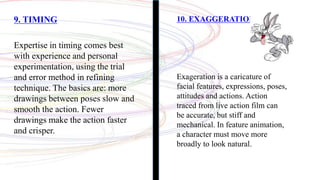
10. EXAGGERATION
Exageration is a caricature of
facial features, expressions, poses,
attitudes and actions. Action
traced from live action film can
be accurate, but stiff and
mechanical. In feature animation,
a character must move more
broadly to look natural.
11. SOLID DRAWING
The basic principles of drawing form,
weight, volume solidity and the
illusion of 3D apply to animation as it
does to art drawings. One draws in
the classical sense, using pencil
sketches and drawings for
reproduction of life. These are then
transformed into color and movement
giving the characters the illusion of
3D and 4D life; 3D being perspective
and staging in space. 4D dimension is
movement in time.
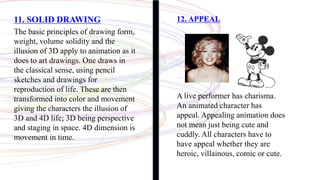
12. APPEAL
A live performer has charisma.
An animated character has
appeal. Appealing animation does
not mean just being cute and
cuddly. All characters have to
have appeal whether they are
heroic, villainous, comic or cute.
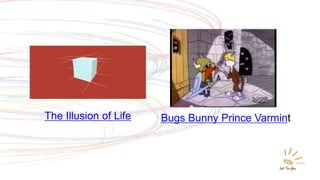
The Illusion of Life Bugs Bunny Prince Varmint
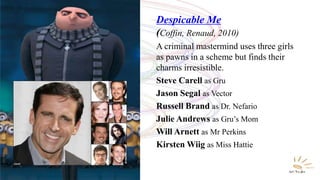
Despicable Me
(Coffin, Renaud, 2010)
A criminal mastermind uses three girls
as pawns in a scheme but finds their
charms irresistible.
Steve Carell as Gru
Jason Segal as Vector
Russell Brand as Dr. Nefario
Julie Andrews as Gru’s Mom
Will Arnett as Mr Perkins
Kirsten Wiig as Miss Hattie

Principles of Animation

  • 1.
    Twelve Principles ofAnimation Developed by Frank Thomas and Ollie Johnston based on the work of Disney Studio animators from the 1930s.
  • 2.
    The Illusion ofLife (1981) Thomas and Johnston The purpose of the 12 principles was to produce an illusion of characters adhering to the basic laws of physics, but also dealing with emotional timing and character appeal of performance.
  • 3.
    1. Squash andStretch The most important principle is “squash and stretch,” the purpose of which is to give a sense of weight and flexibility to drawn objects. It can be applied to simple objects, like a bouncing ball, or more complex constructions, like the musculature of a human face. 1878 Eadweard Muybridge Horse as another example 2. Anticipation Anticipation is used to prepare the audience for an action, and to make the action appear more realistic, eg. dancer jumping off the floor has to bend his knees first; a golfer making a swing has to swing the club back first.
  • 4.
    3. STAGING The mise-en-sceneshould clearly communicate the attitude, mood, reaction or idea of the character as it relates to the story and continuity of the narrative. Long, medium, or close up shots, and camera angles also helps tell the story. 4. POSE TO POSE “Pose to Pose” is planned out and charted with key drawings done at intervals throughout the scene. Size, volumes, and proportions are controlled this way, as is the action. (“Straight ahead animation” starts at the first drawing and works drawing to drawing to the end of a scene -- does not have the same spontaneity and freshness.
  • 5.
    5. FOLLOW THROUGHAND OVERLAPPING ACTION When the main body of the character stops all other parts continue to catch up to the main mass of the character, such as arms, long hair, clothing, coat tails or a dress, floppy ears or a long tail (these follow the path of action). Nothing stops all at once. 6. SLOW-OUT AND SLOW-IN As action starts, we have more drawings near the starting pose, one or two in the middle, and more drawings near the next pose. Fewer drawings make the action faster and more drawings make the action slower.
  • 6.
    7. ARCS All actions,with few exceptions (such as the animation of a mechanical device), follow an arc or slightly circular path. This is especially true of the human figure and the action of animals. Arcs give animation a more natural action and better flow. 8. SECONDARY ACTION This action adds to and enriches the main action and adds more dimension to the character animation, supplementing and/or re-enforcing the main action. Example: A character is angrily walking toward another character. The walk is forceful, aggressive, and forward leaning.
  • 7.
    9. TIMING Expertise intiming comes best with experience and personal experimentation, using the trial and error method in refining technique. The basics are: more drawings between poses slow and smooth the action. Fewer drawings make the action faster and crisper. 10. EXAGGERATION Exageration is a caricature of facial features, expressions, poses, attitudes and actions. Action traced from live action film can be accurate, but stiff and mechanical. In feature animation, a character must move more broadly to look natural.
  • 8.
    11. SOLID DRAWING Thebasic principles of drawing form, weight, volume solidity and the illusion of 3D apply to animation as it does to art drawings. One draws in the classical sense, using pencil sketches and drawings for reproduction of life. These are then transformed into color and movement giving the characters the illusion of 3D and 4D life; 3D being perspective and staging in space. 4D dimension is movement in time. 12. APPEAL A live performer has charisma. An animated character has appeal. Appealing animation does not mean just being cute and cuddly. All characters have to have appeal whether they are heroic, villainous, comic or cute.
  • 9.
    The Illusion ofLife Bugs Bunny Prince Varmint
  • 10.
    Despicable Me (Coffin, Renaud,2010) A criminal mastermind uses three girls as pawns in a scheme but finds their charms irresistible. Steve Carell as Gru Jason Segal as Vector Russell Brand as Dr. Nefario Julie Andrews as Gru’s Mom Will Arnett as Mr Perkins Kirsten Wiig as Miss Hattie