Illusion of movement
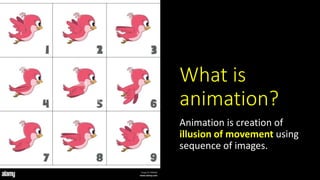
What is
animation?
Animation is creation of
illusion of movement using
sequence of images.
Animation word origin
Animation word
origin from Latin
word 'Anima'
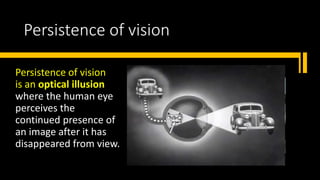
Persistence of vision
is an optical illusion
where the human eye
perceives the
continued presence of
an image after it has
disappeared from view.
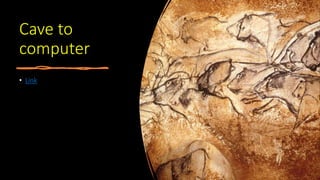
Cave to
computer
• Link
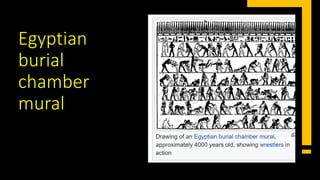
Egyptian
burial
chamber
mural
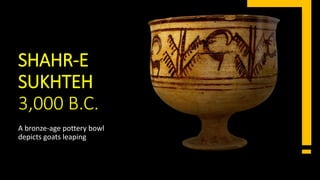
SHAHR-E
SUKHTEH
3,000 B.C.
A bronze-age pottery bowl
depicts goats leaping
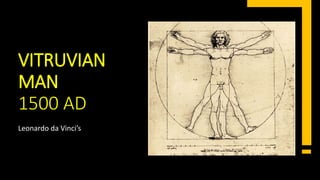
VITRUVIAN
MAN
1500 AD
Leonardo da Vinci’s
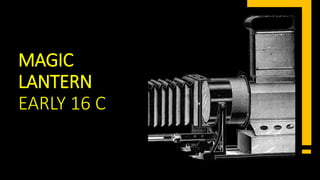
MAGIC
LANTERN
EARLY 16 C
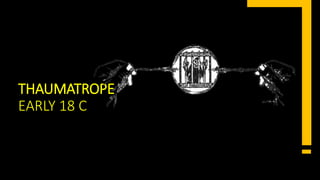
THAUMATROPE
EARLY 18 C
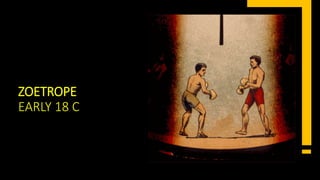
ZOETROPE
EARLY 18 C
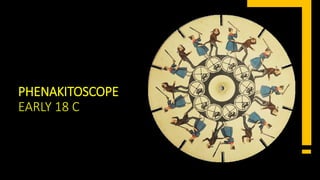
PHENAKITOSCOPE
EARLY 18 C
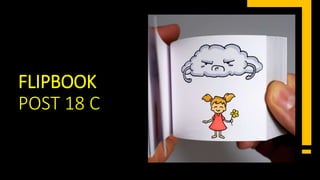
FLIPBOOK
POST 18 C
Type of animation
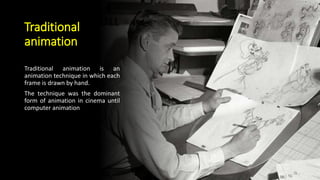
Traditional
animation
Traditional animation is an
animation technique in which each
frame is drawn by hand.
The technique was the dominant
form of animation in cinema until
computer animation
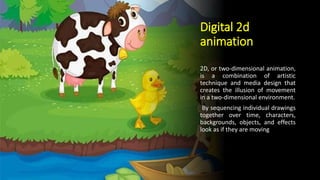
Digital 2d
animation
2D, or two-dimensional animation,
is a combination of artistic
technique and media design that
creates the illusion of movement
in a two-dimensional environment.
By sequencing individual drawings
together over time, characters,
backgrounds, objects, and effects
look as if they are moving
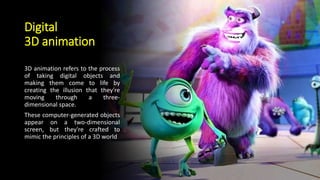
Digital
3D animation
3D animation refers to the process
of taking digital objects and
making them come to life by
creating the illusion that they're
moving through a three-
dimensional space.
These computer-generated objects
appear on a two-dimensional
screen, but they're crafted to
mimic the principles of a 3D world
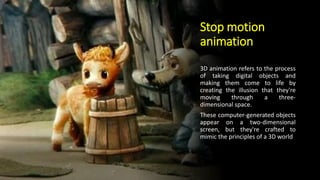
Stop motion
animation
3D animation refers to the process
of taking digital objects and
making them come to life by
creating the illusion that they're
moving through a three-
dimensional space.
These computer-generated objects
appear on a two-dimensional
screen, but they're crafted to
mimic the principles of a 3D world
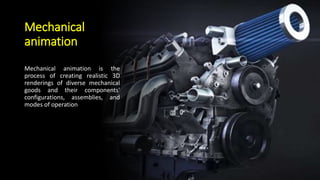
Mechanical
animation
Mechanical animation is the
process of creating realistic 3D
renderings of diverse mechanical
goods and their components'
configurations, assemblies, and
modes of operation
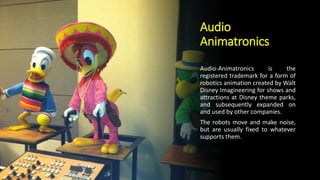
Audio
Animatronics
Audio-Animatronics is the
registered trademark for a form of
robotics animation created by Walt
Disney Imagineering for shows and
attractions at Disney theme parks,
and subsequently expanded on
and used by other companies.
The robots move and make noise,
but are usually fixed to whatever
supports them.
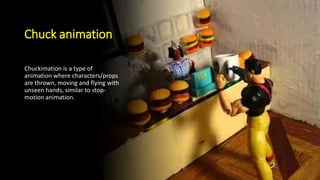
Chuck animation
Chuckimation is a type of
animation where characters/props
are thrown, moving and flying with
unseen hands, similar to stop-
motion animation.
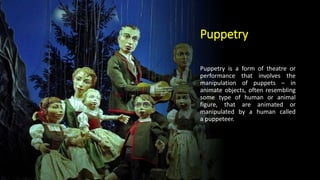
Puppetry
Puppetry is a form of theatre or
performance that involves the
manipulation of puppets – in
animate objects, often resembling
some type of human or animal
figure, that are animated or
manipulated by a human called
a puppeteer.
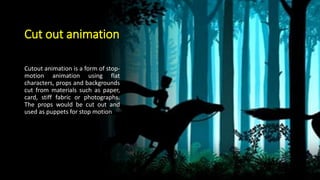
Cut out animation
Cutout animation is a form of stop-
motion animation using flat
characters, props and backgrounds
cut from materials such as paper,
card, stiff fabric or photographs.
The props would be cut out and
used as puppets for stop motion
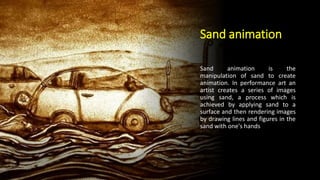
Sand animation
Sand animation is the
manipulation of sand to create
animation. In performance art an
artist creates a series of images
using sand, a process which is
achieved by applying sand to a
surface and then rendering images
by drawing lines and figures in the
sand with one's hands
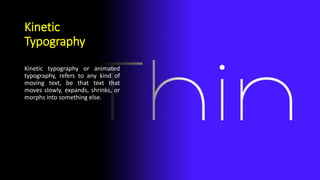
Kinetic
Typography
Kinetic typography or animated
typography, refers to any kind of
moving text, be that text that
moves slowly, expands, shrinks, or
morphs into something else.
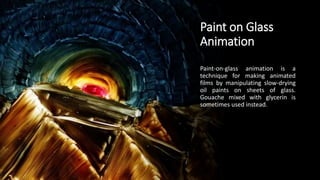
Paint on Glass
Animation
Paint-on-glass animation is a
technique for making animated
films by manipulating slow-drying
oil paints on sheets of glass.
Gouache mixed with glycerin is
sometimes used instead.
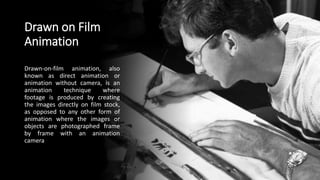
Drawn on Film
Animation
Drawn-on-film animation, also
known as direct animation or
animation without camera, is an
animation technique where
footage is produced by creating
the images directly on film stock,
as opposed to any other form of
animation where the images or
objects are photographed frame
by frame with an animation
camera
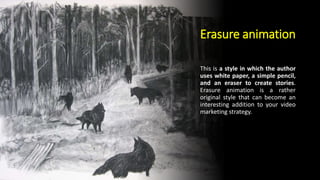
Erasure animation
This is a style in which the author
uses white paper, a simple pencil,
and an eraser to create stories.
Erasure animation is a rather
original style that can become an
interesting addition to your video
marketing strategy.
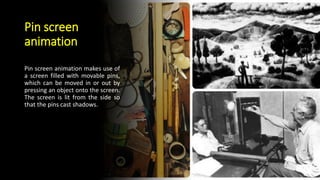
Pin screen
animation
Pin screen animation makes use of
a screen filled with movable pins,
which can be moved in or out by
pressing an object onto the screen.
The screen is lit from the side so
that the pins cast shadows.
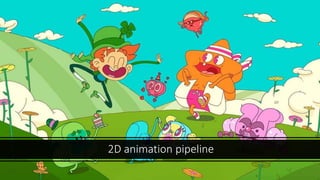
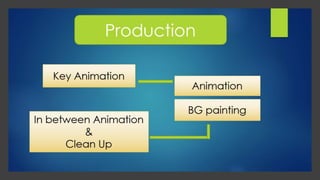
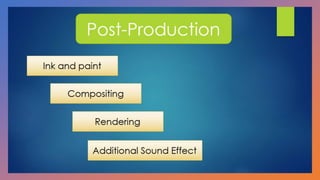
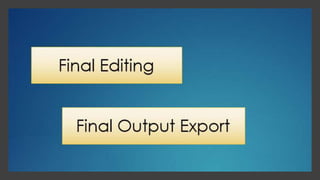
2D animation pipeline
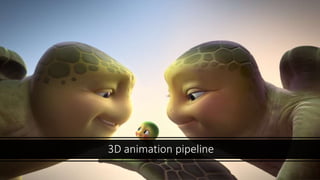
3D animation pipeline
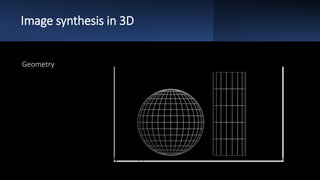
Image synthesis in 3D
Geometry
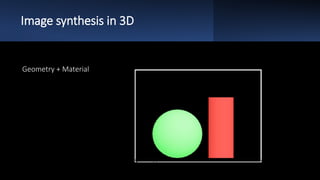
Image synthesis in 3D
Geometry + Material
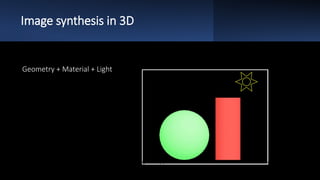
Image synthesis in 3D
Geometry + Material + Light
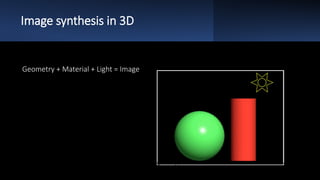
Image synthesis in 3D
Geometry + Material + Light = Image
Image synthesis in 3D
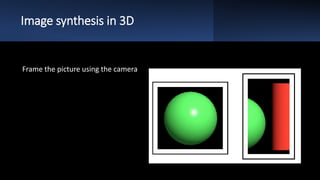
Frame the picture using the camera
Image synthesis in 3D
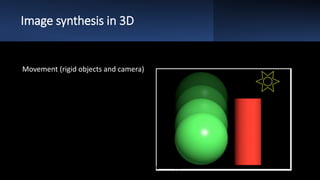
Movement (rigid objects and camera)
Image synthesis in 3D
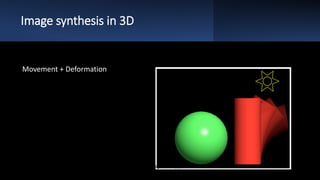
Movement + Deformation
Image synthesis in 3D
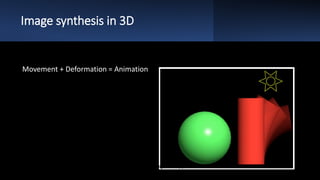
Movement + Deformation = Animation
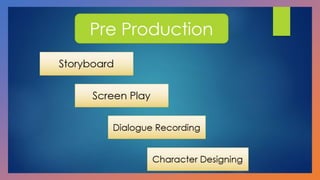
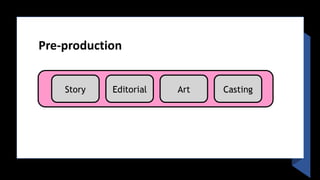
Pre-production
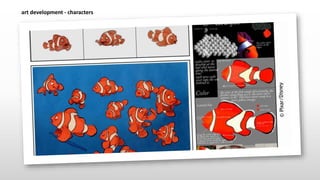
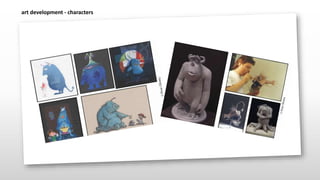
art development - characters
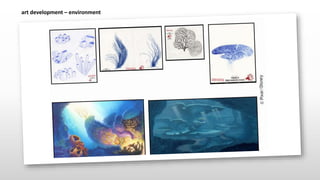
art development – environment
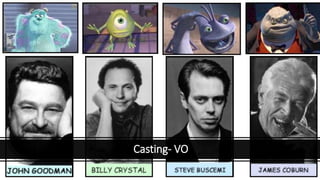
Casting- VO
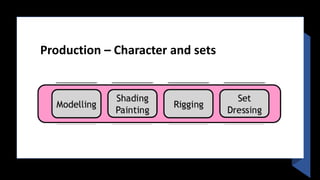
Production – Character and sets
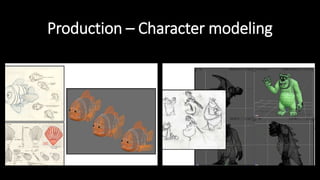
Production – Character modeling
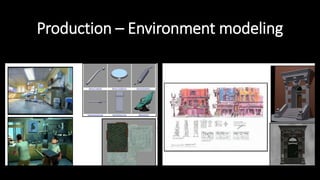
Production – Environment modeling
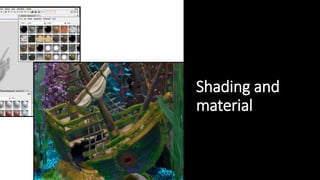
Shading and
material
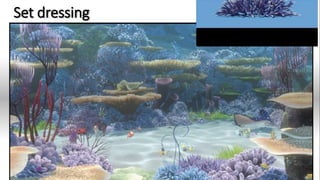
Set dressing
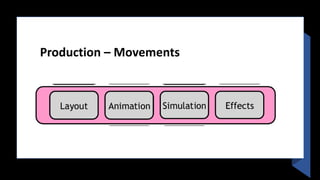
Production – Movements
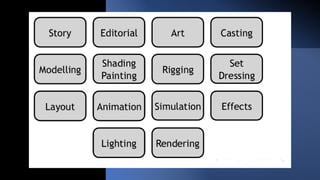
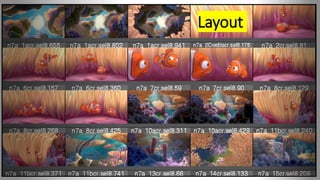
Layout
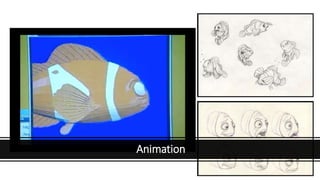
Animation
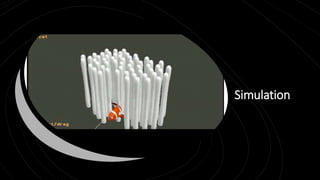
Simulation
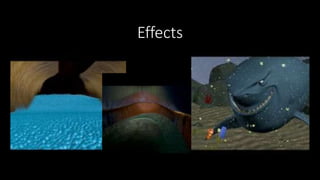
Effects
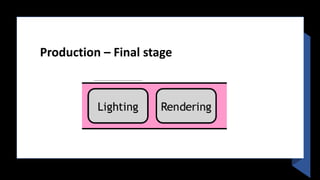
Production – Final stage
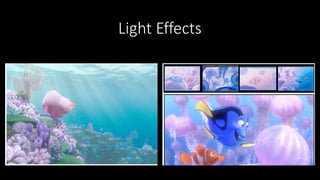
Light Effects
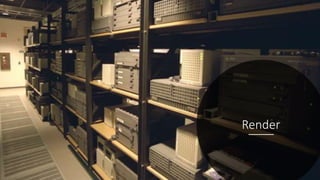
Render
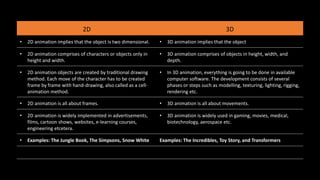
2D 3D
• 2D animation implies that the object is two dimensional. • 3D animation implies that the object
• 2D animation comprises of characters or objects only in
height and width.
• 3D animation comprises of objects in height, width, and
depth.
• 2D animation objects are created by traditional drawing
method. Each move of the character has to be created
frame by frame with hand-drawing, also called as a cell-
animation method.
• In 3D animation, everything is going to be done in available
computer software. The development consists of several
phases or steps such as modelling, texturing, lighting, rigging,
rendering etc.
• 2D animation is all about frames. • 3D animation is all about movements.
• 2D animation is widely implemented in advertisements,
films, cartoon shows, websites, e-learning courses,
engineering etcetera.
• 3D animation is widely used in gaming, movies, medical,
biotechnology, aerospace etc.
• Examples: The Jungle Book, The Simpsons, Snow White Examples: The Incredibles, Toy Story, and Transformers
12 Animation principle's
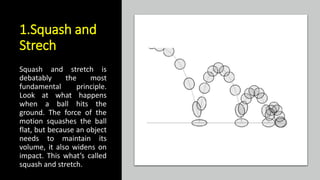
1.Squash and
Strech
Squash and stretch is
debatably the most
fundamental principle.
Look at what happens
when a ball hits the
ground. The force of the
motion squashes the ball
flat, but because an object
needs to maintain its
volume, it also widens on
impact. This what’s called
squash and stretch.
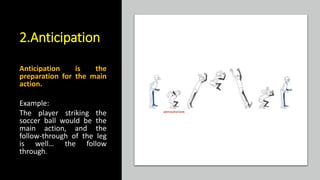
2.Anticipation
Anticipation is the
preparation for the main
action.
Example:
The player striking the
soccer ball would be the
main action, and the
follow-through of the leg
is well… the follow
through.
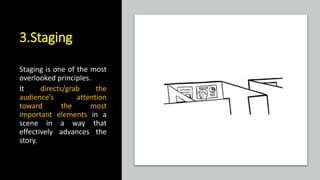
3.Staging
Staging is one of the most
overlooked principles.
It directs/grab the
audience’s attention
toward the most
important elements in a
scene in a way that
effectively advances the
story.
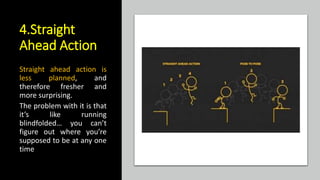
4.Straight
Ahead Action
Straight ahead action is
less planned, and
therefore fresher and
more surprising.
The problem with it is that
it’s like running
blindfolded… you can’t
figure out where you’re
supposed to be at any one
time
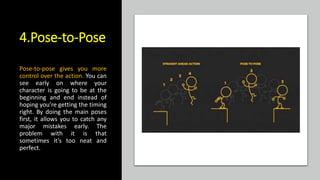
4.Pose-to-Pose
Pose-to-pose gives you more
control over the action. You can
see early on where your
character is going to be at the
beginning and end instead of
hoping you’re getting the timing
right. By doing the main poses
first, it allows you to catch any
major mistakes early. The
problem with it is that
sometimes it’s too neat and
perfect.
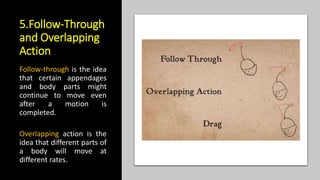
5.Follow-Through
and Overlapping
Action
Follow-through is the idea
that certain appendages
and body parts might
continue to move even
after a motion is
completed.
Overlapping action is the
idea that different parts of
a body will move at
different rates.
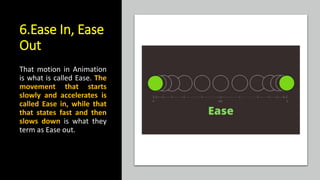
6.Ease In, Ease
Out
That motion in Animation
is what is called Ease. The
movement that starts
slowly and accelerates is
called Ease in, while that
that states fast and then
slows down is what they
term as Ease out.
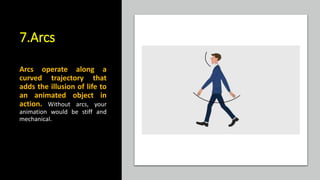
7.Arcs
Arcs operate along a
curved trajectory that
adds the illusion of life to
an animated object in
action. Without arcs, your
animation would be stiff and
mechanical.
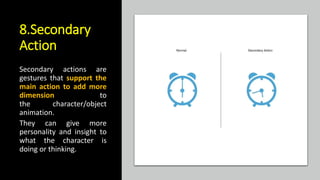
8.Secondary
Action
Secondary actions are
gestures that support the
main action to add more
dimension to
the character/object
animation.
They can give more
personality and insight to
what the character is
doing or thinking.
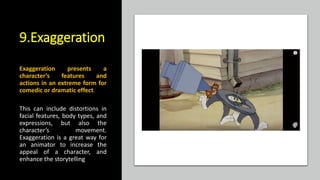
9.Exaggeration
Exaggeration presents a
character’s features and
actions in an extreme form for
comedic or dramatic effect.
This can include distortions in
facial features, body types, and
expressions, but also the
character’s movement.
Exaggeration is a great way for
an animator to increase the
appeal of a character, and
enhance the storytelling
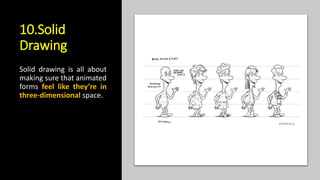
10.Solid
Drawing
Solid drawing is all about
making sure that animated
forms feel like they’re in
three-dimensional space.
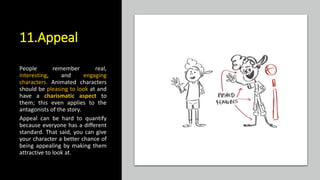
11.Appeal
People remember real,
interesting, and engaging
characters. Animated characters
should be pleasing to look at and
have a charismatic aspect to
them; this even applies to the
antagonists of the story.
Appeal can be hard to quantify
because everyone has a different
standard. That said, you can give
your character a better chance of
being appealing by making them
attractive to look at.
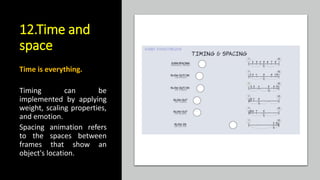
12.Time and
space
Time is everything.
Timing can be
implemented by applying
weight, scaling properties,
and emotion.
Spacing animation refers
to the spaces between
frames that show an
object's location.

Screen art 1.pptx

  • 1.
  • 2.
    What is animation? Animation iscreation of illusion of movement using sequence of images.
  • 3.
    Animation word origin Animationword origin from Latin word 'Anima'
  • 4.
    Persistence of vision Persistenceof vision is an optical illusion where the human eye perceives the continued presence of an image after it has disappeared from view.
  • 5.
  • 6.
  • 7.
    SHAHR-E SUKHTEH 3,000 B.C. A bronze-agepottery bowl depicts goats leaping
  • 8.
  • 9.
  • 10.
  • 11.
  • 12.
  • 13.
  • 14.
  • 15.
    Traditional animation Traditional animation isan animation technique in which each frame is drawn by hand. The technique was the dominant form of animation in cinema until computer animation
  • 16.
    Digital 2d animation 2D, ortwo-dimensional animation, is a combination of artistic technique and media design that creates the illusion of movement in a two-dimensional environment. By sequencing individual drawings together over time, characters, backgrounds, objects, and effects look as if they are moving
  • 17.
    Digital 3D animation 3D animationrefers to the process of taking digital objects and making them come to life by creating the illusion that they're moving through a three- dimensional space. These computer-generated objects appear on a two-dimensional screen, but they're crafted to mimic the principles of a 3D world
  • 18.
    Stop motion animation 3D animationrefers to the process of taking digital objects and making them come to life by creating the illusion that they're moving through a three- dimensional space. These computer-generated objects appear on a two-dimensional screen, but they're crafted to mimic the principles of a 3D world
  • 19.
    Mechanical animation Mechanical animation isthe process of creating realistic 3D renderings of diverse mechanical goods and their components' configurations, assemblies, and modes of operation
  • 20.
    Audio Animatronics Audio-Animatronics is the registeredtrademark for a form of robotics animation created by Walt Disney Imagineering for shows and attractions at Disney theme parks, and subsequently expanded on and used by other companies. The robots move and make noise, but are usually fixed to whatever supports them.
  • 21.
    Chuck animation Chuckimation isa type of animation where characters/props are thrown, moving and flying with unseen hands, similar to stop- motion animation.
  • 22.
    Puppetry Puppetry is aform of theatre or performance that involves the manipulation of puppets – in animate objects, often resembling some type of human or animal figure, that are animated or manipulated by a human called a puppeteer.
  • 23.
    Cut out animation Cutoutanimation is a form of stop- motion animation using flat characters, props and backgrounds cut from materials such as paper, card, stiff fabric or photographs. The props would be cut out and used as puppets for stop motion
  • 24.
    Sand animation Sand animationis the manipulation of sand to create animation. In performance art an artist creates a series of images using sand, a process which is achieved by applying sand to a surface and then rendering images by drawing lines and figures in the sand with one's hands
  • 25.
    Kinetic Typography Kinetic typography oranimated typography, refers to any kind of moving text, be that text that moves slowly, expands, shrinks, or morphs into something else.
  • 26.
    Paint on Glass Animation Paint-on-glassanimation is a technique for making animated films by manipulating slow-drying oil paints on sheets of glass. Gouache mixed with glycerin is sometimes used instead.
  • 27.
    Drawn on Film Animation Drawn-on-filmanimation, also known as direct animation or animation without camera, is an animation technique where footage is produced by creating the images directly on film stock, as opposed to any other form of animation where the images or objects are photographed frame by frame with an animation camera
  • 28.
    Erasure animation This isa style in which the author uses white paper, a simple pencil, and an eraser to create stories. Erasure animation is a rather original style that can become an interesting addition to your video marketing strategy.
  • 29.
    Pin screen animation Pin screenanimation makes use of a screen filled with movable pins, which can be moved in or out by pressing an object onto the screen. The screen is lit from the side so that the pins cast shadows.
  • 30.
  • 36.
  • 37.
    Image synthesis in3D Geometry
  • 38.
    Image synthesis in3D Geometry + Material
  • 39.
    Image synthesis in3D Geometry + Material + Light
  • 40.
    Image synthesis in3D Geometry + Material + Light = Image
  • 41.
    Image synthesis in3D Frame the picture using the camera
  • 42.
    Image synthesis in3D Movement (rigid objects and camera)
  • 43.
    Image synthesis in3D Movement + Deformation
  • 44.
    Image synthesis in3D Movement + Deformation = Animation
  • 46.
  • 47.
  • 48.
  • 49.
  • 50.
  • 51.
  • 52.
  • 53.
  • 54.
  • 55.
  • 56.
  • 57.
  • 58.
  • 59.
  • 60.
  • 61.
  • 62.
  • 63.
  • 64.
    2D 3D • 2Danimation implies that the object is two dimensional. • 3D animation implies that the object • 2D animation comprises of characters or objects only in height and width. • 3D animation comprises of objects in height, width, and depth. • 2D animation objects are created by traditional drawing method. Each move of the character has to be created frame by frame with hand-drawing, also called as a cell- animation method. • In 3D animation, everything is going to be done in available computer software. The development consists of several phases or steps such as modelling, texturing, lighting, rigging, rendering etc. • 2D animation is all about frames. • 3D animation is all about movements. • 2D animation is widely implemented in advertisements, films, cartoon shows, websites, e-learning courses, engineering etcetera. • 3D animation is widely used in gaming, movies, medical, biotechnology, aerospace etc. • Examples: The Jungle Book, The Simpsons, Snow White Examples: The Incredibles, Toy Story, and Transformers
  • 65.
  • 66.
    1.Squash and Strech Squash andstretch is debatably the most fundamental principle. Look at what happens when a ball hits the ground. The force of the motion squashes the ball flat, but because an object needs to maintain its volume, it also widens on impact. This what’s called squash and stretch.
  • 67.
    2.Anticipation Anticipation is the preparationfor the main action. Example: The player striking the soccer ball would be the main action, and the follow-through of the leg is well… the follow through.
  • 68.
    3.Staging Staging is oneof the most overlooked principles. It directs/grab the audience’s attention toward the most important elements in a scene in a way that effectively advances the story.
  • 69.
    4.Straight Ahead Action Straight aheadaction is less planned, and therefore fresher and more surprising. The problem with it is that it’s like running blindfolded… you can’t figure out where you’re supposed to be at any one time
  • 70.
    4.Pose-to-Pose Pose-to-pose gives youmore control over the action. You can see early on where your character is going to be at the beginning and end instead of hoping you’re getting the timing right. By doing the main poses first, it allows you to catch any major mistakes early. The problem with it is that sometimes it’s too neat and perfect.
  • 71.
    5.Follow-Through and Overlapping Action Follow-through isthe idea that certain appendages and body parts might continue to move even after a motion is completed. Overlapping action is the idea that different parts of a body will move at different rates.
  • 72.
    6.Ease In, Ease Out Thatmotion in Animation is what is called Ease. The movement that starts slowly and accelerates is called Ease in, while that that states fast and then slows down is what they term as Ease out.
  • 73.
    7.Arcs Arcs operate alonga curved trajectory that adds the illusion of life to an animated object in action. Without arcs, your animation would be stiff and mechanical.
  • 74.
    8.Secondary Action Secondary actions are gesturesthat support the main action to add more dimension to the character/object animation. They can give more personality and insight to what the character is doing or thinking.
  • 75.
    9.Exaggeration Exaggeration presents a character’sfeatures and actions in an extreme form for comedic or dramatic effect. This can include distortions in facial features, body types, and expressions, but also the character’s movement. Exaggeration is a great way for an animator to increase the appeal of a character, and enhance the storytelling
  • 76.
    10.Solid Drawing Solid drawing isall about making sure that animated forms feel like they’re in three-dimensional space.
  • 77.
    11.Appeal People remember real, interesting,and engaging characters. Animated characters should be pleasing to look at and have a charismatic aspect to them; this even applies to the antagonists of the story. Appeal can be hard to quantify because everyone has a different standard. That said, you can give your character a better chance of being appealing by making them attractive to look at.
  • 78.
    12.Time and space Time iseverything. Timing can be implemented by applying weight, scaling properties, and emotion. Spacing animation refers to the spaces between frames that show an object's location.