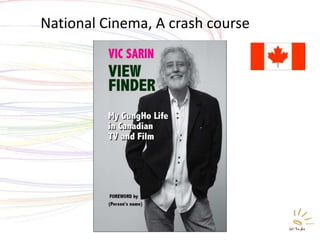
National Cinema, A crash course
“Canada’s tradition grew out of an institution and a socialist-
minded idea, nurtured by the “National Film Board” of showing
Canadians honest reflections of themselves.
The American, or Hollywood, film tradition began as a collective
dream in the minds of several Jewish immigrants who were
possessed by a desire to create pure fantasy and to reinvent the
American Dream as an accessible, if entirely ethereal, ideal.”
From Weird Sex and Snowshoes, Katherine Monk
National Cinema, a crash course
.
Motifs of Canadian Film
(from Katherine Monk, Weird Sex and Snowshoes)
Morality, Passion, Survival.
“Creative non-victimhood.”
Weird Sex, Snowscapes, Vast Landscapes,
Survival guilt, Orphans, Fragmented
narratives, Pluralism, Passive heroes, Potent
women, Outsider stance.
Plus … being “Rooted in Realism.”
Styles and Types (Modes) of Films
REALISM CLASSICISM FORMALISM
Documentary F I C T I O N Avant-Garde
Lonely Boy Blinkety Blink
Mon Oncle Antoine Men With Brooms waydowntown
NB. These are not airtight categories and often overlap.
styles
Types
(modes)
Lonely Boy (Wolf Koenig, Roman Kroitor, 1963)
Produced by: NFB National Filmboard of Canada
Style: Realism
Type/Mode: Documentary – Cinéma-vérité
Genre: Documentary
Plot Outline: A documentary chronicling the career of teen singing star
Paul Anka (the title is taken from one of his hit songs)
Documentaries are constructions rather than transparent
windows into “reality.” What kind of choices were made in the
process of constructing and editing this film: images, words,
music, silence, the title -- the tools that filmmakers use to create
an experience for the audience.
1. Is there such a thing as a completely candid film?
2. What difference does the presence of the camera make for
those who are under its scrutiny?
3. Should the filmmaker be an uninvolved fly-on-the-wall who
records life as it happens, or an engaged participant?
4. What ethical issues are raised?
Documentary: Lonely Boy
Cinéma Vérité or “Direct Cinema” – a style of filmmaking
characterized by realistic, typically documentary
motion pictures that avoid artificiality and artistic
effect and are generally made with simple equipment.
Filmmakers from the National Film Board of Canada
had a significant influence on the development of this
particular approach to filmmaking, especially during
the late 1950s and throughout the 1960s.
Documentary: Lonely Boy
Direct Cinema has had a profound influence on the
history of the film industry.
With the use of the lighter filming equipment
available that became available in the 1950s,
documentary filmmakers such as from NFB were
able to get closer to their subjects, thereby making
their movies much more vivid and personal.
In so doing, film producers were able to present their
subjects in such a more genuine, realistic light,
that the movement has sometimes been called
Cinéma-vérité or “truthful cinema”.
Documentary: Lonely Boy
Boogie Doodle (Norman McLaren, 1948)
Produced by: NFB National Filmboard of Canada
Style: Experimental-Formalist/
Mode: Avant Garde
Genre: Animation/Short
Plot Outline: An experimental film (...) made without
camera, by drawing directly upon 35 mm film
with an ordinary pen and ink." Various abstract
shapes interact and transform into one another.
Artisitic Influences: Russian Constructivism
Norman McLaren literally does what the title
says, to a fast paced boogie woogie tune he
intertwines the movement on screen and the
rhythm of the soundtrack, giving us a Boogie
Doodle.
Russian Constructivists
In art and architecture, constructivism was an artistic movement
in Russia from 1914 in favour of "pure" art with no social
function which used designs influenced by, and materials used in,
industry. Prominent constructivists include Antoine Pevsner,
Naum Gabo and Kasimir Malevich. Below are examples of
Malevich’s work including “Black on White.”

2017 02a. 571

  • 1.
    National Cinema, Acrash course
  • 2.
    “Canada’s tradition grewout of an institution and a socialist- minded idea, nurtured by the “National Film Board” of showing Canadians honest reflections of themselves. The American, or Hollywood, film tradition began as a collective dream in the minds of several Jewish immigrants who were possessed by a desire to create pure fantasy and to reinvent the American Dream as an accessible, if entirely ethereal, ideal.” From Weird Sex and Snowshoes, Katherine Monk National Cinema, a crash course
  • 3.
    . Motifs of CanadianFilm (from Katherine Monk, Weird Sex and Snowshoes) Morality, Passion, Survival. “Creative non-victimhood.” Weird Sex, Snowscapes, Vast Landscapes, Survival guilt, Orphans, Fragmented narratives, Pluralism, Passive heroes, Potent women, Outsider stance. Plus … being “Rooted in Realism.”
  • 4.
    Styles and Types(Modes) of Films REALISM CLASSICISM FORMALISM Documentary F I C T I O N Avant-Garde Lonely Boy Blinkety Blink Mon Oncle Antoine Men With Brooms waydowntown NB. These are not airtight categories and often overlap. styles Types (modes)
  • 5.
    Lonely Boy (WolfKoenig, Roman Kroitor, 1963) Produced by: NFB National Filmboard of Canada Style: Realism Type/Mode: Documentary – Cinéma-vérité Genre: Documentary Plot Outline: A documentary chronicling the career of teen singing star Paul Anka (the title is taken from one of his hit songs)
  • 6.
    Documentaries are constructionsrather than transparent windows into “reality.” What kind of choices were made in the process of constructing and editing this film: images, words, music, silence, the title -- the tools that filmmakers use to create an experience for the audience. 1. Is there such a thing as a completely candid film? 2. What difference does the presence of the camera make for those who are under its scrutiny? 3. Should the filmmaker be an uninvolved fly-on-the-wall who records life as it happens, or an engaged participant? 4. What ethical issues are raised? Documentary: Lonely Boy
  • 7.
    Cinéma Vérité or“Direct Cinema” – a style of filmmaking characterized by realistic, typically documentary motion pictures that avoid artificiality and artistic effect and are generally made with simple equipment. Filmmakers from the National Film Board of Canada had a significant influence on the development of this particular approach to filmmaking, especially during the late 1950s and throughout the 1960s. Documentary: Lonely Boy
  • 8.
    Direct Cinema hashad a profound influence on the history of the film industry. With the use of the lighter filming equipment available that became available in the 1950s, documentary filmmakers such as from NFB were able to get closer to their subjects, thereby making their movies much more vivid and personal. In so doing, film producers were able to present their subjects in such a more genuine, realistic light, that the movement has sometimes been called Cinéma-vérité or “truthful cinema”. Documentary: Lonely Boy
  • 9.
    Boogie Doodle (NormanMcLaren, 1948) Produced by: NFB National Filmboard of Canada Style: Experimental-Formalist/ Mode: Avant Garde Genre: Animation/Short Plot Outline: An experimental film (...) made without camera, by drawing directly upon 35 mm film with an ordinary pen and ink." Various abstract shapes interact and transform into one another. Artisitic Influences: Russian Constructivism Norman McLaren literally does what the title says, to a fast paced boogie woogie tune he intertwines the movement on screen and the rhythm of the soundtrack, giving us a Boogie Doodle.
  • 10.
    Russian Constructivists In artand architecture, constructivism was an artistic movement in Russia from 1914 in favour of "pure" art with no social function which used designs influenced by, and materials used in, industry. Prominent constructivists include Antoine Pevsner, Naum Gabo and Kasimir Malevich. Below are examples of Malevich’s work including “Black on White.”