Aesthetics II – Composition/Kinetics
Mise-en-scène, Rule of Thirds, Camera Movement
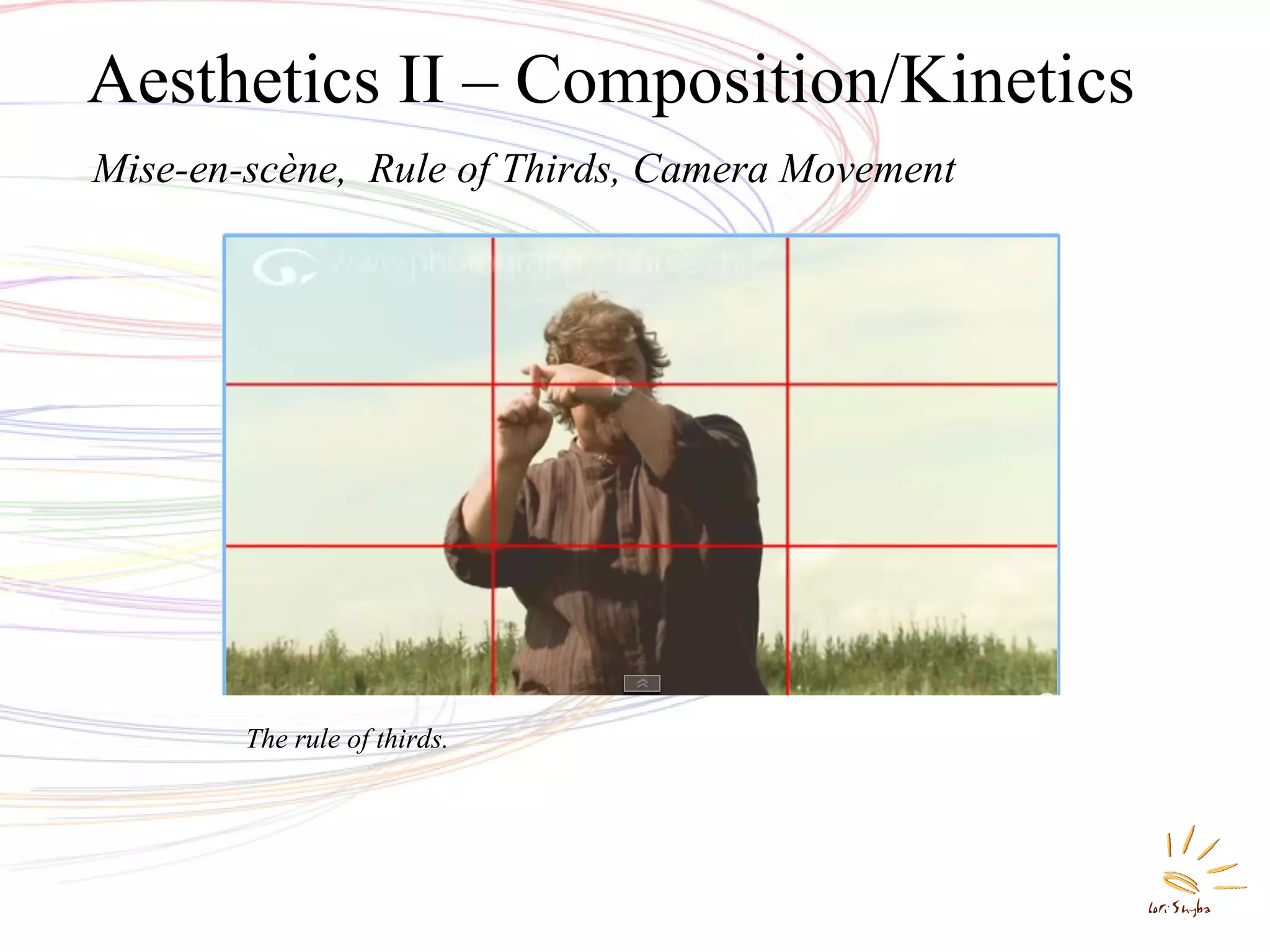
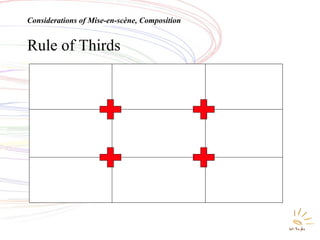
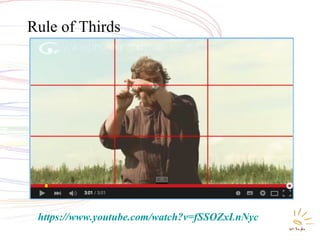
The rule of thirds.
Mise en SceneMise-en-scène
Mise-en-scène : How the visual materials are
photographed, staged, and framed (as a captured
moment in time).
Mise-en-scène -- originally a French theatrical term,
meaning “placing on stage.”
In movies, mise-en-scene is a blend of the visual
conventions of live theatre and converted into a two-
dimensional image of the real thing. The “visual”
text.
Aesthetics of Filmmaking
Systematic Mise en Scene
Analysis
15 pt. Systematic Mise en Scene Analysis
.
Aesthetics of Filmmaking II
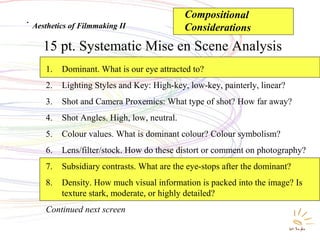
1. Dominant. What is our eye attracted to?
2. Lighting Styles and Key: High-key, low-key, painterly, linear?
3. Shot and Camera Proxemics: What type of shot? How far away?
4. Shot Angles. High, low, neutral.
5. Colour values. What is dominant colour? Colour symbolism?
6. Lens/filter/stock. How do these distort or comment on photography?
7. Subsidiary contrasts. What are the eye-stops after the dominant?
8. Density. How much visual information is packed into the image? Is
texture stark, moderate, or highly detailed?
Continued next screen
Compositional
Considerations
Systematic Mise en Scene
Analysis
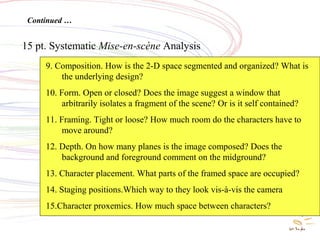
15 pt. Systematic Mise-en-scène Analysis
Continued …
9. Composition. How is the 2-D space segmented and organized? What is
the underlying design?
10. Form. Open or closed? Does the image suggest a window that
arbitrarily isolates a fragment of the scene? Or is it self contained?
11. Framing. Tight or loose? How much room do the characters have to
move around?
12. Depth. On how many planes is the image composed? Does the
background and foreground comment on the midground?
13. Character placement. What parts of the framed space are occupied?
14. Staging positions.Which way to they look vis-à-vis the camera
15.Character proxemics. How much space between characters?
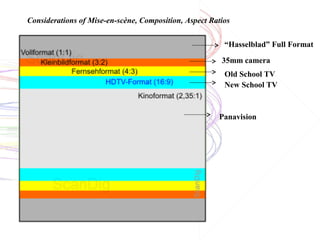
Considerations of Mise-en-scène, Composition, Aspect Ratios
“Hasselblad” Full Format
35mm camera
Old School TV
New School TV
Panavision
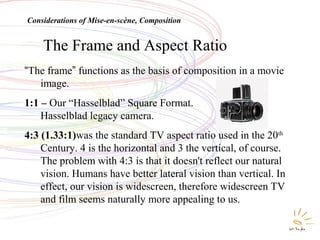
The Frame and Aspect Ratio
“The frame” functions as the basis of composition in a movie
image.
1:1 – Our “Hasselblad” Square Format.
Hasselblad legacy camera.
4:3 (1.33:1)was the standard TV aspect ratio used in the 20th
Century. 4 is the horizontal and 3 the vertical, of course.
The problem with 4:3 is that it doesn't reflect our natural
vision. Humans have better lateral vision than vertical. In
effect, our vision is widescreen, therefore widescreen TV
and film seems naturally more appealing to us.
Considerations of Mise-en-scène, Composition
The Frame and Aspect Ratio
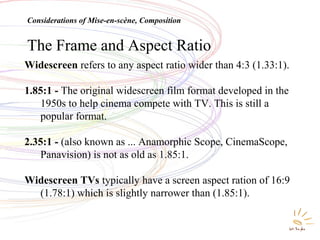
Widescreen refers to any aspect ratio wider than 4:3 (1.33:1).
1.85:1 - The original widescreen film format developed in the
1950s to help cinema compete with TV. This is still a
popular format.
2.35:1 - (also known as ... Anamorphic Scope, CinemaScope,
Panavision) is not as old as 1.85:1.
Widescreen TVs typically have a screen aspect ration of 16:9
(1.78:1) which is slightly narrower than (1.85:1).
Considerations of Mise-en-scène, Composition
Rule of Thirds
Considerations of Mise-en-scène, Composition
Rule of Thirds
https://www.youtube.com/watch?v=fSSOZxLnNyc
Movement -- KineticsThe Moving Camera
There are Seven Basic Moving Camera Shots:
Panning shots (swish pans)
Tilts
Dolly Shots (Trucking, Tracking, Pull-backs)
Handheld Shots
Crane Shots
Zoom Shots
Aerial Shots (Drones, Helicopters)
This is a good resource for Camera Angles, Proxemics,
Movement! http://www.youtube.com/watch?v=d1japIhKU9I
Camera Kinetics

2017 04 571

  • 1.
    Aesthetics II –Composition/Kinetics Mise-en-scène, Rule of Thirds, Camera Movement The rule of thirds.
  • 2.
    Mise en SceneMise-en-scène Mise-en-scène: How the visual materials are photographed, staged, and framed (as a captured moment in time). Mise-en-scène -- originally a French theatrical term, meaning “placing on stage.” In movies, mise-en-scene is a blend of the visual conventions of live theatre and converted into a two- dimensional image of the real thing. The “visual” text. Aesthetics of Filmmaking
  • 3.
    Systematic Mise enScene Analysis 15 pt. Systematic Mise en Scene Analysis . Aesthetics of Filmmaking II 1. Dominant. What is our eye attracted to? 2. Lighting Styles and Key: High-key, low-key, painterly, linear? 3. Shot and Camera Proxemics: What type of shot? How far away? 4. Shot Angles. High, low, neutral. 5. Colour values. What is dominant colour? Colour symbolism? 6. Lens/filter/stock. How do these distort or comment on photography? 7. Subsidiary contrasts. What are the eye-stops after the dominant? 8. Density. How much visual information is packed into the image? Is texture stark, moderate, or highly detailed? Continued next screen Compositional Considerations
  • 4.
    Systematic Mise enScene Analysis 15 pt. Systematic Mise-en-scène Analysis Continued … 9. Composition. How is the 2-D space segmented and organized? What is the underlying design? 10. Form. Open or closed? Does the image suggest a window that arbitrarily isolates a fragment of the scene? Or is it self contained? 11. Framing. Tight or loose? How much room do the characters have to move around? 12. Depth. On how many planes is the image composed? Does the background and foreground comment on the midground? 13. Character placement. What parts of the framed space are occupied? 14. Staging positions.Which way to they look vis-à-vis the camera 15.Character proxemics. How much space between characters?
  • 5.
    Considerations of Mise-en-scène,Composition, Aspect Ratios “Hasselblad” Full Format 35mm camera Old School TV New School TV Panavision
  • 6.
    The Frame andAspect Ratio “The frame” functions as the basis of composition in a movie image. 1:1 – Our “Hasselblad” Square Format. Hasselblad legacy camera. 4:3 (1.33:1)was the standard TV aspect ratio used in the 20th Century. 4 is the horizontal and 3 the vertical, of course. The problem with 4:3 is that it doesn't reflect our natural vision. Humans have better lateral vision than vertical. In effect, our vision is widescreen, therefore widescreen TV and film seems naturally more appealing to us. Considerations of Mise-en-scène, Composition
  • 7.
    The Frame andAspect Ratio Widescreen refers to any aspect ratio wider than 4:3 (1.33:1). 1.85:1 - The original widescreen film format developed in the 1950s to help cinema compete with TV. This is still a popular format. 2.35:1 - (also known as ... Anamorphic Scope, CinemaScope, Panavision) is not as old as 1.85:1. Widescreen TVs typically have a screen aspect ration of 16:9 (1.78:1) which is slightly narrower than (1.85:1). Considerations of Mise-en-scène, Composition
  • 8.
    Rule of Thirds Considerationsof Mise-en-scène, Composition
  • 9.
  • 10.
    Movement -- KineticsTheMoving Camera There are Seven Basic Moving Camera Shots: Panning shots (swish pans) Tilts Dolly Shots (Trucking, Tracking, Pull-backs) Handheld Shots Crane Shots Zoom Shots Aerial Shots (Drones, Helicopters) This is a good resource for Camera Angles, Proxemics, Movement! http://www.youtube.com/watch?v=d1japIhKU9I Camera Kinetics