helpdesk@construction-productivity.co.uk
htt://www.construction-productivity.co.uk
LEAN SUPPLY
CHAIN
•Change is needed to
increase competitiveness
LEAN SUPPLY
CHAIN
•If we stand still, our
competitors will pass us by
LEAN SUPPLY
CHAIN
• In hard economic conditions, only
the fittest will survive
LEAN SUPPLY
CHAIN
• Reducing costs and providing the
highest value to our customers is
crucial for success
LEAN SUPPLY
CHAIN
•“Lean” is
one way
forward
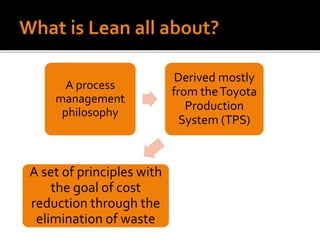
A process
management
philosophy
Derived mostly
from theToyota
Production
System (TPS)
A set of principles with
the goal of cost
reduction through the
elimination of waste
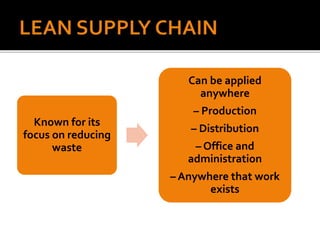
Known for its
focus on reducing
waste
Can be applied
anywhere
– Production
– Distribution
– Office and
administration
– Anywhere that work
exists
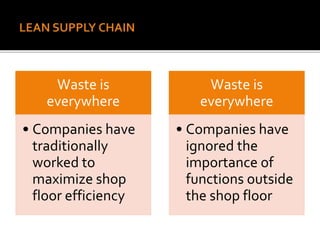
Waste is
everywhere
• Companies have
traditionally
worked to
maximize shop
floor efficiency
Waste is
everywhere
• Companies have
ignored the
importance of
functions outside
the shop floor
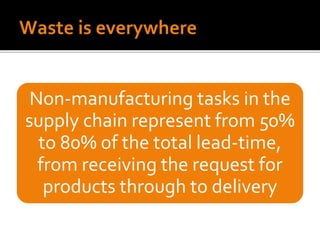
Non-manufacturing tasks in the
supply chain represent from 50%
to 80% of the total lead-time,
from receiving the request for
products through to delivery
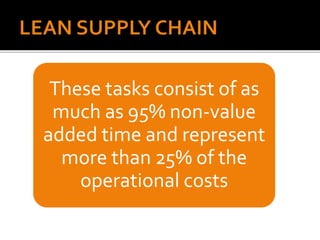
These tasks consist of as
much as 95% non-value
added time and represent
more than 25% of the
operational costs
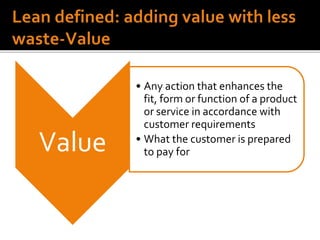
Value
• Any action that enhances the
fit, form or function of a product
or service in accordance with
customer requirements
• What the customer is prepared
to pay for
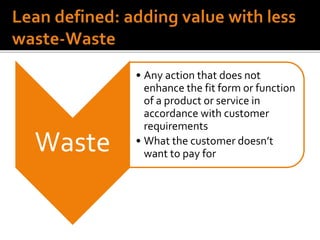
Waste
• Any action that does not
enhance the fit form or function
of a product or service in
accordance with customer
requirements
• What the customer doesn’t
want to pay for
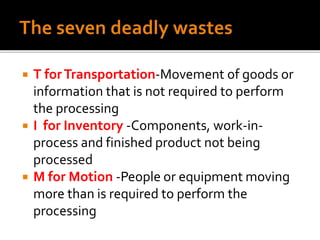
 T forTransportation-Movement of goods or
information that is not required to perform
the processing
 I for Inventory -Components, work-in-
process and finished product not being
processed
 M for Motion -People or equipment moving
more than is required to perform the
processing
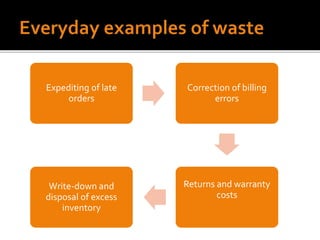
Expediting of late
orders
Correction of billing
errors
Returns and warranty
costs
Write-down and
disposal of excess
inventory
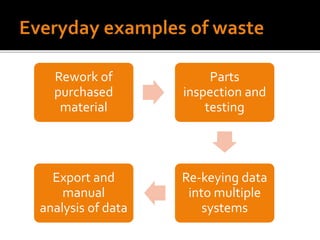
Rework of
purchased
material
Parts
inspection and
testing
Re-keying data
into multiple
systems
Export and
manual
analysis of data
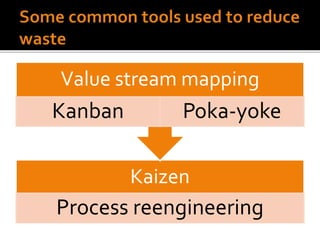
Kaizen
Process reengineering
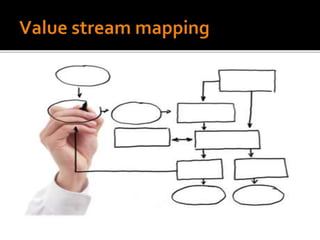
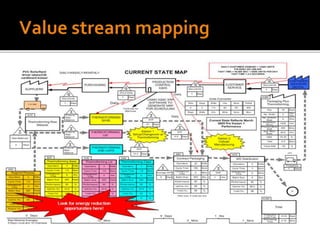
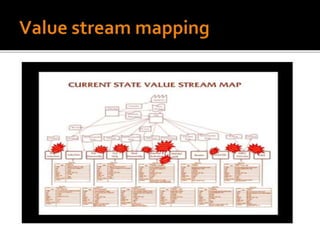
Value stream mapping
Kanban Poka-yoke
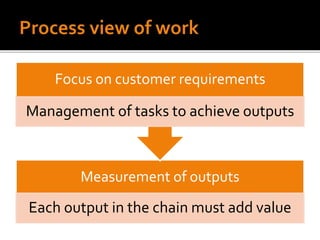
Measurement of outputs
Each output in the chain must add value
Focus on customer requirements
Management of tasks to achieve outputs
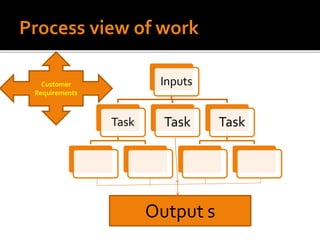
Inputs
Task Task Task
Customer
Requirements
Output s
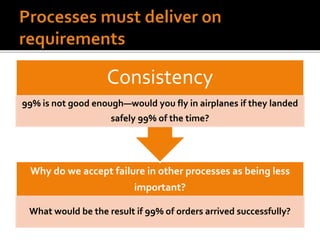
Why do we accept failure in other processes as being less
important?
What would be the result if 99% of orders arrived successfully?
Consistency
99% is not good enough—would you fly in airplanes if they landed
safely 99% of the time?
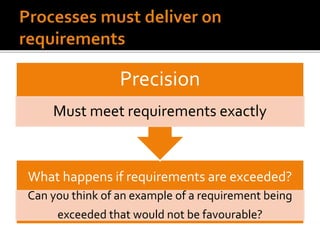
What happens if requirements are exceeded?
Can you think of an example of a requirement being
exceeded that would not be favourable?
Precision
Must meet requirements exactly
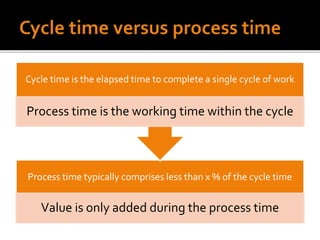
Process time typically comprises less than x % of the cycle time
Value is only added during the process time
Cycle time is the elapsed time to complete a single cycle of work
Process time is the working time within the cycle
The goal is to get
cycle time to equal
process time
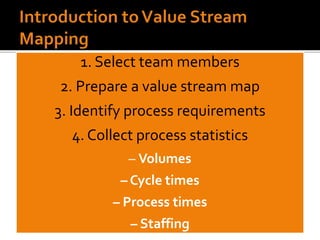
1. Select team members
2. Prepare a value stream map
3. Identify process requirements
4. Collect process statistics
– Volumes
– Cycle times
– Process times
– Staffing
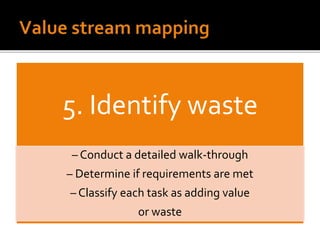
5. Identify waste
– Conduct a detailed walk-through
– Determine if requirements are met
– Classify each task as adding value
or waste
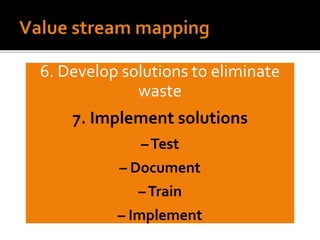
6. Develop solutions to eliminate
waste
7. Implement solutions
–Test
– Document
–Train
– Implement
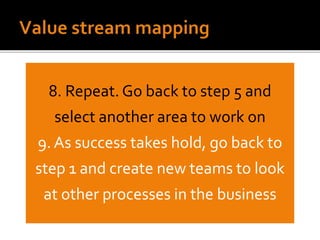
8. Repeat. Go back to step 5 and
select another area to work on
9. As success takes hold, go back to
step 1 and create new teams to look
at other processes in the business
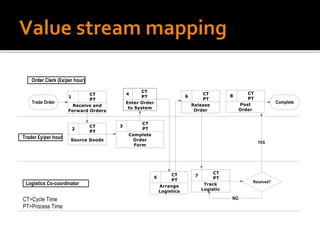
 A timber trading company facilitates deals
between buyers in one country and sellers in
another country
 A total of 100,000 such transactions is processed
each year
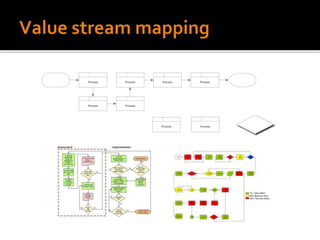
 An analyst has prepared a value stream process
map on the following page
 The cycle time (“CT”) per order is 20 hours, 5
minutes plus shipping
 The process time (“PT”) per order is 1 hour, 18
minutes
Reduce the time to
enter orders
Reduce the wait time
for a back-office process
Shorten the lead time
to obtain raw materials
Automate production of shipping documentation
Redesign a job to reduce walking distances
Create a lean work cell for an assembly or production process
Reduce excess work-in-process inventory
Reduce the elapsed time to
pick, pack and ship an order
‘Fail-safe’ a
process to
eliminate errors or
defects
Eliminate double
entry of
information into
spreadsheets
060 lean supply chain

060 lean supply chain

  • 1.
  • 2.
    LEAN SUPPLY CHAIN •Change isneeded to increase competitiveness LEAN SUPPLY CHAIN •If we stand still, our competitors will pass us by
  • 3.
    LEAN SUPPLY CHAIN • Inhard economic conditions, only the fittest will survive LEAN SUPPLY CHAIN • Reducing costs and providing the highest value to our customers is crucial for success
  • 4.
  • 5.
    A process management philosophy Derived mostly fromtheToyota Production System (TPS) A set of principles with the goal of cost reduction through the elimination of waste
  • 6.
    Known for its focuson reducing waste Can be applied anywhere – Production – Distribution – Office and administration – Anywhere that work exists
  • 7.
    Waste is everywhere • Companieshave traditionally worked to maximize shop floor efficiency Waste is everywhere • Companies have ignored the importance of functions outside the shop floor
  • 8.
    Non-manufacturing tasks inthe supply chain represent from 50% to 80% of the total lead-time, from receiving the request for products through to delivery
  • 9.
    These tasks consistof as much as 95% non-value added time and represent more than 25% of the operational costs
  • 10.
    Value • Any actionthat enhances the fit, form or function of a product or service in accordance with customer requirements • What the customer is prepared to pay for
  • 11.
    Waste • Any actionthat does not enhance the fit form or function of a product or service in accordance with customer requirements • What the customer doesn’t want to pay for
  • 12.
     T forTransportation-Movementof goods or information that is not required to perform the processing  I for Inventory -Components, work-in- process and finished product not being processed  M for Motion -People or equipment moving more than is required to perform the processing
  • 13.
    Expediting of late orders Correctionof billing errors Returns and warranty costs Write-down and disposal of excess inventory
  • 14.
    Rework of purchased material Parts inspection and testing Re-keyingdata into multiple systems Export and manual analysis of data
  • 15.
  • 16.
    Measurement of outputs Eachoutput in the chain must add value Focus on customer requirements Management of tasks to achieve outputs
  • 17.
  • 18.
    Why do weaccept failure in other processes as being less important? What would be the result if 99% of orders arrived successfully? Consistency 99% is not good enough—would you fly in airplanes if they landed safely 99% of the time?
  • 19.
    What happens ifrequirements are exceeded? Can you think of an example of a requirement being exceeded that would not be favourable? Precision Must meet requirements exactly
  • 20.
    Process time typicallycomprises less than x % of the cycle time Value is only added during the process time Cycle time is the elapsed time to complete a single cycle of work Process time is the working time within the cycle
  • 21.
    The goal isto get cycle time to equal process time
  • 22.
    1. Select teammembers 2. Prepare a value stream map 3. Identify process requirements 4. Collect process statistics – Volumes – Cycle times – Process times – Staffing
  • 23.
    5. Identify waste –Conduct a detailed walk-through – Determine if requirements are met – Classify each task as adding value or waste
  • 24.
    6. Develop solutionsto eliminate waste 7. Implement solutions –Test – Document –Train – Implement
  • 25.
    8. Repeat. Goback to step 5 and select another area to work on 9. As success takes hold, go back to step 1 and create new teams to look at other processes in the business
  • 26.
     A timbertrading company facilitates deals between buyers in one country and sellers in another country  A total of 100,000 such transactions is processed each year  An analyst has prepared a value stream process map on the following page  The cycle time (“CT”) per order is 20 hours, 5 minutes plus shipping  The process time (“PT”) per order is 1 hour, 18 minutes
  • 28.
    Reduce the timeto enter orders Reduce the wait time for a back-office process Shorten the lead time to obtain raw materials
  • 29.
    Automate production ofshipping documentation Redesign a job to reduce walking distances Create a lean work cell for an assembly or production process Reduce excess work-in-process inventory
  • 30.
    Reduce the elapsedtime to pick, pack and ship an order ‘Fail-safe’ a process to eliminate errors or defects Eliminate double entry of information into spreadsheets