Copyright © 2002 by The McGraw-Hill Companies, Inc. All rights reserved.
1-1
Bateman Snell
Management
5th
Edition
Competing
in the
New Era
Copyright © 2002 by The McGraw-Hill Companies, Inc. All rights reserved.
1-2
Part One
Chapter 1 - Managing
Chapter Outline
Setting The Stage
Managing In The New Era
Managing For Competitive Advantage
The Functions Of Management
Management Levels And Skills
You And Your Career
Copyright © 2002 by The McGraw-Hill Companies, Inc. All rights reserved.
1-3
Learning Objectives
After studying Chapter 1, you will know:
 the major challenges of managing in the new era
 the drivers of competitive advantage for your company
 the functions of management and how they are evolving in
today’s business environment
 the nature of management at different organizational levels
 the skills you need to be an effective manager
 what to strive for as you manage your career
Copyright © 2002 by The McGraw-Hill Companies, Inc. All rights reserved.
1-4
Managing In The New Era
The Internet
 changes the way management must think and act
 chief Web officer will be one of the most important jobs
will oversee information systems and strategies
will create and manage business relationships via new
communications technologies
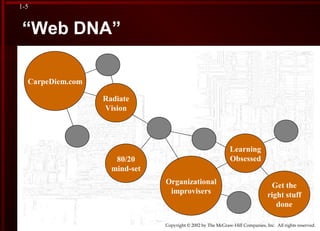
Web DNA - personal characteristics considered to be the ‘right
stuff” for managers in Internet economy
 great companies will capitalize most fully on the Web’s
potential
 distinction between Internet and non-Internet companies is
fading
Copyright © 2002 by The McGraw-Hill Companies, Inc. All rights reserved.
1-5
“Web DNA”
CarpeDiem.com
Radiate
Vision
Organizational
improvisers
Get the
right stuff
done
Learning
Obsessed80/20
mind-set
Copyright © 2002 by The McGraw-Hill Companies, Inc. All rights reserved.
1-6
Managing In The New Era (cont.)
Globalization
 isolationism is a thing of the past
 multinational enterprises have sales offices all over the world
 corporations use their transnational status to operate beyond
the control of national governments
 even small firms that do not operate on a global scale must
make strategic decisions based on international
considerations
Copyright © 2002 by The McGraw-Hill Companies, Inc. All rights reserved.
1-7
Managing In The New Era (cont.)
Knowledge management
 set of practices aimed at discovering and harnessing an
organization’s intellectual resources
unlock people’s expertise, skills, wisdom, and relationships
 intellectual capital is the collective brainpower of the
organization
Collaboration across “boundaries”
 capitalize on the ideas of people outside the traditional
company “boundaries”
must effectively capitalize on customers’ brains
 get customers to think creatively to identify new product and
service ideas
Copyright © 2002 by The McGraw-Hill Companies, Inc. All rights reserved.
1-8
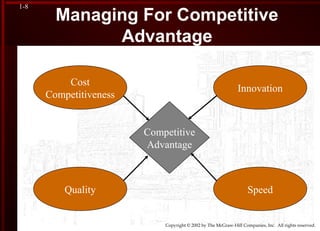
Competitive
Advantage
Cost
Competitiveness
SpeedQuality
Innovation
Managing For Competitive
Advantage
Copyright © 2002 by The McGraw-Hill Companies, Inc. All rights reserved.
1-9
Managing For Competitive
Advantage
Cost competitiveness
 costs are kept low enough so that you can realize profits and
price your products at levels that are attractive to consumers
 key is efficiency - accomplishing goals by using resources
wisely and minimizing waste
Quality
 excellence of a product, including its attractiveness, lack of
defects, reliability, and long-term durability
 importance of quality has increased dramatically
 must identify specific elements of quality to correct
problems, target needs, and deliver world-class value
Copyright © 2002 by The McGraw-Hill Companies, Inc. All rights reserved.
1-10
Managing For Competitive
Advantage (cont.)
Speed
 often separates winners from losers in world competition
 speed became a vital requirement in the 1990s
requirement has increased exponentially
Innovation
 the introduction of new goods and services
 important to adapt to changes in consumer demands and to
new sources of competition
Best managers and companies delivering all four
Copyright © 2002 by The McGraw-Hill Companies, Inc. All rights reserved.
1-11
The Functions Of Management
Management
 process of working with people and resources to accomplish
organizational goals
effective - achieve organizational goals
efficient - achieve goals with minimum waste of resources
 there are timeless principles of management
still important for making managers and companies great
Copyright © 2002 by The McGraw-Hill Companies, Inc. All rights reserved.
1-12
Planning
Leading
Controlling
The Functions Of Management
Organizing
Copyright © 2002 by The McGraw-Hill Companies, Inc. All rights reserved.
1-13
The Functions Of Management
(cont.)
Planning
 specifying the goals to be achieved and deciding in advance
the appropriate actions taken to achieve those goals
 delivering strategic value - planning function for the new era
a dynamic process in which the organization uses the brains of
its members and of stakeholders to identify opportunities to
maintain and increase competitive advantage
process intended to create more value for the customer
Organizing
 assembling and coordinating the human, financial, physical,
informational, and other resources needed to achieve goals
 the future requires building flexible organizations
Copyright © 2002 by The McGraw-Hill Companies, Inc. All rights reserved.
1-14
The Functions Of Management
(cont.)
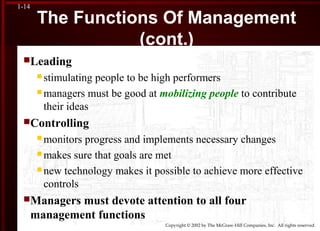
Leading
 stimulating people to be high performers
 managers must be good at mobilizing people to contribute
their ideas
Controlling
 monitors progress and implements necessary changes
 makes sure that goals are met
 new technology makes it possible to achieve more effective
controls
Managers must devote attention to all four
management functions
Copyright © 2002 by The McGraw-Hill Companies, Inc. All rights reserved.
1-15
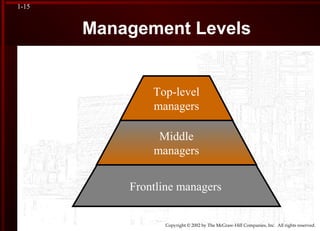
Management Levels
Frontline managers
Top-level
managers
Middle
managers
Copyright © 2002 by The McGraw-Hill Companies, Inc. All rights reserved.
1-16
Management Levels And Skills
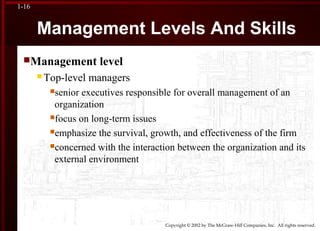
Management level
 Top-level managers
senior executives responsible for overall management of an
organization
focus on long-term issues
emphasize the survival, growth, and effectiveness of the firm
concerned with the interaction between the organization and its
external environment
Copyright © 2002 by The McGraw-Hill Companies, Inc. All rights reserved.
1-17
Management Levels And Skills
(cont.)
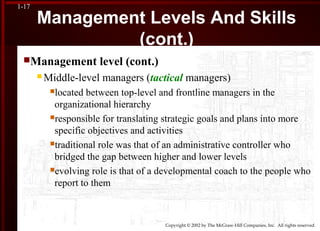
Management level (cont.)
 Middle-level managers (tactical managers)
located between top-level and frontline managers in the
organizational hierarchy
responsible for translating strategic goals and plans into more
specific objectives and activities
traditional role was that of an administrative controller who
bridged the gap between higher and lower levels
evolving role is that of a developmental coach to the people who
report to them
Copyright © 2002 by The McGraw-Hill Companies, Inc. All rights reserved.
1-18
Management Levels And Skills
(cont.)
Management level (cont.)
 Frontline managers (operational managers)
lower-level managers who supervise the operational activities of
the organization
directly involved with nonmanagement employees
increasingly being called on to be innovative and
entrepreneurial
 Working leaders with broad responsibilities
in leading small companies, managers have strategic, tactical,
and operational responsibilities
have a knowledge of all business functions, are accountable for
results, and focus on internal and external customers
Copyright © 2002 by The McGraw-Hill Companies, Inc. All rights reserved.
1-19
Management Levels And Skills
(cont.)
Management skills
 skill - specific ability that results from knowledge,
information, and aptitude
 technical skill - ability to perform a specialized task that
involves a certain method or process
managers at higher levels rely less on technical skills
 conceptual and decision skills - ability to identify problems,
resolve problems for the benefit of the organization
necessary when considering the overall objectives and strategy
of the organization and the interactions among its different parts
assume greater importance as manager acquires more
responsibility
Copyright © 2002 by The McGraw-Hill Companies, Inc. All rights reserved.
1-20
Management Levels And Skills
(cont.)
Management skills (cont.)
 interpersonal and communication skills - ability to work
well with people
increasingly important in today’s organizations
 greater reliance on teams, information sharing, and coaching
Copyright © 2002 by The McGraw-Hill Companies, Inc. All rights reserved.
1-21
You And Your Career
Jobs are no longer as secure for managers as they used
to be
 organizations still try to develop and retain good employees
 employee loyalty and commitment are still important
Companies offering “employability” to workers tend to
be more successful
 provide training and other learning experiences
 employees perform work with greater responsibility
Copyright © 2002 by The McGraw-Hill Companies, Inc. All rights reserved.
1-22
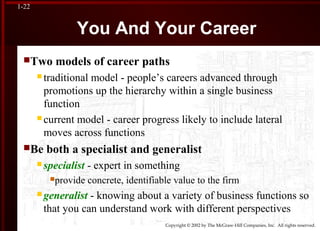
Two models of career paths
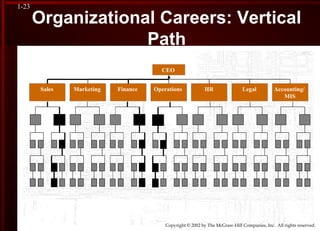
 traditional model - people’s careers advanced through
promotions up the hierarchy within a single business
function
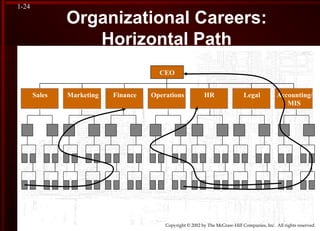
 current model - career progress likely to include lateral
moves across functions
Be both a specialist and generalist
 specialist - expert in something
provide concrete, identifiable value to the firm
 generalist - knowing about a variety of business functions so
that you can understand work with different perspectives
You And Your Career
Copyright © 2002 by The McGraw-Hill Companies, Inc. All rights reserved.
1-23
Sales Marketing Finance Operations HR Legal Accounting/
MIS
CEO
Organizational Careers: Vertical
Path
Copyright © 2002 by The McGraw-Hill Companies, Inc. All rights reserved.
1-24
Organizational Careers:
Horizontal Path
Sales Operations HR Legal Accounting/
MIS
Marketing Finance
CEO
Copyright © 2002 by The McGraw-Hill Companies, Inc. All rights reserved.
1-25
You And Your Career (cont.)
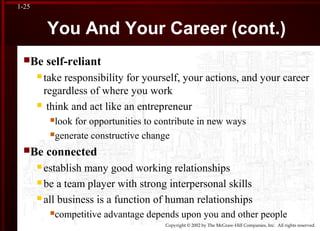
Be self-reliant
 take responsibility for yourself, your actions, and your career
regardless of where you work
 think and act like an entrepreneur
look for opportunities to contribute in new ways
generate constructive change
Be connected
 establish many good working relationships
 be a team player with strong interpersonal skills
 all business is a function of human relationships
competitive advantage depends upon you and other people
Copyright © 2002 by The McGraw-Hill Companies, Inc. All rights reserved.
1-26
Actively manage your relationship with your
organization
 two ways to think about the nature of the relationships
between you and your employer
view yourself as an employee
 model for just getting by
 contributions likely to be minimal
two-way, mutually-beneficial exchange relationship
 think about how you can contribute and act accordingly
 figure out new ways to add value
 organization likely provide full and fair rewards, support further
personal development, and offer more gratifying work
environment
You And Your Career (cont.)
Copyright © 2002 by The McGraw-Hill Companies, Inc. All rights reserved.
1-27
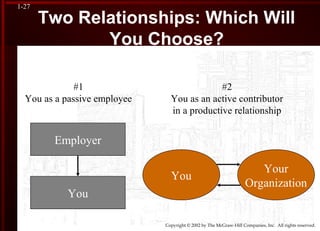
Two Relationships: Which Will
You Choose?
#2
You as an active contributor
in a productive relationship
#1
You as a passive employee
Employer
You
You
Your
Organization
Copyright © 2002 by The McGraw-Hill Companies, Inc. All rights reserved.
1-28
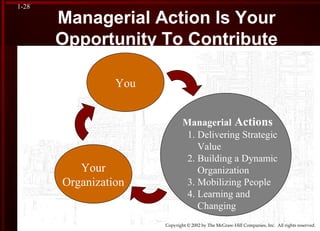
Managerial Action Is Your
Opportunity To Contribute
You
Your
Organization
Managerial Actions
1. Delivering Strategic
Value
2. Building a Dynamic
Organization
3. Mobilizing People
4. Learning and
Changing
Copyright © 2002 by The McGraw-Hill Companies, Inc. All rights reserved.
1-29
Survive and thrive
 be prepared to move from project to project, team to team
 be a master at something that the world values
 develop a strong network of colleagues who can help with
current and future projects
 have entrepreneurial skills that help you act as if you were
running your own business
 love technology
 market yourself
 be willing to constantly improve and even reinvent yourself
You And Your Career (cont.)

063 management theory

  • 1.
    Copyright © 2002by The McGraw-Hill Companies, Inc. All rights reserved. 1-1 Bateman Snell Management 5th Edition Competing in the New Era
  • 2.
    Copyright © 2002by The McGraw-Hill Companies, Inc. All rights reserved. 1-2 Part One Chapter 1 - Managing Chapter Outline Setting The Stage Managing In The New Era Managing For Competitive Advantage The Functions Of Management Management Levels And Skills You And Your Career
  • 3.
    Copyright © 2002by The McGraw-Hill Companies, Inc. All rights reserved. 1-3 Learning Objectives After studying Chapter 1, you will know:  the major challenges of managing in the new era  the drivers of competitive advantage for your company  the functions of management and how they are evolving in today’s business environment  the nature of management at different organizational levels  the skills you need to be an effective manager  what to strive for as you manage your career
  • 4.
    Copyright © 2002by The McGraw-Hill Companies, Inc. All rights reserved. 1-4 Managing In The New Era The Internet  changes the way management must think and act  chief Web officer will be one of the most important jobs will oversee information systems and strategies will create and manage business relationships via new communications technologies Web DNA - personal characteristics considered to be the ‘right stuff” for managers in Internet economy  great companies will capitalize most fully on the Web’s potential  distinction between Internet and non-Internet companies is fading
  • 5.
    Copyright © 2002by The McGraw-Hill Companies, Inc. All rights reserved. 1-5 “Web DNA” CarpeDiem.com Radiate Vision Organizational improvisers Get the right stuff done Learning Obsessed80/20 mind-set
  • 6.
    Copyright © 2002by The McGraw-Hill Companies, Inc. All rights reserved. 1-6 Managing In The New Era (cont.) Globalization  isolationism is a thing of the past  multinational enterprises have sales offices all over the world  corporations use their transnational status to operate beyond the control of national governments  even small firms that do not operate on a global scale must make strategic decisions based on international considerations
  • 7.
    Copyright © 2002by The McGraw-Hill Companies, Inc. All rights reserved. 1-7 Managing In The New Era (cont.) Knowledge management  set of practices aimed at discovering and harnessing an organization’s intellectual resources unlock people’s expertise, skills, wisdom, and relationships  intellectual capital is the collective brainpower of the organization Collaboration across “boundaries”  capitalize on the ideas of people outside the traditional company “boundaries” must effectively capitalize on customers’ brains  get customers to think creatively to identify new product and service ideas
  • 8.
    Copyright © 2002by The McGraw-Hill Companies, Inc. All rights reserved. 1-8 Competitive Advantage Cost Competitiveness SpeedQuality Innovation Managing For Competitive Advantage
  • 9.
    Copyright © 2002by The McGraw-Hill Companies, Inc. All rights reserved. 1-9 Managing For Competitive Advantage Cost competitiveness  costs are kept low enough so that you can realize profits and price your products at levels that are attractive to consumers  key is efficiency - accomplishing goals by using resources wisely and minimizing waste Quality  excellence of a product, including its attractiveness, lack of defects, reliability, and long-term durability  importance of quality has increased dramatically  must identify specific elements of quality to correct problems, target needs, and deliver world-class value
  • 10.
    Copyright © 2002by The McGraw-Hill Companies, Inc. All rights reserved. 1-10 Managing For Competitive Advantage (cont.) Speed  often separates winners from losers in world competition  speed became a vital requirement in the 1990s requirement has increased exponentially Innovation  the introduction of new goods and services  important to adapt to changes in consumer demands and to new sources of competition Best managers and companies delivering all four
  • 11.
    Copyright © 2002by The McGraw-Hill Companies, Inc. All rights reserved. 1-11 The Functions Of Management Management  process of working with people and resources to accomplish organizational goals effective - achieve organizational goals efficient - achieve goals with minimum waste of resources  there are timeless principles of management still important for making managers and companies great
  • 12.
    Copyright © 2002by The McGraw-Hill Companies, Inc. All rights reserved. 1-12 Planning Leading Controlling The Functions Of Management Organizing
  • 13.
    Copyright © 2002by The McGraw-Hill Companies, Inc. All rights reserved. 1-13 The Functions Of Management (cont.) Planning  specifying the goals to be achieved and deciding in advance the appropriate actions taken to achieve those goals  delivering strategic value - planning function for the new era a dynamic process in which the organization uses the brains of its members and of stakeholders to identify opportunities to maintain and increase competitive advantage process intended to create more value for the customer Organizing  assembling and coordinating the human, financial, physical, informational, and other resources needed to achieve goals  the future requires building flexible organizations
  • 14.
    Copyright © 2002by The McGraw-Hill Companies, Inc. All rights reserved. 1-14 The Functions Of Management (cont.) Leading  stimulating people to be high performers  managers must be good at mobilizing people to contribute their ideas Controlling  monitors progress and implements necessary changes  makes sure that goals are met  new technology makes it possible to achieve more effective controls Managers must devote attention to all four management functions
  • 15.
    Copyright © 2002by The McGraw-Hill Companies, Inc. All rights reserved. 1-15 Management Levels Frontline managers Top-level managers Middle managers
  • 16.
    Copyright © 2002by The McGraw-Hill Companies, Inc. All rights reserved. 1-16 Management Levels And Skills Management level  Top-level managers senior executives responsible for overall management of an organization focus on long-term issues emphasize the survival, growth, and effectiveness of the firm concerned with the interaction between the organization and its external environment
  • 17.
    Copyright © 2002by The McGraw-Hill Companies, Inc. All rights reserved. 1-17 Management Levels And Skills (cont.) Management level (cont.)  Middle-level managers (tactical managers) located between top-level and frontline managers in the organizational hierarchy responsible for translating strategic goals and plans into more specific objectives and activities traditional role was that of an administrative controller who bridged the gap between higher and lower levels evolving role is that of a developmental coach to the people who report to them
  • 18.
    Copyright © 2002by The McGraw-Hill Companies, Inc. All rights reserved. 1-18 Management Levels And Skills (cont.) Management level (cont.)  Frontline managers (operational managers) lower-level managers who supervise the operational activities of the organization directly involved with nonmanagement employees increasingly being called on to be innovative and entrepreneurial  Working leaders with broad responsibilities in leading small companies, managers have strategic, tactical, and operational responsibilities have a knowledge of all business functions, are accountable for results, and focus on internal and external customers
  • 19.
    Copyright © 2002by The McGraw-Hill Companies, Inc. All rights reserved. 1-19 Management Levels And Skills (cont.) Management skills  skill - specific ability that results from knowledge, information, and aptitude  technical skill - ability to perform a specialized task that involves a certain method or process managers at higher levels rely less on technical skills  conceptual and decision skills - ability to identify problems, resolve problems for the benefit of the organization necessary when considering the overall objectives and strategy of the organization and the interactions among its different parts assume greater importance as manager acquires more responsibility
  • 20.
    Copyright © 2002by The McGraw-Hill Companies, Inc. All rights reserved. 1-20 Management Levels And Skills (cont.) Management skills (cont.)  interpersonal and communication skills - ability to work well with people increasingly important in today’s organizations  greater reliance on teams, information sharing, and coaching
  • 21.
    Copyright © 2002by The McGraw-Hill Companies, Inc. All rights reserved. 1-21 You And Your Career Jobs are no longer as secure for managers as they used to be  organizations still try to develop and retain good employees  employee loyalty and commitment are still important Companies offering “employability” to workers tend to be more successful  provide training and other learning experiences  employees perform work with greater responsibility
  • 22.
    Copyright © 2002by The McGraw-Hill Companies, Inc. All rights reserved. 1-22 Two models of career paths  traditional model - people’s careers advanced through promotions up the hierarchy within a single business function  current model - career progress likely to include lateral moves across functions Be both a specialist and generalist  specialist - expert in something provide concrete, identifiable value to the firm  generalist - knowing about a variety of business functions so that you can understand work with different perspectives You And Your Career
  • 23.
    Copyright © 2002by The McGraw-Hill Companies, Inc. All rights reserved. 1-23 Sales Marketing Finance Operations HR Legal Accounting/ MIS CEO Organizational Careers: Vertical Path
  • 24.
    Copyright © 2002by The McGraw-Hill Companies, Inc. All rights reserved. 1-24 Organizational Careers: Horizontal Path Sales Operations HR Legal Accounting/ MIS Marketing Finance CEO
  • 25.
    Copyright © 2002by The McGraw-Hill Companies, Inc. All rights reserved. 1-25 You And Your Career (cont.) Be self-reliant  take responsibility for yourself, your actions, and your career regardless of where you work  think and act like an entrepreneur look for opportunities to contribute in new ways generate constructive change Be connected  establish many good working relationships  be a team player with strong interpersonal skills  all business is a function of human relationships competitive advantage depends upon you and other people
  • 26.
    Copyright © 2002by The McGraw-Hill Companies, Inc. All rights reserved. 1-26 Actively manage your relationship with your organization  two ways to think about the nature of the relationships between you and your employer view yourself as an employee  model for just getting by  contributions likely to be minimal two-way, mutually-beneficial exchange relationship  think about how you can contribute and act accordingly  figure out new ways to add value  organization likely provide full and fair rewards, support further personal development, and offer more gratifying work environment You And Your Career (cont.)
  • 27.
    Copyright © 2002by The McGraw-Hill Companies, Inc. All rights reserved. 1-27 Two Relationships: Which Will You Choose? #2 You as an active contributor in a productive relationship #1 You as a passive employee Employer You You Your Organization
  • 28.
    Copyright © 2002by The McGraw-Hill Companies, Inc. All rights reserved. 1-28 Managerial Action Is Your Opportunity To Contribute You Your Organization Managerial Actions 1. Delivering Strategic Value 2. Building a Dynamic Organization 3. Mobilizing People 4. Learning and Changing
  • 29.
    Copyright © 2002by The McGraw-Hill Companies, Inc. All rights reserved. 1-29 Survive and thrive  be prepared to move from project to project, team to team  be a master at something that the world values  develop a strong network of colleagues who can help with current and future projects  have entrepreneurial skills that help you act as if you were running your own business  love technology  market yourself  be willing to constantly improve and even reinvent yourself You And Your Career (cont.)