helpdesk@construction-productivity.co.uk
htt://www.construction-productivity.co.uk
LEAN
CONSTRUCTION
LEAN CONSTRUCTION
 In the past 50 years, manufacturing
industries have greatly improved their
competitiveness.
 This has been achieved through the use of
lean methods such as:
 Supply Chain Management
 Just-In-Time techniques.
 Also, for several years lean methods have
been applied to the construction industry,
LEAN CONSTRUCTION
 Lean construction is a process used to
maximizes value and reduces waste.
 Lean construction comes from Lean
production.
 It captures these objectives through
the use of Supply Chain Management
(SCM) and Just-In-Time (JIT)
techniques,
 Also, by sharing information between
all the parties involved in the
production process.
LEAN CONSTRUCTION
 It is based on lean manufacturing,
of the Toyota Production system.
 developed by Taichii Ohno in the
1950s.
 Ohno learnt from mass production at
Ford Motor manufacturing facilities
in the U.S. and witnessed high level
of waste during production.
LEAN CONSTRUCTION
Ohno identified several
wastes in mass production
systems in car industry such
as:
1. overproducing
2. waiting time
3. transporting
LEAN CONSTRUCTION
also, in other areas such as:
1. processing methods;
2. unnecessary stock on hand;
3. unnecessary motion;
4. defective goods;
5. failure to meet customers’ needs;
6. high waste through out the
process.
LEAN CONSTRUCTION
The Toyota Production System was
based on the “Just –In – Time (JIT)
philosophy;
 The main objectives were:
 minimizing waste
 continuous improvement from
inception to completion
 with highly motivated work force
LEAN CONSTRUCTION
The outcome was:
reduced inventories
High productivity
better equipment utilization
of machinery
shorter lead times
LEAN CONSTRUCTION
 Less errors
 Highly motivated workforce
 with higher morale
 JIT is a pull system that responds
to actual customer demand.
 products are “pulled from ” the JIT
system.
LEAN CONSTRUCTION
 JIT only considers the resources
required to meet the customer’s
needs.
 In the mid – 1970’s Toyota
reduced the time needed to
produce a car from fifteen days to
one day, by using JIT.
LEAN CONSTRUCTION
Applying Lean Thinking in construction
 Using experienced design teams
 The same design team working on the design
of the project from beginning to end.
 Speed up the design process.
 Use innovative approaches to speed up the
design process.
 Innovative ideas in design and assembly.
 The use of pre-fabricated building elements.
 Manufactured off site and pre-assembled on
site.
LEAN CONSTRUCTION
 Supporting sub-contractors in developing
tools for improving processes.
 In order to keep up with Leanconstruction
It is important to follow the work of
Construction Lean Improvement
Programme (CLIP).
 CLIP operates across the whole
construction supply chain, from raw
materials processors to clients.
LEAN CONSTRUCTION
 Researchers believe that project cost
will increase up to ten percent because
of poor supply chain design.
 Supply Chain Management (SCM)
analyzes the impact of design on the
construction process.
 Through SCM, all parties are kept
aware of commitments, schedules, etc.
LEAN CONSTRUCTION
 All the parties work for high quality
product with minimal lead-time,
including:
 minimizing wastage;
 eliminating delays and disruptions.
 Ballard and Howell designed the
Last Planner System as one
method for applying lean
techniques to construction.
LEAN CONSTRUCTION
 Womack and Jones (1996) suggested
that there are five key principles that
need to be monitored when lean
construction systems are applied in
construction. Those are:
 Value-clarifying the customer’s needs;
 the supply chain involvement in all
stages, from inception to completion;
 By clarifying activities or products
that signify value.
LEAN CONSTRUCTION
Value stream: By mapping the
whole value stream
 establishing cooperation between
all parties involved;
 identifying and eliminating waste;
 From taking such steps the
construction process can be
improved.
LEAN CONSTRUCTION
Flow:
 Business flow includes project
information such as:
1. specifications
2. contracts
3. plans, etc.
 Job site flow involves the activities and
the way they have to be carried out.
 Supply flow refers to the materials
used in a project.
LEAN CONSTRUCTION
Pull:
 The efforts of all participants
provides smooth pulls during the
construction process.
Perfection:
 Use of best methods of work
instructions and best procedures.
 Introduction of best quality
control methods.
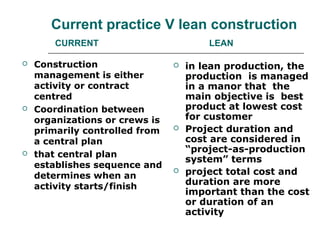
Current practice V lean construction
CURRENT LEAN
 Construction
management is either
activity or contract
centred
 Coordination between
organizations or crews is
primarily controlled from
a central plan
 that central plan
establishes sequence and
determines when an
activity starts/finish
 in lean production, the
production is managed
in a manor that the
main objective is best
product at lowest cost
for customer
 Project duration and
cost are considered in
“project-as-production
system” terms
 project total cost and
duration are more
important than the cost
or duration of an
activity
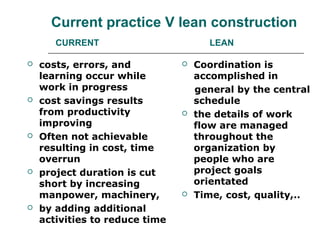
Current practice V lean construction
CURRENT LEAN
 costs, errors, and
learning occur while
work in progress
 cost savings results
from productivity
improving
 Often not achievable
resulting in cost, time
overrun
 project duration is cut
short by increasing
manpower, machinery,
 by adding additional
activities to reduce time
 Coordination is
accomplished in
general by the central
schedule
 the details of work
flow are managed
throughout the
organization by
people who are
project goals
orientated
 Time, cost, quality,..
LEAN CONSTRUCTION
CURRENT LEAN
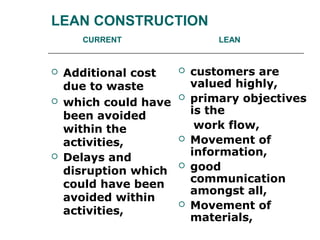
 Additional cost
due to waste
 which could have
been avoided
within the
activities,
 Delays and
disruption which
could have been
avoided within
activities,
 customers are
valued highly,
 primary objectives
is the
work flow,
 Movement of
information,
 good
communication
amongst all,
 Movement of
materials,
LEAN CONSTRUCTION
CURRENT LEAN
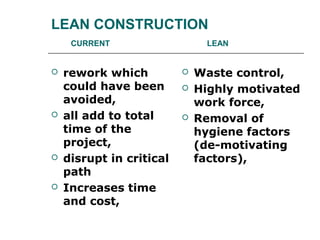
 rework which
could have been
avoided,
 all add to total
time of the
project,
 disrupt in critical
path
 Increases time
and cost,
 Waste control,
 Highly motivated
work force,
 Removal of
hygiene factors
(de-motivating
factors),
LEAN CONSTRUCTION
 Lean thinking forces attention on
how value is generated rather
than how any one activity is
managed.
 An overall success.
LEAN CONSTRUCTION

058 lean construction (2)

  • 1.
  • 2.
    LEAN CONSTRUCTION  Inthe past 50 years, manufacturing industries have greatly improved their competitiveness.  This has been achieved through the use of lean methods such as:  Supply Chain Management  Just-In-Time techniques.  Also, for several years lean methods have been applied to the construction industry,
  • 3.
    LEAN CONSTRUCTION  Leanconstruction is a process used to maximizes value and reduces waste.  Lean construction comes from Lean production.  It captures these objectives through the use of Supply Chain Management (SCM) and Just-In-Time (JIT) techniques,  Also, by sharing information between all the parties involved in the production process.
  • 4.
    LEAN CONSTRUCTION  Itis based on lean manufacturing, of the Toyota Production system.  developed by Taichii Ohno in the 1950s.  Ohno learnt from mass production at Ford Motor manufacturing facilities in the U.S. and witnessed high level of waste during production.
  • 5.
    LEAN CONSTRUCTION Ohno identifiedseveral wastes in mass production systems in car industry such as: 1. overproducing 2. waiting time 3. transporting
  • 6.
    LEAN CONSTRUCTION also, inother areas such as: 1. processing methods; 2. unnecessary stock on hand; 3. unnecessary motion; 4. defective goods; 5. failure to meet customers’ needs; 6. high waste through out the process.
  • 7.
    LEAN CONSTRUCTION The ToyotaProduction System was based on the “Just –In – Time (JIT) philosophy;  The main objectives were:  minimizing waste  continuous improvement from inception to completion  with highly motivated work force
  • 8.
    LEAN CONSTRUCTION The outcomewas: reduced inventories High productivity better equipment utilization of machinery shorter lead times
  • 9.
    LEAN CONSTRUCTION  Lesserrors  Highly motivated workforce  with higher morale  JIT is a pull system that responds to actual customer demand.  products are “pulled from ” the JIT system.
  • 10.
    LEAN CONSTRUCTION  JITonly considers the resources required to meet the customer’s needs.  In the mid – 1970’s Toyota reduced the time needed to produce a car from fifteen days to one day, by using JIT.
  • 11.
    LEAN CONSTRUCTION Applying LeanThinking in construction  Using experienced design teams  The same design team working on the design of the project from beginning to end.  Speed up the design process.  Use innovative approaches to speed up the design process.  Innovative ideas in design and assembly.  The use of pre-fabricated building elements.  Manufactured off site and pre-assembled on site.
  • 12.
    LEAN CONSTRUCTION  Supportingsub-contractors in developing tools for improving processes.  In order to keep up with Leanconstruction It is important to follow the work of Construction Lean Improvement Programme (CLIP).  CLIP operates across the whole construction supply chain, from raw materials processors to clients.
  • 13.
    LEAN CONSTRUCTION  Researchersbelieve that project cost will increase up to ten percent because of poor supply chain design.  Supply Chain Management (SCM) analyzes the impact of design on the construction process.  Through SCM, all parties are kept aware of commitments, schedules, etc.
  • 14.
    LEAN CONSTRUCTION  Allthe parties work for high quality product with minimal lead-time, including:  minimizing wastage;  eliminating delays and disruptions.  Ballard and Howell designed the Last Planner System as one method for applying lean techniques to construction.
  • 15.
    LEAN CONSTRUCTION  Womackand Jones (1996) suggested that there are five key principles that need to be monitored when lean construction systems are applied in construction. Those are:  Value-clarifying the customer’s needs;  the supply chain involvement in all stages, from inception to completion;  By clarifying activities or products that signify value.
  • 16.
    LEAN CONSTRUCTION Value stream:By mapping the whole value stream  establishing cooperation between all parties involved;  identifying and eliminating waste;  From taking such steps the construction process can be improved.
  • 17.
    LEAN CONSTRUCTION Flow:  Businessflow includes project information such as: 1. specifications 2. contracts 3. plans, etc.  Job site flow involves the activities and the way they have to be carried out.  Supply flow refers to the materials used in a project.
  • 18.
    LEAN CONSTRUCTION Pull:  Theefforts of all participants provides smooth pulls during the construction process. Perfection:  Use of best methods of work instructions and best procedures.  Introduction of best quality control methods.
  • 19.
    Current practice Vlean construction CURRENT LEAN  Construction management is either activity or contract centred  Coordination between organizations or crews is primarily controlled from a central plan  that central plan establishes sequence and determines when an activity starts/finish  in lean production, the production is managed in a manor that the main objective is best product at lowest cost for customer  Project duration and cost are considered in “project-as-production system” terms  project total cost and duration are more important than the cost or duration of an activity
  • 20.
    Current practice Vlean construction CURRENT LEAN  costs, errors, and learning occur while work in progress  cost savings results from productivity improving  Often not achievable resulting in cost, time overrun  project duration is cut short by increasing manpower, machinery,  by adding additional activities to reduce time  Coordination is accomplished in general by the central schedule  the details of work flow are managed throughout the organization by people who are project goals orientated  Time, cost, quality,..
  • 21.
    LEAN CONSTRUCTION CURRENT LEAN Additional cost due to waste  which could have been avoided within the activities,  Delays and disruption which could have been avoided within activities,  customers are valued highly,  primary objectives is the work flow,  Movement of information,  good communication amongst all,  Movement of materials,
  • 22.
    LEAN CONSTRUCTION CURRENT LEAN rework which could have been avoided,  all add to total time of the project,  disrupt in critical path  Increases time and cost,  Waste control,  Highly motivated work force,  Removal of hygiene factors (de-motivating factors),
  • 23.
    LEAN CONSTRUCTION  Leanthinking forces attention on how value is generated rather than how any one activity is managed.  An overall success.
  • 24.