Freezing Point Depression
General Chemistry Laboratory
Goals
• To determine the freezing point depression
constant of water
• To determine the relationship between
concentration and freezing point
• To explore the effect of electrolytes on the
freezing point of a solution
Colligative Properties
• Properties that depend on the number of
dissolved particles (aka concentration)
present in the solution
• What is the effect of increased
concentration on BP and FP?
Molality (m)
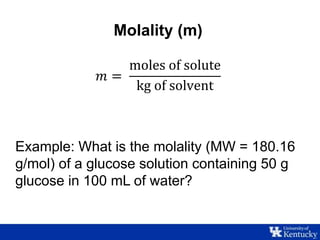
𝑚 =
moles of solute
kg of solvent
Example: What is the molality (MW = 180.16
g/mol) of a glucose solution containing 50 g
glucose in 100 mL of water?
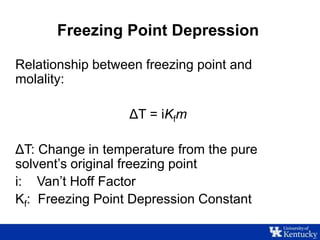
Freezing Point Depression
Relationship between freezing point and
molality:
ΔT = iKfm
ΔT: Change in temperature from the pure
solvent’s original freezing point
i: Van’t Hoff Factor
Kf: Freezing Point Depression Constant
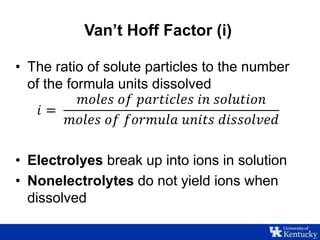
Van’t Hoff Factor (i)
• The ratio of solute particles to the number
of the formula units dissolved
𝑖 =
𝑚𝑜𝑙𝑒𝑠 𝑜𝑓 𝑝𝑎𝑟𝑡𝑖𝑐𝑙𝑒𝑠 𝑖𝑛 𝑠𝑜𝑙𝑢𝑡𝑖𝑜𝑛
𝑚𝑜𝑙𝑒𝑠 𝑜𝑓 𝑓𝑜𝑟𝑚𝑢𝑙𝑎 𝑢𝑛𝑖𝑡𝑠 𝑑𝑖𝑠𝑠𝑜𝑙𝑣𝑒𝑑
• Electrolyes break up into ions in solution
• Nonelectrolytes do not yield ions when
dissolved
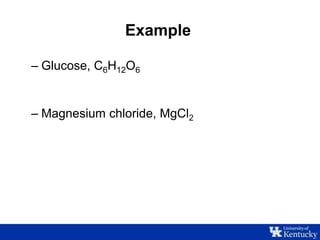
Example
– Glucose, C6H12O6
– Magnesium chloride, MgCl2
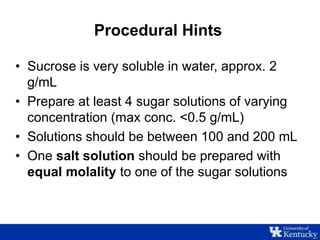
Procedural Hints
• Sucrose is very soluble in water, approx. 2
g/mL
• Prepare at least 4 sugar solutions of varying
concentration (max conc. <0.5 g/mL)
• Solutions should be between 100 and 200 mL
• One salt solution should be prepared with
equal molality to one of the sugar solutions
Interpreting Your Data
• Interpreting these graphs will be on your exams.
Waste Disposal
• Solids  trash can
• Liquids  sink
• Dry ice  sink
• Brush off the balances when you are done
weighing your sample.
• Weigh boats should be put in the trash
after use.

Exp 12 FP depression

  • 1.
  • 2.
    Goals • To determinethe freezing point depression constant of water • To determine the relationship between concentration and freezing point • To explore the effect of electrolytes on the freezing point of a solution
  • 3.
    Colligative Properties • Propertiesthat depend on the number of dissolved particles (aka concentration) present in the solution • What is the effect of increased concentration on BP and FP?
  • 4.
    Molality (m) 𝑚 = molesof solute kg of solvent Example: What is the molality (MW = 180.16 g/mol) of a glucose solution containing 50 g glucose in 100 mL of water?
  • 5.
    Freezing Point Depression Relationshipbetween freezing point and molality: ΔT = iKfm ΔT: Change in temperature from the pure solvent’s original freezing point i: Van’t Hoff Factor Kf: Freezing Point Depression Constant
  • 6.
    Van’t Hoff Factor(i) • The ratio of solute particles to the number of the formula units dissolved 𝑖 = 𝑚𝑜𝑙𝑒𝑠 𝑜𝑓 𝑝𝑎𝑟𝑡𝑖𝑐𝑙𝑒𝑠 𝑖𝑛 𝑠𝑜𝑙𝑢𝑡𝑖𝑜𝑛 𝑚𝑜𝑙𝑒𝑠 𝑜𝑓 𝑓𝑜𝑟𝑚𝑢𝑙𝑎 𝑢𝑛𝑖𝑡𝑠 𝑑𝑖𝑠𝑠𝑜𝑙𝑣𝑒𝑑 • Electrolyes break up into ions in solution • Nonelectrolytes do not yield ions when dissolved
  • 7.
    Example – Glucose, C6H12O6 –Magnesium chloride, MgCl2
  • 8.
    Procedural Hints • Sucroseis very soluble in water, approx. 2 g/mL • Prepare at least 4 sugar solutions of varying concentration (max conc. <0.5 g/mL) • Solutions should be between 100 and 200 mL • One salt solution should be prepared with equal molality to one of the sugar solutions
  • 9.
    Interpreting Your Data •Interpreting these graphs will be on your exams.
  • 10.
    Waste Disposal • Solids trash can • Liquids  sink • Dry ice  sink • Brush off the balances when you are done weighing your sample. • Weigh boats should be put in the trash after use.

Editor's Notes

  • #8 Glucose is a nonelectrolyte, so does not form ions in solution. Magnesium chloride is an electrolyte. It breaks apart into Mg2+ and Cl- ions, thus its van’t Hoff factor is 3.