ZigBee  Agenda Intro Market Applications Requirements Standardization Technical Specification Software stack Integration For NEC Internal Use Only
ZigBee A very low cost, low power consumption two-way, wireless communications standard for automation, toys, & PC peripherals For NEC Internal Use Only
MARKET For NEC Internal Use Only
ZigBee Mission: To bring about the existence of a broad range of interoperable consumer devices by establishing open industry specifications for unlicensed, untethered peripheral, control and entertainment devices requiring the  lowest cost  and  lowest power consumption  communications between compliant devices anywhere in and around the home. For NEC Internal Use Only
The Need for ZigBee Low Power consumption 6 months to 5 years battery life for most applications Low Cost At least half the cost of Bluetooth solutions High density of nodes per network 250 nodes per network, multiple co-located networks Data rate requirements  Few bits to 250kbps sufficient Simple protocol, Global Implementation 2.4GHz Standard in a fragmented market Many proprietary solutions, interoperability issues Pent up demand due to lack of standard For NEC Internal Use Only
Objective of ZigBee Interoperable consumer device s Open industry specificatio n Peripheral, control and entertainment devicesLowest cost and lowest power consumption  Anywhere in and around the hom e For NEC Internal Use Only
Traget Market: A multimedia PC with interactive gaming options or a 32" television equipped with Home Theatre features, Internet access (e.g. WebTV) or a video gaming console (e.g. Sega, Nintendo, Sony). These residents potentially have the need for advanced HID and toy solutions that could enhance their living or entertainment experiences. Low cost solutions for interconnectivity between toys, such as, TomoguchisExisting homes with installed security, home automation or HVAC systems, and new homes with plans for these systems. The Small Office/Home Office (SOHO) market may also find use for ZigBee products for controlling multimedia presentations, conference rooms, training rooms and automation or control functions. For NEC Internal Use Only
Must have features: Saftey meets Government regulations:  As safe as coordless phone Unlicensed Band Low Cost BOM Reliability Throughput degrades gracefully Ease of Use… Ability to add/remove new devices Register once…authenticate each time Global market Minimum battery life 6months/2 years For NEC Internal Use Only
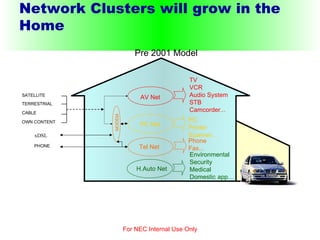
Network Clusters will grow in the Home For NEC Internal Use Only AV Net PC Net Tel Net MODEM TV VCR Audio System STB Camcorder... PC Printer Scanner... Phone Fax... H.Auto Net Environmental Security Medical Domestic app… Pre 2001 Model SATELLITE TERRESTRIAL CABLE OWN CONTENT PHONE xDSL
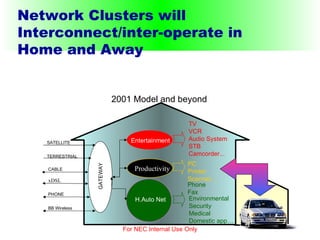
Network Clusters will Interconnect/inter-operate in Home and Away For NEC Internal Use Only TV VCR Audio System STB Camcorder... PC Printer Scanner... Phone Fax Environmental Security Medical Domestic app… 2001 Model and beyond SATELLITE TERRESTRIAL CABLE xDSL PHONE BB Wireless Entertainment Productivity H.Auto Net GATEWAY
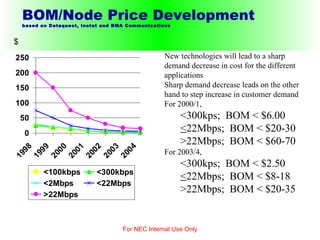
BOM/Node Price Development  based on Dataquest, Instat and BMA Communications For NEC Internal Use Only New technologies will lead to a sharp demand decrease in cost for the different applications  Sharp demand decrease leads on the other hand to step increase in customer demand For 2000/1, <300kps;  BOM < $6.00 < 22Mbps;  BOM < $20-30 >22Mbps;  BOM < $60-70 For 2003/4, <300kps;  BOM < $2.50 < 22Mbps;  BOM < $8-18 >22Mbps;  BOM < $20-35 $
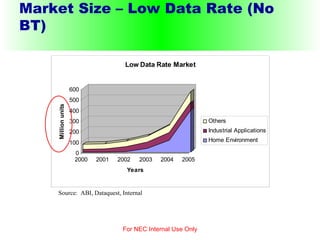
Market Size – Low Data Rate (No BT) For NEC Internal Use Only Source:  ABI, Dataquest, Internal
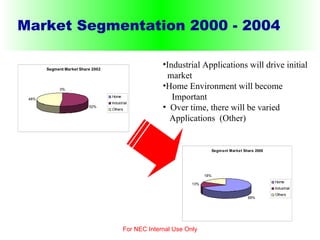
Market Segmentation 2000 - 2004 For NEC Internal Use Only Industrial Applications will drive initial  market  Home Environment will become Important Over time, there will be varied  Applications  (Other)
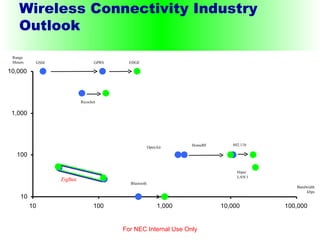
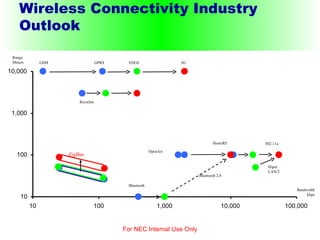
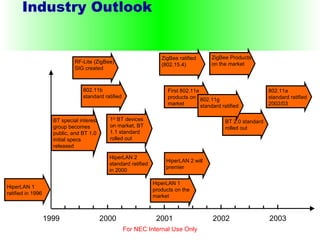
Wireless connectivity outlook: For NEC Internal Use Only
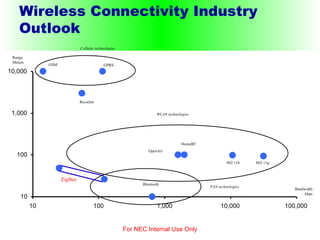
Wireless Connectivity Industry Outlook For NEC Internal Use Only 10 100 1,000 10,000 10 100 1,000 10,000 100,000 Bandwidth kbps Ricochet HomeRF OpenAir 802.11b Bluetooth WLAN technologies GSM GPRS Range Meters 802.11g ZigBee Cellular technologies PAN technologies
Wireless Connectivity Industry Outlook For NEC Internal Use Only 10 100 1,000 10,000 10 100 1,000 10,000 100,000 Bandwidth kbps Bluetooth OpenAir Ricochet 802.11b Hiper LAN/1 HomeRF GSM GPRS EDGE Range Meters ZigBee
Wireless Connectivity Industry Outlook For NEC Internal Use Only 10 100 1,000 10,000 10 100 1,000 10,000 100,000 Bandwidth kbps GSM OpenAir Ricochet 802.11a GPRS EDGE Bluetooth 3G Hiper LAN/2 Bluetooth 2.0 Range Meters HomeRF ZigBee
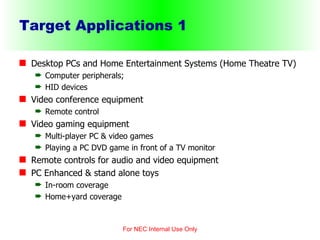
Industry Outlook For NEC Internal Use Only BT 2.0 standard rolled out 2000 2001 First 802.11a products on  the market 2002 2003 HiperLAN 2 will premier 1999 1 st  BT devices on market, BT 1.1 standard rolled out BT special interest group becomes public, and BT 1.0 initial specs released 802.11b standard ratified 802.11a standard ratified 2002/03 HiperLAN 1 ratified in 1996 HiperLAN 1 products on the market HiperLAN 2 standard ratified in 2000 RF-Lite (ZigBee) SIG created ZigBee Products on the market ZigBee ratified (802.15.4) 802.11g standard ratified
Target Applications 1 Desktop PCs and Home Entertainment Systems (Home Theatre TV) Computer peripherals; HID devices Video conference equipment Remote control Video gaming equipment Multi-player PC & video games Playing a PC DVD game in front of a TV monitor Remote controls for audio and video equipment PC Enhanced & stand alone toys In-room coverage Home+yard coverage For NEC Internal Use Only
Target Applications 2 Home appliances/general consumer electronic devices Existing home security systems, electrical & heating systems Wireless door and opening monitoring, system control Wireless Keypads Smoke and flame detectors Lighting and remote control of appliances in the home; Blinds/Shades Pool/Spa equipment Garage door openers Voice Control New device categories that have not yet been developed, such as news tablets, and keyboards with built-in displays For NEC Internal Use Only
Device Examples: HID devices Video gaming equipment; Multi-player PC & video games Playing a PC DVD game in front of a TV monitor Remote controls for audio and video equipment Glass breakage monitoring (sensors); Wireless Keypads; Child Monitor; Smoke and flame detectors; Fire Pull stations; Personal transponders; Lighting and remote control of appliances in the home; Fireplaces Pool/Spa equipment Garage door openers For NEC Internal Use Only
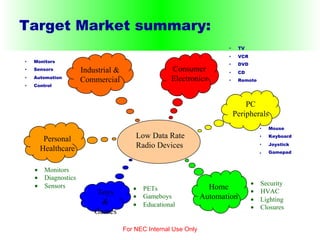
Target Market summary: For NEC Internal Use Only Low Data Rate Radio Devices Industrial & Commercial Consumer Electronics Personal Healthcare Toys & Games Home Automation PC Peripherals · TV · VCR · DVD · CD · Remote · Mouse · Keyboard · Joystick · Gamepad  Security  HVAC  Lighting  Closures  PETs  Gameboys  Educational  Monitors  Diagnostics  Sensors · Monitors · Sensors · Automation · Control
Market Requirements Global licence free ISM band operation Unrestricted geographic use RF penetration through walls & ceilings Automatic/semi-automatic installation Ability to add or remove devices Possible voice support For NEC Internal Use Only
Market Requirements, cont... 10k-115.2kbps data throughput 10-75m coverage range (home/garden) Support for 32-255 nodes Support for 4 critical devices 4-100 co-located networks 0.5-2 year battery life Up to 5ms-1 permitted mobility  Module cost: $1.5-$2.5 in 2003! For NEC Internal Use Only
Applications: Human Input Devices (HID) Keyboard Mouse / Pointing Device Remote Controls (controls for audio & video equipment) Gaming Device For NEC Internal Use Only
Applications: Home Automation and Control Automation Devices Control Devices Home Security Interactive Toys For NEC Internal Use Only
Success Factors Low cost Data type support Ease of installation Reliable data transfer Short range operation Reasonable battery life   Unlicensed band Unrestricted geographical use Global implementation Governmental regulations For NEC Internal Use Only
STANDARDIZATION For NEC Internal Use Only
History Low-rate solution for HomeRF, January 1998 Initial MRD, October 1998 Initial RSI/TRD, October 1999 Proposals submitted, July 2000 Initial specification, v0.2, September 2000 Proposal to IEEE 802.15.4, March 2001 Proposal accepted by IEEE, July 2001 For NEC Internal Use Only
HomeRF-Lite -> Firefly -> RF-Lite -> ZigBee Description Low data rate (<250kbps), very low cost (BOM<$6.00) consumer market Replaces wired solutions that require low data rates Replaces IrDA links with a low cost wireless network Simple MAC protocol: master-slave or virtual point-to-point applications, reduces system compexity  Applications: peripherals to PC,  temperature control, home security, toys, etc. For NEC Internal Use Only
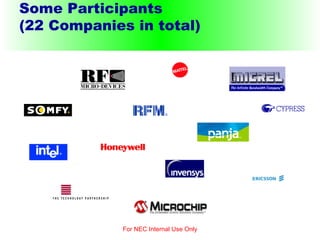
Some Participants (22 Companies in total) For NEC Internal Use Only
Technical: For NEC Internal Use Only
Protocol Features Master/slave topology Automatic network configuration Dynamic slave device addressing Virtual peer-to-peer links (pairing) Full handshaking for packet transfers Power management features Up to 254 (+ master) network nodes For NEC Internal Use Only
Protocol Features Cont... CSMA-CA channel access mechanism 28kbps (Optional) & 200kbps (actual) data throughput  Service discovery Low impact internet capability For NEC Internal Use Only
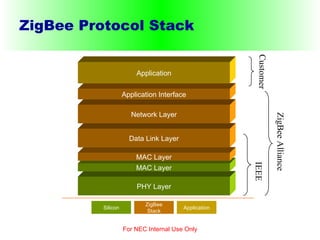
ZigBee Protocol Stack For NEC Internal Use Only Silicon ZigBee Stack Application Application Customer ZigBee Alliance IEEE PHY Layer MAC Layer MAC Layer Data Link Layer Network Layer Application Interface
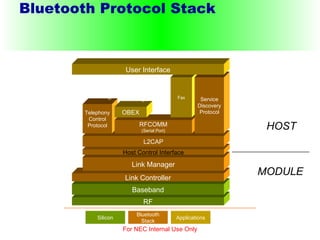
Bluetooth Protocol Stack  For NEC Internal Use Only Silicon RF Baseband Link Controller Voice Link Manager Host Control Interface L2CAP Telephony Control Protocol Intercom Headset Cordless Group Call RFCOMM (Serial Port) OBEX HOST MODULE Bluetooth Stack Applications vCard vCal vNote vMessage Dial-up Networking Fax Service Discovery Protocol User Interface
Direct Sequence Spread spectrum regulations allow higher transmit power Longer range Transmit power: -4 - +20dBm  Direct sequence Faster acquisition than frequency hopping Complexity in digital domain (cheaper) Spread using length 11 bit Barker sequence Optimal autocorrelation properties Short sequence gives fast acquisition Used in IEEE802.11 For NEC Internal Use Only
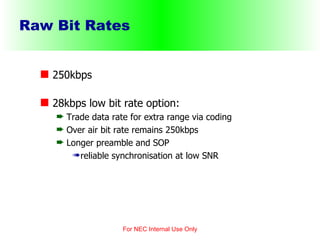
Raw Bit Rates 250kbps 28kbps low bit rate option : Trade data rate for extra range via coding Over air bit rate remains 200kbps Longer preamble and SOP reliable synchronisation at low SNR For NEC Internal Use Only
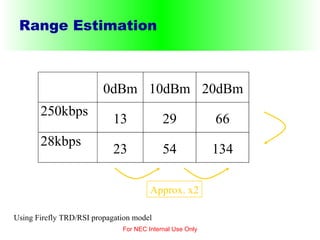
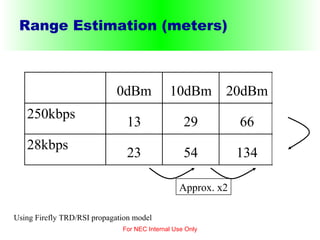
Range Estimation For NEC Internal Use Only Using Firefly TRD/RSI propagation model Approx. x2
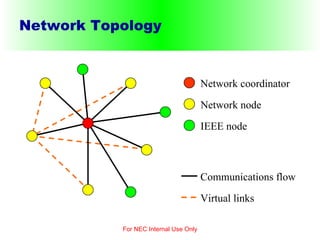
Network Topology For NEC Internal Use Only Network coordinator Network node Communications flow Virtual links IEEE node
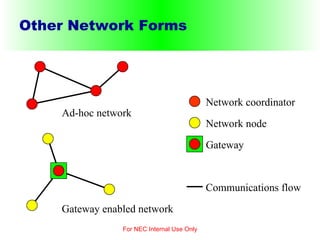
Other Network Forms For NEC Internal Use Only Network coordinator Communications flow Ad-hoc network Gateway Network node Gateway enabled network
Supported Traffic Types Periodic data Application defined rate Intermittent Basic communication Repetitive low latency data Allocation of guaranteed time slots For NEC Internal Use Only
The Network Coordinator Transmits network beacons Sets up a network Manages network nodes Stores network node information Routes messages between paired nodes Receives constantly For NEC Internal Use Only
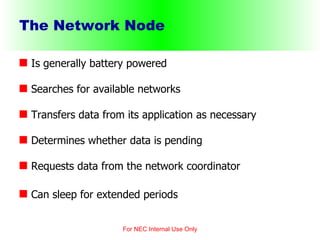
The Network Node Is generally battery powered Searches for available networks Transfers data from its application as necessary Determines whether data is pending Requests data from the network coordinator Can sleep for extended periods For NEC Internal Use Only
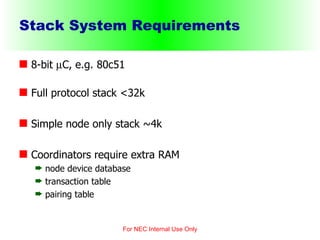
Stack System Requirements 8-bit   C, e.g. 80c51  Full protocol stack <32k Simple node only stack ~4k Coordinators require extra RAM node device database transaction table pairing table For NEC Internal Use Only
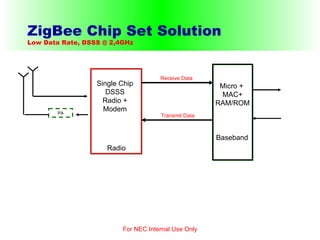
ZigBee Chip Set Solution Low Data Rate, DSSS @ 2,4GHz For NEC Internal Use Only PA Micro +  MAC+ RAM/ROM Radio Single Chip DSSS Radio + Modem Baseband Transmit Data Receive Data
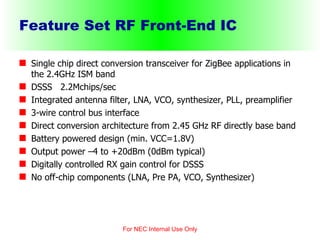
Feature Set RF Front-End IC Single chip direct conversion transceiver for ZigBee applications in the 2.4GHz ISM band DSSS  2.2Mchips/sec Integrated antenna filter, LNA, VCO, synthesizer, PLL, preamplifier 3-wire control bus interface Direct conversion architecture from 2.45 GHz RF directly base band Battery powered design (min. VCC=1.8V) Output power –4 to +20dBm (0dBm typical) Digitally controlled RX gain control for DSSS No off-chip components (LNA, Pre PA, VCO, Synthesizer) For NEC Internal Use Only
ZigBee Base Band & MAC Single chip Modem and MAC 80C51 (or equivalent) 8-bit low power micro controller core  Interfaces: Full duplex UART for communication with host processor or other devices 2 3 wire buses for host and RF Front-end communication Master/slave I2C  2 analog inputs Minimum external components for low BOM CMOS 0.18 or other low cost similar capablity process  For NEC Internal Use Only
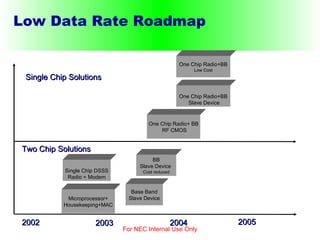
Low Data Rate Roadmap For NEC Internal Use Only Single Chip Solutions Single Chip DSSS Radio + Modem Microprocessor+ Housekeeping+MAC 2002 2003 Two Chip Solutions One Chip Radio+ BB RF CMOS One Chip Radio+BB Slave Device 2004 2005 Base Band Slave Device BB Slave Device  Cost reduced One Chip Radio+BB Low Cost
Protocol Features Master/slave topology Automatic network configuration Dynamic slave device addressing Virtual peer-to-peer links (pairing) Full handshaking for packet transfers Power management features Up to 254 (+ master) network nodes For NEC Internal Use Only
Protocol Features Cont... CSMA-CA channel access mechanism 15ms frame structure TDMA slots can be allocated 28kbps & 250kbps data throughput  Service discovery Low impact internet capability For NEC Internal Use Only
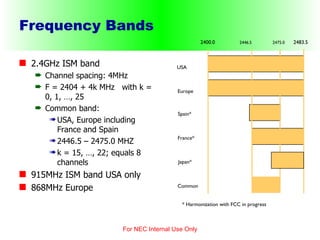
Frequency Bands 2.4GHz ISM band Channel spacing: 4MHz  F = 2404 + 4k MHz  with k = 0, 1, …, 25  Common band: USA, Europe including France and Spain 2446.5 – 2475.0  MHZ k = 15, …, 22; equals 8 channels 915MHz ISM band USA only 868MHz Europe For NEC Internal Use Only USA Europe Spain* France* 2400.0 2483.5 2446.5 2475.0 Japan* Common * Harmonization with FCC in progress
Raw Bit Rates 250kbps 28kbps low bit rate option: Trade data rate for extra range via coding Over air bit rate remains 250kbps Longer preamble and SOP reliable synchronisation at low SNR For NEC Internal Use Only
Range Estimation (meters) For NEC Internal Use Only Using Firefly TRD/RSI propagation model Approx. x2
Summary Solution that effectively addresses the needs of the target market place with: Low data rate (<250Kbps) Low cost  (~ BT/2) Very low power (6 months - 2 years on 2 AA batteries.) Network Solution For NEC Internal Use Only
ZigBee vs. Bluetooth  For NEC Internal Use Only
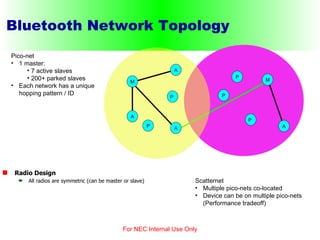
Bluetooth Network Topology Radio Design All radios are symmetric (can be master or slave)   For NEC Internal Use Only Pico-net 1 master: 7 active slaves 200+ parked slaves Each network has a unique hopping pattern / ID M A P P P Scatternet Multiple pico-nets co-located Device can be on multiple pico-nets (Performance tradeoff) M A A A P P
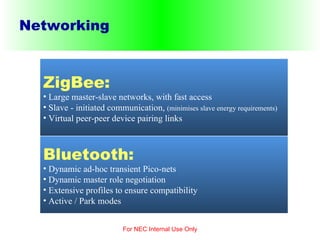
Networking For NEC Internal Use Only Bluetooth: Dynamic ad-hoc transient Pico-nets Dynamic master role negotiation Extensive profiles to ensure compatibility Active / Park modes ZigBee: Large master-slave networks, with fast access Slave - initiated communication,  (minimises slave energy requirements) Virtual peer-peer device pairing links
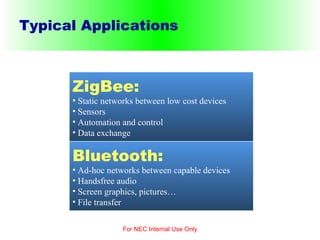
Typical Applications For NEC Internal Use Only Bluetooth: Ad-hoc networks between capable devices Handsfree audio Screen graphics, pictures… File transfer ZigBee: Static networks between low cost devices Sensors  Automation and control Data exchange
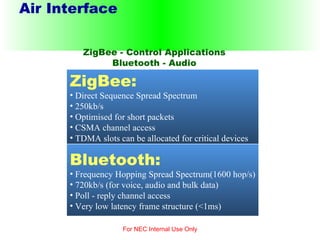
Air Interface For NEC Internal Use Only Bluetooth: Frequency Hopping Spread Spectrum(1600 hop/s) 720kb/s (for voice, audio and bulk data) Poll - reply channel access Very low latency frame structure (<1ms) ZigBee: Direct Sequence Spread Spectrum  250kb/s  Optimised for short packets CSMA channel access TDMA slots can be allocated for critical devices ZigBee - Control Applications Bluetooth - Audio
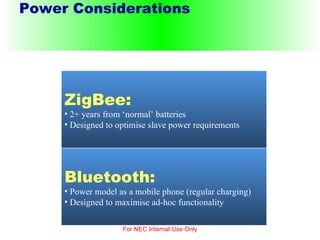
Power Considerations For NEC Internal Use Only Bluetooth: Power model as a mobile phone (regular charging) Designed to maximise ad-hoc functionality ZigBee: 2+ years from ‘normal’ batteries Designed to optimise slave power requirements
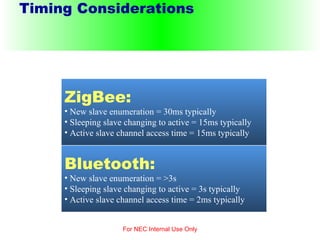
Timing Considerations For NEC Internal Use Only Bluetooth: New slave enumeration = >3s Sleeping slave changing to active = 3s typically Active slave channel access time = 2ms typically ZigBee: New slave enumeration = 30ms typically  Sleeping slave changing to active = 15ms typically Active slave channel access time = 15ms typically
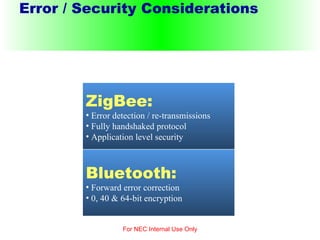
Error / Security Considerations For NEC Internal Use Only Bluetooth: Forward error correction 0, 40 & 64-bit encryption ZigBee: Error detection / re-transmissions Fully handshaked protocol Application level security
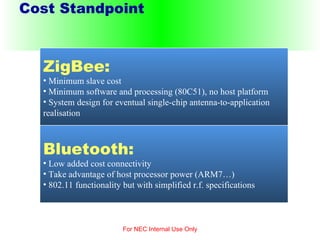
Cost Standpoint For NEC Internal Use Only Bluetooth: Low added cost connectivity Take advantage of host processor power (ARM7…) 802.11 functionality but with simplified r.f. specifications ZigBee: Minimum slave cost Minimum software and processing (80C51), no host platform System design for eventual single-chip antenna-to-application realisation
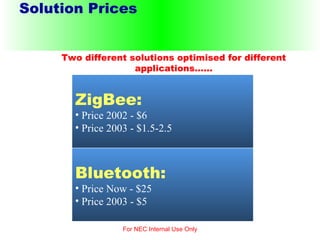
Solution Prices For NEC Internal Use Only Two different solutions optimised for different applications…... Bluetooth: Price Now - $25 Price 2003 - $5 ZigBee: Price 2002 - $6 Price 2003 - $1.5-2.5

Zigbee master

  • 1.
    ZigBee AgendaIntro Market Applications Requirements Standardization Technical Specification Software stack Integration For NEC Internal Use Only
  • 2.
    ZigBee A verylow cost, low power consumption two-way, wireless communications standard for automation, toys, & PC peripherals For NEC Internal Use Only
  • 3.
    MARKET For NECInternal Use Only
  • 4.
    ZigBee Mission: Tobring about the existence of a broad range of interoperable consumer devices by establishing open industry specifications for unlicensed, untethered peripheral, control and entertainment devices requiring the lowest cost and lowest power consumption communications between compliant devices anywhere in and around the home. For NEC Internal Use Only
  • 5.
    The Need forZigBee Low Power consumption 6 months to 5 years battery life for most applications Low Cost At least half the cost of Bluetooth solutions High density of nodes per network 250 nodes per network, multiple co-located networks Data rate requirements Few bits to 250kbps sufficient Simple protocol, Global Implementation 2.4GHz Standard in a fragmented market Many proprietary solutions, interoperability issues Pent up demand due to lack of standard For NEC Internal Use Only
  • 6.
    Objective of ZigBeeInteroperable consumer device s Open industry specificatio n Peripheral, control and entertainment devicesLowest cost and lowest power consumption Anywhere in and around the hom e For NEC Internal Use Only
  • 7.
    Traget Market: Amultimedia PC with interactive gaming options or a 32&quot; television equipped with Home Theatre features, Internet access (e.g. WebTV) or a video gaming console (e.g. Sega, Nintendo, Sony). These residents potentially have the need for advanced HID and toy solutions that could enhance their living or entertainment experiences. Low cost solutions for interconnectivity between toys, such as, TomoguchisExisting homes with installed security, home automation or HVAC systems, and new homes with plans for these systems. The Small Office/Home Office (SOHO) market may also find use for ZigBee products for controlling multimedia presentations, conference rooms, training rooms and automation or control functions. For NEC Internal Use Only
  • 8.
    Must have features:Saftey meets Government regulations: As safe as coordless phone Unlicensed Band Low Cost BOM Reliability Throughput degrades gracefully Ease of Use… Ability to add/remove new devices Register once…authenticate each time Global market Minimum battery life 6months/2 years For NEC Internal Use Only
  • 9.
    Network Clusters willgrow in the Home For NEC Internal Use Only AV Net PC Net Tel Net MODEM TV VCR Audio System STB Camcorder... PC Printer Scanner... Phone Fax... H.Auto Net Environmental Security Medical Domestic app… Pre 2001 Model SATELLITE TERRESTRIAL CABLE OWN CONTENT PHONE xDSL
  • 10.
    Network Clusters willInterconnect/inter-operate in Home and Away For NEC Internal Use Only TV VCR Audio System STB Camcorder... PC Printer Scanner... Phone Fax Environmental Security Medical Domestic app… 2001 Model and beyond SATELLITE TERRESTRIAL CABLE xDSL PHONE BB Wireless Entertainment Productivity H.Auto Net GATEWAY
  • 11.
    BOM/Node Price Development based on Dataquest, Instat and BMA Communications For NEC Internal Use Only New technologies will lead to a sharp demand decrease in cost for the different applications Sharp demand decrease leads on the other hand to step increase in customer demand For 2000/1, <300kps; BOM < $6.00 < 22Mbps; BOM < $20-30 >22Mbps; BOM < $60-70 For 2003/4, <300kps; BOM < $2.50 < 22Mbps; BOM < $8-18 >22Mbps; BOM < $20-35 $
  • 12.
    Market Size –Low Data Rate (No BT) For NEC Internal Use Only Source: ABI, Dataquest, Internal
  • 13.
    Market Segmentation 2000- 2004 For NEC Internal Use Only Industrial Applications will drive initial market Home Environment will become Important Over time, there will be varied Applications (Other)
  • 14.
    Wireless connectivity outlook:For NEC Internal Use Only
  • 15.
    Wireless Connectivity IndustryOutlook For NEC Internal Use Only 10 100 1,000 10,000 10 100 1,000 10,000 100,000 Bandwidth kbps Ricochet HomeRF OpenAir 802.11b Bluetooth WLAN technologies GSM GPRS Range Meters 802.11g ZigBee Cellular technologies PAN technologies
  • 16.
    Wireless Connectivity IndustryOutlook For NEC Internal Use Only 10 100 1,000 10,000 10 100 1,000 10,000 100,000 Bandwidth kbps Bluetooth OpenAir Ricochet 802.11b Hiper LAN/1 HomeRF GSM GPRS EDGE Range Meters ZigBee
  • 17.
    Wireless Connectivity IndustryOutlook For NEC Internal Use Only 10 100 1,000 10,000 10 100 1,000 10,000 100,000 Bandwidth kbps GSM OpenAir Ricochet 802.11a GPRS EDGE Bluetooth 3G Hiper LAN/2 Bluetooth 2.0 Range Meters HomeRF ZigBee
  • 18.
    Industry Outlook ForNEC Internal Use Only BT 2.0 standard rolled out 2000 2001 First 802.11a products on the market 2002 2003 HiperLAN 2 will premier 1999 1 st BT devices on market, BT 1.1 standard rolled out BT special interest group becomes public, and BT 1.0 initial specs released 802.11b standard ratified 802.11a standard ratified 2002/03 HiperLAN 1 ratified in 1996 HiperLAN 1 products on the market HiperLAN 2 standard ratified in 2000 RF-Lite (ZigBee) SIG created ZigBee Products on the market ZigBee ratified (802.15.4) 802.11g standard ratified
  • 19.
    Target Applications 1Desktop PCs and Home Entertainment Systems (Home Theatre TV) Computer peripherals; HID devices Video conference equipment Remote control Video gaming equipment Multi-player PC & video games Playing a PC DVD game in front of a TV monitor Remote controls for audio and video equipment PC Enhanced & stand alone toys In-room coverage Home+yard coverage For NEC Internal Use Only
  • 20.
    Target Applications 2Home appliances/general consumer electronic devices Existing home security systems, electrical & heating systems Wireless door and opening monitoring, system control Wireless Keypads Smoke and flame detectors Lighting and remote control of appliances in the home; Blinds/Shades Pool/Spa equipment Garage door openers Voice Control New device categories that have not yet been developed, such as news tablets, and keyboards with built-in displays For NEC Internal Use Only
  • 21.
    Device Examples: HIDdevices Video gaming equipment; Multi-player PC & video games Playing a PC DVD game in front of a TV monitor Remote controls for audio and video equipment Glass breakage monitoring (sensors); Wireless Keypads; Child Monitor; Smoke and flame detectors; Fire Pull stations; Personal transponders; Lighting and remote control of appliances in the home; Fireplaces Pool/Spa equipment Garage door openers For NEC Internal Use Only
  • 22.
    Target Market summary:For NEC Internal Use Only Low Data Rate Radio Devices Industrial & Commercial Consumer Electronics Personal Healthcare Toys & Games Home Automation PC Peripherals · TV · VCR · DVD · CD · Remote · Mouse · Keyboard · Joystick · Gamepad  Security  HVAC  Lighting  Closures  PETs  Gameboys  Educational  Monitors  Diagnostics  Sensors · Monitors · Sensors · Automation · Control
  • 23.
    Market Requirements Globallicence free ISM band operation Unrestricted geographic use RF penetration through walls & ceilings Automatic/semi-automatic installation Ability to add or remove devices Possible voice support For NEC Internal Use Only
  • 24.
    Market Requirements, cont...10k-115.2kbps data throughput 10-75m coverage range (home/garden) Support for 32-255 nodes Support for 4 critical devices 4-100 co-located networks 0.5-2 year battery life Up to 5ms-1 permitted mobility Module cost: $1.5-$2.5 in 2003! For NEC Internal Use Only
  • 25.
    Applications: Human InputDevices (HID) Keyboard Mouse / Pointing Device Remote Controls (controls for audio & video equipment) Gaming Device For NEC Internal Use Only
  • 26.
    Applications: Home Automationand Control Automation Devices Control Devices Home Security Interactive Toys For NEC Internal Use Only
  • 27.
    Success Factors Lowcost Data type support Ease of installation Reliable data transfer Short range operation Reasonable battery life Unlicensed band Unrestricted geographical use Global implementation Governmental regulations For NEC Internal Use Only
  • 28.
    STANDARDIZATION For NECInternal Use Only
  • 29.
    History Low-rate solutionfor HomeRF, January 1998 Initial MRD, October 1998 Initial RSI/TRD, October 1999 Proposals submitted, July 2000 Initial specification, v0.2, September 2000 Proposal to IEEE 802.15.4, March 2001 Proposal accepted by IEEE, July 2001 For NEC Internal Use Only
  • 30.
    HomeRF-Lite -> Firefly-> RF-Lite -> ZigBee Description Low data rate (<250kbps), very low cost (BOM<$6.00) consumer market Replaces wired solutions that require low data rates Replaces IrDA links with a low cost wireless network Simple MAC protocol: master-slave or virtual point-to-point applications, reduces system compexity Applications: peripherals to PC, temperature control, home security, toys, etc. For NEC Internal Use Only
  • 31.
    Some Participants (22Companies in total) For NEC Internal Use Only
  • 32.
    Technical: For NECInternal Use Only
  • 33.
    Protocol Features Master/slavetopology Automatic network configuration Dynamic slave device addressing Virtual peer-to-peer links (pairing) Full handshaking for packet transfers Power management features Up to 254 (+ master) network nodes For NEC Internal Use Only
  • 34.
    Protocol Features Cont...CSMA-CA channel access mechanism 28kbps (Optional) & 200kbps (actual) data throughput Service discovery Low impact internet capability For NEC Internal Use Only
  • 35.
    ZigBee Protocol StackFor NEC Internal Use Only Silicon ZigBee Stack Application Application Customer ZigBee Alliance IEEE PHY Layer MAC Layer MAC Layer Data Link Layer Network Layer Application Interface
  • 36.
    Bluetooth Protocol Stack For NEC Internal Use Only Silicon RF Baseband Link Controller Voice Link Manager Host Control Interface L2CAP Telephony Control Protocol Intercom Headset Cordless Group Call RFCOMM (Serial Port) OBEX HOST MODULE Bluetooth Stack Applications vCard vCal vNote vMessage Dial-up Networking Fax Service Discovery Protocol User Interface
  • 37.
    Direct Sequence Spreadspectrum regulations allow higher transmit power Longer range Transmit power: -4 - +20dBm Direct sequence Faster acquisition than frequency hopping Complexity in digital domain (cheaper) Spread using length 11 bit Barker sequence Optimal autocorrelation properties Short sequence gives fast acquisition Used in IEEE802.11 For NEC Internal Use Only
  • 38.
    Raw Bit Rates250kbps 28kbps low bit rate option : Trade data rate for extra range via coding Over air bit rate remains 200kbps Longer preamble and SOP reliable synchronisation at low SNR For NEC Internal Use Only
  • 39.
    Range Estimation ForNEC Internal Use Only Using Firefly TRD/RSI propagation model Approx. x2
  • 40.
    Network Topology ForNEC Internal Use Only Network coordinator Network node Communications flow Virtual links IEEE node
  • 41.
    Other Network FormsFor NEC Internal Use Only Network coordinator Communications flow Ad-hoc network Gateway Network node Gateway enabled network
  • 42.
    Supported Traffic TypesPeriodic data Application defined rate Intermittent Basic communication Repetitive low latency data Allocation of guaranteed time slots For NEC Internal Use Only
  • 43.
    The Network CoordinatorTransmits network beacons Sets up a network Manages network nodes Stores network node information Routes messages between paired nodes Receives constantly For NEC Internal Use Only
  • 44.
    The Network NodeIs generally battery powered Searches for available networks Transfers data from its application as necessary Determines whether data is pending Requests data from the network coordinator Can sleep for extended periods For NEC Internal Use Only
  • 45.
    Stack System Requirements8-bit  C, e.g. 80c51 Full protocol stack <32k Simple node only stack ~4k Coordinators require extra RAM node device database transaction table pairing table For NEC Internal Use Only
  • 46.
    ZigBee Chip SetSolution Low Data Rate, DSSS @ 2,4GHz For NEC Internal Use Only PA Micro + MAC+ RAM/ROM Radio Single Chip DSSS Radio + Modem Baseband Transmit Data Receive Data
  • 47.
    Feature Set RFFront-End IC Single chip direct conversion transceiver for ZigBee applications in the 2.4GHz ISM band DSSS 2.2Mchips/sec Integrated antenna filter, LNA, VCO, synthesizer, PLL, preamplifier 3-wire control bus interface Direct conversion architecture from 2.45 GHz RF directly base band Battery powered design (min. VCC=1.8V) Output power –4 to +20dBm (0dBm typical) Digitally controlled RX gain control for DSSS No off-chip components (LNA, Pre PA, VCO, Synthesizer) For NEC Internal Use Only
  • 48.
    ZigBee Base Band& MAC Single chip Modem and MAC 80C51 (or equivalent) 8-bit low power micro controller core Interfaces: Full duplex UART for communication with host processor or other devices 2 3 wire buses for host and RF Front-end communication Master/slave I2C 2 analog inputs Minimum external components for low BOM CMOS 0.18 or other low cost similar capablity process For NEC Internal Use Only
  • 49.
    Low Data RateRoadmap For NEC Internal Use Only Single Chip Solutions Single Chip DSSS Radio + Modem Microprocessor+ Housekeeping+MAC 2002 2003 Two Chip Solutions One Chip Radio+ BB RF CMOS One Chip Radio+BB Slave Device 2004 2005 Base Band Slave Device BB Slave Device Cost reduced One Chip Radio+BB Low Cost
  • 50.
    Protocol Features Master/slavetopology Automatic network configuration Dynamic slave device addressing Virtual peer-to-peer links (pairing) Full handshaking for packet transfers Power management features Up to 254 (+ master) network nodes For NEC Internal Use Only
  • 51.
    Protocol Features Cont...CSMA-CA channel access mechanism 15ms frame structure TDMA slots can be allocated 28kbps & 250kbps data throughput Service discovery Low impact internet capability For NEC Internal Use Only
  • 52.
    Frequency Bands 2.4GHzISM band Channel spacing: 4MHz F = 2404 + 4k MHz with k = 0, 1, …, 25 Common band: USA, Europe including France and Spain 2446.5 – 2475.0 MHZ k = 15, …, 22; equals 8 channels 915MHz ISM band USA only 868MHz Europe For NEC Internal Use Only USA Europe Spain* France* 2400.0 2483.5 2446.5 2475.0 Japan* Common * Harmonization with FCC in progress
  • 53.
    Raw Bit Rates250kbps 28kbps low bit rate option: Trade data rate for extra range via coding Over air bit rate remains 250kbps Longer preamble and SOP reliable synchronisation at low SNR For NEC Internal Use Only
  • 54.
    Range Estimation (meters)For NEC Internal Use Only Using Firefly TRD/RSI propagation model Approx. x2
  • 55.
    Summary Solution thateffectively addresses the needs of the target market place with: Low data rate (<250Kbps) Low cost (~ BT/2) Very low power (6 months - 2 years on 2 AA batteries.) Network Solution For NEC Internal Use Only
  • 56.
    ZigBee vs. Bluetooth For NEC Internal Use Only
  • 57.
    Bluetooth Network TopologyRadio Design All radios are symmetric (can be master or slave) For NEC Internal Use Only Pico-net 1 master: 7 active slaves 200+ parked slaves Each network has a unique hopping pattern / ID M A P P P Scatternet Multiple pico-nets co-located Device can be on multiple pico-nets (Performance tradeoff) M A A A P P
  • 58.
    Networking For NECInternal Use Only Bluetooth: Dynamic ad-hoc transient Pico-nets Dynamic master role negotiation Extensive profiles to ensure compatibility Active / Park modes ZigBee: Large master-slave networks, with fast access Slave - initiated communication, (minimises slave energy requirements) Virtual peer-peer device pairing links
  • 59.
    Typical Applications ForNEC Internal Use Only Bluetooth: Ad-hoc networks between capable devices Handsfree audio Screen graphics, pictures… File transfer ZigBee: Static networks between low cost devices Sensors Automation and control Data exchange
  • 60.
    Air Interface ForNEC Internal Use Only Bluetooth: Frequency Hopping Spread Spectrum(1600 hop/s) 720kb/s (for voice, audio and bulk data) Poll - reply channel access Very low latency frame structure (<1ms) ZigBee: Direct Sequence Spread Spectrum 250kb/s Optimised for short packets CSMA channel access TDMA slots can be allocated for critical devices ZigBee - Control Applications Bluetooth - Audio
  • 61.
    Power Considerations ForNEC Internal Use Only Bluetooth: Power model as a mobile phone (regular charging) Designed to maximise ad-hoc functionality ZigBee: 2+ years from ‘normal’ batteries Designed to optimise slave power requirements
  • 62.
    Timing Considerations ForNEC Internal Use Only Bluetooth: New slave enumeration = >3s Sleeping slave changing to active = 3s typically Active slave channel access time = 2ms typically ZigBee: New slave enumeration = 30ms typically Sleeping slave changing to active = 15ms typically Active slave channel access time = 15ms typically
  • 63.
    Error / SecurityConsiderations For NEC Internal Use Only Bluetooth: Forward error correction 0, 40 & 64-bit encryption ZigBee: Error detection / re-transmissions Fully handshaked protocol Application level security
  • 64.
    Cost Standpoint ForNEC Internal Use Only Bluetooth: Low added cost connectivity Take advantage of host processor power (ARM7…) 802.11 functionality but with simplified r.f. specifications ZigBee: Minimum slave cost Minimum software and processing (80C51), no host platform System design for eventual single-chip antenna-to-application realisation
  • 65.
    Solution Prices ForNEC Internal Use Only Two different solutions optimised for different applications…... Bluetooth: Price Now - $25 Price 2003 - $5 ZigBee: Price 2002 - $6 Price 2003 - $1.5-2.5

Editor's Notes

  • #22 Desktop PCs and Home Entertainment Systems (Theatre TV); • Computer peripherals; • HID devices • Video conference equipment; • Remote control • Video gaming equipment; • Multi-player PC &amp; video games • Playing a PC DVD game in front of a TV monitor • Remote controls for audio and video equipment • PC Enhanced &amp; stand alone toys • In-room coverage • Home+yard coverage Home appliances and general consumer electronic devices • Existing home security systems, electrical &amp; heating systems; • Wireless door and opening monitoring, system control; • Glass breakage monitoring (sensors); • Wireless Keypads; • Child Monitor; • Smoke and flame detectors; • Fire Pull stations; • Personal transponders; • Lighting and remote control of appliances in the home; • Blinds • Shades • Fireplaces • Pool/Spa equipment • Garage door openers • Voice Control; • Home Comfort Control; • New device categories that have not yet been developed, such as news tablets, and keyboards with built-in displays
  • #26 Human Input Devices (HID) • Keyboard Communication is typically uni-directional Expected throughput: 1.0 kbps Expected response time: &lt; 50 msec. Expected Battery Life: 6 months minimum with typical use, where typical use is defined as 10 keystrokes/second for 3 hours/day • Mouse / Pointing Device Communication is typically uni-directional Expected throughput: 3.0 kbps Expected response time: &lt; 25 msec. Expected Battery Life: 6 months minimum with typical use, where typical use is defined as updating the screen 5 times/second for 3 hours/day • Remote Controls (controls for audio &amp; video equipment) Communication is uni- and/or bi-directional Expected throughput: 3.0 kbps Expected response time: &lt; 25 msec. Expected Battery Life: 6 months minimum with typical use, where typical use is defined as updating the screen 5 times/second for 3 hours/day • Gaming Device Double Joystick Communication is typically bi-directional for feedback controllers Expected throughput: 6.0 kbps Expected response time: &lt; 16.7 msec. Expected Battery Life: 6 months minimum with typical use, where typical use is defined as updating the screen 5 times/second for 3 hours/day Game Pad for DirectX Communication is typically bi-directional for feedback controllers Expected throughput: 9.0 kbps Expected response time: &lt; 16.7 msec. Expected Battery Life: 6 months minimum with typical use, where typical use is defined as updating the screen 5 times/second for 3 hours/day
  • #27 Home Automation and Control Automated lighting, temperature control, maintenance, and amenities Interaction with a controller for updates and supervisory functions • Automation Devices Communication is uni- and/or bi-directional Expected data rates: &lt;10 kbps to 64 kbps (aggregate) Expected Response Times: 100 msec. Expected battery life &gt;2 years operating on 2AA batteries Very low power consumption High density of units, up to 128 • Control Devices Communication is uni- and/or bi-directional Expected data rates from &lt;10kbps (aggregate) Expected Response Times: 100 msec. Battery life &gt;2 years operating on 2AA batteries Very low power consumption Medium density of units, up to 64 Home Security Communication is uni- and/or bi-directional Expected data rates: &lt;10 kbps to 64 kbps (aggregate) Expected battery life: &gt;2 years operating on 2AA batteries Very low power consumption High density of units, up to 128 • Interactive Toys In-room interaction with TV or PC program Home+yard coverage for mobile robots and multi-user gaming Support for voice recognition and TTS desired Communication link must support bi-directional communication - Some applications may need to support packetized audio at 32 kbps with latencies on the order of 100 msec. Expected bandwidth: 115.2 kbps Must support four (4) simultaneous links Use the “Alkaline Battery Model” – throw away after use - Expected battery life: &gt; 3 months with typical use (Low data rate toys) - Expected battery life: &gt; 30 days with typical use (Medium data rate toys) - Typical use is defined as 4 hours/day