Cost Drivers
The Third Key to Strategic Cost
Management
Blocher,Stout,Cokins,Chen, Cost Management 4e ©The McGraw-Hill Companies 2008
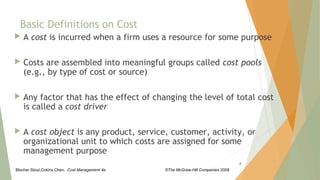
 A cost is incurred when a firm uses a resource for some purpose
 Costs are assembled into meaningful groups called cost pools
(e.g., by type of cost or source)
 Any factor that has the effect of changing the level of total cost
is called a cost driver
 A cost object is any product, service, customer, activity, or
organizational unit to which costs are assigned for some
management purpose
2
Basic Definitions on Cost
Blocher,Stout,Cokins,Chen, Cost Management 4e ©The McGraw-Hill Companies 2008
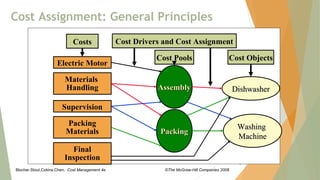
Cost Assignment: General Principles
3
Costs
Electric Motor
Materials
Handling
Supervision
Packing
Materials
Cost Pools
AssemblyAssembly
PackingPacking
Cost Objects
DishwasherDishwasher
WashingWashing
MachineMachine
Final
Inspection
Cost Drivers and Cost Assignment
Blocher,Stout,Cokins,Chen, Cost Management 4e ©The McGraw-Hill Companies 2008
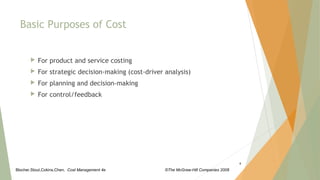
 For product and service costing
 For strategic decision-making (cost-driver analysis)
 For planning and decision-making
 For control/feedback
4
Basic Purposes of Cost
Blocher,Stout,Cokins,Chen, Cost Management 4e ©The McGraw-Hill Companies 2008
The process of assigning costs to cost pools or from cost
pools to cost objects
 Direct costs can be conveniently and economically traced to
a cost pool or a cost object
 Indirect costs cannot be traced conveniently or economically
to a cost pool or a cost object
 Because indirect costs cannot be traced, assignment is made
through the use of cost drivers (cost allocation)
 These cost drivers are often called allocation bases
5
Product/Service Costing
Blocher,Stout,Cokins,Chen, Cost Management 4e ©The McGraw-Hill Companies 2008
Product and Service Costing Concepts
 Product costs include only the costs necessary to
complete the product at the manufacturing step in the
value chain (manufacturing) or to purchase and
transport the product to the location of sale
(merchandising)
 Period costs include all other costs incurred by the firm
in managing or selling the product (indirect costs
outside the manufacturing step of the value chain)
6
Blocher,Stout,Cokins,Chen, Cost Management 4e ©The McGraw-Hill Companies 2008
Costs for Strategic Decision-Making – Cost driver
Analysis
 Cost drivers provide two roles for the management
accountant
 Assigning costs to cost objects
 Explaining cost behavior, i.e., how total cost changes as the cost
driver changes
7
Blocher,Stout,Cokins,Chen, Cost Management 4e ©The McGraw-Hill Companies 2008
Types of Cost Drivers
 The four types of cost drivers:
 Volume-based cost drivers,
 Activity-based cost drivers,
 Structural cost drivers, and
 Executional cost drivers.
8
Blocher,Stout,Cokins,Chen, Cost Management 4e ©The McGraw-Hill Companies 2008
 Activity-based drivers are developed at a detailed level of operations
and are associated with a given manufacturing activity. Activity-based
cost drivers are identified by using activity analysis, a detailed
description of the specific activities performed in the firm’s operations.
 Volume-based cost drivers are developed at an aggregate level. The
relationship between the cost driver and total cost is approximately
linear within the relevant range.
 Cost concept relating to the volume based:
Fixed Vs. Variable, Average cost Vs. Marginal cost, CVP analysis, Break even
Analysis etc.
 Volume based cost drivers capture very little of richness of cost
behavior.
9
Blocher,Stout,Cokins,Chen, Cost Management 4e ©The McGraw-Hill Companies 2008
Drawbacks of volume based cost drivers
 Ignores the fact that different products make different demands on
factory support services. It not relate to unique manufacturing
characteristics in different operations
 As absorption costing emphasized on total cost namely both variable
and fixed, it is not so useful for management to use to make decision,
planning and control.
 It only uses a common plant wide or departmental cost driver and
ignores differences in activities for different products or productions
runs with in the plant.
 Employs a common activity volume of all products
10
Blocher,Stout,Cokins,Chen, Cost Management 4e ©The McGraw-Hill Companies 2008
 Structural and executional drivers involve strategic and
operational decisions that affect the relationship between these
cost drivers and total cost.
 Structural cost drivers facilitate strategic decision making
because they involve plans and decisions that have long-term
effects.
 It involves choices by the firm that drive product cost
 Scale, experience, technology, and complexity are considered in
hopes of improving competitive position
11
Structural and executional drivers
Blocher,Stout,Cokins,Chen, Cost Management 4e ©The McGraw-Hill Companies 2008
 Executional cost drivers facilitate operational decision making
by focusing on short-term effects.
 Those determinants of a firm’s cost position that hinge on its
ability to execute successfully. (Related to organizational skills)
 Workforce involvement, design of the production process, and supplier
relationships are considered in an attempt to reduce costs
12
Blocher,Stout,Cokins,Chen, Cost Management 4e ©The McGraw-Hill Companies 2008
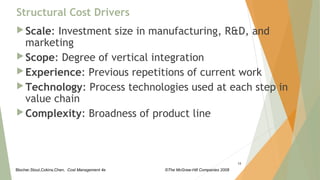
Structural Cost Drivers
Scale: Investment size in manufacturing, R&D, and
marketing
Scope: Degree of vertical integration
Experience: Previous repetitions of current work
Technology: Process technologies used at each step in
value chain
Complexity: Broadness of product line
13
Blocher,Stout,Cokins,Chen, Cost Management 4e ©The McGraw-Hill Companies 2008
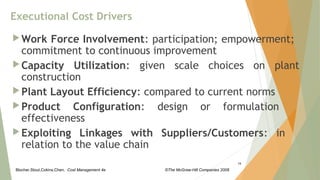
Executional Cost Drivers
Work Force Involvement: participation; empowerment;
commitment to continuous improvement
Capacity Utilization: given scale choices on plant
construction
Plant Layout Efficiency: compared to current norms
Product Configuration: design or formulation
effectiveness
Exploiting Linkages with Suppliers/Customers: in
relation to the value chain
14
Blocher,Stout,Cokins,Chen, Cost Management 4e ©The McGraw-Hill Companies 2008
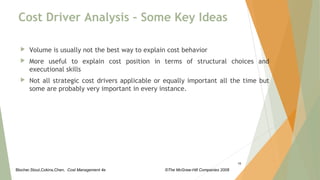
Cost Driver Analysis – Some Key Ideas
 Volume is usually not the best way to explain cost behavior
 More useful to explain cost position in terms of structural choices and
executional skills
 Not all strategic cost drivers applicable or equally important all the time but
some are probably very important in every instance.
15
Blocher,Stout,Cokins,Chen, Cost Management 4e ©The McGraw-Hill Companies 2008
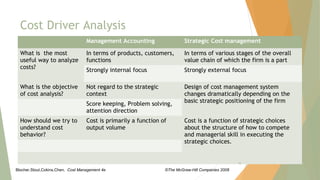
Cost Driver Analysis
Management Accounting Strategic Cost management
What is the most
useful way to analyze
costs?
In terms of products, customers,
functions
In terms of various stages of the overall
value chain of which the firm is a part
Strongly internal focus Strongly external focus
What is the objective
of cost analysis?
Not regard to the strategic
context
Design of cost management system
changes dramatically depending on the
basic strategic positioning of the firmScore keeping, Problem solving,
attention direction
How should we try to
understand cost
behavior?
Cost is primarily a function of
output volume
Cost is a function of strategic choices
about the structure of how to compete
and managerial skill in executing the
strategic choices.
16
Blocher,Stout,Cokins,Chen, Cost Management 4e ©The McGraw-Hill Companies 2008
Linkages Among Value Chain Analysis, Strategic
Positioning Analysis and Cost Driver Analysis
 Understanding the value chain helps define the optimal
positioning strategy
 Understanding the value chain and positioning strategy helps
identify the relevant cost drivers
17

04 cost drivers final

  • 1.
    Cost Drivers The ThirdKey to Strategic Cost Management
  • 2.
    Blocher,Stout,Cokins,Chen, Cost Management4e ©The McGraw-Hill Companies 2008  A cost is incurred when a firm uses a resource for some purpose  Costs are assembled into meaningful groups called cost pools (e.g., by type of cost or source)  Any factor that has the effect of changing the level of total cost is called a cost driver  A cost object is any product, service, customer, activity, or organizational unit to which costs are assigned for some management purpose 2 Basic Definitions on Cost
  • 3.
    Blocher,Stout,Cokins,Chen, Cost Management4e ©The McGraw-Hill Companies 2008 Cost Assignment: General Principles 3 Costs Electric Motor Materials Handling Supervision Packing Materials Cost Pools AssemblyAssembly PackingPacking Cost Objects DishwasherDishwasher WashingWashing MachineMachine Final Inspection Cost Drivers and Cost Assignment
  • 4.
    Blocher,Stout,Cokins,Chen, Cost Management4e ©The McGraw-Hill Companies 2008  For product and service costing  For strategic decision-making (cost-driver analysis)  For planning and decision-making  For control/feedback 4 Basic Purposes of Cost
  • 5.
    Blocher,Stout,Cokins,Chen, Cost Management4e ©The McGraw-Hill Companies 2008 The process of assigning costs to cost pools or from cost pools to cost objects  Direct costs can be conveniently and economically traced to a cost pool or a cost object  Indirect costs cannot be traced conveniently or economically to a cost pool or a cost object  Because indirect costs cannot be traced, assignment is made through the use of cost drivers (cost allocation)  These cost drivers are often called allocation bases 5 Product/Service Costing
  • 6.
    Blocher,Stout,Cokins,Chen, Cost Management4e ©The McGraw-Hill Companies 2008 Product and Service Costing Concepts  Product costs include only the costs necessary to complete the product at the manufacturing step in the value chain (manufacturing) or to purchase and transport the product to the location of sale (merchandising)  Period costs include all other costs incurred by the firm in managing or selling the product (indirect costs outside the manufacturing step of the value chain) 6
  • 7.
    Blocher,Stout,Cokins,Chen, Cost Management4e ©The McGraw-Hill Companies 2008 Costs for Strategic Decision-Making – Cost driver Analysis  Cost drivers provide two roles for the management accountant  Assigning costs to cost objects  Explaining cost behavior, i.e., how total cost changes as the cost driver changes 7
  • 8.
    Blocher,Stout,Cokins,Chen, Cost Management4e ©The McGraw-Hill Companies 2008 Types of Cost Drivers  The four types of cost drivers:  Volume-based cost drivers,  Activity-based cost drivers,  Structural cost drivers, and  Executional cost drivers. 8
  • 9.
    Blocher,Stout,Cokins,Chen, Cost Management4e ©The McGraw-Hill Companies 2008  Activity-based drivers are developed at a detailed level of operations and are associated with a given manufacturing activity. Activity-based cost drivers are identified by using activity analysis, a detailed description of the specific activities performed in the firm’s operations.  Volume-based cost drivers are developed at an aggregate level. The relationship between the cost driver and total cost is approximately linear within the relevant range.  Cost concept relating to the volume based: Fixed Vs. Variable, Average cost Vs. Marginal cost, CVP analysis, Break even Analysis etc.  Volume based cost drivers capture very little of richness of cost behavior. 9
  • 10.
    Blocher,Stout,Cokins,Chen, Cost Management4e ©The McGraw-Hill Companies 2008 Drawbacks of volume based cost drivers  Ignores the fact that different products make different demands on factory support services. It not relate to unique manufacturing characteristics in different operations  As absorption costing emphasized on total cost namely both variable and fixed, it is not so useful for management to use to make decision, planning and control.  It only uses a common plant wide or departmental cost driver and ignores differences in activities for different products or productions runs with in the plant.  Employs a common activity volume of all products 10
  • 11.
    Blocher,Stout,Cokins,Chen, Cost Management4e ©The McGraw-Hill Companies 2008  Structural and executional drivers involve strategic and operational decisions that affect the relationship between these cost drivers and total cost.  Structural cost drivers facilitate strategic decision making because they involve plans and decisions that have long-term effects.  It involves choices by the firm that drive product cost  Scale, experience, technology, and complexity are considered in hopes of improving competitive position 11 Structural and executional drivers
  • 12.
    Blocher,Stout,Cokins,Chen, Cost Management4e ©The McGraw-Hill Companies 2008  Executional cost drivers facilitate operational decision making by focusing on short-term effects.  Those determinants of a firm’s cost position that hinge on its ability to execute successfully. (Related to organizational skills)  Workforce involvement, design of the production process, and supplier relationships are considered in an attempt to reduce costs 12
  • 13.
    Blocher,Stout,Cokins,Chen, Cost Management4e ©The McGraw-Hill Companies 2008 Structural Cost Drivers Scale: Investment size in manufacturing, R&D, and marketing Scope: Degree of vertical integration Experience: Previous repetitions of current work Technology: Process technologies used at each step in value chain Complexity: Broadness of product line 13
  • 14.
    Blocher,Stout,Cokins,Chen, Cost Management4e ©The McGraw-Hill Companies 2008 Executional Cost Drivers Work Force Involvement: participation; empowerment; commitment to continuous improvement Capacity Utilization: given scale choices on plant construction Plant Layout Efficiency: compared to current norms Product Configuration: design or formulation effectiveness Exploiting Linkages with Suppliers/Customers: in relation to the value chain 14
  • 15.
    Blocher,Stout,Cokins,Chen, Cost Management4e ©The McGraw-Hill Companies 2008 Cost Driver Analysis – Some Key Ideas  Volume is usually not the best way to explain cost behavior  More useful to explain cost position in terms of structural choices and executional skills  Not all strategic cost drivers applicable or equally important all the time but some are probably very important in every instance. 15
  • 16.
    Blocher,Stout,Cokins,Chen, Cost Management4e ©The McGraw-Hill Companies 2008 Cost Driver Analysis Management Accounting Strategic Cost management What is the most useful way to analyze costs? In terms of products, customers, functions In terms of various stages of the overall value chain of which the firm is a part Strongly internal focus Strongly external focus What is the objective of cost analysis? Not regard to the strategic context Design of cost management system changes dramatically depending on the basic strategic positioning of the firmScore keeping, Problem solving, attention direction How should we try to understand cost behavior? Cost is primarily a function of output volume Cost is a function of strategic choices about the structure of how to compete and managerial skill in executing the strategic choices. 16
  • 17.
    Blocher,Stout,Cokins,Chen, Cost Management4e ©The McGraw-Hill Companies 2008 Linkages Among Value Chain Analysis, Strategic Positioning Analysis and Cost Driver Analysis  Understanding the value chain helps define the optimal positioning strategy  Understanding the value chain and positioning strategy helps identify the relevant cost drivers 17