Responsibility 
Accounting
• The management accounting construct that 
deals with both planned and actual 
accounting information about the inputs and 
outputs of a responsibility center is called 
responsibility accounting. 
• It involves a continuous flow of information 
that corresponds to the continuous flow of 
inputs into and outputs from an 
organisations responsibility centers.
Responsibility centers 
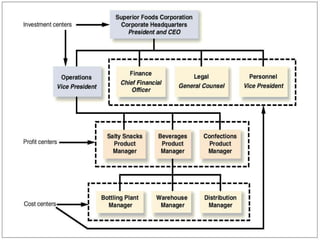
• Each organisational unit is headed by a 
manager who is responsible for the work done 
by the unit, therefore , each unit is called a 
responsibility center. 
• There are 4 types of responsibility centers: 
1. Revenue centers 
2. Expense centers 
3. Profit centers 
4. Investments centers
Revenue centers 
• If a responsibility center manager is 
held responsible for the outputs of the 
center as measured in monetary terms 
but is not responsible for the costs of 
the goods or services that the center 
sells, then the responsibility center is a 
revenue center. 
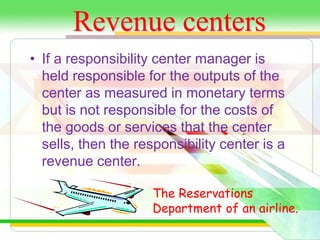
The Reservations 
Department of an airline.
Expense centers 
• If the control system measures the 
expenses incurred by a responsibility 
center but does not measure its 
outputs in terms of revenues, then 
the responsibility center is called an 
expense center. 
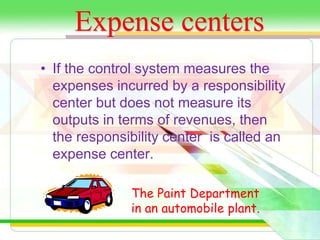
The Paint Department 
in an automobile plant.
Profit centers 
• Profit is the difference between revenue and expense. 
• If performance of the responsibility center is measured in 
terms of profit then it is a profit center. 
• A profit center resembles a business in miniature. 
• It is a good training ground for general management 
responsibility. 
• This concept has made possible the decentralization of 
profit responsibility in large companies. 
Company-owned restaurant in 
a fast-food chain.
Investment centers 
• An investment center is a responsibility 
center in which the manager is held 
responsible for the use of assets as well 
as for profit. 
• The manager is expected to earn a 
satisfactory return on the assets employed 
in the responsibility center. 
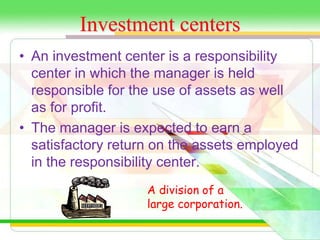
A division of a 
large corporation.
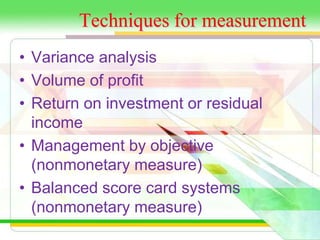
Techniques for measurement 
• Variance analysis 
• Volume of profit 
• Return on investment or residual 
income 
• Management by objective 
(nonmonetary measure) 
• Balanced score card systems 
(nonmonetary measure)
THANK YOU

Responsibility accounting

  • 1.
  • 2.
    • The managementaccounting construct that deals with both planned and actual accounting information about the inputs and outputs of a responsibility center is called responsibility accounting. • It involves a continuous flow of information that corresponds to the continuous flow of inputs into and outputs from an organisations responsibility centers.
  • 3.
    Responsibility centers •Each organisational unit is headed by a manager who is responsible for the work done by the unit, therefore , each unit is called a responsibility center. • There are 4 types of responsibility centers: 1. Revenue centers 2. Expense centers 3. Profit centers 4. Investments centers
  • 5.
    Revenue centers •If a responsibility center manager is held responsible for the outputs of the center as measured in monetary terms but is not responsible for the costs of the goods or services that the center sells, then the responsibility center is a revenue center. The Reservations Department of an airline.
  • 6.
    Expense centers •If the control system measures the expenses incurred by a responsibility center but does not measure its outputs in terms of revenues, then the responsibility center is called an expense center. The Paint Department in an automobile plant.
  • 7.
    Profit centers •Profit is the difference between revenue and expense. • If performance of the responsibility center is measured in terms of profit then it is a profit center. • A profit center resembles a business in miniature. • It is a good training ground for general management responsibility. • This concept has made possible the decentralization of profit responsibility in large companies. Company-owned restaurant in a fast-food chain.
  • 8.
    Investment centers •An investment center is a responsibility center in which the manager is held responsible for the use of assets as well as for profit. • The manager is expected to earn a satisfactory return on the assets employed in the responsibility center. A division of a large corporation.
  • 9.
    Techniques for measurement • Variance analysis • Volume of profit • Return on investment or residual income • Management by objective (nonmonetary measure) • Balanced score card systems (nonmonetary measure)
  • 10.