Submitted To
Prof. S.K. Srivastava
Presentation on Environmental Appraisal
Submitted By
Sadhika Katiyar
Rupesh Kumar Mishra
Gaurav Katiyar
Ashish Chandra
Namam
Tilak Diwedi
Saurabh Singh Rajpoot
Pranay Ranjan
What is environment
 Environment means the surroundings, external
objects, influences or circumstances under which
someone or something exists.
 The environment of any organization is the aggregate
of all conditions, events and influences that surround
and affect it
Characteristics of environment
 Environment is complex:
The environment consist of number of
factors, events, conditions and influences arising from
different sources. All these do not exist in isolation but
interact with each other to create an entirely new set of
influences.
 Environment is dynamic:
The environment is consistently changing in nature. Due to
many and varied influence operating, there is dynamism in
the environment causing it to continuously change its shape
and character.
 Environment is multi faceted:
What shape and character an environment assumes
depends on perception of observer. A particular change
in environment or a new development may be viewed
differently by different observers.
 Environment has a far reaching impact on
organizations. The growth and profitability of an
organization depends critically on environment in
which it exists. Any environmental change has an
impact on organization in several different ways.
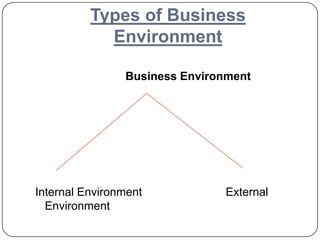
Types of Business

Environment
Business Environment
Internal Environment External
Environment
INTERNAL ENVIRONMENT
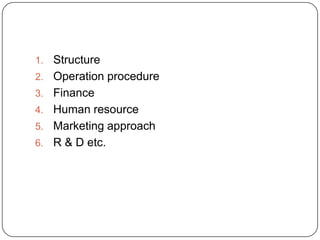
1. Structure
2. Operation procedure
3. Finance
4. Human resource
5. Marketing approach
6. R & D etc.
EXTERNAL ENVIRONMENT
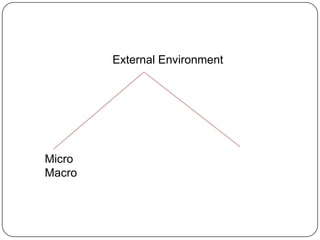
External Environment
Micro
Macro
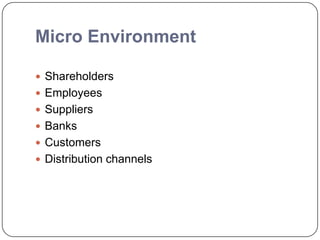
Micro Environment
 Shareholders
 Employees
 Suppliers
 Banks
 Customers
 Distribution channels
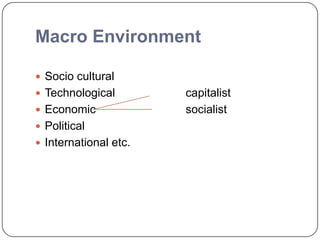
Macro Environment
 Socio cultural
 Technological capitalist
 Economic socialist
 Political
 International etc.
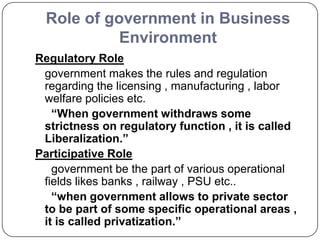
Role of government in Business
Environment
Regulatory Role
government makes the rules and regulation
regarding the licensing , manufacturing , labor
welfare policies etc.
“When government withdraws some
strictness on regulatory function , it is called
Liberalization.”
Participative Role
government be the part of various operational
fields likes banks , railway , PSU etc..
“when government allows to private sector
to be part of some specific operational areas ,
it is called privatization.”
 Protective Role
government makes some specific rules in forms
of various taxes and restrictions to protect the
domestic industry.
“when government withdraws some
restrictions to attract the FDI , FII and
providing best product , it is called
Globalization.”
Environmental sectors
1. Economic environment
2. International Environment
3. Market Environment
4. Political Environment
5. Regulatory Environment
6. Socio Cultural Environment
7. Supplier Environment
8. Technological Environment
Economic Environment
The economic environment consists of macro level factors
related to means of production and distribution of wealth
that have on business of organization.
Some important factors are
1. Economic stage at which a country exists
2. Economic structure adopted
3. Economic policies
4. Economic planning
5. Infrastructural factors
International Environment
The international environment consists of all those
factors that operate at transnational, cross cultural
and across border level, having impact on business of
organization.
1. Globalization, its process, content and direction
2. Global economic forces, block and forum
3. Global trade and commerce, its process and trend
4. Global financial system, sources of financing
5. Geopolitical situation, equation, alliances and
strategic interests of nations
Market Environment
The market environment consist of factors related
to group and other organization that compete with
and have an impact on an organizations market.
Some factors are as below :
1. Customer or client factors
2. Product factors such as demand , image
3. Marketing intermediary factors
4. Competitor-related factors
Political Environment
The political environment consist of factors related to
management of public affairs and impact on business
organization.
1. The political system and its features like nature of
political system
2. The political structure, its goals and stability
3. Political processes like operation of party
system, elections
4. Political philosophy, govt role in business etc
Regulatory environment
The regulatory environment consists of factors related
to planning, promotion and regulation of economic
activities.
1. The constitutional framework , directive principles
2. Policies related to licensing, monopolies and foreign
investment
3. Policies related to distribution and pricing and
control
4. Policies related to import and exports
Socio Cultural environment
The socio cultural environment consists of factor
related to human relationship within society, the
development, forms and function of such relationship
and learned and shared behavior of groups of human
being having a bearing in business of organization
Some of important factors and influences
operating in social environment
1. Demographic characteristics like
population, density
2. Socio cultural attitudes and values such as
expectation of society from business, social
custom
3. Family structure and changes in it
4. Role and position of men, women, children and
aged in family and society
Supplier environment
The supplier environment consists of factors
related to cost, reliability and availability of factors
of production or services that have impact on
business of an organization
Some important factors are
1. Cost availability and continuity of supply of raw
material
2. Cost availability of finance
3. Cost , reliability and availability of energy used
in production
4. Cost ,availability and dependability of human
resource
Technological Environment
The technological environment consist of those
factors related to knowledge applied and material
and machines used in production of goods and
services that have impact on business of an
organization
Some important factors are
1. Sources of technology like company source
, external sources and foreign sources
2. Technological development, stages of
development change and rate of change of
technology
3. Communication and infrastructural technology
in management
Environmental scanning
Environmental scanning can be defined as
process by which organizations monitor their
relevant environment to identify opportunities and
threats affecting their business for purpose of
taking strategic decisions
Factors to be considered for
scanning
The external environment in which an organization
exists consists of a bewildering variety of factors.
These are as below:
1. Events are important and specific occurrences
taking place in different environmental sectors
2. Trends are general tendencies or the courses
action along which events take place.
3. Issues are current concerns that arise in
response to events and trends.
4. Expectations are demands made by interested
groups in light of their concern for issues.
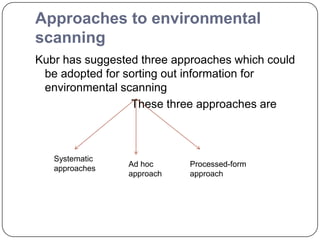
Approaches to environmental
scanning
Kubr has suggested three approaches which could
be adopted for sorting out information for
environmental scanning
These three approaches are
Systematic
approaches
Ad hoc
approach
Processed-form
approach
Systematic Approach
Under this approach, information for
environmental scanning is collected
systematically. Information related to markets and
customers, changes in legislation and regulations
that have a direct impact on organizations
activities etc. It could be collected continuously to
monitor changes and take the relevant factors
into account. Continuously updating such
information is necessary not only for strategic
management but also for operational activities
Adhoc Approach
Using this approach an organization may conduct
special service and studies to deal with specific
environmental issues from time to time. Such
studies may be conducted for instance when an
organization has to undertake special project,
evaluate existing strategies or devise new
strategies.
Processed-Form Approach
For adopting this approach the organization uses
information in processed form, available from
different sources both inside and outside the
organization. When an organization uses
information supplied by Govt. agencies or private
institutions, it uses secondary source of data and
the information is available in processed form.
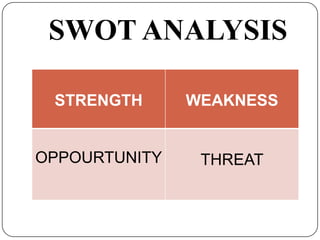
SWOT ANALYSIS
STRENGTH WEAKNESS
OPPOURTUNITY THREAT
INTERNAL ENVIRONMENT
 Strength: It is an inherent capacity which an
organization can use to gain strategic advantage.
Eg good reputation among customers, resources,
assets, people, experience.
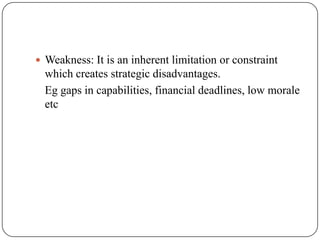
 Weakness: It is an inherent limitation or constraint
which creates strategic disadvantages.
Eg gaps in capabilities, financial deadlines, low morale
etc
EXTERNAL ENVIRONMENT
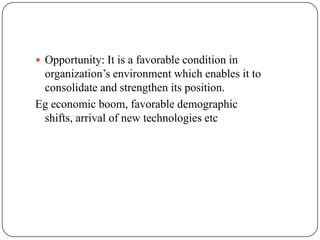
 Opportunity: It is a favorable condition in
organization’s environment which enables it to
consolidate and strengthen its position.
Eg economic boom, favorable demographic
shifts, arrival of new technologies etc
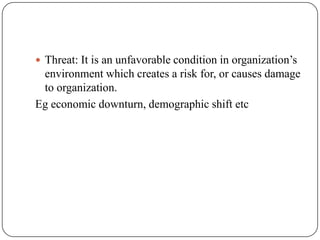
 Threat: It is an unfavorable condition in organization’s
environment which creates a risk for, or causes damage
to organization.
Eg economic downturn, demographic shift etc
Benefits of SWOT analysis
 Simple to use
 Low cost
 Flexible and can be adapted to varying situations
 Leads to clarification of issue
 Development of goal alternatives
 Useful as a starting point for strategic analysis
Environmental appraisal

Environmental appraisal

  • 1.
    Submitted To Prof. S.K.Srivastava Presentation on Environmental Appraisal Submitted By Sadhika Katiyar Rupesh Kumar Mishra Gaurav Katiyar Ashish Chandra Namam Tilak Diwedi Saurabh Singh Rajpoot Pranay Ranjan
  • 2.
    What is environment Environment means the surroundings, external objects, influences or circumstances under which someone or something exists.  The environment of any organization is the aggregate of all conditions, events and influences that surround and affect it
  • 3.
    Characteristics of environment Environment is complex: The environment consist of number of factors, events, conditions and influences arising from different sources. All these do not exist in isolation but interact with each other to create an entirely new set of influences.  Environment is dynamic: The environment is consistently changing in nature. Due to many and varied influence operating, there is dynamism in the environment causing it to continuously change its shape and character.
  • 4.
     Environment ismulti faceted: What shape and character an environment assumes depends on perception of observer. A particular change in environment or a new development may be viewed differently by different observers.  Environment has a far reaching impact on organizations. The growth and profitability of an organization depends critically on environment in which it exists. Any environmental change has an impact on organization in several different ways.
  • 5.
    Types of Business Environment BusinessEnvironment Internal Environment External Environment
  • 6.
  • 7.
    1. Structure 2. Operationprocedure 3. Finance 4. Human resource 5. Marketing approach 6. R & D etc.
  • 8.
  • 9.
  • 10.
    Micro Environment  Shareholders Employees  Suppliers  Banks  Customers  Distribution channels
  • 11.
    Macro Environment  Sociocultural  Technological capitalist  Economic socialist  Political  International etc.
  • 12.
    Role of governmentin Business Environment Regulatory Role government makes the rules and regulation regarding the licensing , manufacturing , labor welfare policies etc. “When government withdraws some strictness on regulatory function , it is called Liberalization.” Participative Role government be the part of various operational fields likes banks , railway , PSU etc.. “when government allows to private sector to be part of some specific operational areas , it is called privatization.”
  • 13.
     Protective Role governmentmakes some specific rules in forms of various taxes and restrictions to protect the domestic industry. “when government withdraws some restrictions to attract the FDI , FII and providing best product , it is called Globalization.”
  • 14.
    Environmental sectors 1. Economicenvironment 2. International Environment 3. Market Environment 4. Political Environment 5. Regulatory Environment 6. Socio Cultural Environment 7. Supplier Environment 8. Technological Environment
  • 15.
    Economic Environment The economicenvironment consists of macro level factors related to means of production and distribution of wealth that have on business of organization. Some important factors are 1. Economic stage at which a country exists 2. Economic structure adopted 3. Economic policies 4. Economic planning 5. Infrastructural factors
  • 16.
    International Environment The internationalenvironment consists of all those factors that operate at transnational, cross cultural and across border level, having impact on business of organization. 1. Globalization, its process, content and direction 2. Global economic forces, block and forum 3. Global trade and commerce, its process and trend 4. Global financial system, sources of financing 5. Geopolitical situation, equation, alliances and strategic interests of nations
  • 17.
    Market Environment The marketenvironment consist of factors related to group and other organization that compete with and have an impact on an organizations market. Some factors are as below : 1. Customer or client factors 2. Product factors such as demand , image 3. Marketing intermediary factors 4. Competitor-related factors
  • 18.
    Political Environment The politicalenvironment consist of factors related to management of public affairs and impact on business organization. 1. The political system and its features like nature of political system 2. The political structure, its goals and stability 3. Political processes like operation of party system, elections 4. Political philosophy, govt role in business etc
  • 19.
    Regulatory environment The regulatoryenvironment consists of factors related to planning, promotion and regulation of economic activities. 1. The constitutional framework , directive principles 2. Policies related to licensing, monopolies and foreign investment 3. Policies related to distribution and pricing and control 4. Policies related to import and exports
  • 20.
    Socio Cultural environment Thesocio cultural environment consists of factor related to human relationship within society, the development, forms and function of such relationship and learned and shared behavior of groups of human being having a bearing in business of organization
  • 21.
    Some of importantfactors and influences operating in social environment 1. Demographic characteristics like population, density 2. Socio cultural attitudes and values such as expectation of society from business, social custom 3. Family structure and changes in it 4. Role and position of men, women, children and aged in family and society
  • 22.
    Supplier environment The supplierenvironment consists of factors related to cost, reliability and availability of factors of production or services that have impact on business of an organization Some important factors are 1. Cost availability and continuity of supply of raw material 2. Cost availability of finance 3. Cost , reliability and availability of energy used in production 4. Cost ,availability and dependability of human resource
  • 23.
    Technological Environment The technologicalenvironment consist of those factors related to knowledge applied and material and machines used in production of goods and services that have impact on business of an organization Some important factors are 1. Sources of technology like company source , external sources and foreign sources 2. Technological development, stages of development change and rate of change of technology 3. Communication and infrastructural technology in management
  • 24.
    Environmental scanning Environmental scanningcan be defined as process by which organizations monitor their relevant environment to identify opportunities and threats affecting their business for purpose of taking strategic decisions
  • 25.
    Factors to beconsidered for scanning The external environment in which an organization exists consists of a bewildering variety of factors. These are as below: 1. Events are important and specific occurrences taking place in different environmental sectors 2. Trends are general tendencies or the courses action along which events take place. 3. Issues are current concerns that arise in response to events and trends. 4. Expectations are demands made by interested groups in light of their concern for issues.
  • 26.
    Approaches to environmental scanning Kubrhas suggested three approaches which could be adopted for sorting out information for environmental scanning These three approaches are Systematic approaches Ad hoc approach Processed-form approach
  • 27.
    Systematic Approach Under thisapproach, information for environmental scanning is collected systematically. Information related to markets and customers, changes in legislation and regulations that have a direct impact on organizations activities etc. It could be collected continuously to monitor changes and take the relevant factors into account. Continuously updating such information is necessary not only for strategic management but also for operational activities
  • 28.
    Adhoc Approach Using thisapproach an organization may conduct special service and studies to deal with specific environmental issues from time to time. Such studies may be conducted for instance when an organization has to undertake special project, evaluate existing strategies or devise new strategies.
  • 29.
    Processed-Form Approach For adoptingthis approach the organization uses information in processed form, available from different sources both inside and outside the organization. When an organization uses information supplied by Govt. agencies or private institutions, it uses secondary source of data and the information is available in processed form.
  • 30.
  • 31.
  • 32.
     Strength: Itis an inherent capacity which an organization can use to gain strategic advantage. Eg good reputation among customers, resources, assets, people, experience.
  • 33.
     Weakness: Itis an inherent limitation or constraint which creates strategic disadvantages. Eg gaps in capabilities, financial deadlines, low morale etc
  • 34.
  • 35.
     Opportunity: Itis a favorable condition in organization’s environment which enables it to consolidate and strengthen its position. Eg economic boom, favorable demographic shifts, arrival of new technologies etc
  • 36.
     Threat: Itis an unfavorable condition in organization’s environment which creates a risk for, or causes damage to organization. Eg economic downturn, demographic shift etc
  • 37.
    Benefits of SWOTanalysis  Simple to use  Low cost  Flexible and can be adapted to varying situations  Leads to clarification of issue  Development of goal alternatives  Useful as a starting point for strategic analysis