

Identify
Cost Drivers
Cost Dynamics
• What cause the change of cost drivers
Cost Dynamics
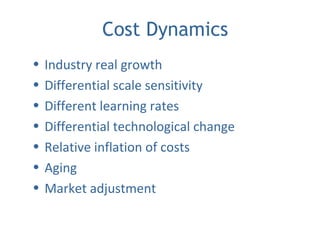
• Industry real growth
• Differential scale sensitivity
• Different learning rates
• Differential technological change
• Relative inflation of costs
• Aging
• Market adjustment
How to Achieve Cost Advantage
Analyze Cost Advantage
Control Cost Drivers
• E.g., control scale – gain the appropriate
firm size
Reconfigure the Value Chain
• Reconfiguration of the value chain presents
the opportunity to fundamentally restructure
a firm’s cost, compared to settling for
incremental improvements.
• By altering the basis of competition in a way
that favors a firm’s strengths, it may change
the important cost drivers in a way that favors
a firm.
Steps in Strategic Cost Analysis
1. Identify the appropriate value chain and assign
costs and assets to it.
2. Diagnose the cost drivers of each value activity
and how they interact.
3. Identify competitor value chains, and determine
the relative cost of competitors and the sources
of cost differences.
4. Develop a strategy to lower relative cost
position through controlling cost drivers or
reconfiguring the value chain and/or
downstream value.
Cost Focus
A firm dedicates its efforts to a well-chosen
segment of an industry can often lower its
costs significantly.
Differentiation
• Emphasize on a unique source of
differentiation in the Value Chain, rather
than on products or markets only
• Differentiation base on buyers’ value, not
only difference that buyers do not value
• Should consider the cost of differentiation
Identify Sources of
Differentiation
Drivers of Uniqueness
• Policy Choices
• Linkages
– Linkages within the value chain
– Supplier linkages
– Channel linkages
• Timing
Be the first
• Location
Drivers of Uniqueness
• Interrelationship
Sharing a value activity with sister business units. E.g.,
sharing a sales force for both insurance and other
financial products
• Proprietary learning
• Integration – e.g., integrating online systems to
current ordering systems
• Scale
• Institutional factors – e.g., “Madame’s route”

Value Chain: Identify Cost Drivers

  • 1.
  • 2.
    Cost Dynamics • Whatcause the change of cost drivers
  • 3.
    Cost Dynamics • Industryreal growth • Differential scale sensitivity • Different learning rates • Differential technological change • Relative inflation of costs • Aging • Market adjustment
  • 4.
    How to AchieveCost Advantage
  • 5.
  • 6.
    Control Cost Drivers •E.g., control scale – gain the appropriate firm size
  • 7.
    Reconfigure the ValueChain • Reconfiguration of the value chain presents the opportunity to fundamentally restructure a firm’s cost, compared to settling for incremental improvements. • By altering the basis of competition in a way that favors a firm’s strengths, it may change the important cost drivers in a way that favors a firm.
  • 8.
    Steps in StrategicCost Analysis 1. Identify the appropriate value chain and assign costs and assets to it. 2. Diagnose the cost drivers of each value activity and how they interact. 3. Identify competitor value chains, and determine the relative cost of competitors and the sources of cost differences. 4. Develop a strategy to lower relative cost position through controlling cost drivers or reconfiguring the value chain and/or downstream value.
  • 9.
    Cost Focus A firmdedicates its efforts to a well-chosen segment of an industry can often lower its costs significantly.
  • 10.
    Differentiation • Emphasize ona unique source of differentiation in the Value Chain, rather than on products or markets only • Differentiation base on buyers’ value, not only difference that buyers do not value • Should consider the cost of differentiation
  • 12.
  • 13.
    Drivers of Uniqueness •Policy Choices • Linkages – Linkages within the value chain – Supplier linkages – Channel linkages • Timing Be the first • Location
  • 14.
    Drivers of Uniqueness •Interrelationship Sharing a value activity with sister business units. E.g., sharing a sales force for both insurance and other financial products • Proprietary learning • Integration – e.g., integrating online systems to current ordering systems • Scale • Institutional factors – e.g., “Madame’s route”