The concept of strategy
 Strategy is the great work of organisation. In situations of life or death it is the Tao
of survival or extinction.
 Its study cannot be neglected.----SUN TZU, The Art of War.500 B.C
 Strategy is about winning.
 Strategy is not a detailed plan or program of instructions, it is a unifying theme that
gives coherence and direction to the actions and decisions of an individual or an
organisation.
Origin of the word
 Strategia means generalship in Greek.Stratos means “ army “. Ag
means “ to lead” .
 The concept of strategy was first given in the ART OF WAR by
SUN TZU in China 500 BC
 There are 13 chapters in the book.
 Laying plans
 On waging war
 The sheathed sword
 Tactics
 Energy
 Weak points and strong points
 Maneuvering
 Variations of tactics (cont..)
 The army on the march
 Terrain
 The nine situations
 Attack by fire
 The use of spies.
• It is the identification of the purpose of the organisation and the plans and actionss
to achieve that purpose
• Art and science of formulating ,implementing and evaluating cross functional
decisions that enable an organisation to achieve its objectives
• Strategic management achieves a firm’s success through FUNCTIONAL
INTEGRATION
• Management+ Finance/Accounting +Research & Development + Marketing/HR
+Production/Operations +MIS
Evolution of SM
• Evolved hand in hand with evolution of industrial system
• First three decades of 20th century constituted mass production Era
• 1930s witnessed intense changes
 Variety
 Market segmentation
 Promotion
 Change in orientation etc.,
Environmental Changes
• Changes in technology
• Faster commercialization
• Business boundaries getting blurred
• Socio-political changes
• Governments becoming bargainers in the conduct of business
• Emergence of Global firms
• Emergence of Global markets
• Emergence of Global brands
• Change in tastes and preferences of consumers
New Demands on the Firm
• To be strategically alert
• To be future oriented
• To be able to take risk in tapping opportunities
• To be insulated against environmental threats
• To develop the competence for assimilating changes faster.
• To respond effectively and more economically
• To grow big
• To be able to generate large resources
• To gain expertise in technology, marketing and decision
support systems.
SM deals with . . .
• Purposes and missions
• Corporate objectives
• Choice of businesses
• Course of activities for achieving the
objectives
Nature and Scope
• Serves as a route map
• Lends a frame work for systematic handling of
corporate decisions
• Lays down growth objectives and strategies
• Ensures the firm remains prepared
• Ensures best utilization of recourses
• Serves as a hedge against uncertainty
• Helps to understand trends in advance
Nature and Scope
• Helps to avoid hazard response
• Provides the best possible fit
• Helps build competitive advantage and core
competencies
• Draws from both intuition and logic
• Prepares the firm to not only face the future, but
even shape the future in its favour
• Seeks to influence the firm’s mega environs in its
favour
Concerns of Strategic Planning
• Future
• Growth
• Environment
• Portfolios of businesses
• Strategy
• Integration
• Creating core competencies/ competitive advantage
• In a nutshell, corporate strategy is its concern.
13
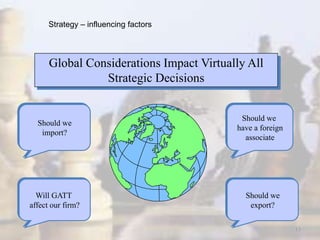
Should we
import?
Will GATT
affect our firm?
Should we
export?
Should we
have a foreign
associate
Global Considerations Impact Virtually All
Strategic Decisions
Strategy – influencing factors
14
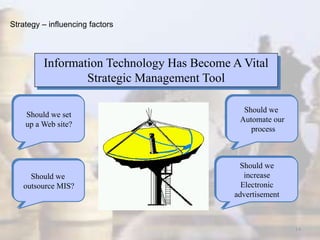
Should we
outsource MIS?
Should we
increase
Electronic
advertisement
Should we
Automate our
process
Should we set
up a Web site?
Information Technology Has Become A Vital
Strategic Management Tool
Strategy – influencing factors
15
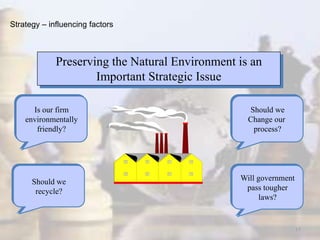
Should we
recycle?
Will government
pass tougher
laws?
Should we
Change our
process?
Is our firm
environmentally
friendly?
Preserving the Natural Environment is an
Important Strategic Issue
Strategy – influencing factors
16
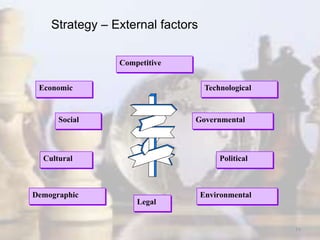
Economic
Social
Cultural
Demographic Environmental
Political
Legal
Governmental
Technological
Competitive
Strategy – External factors
17
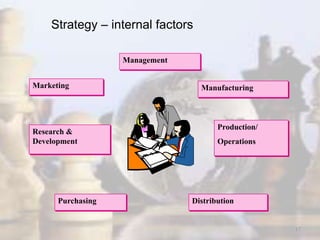
Management
Marketing
Distribution
Production/
Operations
Research &
Development
Purchasing
Manufacturing
Strategy – internal factors
18
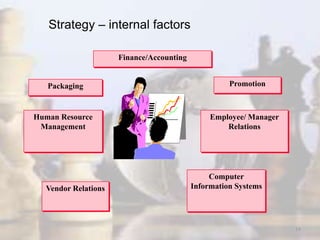
Finance/Accounting
Packaging
Computer
Information SystemsVendor Relations
Promotion
Human Resource
Management
Employee/ Manager
Relations
Strategy – internal factors
19
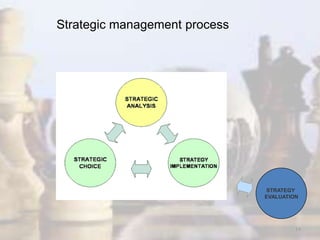
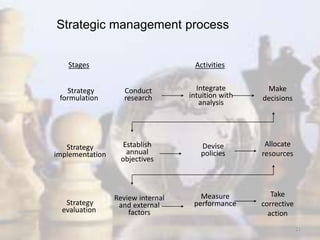
Strategic management process
STRATEGY
EVALUATION
Strategic management process
21
Stages Activities
Strategy
formulation
Strategy
evaluation
Strategy
implementation
Conduct
research
Establish
annual
objectives
Review internal
and external
factors
Integrate
intuition with
analysis
Devise
policies
Measure
performance
Make
decisions
Allocate
resources
Take
corrective
action
Strategic management process
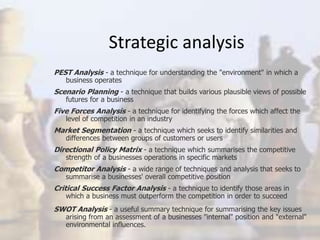
Strategic analysis
PEST Analysis - a technique for understanding the "environment" in which a
business operates
Scenario Planning - a technique that builds various plausible views of possible
futures for a business
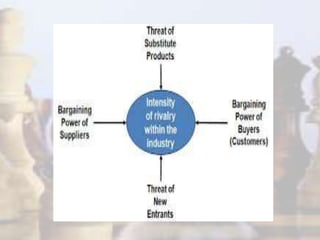
Five Forces Analysis - a technique for identifying the forces which affect the
level of competition in an industry
Market Segmentation - a technique which seeks to identify similarities and
differences between groups of customers or users
Directional Policy Matrix - a technique which summarises the competitive
strength of a businesses operations in specific markets
Competitor Analysis - a wide range of techniques and analysis that seeks to
summarise a businesses' overall competitive position
Critical Success Factor Analysis - a technique to identify those areas in
which a business must outperform the competition in order to succeed
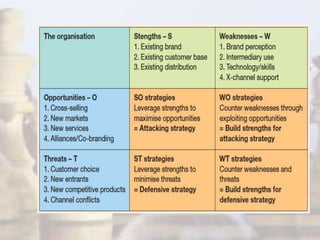
SWOT Analysis - a useful summary technique for summarising the key issues
arising from an assessment of a businesses "internal" position and "external"
environmental influences.
Strategies
• Means by which long term objectives are achieved
• Eg: geographic expansion
• Diversification
• Acquisition
• Market penetration
• Retrenchment
• Liquidation
• Joint venture
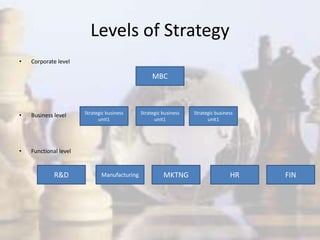
Levels of Strategy
• Corporate level
• Business level
• Functional level
MBC
Strategic business
unit1
Strategic business
unit1
Strategic business
unit1
R&D Manufacturing MKTNG HR FIN
Benefits of SM
• Financial benefits
• Non financial benefits
• WHY SOME FIRMS DO NO STRATEGIC PLANNING
Poor reward structures
Fire fighting
Waste of time
Too expensive
Laziness
Content with success
• WHY STAY BACK FROM STRATEGIC MANAGEMENT
Fear of failure
Over confidence
Prior bad experience
Self interest
Fear of the unknown
Suspiscion
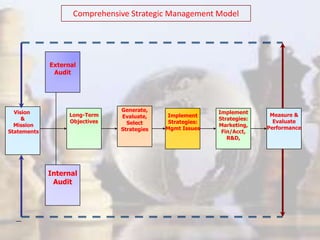
Comprehensive Strategic Management Model
Vision
&
Mission
Statements
External
Audit
Internal
Audit
Long-Term
Objectives
Generate,
Evaluate,
Select
Strategies
Implement
Strategies:
Mgmt Issues
Implement
Strategies:
Marketing,
Fin/Acct,
R&D,
Measure &
Evaluate
Performance
“…the determination of the basic long-term goals and objectives of an
enterprise, and the adoption of courses of action and the allocation of
resources necessary for carrying out these goals.”
Alfred Chandler, Strategy & Structure, 1962
“… the patterns of objectives, purposes or goals, and the major policies or
plans for achieving these goals, stated in such a way as to define what
business the company is in or should be in and the kind of company it is or
should be.”
Kenneth Andrews, The Concept of Corporate Strategy, 1971
Defining strategy ……..2
“Strategic management is that set of managerial decisions and
actions that determines the long-run performance of a
corporation.”
“Strategy is a process of adapting the firm to its environment”
‘Strategy is how the firm achieves its objectives by applying its
resources to cope with its environment”
Defining strategy ……..3
Strategic decision
• Done by top management and strategist
Issues
1. Criteria for DM
a. Maximization concept
b. Satisfying concept
c. Incrementalism
d. Objective setting
2. Rationality in DM
3. Creativity
4. Variability
5. Person related factors
6. Individual Vs Group DM
The process of SDM
• 1. Problem awareness
• 2. Problem diagnosis
• 3. Development of solutions
• 4. Selection of a solution
• 5. Implementation of the solution
Approaches to DM
• The intuitive- emotional approach
• The Rational- analytical approach
a. Recognize the need for a decision
b. Establish rank and weight criteria
c. Gather data
d. Identity possible alternatives
e. Evaluate each alternatives
f. Select the best alternative
• A satisfying approach
• Political-Behavioral approach
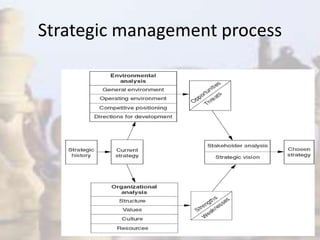
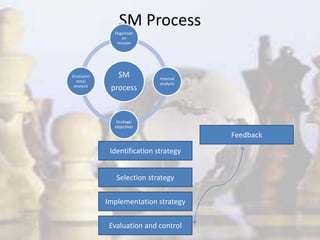
SM Process
SM
process
Organisati
on
mission
Internal
analysis
Strategic
objectives
Environm
ental
analysis
Identification strategy
Selection strategy
Implementation strategy
Evaluation and control
Feedback
Strategic planning
• An orderly process by which top management
determines organizational objectives.
• strategies needed to reach these objectives
and short range of top level action necessary
to implement the strategy properly
Tactical Planning
• Refers to a short range of planning tactics
oriented towards operations and is concerned
with specific and short range details
• Operational planning :- the process of deciding
the most effective use of the resources already
allocated and to develop a control mechanism to
assure effective implementation of the actions so
that organizational objectives are achieved
• Programme strategies:- Used to achieve
organizational goals.
• Contingency strategies :- planned in advance
to deal with sudden changes in future
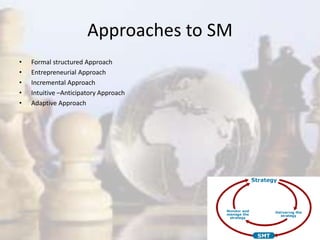
Approaches to SM
• Formal structured Approach
• Entrepreneurial Approach
• Incremental Approach
• Intuitive –Anticipatory Approach
• Adaptive Approach
Purpose of an Organization
• Vision
• Mission
• Business definition
• Goals
• Objectives
Vision and Mission
• Many organisations develop both vision and
mission statements
• Vision and mission are necessary to effectively
motivate a work force
• Shared vision creates a commonality of
interests
Vision
• “ what do we want to become?”
• Clear vision
• Provides foundation for comprehensive
mission statement
• Vision statement developed first
• Short-preferably one sentence
• Broad management involvement
Mission
• “What is our business?”
• Reveal what an organisation wants to be and whom it wants to serve
• It is the continuing statement of purpose
• Distinguishes one organization from another in same industry
• Declaration of an organisation’s “reason for being”
• Basis for allocating resources
• Establish organisational climate
• Focal point for direction
• Helps to fix up objectives
• Cost,time and performance parameters assessed and controlled
Components of mission
• Customers :- who are the firm’s customers?
• Products or services :- what are the firms major products or services?
• Markets :- Geographically,where does the firm compete?
• Technology :- Is the firm technologically current?
• Concern for survival,growth and profitability:-Is the firm committed to growth and financial
soundness?
• Philosophy :- what are the basic beliefs,values ,aspirations and ethical priorities of the firm?
• Competitive advantage :- what is the firm’s distinctive competence or major competitive
advantage?
• Concern for public image:- is the firm responsive to social ,community and environmental
concerns?
• Concern for employees:- Are employees a valuable asset to the firm?
Industry Analysis
• Industry Features Industry Boundaries
• Overall size breadth of market
• Market growth rate product and services
• Geographic boundaries of market geographic distribution
• No Of competitors Level of vertical integration
• Pace of technological change
• Product innovation
• Industry analysis
• Internal analysis
• External analysis
• SWOT analysis
• Competitive analysis
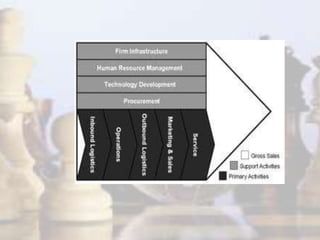
• Value chain analysis
• Industry environment structure of Industry
Fragmented industry concentration
Consolidated Industry Economies of scale
• Industry life cycle product differentiation
Embryonic industry Barriers to Entry
Growing industry
Mature industry Industry Attractiveness
Decline industry profit potential
• Industry Performance growth prospects
Production competition
Sales
Profitability
Technological advancement
Internal Analysis
• Marketing Financial Performance
1. Product and services Ability to raise long term capital: debt, equity
2. Market share Cost of capital relative to industry and competitors
3. Channels of distribution Tax considerations
4. Brand value Relations with owners, investors and stock holders
5. Customer concentration Presence of financial planning and budgeting practices
6. Sales force team performance Production/Operations/Technical
7. Dealers relationship Raw material cost and availability
8. Pricing strategy Inventory control system
9. CRM Location of facilities
10. Advertisement and promotion effect Lay out and utilization of facilities
Efficiency of Equipment
Effective operation control procedures, design
scheduling purchasing
R&D technology,Innovation
Quality control
• Human Resources
Management personnel
Employee skill and morale
Labor relations/costs relative to industry and competitors
Efficient and effective personnel policies
Effective use of incentives to motivate performance
Ability to level peaks and valleys of employement
Employee turnover and absenteeism
Specialized skills
Experience
Organization/General Management
• Organizational structure
• Firm’s image and prestige
• Firm’s record for achieving objectives
• Organization of communication system
• Overall organizational control system
• Organizational climate
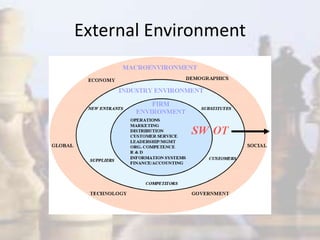
External Environment
Objectives
 Objectives are plans
 Convert strategic vision and mission into specific performance
 Yardsticks for tracing performances and progress
Why objectives?
• It state direction
• Aid in evaluation
• Create synergy
• Helps to set priorities
• Focused coordination
• Help for resource allocation
• Benchmarking tool
• Provide motivation
Characteristics of objectives
• Specific
• Measurable
• Achievable
• Realistic
• Timely
• Clear
• Quantifiable
• Consistent
• Reasonable
• Challenging
• communicated
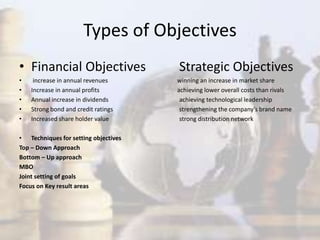
Types of Objectives
• Financial Objectives Strategic Objectives
• increase in annual revenues winning an increase in market share
• Increase in annual profits achieving lower overall costs than rivals
• Annual increase in dividends achieving technological leadership
• Strong bond and credit ratings strengthening the company’s brand name
• Increased share holder value strong distribution network
• Techniques for setting objectives
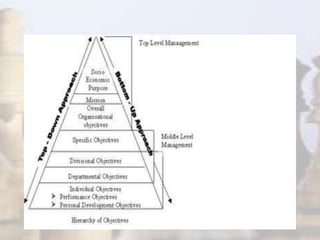
Top – Down Approach
Bottom – Up approach
MBO
Joint setting of goals
Focus on Key result areas
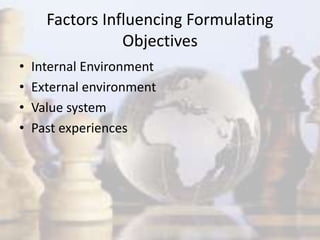
Factors Influencing Formulating
Objectives
• Internal Environment
• External environment
• Value system
• Past experiences
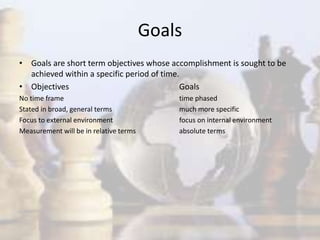
Goals
• Goals are short term objectives whose accomplishment is sought to be
achieved within a specific period of time.
• Objectives Goals
No time frame time phased
Stated in broad, general terms much more specific
Focus to external environment focus on internal environment
Measurement will be in relative terms absolute terms
SM Tools
• Core competency
• Benchmarking
• TQM
• GAP Analysis
• SWOT

strategic management

  • 3.
    The concept ofstrategy  Strategy is the great work of organisation. In situations of life or death it is the Tao of survival or extinction.  Its study cannot be neglected.----SUN TZU, The Art of War.500 B.C  Strategy is about winning.  Strategy is not a detailed plan or program of instructions, it is a unifying theme that gives coherence and direction to the actions and decisions of an individual or an organisation.
  • 4.
    Origin of theword  Strategia means generalship in Greek.Stratos means “ army “. Ag means “ to lead” .  The concept of strategy was first given in the ART OF WAR by SUN TZU in China 500 BC  There are 13 chapters in the book.  Laying plans  On waging war  The sheathed sword  Tactics  Energy  Weak points and strong points  Maneuvering  Variations of tactics (cont..)
  • 5.
     The armyon the march  Terrain  The nine situations  Attack by fire  The use of spies. • It is the identification of the purpose of the organisation and the plans and actionss to achieve that purpose • Art and science of formulating ,implementing and evaluating cross functional decisions that enable an organisation to achieve its objectives • Strategic management achieves a firm’s success through FUNCTIONAL INTEGRATION • Management+ Finance/Accounting +Research & Development + Marketing/HR +Production/Operations +MIS
  • 6.
    Evolution of SM •Evolved hand in hand with evolution of industrial system • First three decades of 20th century constituted mass production Era • 1930s witnessed intense changes  Variety  Market segmentation  Promotion  Change in orientation etc.,
  • 7.
    Environmental Changes • Changesin technology • Faster commercialization • Business boundaries getting blurred • Socio-political changes • Governments becoming bargainers in the conduct of business • Emergence of Global firms • Emergence of Global markets • Emergence of Global brands • Change in tastes and preferences of consumers
  • 8.
    New Demands onthe Firm • To be strategically alert • To be future oriented • To be able to take risk in tapping opportunities • To be insulated against environmental threats • To develop the competence for assimilating changes faster. • To respond effectively and more economically • To grow big • To be able to generate large resources • To gain expertise in technology, marketing and decision support systems.
  • 9.
    SM deals with. . . • Purposes and missions • Corporate objectives • Choice of businesses • Course of activities for achieving the objectives
  • 10.
    Nature and Scope •Serves as a route map • Lends a frame work for systematic handling of corporate decisions • Lays down growth objectives and strategies • Ensures the firm remains prepared • Ensures best utilization of recourses • Serves as a hedge against uncertainty • Helps to understand trends in advance
  • 11.
    Nature and Scope •Helps to avoid hazard response • Provides the best possible fit • Helps build competitive advantage and core competencies • Draws from both intuition and logic • Prepares the firm to not only face the future, but even shape the future in its favour • Seeks to influence the firm’s mega environs in its favour
  • 12.
    Concerns of StrategicPlanning • Future • Growth • Environment • Portfolios of businesses • Strategy • Integration • Creating core competencies/ competitive advantage • In a nutshell, corporate strategy is its concern.
  • 13.
    13 Should we import? Will GATT affectour firm? Should we export? Should we have a foreign associate Global Considerations Impact Virtually All Strategic Decisions Strategy – influencing factors
  • 14.
    14 Should we outsource MIS? Shouldwe increase Electronic advertisement Should we Automate our process Should we set up a Web site? Information Technology Has Become A Vital Strategic Management Tool Strategy – influencing factors
  • 15.
    15 Should we recycle? Will government passtougher laws? Should we Change our process? Is our firm environmentally friendly? Preserving the Natural Environment is an Important Strategic Issue Strategy – influencing factors
  • 16.
  • 17.
  • 18.
    18 Finance/Accounting Packaging Computer Information SystemsVendor Relations Promotion HumanResource Management Employee/ Manager Relations Strategy – internal factors
  • 19.
  • 20.
  • 21.
    21 Stages Activities Strategy formulation Strategy evaluation Strategy implementation Conduct research Establish annual objectives Review internal andexternal factors Integrate intuition with analysis Devise policies Measure performance Make decisions Allocate resources Take corrective action Strategic management process
  • 22.
    Strategic analysis PEST Analysis- a technique for understanding the "environment" in which a business operates Scenario Planning - a technique that builds various plausible views of possible futures for a business Five Forces Analysis - a technique for identifying the forces which affect the level of competition in an industry Market Segmentation - a technique which seeks to identify similarities and differences between groups of customers or users Directional Policy Matrix - a technique which summarises the competitive strength of a businesses operations in specific markets Competitor Analysis - a wide range of techniques and analysis that seeks to summarise a businesses' overall competitive position Critical Success Factor Analysis - a technique to identify those areas in which a business must outperform the competition in order to succeed SWOT Analysis - a useful summary technique for summarising the key issues arising from an assessment of a businesses "internal" position and "external" environmental influences.
  • 23.
    Strategies • Means bywhich long term objectives are achieved • Eg: geographic expansion • Diversification • Acquisition • Market penetration • Retrenchment • Liquidation • Joint venture
  • 24.
    Levels of Strategy •Corporate level • Business level • Functional level MBC Strategic business unit1 Strategic business unit1 Strategic business unit1 R&D Manufacturing MKTNG HR FIN
  • 25.
    Benefits of SM •Financial benefits • Non financial benefits • WHY SOME FIRMS DO NO STRATEGIC PLANNING Poor reward structures Fire fighting Waste of time Too expensive Laziness Content with success • WHY STAY BACK FROM STRATEGIC MANAGEMENT Fear of failure Over confidence Prior bad experience Self interest Fear of the unknown Suspiscion
  • 26.
    Comprehensive Strategic ManagementModel Vision & Mission Statements External Audit Internal Audit Long-Term Objectives Generate, Evaluate, Select Strategies Implement Strategies: Mgmt Issues Implement Strategies: Marketing, Fin/Acct, R&D, Measure & Evaluate Performance
  • 27.
    “…the determination ofthe basic long-term goals and objectives of an enterprise, and the adoption of courses of action and the allocation of resources necessary for carrying out these goals.” Alfred Chandler, Strategy & Structure, 1962 “… the patterns of objectives, purposes or goals, and the major policies or plans for achieving these goals, stated in such a way as to define what business the company is in or should be in and the kind of company it is or should be.” Kenneth Andrews, The Concept of Corporate Strategy, 1971 Defining strategy ……..2
  • 28.
    “Strategic management isthat set of managerial decisions and actions that determines the long-run performance of a corporation.” “Strategy is a process of adapting the firm to its environment” ‘Strategy is how the firm achieves its objectives by applying its resources to cope with its environment” Defining strategy ……..3
  • 29.
    Strategic decision • Doneby top management and strategist Issues 1. Criteria for DM a. Maximization concept b. Satisfying concept c. Incrementalism d. Objective setting 2. Rationality in DM 3. Creativity 4. Variability 5. Person related factors 6. Individual Vs Group DM
  • 30.
    The process ofSDM • 1. Problem awareness • 2. Problem diagnosis • 3. Development of solutions • 4. Selection of a solution • 5. Implementation of the solution
  • 31.
    Approaches to DM •The intuitive- emotional approach • The Rational- analytical approach a. Recognize the need for a decision b. Establish rank and weight criteria c. Gather data d. Identity possible alternatives e. Evaluate each alternatives f. Select the best alternative • A satisfying approach • Political-Behavioral approach
  • 32.
  • 33.
    Strategic planning • Anorderly process by which top management determines organizational objectives. • strategies needed to reach these objectives and short range of top level action necessary to implement the strategy properly
  • 34.
    Tactical Planning • Refersto a short range of planning tactics oriented towards operations and is concerned with specific and short range details • Operational planning :- the process of deciding the most effective use of the resources already allocated and to develop a control mechanism to assure effective implementation of the actions so that organizational objectives are achieved
  • 35.
    • Programme strategies:-Used to achieve organizational goals. • Contingency strategies :- planned in advance to deal with sudden changes in future
  • 36.
    Approaches to SM •Formal structured Approach • Entrepreneurial Approach • Incremental Approach • Intuitive –Anticipatory Approach • Adaptive Approach
  • 37.
    Purpose of anOrganization • Vision • Mission • Business definition • Goals • Objectives
  • 38.
    Vision and Mission •Many organisations develop both vision and mission statements • Vision and mission are necessary to effectively motivate a work force • Shared vision creates a commonality of interests
  • 39.
    Vision • “ whatdo we want to become?” • Clear vision • Provides foundation for comprehensive mission statement • Vision statement developed first • Short-preferably one sentence • Broad management involvement
  • 40.
    Mission • “What isour business?” • Reveal what an organisation wants to be and whom it wants to serve • It is the continuing statement of purpose • Distinguishes one organization from another in same industry • Declaration of an organisation’s “reason for being” • Basis for allocating resources • Establish organisational climate • Focal point for direction • Helps to fix up objectives • Cost,time and performance parameters assessed and controlled
  • 41.
    Components of mission •Customers :- who are the firm’s customers? • Products or services :- what are the firms major products or services? • Markets :- Geographically,where does the firm compete? • Technology :- Is the firm technologically current? • Concern for survival,growth and profitability:-Is the firm committed to growth and financial soundness? • Philosophy :- what are the basic beliefs,values ,aspirations and ethical priorities of the firm? • Competitive advantage :- what is the firm’s distinctive competence or major competitive advantage? • Concern for public image:- is the firm responsive to social ,community and environmental concerns? • Concern for employees:- Are employees a valuable asset to the firm?
  • 42.
    Industry Analysis • IndustryFeatures Industry Boundaries • Overall size breadth of market • Market growth rate product and services • Geographic boundaries of market geographic distribution • No Of competitors Level of vertical integration • Pace of technological change • Product innovation • Industry analysis • Internal analysis • External analysis • SWOT analysis • Competitive analysis • Value chain analysis
  • 43.
    • Industry environmentstructure of Industry Fragmented industry concentration Consolidated Industry Economies of scale • Industry life cycle product differentiation Embryonic industry Barriers to Entry Growing industry Mature industry Industry Attractiveness Decline industry profit potential • Industry Performance growth prospects Production competition Sales Profitability Technological advancement
  • 44.
    Internal Analysis • MarketingFinancial Performance 1. Product and services Ability to raise long term capital: debt, equity 2. Market share Cost of capital relative to industry and competitors 3. Channels of distribution Tax considerations 4. Brand value Relations with owners, investors and stock holders 5. Customer concentration Presence of financial planning and budgeting practices 6. Sales force team performance Production/Operations/Technical 7. Dealers relationship Raw material cost and availability 8. Pricing strategy Inventory control system 9. CRM Location of facilities 10. Advertisement and promotion effect Lay out and utilization of facilities Efficiency of Equipment Effective operation control procedures, design scheduling purchasing R&D technology,Innovation Quality control
  • 45.
    • Human Resources Managementpersonnel Employee skill and morale Labor relations/costs relative to industry and competitors Efficient and effective personnel policies Effective use of incentives to motivate performance Ability to level peaks and valleys of employement Employee turnover and absenteeism Specialized skills Experience
  • 46.
    Organization/General Management • Organizationalstructure • Firm’s image and prestige • Firm’s record for achieving objectives • Organization of communication system • Overall organizational control system • Organizational climate
  • 47.
  • 51.
    Objectives  Objectives areplans  Convert strategic vision and mission into specific performance  Yardsticks for tracing performances and progress Why objectives? • It state direction • Aid in evaluation • Create synergy • Helps to set priorities • Focused coordination • Help for resource allocation • Benchmarking tool • Provide motivation
  • 52.
    Characteristics of objectives •Specific • Measurable • Achievable • Realistic • Timely • Clear • Quantifiable • Consistent • Reasonable • Challenging • communicated
  • 53.
    Types of Objectives •Financial Objectives Strategic Objectives • increase in annual revenues winning an increase in market share • Increase in annual profits achieving lower overall costs than rivals • Annual increase in dividends achieving technological leadership • Strong bond and credit ratings strengthening the company’s brand name • Increased share holder value strong distribution network • Techniques for setting objectives Top – Down Approach Bottom – Up approach MBO Joint setting of goals Focus on Key result areas
  • 55.
    Factors Influencing Formulating Objectives •Internal Environment • External environment • Value system • Past experiences
  • 56.
    Goals • Goals areshort term objectives whose accomplishment is sought to be achieved within a specific period of time. • Objectives Goals No time frame time phased Stated in broad, general terms much more specific Focus to external environment focus on internal environment Measurement will be in relative terms absolute terms
  • 57.
    SM Tools • Corecompetency • Benchmarking • TQM • GAP Analysis • SWOT