Disclaimer: This presentation is prepared by trainees of
baabtra as a part of mentoring program. This is not official
document of baabtra –Mentoring Partner
Baabtra-Mentoring Partner is the mentoring division of baabte System Technologies Pvt .
Ltd
DBMS
• Database is a collection of related data.
• Database Management System(DBMS) is a
  collection of programs that enables users to create
  and maintain database.
• It facilitates the process of
  • Defining
  • Constructing
  • Manipulating
  • Sharing database
RDBMS
• A Relational database management system
  (RDBMS) is a database management system (DBMS)
  that is based on the relational model.
• Features:
  • Provides data to be stored in tables
  • Persists data in the form of rows and columns
  • Each column is an attribute.
  • Provides facility primary key, to uniquely identify
     the rows
• Relationships are not explicit, but implied by
  values in specific fields (e.g., foreign keys).
• Disadvantages
  • Do not have enough storage area to handle data
    such as images, audio, video.
  • Information must be in tables where
    relationships between entities are defined by
    values.
Object Oriented Database - OODBMS
OO principles brought to databases:
  -New modeling power
  -Extensibility of systems
  -Code reuse
  -Easy maintenance of programs
• Examples
   • Sterling is a lightweight OODB for .net
   • ONTOS, Object Store
• Object Identity-In object oriented databases objects
  are uniquely identified by OID.
• Objects with the same type are grouped into
  classes.
• Classes encompass objects having the same
  structure and behaviour, which is expressed by the
  set of methods or operations applicable to the
  objects they contain.
• Inheritance: Inheritance is mechanism allowing
  child object to inherit behavior and properties of
  parent object.
• Encapsulation-A class corresponds to the
  implementation of an abstract data type (ADT).
  • Neither the structure of the ADT nor its
     implementation is visible from the outside world.
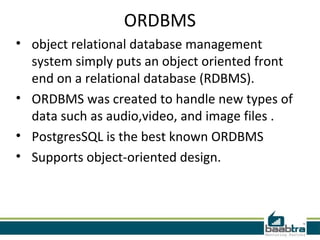
ORDBMS
• object relational database management
  system simply puts an object oriented front
  end on a relational database (RDBMS).
• ORDBMS was created to handle new types of
  data such as audio,video, and image files .
• PostgresSQL is the best known ORDBMS
• Supports object-oriented design.
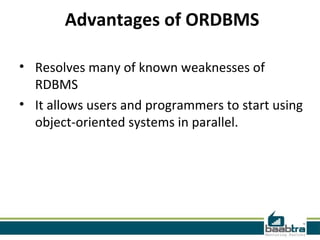
Advantages of ORDBMS

• Resolves many of known weaknesses of
  RDBMS
• It allows users and programmers to start using
  object-oriented systems in parallel.
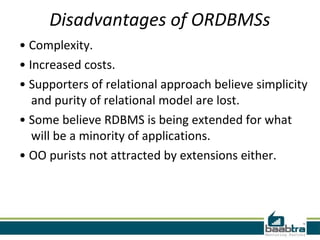
Disadvantages of ORDBMSs
• Complexity.
• Increased costs.
• Supporters of relational approach believe simplicity
   and purity of relational model are lost.
• Some believe RDBMS is being extended for what
   will be a minority of applications.
• OO purists not attracted by extensions either.
If this presentation helped you, please visit our
           page facebook.com/baabtra and like it.
                 Thanks in advance.
www.baabtra.com | www.massbaab.com |www.baabte.com
Contact Us

ORDBMS

  • 2.
    Disclaimer: This presentationis prepared by trainees of baabtra as a part of mentoring program. This is not official document of baabtra –Mentoring Partner Baabtra-Mentoring Partner is the mentoring division of baabte System Technologies Pvt . Ltd
  • 3.
    DBMS • Database isa collection of related data. • Database Management System(DBMS) is a collection of programs that enables users to create and maintain database. • It facilitates the process of • Defining • Constructing • Manipulating • Sharing database
  • 4.
    RDBMS • A Relationaldatabase management system (RDBMS) is a database management system (DBMS) that is based on the relational model. • Features: • Provides data to be stored in tables • Persists data in the form of rows and columns • Each column is an attribute. • Provides facility primary key, to uniquely identify the rows
  • 5.
    • Relationships arenot explicit, but implied by values in specific fields (e.g., foreign keys). • Disadvantages • Do not have enough storage area to handle data such as images, audio, video. • Information must be in tables where relationships between entities are defined by values.
  • 6.
    Object Oriented Database- OODBMS OO principles brought to databases: -New modeling power -Extensibility of systems -Code reuse -Easy maintenance of programs • Examples • Sterling is a lightweight OODB for .net • ONTOS, Object Store
  • 7.
    • Object Identity-Inobject oriented databases objects are uniquely identified by OID. • Objects with the same type are grouped into classes. • Classes encompass objects having the same structure and behaviour, which is expressed by the set of methods or operations applicable to the objects they contain.
  • 8.
    • Inheritance: Inheritanceis mechanism allowing child object to inherit behavior and properties of parent object. • Encapsulation-A class corresponds to the implementation of an abstract data type (ADT). • Neither the structure of the ADT nor its implementation is visible from the outside world.
  • 9.
    ORDBMS • object relationaldatabase management system simply puts an object oriented front end on a relational database (RDBMS). • ORDBMS was created to handle new types of data such as audio,video, and image files . • PostgresSQL is the best known ORDBMS • Supports object-oriented design.
  • 10.
    Advantages of ORDBMS •Resolves many of known weaknesses of RDBMS • It allows users and programmers to start using object-oriented systems in parallel.
  • 11.
    Disadvantages of ORDBMSs •Complexity. • Increased costs. • Supporters of relational approach believe simplicity and purity of relational model are lost. • Some believe RDBMS is being extended for what will be a minority of applications. • OO purists not attracted by extensions either.
  • 12.
    If this presentationhelped you, please visit our page facebook.com/baabtra and like it. Thanks in advance. www.baabtra.com | www.massbaab.com |www.baabte.com
  • 13.