Advance Database Management Systems : 9
Complex Objects
Prof Neeraj Bhargava
Vaibhav Khanna
Department of Computer Science
School of Engineering and Systems Sciences
Maharshi Dayanand Saraswati University Ajmer
2
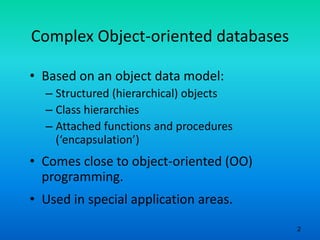
Complex Object-oriented databases
• Based on an object data model:
– Structured (hierarchical) objects
– Class hierarchies
– Attached functions and procedures
(‘encapsulation’)
• Comes close to object-oriented (OO)
programming.
• Used in special application areas.
3
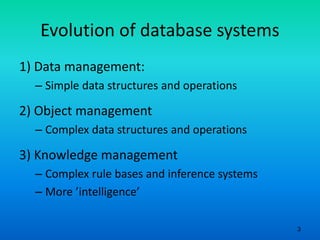
Evolution of database systems
1) Data management:
– Simple data structures and operations
2) Object management
– Complex data structures and operations
3) Knowledge management
– Complex rule bases and inference systems
– More ’intelligence’
4
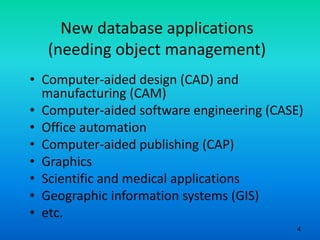
New database applications
(needing object management)
• Computer-aided design (CAD) and
manufacturing (CAM)
• Computer-aided software engineering (CASE)
• Office automation
• Computer-aided publishing (CAP)
• Graphics
• Scientific and medical applications
• Geographic information systems (GIS)
• etc.
5
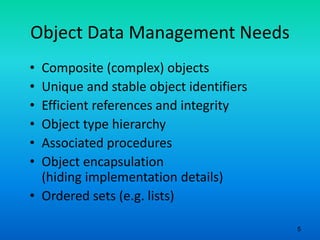
Object Data Management Needs
• Composite (complex) objects
• Unique and stable object identifiers
• Efficient references and integrity
• Object type hierarchy
• Associated procedures
• Object encapsulation
(hiding implementation details)
• Ordered sets (e.g. lists)
6
Object Data Management Needs
(cont.)
• Long fields (text, image, audio, video)
• Efficient remote access (check-out / check-in)
• Long transactions (implying long locks)
• Single-user performance
• Versioning
• Support for schema changes
• Programming language interface (C++, Java)
7
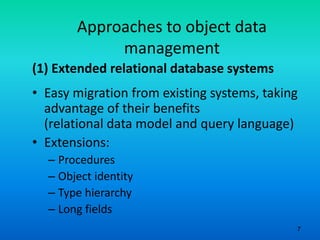
Approaches to object data
management
(1) Extended relational database systems
• Easy migration from existing systems, taking
advantage of their benefits
(relational data model and query language)
• Extensions:
– Procedures
– Object identity
– Type hierarchy
– Long fields
8
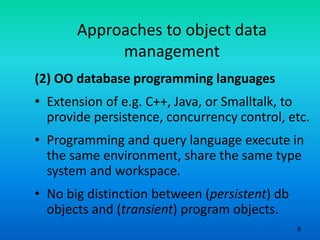
Approaches to object data
management
(2) OO database programming languages
• Extension of e.g. C++, Java, or Smalltalk, to
provide persistence, concurrency control, etc.
• Programming and query language execute in
the same environment, share the same type
system and workspace.
• No big distinction between (persistent) db
objects and (transient) program objects.
9
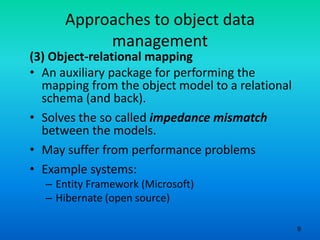
Approaches to object data
management
(3) Object-relational mapping
• An auxiliary package for performing the
mapping from the object model to a relational
schema (and back).
• Solves the so called impedance mismatch
between the models.
• May suffer from performance problems
• Example systems:
– Entity Framework (Microsoft)
– Hibernate (open source)
10
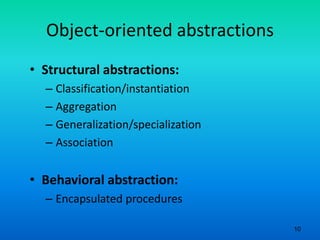
Object-oriented abstractions
• Structural abstractions:
– Classification/instantiation
– Aggregation
– Generalization/specialization
– Association
• Behavioral abstraction:
– Encapsulated procedures
11
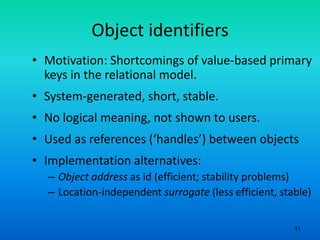
Object identifiers
• Motivation: Shortcomings of value-based primary
keys in the relational model.
• System-generated, short, stable.
• No logical meaning, not shown to users.
• Used as references (‘handles’) between objects
• Implementation alternatives:
– Object address as id (efficient; stability problems)
– Location-independent surrogate (less efficient, stable)
12
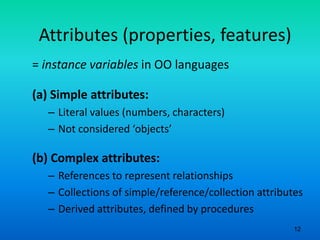
Attributes (properties, features)
= instance variables in OO languages
(a) Simple attributes:
– Literal values (numbers, characters)
– Not considered ‘objects’
(b) Complex attributes:
– References to represent relationships
– Collections of simple/reference/collection attributes
– Derived attributes, defined by procedures
13
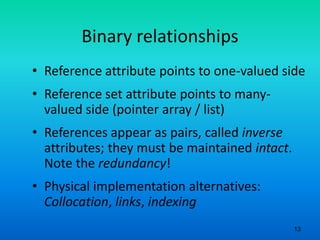
Binary relationships
• Reference attribute points to one-valued side
• Reference set attribute points to many-
valued side (pointer array / list)
• References appear as pairs, called inverse
attributes; they must be maintained intact.
Note the redundancy!
• Physical implementation alternatives:
Collocation, links, indexing
14
N-ary relationships
• A separate relationship object type must be
created.
• Also binary M:M relationships having a
relationship attribute require a separate
object type.
• Creates an extra step in the ‘navigation’
through relationships.
Assignment
• What are the Object Data Management Needs
in ORDBMS
• Explain the Evolution of DBMS to New database

Adbms 9 complex objects

  • 1.
    Advance Database ManagementSystems : 9 Complex Objects Prof Neeraj Bhargava Vaibhav Khanna Department of Computer Science School of Engineering and Systems Sciences Maharshi Dayanand Saraswati University Ajmer
  • 2.
    2 Complex Object-oriented databases •Based on an object data model: – Structured (hierarchical) objects – Class hierarchies – Attached functions and procedures (‘encapsulation’) • Comes close to object-oriented (OO) programming. • Used in special application areas.
  • 3.
    3 Evolution of databasesystems 1) Data management: – Simple data structures and operations 2) Object management – Complex data structures and operations 3) Knowledge management – Complex rule bases and inference systems – More ’intelligence’
  • 4.
    4 New database applications (needingobject management) • Computer-aided design (CAD) and manufacturing (CAM) • Computer-aided software engineering (CASE) • Office automation • Computer-aided publishing (CAP) • Graphics • Scientific and medical applications • Geographic information systems (GIS) • etc.
  • 5.
    5 Object Data ManagementNeeds • Composite (complex) objects • Unique and stable object identifiers • Efficient references and integrity • Object type hierarchy • Associated procedures • Object encapsulation (hiding implementation details) • Ordered sets (e.g. lists)
  • 6.
    6 Object Data ManagementNeeds (cont.) • Long fields (text, image, audio, video) • Efficient remote access (check-out / check-in) • Long transactions (implying long locks) • Single-user performance • Versioning • Support for schema changes • Programming language interface (C++, Java)
  • 7.
    7 Approaches to objectdata management (1) Extended relational database systems • Easy migration from existing systems, taking advantage of their benefits (relational data model and query language) • Extensions: – Procedures – Object identity – Type hierarchy – Long fields
  • 8.
    8 Approaches to objectdata management (2) OO database programming languages • Extension of e.g. C++, Java, or Smalltalk, to provide persistence, concurrency control, etc. • Programming and query language execute in the same environment, share the same type system and workspace. • No big distinction between (persistent) db objects and (transient) program objects.
  • 9.
    9 Approaches to objectdata management (3) Object-relational mapping • An auxiliary package for performing the mapping from the object model to a relational schema (and back). • Solves the so called impedance mismatch between the models. • May suffer from performance problems • Example systems: – Entity Framework (Microsoft) – Hibernate (open source)
  • 10.
    10 Object-oriented abstractions • Structuralabstractions: – Classification/instantiation – Aggregation – Generalization/specialization – Association • Behavioral abstraction: – Encapsulated procedures
  • 11.
    11 Object identifiers • Motivation:Shortcomings of value-based primary keys in the relational model. • System-generated, short, stable. • No logical meaning, not shown to users. • Used as references (‘handles’) between objects • Implementation alternatives: – Object address as id (efficient; stability problems) – Location-independent surrogate (less efficient, stable)
  • 12.
    12 Attributes (properties, features) =instance variables in OO languages (a) Simple attributes: – Literal values (numbers, characters) – Not considered ‘objects’ (b) Complex attributes: – References to represent relationships – Collections of simple/reference/collection attributes – Derived attributes, defined by procedures
  • 13.
    13 Binary relationships • Referenceattribute points to one-valued side • Reference set attribute points to many- valued side (pointer array / list) • References appear as pairs, called inverse attributes; they must be maintained intact. Note the redundancy! • Physical implementation alternatives: Collocation, links, indexing
  • 14.
    14 N-ary relationships • Aseparate relationship object type must be created. • Also binary M:M relationships having a relationship attribute require a separate object type. • Creates an extra step in the ‘navigation’ through relationships.
  • 15.
    Assignment • What arethe Object Data Management Needs in ORDBMS • Explain the Evolution of DBMS to New database