HIGHWAY PLANNING,
ALIGNMENT &
GEOMETRIC DESIGN.
U N I T
WHY WE NEED HIGHWAY ?
For
“TRANSPORTATIO
N”.
WHAT IS
“TRANSPORTATION” ?
PROCESS IN WHICH A THING
CHANGES IT’S PLACE FROM A
POINT “a” TO A POINT “b”.
WHY WE
TRANSPORT ?“TO FULLFILL OUR
DEMANDS”
• IN STARTING TRANSPORTATION WAS
REMAINED TO WALKING,
• SO JUST A CLEAR,PLAIN PATH ON EARTH WAS
ENOUGH FOR TRANSPORTATION NEEDS.
• WITH TIME , DEVELOPMENT TAKE PLACE NEW MODES OF
TRANSPORTATION COMES IN EXISTENCE
• LIKE CYCLE , ANIMAL POWERED CARTS.
• AS LOAD OF CONVEYANCE INCREASES NEED OF,
• STRONGER AND BETTER PATHS TO BARE THAT INCREASED
LOAD.
• THEN REVOLUTION IN TRANSPORTATION COMES
• HEAVY WEIGHT MOTOR VEHICLES COMES IN RACE AND
REVOLUTIONALISE MEANING OF TRANSPORTATION.
• BUT , THEY ALSO NEEDS EVEN MORE STONG PATHS THEN
BEFORE,HENCE COME IN EXISTENCE PAVED-SURFACED
PATHS=ROADS.
AND FROM HERE , COMES NEED OF HIGHWAYS !
AN OVERVIEW
NOW,
• After 1st world war motor vehicle using the road
increases and this demanded a better road
network.
• Which can carry both animal powered carts and
motor vehicles.
• In 1927 a committee was formed to present
development of roads in india.
• The committee was “Jayakar Committee”.
JAYAKAR COMMITEE
o In 1927 jayakar committee for indian road development was appointed.
o Central government should take proper charge of roads considering it
as a matter of national interest.
o Emphasis on long term plan of 20 years.
o Recommendations for periodic road conferences for discussion on road
development.
o Research organisation to be made for research work & development.
o Inclusion of taxation system for transportation.Like,
taxation on motor transport,licence fees for vehicles,etc.
o The recommendations of jayakar committee gives rise to formation of
I.R.C , C.R.F and C.R.R.I .
Indian Road Congress
• Central semi-official body formed in1934.
• For regular exchange of experience &
ideas on matters related to construction
and maintenance of highways.
• It provides standardization and
recommendations on materials, design of
roads and bridges.
There are 4 such plans till
date.
Some of salient features of
those plans are as follows…
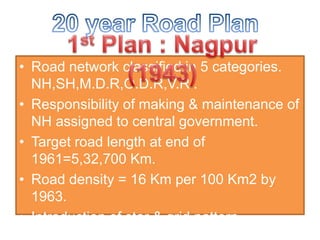
• Road network classified in 5 categories.
NH,SH,M.D.R,O.D.R,V.R .
• Responsibility of making & maintenance of
NH assigned to central government.
• Target road length at end of
1961=5,32,700 Km.
• Road density = 16 Km per 100 Km2 by
1963.
• Introduction of star & grid pattern.
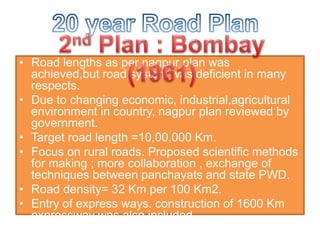
• Road lengths as per nagpur plan was
achieved,but road system was deficient in many
respects.
• Due to changing economic, industrial,agricultural
environment in country, nagpur plan reviewed by
government.
• Target road length =10,00,000 Km.
• Focus on rural roads. Proposed scientific methods
for making ; more collaboration , exchange of
techniques between panchayats and state PWD.
• Road density= 32 Km per 100 Km2.
• Entry of express ways. construction of 1600 Km
expressway was also included.
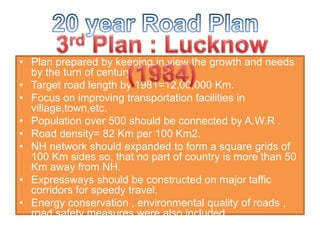
• Plan prepared by keeping in view the growth and needs
by the turn of century.
• Target road length by 1981=12,00,000 Km.
• Focus on improving transportation facilities in
village,town,etc.
• Population over 500 should be connected by A.W.R .
• Road density= 82 Km per 100 Km2.
• NH network should expanded to form a square grids of
100 Km sides so, that no part of country is more than 50
Km away from NH.
• Expressways should be constructed on major taffic
corridors for speedy travel.
• Energy conservation , environmental quality of roads ,
road safety measures were also included.
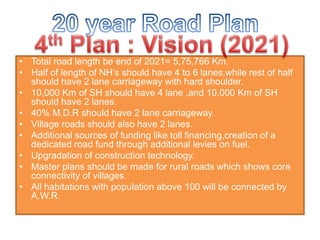
• Total road length be end of 2021= 5,75,766 Km.
• Half of length of NH’s should have 4 to 6 lanes,while rest of half
should have 2 lane carriageway with hard shoulder.
• 10,000 Km of SH should have 4 lane ,and 10,000 Km of SH
should have 2 lanes.
• 40% M.D.R should have 2 lane carriageway.
• Village roads should also have 2 lanes.
• Additional sources of funding like toll financing,creation of a
dedicated road fund through additional levies on fuel.
• Upgradation of construction technology.
• Master plans should be made for rural roads which shows core
connectivity of villages.
• All habitations with population above 100 will be connected by
A.W.R.
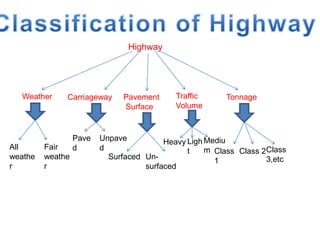
Highway
Weather Carriageway Pavement
Surface
Traffic
Volume
Tonnage
All
weathe
r
Fair
weathe
r
Pave
d
Unpave
d
Surfaced Un-
surfaced
Heavy Ligh
t
Mediu
m Class
1
Class 2Class
3,etc
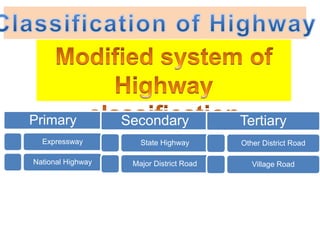
Primary
Expressway
National Highway
Secondary
State Highway
Major District Road
Tertiary
Other District Road
Village Road
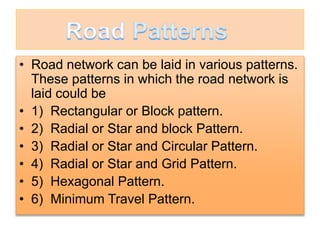
• Road network can be laid in various patterns.
These patterns in which the road network is
laid could be
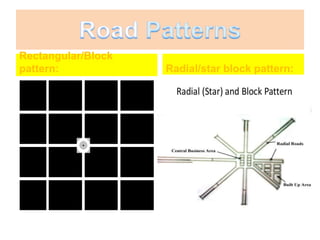
• 1) Rectangular or Block pattern.
• 2) Radial or Star and block Pattern.
• 3) Radial or Star and Circular Pattern.
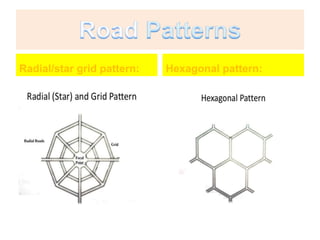
• 4) Radial or Star and Grid Pattern.
• 5) Hexagonal Pattern.
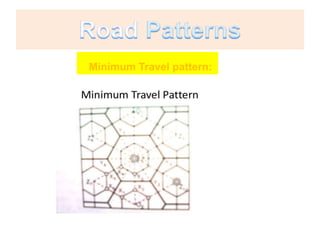
• 6) Minimum Travel Pattern.
Rectangular/Block
pattern: Radial/star block pattern:
Radial/star grid pattern: Hexagonal pattern:
Minimum Travel pattern:
Planning of Highway
While planning a highway alignment we should keep
these 4 points in our minds
1.safety. It should be safe.
2.economy. It should fit in budget
3.Easy. It should easy to make
& drive.
4.short. It should cover distance in
least possible time.
1. MapStudy:
In this we study map of area with
details . Considering all visible
obstructions on map , we draw all
possible alignments on map.
2. Reconnaissance:
In this we study all important historical,
geographical features of area from local
surveys and other sources.
3. Preliminary:
In this we select out the best
possible alignment , on basis of
economy , ease, covering distance
in least possible time.
4. Detailed survey:
In this we study the selected alignment
on ground in reality . giving any further
final touch to planning is done here.
Key Map: A map which shows the proposed alignment and the
existing roads
along with connected area.
Factors affecting
geometric design of
highway:
Cross-section.
(All the components we see when a
road is
cut transverse.)
Sight Distance.
(Distance we can see in-a-once on
road.)
Horizontal Alignment.
(Horizontal layout ; left or right turn ,
change of direction.)
Vertical Alignment.
(Vertical layout ; uphill or downhill ;
change of grade.)
Intersection.
Factors affects Highway
geometry design
Design control :
These are factors which
bound our creativity during
designing.
1. Design Speed.
2. Topography.
3. Traffic.
4. Hourly Volume.
5. Environment.
Factors affects Highway geometry
design
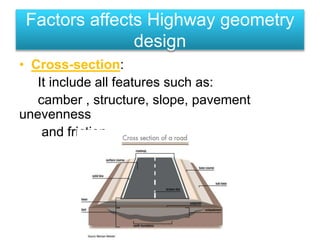
• Cross-section:
It include all features such as:
camber , structure, slope, pavement
unevenness
and friction.
• FRICTION:
• On a road , when we move in straight path
then “Longitudinal friction” works on us. It’s
value should be between 0.35 to 0.40 .
• When we are on a curve then , lateral
friction works on us , it’s value should be
0.15.
Factors affects Highway geometry
design
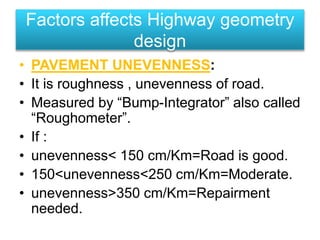
• PAVEMENT UNEVENNESS:
• It is roughness , unevenness of road.
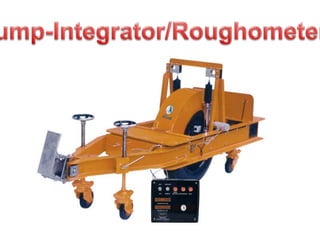
• Measured by “Bump-Integrator” also called
“Roughometer”.
• If :
• unevenness< 150 cm/Km=Road is good.
• 150<unevenness<250 cm/Km=Moderate.
• unevenness>350 cm/Km=Repairment
needed.
Factors affects Highway geometry
design
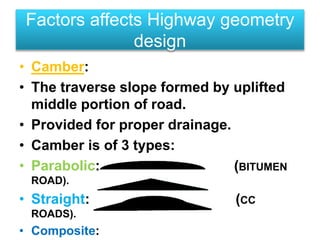
• Camber:
• The traverse slope formed by uplifted
middle portion of road.
• Provided for proper drainage.
• Camber is of 3 types:
• Parabolic: (BITUMEN
ROAD).
• Straight: (CC
ROADS).
• Composite:
Factors affects Highway geometry
design
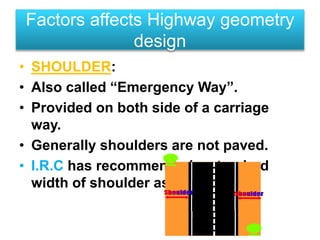
• SHOULDER:
• Also called “Emergency Way”.
• Provided on both side of a carriage
way.
• Generally shoulders are not paved.
• I.R.C has recommended a standard
width of shoulder as 2.5 m .
Factors affects Highway geometry
design
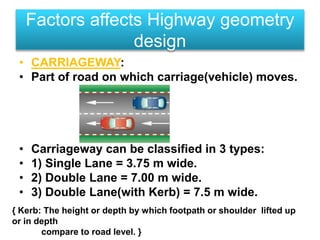
• CARRIAGEWAY:
• Part of road on which carriage(vehicle) moves.
• Carriageway can be classified in 3 types:
• 1) Single Lane = 3.75 m wide.
• 2) Double Lane = 7.00 m wide.
• 3) Double Lane(with Kerb) = 7.5 m wide.
Factors affects Highway geometry
design
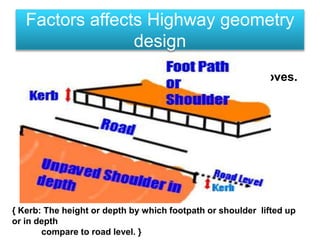
{ Kerb: The height or depth by which footpath or shoulder lifted up
or in depth
compare to road level. }
• CARRIAGEWAY:
• Part of road on which carriage(vehicle) moves.
• Carriageway can be classified in 3 types:
• 1) Single Lane = 3.75 m wide.
• 2) Double Lane = 7.00 m wide.
• 3) Double Lane(with Kerb) = 7.5 m wide.
Factors affects Highway geometry
design
{ Kerb: The height or depth by which footpath or shoulder lifted up
or in depth
compare to road level. }
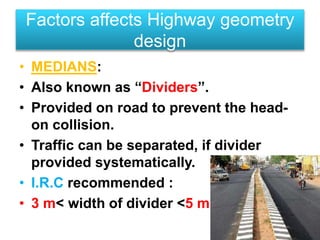
• MEDIANS:
• Also known as “Dividers”.
• Provided on road to prevent the head-
on collision.
• Traffic can be separated, if divider
provided systematically.
• I.R.C recommended :
• 3 m< width of divider <5 m .
Factors affects Highway geometry
design
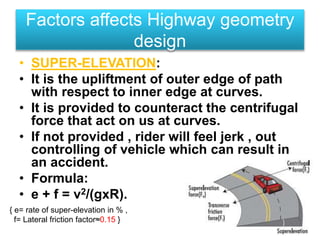
• SUPER-ELEVATION:
• It is the upliftment of outer edge of path
with respect to inner edge at curves.
• It is provided to counteract the centrifugal
force that act on us at curves.
• If not provided , rider will feel jerk , out
controlling of vehicle which can result in
an accident.
• Formula:
• e + f = v2/(gxR).
Factors affects Highway geometry
design
{ e= rate of super-elevation in % ,
f= Lateral friction factor≈0.15 }
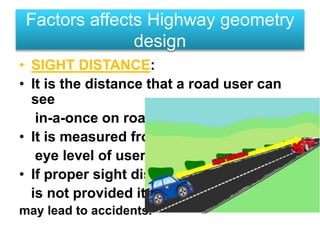
• SIGHT DISTANCE:
• It is the distance that a road user can
see
in-a-once on road.
• It is measured from
eye level of user.
• If proper sight dis.
is not provided it
may lead to accidents.
Factors affects Highway geometry
design
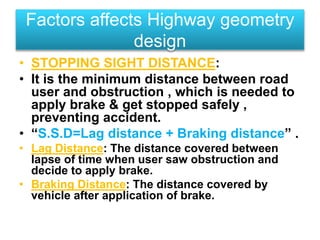
• STOPPING SIGHT DISTANCE:
• It is the minimum distance between road
user and obstruction , which is needed to
apply brake & get stopped safely ,
preventing accident.
• “S.S.D=Lag distance + Braking distance” .
• Lag Distance: The distance covered between
lapse of time when user saw obstruction and
decide to apply brake.
• Braking Distance: The distance covered by
vehicle after application of brake.
Factors affects Highway geometry
design
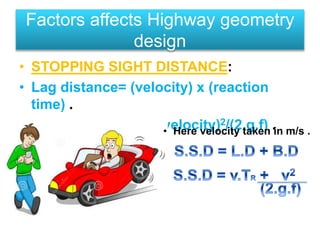
• STOPPING SIGHT DISTANCE:
• Lag distance= (velocity) x (reaction
time) .
• Braking distance= (velocity)2/(2.g.f) .
Factors affects Highway geometry
design
• Here velocity taken in m/s .
_____
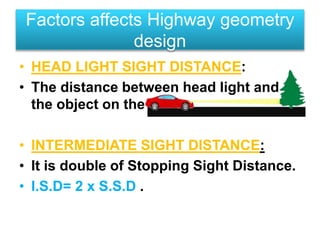
• HEAD LIGHT SIGHT DISTANCE:
• The distance between head light and
the object on the road.
• INTERMEDIATE SIGHT DISTANCE:
• It is double of Stopping Sight Distance.
• I.S.D= 2 x S.S.D .
Factors affects Highway geometry
design
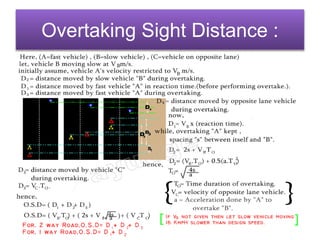
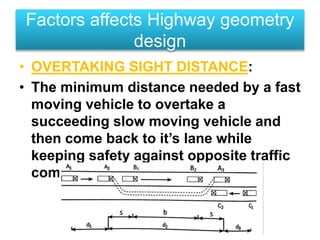
• OVERTAKING SIGHT DISTANCE:
• The minimum distance needed by a fast
moving vehicle to overtake a
succeeding slow moving vehicle and
then come back to it’s lane while
keeping safety against opposite traffic
coming on other lane.
Factors affects Highway geometry
design
Overtaking Sight Distance :
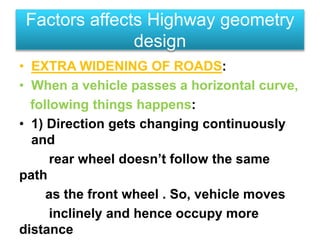
• EXTRA WIDENING OF ROADS:
• When a vehicle passes a horizontal curve,
following things happens:
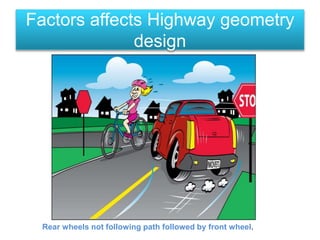
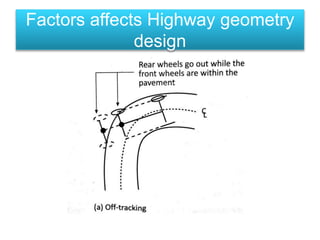
• 1) Direction gets changing continuously
and
rear wheel doesn’t follow the same
path
as the front wheel . So, vehicle moves
inclinely and hence occupy more
distance
Factors affects Highway geometry
design
Factors affects Highway geometry
design
Rear wheels not following path followed by front wheel.
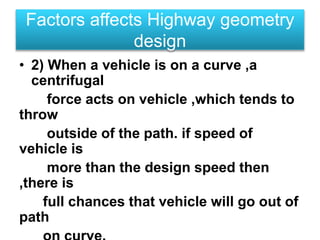
• 2) When a vehicle is on a curve ,a
centrifugal
force acts on vehicle ,which tends to
throw
outside of the path. if speed of
vehicle is
more than the design speed then
,there is
full chances that vehicle will go out of
path
Factors affects Highway geometry
design
Factors affects Highway geometry
design
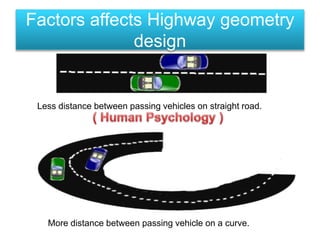
• 3) On straight path 2 vehicles can pass
by each other with very less distance
between them. without any problem.
But,on a curve , human psychology
comes in
to play.
• On a curve users wants as much
distance as much possible, so to get a
feeling of safety , while turning on a
curve.
Factors affects Highway geometry
design
Factors affects Highway geometry
design
Less distance between passing vehicles on straight road.
More distance between passing vehicle on a curve.
• Hence, due to all these factors , a extra
widening is provided on curves to prevent
any of bad outcomes due to above
reasons.
• The total widening of road at curve (We) is
finded by taking both mechanical and
psychological reasons.
• The mechanical widening of road is due to
mechanical reasons. Denoted by “ Wm”.
• The psychological widening of road is due
to psychological reasons. Denoted by “
W ”.
Factors affects Highway geometry
design
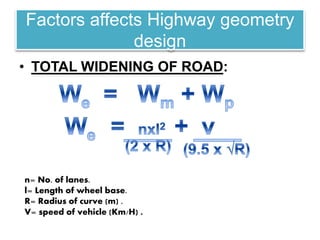
• TOTAL WIDENING OF ROAD:
Factors affects Highway geometry
design
n= No. of lanes.
l= Length of wheel base.
R= Radius of curve (m) .
V= speed of vehicle (Km/H) .
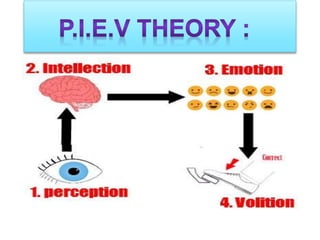
• It’s a theory to understand concept of
“reaction time”.
• The whole process of when a road user
interact with a thing on road, can be
divided into small time segments.
1) Road user see ,the fore coming
thing/object
analyse it,eyes capture photo,send to
brain
brain identify it, figure out it’s harmful
or
not.
The process is “Perception” and time
taken in
2) If the forecoming thing is harmful, brain
brain start scanning it’s database,to find
ways to act against it ,being safe.
Process is intellection and time taken in it
is
“intellection time” (TI) .
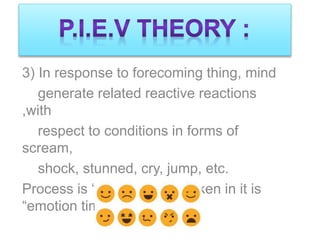
3) In response to forecoming thing, mind
generate related reactive reactions
,with
respect to conditions in forms of
scream,
shock, stunned, cry, jump, etc.
Process is “emotion” time taken in it is
“emotion time” (Te) .
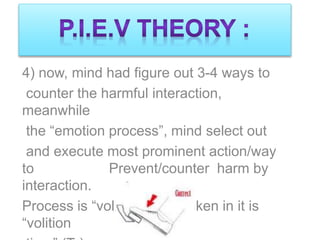
4) now, mind had figure out 3-4 ways to
counter the harmful interaction,
meanwhile
the “emotion process”, mind select out
and execute most prominent action/way
to Prevent/counter harm by
interaction.
Process is “volition”, time taken in it is
“volition
Summation of all the times ( I,e.
TP,TI,TE,TV ) is
“Total Reaction Time” of an
individual.
• As, per IRC standard:
standard Total Reaction Time for
THANK YOU

transportation Engineering.Highway planning,alignment and geometry.

  • 2.
  • 3.
    WHY WE NEEDHIGHWAY ? For “TRANSPORTATIO N”.
  • 4.
    WHAT IS “TRANSPORTATION” ? PROCESSIN WHICH A THING CHANGES IT’S PLACE FROM A POINT “a” TO A POINT “b”. WHY WE TRANSPORT ?“TO FULLFILL OUR DEMANDS”
  • 5.
    • IN STARTINGTRANSPORTATION WAS REMAINED TO WALKING, • SO JUST A CLEAR,PLAIN PATH ON EARTH WAS ENOUGH FOR TRANSPORTATION NEEDS. • WITH TIME , DEVELOPMENT TAKE PLACE NEW MODES OF TRANSPORTATION COMES IN EXISTENCE • LIKE CYCLE , ANIMAL POWERED CARTS. • AS LOAD OF CONVEYANCE INCREASES NEED OF, • STRONGER AND BETTER PATHS TO BARE THAT INCREASED LOAD. • THEN REVOLUTION IN TRANSPORTATION COMES • HEAVY WEIGHT MOTOR VEHICLES COMES IN RACE AND REVOLUTIONALISE MEANING OF TRANSPORTATION. • BUT , THEY ALSO NEEDS EVEN MORE STONG PATHS THEN BEFORE,HENCE COME IN EXISTENCE PAVED-SURFACED PATHS=ROADS. AND FROM HERE , COMES NEED OF HIGHWAYS ! AN OVERVIEW
  • 6.
    NOW, • After 1stworld war motor vehicle using the road increases and this demanded a better road network. • Which can carry both animal powered carts and motor vehicles. • In 1927 a committee was formed to present development of roads in india. • The committee was “Jayakar Committee”.
  • 7.
    JAYAKAR COMMITEE o In1927 jayakar committee for indian road development was appointed. o Central government should take proper charge of roads considering it as a matter of national interest. o Emphasis on long term plan of 20 years. o Recommendations for periodic road conferences for discussion on road development. o Research organisation to be made for research work & development. o Inclusion of taxation system for transportation.Like, taxation on motor transport,licence fees for vehicles,etc. o The recommendations of jayakar committee gives rise to formation of I.R.C , C.R.F and C.R.R.I .
  • 8.
    Indian Road Congress •Central semi-official body formed in1934. • For regular exchange of experience & ideas on matters related to construction and maintenance of highways. • It provides standardization and recommendations on materials, design of roads and bridges.
  • 9.
    There are 4such plans till date. Some of salient features of those plans are as follows…
  • 10.
    • Road networkclassified in 5 categories. NH,SH,M.D.R,O.D.R,V.R . • Responsibility of making & maintenance of NH assigned to central government. • Target road length at end of 1961=5,32,700 Km. • Road density = 16 Km per 100 Km2 by 1963. • Introduction of star & grid pattern.
  • 11.
    • Road lengthsas per nagpur plan was achieved,but road system was deficient in many respects. • Due to changing economic, industrial,agricultural environment in country, nagpur plan reviewed by government. • Target road length =10,00,000 Km. • Focus on rural roads. Proposed scientific methods for making ; more collaboration , exchange of techniques between panchayats and state PWD. • Road density= 32 Km per 100 Km2. • Entry of express ways. construction of 1600 Km expressway was also included.
  • 12.
    • Plan preparedby keeping in view the growth and needs by the turn of century. • Target road length by 1981=12,00,000 Km. • Focus on improving transportation facilities in village,town,etc. • Population over 500 should be connected by A.W.R . • Road density= 82 Km per 100 Km2. • NH network should expanded to form a square grids of 100 Km sides so, that no part of country is more than 50 Km away from NH. • Expressways should be constructed on major taffic corridors for speedy travel. • Energy conservation , environmental quality of roads , road safety measures were also included.
  • 13.
    • Total roadlength be end of 2021= 5,75,766 Km. • Half of length of NH’s should have 4 to 6 lanes,while rest of half should have 2 lane carriageway with hard shoulder. • 10,000 Km of SH should have 4 lane ,and 10,000 Km of SH should have 2 lanes. • 40% M.D.R should have 2 lane carriageway. • Village roads should also have 2 lanes. • Additional sources of funding like toll financing,creation of a dedicated road fund through additional levies on fuel. • Upgradation of construction technology. • Master plans should be made for rural roads which shows core connectivity of villages. • All habitations with population above 100 will be connected by A.W.R.
  • 14.
  • 15.
    Primary Expressway National Highway Secondary State Highway MajorDistrict Road Tertiary Other District Road Village Road
  • 16.
    • Road networkcan be laid in various patterns. These patterns in which the road network is laid could be • 1) Rectangular or Block pattern. • 2) Radial or Star and block Pattern. • 3) Radial or Star and Circular Pattern. • 4) Radial or Star and Grid Pattern. • 5) Hexagonal Pattern. • 6) Minimum Travel Pattern.
  • 17.
  • 18.
    Radial/star grid pattern:Hexagonal pattern:
  • 19.
  • 20.
    Planning of Highway Whileplanning a highway alignment we should keep these 4 points in our minds 1.safety. It should be safe. 2.economy. It should fit in budget 3.Easy. It should easy to make & drive. 4.short. It should cover distance in least possible time.
  • 21.
    1. MapStudy: In thiswe study map of area with details . Considering all visible obstructions on map , we draw all possible alignments on map. 2. Reconnaissance: In this we study all important historical, geographical features of area from local surveys and other sources.
  • 22.
    3. Preliminary: In thiswe select out the best possible alignment , on basis of economy , ease, covering distance in least possible time. 4. Detailed survey: In this we study the selected alignment on ground in reality . giving any further final touch to planning is done here. Key Map: A map which shows the proposed alignment and the existing roads along with connected area.
  • 23.
    Factors affecting geometric designof highway: Cross-section. (All the components we see when a road is cut transverse.) Sight Distance. (Distance we can see in-a-once on road.) Horizontal Alignment. (Horizontal layout ; left or right turn , change of direction.) Vertical Alignment. (Vertical layout ; uphill or downhill ; change of grade.) Intersection. Factors affects Highway geometry design Design control : These are factors which bound our creativity during designing. 1. Design Speed. 2. Topography. 3. Traffic. 4. Hourly Volume. 5. Environment.
  • 24.
    Factors affects Highwaygeometry design • Cross-section: It include all features such as: camber , structure, slope, pavement unevenness and friction.
  • 25.
    • FRICTION: • Ona road , when we move in straight path then “Longitudinal friction” works on us. It’s value should be between 0.35 to 0.40 . • When we are on a curve then , lateral friction works on us , it’s value should be 0.15. Factors affects Highway geometry design
  • 26.
    • PAVEMENT UNEVENNESS: •It is roughness , unevenness of road. • Measured by “Bump-Integrator” also called “Roughometer”. • If : • unevenness< 150 cm/Km=Road is good. • 150<unevenness<250 cm/Km=Moderate. • unevenness>350 cm/Km=Repairment needed. Factors affects Highway geometry design
  • 28.
    • Camber: • Thetraverse slope formed by uplifted middle portion of road. • Provided for proper drainage. • Camber is of 3 types: • Parabolic: (BITUMEN ROAD). • Straight: (CC ROADS). • Composite: Factors affects Highway geometry design
  • 29.
    • SHOULDER: • Alsocalled “Emergency Way”. • Provided on both side of a carriage way. • Generally shoulders are not paved. • I.R.C has recommended a standard width of shoulder as 2.5 m . Factors affects Highway geometry design
  • 30.
    • CARRIAGEWAY: • Partof road on which carriage(vehicle) moves. • Carriageway can be classified in 3 types: • 1) Single Lane = 3.75 m wide. • 2) Double Lane = 7.00 m wide. • 3) Double Lane(with Kerb) = 7.5 m wide. Factors affects Highway geometry design { Kerb: The height or depth by which footpath or shoulder lifted up or in depth compare to road level. }
  • 31.
    • CARRIAGEWAY: • Partof road on which carriage(vehicle) moves. • Carriageway can be classified in 3 types: • 1) Single Lane = 3.75 m wide. • 2) Double Lane = 7.00 m wide. • 3) Double Lane(with Kerb) = 7.5 m wide. Factors affects Highway geometry design { Kerb: The height or depth by which footpath or shoulder lifted up or in depth compare to road level. }
  • 32.
    • MEDIANS: • Alsoknown as “Dividers”. • Provided on road to prevent the head- on collision. • Traffic can be separated, if divider provided systematically. • I.R.C recommended : • 3 m< width of divider <5 m . Factors affects Highway geometry design
  • 33.
    • SUPER-ELEVATION: • Itis the upliftment of outer edge of path with respect to inner edge at curves. • It is provided to counteract the centrifugal force that act on us at curves. • If not provided , rider will feel jerk , out controlling of vehicle which can result in an accident. • Formula: • e + f = v2/(gxR). Factors affects Highway geometry design { e= rate of super-elevation in % , f= Lateral friction factor≈0.15 }
  • 34.
    • SIGHT DISTANCE: •It is the distance that a road user can see in-a-once on road. • It is measured from eye level of user. • If proper sight dis. is not provided it may lead to accidents. Factors affects Highway geometry design
  • 35.
    • STOPPING SIGHTDISTANCE: • It is the minimum distance between road user and obstruction , which is needed to apply brake & get stopped safely , preventing accident. • “S.S.D=Lag distance + Braking distance” . • Lag Distance: The distance covered between lapse of time when user saw obstruction and decide to apply brake. • Braking Distance: The distance covered by vehicle after application of brake. Factors affects Highway geometry design
  • 36.
    • STOPPING SIGHTDISTANCE: • Lag distance= (velocity) x (reaction time) . • Braking distance= (velocity)2/(2.g.f) . Factors affects Highway geometry design • Here velocity taken in m/s . _____
  • 37.
    • HEAD LIGHTSIGHT DISTANCE: • The distance between head light and the object on the road. • INTERMEDIATE SIGHT DISTANCE: • It is double of Stopping Sight Distance. • I.S.D= 2 x S.S.D . Factors affects Highway geometry design
  • 38.
    • OVERTAKING SIGHTDISTANCE: • The minimum distance needed by a fast moving vehicle to overtake a succeeding slow moving vehicle and then come back to it’s lane while keeping safety against opposite traffic coming on other lane. Factors affects Highway geometry design
  • 39.
  • 40.
    • EXTRA WIDENINGOF ROADS: • When a vehicle passes a horizontal curve, following things happens: • 1) Direction gets changing continuously and rear wheel doesn’t follow the same path as the front wheel . So, vehicle moves inclinely and hence occupy more distance Factors affects Highway geometry design
  • 41.
    Factors affects Highwaygeometry design Rear wheels not following path followed by front wheel.
  • 42.
    • 2) Whena vehicle is on a curve ,a centrifugal force acts on vehicle ,which tends to throw outside of the path. if speed of vehicle is more than the design speed then ,there is full chances that vehicle will go out of path Factors affects Highway geometry design
  • 43.
    Factors affects Highwaygeometry design
  • 44.
    • 3) Onstraight path 2 vehicles can pass by each other with very less distance between them. without any problem. But,on a curve , human psychology comes in to play. • On a curve users wants as much distance as much possible, so to get a feeling of safety , while turning on a curve. Factors affects Highway geometry design
  • 45.
    Factors affects Highwaygeometry design Less distance between passing vehicles on straight road. More distance between passing vehicle on a curve.
  • 46.
    • Hence, dueto all these factors , a extra widening is provided on curves to prevent any of bad outcomes due to above reasons. • The total widening of road at curve (We) is finded by taking both mechanical and psychological reasons. • The mechanical widening of road is due to mechanical reasons. Denoted by “ Wm”. • The psychological widening of road is due to psychological reasons. Denoted by “ W ”. Factors affects Highway geometry design
  • 47.
    • TOTAL WIDENINGOF ROAD: Factors affects Highway geometry design n= No. of lanes. l= Length of wheel base. R= Radius of curve (m) . V= speed of vehicle (Km/H) .
  • 48.
    • It’s atheory to understand concept of “reaction time”. • The whole process of when a road user interact with a thing on road, can be divided into small time segments.
  • 50.
    1) Road usersee ,the fore coming thing/object analyse it,eyes capture photo,send to brain brain identify it, figure out it’s harmful or not. The process is “Perception” and time taken in
  • 51.
    2) If theforecoming thing is harmful, brain brain start scanning it’s database,to find ways to act against it ,being safe. Process is intellection and time taken in it is “intellection time” (TI) .
  • 52.
    3) In responseto forecoming thing, mind generate related reactive reactions ,with respect to conditions in forms of scream, shock, stunned, cry, jump, etc. Process is “emotion” time taken in it is “emotion time” (Te) .
  • 53.
    4) now, mindhad figure out 3-4 ways to counter the harmful interaction, meanwhile the “emotion process”, mind select out and execute most prominent action/way to Prevent/counter harm by interaction. Process is “volition”, time taken in it is “volition
  • 54.
    Summation of allthe times ( I,e. TP,TI,TE,TV ) is “Total Reaction Time” of an individual. • As, per IRC standard: standard Total Reaction Time for
  • 55.