1 
Geological Structures 
What are Geologic Structures? 
Division of Structures 
A- Primary structures 
 Ripple marks 
 Mud cracks 
 Cross bedding 
 Graded bedding 
 Burrows 
B- Secondary Structures 
 Folds 
 Faults 
 Joints 
 Unconformities
2 
What are Geologic Structures? 
 Geologic structure is any feature in rocks that results from deformation, such as folds, joints, and faults. 
 Geologic structures are usually the result of the powerful that occur within the earth. These forces fold and break rocks, form deep faults, and build mountains .
3 
Division of Structures 
 Primary (or sedimentary) structures: such as ripple marks, cross-bedding, and mud cracks form in sediments during or shortly after deposition. 
 Secondary structures: 
is that structures formed after the formations of any kind of rocks, such as folds, faults, or unconformities.
4 
Primary structures 
They are any structures in sedimentary rock formed at or shortly after the time of deposition: such as: 
 Ripple marks 
They are wavelike (undulating) structures produced in granular sediment such as sand by unidirectional wind and water currents or by oscillating wave currents. 
Wind and current ripples. (Asymmetric 
Wave ripples. (Symmetric
5 
 Mud cracks Mud crack is a crack in clay-rich sediment that has dried out. 
 Cross bedding • Cross-bedding takes place when individual beds or strata are deposited at an angle to the surface upon which they accumulate.
6 
• Origin of cross-bedding by deposition on the sloping surface of a desert dune. 
• Cross-bedding is also common in dune like structures in stream and river channels. 
 Graded bedding
7 
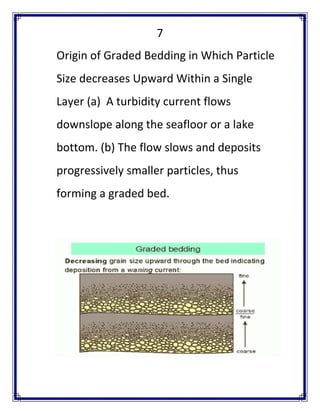
Origin of Graded Bedding in Which Particle Size decreases Upward Within a Single Layer (a) A turbidity current flows downslope along the seafloor or a lake bottom. (b) The flow slows and deposits progressively smaller particles, thus forming a graded bed.
8 
 Burrows 
is a hole or tunnel excavated into the ground by an animal to create a space suitable for habitation Burrows are also commonly preserved in the fossil record as a type of trace fossil.
9 
Secondary Structures 
 Folds 
Fold is a type of geologic structure in which planar features in rock layers such as bedding and foliation have been bent. 
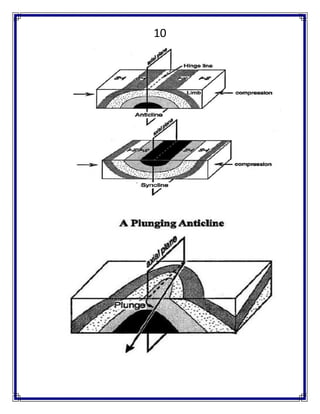
Anticline is a convex upward fold in which the oldest exposed rocks coincide with the fold axis and all strata dip away from the axis. 
Syncline is a down-arched fold in which the youngest exposed rocks coincide with the fold axis and all strata dip toward the axis.
10
11 
 Faults 
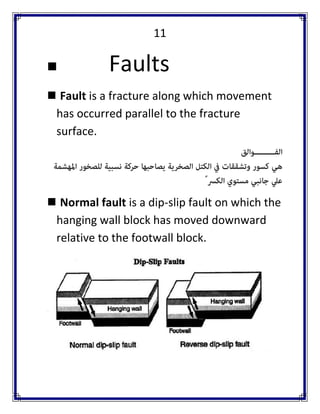
 Fault is a fracture along which movement has occurred parallel to the fracture surface. 
 Normal fault is a dip-slip fault on which the hanging wall block has moved downward relative to the footwall block.
12 
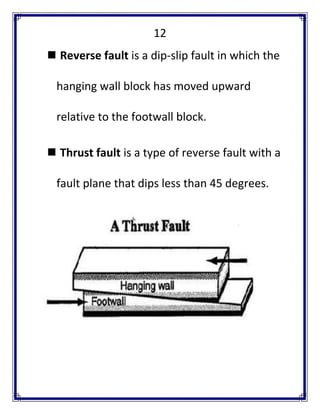
 Reverse fault is a dip-slip fault in which the hanging wall block has moved upward relative to the footwall block. 
 Thrust fault is a type of reverse fault with a fault plane that dips less than 45 degrees.
13 
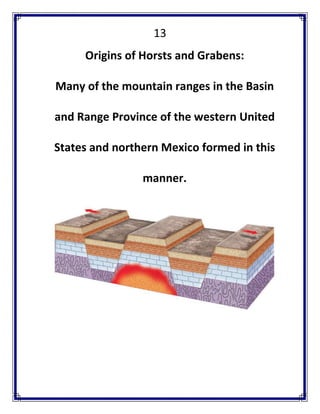
Origins of Horsts and Grabens: Many of the mountain ranges in the Basin and Range Province of the western United States and northern Mexico formed in this manner.
14 
 Joint 
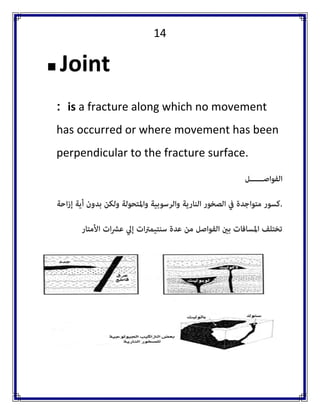
: is a fracture along which no movement has occurred or where movement has been perpendicular to the fracture surface.
15 
 Unconformities 
Unconformity is a break in the geologic record represented by an erosion surface separating younger strata from older rocks. 
An unconformity is a contact between two rock units in which the upper unit is usually much younger than the lower unit. 
Unconformities are typically buried erosional surfaces that can represent a break in the geologic record of hundreds of millions of years or more.
16 
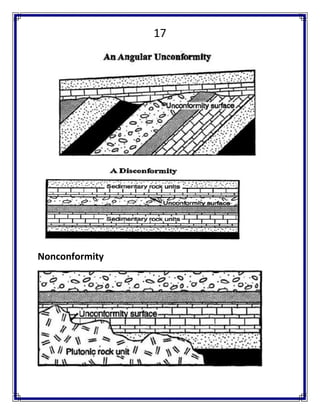
Types of Unconformaties 
1. Angular Unconformity 
An unconformity below which older rocks dip at a different angle (usually steeper) than the overlying strata 
2. Disconformity 
An unconformity above and below which the strata are parallel. 
3. Nonconformity 
An unconformity in which stratified sedimentary rocks overlie an erosion surface cut into igneous or metamorphic rocks.
17 
Nonconformity

Geological structures- التراكيب الجيولوجيه

  • 1.
    1 Geological Structures What are Geologic Structures? Division of Structures A- Primary structures  Ripple marks  Mud cracks  Cross bedding  Graded bedding  Burrows B- Secondary Structures  Folds  Faults  Joints  Unconformities
  • 2.
    2 What areGeologic Structures?  Geologic structure is any feature in rocks that results from deformation, such as folds, joints, and faults.  Geologic structures are usually the result of the powerful that occur within the earth. These forces fold and break rocks, form deep faults, and build mountains .
  • 3.
    3 Division ofStructures  Primary (or sedimentary) structures: such as ripple marks, cross-bedding, and mud cracks form in sediments during or shortly after deposition.  Secondary structures: is that structures formed after the formations of any kind of rocks, such as folds, faults, or unconformities.
  • 4.
    4 Primary structures They are any structures in sedimentary rock formed at or shortly after the time of deposition: such as:  Ripple marks They are wavelike (undulating) structures produced in granular sediment such as sand by unidirectional wind and water currents or by oscillating wave currents. Wind and current ripples. (Asymmetric Wave ripples. (Symmetric
  • 5.
    5  Mudcracks Mud crack is a crack in clay-rich sediment that has dried out.  Cross bedding • Cross-bedding takes place when individual beds or strata are deposited at an angle to the surface upon which they accumulate.
  • 6.
    6 • Originof cross-bedding by deposition on the sloping surface of a desert dune. • Cross-bedding is also common in dune like structures in stream and river channels.  Graded bedding
  • 7.
    7 Origin ofGraded Bedding in Which Particle Size decreases Upward Within a Single Layer (a) A turbidity current flows downslope along the seafloor or a lake bottom. (b) The flow slows and deposits progressively smaller particles, thus forming a graded bed.
  • 8.
    8  Burrows is a hole or tunnel excavated into the ground by an animal to create a space suitable for habitation Burrows are also commonly preserved in the fossil record as a type of trace fossil.
  • 9.
    9 Secondary Structures  Folds Fold is a type of geologic structure in which planar features in rock layers such as bedding and foliation have been bent. Anticline is a convex upward fold in which the oldest exposed rocks coincide with the fold axis and all strata dip away from the axis. Syncline is a down-arched fold in which the youngest exposed rocks coincide with the fold axis and all strata dip toward the axis.
  • 10.
  • 11.
    11  Faults  Fault is a fracture along which movement has occurred parallel to the fracture surface.  Normal fault is a dip-slip fault on which the hanging wall block has moved downward relative to the footwall block.
  • 12.
    12  Reversefault is a dip-slip fault in which the hanging wall block has moved upward relative to the footwall block.  Thrust fault is a type of reverse fault with a fault plane that dips less than 45 degrees.
  • 13.
    13 Origins ofHorsts and Grabens: Many of the mountain ranges in the Basin and Range Province of the western United States and northern Mexico formed in this manner.
  • 14.
    14  Joint : is a fracture along which no movement has occurred or where movement has been perpendicular to the fracture surface.
  • 15.
    15  Unconformities Unconformity is a break in the geologic record represented by an erosion surface separating younger strata from older rocks. An unconformity is a contact between two rock units in which the upper unit is usually much younger than the lower unit. Unconformities are typically buried erosional surfaces that can represent a break in the geologic record of hundreds of millions of years or more.
  • 16.
    16 Types ofUnconformaties 1. Angular Unconformity An unconformity below which older rocks dip at a different angle (usually steeper) than the overlying strata 2. Disconformity An unconformity above and below which the strata are parallel. 3. Nonconformity An unconformity in which stratified sedimentary rocks overlie an erosion surface cut into igneous or metamorphic rocks.
  • 17.