Histology and Cell Biology
An Introduction to Pathology
(Abraham L. Kierszenbaum, MD, PhD)
Histology and Cell Biology
An Introduction to Pathology
(Abraham L. Kierszenbaum, MD, PhD)
Overview
Part I: Basic Tissues and Integrated Cell Biology
Epithelial tissue
Connective tissue
Muscle tissue
Nervous tissue
Part II: Organ Systems: Protection of the Body
Immune system
Integumentary system
Overview
Part I: Basic Tissues and Integrated Cell Biology
Epithelial tissue
Connective tissue
Muscle tissue
Nervous tissue
Part II: Organ Systems: Protection of the Body
Immune system
Integumentary system
Overview
Part III: Organ Systems: Blood Circulatory Systems
Cardiovascular system
Respiratory system
Urinary system
Part IV: Organ Systems: the Alimentary System
Digestive system
Part V: Organ Systems: the Endocrine system
Neuroendocrine and endocrine systems
Part IV: Organ Systems: the Reproduction system
Male and Female reproductive systems
Overview
Part III: Organ Systems: Blood Circulatory Systems
Cardiovascular system
Respiratory system
Urinary system
Part IV: Organ Systems: the Alimentary System
Digestive system
Part V: Organ Systems: the Endocrine system
Neuroendocrine and endocrine systems
Part IV: Organ Systems: the Reproduction system
Male and Female reproductive systems
Classification of EpitheliumClassification of Epithelium
Simple epithelia
Simple squamous epithelium
Simple cuboidal epithelium
Simple columnar epithelium
Stratified epithelia
Stratified squamous epithelium
Stratified cuboidal epithelium
Stratified columnar epithelium
Pseudostratified epithelia
Pseudostratified columnar ciliated epithelium (treachea)
Pseudostartified columnar epi with stereocilia (epididymis)
Transtional epithelium (urothelium)
Simple epithelia
Simple squamous epithelium
Simple cuboidal epithelium
Simple columnar epithelium
Stratified epithelia
Stratified squamous epithelium
Stratified cuboidal epithelium
Stratified columnar epithelium
Pseudostratified epithelia
Pseudostratified columnar ciliated epithelium (treachea)
Pseudostartified columnar epi with stereocilia (epididymis)
Transtional epithelium (urothelium)
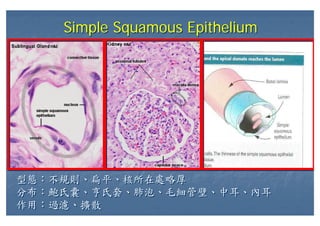
Simple Squamous EpitheliumSimple Squamous Epithelium
型態:不規則、扁平、核所在處略厚
分布:鮑氏囊、亨氏套、肺泡、毛細管壁、中耳、內耳
作用:過濾、擴散
型態:不規則、扁平、核所在處略厚
分布:鮑氏囊、亨氏套、肺泡、毛細管壁、中耳、內耳
作用:過濾、擴散
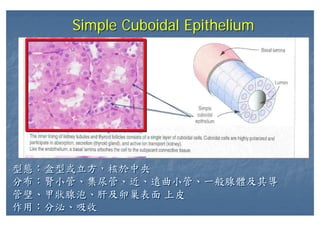
Simple Cuboidal EpitheliumSimple Cuboidal Epithelium
型態:盒型或立方,核於中央
分布:腎小管、集尿管、近、遠曲小管、一般腺體及其導
管壁、甲狀腺泡、肝及卵巢表面 上皮
作用:分泌、吸收
型態:盒型或立方,核於中央
分布:腎小管、集尿管、近、遠曲小管、一般腺體及其導
管壁、甲狀腺泡、肝及卵巢表面 上皮
作用:分泌、吸收
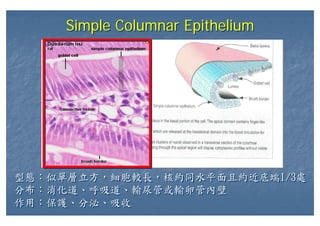
Simple Columnar EpitheliumSimple Columnar Epithelium
型態:似單層立方,細胞較長,核約同水平面且約近底端1/3處
分布:消化道、呼吸道、輸尿管或輸卵管內壁
作用:保護、分泌、吸收
型態:似單層立方,細胞較長,核約同水平面且約近底端1/3處
分布:消化道、呼吸道、輸尿管或輸卵管內壁
作用:保護、分泌、吸收
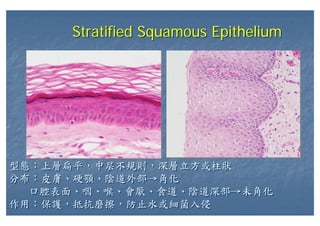
Stratified Squamous EpitheliumStratified Squamous Epithelium
型態:上層扁平,中层不規則,深層立方或柱狀
分布:皮膚、硬顎、陰道外部→角化
口腔表面、咽、喉、會厭、食道、陰道深部→未角化
作用:保護,抵抗磨擦,防止水或細菌入侵
型態:上層扁平,中层不規則,深層立方或柱狀
分布:皮膚、硬顎、陰道外部→角化
口腔表面、咽、喉、會厭、食道、陰道深部→未角化
作用:保護,抵抗磨擦,防止水或細菌入侵
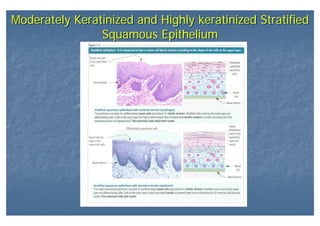
Moderately Keratinized and Highly keratinized Stratified
Squamous Epithelium
Moderately Keratinized and Highly keratinized Stratified
Squamous Epithelium
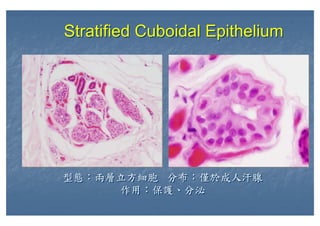
型態:兩層立方細胞 分布:僅於成人汗腺
作用:保護、分泌
型態:兩層立方細胞 分布:僅於成人汗腺
作用:保護、分泌
Stratified Cuboidal EpitheliumStratified Cuboidal Epithelium
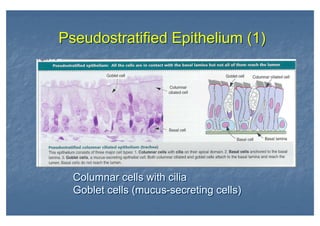
Columnar cells with cilia
Goblet cells (mucus-secreting cells)
Columnar cells with cilia
Goblet cells (mucus-secreting cells)
Pseudostratified Epithelium (1)Pseudostratified Epithelium (1)
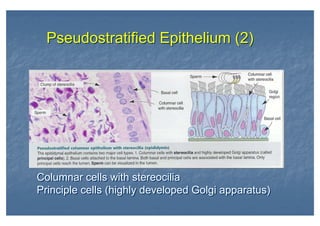
Pseudostratified Epithelium (2)Pseudostratified Epithelium (2)
Columnar cells with stereocilia
Principle cells (highly developed Golgi apparatus)
Columnar cells with stereocilia
Principle cells (highly developed Golgi apparatus)
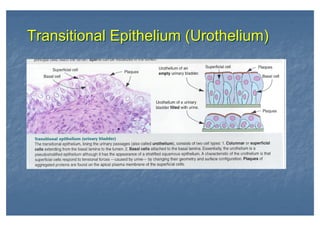
Transitional Epithelium (Urothelium)Transitional Epithelium (Urothelium)
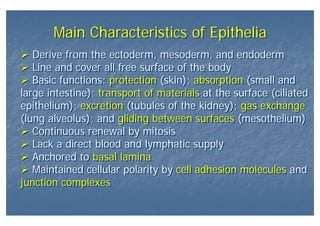
Main Characteristics of EpitheliaMain Characteristics of Epithelia
Derive from the ectoderm, mesoderm, and endoderm
Line and cover all free surface of the body
Basic functions: protection (skin); absorption (small and
large intestine); transport of materials at the surface (ciliated
epithelium); excretion (tubules of the kidney); gas exchange
(lung alveolus); and gliding between surfaces (mesothelium)
Continuous renewal by mitosis
Lack a direct blood and lymphatic supply
Anchored to basal lamina
Maintained cellular polarity by cell adhesion molecules and
junction complexes
Derive from the ectoderm, mesoderm, and endoderm
Line and cover all free surface of the body
Basic functions: protection (skin); absorption (small and
large intestine); transport of materials at the surface (ciliated
epithelium); excretion (tubules of the kidney); gas exchange
(lung alveolus); and gliding between surfaces (mesothelium)
Continuous renewal by mitosis
Lack a direct blood and lymphatic supply
Anchored to basal lamina
Maintained cellular polarity by cell adhesion molecules and
junction complexes
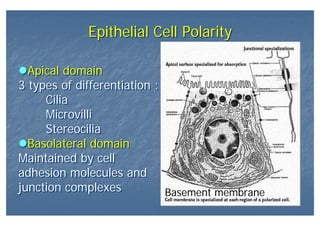
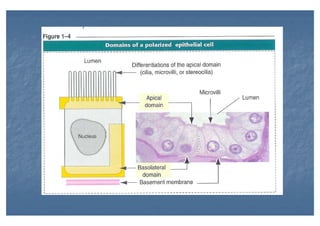
Epithelial Cell PolarityEpithelial Cell Polarity
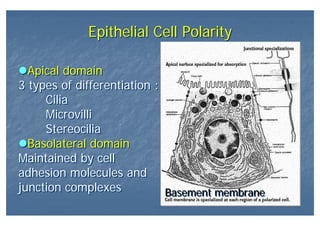
Apical domain
3 types of differentiation :
Cilia
Microvilli
Stereocilia
Basolateral domain
Maintained by cell
adhesion molecules and
junction complexes
Apical domain
3 types of differentiation :
Cilia
Microvilli
Stereocilia
Basolateral domain
Maintained by cell
adhesion molecules and
junction complexes Basement membrane
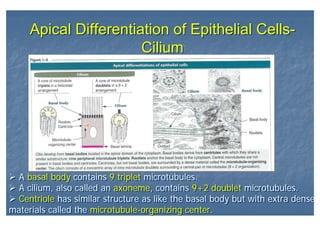
Apical Differentiation of Epithelial Cells-
Cilium
Apical Differentiation of Epithelial Cells-
Cilium
A basal body contains 9 triplet microtubules.
A cilium, also called an axoneme, contains 9+2 doublet microtubules.
Centriole has similar structure as like the basal body but with extra dense
materials called the microtubule-organizing center.
A basal body contains 9 triplet microtubules.
A cilium, also called an axoneme, contains 9+2 doublet microtubules.
Centriole has similar structure as like the basal body but with extra dense
materials called the microtubule-organizing center.
Apical Differentiation of Epithelial Cells-
Microvillus
Apical Differentiation of Epithelial Cells-
Microvillus
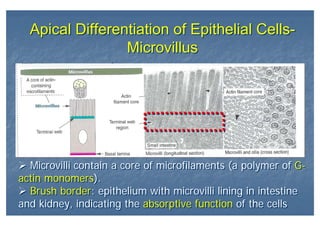
Microvilli contain a core of microfilaments (a polymer of G-
actin monomers).
Brush border: epithelium with microvilli lining in intestine
and kidney, indicating the absorptive function of the cells
Microvilli contain a core of microfilaments (a polymer of G-
actin monomers).
Brush border: epithelium with microvilli lining in intestine
and kidney, indicating the absorptive function of the cells
Apical Differentiation of Epithelial Cells-
Stereocilium
Apical Differentiation of Epithelial Cells-
Stereocilium
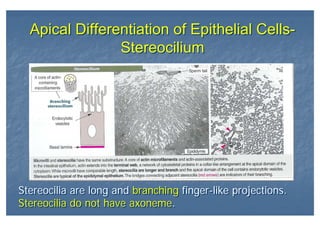
Stereocilia are long and branching finger-like projections.
Stereocilia do not have axoneme.
Stereocilia are long and branching finger-like projections.
Stereocilia do not have axoneme.
Epithelial Cell PolarityEpithelial Cell Polarity
Apical domain
3 types of differentiation :
Cilia
Microvilli
Stereocilia
Basolateral domain
Maintained by cell
adhesion molecules and
junction complexes
Apical domain
3 types of differentiation :
Cilia
Microvilli
Stereocilia
Basolateral domain
Maintained by cell
adhesion molecules and
junction complexes Basement membraneBasement membrane
Cell Adhesion Molecules and Cell JunctionsCell Adhesion Molecules and Cell Junctions
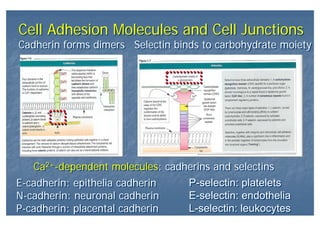
Ca2+-dependent molecules: cadherins and selectinsCa2+-dependent molecules: cadherins and selectins
E-cadherin: epithelia cadherin
N-cadherin: neuronal cadherin
P-cadherin: placental cadherin
E-cadherin: epithelia cadherin
N-cadherin: neuronal cadherin
P-cadherin: placental cadherin
Cadherin forms dimersCadherin forms dimers Selectin binds to carbohydrate moietySelectin binds to carbohydrate moiety
P-selectin: platelets
E-selectin: endothelia
L-selectin: leukocytes
P-selectin: platelets
E-selectin: endothelia
L-selectin: leukocytes
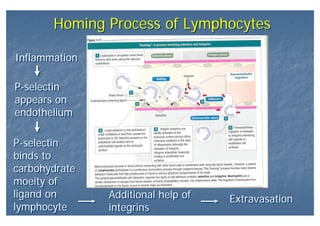
Homing Process of LymphocytesHoming Process of Lymphocytes
InflammationInflammation
P-selectin
appears on
endothelium
P-selectin
appears on
endothelium
P-selectin
binds to
carbohydrate
moeity of
ligand on
lymphocyte
P-selectin
binds to
carbohydrate
moeity of
ligand on
lymphocyte
Additional help of
integrins
Additional help of
integrins
ExtravasationExtravasation
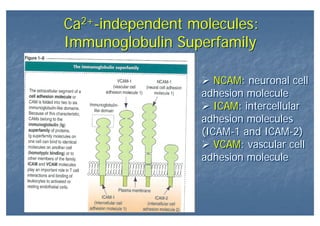
Ca2+-independent molecules:
Immunoglobulin Superfamily
Ca2+-independent molecules:
Immunoglobulin Superfamily
NCAM: neuronal cell
adhesion molecule
ICAM: intercellular
adhesion molecules
(ICAM-1 and ICAM-2)
VCAM: vascular cell
adhesion molecule
NCAM: neuronal cell
adhesion molecule
ICAM: intercellular
adhesion molecules
(ICAM-1 and ICAM-2)
VCAM: vascular cell
adhesion molecule
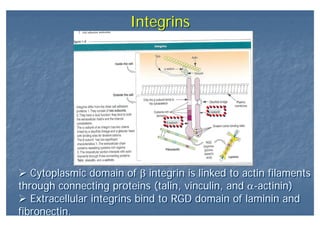
IntegrinsIntegrins
Cytoplasmic domain of β integrin is linked to actin filaments
through connecting proteins (talin, vinculin, and α-actinin)
Extracellular integrins bind to RGD domain of laminin and
fibronectin.
Cytoplasmic domain of β integrin is linked to actin filaments
through connecting proteins (talin, vinculin, and α-actinin)
Extracellular integrins bind to RGD domain of laminin and
fibronectin.
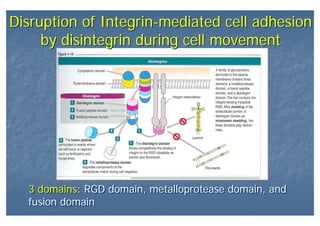
Disruption of Integrin-mediated cell adhesion
by disintegrin during cell movement
Disruption of Integrin-mediated cell adhesion
by disintegrin during cell movement
3 domains: RGD domain, metalloprotease domain, and
fusion domain
3 domains: RGD domain, metalloprotease domain, and
fusion domain
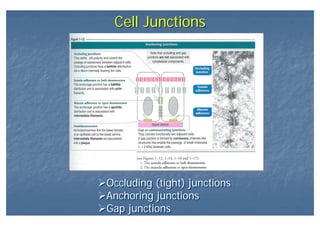
Cell JunctionsCell Junctions
Occluding (tight) junctions
Anchoring junctions
Gap junctions
Occluding (tight) junctions
Anchoring junctions
Gap junctions
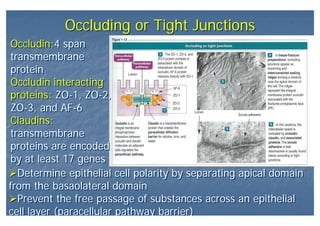
Occluding or Tight JunctionsOccluding or Tight Junctions
Determine epithelial cell polarity by separating apical domain
from the basaolateral domain
Prevent the free passage of substances across an epithelial
cell layer (paracellular pathway barrier)
Determine epithelial cell polarity by separating apical domain
from the basaolateral domain
Prevent the free passage of substances across an epithelial
cell layer (paracellular pathway barrier)
Occludin:4 span
transmembrane
protein
Occludin interacting
proteins: ZO-1, ZO-2,
ZO-3, and AF-6
Claudins:
transmembrane
proteins are encoded
by at least 17 genes
Occludin:4 span
transmembrane
protein
Occludin interacting
proteins: ZO-1, ZO-2,
ZO-3, and AF-6
Claudins:
transmembrane
proteins are encoded
by at least 17 genes
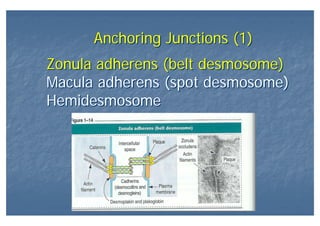
Anchoring Junctions (1)Anchoring Junctions (1)
Zonula adherens (belt desmosome)
Macula adherens (spot desmosome)
Hemidesmosome
Zonula adherens (belt desmosome)
Macula adherens (spot desmosome)
Hemidesmosome
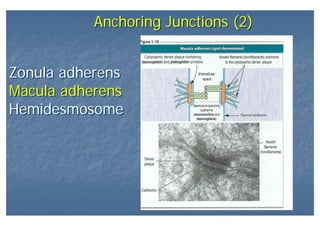
Anchoring Junctions (2)Anchoring Junctions (2)
Zonula adherens
Macula adherens
Hemidesmosome
Zonula adherens
Macula adherens
Hemidesmosome
Anchoring Junctions (3)Anchoring Junctions (3)
Zonula adherens
Macula adherens
Hemidesmosome
Zonula adherens
Macula adherens
Hemidesmosome
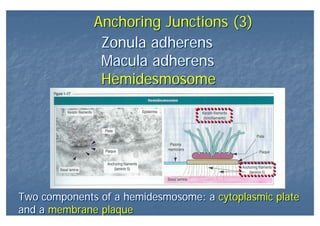
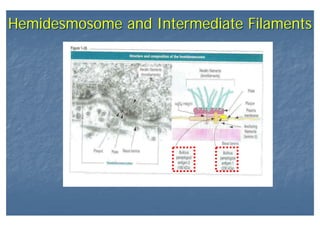
Two components of a hemidesmosome: a cytoplasmic plate
and a membrane plaque
Two components of a hemidesmosome: a cytoplasmic plate
and a membrane plaque
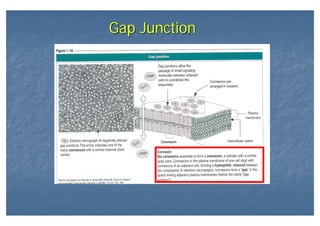
Gap JunctionGap Junction
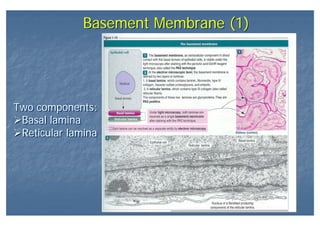
Basement Membrane (1)Basement Membrane (1)
Two components:
Basal lamina
Reticular lamina
Two components:
Basal lamina
Reticular lamina
Laminin and FibronectinLaminin and Fibronectin
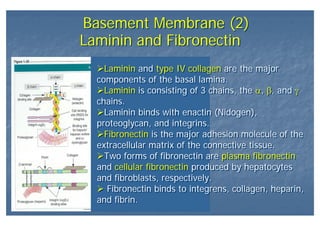
Basement Membrane (2)Basement Membrane (2)
Laminin and type IV collagen are the major
components of the basal lamina.
Laminin is consisting of 3 chains, the α, β, and γ
chains.
Laminin binds with enactin (Nidogen),
proteoglycan, and integrins.
Fibronectin is the major adhesion molecule of the
extracellular matrix of the connective tissue.
Two forms of fibronectin are plasma fibronectin
and cellular fibronectin produced by hepatocytes
and fibroblasts, respectively.
Fibronectin binds to integrens, collagen, heparin,
and fibrin.
Laminin and type IV collagen are the major
components of the basal lamina.
Laminin is consisting of 3 chains, the α, β, and γ
chains.
Laminin binds with enactin (Nidogen),
proteoglycan, and integrins.
Fibronectin is the major adhesion molecule of the
extracellular matrix of the connective tissue.
Two forms of fibronectin are plasma fibronectin
and cellular fibronectin produced by hepatocytes
and fibroblasts, respectively.
Fibronectin binds to integrens, collagen, heparin,
and fibrin.
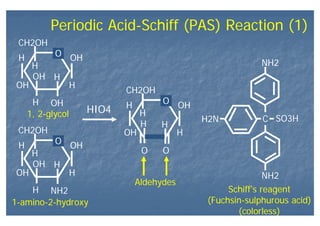
Periodic Acid-Schiff (PAS) Reaction (1)
CH2OH
O OH
HOH
H
H
H
OH
OH
H
CH2OH
O OH
HOH
H
H
H
NH2
OH
H
CH2OH
O OH
HOH
H
H
H
O
H
O
HIO4
H2N C SO3H
NH2
NH2
1, 2-glycol
1-amino-2-hydroxy
Aldehydes
Schiff’s reagent
(Fuchsin-sulphurous acid)
(colorless)
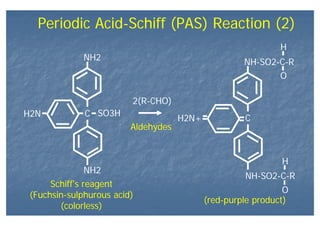
Periodic Acid-Schiff (PAS) Reaction (2)
H2N C SO3H
NH2
NH2
Schiff’s reagent
(Fuchsin-sulphurous acid)
(colorless)
H2N+ C
NH-SO2-C-R
O
H
NH-SO2-C-R
O
H
2(R-CHO)
Aldehydes
(red-purple product)
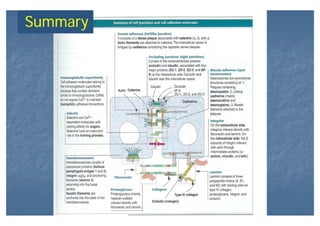
Summary
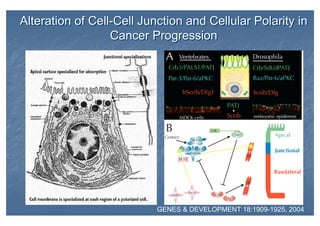
Alteration of Cell-Cell Junction and Cellular Polarity in
Cancer Progression
Alteration of Cell-Cell Junction and Cellular Polarity in
Cancer Progression
GENES & DEVELOPMENT 18:1909-1925, 2004
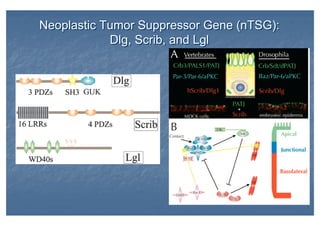
Neoplastic Tumor Suppressor Gene (nTSG):
Dlg, Scrib, and Lgl
Neoplastic Tumor Suppressor Gene (nTSG):
Dlg, Scrib, and Lgl
Roles of CytoskeletonRoles of Cytoskeleton
Cell movement
Support and strength for the cell
Phagocytosis
Cytokinesis
Cell-cell and cell-extracellular matrix adherence
Change in cell shape
Cell movement
Support and strength for the cell
Phagocytosis
Cytokinesis
Cell-cell and cell-extracellular matrix adherence
Change in cell shape
Three Size Groups of CytoskeletonThree Size Groups of Cytoskeleton
Microfilaments (~7 nm)
Intermediate filaments (~10 nm)
Microtubules (~25 nm)
Microfilaments (~7 nm)
Intermediate filaments (~10 nm)
Microtubules (~25 nm)
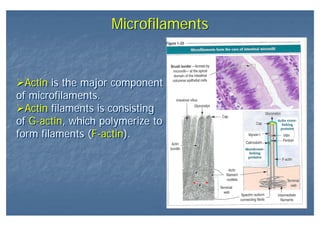
MicrofilamentsMicrofilaments
Actin is the major component
of microfilaments.
Actin filaments is consisting
of G-actin, which polymerize to
form filaments (F-actin).
Actin is the major component
of microfilaments.
Actin filaments is consisting
of G-actin, which polymerize to
form filaments (F-actin).
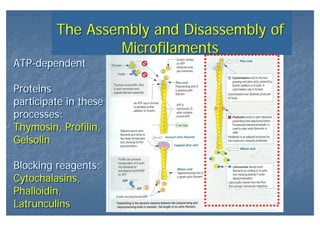
The Assembly and Disassembly of
Microfilaments
The Assembly and Disassembly of
Microfilaments
ATP-dependent
Proteins
participate in these
processes:
Thymosin, Profilin,
Gelsolin
Blocking reagents:
Cytochalasins,
Phalloidin,
Latrunculins
ATP-dependent
Proteins
participate in these
processes:
Thymosin, Profilin,
Gelsolin
Blocking reagents:
Cytochalasins,
Phalloidin,
Latrunculins
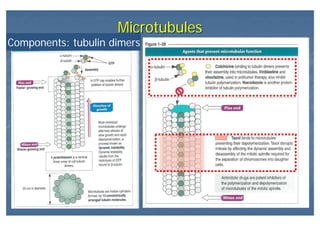
MicrotubulesMicrotubules
Components: tubulin dimers
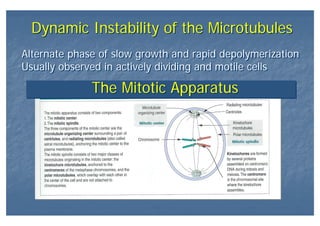
Dynamic Instability of the MicrotubulesDynamic Instability of the Microtubules
Alternate phase of slow growth and rapid depolymerization
Usually observed in actively dividing and motile cells
Alternate phase of slow growth and rapid depolymerization
Usually observed in actively dividing and motile cells
The Mitotic ApparatusThe Mitotic Apparatus
Intermediate FilamentsIntermediate Filaments
the most stable cytoskeletons
insoluble while treated with detergent and salt
regulated by phosphorylation during
assemly/disassembly processes
Mechanical support for the cell
the most stable cytoskeletons
insoluble while treated with detergent and salt
regulated by phosphorylation during
assemly/disassembly processes
Mechanical support for the cell
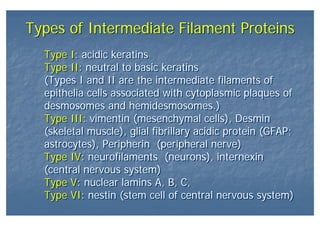
Types of Intermediate Filament ProteinsTypes of Intermediate Filament Proteins
Type I: acidic keratins
Type II: neutral to basic keratins
(Types I and II are the intermediate filaments of
epithelia cells associated with cytoplasmic plaques of
desmosomes and hemidesmosomes.)
Type III: vimentin (mesenchymal cells), Desmin
(skeletal muscle), glial fibrillary acidic protein (GFAP;
astrocytes), Peripherin (peripheral nerve)
Type IV: neurofilaments (neurons), internexin
(central nervous system)
Type V: nuclear lamins A, B, C,
Type VI: nestin (stem cell of central nervous system)
Type I: acidic keratins
Type II: neutral to basic keratins
(Types I and II are the intermediate filaments of
epithelia cells associated with cytoplasmic plaques of
desmosomes and hemidesmosomes.)
Type III: vimentin (mesenchymal cells), Desmin
(skeletal muscle), glial fibrillary acidic protein (GFAP;
astrocytes), Peripherin (peripheral nerve)
Type IV: neurofilaments (neurons), internexin
(central nervous system)
Type V: nuclear lamins A, B, C,
Type VI: nestin (stem cell of central nervous system)
Hemidesmosome and Intermediate FilamentsHemidesmosome and Intermediate Filaments
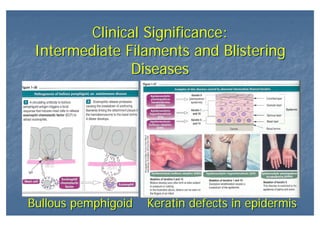
Clinical Significance:
Intermediate Filaments and Blistering
Diseases
Clinical Significance:
Intermediate Filaments and Blistering
Diseases
Bullous pemphigoidBullous pemphigoid Keratin defects in epidermisKeratin defects in epidermis
Study by Yourself…Study by Yourself…
The cell nucleus
The nucleolus
Control of the cell cycle
Tumor suppressor gene
Telomerase, senescence, and tumor
growth
…
The cell nucleus
The nucleolus
Control of the cell cycle
Tumor suppressor gene
Telomerase, senescence, and tumor
growth
…

(022607)chapter 1 epithelium

  • 1.
    Histology and CellBiology An Introduction to Pathology (Abraham L. Kierszenbaum, MD, PhD) Histology and Cell Biology An Introduction to Pathology (Abraham L. Kierszenbaum, MD, PhD) Overview Part I: Basic Tissues and Integrated Cell Biology Epithelial tissue Connective tissue Muscle tissue Nervous tissue Part II: Organ Systems: Protection of the Body Immune system Integumentary system Overview Part I: Basic Tissues and Integrated Cell Biology Epithelial tissue Connective tissue Muscle tissue Nervous tissue Part II: Organ Systems: Protection of the Body Immune system Integumentary system
  • 2.
    Overview Part III: OrganSystems: Blood Circulatory Systems Cardiovascular system Respiratory system Urinary system Part IV: Organ Systems: the Alimentary System Digestive system Part V: Organ Systems: the Endocrine system Neuroendocrine and endocrine systems Part IV: Organ Systems: the Reproduction system Male and Female reproductive systems Overview Part III: Organ Systems: Blood Circulatory Systems Cardiovascular system Respiratory system Urinary system Part IV: Organ Systems: the Alimentary System Digestive system Part V: Organ Systems: the Endocrine system Neuroendocrine and endocrine systems Part IV: Organ Systems: the Reproduction system Male and Female reproductive systems
  • 3.
    Classification of EpitheliumClassificationof Epithelium Simple epithelia Simple squamous epithelium Simple cuboidal epithelium Simple columnar epithelium Stratified epithelia Stratified squamous epithelium Stratified cuboidal epithelium Stratified columnar epithelium Pseudostratified epithelia Pseudostratified columnar ciliated epithelium (treachea) Pseudostartified columnar epi with stereocilia (epididymis) Transtional epithelium (urothelium) Simple epithelia Simple squamous epithelium Simple cuboidal epithelium Simple columnar epithelium Stratified epithelia Stratified squamous epithelium Stratified cuboidal epithelium Stratified columnar epithelium Pseudostratified epithelia Pseudostratified columnar ciliated epithelium (treachea) Pseudostartified columnar epi with stereocilia (epididymis) Transtional epithelium (urothelium)
  • 4.
    Simple Squamous EpitheliumSimpleSquamous Epithelium 型態:不規則、扁平、核所在處略厚 分布:鮑氏囊、亨氏套、肺泡、毛細管壁、中耳、內耳 作用:過濾、擴散 型態:不規則、扁平、核所在處略厚 分布:鮑氏囊、亨氏套、肺泡、毛細管壁、中耳、內耳 作用:過濾、擴散
  • 5.
    Simple Cuboidal EpitheliumSimpleCuboidal Epithelium 型態:盒型或立方,核於中央 分布:腎小管、集尿管、近、遠曲小管、一般腺體及其導 管壁、甲狀腺泡、肝及卵巢表面 上皮 作用:分泌、吸收 型態:盒型或立方,核於中央 分布:腎小管、集尿管、近、遠曲小管、一般腺體及其導 管壁、甲狀腺泡、肝及卵巢表面 上皮 作用:分泌、吸收
  • 6.
    Simple Columnar EpitheliumSimpleColumnar Epithelium 型態:似單層立方,細胞較長,核約同水平面且約近底端1/3處 分布:消化道、呼吸道、輸尿管或輸卵管內壁 作用:保護、分泌、吸收 型態:似單層立方,細胞較長,核約同水平面且約近底端1/3處 分布:消化道、呼吸道、輸尿管或輸卵管內壁 作用:保護、分泌、吸收
  • 7.
    Stratified Squamous EpitheliumStratifiedSquamous Epithelium 型態:上層扁平,中层不規則,深層立方或柱狀 分布:皮膚、硬顎、陰道外部→角化 口腔表面、咽、喉、會厭、食道、陰道深部→未角化 作用:保護,抵抗磨擦,防止水或細菌入侵 型態:上層扁平,中层不規則,深層立方或柱狀 分布:皮膚、硬顎、陰道外部→角化 口腔表面、咽、喉、會厭、食道、陰道深部→未角化 作用:保護,抵抗磨擦,防止水或細菌入侵
  • 8.
    Moderately Keratinized andHighly keratinized Stratified Squamous Epithelium Moderately Keratinized and Highly keratinized Stratified Squamous Epithelium
  • 9.
  • 10.
    Columnar cells withcilia Goblet cells (mucus-secreting cells) Columnar cells with cilia Goblet cells (mucus-secreting cells) Pseudostratified Epithelium (1)Pseudostratified Epithelium (1)
  • 11.
    Pseudostratified Epithelium (2)PseudostratifiedEpithelium (2) Columnar cells with stereocilia Principle cells (highly developed Golgi apparatus) Columnar cells with stereocilia Principle cells (highly developed Golgi apparatus)
  • 12.
  • 13.
    Main Characteristics ofEpitheliaMain Characteristics of Epithelia Derive from the ectoderm, mesoderm, and endoderm Line and cover all free surface of the body Basic functions: protection (skin); absorption (small and large intestine); transport of materials at the surface (ciliated epithelium); excretion (tubules of the kidney); gas exchange (lung alveolus); and gliding between surfaces (mesothelium) Continuous renewal by mitosis Lack a direct blood and lymphatic supply Anchored to basal lamina Maintained cellular polarity by cell adhesion molecules and junction complexes Derive from the ectoderm, mesoderm, and endoderm Line and cover all free surface of the body Basic functions: protection (skin); absorption (small and large intestine); transport of materials at the surface (ciliated epithelium); excretion (tubules of the kidney); gas exchange (lung alveolus); and gliding between surfaces (mesothelium) Continuous renewal by mitosis Lack a direct blood and lymphatic supply Anchored to basal lamina Maintained cellular polarity by cell adhesion molecules and junction complexes
  • 14.
    Epithelial Cell PolarityEpithelialCell Polarity Apical domain 3 types of differentiation : Cilia Microvilli Stereocilia Basolateral domain Maintained by cell adhesion molecules and junction complexes Apical domain 3 types of differentiation : Cilia Microvilli Stereocilia Basolateral domain Maintained by cell adhesion molecules and junction complexes Basement membrane
  • 16.
    Apical Differentiation ofEpithelial Cells- Cilium Apical Differentiation of Epithelial Cells- Cilium A basal body contains 9 triplet microtubules. A cilium, also called an axoneme, contains 9+2 doublet microtubules. Centriole has similar structure as like the basal body but with extra dense materials called the microtubule-organizing center. A basal body contains 9 triplet microtubules. A cilium, also called an axoneme, contains 9+2 doublet microtubules. Centriole has similar structure as like the basal body but with extra dense materials called the microtubule-organizing center.
  • 17.
    Apical Differentiation ofEpithelial Cells- Microvillus Apical Differentiation of Epithelial Cells- Microvillus Microvilli contain a core of microfilaments (a polymer of G- actin monomers). Brush border: epithelium with microvilli lining in intestine and kidney, indicating the absorptive function of the cells Microvilli contain a core of microfilaments (a polymer of G- actin monomers). Brush border: epithelium with microvilli lining in intestine and kidney, indicating the absorptive function of the cells
  • 18.
    Apical Differentiation ofEpithelial Cells- Stereocilium Apical Differentiation of Epithelial Cells- Stereocilium Stereocilia are long and branching finger-like projections. Stereocilia do not have axoneme. Stereocilia are long and branching finger-like projections. Stereocilia do not have axoneme.
  • 19.
    Epithelial Cell PolarityEpithelialCell Polarity Apical domain 3 types of differentiation : Cilia Microvilli Stereocilia Basolateral domain Maintained by cell adhesion molecules and junction complexes Apical domain 3 types of differentiation : Cilia Microvilli Stereocilia Basolateral domain Maintained by cell adhesion molecules and junction complexes Basement membraneBasement membrane
  • 20.
    Cell Adhesion Moleculesand Cell JunctionsCell Adhesion Molecules and Cell Junctions Ca2+-dependent molecules: cadherins and selectinsCa2+-dependent molecules: cadherins and selectins E-cadherin: epithelia cadherin N-cadherin: neuronal cadherin P-cadherin: placental cadherin E-cadherin: epithelia cadherin N-cadherin: neuronal cadherin P-cadherin: placental cadherin Cadherin forms dimersCadherin forms dimers Selectin binds to carbohydrate moietySelectin binds to carbohydrate moiety P-selectin: platelets E-selectin: endothelia L-selectin: leukocytes P-selectin: platelets E-selectin: endothelia L-selectin: leukocytes
  • 21.
    Homing Process ofLymphocytesHoming Process of Lymphocytes InflammationInflammation P-selectin appears on endothelium P-selectin appears on endothelium P-selectin binds to carbohydrate moeity of ligand on lymphocyte P-selectin binds to carbohydrate moeity of ligand on lymphocyte Additional help of integrins Additional help of integrins ExtravasationExtravasation
  • 22.
    Ca2+-independent molecules: Immunoglobulin Superfamily Ca2+-independentmolecules: Immunoglobulin Superfamily NCAM: neuronal cell adhesion molecule ICAM: intercellular adhesion molecules (ICAM-1 and ICAM-2) VCAM: vascular cell adhesion molecule NCAM: neuronal cell adhesion molecule ICAM: intercellular adhesion molecules (ICAM-1 and ICAM-2) VCAM: vascular cell adhesion molecule
  • 23.
    IntegrinsIntegrins Cytoplasmic domain ofβ integrin is linked to actin filaments through connecting proteins (talin, vinculin, and α-actinin) Extracellular integrins bind to RGD domain of laminin and fibronectin. Cytoplasmic domain of β integrin is linked to actin filaments through connecting proteins (talin, vinculin, and α-actinin) Extracellular integrins bind to RGD domain of laminin and fibronectin.
  • 24.
    Disruption of Integrin-mediatedcell adhesion by disintegrin during cell movement Disruption of Integrin-mediated cell adhesion by disintegrin during cell movement 3 domains: RGD domain, metalloprotease domain, and fusion domain 3 domains: RGD domain, metalloprotease domain, and fusion domain
  • 25.
    Cell JunctionsCell Junctions Occluding(tight) junctions Anchoring junctions Gap junctions Occluding (tight) junctions Anchoring junctions Gap junctions
  • 26.
    Occluding or TightJunctionsOccluding or Tight Junctions Determine epithelial cell polarity by separating apical domain from the basaolateral domain Prevent the free passage of substances across an epithelial cell layer (paracellular pathway barrier) Determine epithelial cell polarity by separating apical domain from the basaolateral domain Prevent the free passage of substances across an epithelial cell layer (paracellular pathway barrier) Occludin:4 span transmembrane protein Occludin interacting proteins: ZO-1, ZO-2, ZO-3, and AF-6 Claudins: transmembrane proteins are encoded by at least 17 genes Occludin:4 span transmembrane protein Occludin interacting proteins: ZO-1, ZO-2, ZO-3, and AF-6 Claudins: transmembrane proteins are encoded by at least 17 genes
  • 27.
    Anchoring Junctions (1)AnchoringJunctions (1) Zonula adherens (belt desmosome) Macula adherens (spot desmosome) Hemidesmosome Zonula adherens (belt desmosome) Macula adherens (spot desmosome) Hemidesmosome
  • 28.
    Anchoring Junctions (2)AnchoringJunctions (2) Zonula adherens Macula adherens Hemidesmosome Zonula adherens Macula adherens Hemidesmosome
  • 29.
    Anchoring Junctions (3)AnchoringJunctions (3) Zonula adherens Macula adherens Hemidesmosome Zonula adherens Macula adherens Hemidesmosome Two components of a hemidesmosome: a cytoplasmic plate and a membrane plaque Two components of a hemidesmosome: a cytoplasmic plate and a membrane plaque
  • 30.
  • 31.
    Basement Membrane (1)BasementMembrane (1) Two components: Basal lamina Reticular lamina Two components: Basal lamina Reticular lamina
  • 32.
    Laminin and FibronectinLamininand Fibronectin Basement Membrane (2)Basement Membrane (2) Laminin and type IV collagen are the major components of the basal lamina. Laminin is consisting of 3 chains, the α, β, and γ chains. Laminin binds with enactin (Nidogen), proteoglycan, and integrins. Fibronectin is the major adhesion molecule of the extracellular matrix of the connective tissue. Two forms of fibronectin are plasma fibronectin and cellular fibronectin produced by hepatocytes and fibroblasts, respectively. Fibronectin binds to integrens, collagen, heparin, and fibrin. Laminin and type IV collagen are the major components of the basal lamina. Laminin is consisting of 3 chains, the α, β, and γ chains. Laminin binds with enactin (Nidogen), proteoglycan, and integrins. Fibronectin is the major adhesion molecule of the extracellular matrix of the connective tissue. Two forms of fibronectin are plasma fibronectin and cellular fibronectin produced by hepatocytes and fibroblasts, respectively. Fibronectin binds to integrens, collagen, heparin, and fibrin.
  • 33.
    Periodic Acid-Schiff (PAS)Reaction (1) CH2OH O OH HOH H H H OH OH H CH2OH O OH HOH H H H NH2 OH H CH2OH O OH HOH H H H O H O HIO4 H2N C SO3H NH2 NH2 1, 2-glycol 1-amino-2-hydroxy Aldehydes Schiff’s reagent (Fuchsin-sulphurous acid) (colorless)
  • 34.
    Periodic Acid-Schiff (PAS)Reaction (2) H2N C SO3H NH2 NH2 Schiff’s reagent (Fuchsin-sulphurous acid) (colorless) H2N+ C NH-SO2-C-R O H NH-SO2-C-R O H 2(R-CHO) Aldehydes (red-purple product)
  • 35.
  • 36.
    Alteration of Cell-CellJunction and Cellular Polarity in Cancer Progression Alteration of Cell-Cell Junction and Cellular Polarity in Cancer Progression GENES & DEVELOPMENT 18:1909-1925, 2004
  • 37.
    Neoplastic Tumor SuppressorGene (nTSG): Dlg, Scrib, and Lgl Neoplastic Tumor Suppressor Gene (nTSG): Dlg, Scrib, and Lgl
  • 38.
    Roles of CytoskeletonRolesof Cytoskeleton Cell movement Support and strength for the cell Phagocytosis Cytokinesis Cell-cell and cell-extracellular matrix adherence Change in cell shape Cell movement Support and strength for the cell Phagocytosis Cytokinesis Cell-cell and cell-extracellular matrix adherence Change in cell shape
  • 39.
    Three Size Groupsof CytoskeletonThree Size Groups of Cytoskeleton Microfilaments (~7 nm) Intermediate filaments (~10 nm) Microtubules (~25 nm) Microfilaments (~7 nm) Intermediate filaments (~10 nm) Microtubules (~25 nm)
  • 40.
    MicrofilamentsMicrofilaments Actin is themajor component of microfilaments. Actin filaments is consisting of G-actin, which polymerize to form filaments (F-actin). Actin is the major component of microfilaments. Actin filaments is consisting of G-actin, which polymerize to form filaments (F-actin).
  • 41.
    The Assembly andDisassembly of Microfilaments The Assembly and Disassembly of Microfilaments ATP-dependent Proteins participate in these processes: Thymosin, Profilin, Gelsolin Blocking reagents: Cytochalasins, Phalloidin, Latrunculins ATP-dependent Proteins participate in these processes: Thymosin, Profilin, Gelsolin Blocking reagents: Cytochalasins, Phalloidin, Latrunculins
  • 42.
  • 43.
    Dynamic Instability ofthe MicrotubulesDynamic Instability of the Microtubules Alternate phase of slow growth and rapid depolymerization Usually observed in actively dividing and motile cells Alternate phase of slow growth and rapid depolymerization Usually observed in actively dividing and motile cells The Mitotic ApparatusThe Mitotic Apparatus
  • 44.
    Intermediate FilamentsIntermediate Filaments themost stable cytoskeletons insoluble while treated with detergent and salt regulated by phosphorylation during assemly/disassembly processes Mechanical support for the cell the most stable cytoskeletons insoluble while treated with detergent and salt regulated by phosphorylation during assemly/disassembly processes Mechanical support for the cell
  • 45.
    Types of IntermediateFilament ProteinsTypes of Intermediate Filament Proteins Type I: acidic keratins Type II: neutral to basic keratins (Types I and II are the intermediate filaments of epithelia cells associated with cytoplasmic plaques of desmosomes and hemidesmosomes.) Type III: vimentin (mesenchymal cells), Desmin (skeletal muscle), glial fibrillary acidic protein (GFAP; astrocytes), Peripherin (peripheral nerve) Type IV: neurofilaments (neurons), internexin (central nervous system) Type V: nuclear lamins A, B, C, Type VI: nestin (stem cell of central nervous system) Type I: acidic keratins Type II: neutral to basic keratins (Types I and II are the intermediate filaments of epithelia cells associated with cytoplasmic plaques of desmosomes and hemidesmosomes.) Type III: vimentin (mesenchymal cells), Desmin (skeletal muscle), glial fibrillary acidic protein (GFAP; astrocytes), Peripherin (peripheral nerve) Type IV: neurofilaments (neurons), internexin (central nervous system) Type V: nuclear lamins A, B, C, Type VI: nestin (stem cell of central nervous system)
  • 46.
    Hemidesmosome and IntermediateFilamentsHemidesmosome and Intermediate Filaments
  • 47.
    Clinical Significance: Intermediate Filamentsand Blistering Diseases Clinical Significance: Intermediate Filaments and Blistering Diseases Bullous pemphigoidBullous pemphigoid Keratin defects in epidermisKeratin defects in epidermis
  • 48.
    Study by Yourself…Studyby Yourself… The cell nucleus The nucleolus Control of the cell cycle Tumor suppressor gene Telomerase, senescence, and tumor growth … The cell nucleus The nucleolus Control of the cell cycle Tumor suppressor gene Telomerase, senescence, and tumor growth …