SMOOTH ENDOPLASMIC
RETICULUM & VACUOLES
PRESENTED BY
UPASNA SINGH
NIPERA1820PC16
PHARMACOLOGY &
TOXICOLOGY
GUIDED BY
DR. AMIT KHAIRNAR
1
ENDOPLASMIC RETICULUM
 ER is also known as Warehouse or Manufacturing unit of the cell.
 ER was discovered in 1945 by Ernest Fullam , Keith Porter and
Albert Claude in Belgium at Rockefeller institute.
 ER is a continuous membrane system that forms a series of
flattened sacs within the cytoplasm of eukaryotic cells.
 It serves multiple functions, being important particularly in the
synthesis, folding, modification, and transport of proteins.
 The ER can be classified in two functionally distinct form:-
 1)Rough ER (site for protein synthesis)
 2)smooth ER (site for lipid & carbohydrate metabolism)
2
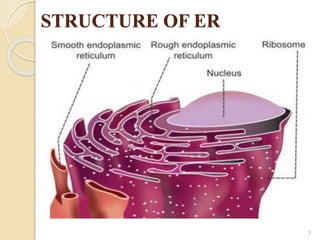
STRUCTURE OF ER
3
SMOOTH ENDOPLASMIC RETICULUM
The smooth ER is a meshwork of fine disk like tubular membrane
vesicles, part of a continuous membrane organelle within the cytoplasm
of eukaryotic cell.
The smooth ER is distinguished from the rough ER by the absence of
membrane-bound ribosomes. Smooth ER is often made of tubular
structures called cisternae.
Smooth ER is prominent
o In cells of the liver that process harmful chemicals,
o In cells of the endocrine system such as those in the adrenals that
produce steroid hormones,
o In excitable cells such as neurons and muscle cells that use
Ca2+ signaling.
4
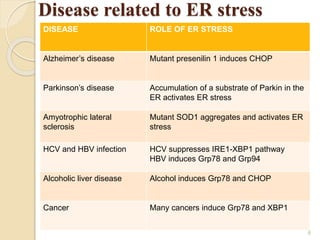
FUNCTIONS OF SER
Calcium store
In skeletal muscle cells, SER occurs as a
specialized membrane structure known as the sarcoplasmic reticulum.
The sarcoplasmic reticulum is a critical storage site for calcium ions,
taking up the ions from the cytoplasm. It also releases calcium ions
when the muscle cell is triggered by nerve stimuli, resulting in muscle
contraction.
Carbohydrate and Lipid Synthesis
Transportation of Proteins
Detoxification
Other Important Functions
5
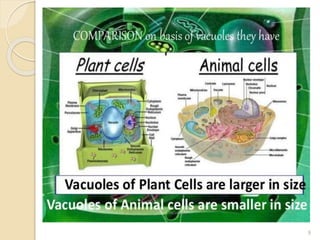
Disease related to ER stress
6
DISEASE ROLE OF ER STRESS
Alzheimer’s disease Mutant presenilin 1 induces CHOP
Parkinson’s disease Accumulation of a substrate of Parkin in the
ER activates ER stress
Amyotrophic lateral
sclerosis
Mutant SOD1 aggregates and activates ER
stress
HCV and HBV infection HCV suppresses IRE1-XBP1 pathway
HBV induces Grp78 and Grp94
Alcoholic liver disease Alcohol induces Grp78 and CHOP
Cancer Many cancers induce Grp78 and XBP1
vacuoles
7
8
9
REFERENCES:-
10
https://www.slideshare.net/amangoel1462/vacuoles-
61662930
https://www.slideshare.net/shimoki/smooth-
endoplasmic-reticulum-36483211
https://www.slideshare.net/Dilippandya/endopla
smic-reticulum-46636368
https://www.britannica.com/science/endoplasmi
c-reticulum
Tabas I, Ron D. 2011. Integrating the mechanisms of
apoptosis induced by endoplasmic reticulum stress.
Nat. Cell Biol. 13:184–90
 Marciniak SJ, Ron D. 2006. Endoplasmic reticulum
stress signaling in disease. Physiol. Rev. 86:1133–49
THANK YOU
11
The function of the SER can vary, depending on cell type. In some cells,
such as those of the adrenal gland and certain other endocrine glands, it
plays a key role in the synthesis of steroid hormonesfrom cholesterol. In
the liver, enzymes in the SER catalyze reactions that render drugs,
metabolic wastes, and harmful chemicals water-soluble, thereby
contributing to their detoxification, or removal, from the body. The SER also
plays a role in the conversion of glycogen to glucose, with glucose-6-
phosphatase, an enzyme present in SER, catalyzing the final step in
glucose production in the liver.
In skeletal muscle cells, SER occurs as a specialized membrane
structure known as the sarcoplasmic reticulum. The sarcoplasmic reticulum
is a critical storage site for calcium ions, taking up the ions from the
cytoplasm. It also releases calcium ions when the muscle cell is triggered
by nerve stimuli, resulting in muscle contraction. In this way, the
sarcoplasmic reticulum helps regulate calcium ion concentrations in the
cytoplasm of skeletal muscle cells. The sarcoplasmic reticulum is also
found in smooth muscle cells, though in a more loosely organized form
than in skeletal muscle.
12
Smooth endoplasmic reticulum (SER), meshwork of fine
disklike tubular membrane vesicles, part of a continuous
membrane organelle within the cytoplasm of eukaryotic cells, that
is involved in the synthesis and storage of lipids,
including cholesterol and phospholipids, which are used in the
production of new cellular membrane. The smooth endoplasmic
reticulum (SER) is distinguished from the rough endoplasmic
reticulum (RER), the other basic type of endoplasmic reticulum,
by its lack of ribosomes, which are protein-synthesizing particles
that can be found attached to the outer surface of the RER to give
the membrane its “rough” appearance. SER occurs both
in animal and in plant cells.
13
14
Endoplasmic reticulum
The endoplasmic reticulum (ER) is a
compartment (organelle) in eukaryotic cells
that consists of membrane sacs called
cisternae. Because of the bound
ribosomes, the 'rough' ER is the site of
synthesis of various proteins and is where
newly synthesized proteins are modified by
glycosylation. The 'smooth' ER is a site for
lipid and carbohydrate metabolism.
15
Smooth E R (SER) is associated with the
production and metabolism of fats and
steroid hormones. It is 'smooth' because it
is not studded with ribosomes and is
associated with smooth slippery fats.
Well it of course depends on which ER
you're speaking of. The rough ER has
attached ribosomes critical for protein
synthesis. Smooth ER produce lipids and
steroids etc so basically cells NEED these
organelles. Without them many enzymatic
processes would be unable to occur
ultimately killing the cell.
What would happen to cells
without the endoplasmic
reticulum?
16
Without the RER the cell is not able to synthesis new
plasma membrane proteins, lysosomal enzymes, proteines
for the Golgi apparatus and proteins for extracellular
secretion. Because these kind of proteins are synthesised
in the RER.
The smooth ER has an important role in lipid and steroid
synthesis, it is a storage for intracellular calcium as well.
Without ER in the skeletal muscle fibers couldn’t happen
muscle contraction.
In the absence of these cellular mechanisms the cell would
probably die.
Maybe the most deadly for the cells is that they can’t
change their membrane proteins for new ones without
secretion. And the continuous damage to the membrane
proteins makes the cells unable to interact with the
extracellular matrix and more susceptible to apoptosis and
phagocytosis.

Smooth endoplasmic reticulum & vacuoles

  • 1.
    SMOOTH ENDOPLASMIC RETICULUM &VACUOLES PRESENTED BY UPASNA SINGH NIPERA1820PC16 PHARMACOLOGY & TOXICOLOGY GUIDED BY DR. AMIT KHAIRNAR 1
  • 2.
    ENDOPLASMIC RETICULUM  ERis also known as Warehouse or Manufacturing unit of the cell.  ER was discovered in 1945 by Ernest Fullam , Keith Porter and Albert Claude in Belgium at Rockefeller institute.  ER is a continuous membrane system that forms a series of flattened sacs within the cytoplasm of eukaryotic cells.  It serves multiple functions, being important particularly in the synthesis, folding, modification, and transport of proteins.  The ER can be classified in two functionally distinct form:-  1)Rough ER (site for protein synthesis)  2)smooth ER (site for lipid & carbohydrate metabolism) 2
  • 3.
  • 4.
    SMOOTH ENDOPLASMIC RETICULUM Thesmooth ER is a meshwork of fine disk like tubular membrane vesicles, part of a continuous membrane organelle within the cytoplasm of eukaryotic cell. The smooth ER is distinguished from the rough ER by the absence of membrane-bound ribosomes. Smooth ER is often made of tubular structures called cisternae. Smooth ER is prominent o In cells of the liver that process harmful chemicals, o In cells of the endocrine system such as those in the adrenals that produce steroid hormones, o In excitable cells such as neurons and muscle cells that use Ca2+ signaling. 4
  • 5.
    FUNCTIONS OF SER Calciumstore In skeletal muscle cells, SER occurs as a specialized membrane structure known as the sarcoplasmic reticulum. The sarcoplasmic reticulum is a critical storage site for calcium ions, taking up the ions from the cytoplasm. It also releases calcium ions when the muscle cell is triggered by nerve stimuli, resulting in muscle contraction. Carbohydrate and Lipid Synthesis Transportation of Proteins Detoxification Other Important Functions 5
  • 6.
    Disease related toER stress 6 DISEASE ROLE OF ER STRESS Alzheimer’s disease Mutant presenilin 1 induces CHOP Parkinson’s disease Accumulation of a substrate of Parkin in the ER activates ER stress Amyotrophic lateral sclerosis Mutant SOD1 aggregates and activates ER stress HCV and HBV infection HCV suppresses IRE1-XBP1 pathway HBV induces Grp78 and Grp94 Alcoholic liver disease Alcohol induces Grp78 and CHOP Cancer Many cancers induce Grp78 and XBP1
  • 7.
  • 8.
  • 9.
  • 10.
    REFERENCES:- 10 https://www.slideshare.net/amangoel1462/vacuoles- 61662930 https://www.slideshare.net/shimoki/smooth- endoplasmic-reticulum-36483211 https://www.slideshare.net/Dilippandya/endopla smic-reticulum-46636368 https://www.britannica.com/science/endoplasmi c-reticulum Tabas I, RonD. 2011. Integrating the mechanisms of apoptosis induced by endoplasmic reticulum stress. Nat. Cell Biol. 13:184–90  Marciniak SJ, Ron D. 2006. Endoplasmic reticulum stress signaling in disease. Physiol. Rev. 86:1133–49
  • 11.
  • 12.
    The function ofthe SER can vary, depending on cell type. In some cells, such as those of the adrenal gland and certain other endocrine glands, it plays a key role in the synthesis of steroid hormonesfrom cholesterol. In the liver, enzymes in the SER catalyze reactions that render drugs, metabolic wastes, and harmful chemicals water-soluble, thereby contributing to their detoxification, or removal, from the body. The SER also plays a role in the conversion of glycogen to glucose, with glucose-6- phosphatase, an enzyme present in SER, catalyzing the final step in glucose production in the liver. In skeletal muscle cells, SER occurs as a specialized membrane structure known as the sarcoplasmic reticulum. The sarcoplasmic reticulum is a critical storage site for calcium ions, taking up the ions from the cytoplasm. It also releases calcium ions when the muscle cell is triggered by nerve stimuli, resulting in muscle contraction. In this way, the sarcoplasmic reticulum helps regulate calcium ion concentrations in the cytoplasm of skeletal muscle cells. The sarcoplasmic reticulum is also found in smooth muscle cells, though in a more loosely organized form than in skeletal muscle. 12
  • 13.
    Smooth endoplasmic reticulum(SER), meshwork of fine disklike tubular membrane vesicles, part of a continuous membrane organelle within the cytoplasm of eukaryotic cells, that is involved in the synthesis and storage of lipids, including cholesterol and phospholipids, which are used in the production of new cellular membrane. The smooth endoplasmic reticulum (SER) is distinguished from the rough endoplasmic reticulum (RER), the other basic type of endoplasmic reticulum, by its lack of ribosomes, which are protein-synthesizing particles that can be found attached to the outer surface of the RER to give the membrane its “rough” appearance. SER occurs both in animal and in plant cells. 13
  • 14.
    14 Endoplasmic reticulum The endoplasmicreticulum (ER) is a compartment (organelle) in eukaryotic cells that consists of membrane sacs called cisternae. Because of the bound ribosomes, the 'rough' ER is the site of synthesis of various proteins and is where newly synthesized proteins are modified by glycosylation. The 'smooth' ER is a site for lipid and carbohydrate metabolism.
  • 15.
    15 Smooth E R(SER) is associated with the production and metabolism of fats and steroid hormones. It is 'smooth' because it is not studded with ribosomes and is associated with smooth slippery fats. Well it of course depends on which ER you're speaking of. The rough ER has attached ribosomes critical for protein synthesis. Smooth ER produce lipids and steroids etc so basically cells NEED these organelles. Without them many enzymatic processes would be unable to occur ultimately killing the cell.
  • 16.
    What would happento cells without the endoplasmic reticulum? 16 Without the RER the cell is not able to synthesis new plasma membrane proteins, lysosomal enzymes, proteines for the Golgi apparatus and proteins for extracellular secretion. Because these kind of proteins are synthesised in the RER. The smooth ER has an important role in lipid and steroid synthesis, it is a storage for intracellular calcium as well. Without ER in the skeletal muscle fibers couldn’t happen muscle contraction. In the absence of these cellular mechanisms the cell would probably die. Maybe the most deadly for the cells is that they can’t change their membrane proteins for new ones without secretion. And the continuous damage to the membrane proteins makes the cells unable to interact with the extracellular matrix and more susceptible to apoptosis and phagocytosis.