Introduction to Histology
• Four basic tissue types:
Epithelial connective muscle nervous
• All animals are composed of ONLY
these four tissue types
• Tissue types are organized to form
organs, which form the functional
systems of the body
Epithelial tissueEpithelial tissue
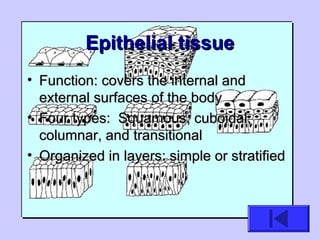
• Function: covers the internal andFunction: covers the internal and
external surfaces of the bodyexternal surfaces of the body
• Four types: Squamous, cuboidal,Four types: Squamous, cuboidal,
columnar, and transitionalcolumnar, and transitional
• Organized in layers: simple or stratifiedOrganized in layers: simple or stratified
Examples: Epithelial
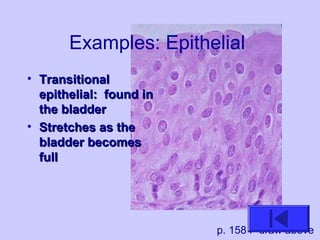
• TransitionalTransitional
epithelial: found inepithelial: found in
the bladderthe bladder
• Stretches as theStretches as the
bladder becomesbladder becomes
fullfull
p. 158 F draw above
Examples: Epithelial
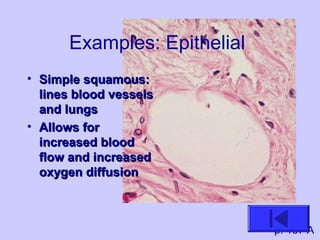
• Simple squamous:Simple squamous:
lines blood vesselslines blood vessels
and lungsand lungs
• Allows forAllows for
increased bloodincreased blood
flow and increasedflow and increased
oxygen diffusionoxygen diffusion
p. 157 A
Examples: Epithelial
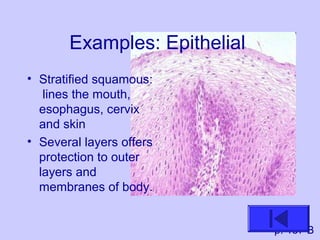
• Stratified squamous:
lines the mouth,
esophagus, cervix
and skin
• Several layers offers
protection to outer
layers and
membranes of body.
p. 157 B
Examples: Epithelial
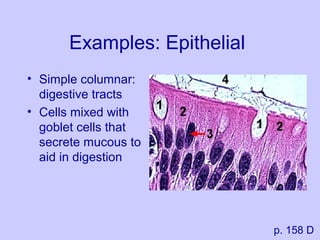
• Simple columnar:
digestive tracts
• Cells mixed with
goblet cells that
secrete mucous to
aid in digestion
p. 158 D
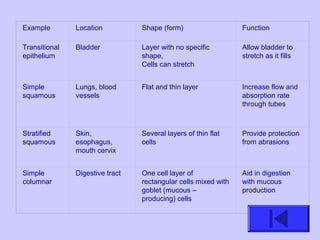
Example Location Shape (form) Function
Transitional
epithelium
Bladder Layer with no specific
shape,
Cells can stretch
Allow bladder to
stretch as it fills
Simple
squamous
Lungs, blood
vessels
Flat and thin layer Increase flow and
absorption rate
through tubes
Stratified
squamous
Skin,
esophagus,
mouth cervix
Several layers of thin flat
cells
Provide protection
from abrasions
Simple
columnar
Digestive tract One cell layer of
rectangular cells mixed with
goblet (mucous –
producing) cells
Aid in digestion
with mucous
production
Connective
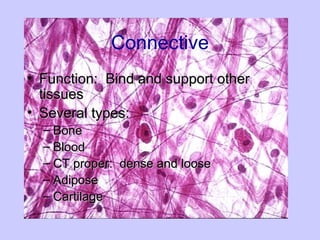
• Function: Bind and support otherFunction: Bind and support other
tissuestissues
• Several types:Several types:
– BoneBone
– BloodBlood
– CT proper: dense and looseCT proper: dense and loose
– AdiposeAdipose
– CartilageCartilage
Examples: Connective
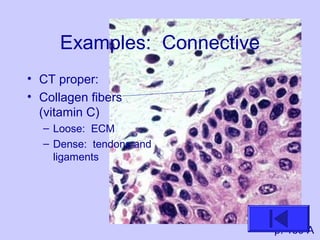
• CT proper:
• Collagen fibers
(vitamin C)
– Loose: ECM
– Dense: tendons and
ligaments
p. 159 A
Examples: Connective
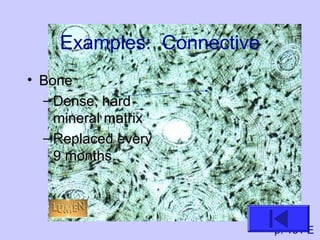
• BoneBone
– Dense, hardDense, hard
mineral matrixmineral matrix
– Replaced everyReplaced every
9 months.9 months.
p. 161 E
Examples: Connective
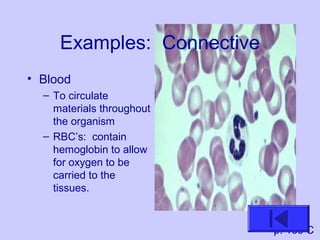
• Blood
– To circulate
materials throughout
the organism
– RBC’s: contain
hemoglobin to allow
for oxygen to be
carried to the
tissues.
p. 160 C
Examples: ConnectiveExamples: Connective
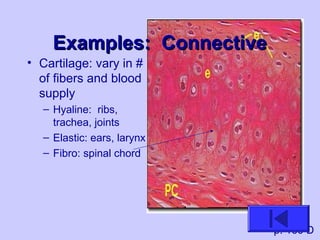
• Cartilage: vary in #
of fibers and blood
supply
– Hyaline: ribs,
trachea, joints
– Elastic: ears, larynx
– Fibro: spinal chord
p. 160 D
Examples: Connective
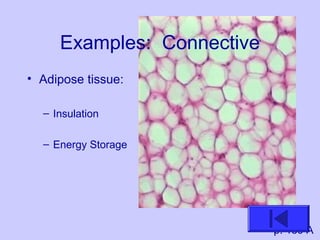
• Adipose tissue:
– Insulation
– Energy Storage
p. 159 A
Muscle tissueMuscle tissue
• Function: Able to contract forFunction: Able to contract for
locomotion.locomotion.
• Three types: skeletal, cardiac andThree types: skeletal, cardiac and
smoothsmooth
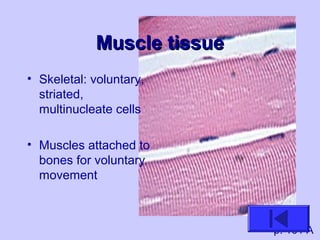
Muscle tissueMuscle tissue
• Skeletal: voluntary,
striated,
multinucleate cells
• Muscles attached to
bones for voluntary
movement
p. 161 A
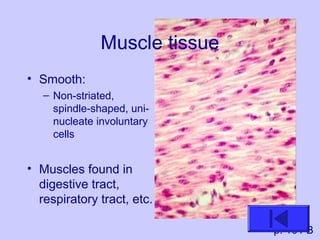
Muscle tissue
• Smooth:
– Non-striated,
spindle-shaped, uni-
nucleate involuntary
cells
• Muscles found in
digestive tract,
respiratory tract, etc.
p. 161 B
Muscle tissue
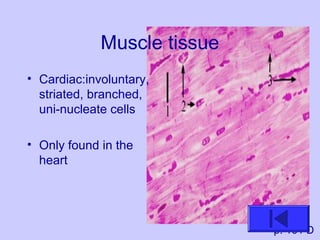
• Cardiac:involuntary,
striated, branched,
uni-nucleate cells
• Only found in the
heart
p. 161 D
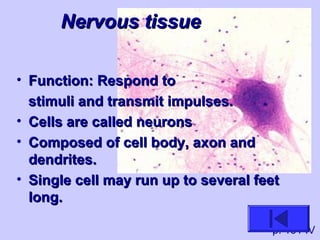
Nervous tissueNervous tissue
• Function: Respond toFunction: Respond to
stimuli and transmit impulses.stimuli and transmit impulses.
• Cells are called neuronsCells are called neurons
• Composed of cell body, axon andComposed of cell body, axon and
dendrites.dendrites.
• Single cell may run up to several feetSingle cell may run up to several feet
long.long.
p. 161 IV
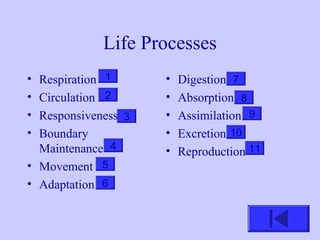
Life Processes
• Respiration
• Circulation
• Responsiveness
• Boundary
Maintenance
• Movement
• Adaptation
• Digestion
• Absorption
• Assimilation
• Excretion
• Reproduction
1
3
4
5
6
11
10
9
8
7
2
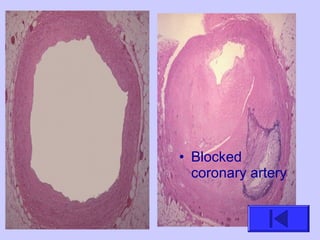
• Blocked
coronary artery
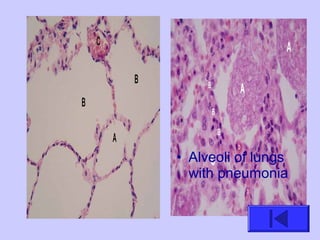
• Alveoli of lungs
with pneumonia
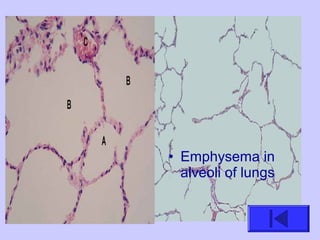
• Emphysema in
alveoli of lungs
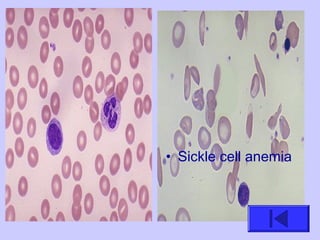
• Sickle cell anemia
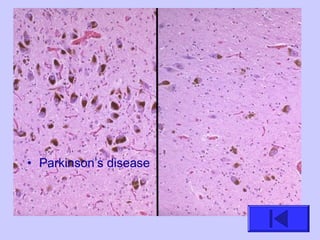
• Parkinson’s disease
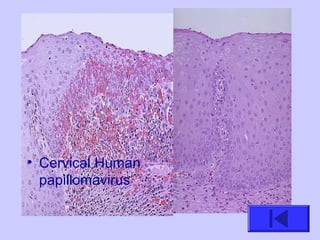
• Cervical Human
papillomavirus
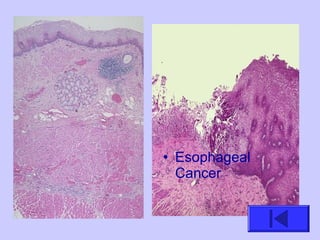
• Esophageal
Cancer
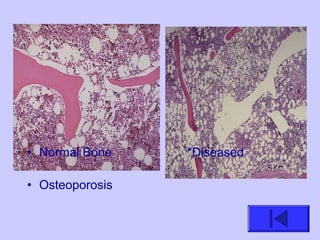
• Normal Bone *Diseased
• Osteoporosis
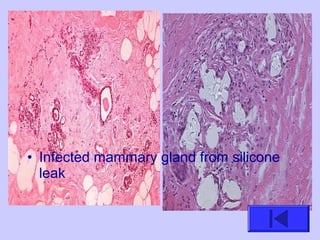
• Infected mammary gland from silicone
leak
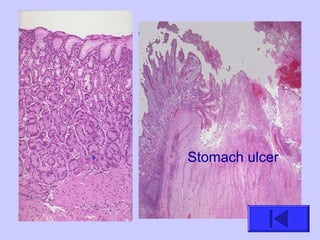
» Stomach ulcer
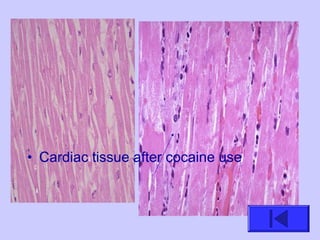
• Cardiac tissue after cocaine use
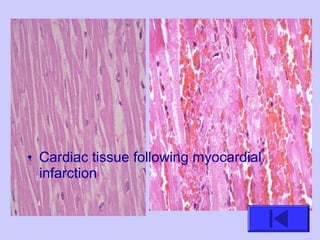
• Cardiac tissue following myocardial
infarction

Histology

  • 1.
    Introduction to Histology •Four basic tissue types: Epithelial connective muscle nervous • All animals are composed of ONLY these four tissue types • Tissue types are organized to form organs, which form the functional systems of the body
  • 2.
    Epithelial tissueEpithelial tissue •Function: covers the internal andFunction: covers the internal and external surfaces of the bodyexternal surfaces of the body • Four types: Squamous, cuboidal,Four types: Squamous, cuboidal, columnar, and transitionalcolumnar, and transitional • Organized in layers: simple or stratifiedOrganized in layers: simple or stratified
  • 3.
    Examples: Epithelial • TransitionalTransitional epithelial:found inepithelial: found in the bladderthe bladder • Stretches as theStretches as the bladder becomesbladder becomes fullfull p. 158 F draw above
  • 4.
    Examples: Epithelial • Simplesquamous:Simple squamous: lines blood vesselslines blood vessels and lungsand lungs • Allows forAllows for increased bloodincreased blood flow and increasedflow and increased oxygen diffusionoxygen diffusion p. 157 A
  • 5.
    Examples: Epithelial • Stratifiedsquamous: lines the mouth, esophagus, cervix and skin • Several layers offers protection to outer layers and membranes of body. p. 157 B
  • 6.
    Examples: Epithelial • Simplecolumnar: digestive tracts • Cells mixed with goblet cells that secrete mucous to aid in digestion p. 158 D
  • 7.
    Example Location Shape(form) Function Transitional epithelium Bladder Layer with no specific shape, Cells can stretch Allow bladder to stretch as it fills Simple squamous Lungs, blood vessels Flat and thin layer Increase flow and absorption rate through tubes Stratified squamous Skin, esophagus, mouth cervix Several layers of thin flat cells Provide protection from abrasions Simple columnar Digestive tract One cell layer of rectangular cells mixed with goblet (mucous – producing) cells Aid in digestion with mucous production
  • 8.
    Connective • Function: Bindand support otherFunction: Bind and support other tissuestissues • Several types:Several types: – BoneBone – BloodBlood – CT proper: dense and looseCT proper: dense and loose – AdiposeAdipose – CartilageCartilage
  • 9.
    Examples: Connective • CTproper: • Collagen fibers (vitamin C) – Loose: ECM – Dense: tendons and ligaments p. 159 A
  • 10.
    Examples: Connective • BoneBone –Dense, hardDense, hard mineral matrixmineral matrix – Replaced everyReplaced every 9 months.9 months. p. 161 E
  • 11.
    Examples: Connective • Blood –To circulate materials throughout the organism – RBC’s: contain hemoglobin to allow for oxygen to be carried to the tissues. p. 160 C
  • 12.
    Examples: ConnectiveExamples: Connective •Cartilage: vary in # of fibers and blood supply – Hyaline: ribs, trachea, joints – Elastic: ears, larynx – Fibro: spinal chord p. 160 D
  • 13.
    Examples: Connective • Adiposetissue: – Insulation – Energy Storage p. 159 A
  • 14.
    Muscle tissueMuscle tissue •Function: Able to contract forFunction: Able to contract for locomotion.locomotion. • Three types: skeletal, cardiac andThree types: skeletal, cardiac and smoothsmooth
  • 15.
    Muscle tissueMuscle tissue •Skeletal: voluntary, striated, multinucleate cells • Muscles attached to bones for voluntary movement p. 161 A
  • 16.
    Muscle tissue • Smooth: –Non-striated, spindle-shaped, uni- nucleate involuntary cells • Muscles found in digestive tract, respiratory tract, etc. p. 161 B
  • 17.
    Muscle tissue • Cardiac:involuntary, striated,branched, uni-nucleate cells • Only found in the heart p. 161 D
  • 18.
    Nervous tissueNervous tissue •Function: Respond toFunction: Respond to stimuli and transmit impulses.stimuli and transmit impulses. • Cells are called neuronsCells are called neurons • Composed of cell body, axon andComposed of cell body, axon and dendrites.dendrites. • Single cell may run up to several feetSingle cell may run up to several feet long.long. p. 161 IV
  • 19.
    Life Processes • Respiration •Circulation • Responsiveness • Boundary Maintenance • Movement • Adaptation • Digestion • Absorption • Assimilation • Excretion • Reproduction 1 3 4 5 6 11 10 9 8 7 2
  • 20.
  • 21.
    • Alveoli oflungs with pneumonia
  • 22.
  • 23.
  • 24.
  • 25.
  • 26.
  • 27.
    • Normal Bone*Diseased • Osteoporosis
  • 28.
    • Infected mammarygland from silicone leak
  • 29.
  • 30.
    • Cardiac tissueafter cocaine use
  • 31.
    • Cardiac tissuefollowing myocardial infarction