EPITHELIUM
General Histology – By Laiq Hussain Siddiqui
Presented by: Dr.Rumaisa PT
Introduction
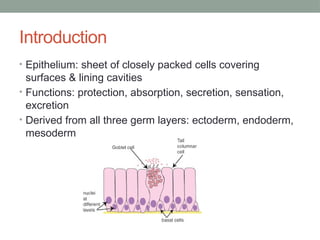
• Epithelium: sheet of closely packed cells covering
surfaces & lining cavities
• Functions: protection, absorption, secretion, sensation,
excretion
• Derived from all three germ layers: ectoderm, endoderm,
mesoderm
General Characteristics
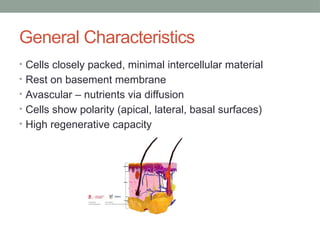
• Cells closely packed, minimal intercellular material
• Rest on basement membrane
• Avascular – nutrients via diffusion
• Cells show polarity (apical, lateral, basal surfaces)
• High regenerative capacity
Basement Membrane
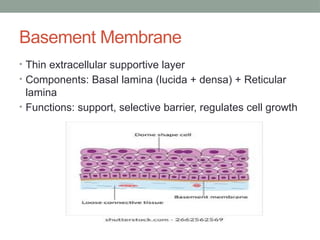
• Thin extracellular supportive layer
• Components: Basal lamina (lucida + densa) + Reticular
lamina
• Functions: support, selective barrier, regulates cell growth
Cell Junctions
• Tight junctions (occludens): prevent leakage
• Adherens junctions: adhesion between cells
• Desmosomes: strong intercellular attachment
• Gap junctions: communication channels
• Hemidesmosomes: anchor to basement membrane
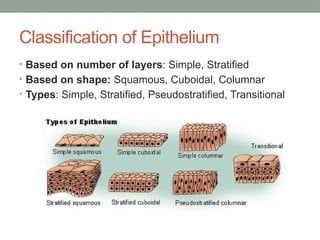
Classification of Epithelium
• Based on number of layers: Simple, Stratified
• Based on shape: Squamous, Cuboidal, Columnar
• Types: Simple, Stratified, Pseudostratified, Transitional
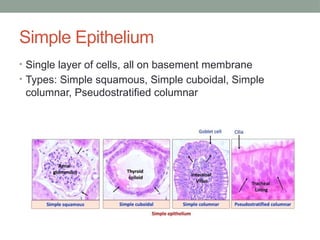
Simple Epithelium
• Single layer of cells, all on basement membrane
• Types: Simple squamous, Simple cuboidal, Simple
columnar, Pseudostratified columnar
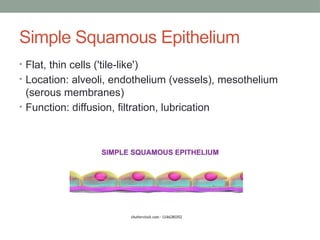
Simple Squamous Epithelium
• Flat, thin cells ('tile-like')
• Location: alveoli, endothelium (vessels), mesothelium
(serous membranes)
• Function: diffusion, filtration, lubrication
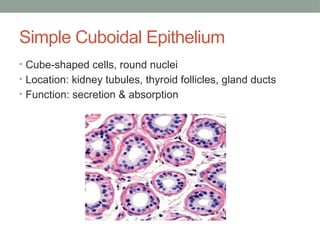
Simple Cuboidal Epithelium
• Cube-shaped cells, round nuclei
• Location: kidney tubules, thyroid follicles, gland ducts
• Function: secretion & absorption
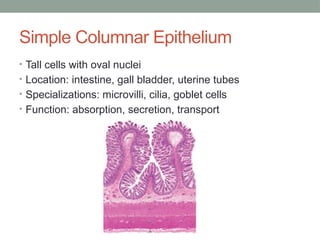
Simple Columnar Epithelium
• Tall cells with oval nuclei
• Location: intestine, gall bladder, uterine tubes
• Specializations: microvilli, cilia, goblet cells
• Function: absorption, secretion, transport
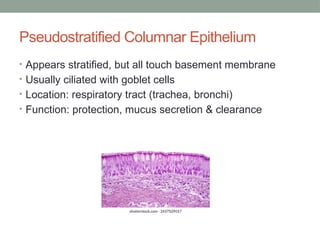
Pseudostratified Columnar Epithelium
• Appears stratified, but all touch basement membrane
• Usually ciliated with goblet cells
• Location: respiratory tract (trachea, bronchi)
• Function: protection, mucus secretion & clearance
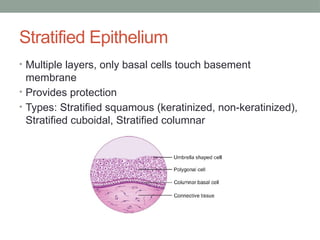
Stratified Epithelium
• Multiple layers, only basal cells touch basement
membrane
• Provides protection
• Types: Stratified squamous (keratinized, non-keratinized),
Stratified cuboidal, Stratified columnar
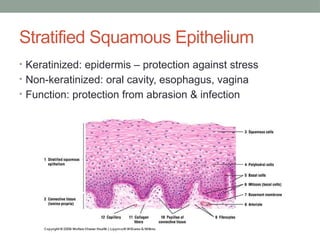
Stratified Squamous Epithelium
• Keratinized: epidermis – protection against stress
• Non-keratinized: oral cavity, esophagus, vagina
• Function: protection from abrasion & infection
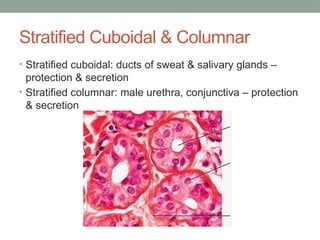
Stratified Cuboidal & Columnar
• Stratified cuboidal: ducts of sweat & salivary glands –
protection & secretion
• Stratified columnar: male urethra, conjunctiva – protection
& secretion
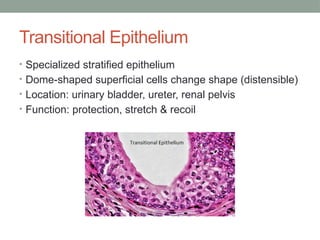
Transitional Epithelium
• Specialized stratified epithelium
• Dome-shaped superficial cells change shape (distensible)
• Location: urinary bladder, ureter, renal pelvis
• Function: protection, stretch & recoil
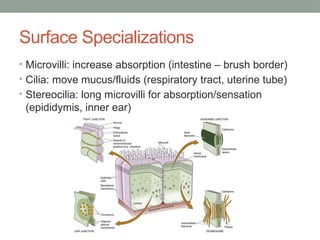
Surface Specializations
• Microvilli: increase absorption (intestine – brush border)
• Cilia: move mucus/fluids (respiratory tract, uterine tube)
• Stereocilia: long microvilli for absorption/sensation
(epididymis, inner ear)
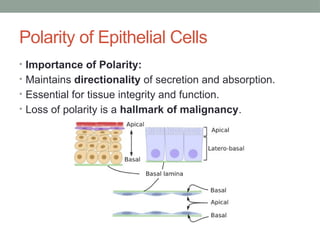
Polarity of Epithelial Cells
• Definition:
• Polarity refers to the functional and structural orientation of epithelial cells,
with distinct domains.
• Domains:
• Apical Surface:
• Faces lumen or external environment.
• Specializations: microvilli, cilia, stereocilia.
• Functions: absorption, secretion, movement.
• Lateral Surface:
• Faces neighboring cells.
• Contains cell junctions (tight junctions, adherens junctions, desmosomes, gap junctions).
• Functions: adhesion, communication, barrier function.
• Basal Surface:
• Rests on basement membrane.
• Contains hemidesmosomes and basal infoldings.
• Functions: attachment, exchange of molecules, anchorage.
Polarity of Epithelial Cells
• Importance of Polarity:
• Maintains directionality of secretion and absorption.
• Essential for tissue integrity and function.
• Loss of polarity is a hallmark of malignancy.
Functions of Epithelium
• Protection: skin, mucosa
• Absorption: intestine, kidney
• Secretion: glands
• Excretion: renal tubules
• Sensation: taste buds, olfactory epithelium
• Transport: ciliary movement
Clinical Correlations
• Carcinomas: malignant epithelial tumors
• Metaplasia: replacement of one epithelium by another
(smoker’s airway)
• Ciliary dysfunction: Kartagener syndrome – infertility,
infections
• Basement membrane thickening: diabetes, hypertension
Summary
• Epithelium = protective & functional covering tissue
• Classified into simple, stratified, pseudostratified,
transitional
• Functions: protection, absorption, secretion, sensation,
transport
• Structural modifications support specialized roles
References
• Laiq Hussain Siddiqui – General Histology
• Junqueira’s Basic Histology
• Gartner & Hiatt – Color Textbook of Histology

Epithelium_Histology_Presentation by Dr.Rumaisa PT

  • 1.
    EPITHELIUM General Histology –By Laiq Hussain Siddiqui Presented by: Dr.Rumaisa PT
  • 2.
    Introduction • Epithelium: sheetof closely packed cells covering surfaces & lining cavities • Functions: protection, absorption, secretion, sensation, excretion • Derived from all three germ layers: ectoderm, endoderm, mesoderm
  • 3.
    General Characteristics • Cellsclosely packed, minimal intercellular material • Rest on basement membrane • Avascular – nutrients via diffusion • Cells show polarity (apical, lateral, basal surfaces) • High regenerative capacity
  • 4.
    Basement Membrane • Thinextracellular supportive layer • Components: Basal lamina (lucida + densa) + Reticular lamina • Functions: support, selective barrier, regulates cell growth
  • 5.
    Cell Junctions • Tightjunctions (occludens): prevent leakage • Adherens junctions: adhesion between cells • Desmosomes: strong intercellular attachment • Gap junctions: communication channels • Hemidesmosomes: anchor to basement membrane
  • 6.
    Classification of Epithelium •Based on number of layers: Simple, Stratified • Based on shape: Squamous, Cuboidal, Columnar • Types: Simple, Stratified, Pseudostratified, Transitional
  • 7.
    Simple Epithelium • Singlelayer of cells, all on basement membrane • Types: Simple squamous, Simple cuboidal, Simple columnar, Pseudostratified columnar
  • 8.
    Simple Squamous Epithelium •Flat, thin cells ('tile-like') • Location: alveoli, endothelium (vessels), mesothelium (serous membranes) • Function: diffusion, filtration, lubrication
  • 9.
    Simple Cuboidal Epithelium •Cube-shaped cells, round nuclei • Location: kidney tubules, thyroid follicles, gland ducts • Function: secretion & absorption
  • 10.
    Simple Columnar Epithelium •Tall cells with oval nuclei • Location: intestine, gall bladder, uterine tubes • Specializations: microvilli, cilia, goblet cells • Function: absorption, secretion, transport
  • 11.
    Pseudostratified Columnar Epithelium •Appears stratified, but all touch basement membrane • Usually ciliated with goblet cells • Location: respiratory tract (trachea, bronchi) • Function: protection, mucus secretion & clearance
  • 12.
    Stratified Epithelium • Multiplelayers, only basal cells touch basement membrane • Provides protection • Types: Stratified squamous (keratinized, non-keratinized), Stratified cuboidal, Stratified columnar
  • 13.
    Stratified Squamous Epithelium •Keratinized: epidermis – protection against stress • Non-keratinized: oral cavity, esophagus, vagina • Function: protection from abrasion & infection
  • 14.
    Stratified Cuboidal &Columnar • Stratified cuboidal: ducts of sweat & salivary glands – protection & secretion • Stratified columnar: male urethra, conjunctiva – protection & secretion
  • 15.
    Transitional Epithelium • Specializedstratified epithelium • Dome-shaped superficial cells change shape (distensible) • Location: urinary bladder, ureter, renal pelvis • Function: protection, stretch & recoil
  • 16.
    Surface Specializations • Microvilli:increase absorption (intestine – brush border) • Cilia: move mucus/fluids (respiratory tract, uterine tube) • Stereocilia: long microvilli for absorption/sensation (epididymis, inner ear)
  • 17.
    Polarity of EpithelialCells • Definition: • Polarity refers to the functional and structural orientation of epithelial cells, with distinct domains. • Domains: • Apical Surface: • Faces lumen or external environment. • Specializations: microvilli, cilia, stereocilia. • Functions: absorption, secretion, movement. • Lateral Surface: • Faces neighboring cells. • Contains cell junctions (tight junctions, adherens junctions, desmosomes, gap junctions). • Functions: adhesion, communication, barrier function. • Basal Surface: • Rests on basement membrane. • Contains hemidesmosomes and basal infoldings. • Functions: attachment, exchange of molecules, anchorage.
  • 18.
    Polarity of EpithelialCells • Importance of Polarity: • Maintains directionality of secretion and absorption. • Essential for tissue integrity and function. • Loss of polarity is a hallmark of malignancy.
  • 19.
    Functions of Epithelium •Protection: skin, mucosa • Absorption: intestine, kidney • Secretion: glands • Excretion: renal tubules • Sensation: taste buds, olfactory epithelium • Transport: ciliary movement
  • 20.
    Clinical Correlations • Carcinomas:malignant epithelial tumors • Metaplasia: replacement of one epithelium by another (smoker’s airway) • Ciliary dysfunction: Kartagener syndrome – infertility, infections • Basement membrane thickening: diabetes, hypertension
  • 21.
    Summary • Epithelium =protective & functional covering tissue • Classified into simple, stratified, pseudostratified, transitional • Functions: protection, absorption, secretion, sensation, transport • Structural modifications support specialized roles
  • 22.
    References • Laiq HussainSiddiqui – General Histology • Junqueira’s Basic Histology • Gartner & Hiatt – Color Textbook of Histology