Lord, our Lord, how majestic is your name in all the earth!
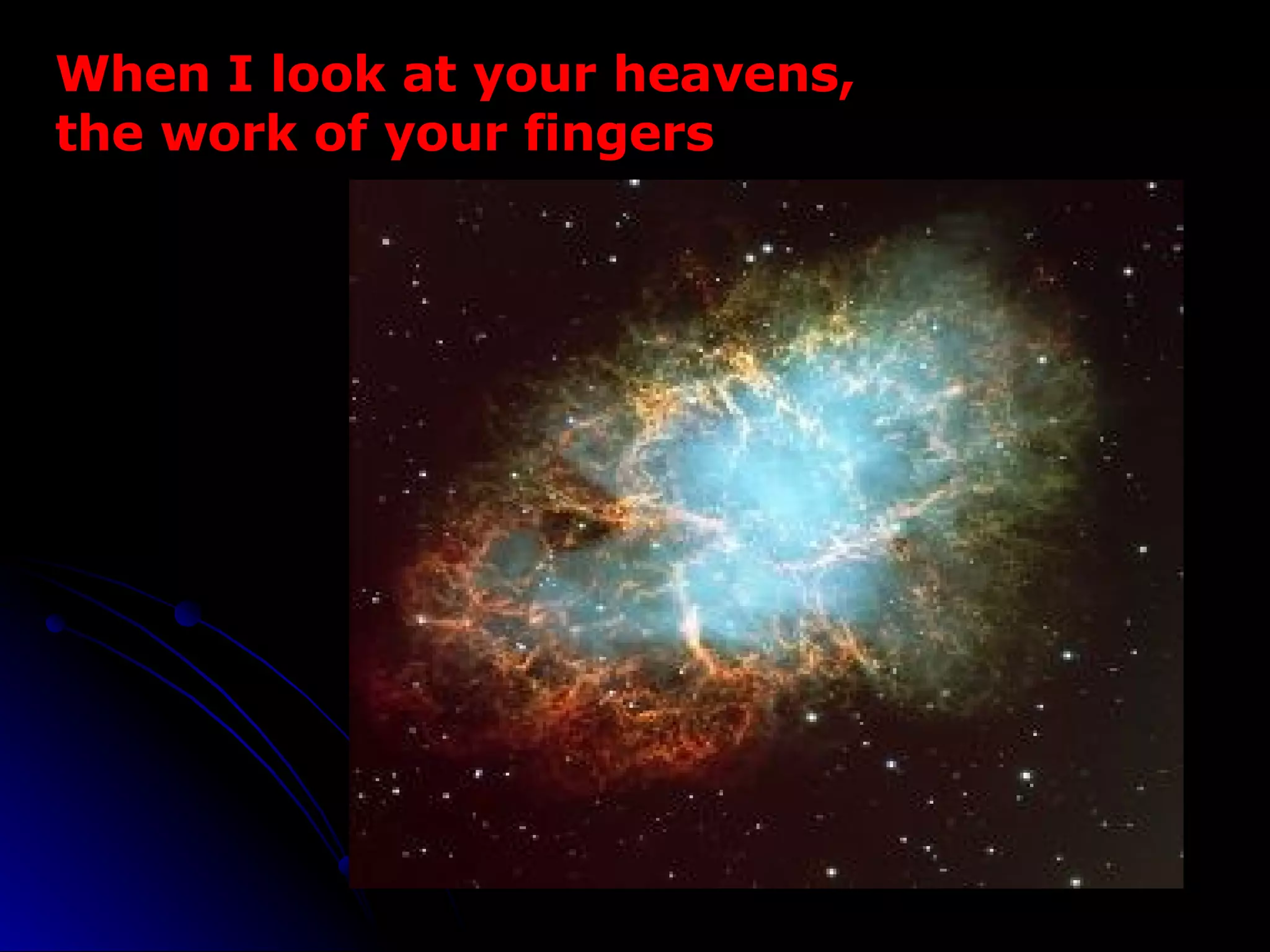
When I look at your heavens, the work of your fingers
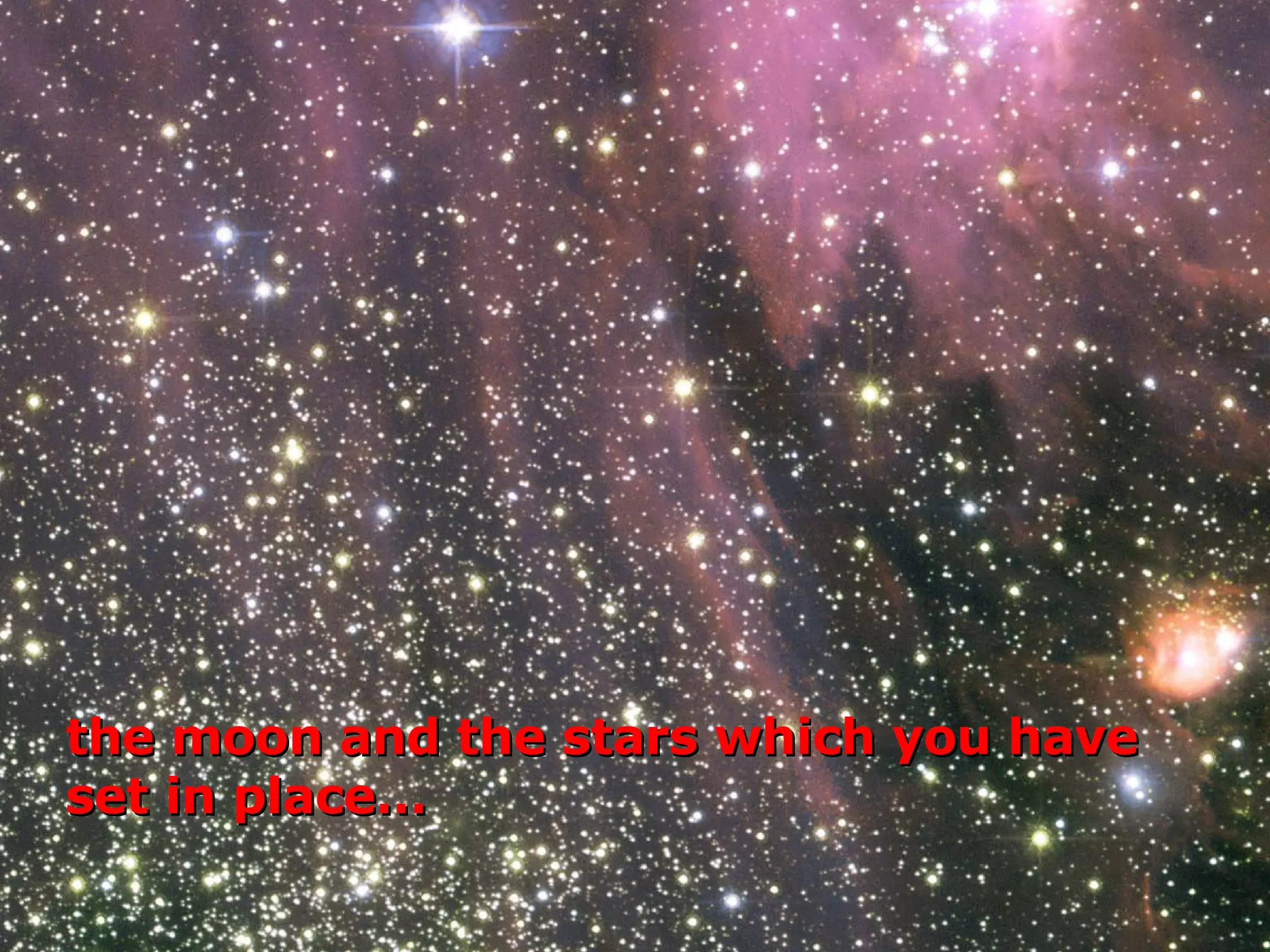
the moon and the stars which you have set in place…
What are human beings that you are mindful of them…
mortals that you care for them?
You have given them dominion over the works of your hands; you have put all things under their feet: The beasts of the field The fish of the sea
Lord, our Lord, how majestic is your name in all the earth!
Creation  and  Evolution   #2 Interpretations of Genesis 1 & 2
Interpretations of Genesis Up to the  1600s , most Christians believed that the world was created a  few thousand years  ago. Justin Martyr  (a.d. 155)  Irenaeus  (a.d. 189)  day =1000 years.  Augustine  (a.d. 400): instantaneous creation
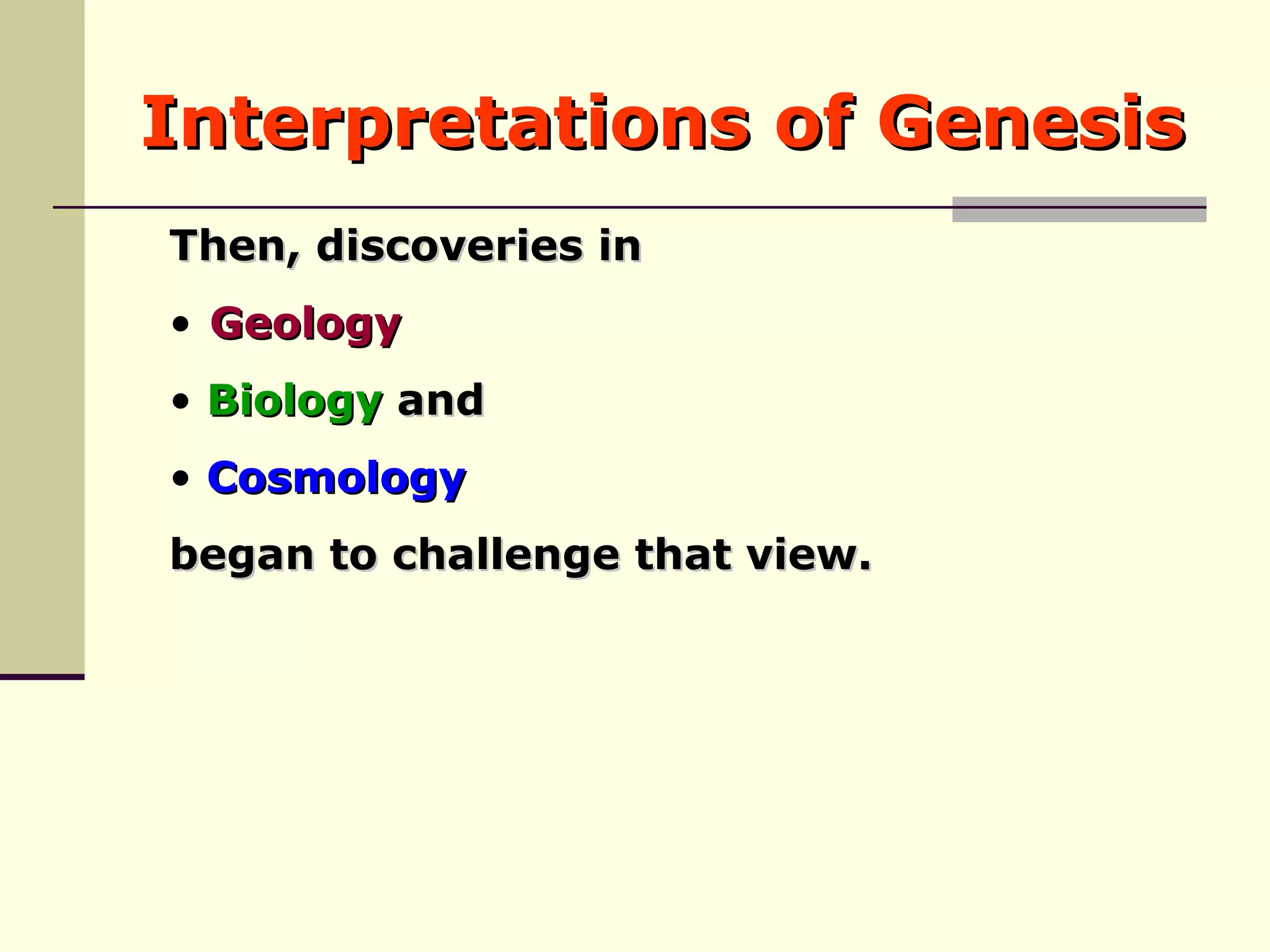
Interpretations of Genesis Then, discoveries in  Geology Biology  and Cosmology began to challenge that view.
Geology in the 1600s In the 1600s most geologists agreed that the  earth was young  and that the  flood  narrated in Genesis was a  global  one.  River valleys  larger than rivers were  caused by receding flood waters Fossils  of sea shells and fish found on high  mountains were there because the flood  lifted them to these higher levels
Geology in the 1600s Stratified rocks  were caused by layers of  sediment laid down by the flood, while  rocks without strata were formed in the  original creation. Denser sediment  would be found in lower  stratification layers  because they sank  more quickly during the flood.
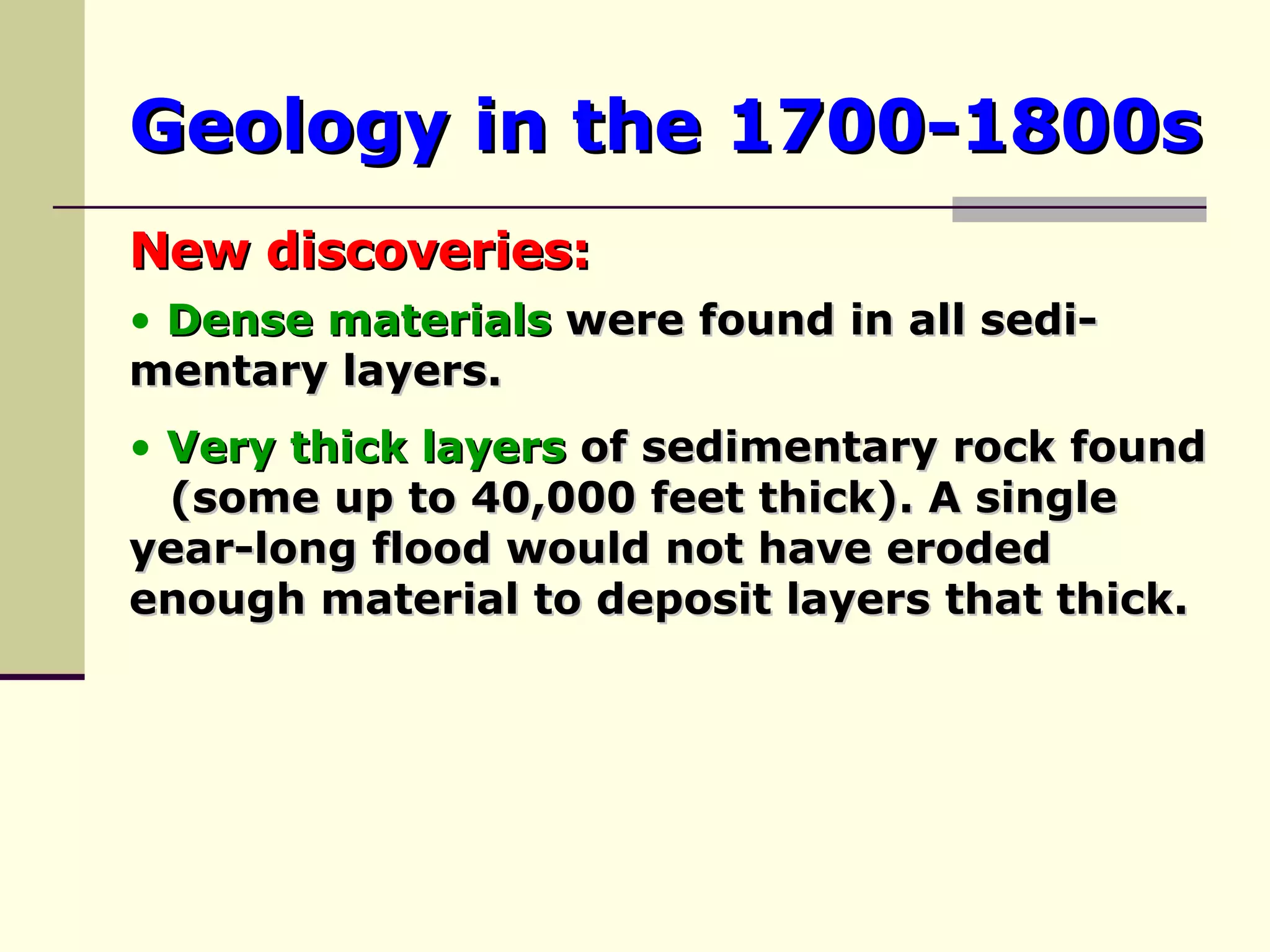
Geology in the 1700-1800s New discoveries: Dense materials  were found in all sedi- mentary layers. Very thick layers  of sedimentary rock found  (some up to 40,000 feet thick). A single  year-long flood would not have eroded  enough material to deposit layers that thick.
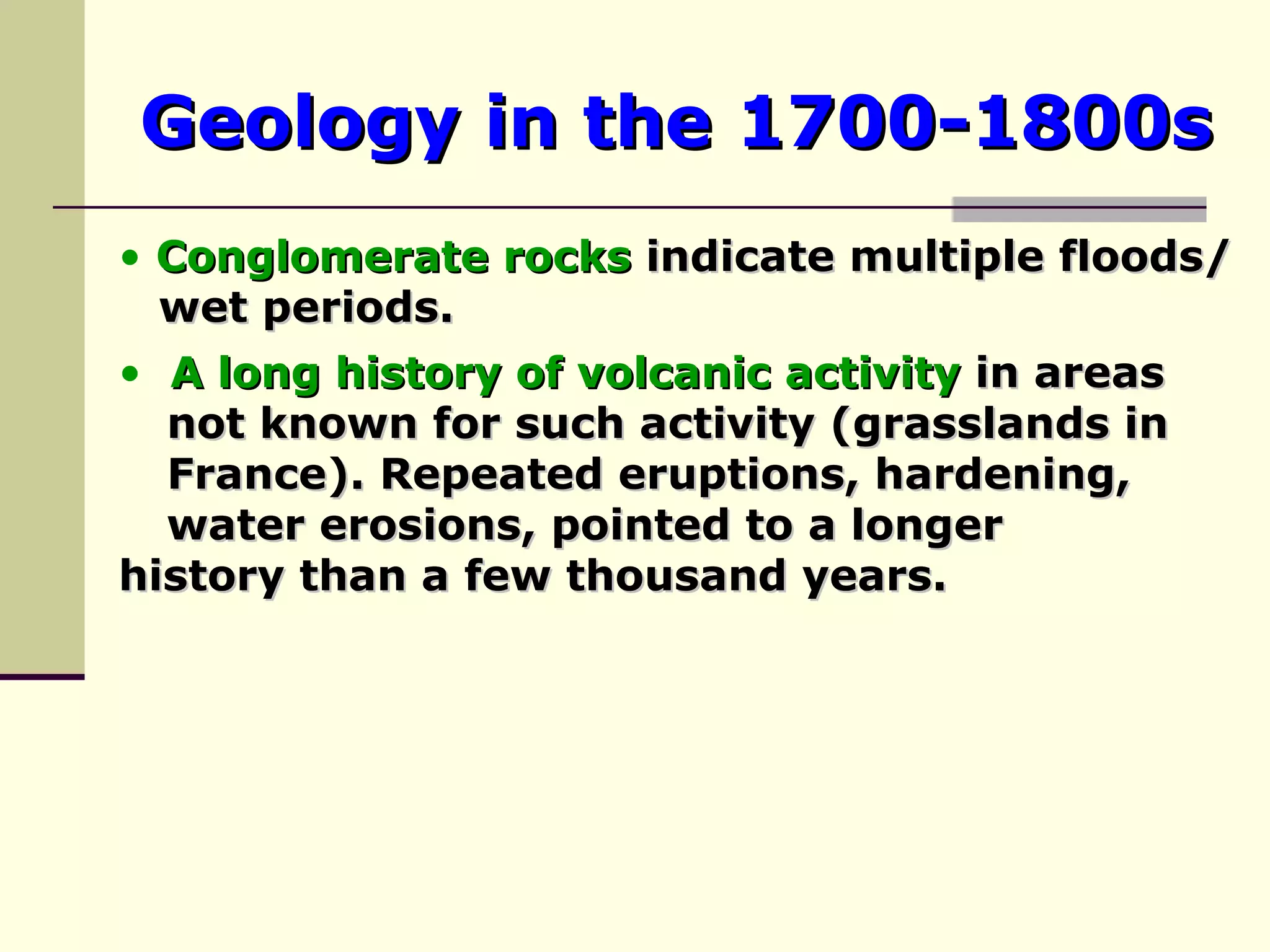
Geology in the 1700-1800s A long history of   volcanic activity  in areas  not known for such activity (grasslands in  France). Repeated eruptions, hardening,  water erosions, pointed to a longer  history than a few thousand years. Conglomerate rocks  indicate multiple floods/  wet periods.
Geology in the 1700-1800s By  1840  “virtually all practicing geologists,  including Christian geologists, believed that  the earth must be at least millions of years  old. Moreover, if a flood had occurred, it  must have been local, not global.”  ( Origins , 89  cf. “Centuries  of Geological Evidence for an Old Earth” on  website)
A Dynamic and Expanding Universe Astronomers  have found that the universe  is incredibly huge… Our sun is one of  100,000,000,000,000,000,000    stars There are some 10 billion galaxies in the universe.
An active stellar “nursery,” NGC346 in which new stars are forming within clouds of gas and dust. has a long and dynamic history…
is old… According to radiometric dating, the oldest  Moon rocks are 4.6 billion years old. The universe must be as old as the time it  takes for light to travel from its farthest  galaxies. All stars in a star cluster form in the same  nebula at about the same time but do not  have the same life span.  Studies show  oldest star clusters to be about 12 billion  years old.
… but not infinitely old. Evidence of expansion:  The fabric of space is  expanding in all directions and the galaxies  are being pulled along with it.  Tracing the expansion  backwards  we arrive at  a moment when the  universe was a densely  packed and extremely  hot gas. This hot, dense  beginning, followed by  expansion, is what  astronomers call the  Big  Bang .
A Dynamic and Expanding Universe Heat radiation  given off by the initial explosion  was predicted and has now been detected.  Astronomers calculate that all the matter in  the universe must have been compressed  together some  13.7 bya
Given   geological,   cosmological  and  biological  evidence for a vast and old universe, how should we interpret   Genesis 1 & 2 ?
Interpretations of Genesis According to  Concordist  interpretations of  Genesis 1, God created the earth  in the  sequence of events  recorded in Genesis: first  light, then sky and ocean, then dry land and  plants, etc.  According to  Non-concordist  interpretations  of Genesis 1, the sequence and timing of  creation events convey important  theological  truths but not literal  scientific   truth.
Interpretations of Genesis Concordist  Interpretations: Young Earth Interpretation:   Creation occurred between 10,000 and  6,000 years ago, during six 24-hour days,  in the order described. A scientific study of  the earth should confirm this.
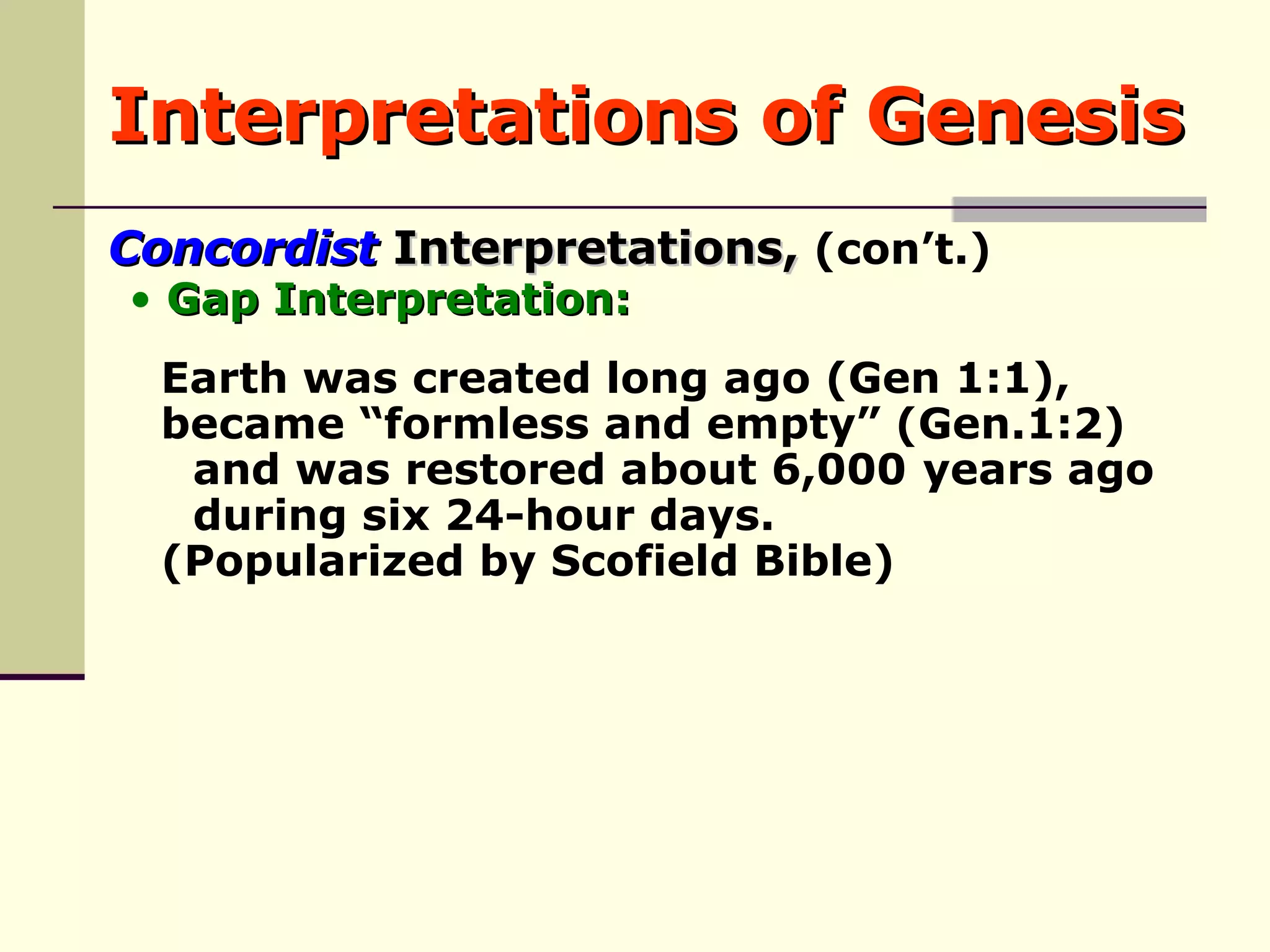
Interpretations of Genesis Earth was created long ago (Gen 1:1),  became “formless and empty” (Gen.1:2)  and was restored about 6,000  years ago  during six 24-hour days.  (Popularized by Scofield Bible) Concordist  Interpretations,  (con’t.) Gap Interpretation:
Interpretations of Genesis Concordist  Interpretations,  (con’t.) Creation occurred over billions of years.  Each “day” of Genesis 1 corresponds to a  long  epoch. Events occurred in the order  given in the text, but stretched out over a  longer time period. Day-Age Interpretation:
Interpretations of Genesis Concordist  Interpretations ,  (con’t.) Creation occurred about 6,000 years ago  during six 24-hour days, but it was  created to look like it had a long history  of  billions of years.  Appearance of Age Interp:
Interpretations of Genesis Non-Concordist  Interpretations: The days of Genesis 1 are not days in which  God created, but days of prophetic vision  to  the original human author. Visionary Day Interpretation: On day 1, God inspired the author to write  about the creation of light…, etc. When  God actually created light is another  matter.
Interpretations of Genesis Non-Concordist  Interpretations  (con’t): The days of Genesis 1 took place in God’s  throne room, wherein God proclaimed to  his court each step of creation. The  throne-room  days are not related to days  or time  periods on earth. Proclamation Day Interpretation: God experiences time differently than we  do (“a thousand years is like a day”).
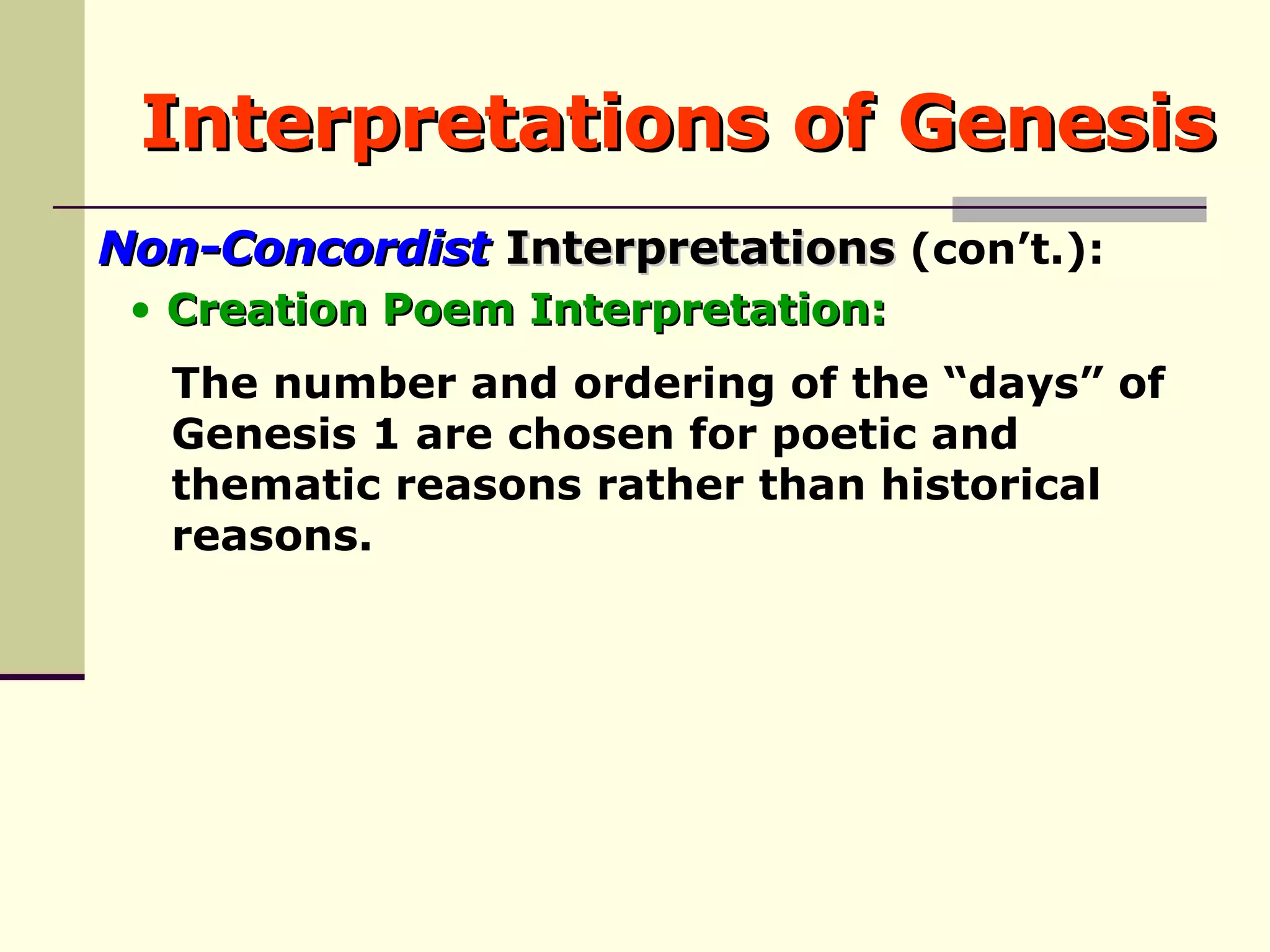
Interpretations of Genesis Non-Concordist  Interpretations  (con’t.): The number and ordering of the “days” of  Genesis 1 are chosen for poetic and  thematic reasons rather than historical  reasons. Creation Poem Interpretation:
Interpretations of Genesis Creation Poem Interpretation of Genesis 1   Initial Problem Days of Forming     Days of Filling Darkness Day 1: Separate   Day 4: Sun,    light & darkness   moon, stars Watery    Day 2: Separate the  Day 5: Birds  abyss    waters into waters & fish     above and waters below Formlessness   Day 3: Separate the  Day 6: Animals & empty earth  dry land from ocean;  and humans    create plants
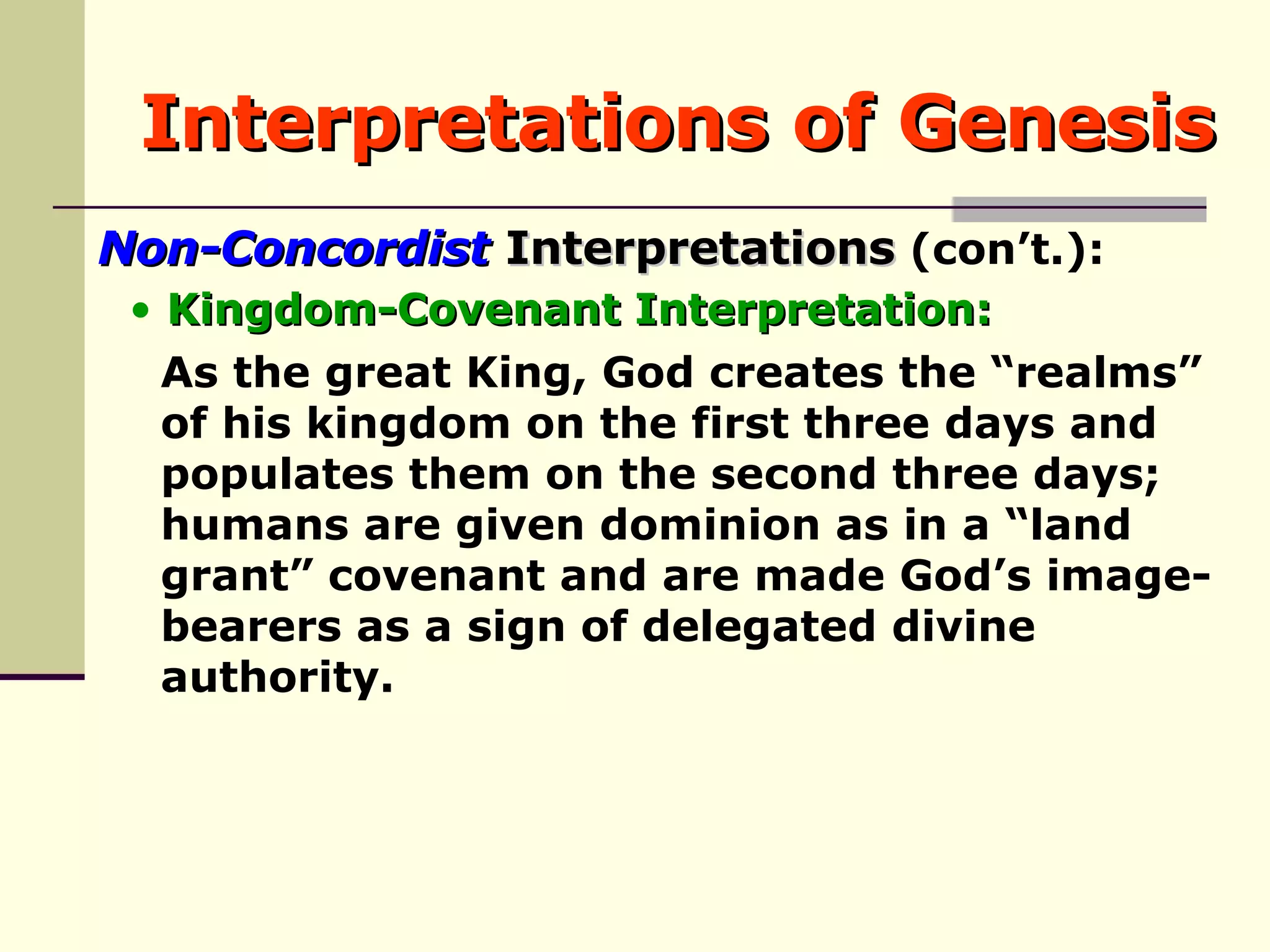
Interpretations of Genesis Non-Concordist  Interpretations  (con’t.): As the great King, God creates the “realms”  of his kingdom on the first three days and  populates them on the second three days;  humans are given dominion as in a “land  grant” covenant and are made God’s image- bearers as a sign of delegated divine  authority.  Kingdom-Covenant Interpretation:
Interpretations of Genesis Non-Concordist  Interpretations  (con’t.): Genesis 1 matches the  physical  picture of the  world believed in Ancient Near East  religions, but presents a dramatically  different  theological  picture, proclaiming  one God as creator of all rather than many  gods.  Ancient Near East Cosmology Interpretation:
Ancient Near East Cosmology waters above pillars sea sea earth waters below Firmament pillars Flood gates Flood gates sheol
Genesis 1 vs.  Enuma Elish There is one God.   There is a pantheon of gods. God created an     The world was formed by ordered world by the  battles among the gods. authority of his Word. No part of the physical   The sun and moon and world is divine.   other physical objects are    gods that control the fate    of humans.
Genesis 1 vs.  Enuma Elish God declared all parts   Some physical structures of creation good.    are related to good gods,    others to bad gods. God created humans    Humans are made as an in his image as the    afterthought at the end of culmination of the    the story from the flesh of story and declared    a defeated god, to be very them good. God gave    slaves to the gods.  them responsibility to  be stewards of creation.
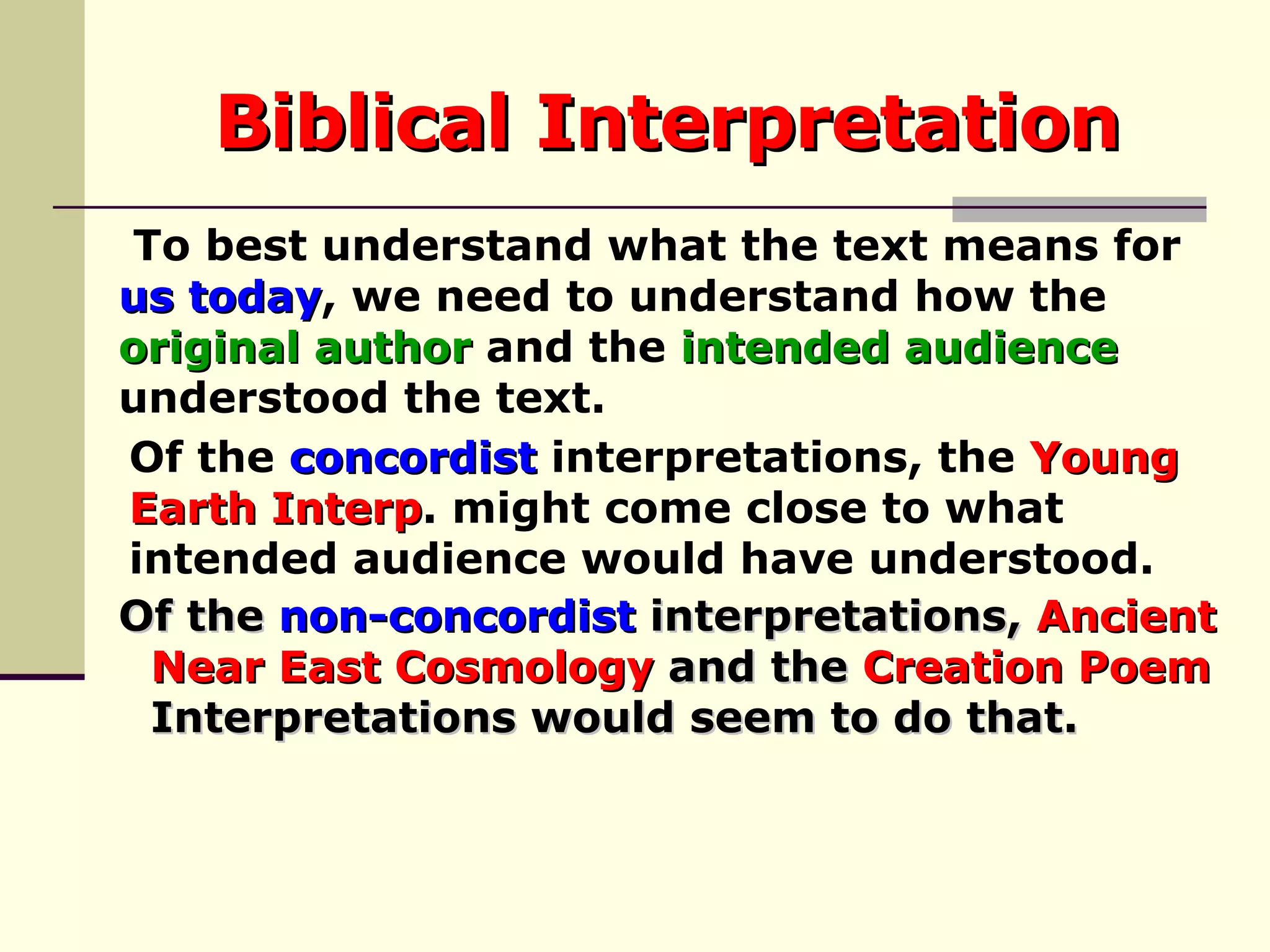
Biblical Interpretation Of the  concordist  interpretations, the  Young  Earth Interp . might come close to what  intended audience would have understood. To best understand what the text means for  us today , we need to understand how the  original author  and the  intended audience   understood the text.  Of the  non-concordist  interpretations,  Ancient  Near East Cosmology  and the  Creation Poem   Interpretations would seem to do that.
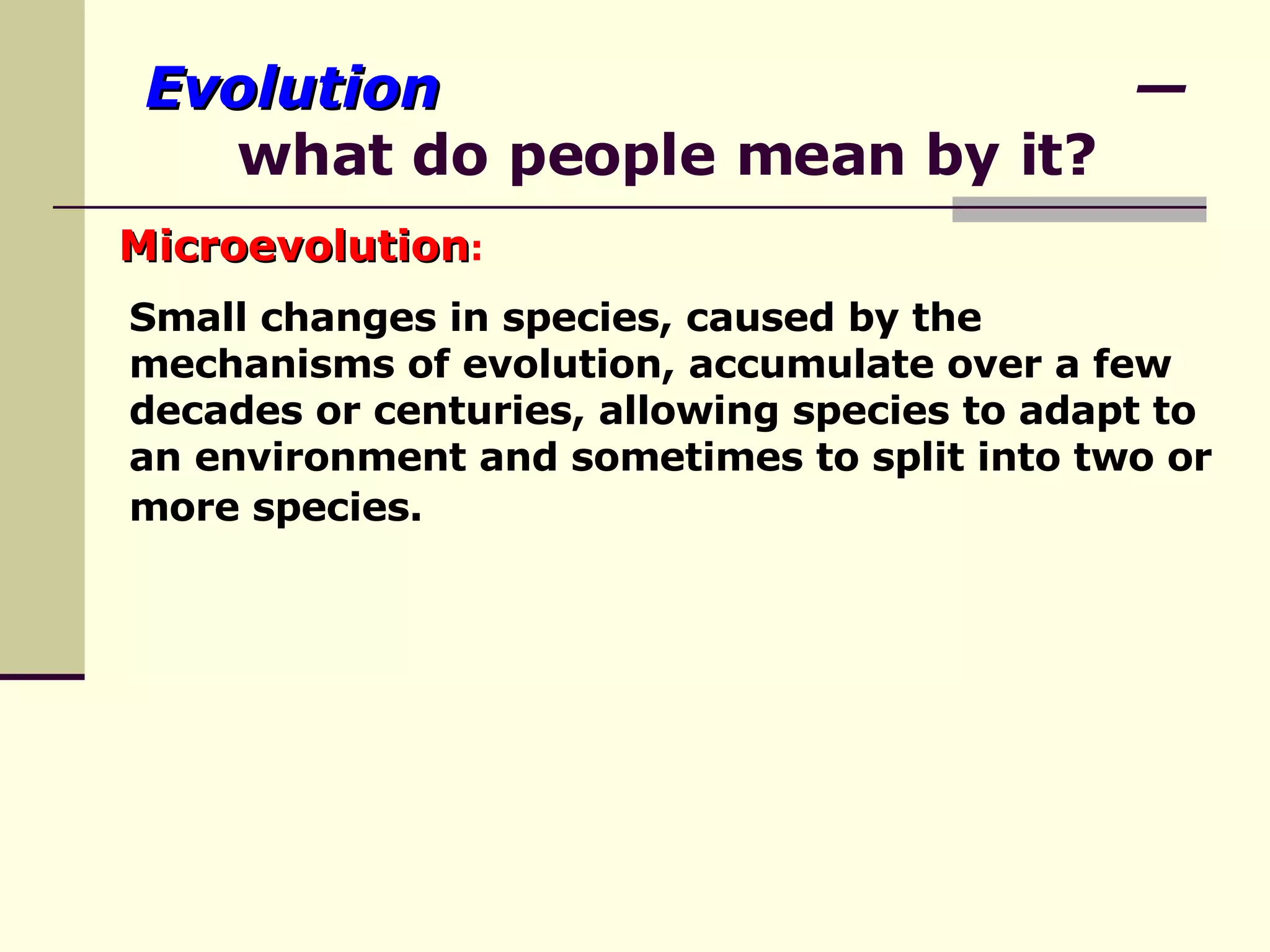
Evolution   — what do people mean by it? Microevolution :   Small changes in species, caused by the mechanisms of evolution, accumulate over a few decades or centuries, allowing species to adapt to an environment and sometimes to split into two or more species.
Evolution   — what do people mean by it? Pattern of change over time:  Common ancestry:   All living and extinct species are linked in a “family tree”; modern species descended from earlier species and all species descended from a common ancestor. The fossil record shows that species go through changes over long periods of time, with some species becoming extinct and new species appearing from time to time.
Evolution   — what do people mean by it? Evolutionism : Attempts to use the theory of evolution to support atheistic claims that there is no Creator and no purpose to human existence.   A scientific model that says the mechanisms of evolution, operating over the long history of life on earth, explain common ancestry and the pattern of change over time.  Theory of Evolution:
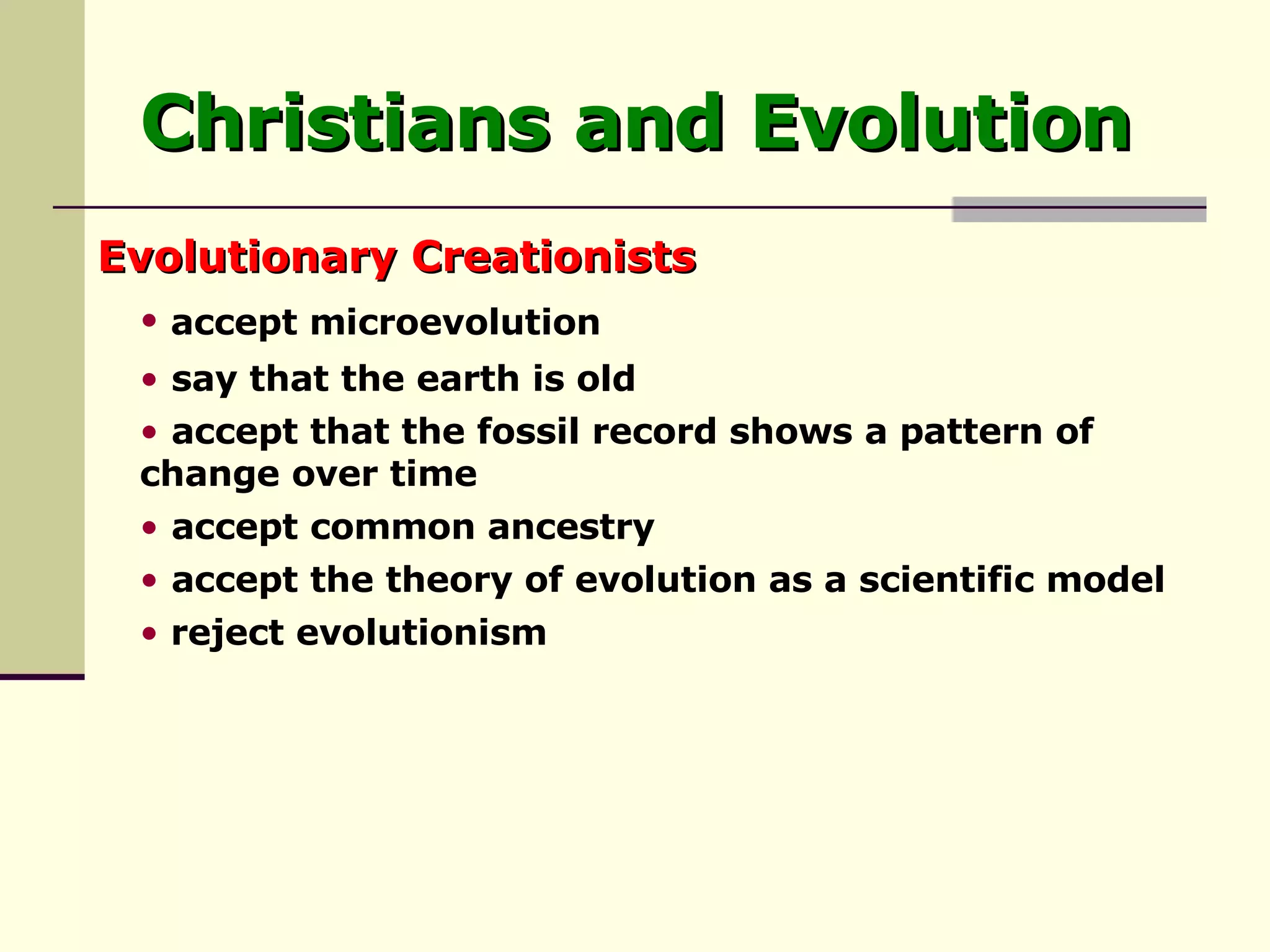
Christians and Evolution Young Earth Creationists (creation science): reject evolutionism   reject the theory of evolution reject common ancestry reject that the fossil record shows a pattern of  change over time say that the earth is young accept microevolution
Christians and Evolution Progressive Creationists: reject evolutionism reject the theory of evolution as a complete model for  biological history, saying that while some evolution  did happen, God must have miraculously guided or  intervened at various points are split about common ancestry accept that the fossil record shows a pattern of change  over time say that the earth is old accept microevolution
Christians and Evolution Evolutionary Creationists reject evolutionism accept the theory of evolution as a scientific model accept common ancestry accept that the fossil record shows a pattern of  change over time say that the earth is old accept microevolution
Creation  and  Evolution   # 3 Evidences of Evolution
 
Order of Creation Ambiguity in the sequence of created events? Heavens, earth, waters  (vv. 1-2)   Light  (v.3)   Sky  (vv. 6-8)   Dry land  (vv. 9-10)   Dry land, rivers  (vv. 5-6)  Plants  (vv. 11-12)   Man  (vv. 7)   Sun, moon, stars  (vv. 14-17)   Plants  (vv. 8-9)*   Sea creatures & birds  (20-21)    Land animals, birds  v19  Land animals  (vv. 24-25)   Woman  (vv. 20-22)   Human beings  (vv. 26-27)   Genesis 1:1-2:3   Genesis 2:4-25
Order of Creation Gen. 1:1-2:3   Gen. 2:4-25 Modern Science Heavens, earth, water   Matter, energy, space,    time 13.7b  Light   Stars 13.5b  Sky Sun 4.6 b  Dry land   Dry land, rivers Moon, earth, dry land  Seed-bearing plants Oceans  4-4.5b  Trees bearing fruit   Man   Single-celled life 3.8b  Sun, moon, stars Multi-celled life 1-2b  Sea creatures   Plants Various sea creatures  including early fish  520m
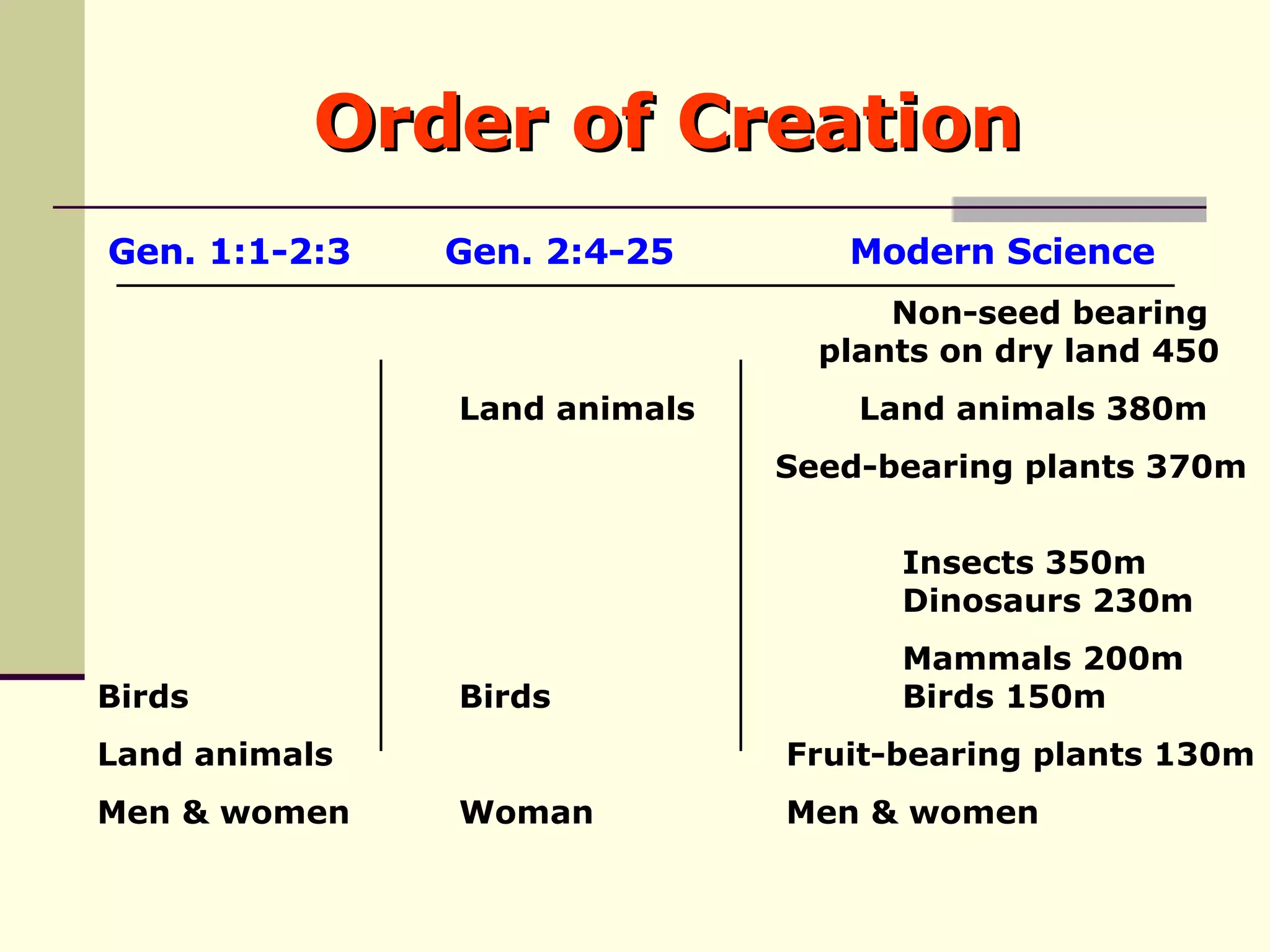
Order of Creation Gen. 1:1-2:3   Gen. 2:4-25   Modern Science   Non-seed bearing    plants on dry land 450   Land animals  Land animals 380m    Seed-bearing plants 370m    Insects 350m    Dinosaurs 230m    Mammals 200m  Birds   Birds   Birds 150m  Land animals   Fruit-bearing plants 130m  Men & women   Woman   Men & women

Creation And Evolution Session 2

  • 1.
    Lord, our Lord,how majestic is your name in all the earth!
  • 2.
    When I lookat your heavens, the work of your fingers
  • 3.
    the moon andthe stars which you have set in place…
  • 4.
    What are humanbeings that you are mindful of them…
  • 5.
    mortals that youcare for them?
  • 6.
    You have giventhem dominion over the works of your hands; you have put all things under their feet: The beasts of the field The fish of the sea
  • 7.
    Lord, our Lord,how majestic is your name in all the earth!
  • 8.
    Creation and Evolution #2 Interpretations of Genesis 1 & 2
  • 9.
    Interpretations of GenesisUp to the 1600s , most Christians believed that the world was created a few thousand years ago. Justin Martyr (a.d. 155) Irenaeus (a.d. 189) day =1000 years. Augustine (a.d. 400): instantaneous creation
  • 10.
    Interpretations of GenesisThen, discoveries in Geology Biology and Cosmology began to challenge that view.
  • 11.
    Geology in the1600s In the 1600s most geologists agreed that the earth was young and that the flood narrated in Genesis was a global one. River valleys larger than rivers were caused by receding flood waters Fossils of sea shells and fish found on high mountains were there because the flood lifted them to these higher levels
  • 12.
    Geology in the1600s Stratified rocks were caused by layers of sediment laid down by the flood, while rocks without strata were formed in the original creation. Denser sediment would be found in lower stratification layers because they sank more quickly during the flood.
  • 13.
    Geology in the1700-1800s New discoveries: Dense materials were found in all sedi- mentary layers. Very thick layers of sedimentary rock found (some up to 40,000 feet thick). A single year-long flood would not have eroded enough material to deposit layers that thick.
  • 14.
    Geology in the1700-1800s A long history of volcanic activity in areas not known for such activity (grasslands in France). Repeated eruptions, hardening, water erosions, pointed to a longer history than a few thousand years. Conglomerate rocks indicate multiple floods/ wet periods.
  • 15.
    Geology in the1700-1800s By 1840 “virtually all practicing geologists, including Christian geologists, believed that the earth must be at least millions of years old. Moreover, if a flood had occurred, it must have been local, not global.” ( Origins , 89 cf. “Centuries of Geological Evidence for an Old Earth” on website)
  • 16.
    A Dynamic andExpanding Universe Astronomers have found that the universe is incredibly huge… Our sun is one of 100,000,000,000,000,000,000 stars There are some 10 billion galaxies in the universe.
  • 17.
    An active stellar“nursery,” NGC346 in which new stars are forming within clouds of gas and dust. has a long and dynamic history…
  • 18.
    is old… Accordingto radiometric dating, the oldest Moon rocks are 4.6 billion years old. The universe must be as old as the time it takes for light to travel from its farthest galaxies. All stars in a star cluster form in the same nebula at about the same time but do not have the same life span. Studies show oldest star clusters to be about 12 billion years old.
  • 19.
    … but notinfinitely old. Evidence of expansion: The fabric of space is expanding in all directions and the galaxies are being pulled along with it. Tracing the expansion backwards we arrive at a moment when the universe was a densely packed and extremely hot gas. This hot, dense beginning, followed by expansion, is what astronomers call the Big Bang .
  • 20.
    A Dynamic andExpanding Universe Heat radiation given off by the initial explosion was predicted and has now been detected. Astronomers calculate that all the matter in the universe must have been compressed together some 13.7 bya
  • 21.
    Given geological, cosmological and biological evidence for a vast and old universe, how should we interpret Genesis 1 & 2 ?
  • 22.
    Interpretations of GenesisAccording to Concordist interpretations of Genesis 1, God created the earth in the sequence of events recorded in Genesis: first light, then sky and ocean, then dry land and plants, etc. According to Non-concordist interpretations of Genesis 1, the sequence and timing of creation events convey important theological truths but not literal scientific truth.
  • 23.
    Interpretations of GenesisConcordist Interpretations: Young Earth Interpretation: Creation occurred between 10,000 and 6,000 years ago, during six 24-hour days, in the order described. A scientific study of the earth should confirm this.
  • 24.
    Interpretations of GenesisEarth was created long ago (Gen 1:1), became “formless and empty” (Gen.1:2) and was restored about 6,000 years ago during six 24-hour days. (Popularized by Scofield Bible) Concordist Interpretations, (con’t.) Gap Interpretation:
  • 25.
    Interpretations of GenesisConcordist Interpretations, (con’t.) Creation occurred over billions of years. Each “day” of Genesis 1 corresponds to a long epoch. Events occurred in the order given in the text, but stretched out over a longer time period. Day-Age Interpretation:
  • 26.
    Interpretations of GenesisConcordist Interpretations , (con’t.) Creation occurred about 6,000 years ago during six 24-hour days, but it was created to look like it had a long history of billions of years. Appearance of Age Interp:
  • 27.
    Interpretations of GenesisNon-Concordist Interpretations: The days of Genesis 1 are not days in which God created, but days of prophetic vision to the original human author. Visionary Day Interpretation: On day 1, God inspired the author to write about the creation of light…, etc. When God actually created light is another matter.
  • 28.
    Interpretations of GenesisNon-Concordist Interpretations (con’t): The days of Genesis 1 took place in God’s throne room, wherein God proclaimed to his court each step of creation. The throne-room days are not related to days or time periods on earth. Proclamation Day Interpretation: God experiences time differently than we do (“a thousand years is like a day”).
  • 29.
    Interpretations of GenesisNon-Concordist Interpretations (con’t.): The number and ordering of the “days” of Genesis 1 are chosen for poetic and thematic reasons rather than historical reasons. Creation Poem Interpretation:
  • 30.
    Interpretations of GenesisCreation Poem Interpretation of Genesis 1 Initial Problem Days of Forming Days of Filling Darkness Day 1: Separate Day 4: Sun, light & darkness moon, stars Watery Day 2: Separate the Day 5: Birds abyss waters into waters & fish above and waters below Formlessness Day 3: Separate the Day 6: Animals & empty earth dry land from ocean; and humans create plants
  • 31.
    Interpretations of GenesisNon-Concordist Interpretations (con’t.): As the great King, God creates the “realms” of his kingdom on the first three days and populates them on the second three days; humans are given dominion as in a “land grant” covenant and are made God’s image- bearers as a sign of delegated divine authority. Kingdom-Covenant Interpretation:
  • 32.
    Interpretations of GenesisNon-Concordist Interpretations (con’t.): Genesis 1 matches the physical picture of the world believed in Ancient Near East religions, but presents a dramatically different theological picture, proclaiming one God as creator of all rather than many gods. Ancient Near East Cosmology Interpretation:
  • 33.
    Ancient Near EastCosmology waters above pillars sea sea earth waters below Firmament pillars Flood gates Flood gates sheol
  • 34.
    Genesis 1 vs. Enuma Elish There is one God. There is a pantheon of gods. God created an The world was formed by ordered world by the battles among the gods. authority of his Word. No part of the physical The sun and moon and world is divine. other physical objects are gods that control the fate of humans.
  • 35.
    Genesis 1 vs. Enuma Elish God declared all parts Some physical structures of creation good. are related to good gods, others to bad gods. God created humans Humans are made as an in his image as the afterthought at the end of culmination of the the story from the flesh of story and declared a defeated god, to be very them good. God gave slaves to the gods. them responsibility to be stewards of creation.
  • 36.
    Biblical Interpretation Ofthe concordist interpretations, the Young Earth Interp . might come close to what intended audience would have understood. To best understand what the text means for us today , we need to understand how the original author and the intended audience understood the text. Of the non-concordist interpretations, Ancient Near East Cosmology and the Creation Poem Interpretations would seem to do that.
  • 37.
    Evolution — what do people mean by it? Microevolution : Small changes in species, caused by the mechanisms of evolution, accumulate over a few decades or centuries, allowing species to adapt to an environment and sometimes to split into two or more species.
  • 38.
    Evolution — what do people mean by it? Pattern of change over time: Common ancestry: All living and extinct species are linked in a “family tree”; modern species descended from earlier species and all species descended from a common ancestor. The fossil record shows that species go through changes over long periods of time, with some species becoming extinct and new species appearing from time to time.
  • 39.
    Evolution — what do people mean by it? Evolutionism : Attempts to use the theory of evolution to support atheistic claims that there is no Creator and no purpose to human existence. A scientific model that says the mechanisms of evolution, operating over the long history of life on earth, explain common ancestry and the pattern of change over time. Theory of Evolution:
  • 40.
    Christians and EvolutionYoung Earth Creationists (creation science): reject evolutionism reject the theory of evolution reject common ancestry reject that the fossil record shows a pattern of change over time say that the earth is young accept microevolution
  • 41.
    Christians and EvolutionProgressive Creationists: reject evolutionism reject the theory of evolution as a complete model for biological history, saying that while some evolution did happen, God must have miraculously guided or intervened at various points are split about common ancestry accept that the fossil record shows a pattern of change over time say that the earth is old accept microevolution
  • 42.
    Christians and EvolutionEvolutionary Creationists reject evolutionism accept the theory of evolution as a scientific model accept common ancestry accept that the fossil record shows a pattern of change over time say that the earth is old accept microevolution
  • 43.
    Creation and Evolution # 3 Evidences of Evolution
  • 44.
  • 45.
    Order of CreationAmbiguity in the sequence of created events? Heavens, earth, waters (vv. 1-2) Light (v.3) Sky (vv. 6-8) Dry land (vv. 9-10) Dry land, rivers (vv. 5-6) Plants (vv. 11-12) Man (vv. 7) Sun, moon, stars (vv. 14-17) Plants (vv. 8-9)* Sea creatures & birds (20-21) Land animals, birds v19 Land animals (vv. 24-25) Woman (vv. 20-22) Human beings (vv. 26-27) Genesis 1:1-2:3 Genesis 2:4-25
  • 46.
    Order of CreationGen. 1:1-2:3 Gen. 2:4-25 Modern Science Heavens, earth, water Matter, energy, space, time 13.7b Light Stars 13.5b Sky Sun 4.6 b Dry land Dry land, rivers Moon, earth, dry land Seed-bearing plants Oceans 4-4.5b Trees bearing fruit Man Single-celled life 3.8b Sun, moon, stars Multi-celled life 1-2b Sea creatures Plants Various sea creatures including early fish 520m
  • 47.
    Order of CreationGen. 1:1-2:3 Gen. 2:4-25 Modern Science Non-seed bearing plants on dry land 450 Land animals Land animals 380m Seed-bearing plants 370m Insects 350m Dinosaurs 230m Mammals 200m Birds Birds Birds 150m Land animals Fruit-bearing plants 130m Men & women Woman Men & women