Alexander Pope
       Nature and Nature's
        laws
    
 lay hid in night

      God said, Let Newton
      be!
    
 and all was light.
Westminster Abbey
Here is buried Isaac Newton, Knight, who by a
strength of mind almost divine, and mathematical
principles peculiarly his own, explored the course and
figures of the planets, the paths of comets, the tides
of the sea, the dissimilarities in rays of light, and,
what no other scholar has previously imagined, the
properties of the colours thus produced. Diligent,
sagacious and faithful, in his expositions of nature,
antiquity and the holy Scriptures, he vindicated by his
philosophy the majesty of God mighty and good, and
expressed the simplicity of the Gospel in his
manners. Mortals rejoice that there has existed such
and so great an ornament of the human race!
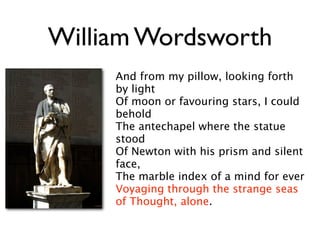
William Wordsworth
     And from my pillow, looking forth
     by light 
     Of moon or favouring stars, I could
     behold  
     The antechapel where the statue
     stood
     Of Newton with his prism and silent
     face,  
     The marble index of a mind for ever  
     Voyaging through the strange seas
     of Thought, alone. 
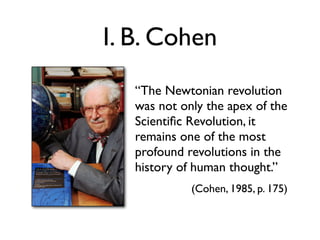
I. B. Cohen
   “The Newtonian revolution
   was not only the apex of the
   Scientific Revolution, it
   remains one of the most
   profound revolutions in the
   history of human thought.”
             (Cohen, 1985, p. 175)
Mathematics
Theory of Limits
Binomial expansion
Geometry of conic sections
The calculus (“method of fluxions & fluents”)
The application of mathematics to physics and
astronomy
Conic Sections
Physics
Optics and the theory of light and colors
Design of scientific instruments
Codification of dynamics
Invention of the concepts of mass, momentum,
force, and gravity
Discovery of the Law of Universal Gravitation
Discovery of the Gravitational Theory of Tides
1661 – Enters Trinity College, Cambridge @ age of 19

1664 – Begins self-directed study of mathematics; Discovers general
binomial expansion; Begins work on “quadtratures” (integration)

1665 – Receives BA; Leaves Cambridge due to plague;

1666/67 – Works on fluxions, optics & color, and motion; Returns to
Cambridge

1669 – Becomes Fellow of Cambridge and Lucasian professor of
mathematics

1672 – Elected Fellow of the Royal Society; Publishes “On Colour”;
Effectively retires from natural philosophy due to negative
comments by Robert Hooke and others; Writes “excessive, furious”
replies to Hooke’s criticism.
Alchemy & Theology
                     1670 - 1684

John Maynard Keynes: “Newton was not the first of the
age of reason: he was the last of the magicians.”
Wrote well over a million words on alchemy., four
million on theollogy
Rejected mechanical philosophy’s inert particles in
motion for “active principles” (which would become the
forces of attraction and repulsion between particles).
Attempted to define “true Christian” beliefs and
determine the end of time.
Heresy
Rejection of triune God as a corruption
Arianism
Christ was a lesser intermediary between God
and man
Demons as delusions of the human mind
Satan as expression of human desires and lusts.
Mortality of Soul
Road to Principia
1679 – Hooke introduces Newton to the
concept of “centripetal force” and Newton
proposes the inverse square law.
1684 – Newton begins Principia;
1687 – Publishes Principia after threatening to
pull Book III because of Hooke.
Centripetal Force
      Hooke noted that the operation of a
      force directed toward the center,
      continually pulling an object from its
      tangential path, is necessary for circular
      motion.
      Newton termed this “centripetal force”
      and refused to acknowledge Hooke.
      This contribution by Hooke would
      finally lead to a successful celestial
      dynamics and “was a deciding factor in
      setting Newton on the path that would
      lead him to the Principia” (Cohen).
Inverse Square Law
            Hooke claimed to
            have given this to
            Newton. He hadn’t
            as he himself
            believed that
Ismael Bullialdus
       “As for the power by which the Sun seizes
       or holds the planets, and which, being
       corporeal, functions in the manner of hands,
       it is emitted in straight lines throughout the
       whole extent of the world, and like the
       species of the Sun, it turns with the body of
       the Sun; now, seeing that it is corporeal, it
       becomes weaker and attenuated at a greater
       distance or interval, and the ratio of its
       decrease in strength is the same as in the
       case of light, namely, the duplicate
       proportion, but inversely, of the distances
       that is, 1/d².”


                           Astronomia philolaica, 1645
Definitions
Axioms, or The Laws of
Motion
Three Laws with
Corollaries
Book I – Motion without
resistance
Book II – Motion with
resistance; pendulums;
wave motion;
Book III – The System of
the World
Definitions
Mass: “The quantity of matter is that which arises conjointly from its
density and magnitude.”
Momentum: “The quantity of motion is a measure of motion that
arises from the velocity and the quantity of matter jointly.”
Inertia: “Inherent force of matter is the power if resisting by which
every body perseveres in its state either of resting or of moving.”
“Impressed force is the action exerted on a body to change its state
either of resting or of moving uniformly straight forward.”
“Centripetal force is the force by which bodies are drawn from all
sides, are impelled, or in any way tend, toward some point as to a
center.”
Laws of Motion
1. Every body perseveres in its state of being at rest or
   of moving uniformly straight forward, except insofar as
   it is compelled to change its state by forces impressed.
2. A change of momentum is proportional to the impulse
   impressed on the body, and happens along the straight
   line on which that impulse is impressed.
3. To every action there is always opposed an equal
   reaction: or the mutual actions of two bodies upon
   each other are always equal, and directed to contrary
   parts.
Rene Descartes proposed that giant
vortices of microparticles carry
planets around a central sun.

Newton disagreed: “Hence it is clear
that planets are not carried along by
corporeal vortices … [the]
hypothesis of vortices can in no way
be reconciled with astronomical
phenomena and serves less to clarify
the celestial motions than to obscure
them. But how these motions are
performed in free spaces without
vortices can be understood from
Book I and will now be shown in
Book III on the system of the
world” (Principia, II, Scholium)
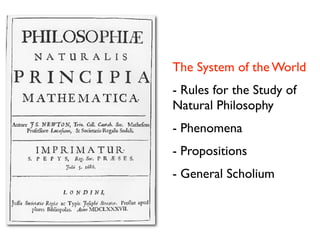
The System of the World
- Rules for the Study of
Natural Philosophy
- Phenomena
- Propositions
- General Scholium
Rules for the Study of
    Natural Philosophy
1. No more causes of natural things should be admitted than are both
   true and sufficient to explain their phenomena.
2. Therefore, the causes assigned to natural effects of the same kind
   must be, so far as possible, the same.
3. Those qualities of bodies that cannot be [increased] or [decreased]
   and that belong to all bodies on which experiments can be made
   should be taken as qualities of all bodies universally.
4. In experimental philosophy, propositions gathered from phenomena
   should be considered either exactly or very nearly true
   notwithstanding any contrary hypotheses, until yet other
   phenomena make such propositions either more exact or liable to
   exceptions.
System of the World
Universal gravitation & action at a distance
explains
- Orbit of the moon
- Motion of the moons of Jupiter
- Any planetary motion and that of comets
- Tidal motion
and allows derivation of Kepler’s Laws
The
 moon
  falls
around
  the
 earth
Every object in the universe attracts every
other object with a force directed along the
line of centers for the two objects that is
proportional to the product of their masses and
inversely proportional to the square of the
separation between the two objects.
“Thus far I have explained the phenomena of the heavens and our sea by
the force of gravity, but I have not yet assigned a cause to gravity … I have
not as yet been able to deduce from phenomena the reason for these
properties of gravity, and I do not feign hypotheses [“hypotheses non
fingo”]. For whatever is not deduced from the phenomena must be called
a hypothesis; and hypotheses, whether metaphysical or physical, or based
on occult qualities, or mechanical, have no place in experimental
philosophy. In this experimental philosophy, propositions are deduced from
the phenomena and are made general by induction. The impenetrability,
mobility, and impetus of bodies, and the laws of motion and the law of
gravity have been found by this method. And it is enough that gravity really
exists and acts according to the laws that we have set forth and is
sufficient to explain all the motions of the heavenly bodies and of our sea.”

                                                General Scholium to Principia
Implications

Mechanism

 Pathway

   Fact
1687 – Opposes entry of
       Catholics to the university

       1690’s – Publishes primarily on
       theology & prophesy

       1696 – Leave Cambridge to
       become Warden of the Royal Mint

       1703 – Becomes President of the
       Royal Society

       1704 – Publishes Opticks

1712   1727 – Newton dies
The Calculus Dispute
1666/67 – Newton invents “the method of fluxions and
fluents”
1675 – Gottfried Leibniz privately uses his “differential
method”
1677 – Leibniz uses his method in a letter to Newton
1684 - Leibniz publishes his method
1693 – Newton first publishes an account of his method
1699 – de Dullier accuses Leibniz of plagiarizing Newton
The Calculus Dispute
1704 – A review implies Newton’s debt to Leibniz
1711 – Dispute erupts / Leibniz asks the RSL to adjudicate.
1713 – The publication of the RSL’s report vindicates
Newton
1716 – Death of Leibniz
1727 – Death of Newton
1736 - Posthumous publication of Newton’s Method of
Fluxions.
Letter to Hooke, 1676

         “What Descartes did was
         a good step.You have
         added much several ways
         … If I have seen a little
         further it is by standing on
         the shoulders of Giants.”
Immanuel Kant
     “It is absurd for human
     beings ... to hope that
     perhaps some day another
     Newton might arise who
     would explain to us, in
     terms of natural laws
     unordered by any
     intention, how even a mere
     blade of grass is produced.”
         Critique of Judgment, 1790

Newton

  • 2.
    Alexander Pope Nature and Nature's laws lay hid in night God said, Let Newton be! and all was light.
  • 3.
    Westminster Abbey Here isburied Isaac Newton, Knight, who by a strength of mind almost divine, and mathematical principles peculiarly his own, explored the course and figures of the planets, the paths of comets, the tides of the sea, the dissimilarities in rays of light, and, what no other scholar has previously imagined, the properties of the colours thus produced. Diligent, sagacious and faithful, in his expositions of nature, antiquity and the holy Scriptures, he vindicated by his philosophy the majesty of God mighty and good, and expressed the simplicity of the Gospel in his manners. Mortals rejoice that there has existed such and so great an ornament of the human race!
  • 4.
    William Wordsworth And from my pillow, looking forth by light  Of moon or favouring stars, I could behold   The antechapel where the statue stood Of Newton with his prism and silent face,   The marble index of a mind for ever   Voyaging through the strange seas of Thought, alone. 
  • 11.
    I. B. Cohen “The Newtonian revolution was not only the apex of the Scientific Revolution, it remains one of the most profound revolutions in the history of human thought.” (Cohen, 1985, p. 175)
  • 12.
    Mathematics Theory of Limits Binomialexpansion Geometry of conic sections The calculus (“method of fluxions & fluents”) The application of mathematics to physics and astronomy
  • 13.
  • 15.
    Physics Optics and thetheory of light and colors Design of scientific instruments Codification of dynamics Invention of the concepts of mass, momentum, force, and gravity Discovery of the Law of Universal Gravitation Discovery of the Gravitational Theory of Tides
  • 17.
    1661 – EntersTrinity College, Cambridge @ age of 19 1664 – Begins self-directed study of mathematics; Discovers general binomial expansion; Begins work on “quadtratures” (integration) 1665 – Receives BA; Leaves Cambridge due to plague; 1666/67 – Works on fluxions, optics & color, and motion; Returns to Cambridge 1669 – Becomes Fellow of Cambridge and Lucasian professor of mathematics 1672 – Elected Fellow of the Royal Society; Publishes “On Colour”; Effectively retires from natural philosophy due to negative comments by Robert Hooke and others; Writes “excessive, furious” replies to Hooke’s criticism.
  • 19.
    Alchemy & Theology 1670 - 1684 John Maynard Keynes: “Newton was not the first of the age of reason: he was the last of the magicians.” Wrote well over a million words on alchemy., four million on theollogy Rejected mechanical philosophy’s inert particles in motion for “active principles” (which would become the forces of attraction and repulsion between particles). Attempted to define “true Christian” beliefs and determine the end of time.
  • 22.
    Heresy Rejection of triuneGod as a corruption Arianism Christ was a lesser intermediary between God and man Demons as delusions of the human mind Satan as expression of human desires and lusts. Mortality of Soul
  • 23.
    Road to Principia 1679– Hooke introduces Newton to the concept of “centripetal force” and Newton proposes the inverse square law. 1684 – Newton begins Principia; 1687 – Publishes Principia after threatening to pull Book III because of Hooke.
  • 24.
    Centripetal Force Hooke noted that the operation of a force directed toward the center, continually pulling an object from its tangential path, is necessary for circular motion. Newton termed this “centripetal force” and refused to acknowledge Hooke. This contribution by Hooke would finally lead to a successful celestial dynamics and “was a deciding factor in setting Newton on the path that would lead him to the Principia” (Cohen).
  • 25.
    Inverse Square Law Hooke claimed to have given this to Newton. He hadn’t as he himself believed that
  • 26.
    Ismael Bullialdus “As for the power by which the Sun seizes or holds the planets, and which, being corporeal, functions in the manner of hands, it is emitted in straight lines throughout the whole extent of the world, and like the species of the Sun, it turns with the body of the Sun; now, seeing that it is corporeal, it becomes weaker and attenuated at a greater distance or interval, and the ratio of its decrease in strength is the same as in the case of light, namely, the duplicate proportion, but inversely, of the distances that is, 1/d².” Astronomia philolaica, 1645
  • 27.
    Definitions Axioms, or TheLaws of Motion Three Laws with Corollaries Book I – Motion without resistance Book II – Motion with resistance; pendulums; wave motion; Book III – The System of the World
  • 28.
    Definitions Mass: “The quantityof matter is that which arises conjointly from its density and magnitude.” Momentum: “The quantity of motion is a measure of motion that arises from the velocity and the quantity of matter jointly.” Inertia: “Inherent force of matter is the power if resisting by which every body perseveres in its state either of resting or of moving.” “Impressed force is the action exerted on a body to change its state either of resting or of moving uniformly straight forward.” “Centripetal force is the force by which bodies are drawn from all sides, are impelled, or in any way tend, toward some point as to a center.”
  • 30.
    Laws of Motion 1.Every body perseveres in its state of being at rest or of moving uniformly straight forward, except insofar as it is compelled to change its state by forces impressed. 2. A change of momentum is proportional to the impulse impressed on the body, and happens along the straight line on which that impulse is impressed. 3. To every action there is always opposed an equal reaction: or the mutual actions of two bodies upon each other are always equal, and directed to contrary parts.
  • 33.
    Rene Descartes proposedthat giant vortices of microparticles carry planets around a central sun. Newton disagreed: “Hence it is clear that planets are not carried along by corporeal vortices … [the] hypothesis of vortices can in no way be reconciled with astronomical phenomena and serves less to clarify the celestial motions than to obscure them. But how these motions are performed in free spaces without vortices can be understood from Book I and will now be shown in Book III on the system of the world” (Principia, II, Scholium)
  • 34.
    The System ofthe World - Rules for the Study of Natural Philosophy - Phenomena - Propositions - General Scholium
  • 35.
    Rules for theStudy of Natural Philosophy 1. No more causes of natural things should be admitted than are both true and sufficient to explain their phenomena. 2. Therefore, the causes assigned to natural effects of the same kind must be, so far as possible, the same. 3. Those qualities of bodies that cannot be [increased] or [decreased] and that belong to all bodies on which experiments can be made should be taken as qualities of all bodies universally. 4. In experimental philosophy, propositions gathered from phenomena should be considered either exactly or very nearly true notwithstanding any contrary hypotheses, until yet other phenomena make such propositions either more exact or liable to exceptions.
  • 36.
    System of theWorld Universal gravitation & action at a distance explains - Orbit of the moon - Motion of the moons of Jupiter - Any planetary motion and that of comets - Tidal motion and allows derivation of Kepler’s Laws
  • 37.
    The moon falls around the earth
  • 38.
    Every object inthe universe attracts every other object with a force directed along the line of centers for the two objects that is proportional to the product of their masses and inversely proportional to the square of the separation between the two objects.
  • 40.
    “Thus far Ihave explained the phenomena of the heavens and our sea by the force of gravity, but I have not yet assigned a cause to gravity … I have not as yet been able to deduce from phenomena the reason for these properties of gravity, and I do not feign hypotheses [“hypotheses non fingo”]. For whatever is not deduced from the phenomena must be called a hypothesis; and hypotheses, whether metaphysical or physical, or based on occult qualities, or mechanical, have no place in experimental philosophy. In this experimental philosophy, propositions are deduced from the phenomena and are made general by induction. The impenetrability, mobility, and impetus of bodies, and the laws of motion and the law of gravity have been found by this method. And it is enough that gravity really exists and acts according to the laws that we have set forth and is sufficient to explain all the motions of the heavenly bodies and of our sea.” General Scholium to Principia
  • 41.
  • 42.
    1687 – Opposesentry of Catholics to the university 1690’s – Publishes primarily on theology & prophesy 1696 – Leave Cambridge to become Warden of the Royal Mint 1703 – Becomes President of the Royal Society 1704 – Publishes Opticks 1712 1727 – Newton dies
  • 43.
    The Calculus Dispute 1666/67– Newton invents “the method of fluxions and fluents” 1675 – Gottfried Leibniz privately uses his “differential method” 1677 – Leibniz uses his method in a letter to Newton 1684 - Leibniz publishes his method 1693 – Newton first publishes an account of his method 1699 – de Dullier accuses Leibniz of plagiarizing Newton
  • 44.
    The Calculus Dispute 1704– A review implies Newton’s debt to Leibniz 1711 – Dispute erupts / Leibniz asks the RSL to adjudicate. 1713 – The publication of the RSL’s report vindicates Newton 1716 – Death of Leibniz 1727 – Death of Newton 1736 - Posthumous publication of Newton’s Method of Fluxions.
  • 46.
    Letter to Hooke,1676 “What Descartes did was a good step.You have added much several ways … If I have seen a little further it is by standing on the shoulders of Giants.”
  • 51.
    Immanuel Kant “It is absurd for human beings ... to hope that perhaps some day another Newton might arise who would explain to us, in terms of natural laws unordered by any intention, how even a mere blade of grass is produced.” Critique of Judgment, 1790

Editor's Notes

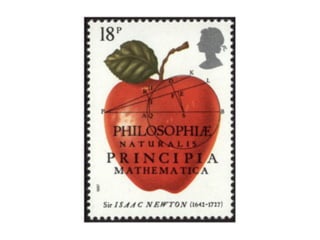
  • #6 Palozzi’s sculpture in forecourt of British Library / Dali / Stamps / Newton in many ways completes the Copernican “revolution” that began in 1547 in 1687 with the publication of PRINCIPIA
  • #7 Palozzi’s sculpture in forecourt of British Library / Dali / Stamps / Newton in many ways completes the Copernican “revolution” that began in 1547 in 1687 with the publication of PRINCIPIA
  • #8 Palozzi’s sculpture in forecourt of British Library / Dali / Stamps / Newton in many ways completes the Copernican “revolution” that began in 1547 in 1687 with the publication of PRINCIPIA
  • #9 Palozzi’s sculpture in forecourt of British Library / Dali / Stamps / Newton in many ways completes the Copernican “revolution” that began in 1547 in 1687 with the publication of PRINCIPIA
  • #12 Building on Galileo, Kepler, Hooke, Christiaan Huygens
  • #21 Problem with Holy Orders - exemption from the King