Mathematical Modeling of Physical Systems
Module-2
Outline
Dr. R.K.Mugelan, Asst. Prof. (Sr), SENSE, VIT
2
 Differential equation, Difference equation, and State
variable representations.
 Mathematical modelling of electrical and mechanical
systems
 Equivalence between the elements of different types of
systems
 Transfer function, Block diagram – Manipulation of block
diagrams
 Open loop transfer function and closed loop transfer
function
 Signal flow graph.
Mathematical Model
Dr. R.K.Mugelan, Asst. Prof. (Sr), SENSE, VIT
3
 The control systems can be represented with a set of
mathematical equations known as mathematical model.
 Useful for analysis and design of control systems.
 Analysis of control system means finding the output when we know
the input and mathematical model.
 Design of control system means finding the mathematical model
when we know the input and the output.
Dr. R.K.Mugelan, Asst. Prof. (Sr), SENSE, VIT
4
 The following mathematical models are mostly
used.
 Differential equation model
 Transfer function model
 State space model
 Let us discuss the first two models in this module.
Differential Equation Model
Dr. R.K.Mugelan, Asst. Prof. (Sr), SENSE, VIT
5
 It is a time domain mathematical model of control systems
(Continuous Time Control Systems).
 Follow these steps for differential equation model.
 Apply basic laws to the given control system.
 Get the differential equation in terms of input and output by
eliminating the intermediate variable(s).
Differential Equation Model
Dr. R.K.Mugelan, Asst. Prof. (Sr), SENSE, VIT
6
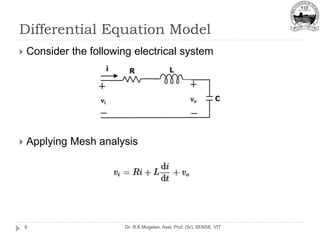
 Consider the following electrical system
 Applying Mesh analysis
Differential Equation Model
Dr. R.K.Mugelan, Asst. Prof. (Sr), SENSE, VIT
7
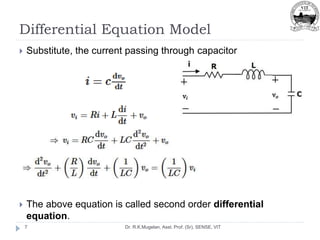
 Substitute, the current passing through capacitor
 The above equation is called second order differential
equation.
Transfer Function Model
Dr. R.K.Mugelan, Asst. Prof. (Sr), SENSE, VIT
8
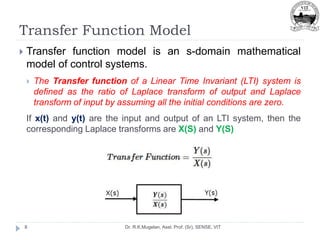
 Transfer function model is an s-domain mathematical
model of control systems.
 The Transfer function of a Linear Time Invariant (LTI) system is
defined as the ratio of Laplace transform of output and Laplace
transform of input by assuming all the initial conditions are zero.
If x(t) and y(t) are the input and output of an LTI system, then the
corresponding Laplace transforms are X(S) and Y(S)
Transfer Function Model
Dr. R.K.Mugelan, Asst. Prof. (Sr), SENSE, VIT
9
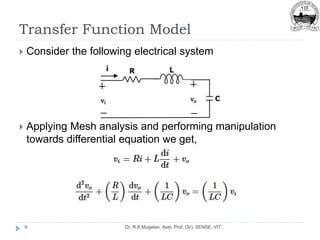
 Consider the following electrical system
 Applying Mesh analysis and performing manipulation
towards differential equation we get,
Transfer Function Model
Dr. R.K.Mugelan, Asst. Prof. (Sr), SENSE, VIT
10
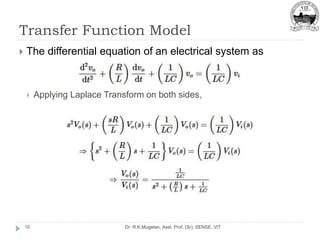
 The differential equation of an electrical system as
 Applying Laplace Transform on both sides,
Transfer Function Model
Dr. R.K.Mugelan, Asst. Prof. (Sr), SENSE, VIT
11
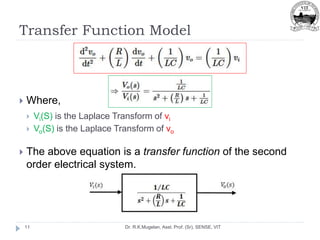
 Where,
 Vi(S) is the Laplace Transform of vi
 Vo(S) is the Laplace Transform of vo
 The above equation is a transfer function of the second
order electrical system.
Modelling of Mechanical Systems
Dr. R.K.Mugelan, Asst. Prof. (Sr), SENSE, VIT
12
 There are two types of mechanical systems based on the
type of motion.
 Translational mechanical systems
 Rotational mechanical systems
Translational Mechanical Systems (TMS)
Dr. R.K.Mugelan, Asst. Prof. (Sr), SENSE, VIT
13
 Translational mechanical systems move along a straight
line.
 These systems mainly consist of three basic elements.
 Mass
 Spring
 Dashpot or Damper
 If a force is applied to a translational mechanical system,
then it is opposed by opposing forces
 Due to mass, elasticity and friction of the system.
 Since the applied force and the opposing forces are in
opposite directions, the algebraic sum of the forces acting
on the system is zero.
TMS: Mass
Dr. R.K.Mugelan, Asst. Prof. (Sr), SENSE, VIT
14
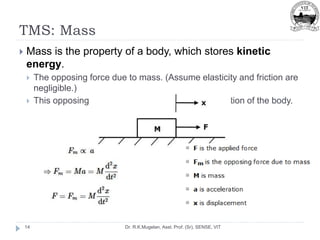
 Mass is the property of a body, which stores kinetic
energy.
 The opposing force due to mass. (Assume elasticity and friction are
negligible.)
 This opposing force is proportional to the acceleration of the body.
TMS: Spring
Dr. R.K.Mugelan, Asst. Prof. (Sr), SENSE, VIT
15
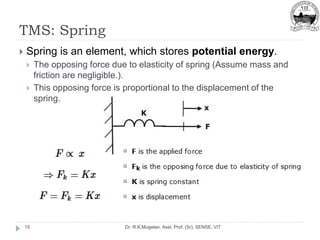
 Spring is an element, which stores potential energy.
 The opposing force due to elasticity of spring (Assume mass and
friction are negligible.).
 This opposing force is proportional to the displacement of the
spring.
TMS: Dashpot or Damper
Dr. R.K.Mugelan, Asst. Prof. (Sr), SENSE, VIT
16
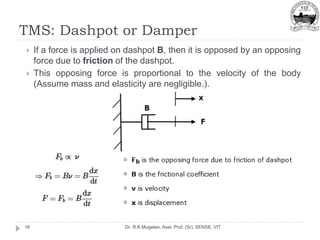
 If a force is applied on dashpot B, then it is opposed by an opposing
force due to friction of the dashpot.
 This opposing force is proportional to the velocity of the body
(Assume mass and elasticity are negligible.).
Rotational Mechanical Systems (RMS)
Dr. R.K.Mugelan, Asst. Prof. (Sr), SENSE, VIT
17
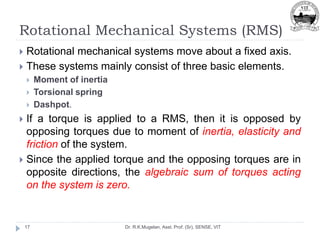
 Rotational mechanical systems move about a fixed axis.
 These systems mainly consist of three basic elements.
 Moment of inertia
 Torsional spring
 Dashpot.
 If a torque is applied to a RMS, then it is opposed by
opposing torques due to moment of inertia, elasticity and
friction of the system.
 Since the applied torque and the opposing torques are in
opposite directions, the algebraic sum of torques acting
on the system is zero.
RMS: Moment of Inertia
Dr. R.K.Mugelan, Asst. Prof. (Sr), SENSE, VIT
18
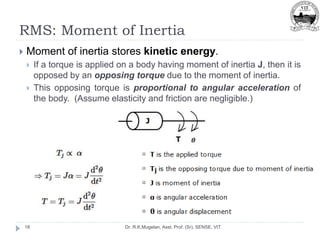
 Moment of inertia stores kinetic energy.
 If a torque is applied on a body having moment of inertia J, then it is
opposed by an opposing torque due to the moment of inertia.
 This opposing torque is proportional to angular acceleration of
the body. (Assume elasticity and friction are negligible.)
RMS: Torsional Spring
Dr. R.K.Mugelan, Asst. Prof. (Sr), SENSE, VIT
19
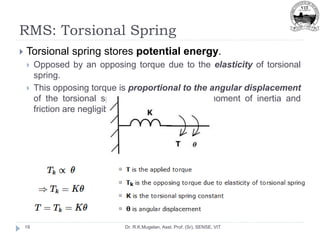
 Torsional spring stores potential energy.
 Opposed by an opposing torque due to the elasticity of torsional
spring.
 This opposing torque is proportional to the angular displacement
of the torsional spring. (Assume that the moment of inertia and
friction are negligible.)
RMS: Dashpot or Damper
Dr. R.K.Mugelan, Asst. Prof. (Sr), SENSE, VIT
20
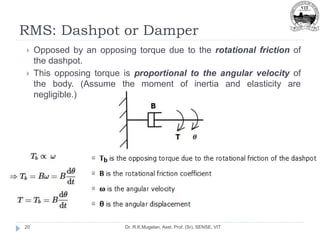
 Opposed by an opposing torque due to the rotational friction of
the dashpot.
 This opposing torque is proportional to the angular velocity of
the body. (Assume the moment of inertia and elasticity are
negligible.)
Analogy between Elec. & Mech. Sys.
Dr. R.K.Mugelan, Asst. Prof. (Sr), SENSE, VIT
21
 Two systems are said to be analogous to each other if
the following two conditions are satisfied.
 The two systems are physically different
 Differential equation modelling of these two systems are same
 Electrical systems and mechanical systems are two
physically different systems.
 There are two types of electrical analogies of translational
mechanical systems.
 Force voltage analogy.
 Force current analogy.
Force Voltage Analogy
Dr. R.K.Mugelan, Asst. Prof. (Sr), SENSE, VIT
22
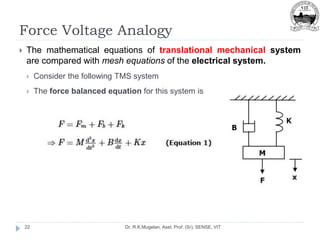
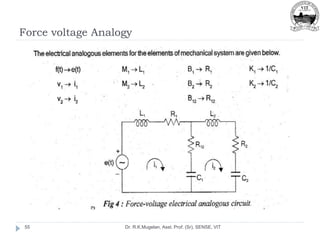
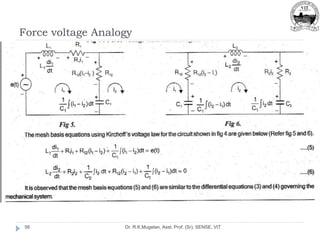
 The mathematical equations of translational mechanical system
are compared with mesh equations of the electrical system.
 Consider the following TMS system
 The force balanced equation for this system is
Force Voltage Analogy
Dr. R.K.Mugelan, Asst. Prof. (Sr), SENSE, VIT
23
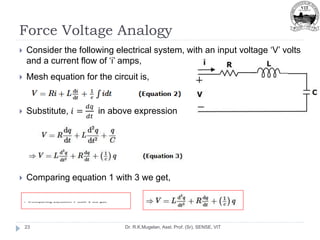
 Consider the following electrical system, with an input voltage ‘V’ volts
and a current flow of ‘i’ amps,
 Mesh equation for the circuit is,
 Substitute, 𝑖 =
𝑑𝑞
𝑑𝑡
in above expression
 Comparing equation 1 with 3 we get,
Force Voltage Analogy
Dr. R.K.Mugelan, Asst. Prof. (Sr), SENSE, VIT
24
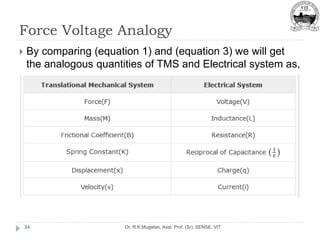
 By comparing (equation 1) and (equation 3) we will get
the analogous quantities of TMS and Electrical system as,
Torque Voltage Analogy
Dr. R.K.Mugelan, Asst. Prof. (Sr), SENSE, VIT
25
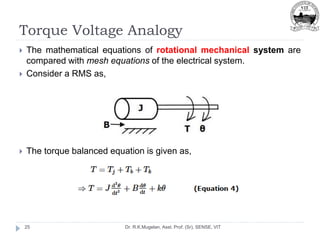
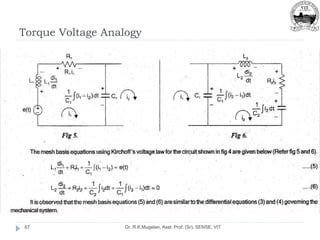
 The mathematical equations of rotational mechanical system are
compared with mesh equations of the electrical system.
 Consider a RMS as,
 The torque balanced equation is given as,
Torque Voltage Analogy
Dr. R.K.Mugelan, Asst. Prof. (Sr), SENSE, VIT
26
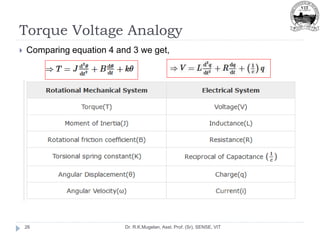
 Comparing equation 4 and 3 we get,
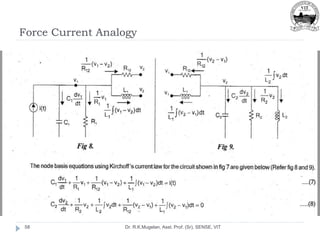
Force Current Analogy
Dr. R.K.Mugelan, Asst. Prof. (Sr), SENSE, VIT
27
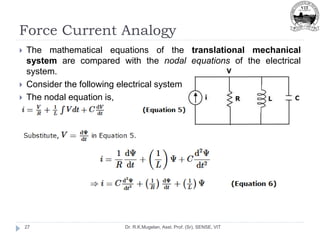
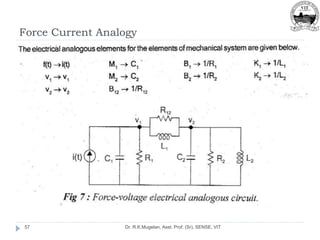
 The mathematical equations of the translational mechanical
system are compared with the nodal equations of the electrical
system.
 Consider the following electrical system
 The nodal equation is,
Force Current Analogy
Dr. R.K.Mugelan, Asst. Prof. (Sr), SENSE, VIT
28
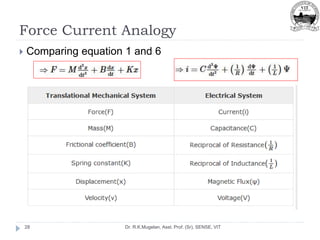
 Comparing equation 1 and 6
Torque Current Analogy
Dr. R.K.Mugelan, Asst. Prof. (Sr), SENSE, VIT
29
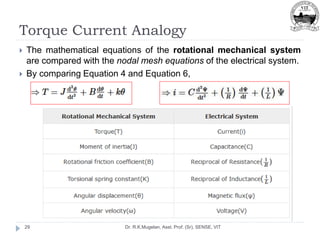
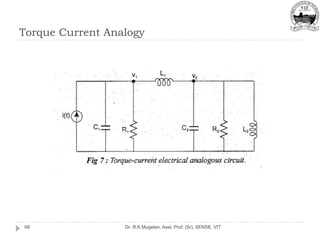
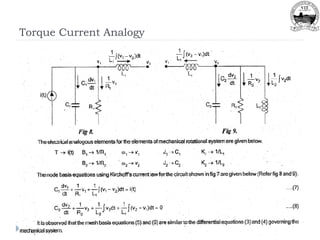
 The mathematical equations of the rotational mechanical system
are compared with the nodal mesh equations of the electrical system.
 By comparing Equation 4 and Equation 6,
Guidelines to determine Transfer Function
Dr. R.K.Mugelan, Asst. Prof. (Sr), SENSE, VIT
30
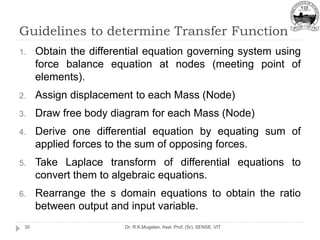
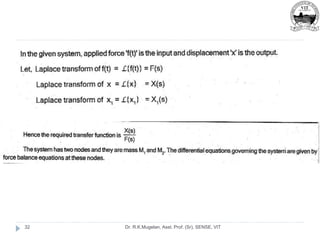
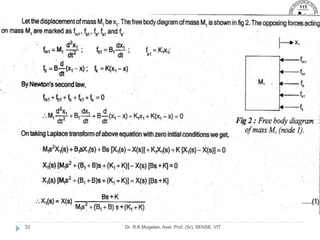
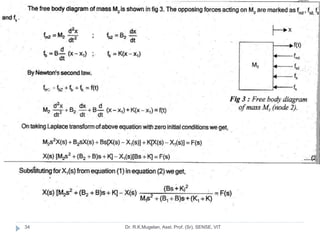
1. Obtain the differential equation governing system using
force balance equation at nodes (meeting point of
elements).
2. Assign displacement to each Mass (Node)
3. Draw free body diagram for each Mass (Node)
4. Derive one differential equation by equating sum of
applied forces to the sum of opposing forces.
5. Take Laplace transform of differential equations to
convert them to algebraic equations.
6. Rearrange the s domain equations to obtain the ratio
between output and input variable.
Example for TMS
Dr. R.K.Mugelan, Asst. Prof. (Sr), SENSE, VIT
31
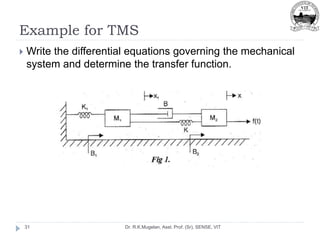
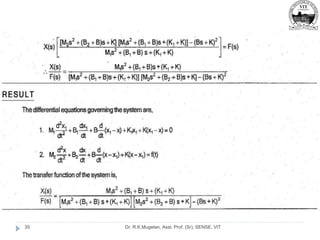
 Write the differential equations governing the mechanical
system and determine the transfer function.
Dr. R.K.Mugelan, Asst. Prof. (Sr), SENSE, VIT
32
Dr. R.K.Mugelan, Asst. Prof. (Sr), SENSE, VIT
33
Dr. R.K.Mugelan, Asst. Prof. (Sr), SENSE, VIT
34
Dr. R.K.Mugelan, Asst. Prof. (Sr), SENSE, VIT
35
Example for RMS
Dr. R.K.Mugelan, Asst. Prof. (Sr), SENSE, VIT
36
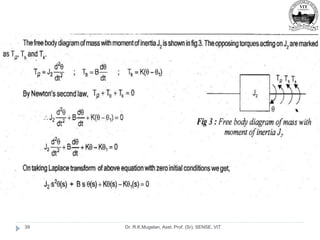
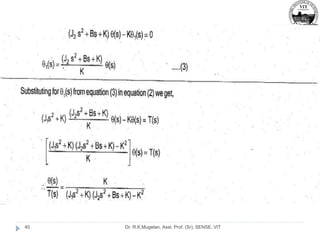
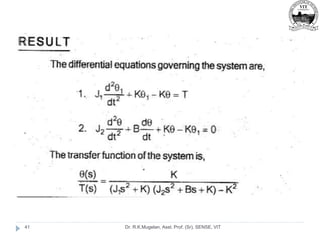
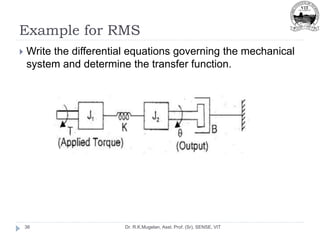
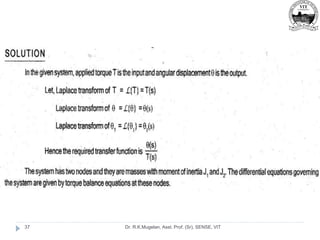
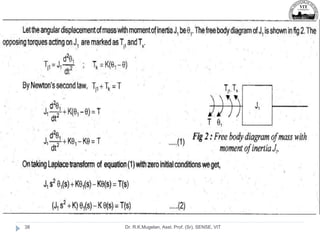
 Write the differential equations governing the mechanical
system and determine the transfer function.
Dr. R.K.Mugelan, Asst. Prof. (Sr), SENSE, VIT
37
Dr. R.K.Mugelan, Asst. Prof. (Sr), SENSE, VIT
38
Dr. R.K.Mugelan, Asst. Prof. (Sr), SENSE, VIT
39
Dr. R.K.Mugelan, Asst. Prof. (Sr), SENSE, VIT
40
Dr. R.K.Mugelan, Asst. Prof. (Sr), SENSE, VIT
41
Example for Electrical System
Dr. R.K.Mugelan, Asst. Prof. (Sr), SENSE, VIT
42
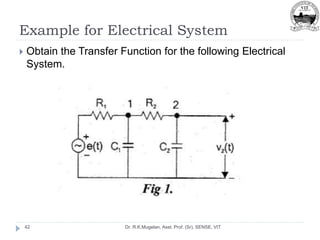
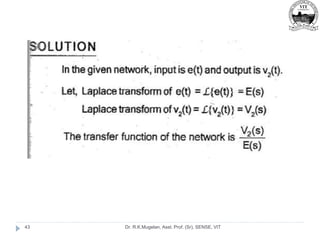
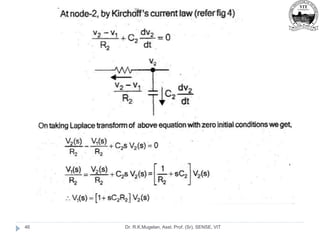
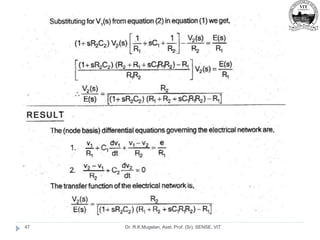
 Obtain the Transfer Function for the following Electrical
System.
Dr. R.K.Mugelan, Asst. Prof. (Sr), SENSE, VIT
43
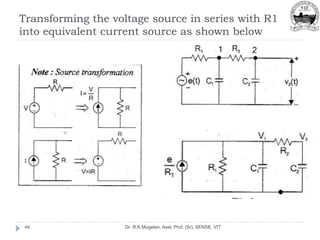
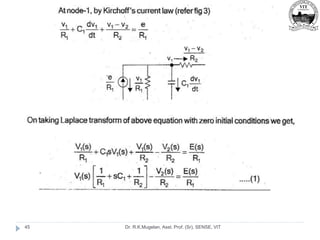
Transforming the voltage source in series with R1
into equivalent current source as shown below
Dr. R.K.Mugelan, Asst. Prof. (Sr), SENSE, VIT
44
Dr. R.K.Mugelan, Asst. Prof. (Sr), SENSE, VIT
45
Dr. R.K.Mugelan, Asst. Prof. (Sr), SENSE, VIT
46
Dr. R.K.Mugelan, Asst. Prof. (Sr), SENSE, VIT
47
Try Yourself..!!
Dr. R.K.Mugelan, Asst. Prof. (Sr), SENSE, VIT
48
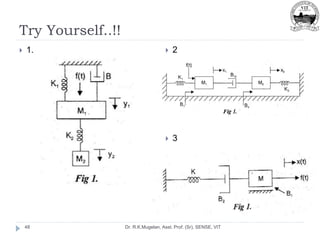
 1.  2
 3
Try Yourself..!!
Dr. R.K.Mugelan, Asst. Prof. (Sr), SENSE, VIT
49
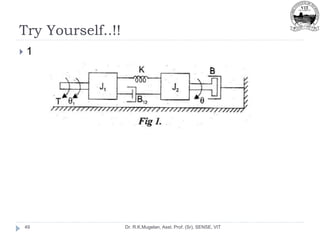
 1
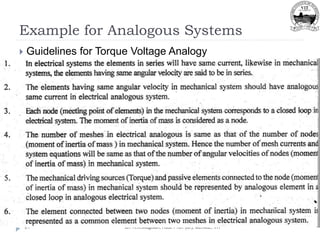
Example for Analogous Systems
Dr. R.K.Mugelan, Asst. Prof. (Sr), SENSE, VIT
50
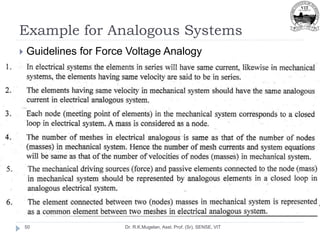
 Guidelines for Force Voltage Analogy
Example for Analogous Systems
Dr. R.K.Mugelan, Asst. Prof. (Sr), SENSE, VIT
51
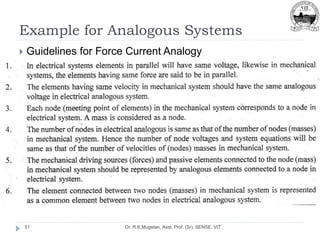
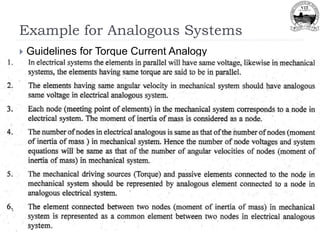
 Guidelines for Force Current Analogy
Example for Analogous Systems
Dr. R.K.Mugelan, Asst. Prof. (Sr), SENSE, VIT
52
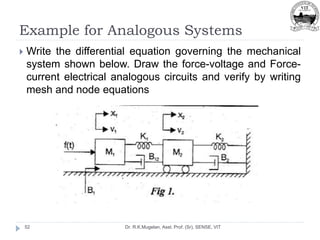
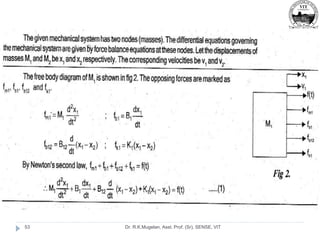
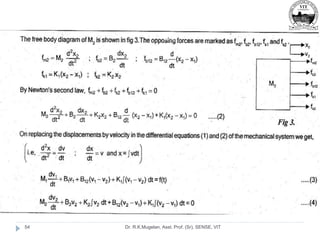
 Write the differential equation governing the mechanical
system shown below. Draw the force-voltage and Force-
current electrical analogous circuits and verify by writing
mesh and node equations
Dr. R.K.Mugelan, Asst. Prof. (Sr), SENSE, VIT
53
Dr. R.K.Mugelan, Asst. Prof. (Sr), SENSE, VIT
54
Force voltage Analogy
Dr. R.K.Mugelan, Asst. Prof. (Sr), SENSE, VIT
55
Force voltage Analogy
Dr. R.K.Mugelan, Asst. Prof. (Sr), SENSE, VIT
56
Force Current Analogy
Dr. R.K.Mugelan, Asst. Prof. (Sr), SENSE, VIT
57
Force Current Analogy
Dr. R.K.Mugelan, Asst. Prof. (Sr), SENSE, VIT
58
Solution
Dr. R.K.Mugelan, Asst. Prof. (Sr), SENSE, VIT
59
 On comparing equations (3) and (4) [Mechanical System]
with expressions (5), (6)[Force Voltage Analogy] and
expressions (6), (7) [Force Current Analogy]
Try for Yourself..!
Dr. R.K.Mugelan, Asst. Prof. (Sr), SENSE, VIT
60
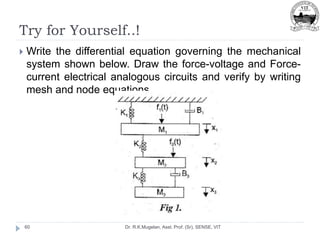
 Write the differential equation governing the mechanical
system shown below. Draw the force-voltage and Force-
current electrical analogous circuits and verify by writing
mesh and node equations
Example for Analogous Systems
Dr. R.K.Mugelan, Asst. Prof. (Sr), SENSE, VIT
61
 Guidelines for Torque Voltage Analogy
Example for Analogous Systems
Dr. R.K.Mugelan, Asst. Prof. (Sr), SENSE, VIT
62
 Guidelines for Torque Current Analogy
Example for Analogous Systems
Dr. R.K.Mugelan, Asst. Prof. (Sr), SENSE, VIT
63
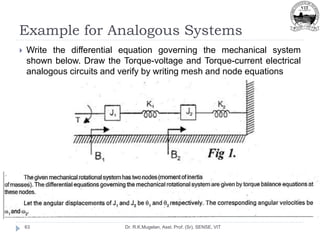
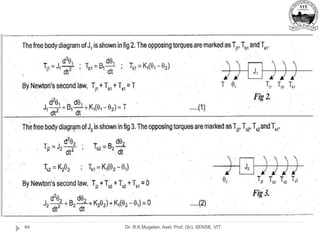
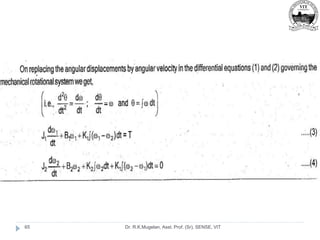
 Write the differential equation governing the mechanical system
shown below. Draw the Torque-voltage and Torque-current electrical
analogous circuits and verify by writing mesh and node equations
Dr. R.K.Mugelan, Asst. Prof. (Sr), SENSE, VIT
64
Dr. R.K.Mugelan, Asst. Prof. (Sr), SENSE, VIT
65
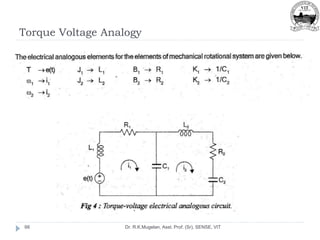
Torque Voltage Analogy
Dr. R.K.Mugelan, Asst. Prof. (Sr), SENSE, VIT
66
Torque Voltage Analogy
Dr. R.K.Mugelan, Asst. Prof. (Sr), SENSE, VIT
67
Torque Current Analogy
Dr. R.K.Mugelan, Asst. Prof. (Sr), SENSE, VIT
68
Torque Current Analogy
Dr. R.K.Mugelan, Asst. Prof. (Sr), SENSE, VIT
69
Solution
Dr. R.K.Mugelan, Asst. Prof. (Sr), SENSE, VIT
70
 On comparing equations (3) and (4) [Mechanical System] with
expressions (5), (6)[Torque Voltage Analogy] and expressions (6), (7)
[Torque Current Analogy]
Try for Yourself.!!
Dr. R.K.Mugelan, Asst. Prof. (Sr), SENSE, VIT
71
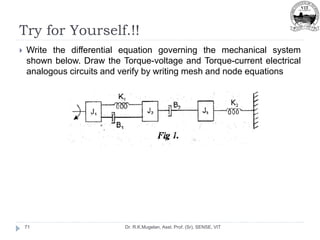
 Write the differential equation governing the mechanical system
shown below. Draw the Torque-voltage and Torque-current electrical
analogous circuits and verify by writing mesh and node equations
BLOCK DIAGRAM
Dr. R.K.Mugelan, Asst. Prof. (Sr), SENSE, VIT
72
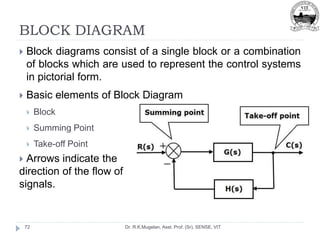
 Block diagrams consist of a single block or a combination
of blocks which are used to represent the control systems
in pictorial form.
 Basic elements of Block Diagram
 Block
 Summing Point
 Take-off Point
 Arrows indicate the
direction of the flow of
signals.
BLOCK
Dr. R.K.Mugelan, Asst. Prof. (Sr), SENSE, VIT
73
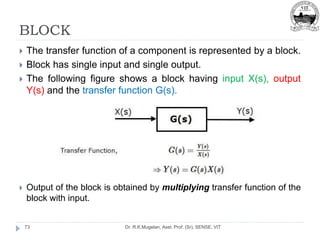
 The transfer function of a component is represented by a block.
 Block has single input and single output.
 The following figure shows a block having input X(s), output
Y(s) and the transfer function G(s).
 Output of the block is obtained by multiplying transfer function of the
block with input.
Summing Point
Dr. R.K.Mugelan, Asst. Prof. (Sr), SENSE, VIT
74
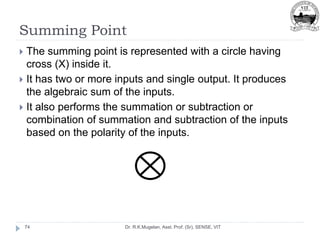
 The summing point is represented with a circle having
cross (X) inside it.
 It has two or more inputs and single output. It produces
the algebraic sum of the inputs.
 It also performs the summation or subtraction or
combination of summation and subtraction of the inputs
based on the polarity of the inputs.
Summing Point
Dr. R.K.Mugelan, Asst. Prof. (Sr), SENSE, VIT
75
 The following figure shows the summing point with two inputs
(A, B) and one output (Y).
 Here, the inputs A and B have a positive sign.
 So, the summing point produces the output, Y as sum of A
and B. [Y=A+B]
Summing Point
Dr. R.K.Mugelan, Asst. Prof. (Sr), SENSE, VIT
76
 The following figure shows the summing point with two inputs
(A, B) and one output (Y).
 Here, the inputs A and B are having opposite signs, i.e., A is
having positive sign and B is having negative sign.
 So, the summing point produces the output Y as the
difference of A and B. [Y=A+(-B)=A-B]
Summing Point
Dr. R.K.Mugelan, Asst. Prof. (Sr), SENSE, VIT
77
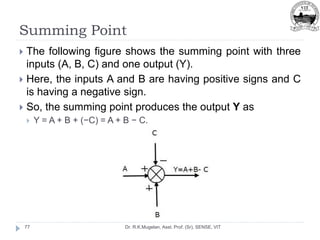
 The following figure shows the summing point with three
inputs (A, B, C) and one output (Y).
 Here, the inputs A and B are having positive signs and C
is having a negative sign.
 So, the summing point produces the output Y as
 Y = A + B + (−C) = A + B − C.
Take-off Point
Dr. R.K.Mugelan, Asst. Prof. (Sr), SENSE, VIT
78
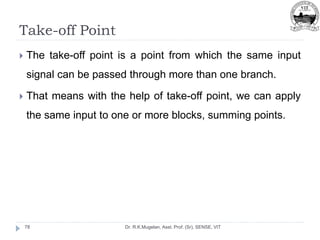
 The take-off point is a point from which the same input
signal can be passed through more than one branch.
 That means with the help of take-off point, we can apply
the same input to one or more blocks, summing points.
Take-off Point
Dr. R.K.Mugelan, Asst. Prof. (Sr), SENSE, VIT
79
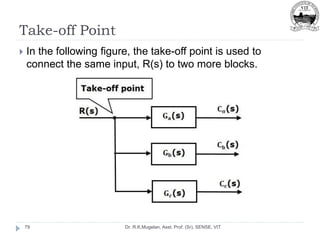
 In the following figure, the take-off point is used to
connect the same input, R(s) to two more blocks.
Take-off Point
Dr. R.K.Mugelan, Asst. Prof. (Sr), SENSE, VIT
80
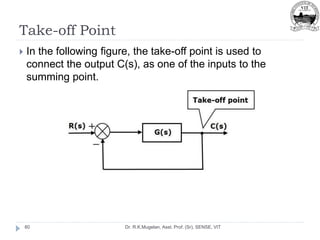
 In the following figure, the take-off point is used to
connect the output C(s), as one of the inputs to the
summing point.
Block Diagram Representation of Electrical
Systems
Dr. R.K.Mugelan, Asst. Prof. (Sr), SENSE, VIT
81
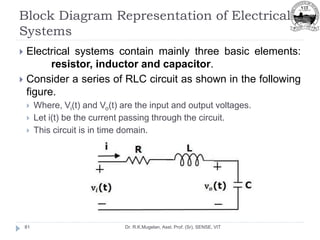
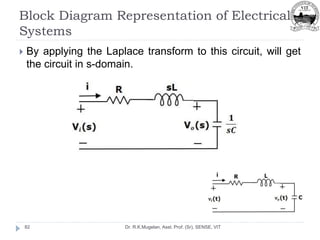
 Electrical systems contain mainly three basic elements:
resistor, inductor and capacitor.
 Consider a series of RLC circuit as shown in the following
figure.
 Where, Vi(t) and Vo(t) are the input and output voltages.
 Let i(t) be the current passing through the circuit.
 This circuit is in time domain.
Block Diagram Representation of Electrical
Systems
Dr. R.K.Mugelan, Asst. Prof. (Sr), SENSE, VIT
82
 By applying the Laplace transform to this circuit, will get
the circuit in s-domain.
Block Diagram Representation of Electrical
Systems
Dr. R.K.Mugelan, Asst. Prof. (Sr), SENSE, VIT
83
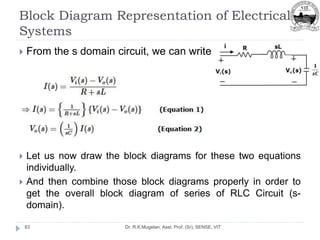
 From the s domain circuit, we can write
 Let us now draw the block diagrams for these two equations
individually.
 And then combine those block diagrams properly in order to
get the overall block diagram of series of RLC Circuit (s-
domain).
Block Diagram Representation of Electrical
Systems
Dr. R.K.Mugelan, Asst. Prof. (Sr), SENSE, VIT
84
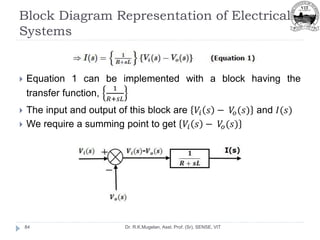
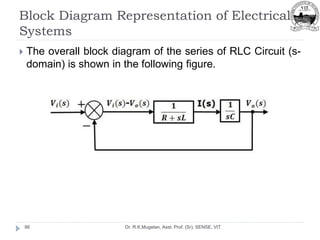
 Equation 1 can be implemented with a block having the
transfer function,
1
𝑅+𝑠𝐿
 The input and output of this block are 𝑉𝑖 𝑠 − 𝑉
𝑜(𝑠) and 𝐼(𝑠)
 We require a summing point to get 𝑉𝑖 𝑠 − 𝑉
𝑜(𝑠)
Block Diagram Representation of Electrical
Systems
Dr. R.K.Mugelan, Asst. Prof. (Sr), SENSE, VIT
85
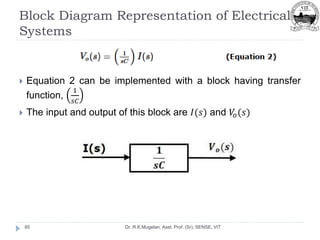
 Equation 2 can be implemented with a block having transfer
function,
1
𝑠𝐶
 The input and output of this block are 𝐼(𝑠) and 𝑉
𝑜(𝑠)
Block Diagram Representation of Electrical
Systems
Dr. R.K.Mugelan, Asst. Prof. (Sr), SENSE, VIT
86
 The overall block diagram of the series of RLC Circuit (s-
domain) is shown in the following figure.
Block Diagram Representation of Electrical
Systems
Dr. R.K.Mugelan, Asst. Prof. (Sr), SENSE, VIT
87
 Procedure to obtain Block Diagram for any
electrical system
 Convert the time domain electrical circuit into an s-
domain electrical circuit by applying Laplace transform.
 Write down the equations for the current passing
through all series branch elements and voltage across
all shunt branches.
 Draw the block diagrams for all the above equations
individually.
 Combine all these block diagrams properly in order to
get the overall block diagram of the electrical circuit (s-
domain).
Basic Connections for Blocks
Dr. R.K.Mugelan, Asst. Prof. (Sr), SENSE, VIT
88
 There are three basic types of connections
between two blocks,
 Series Connection
 Parallel Connection
 Feedback Connection
Series Connection
Dr. R.K.Mugelan, Asst. Prof. (Sr), SENSE, VIT
89
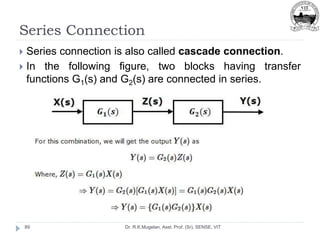
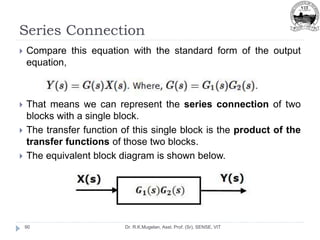
 Series connection is also called cascade connection.
 In the following figure, two blocks having transfer
functions G1(s) and G2(s) are connected in series.
Series Connection
Dr. R.K.Mugelan, Asst. Prof. (Sr), SENSE, VIT
90
 Compare this equation with the standard form of the output
equation,
 That means we can represent the series connection of two
blocks with a single block.
 The transfer function of this single block is the product of the
transfer functions of those two blocks.
 The equivalent block diagram is shown below.
Parallel Connection
Dr. R.K.Mugelan, Asst. Prof. (Sr), SENSE, VIT
91
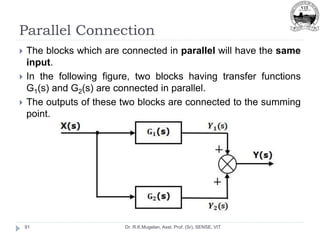
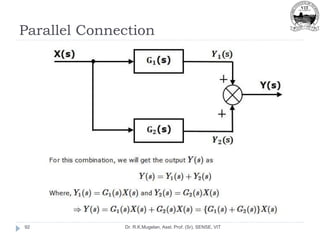
 The blocks which are connected in parallel will have the same
input.
 In the following figure, two blocks having transfer functions
G1(s) and G2(s) are connected in parallel.
 The outputs of these two blocks are connected to the summing
point.
Parallel Connection
Dr. R.K.Mugelan, Asst. Prof. (Sr), SENSE, VIT
92
Parallel Connection
Dr. R.K.Mugelan, Asst. Prof. (Sr), SENSE, VIT
93
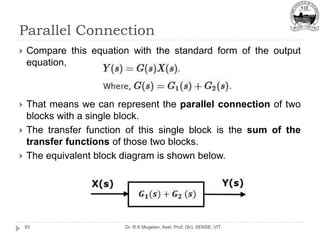
 Compare this equation with the standard form of the output
equation,
 That means we can represent the parallel connection of two
blocks with a single block.
 The transfer function of this single block is the sum of the
transfer functions of those two blocks.
 The equivalent block diagram is shown below.
Feedback Connection
Dr. R.K.Mugelan, Asst. Prof. (Sr), SENSE, VIT
94
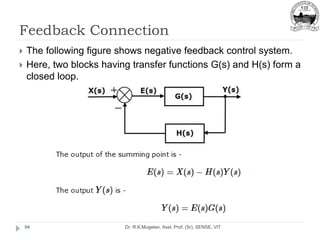
 The following figure shows negative feedback control system.
 Here, two blocks having transfer functions G(s) and H(s) form a
closed loop.
Feedback Connection
Dr. R.K.Mugelan, Asst. Prof. (Sr), SENSE, VIT
95
Feedback Connection
Dr. R.K.Mugelan, Asst. Prof. (Sr), SENSE, VIT
96
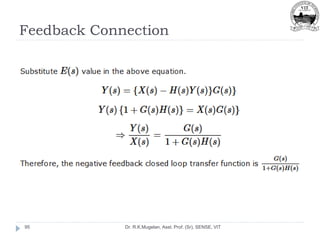
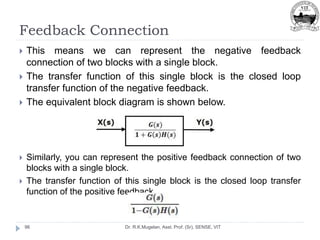
 This means we can represent the negative feedback
connection of two blocks with a single block.
 The transfer function of this single block is the closed loop
transfer function of the negative feedback.
 The equivalent block diagram is shown below.
 Similarly, you can represent the positive feedback connection of two
blocks with a single block.
 The transfer function of this single block is the closed loop transfer
function of the positive feedback,
Block Diagram Algebra for Summing Points
Dr. R.K.Mugelan, Asst. Prof. (Sr), SENSE, VIT
97
 There are two possibilities of shifting summing points with
respect to blocks −
 Shifting summing point after the block
 Shifting summing point before the block
 Let us now see what kind of arrangements need to be
done in the above two cases one by one.
Shifting Summing Point After the Block
Dr. R.K.Mugelan, Asst. Prof. (Sr), SENSE, VIT
98
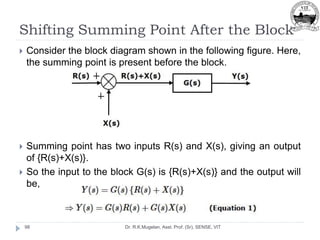
 Consider the block diagram shown in the following figure. Here,
the summing point is present before the block.
 Summing point has two inputs R(s) and X(s), giving an output
of {R(s)+X(s)}.
 So the input to the block G(s) is {R(s)+X(s)} and the output will
be,
Shifting Summing Point After the Block
Dr. R.K.Mugelan, Asst. Prof. (Sr), SENSE, VIT
99
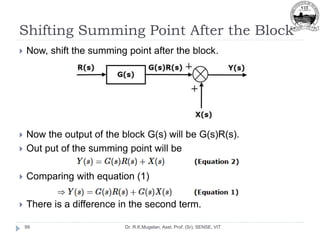
 Now, shift the summing point after the block.
 Now the output of the block G(s) will be G(s)R(s).
 Out put of the summing point will be
 Comparing with equation (1)
 There is a difference in the second term.
Shifting Summing Point After the Block
Dr. R.K.Mugelan, Asst. Prof. (Sr), SENSE, VIT
100
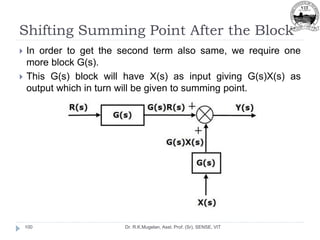
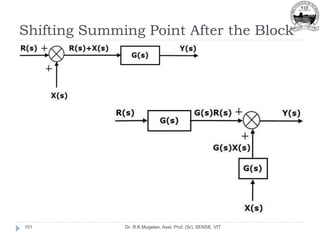
 In order to get the second term also same, we require one
more block G(s).
 This G(s) block will have X(s) as input giving G(s)X(s) as
output which in turn will be given to summing point.
Shifting Summing Point After the Block
Dr. R.K.Mugelan, Asst. Prof. (Sr), SENSE, VIT
101
Shifting Summing Point Before the Block
Dr. R.K.Mugelan, Asst. Prof. (Sr), SENSE, VIT
102
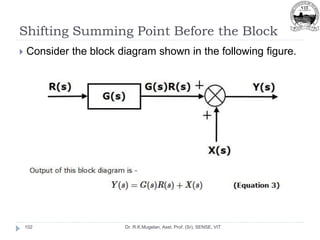
 Consider the block diagram shown in the following figure.
Shifting Summing Point Before the Block
Dr. R.K.Mugelan, Asst. Prof. (Sr), SENSE, VIT
103
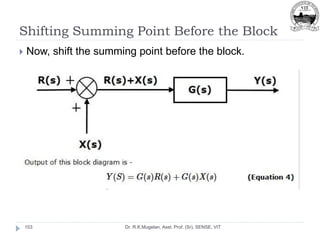
 Now, shift the summing point before the block.
Shifting Summing Point Before the Block
Dr. R.K.Mugelan, Asst. Prof. (Sr), SENSE, VIT
104
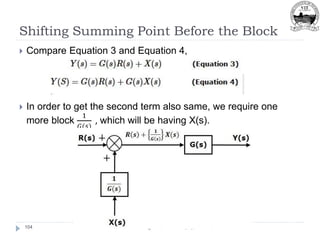
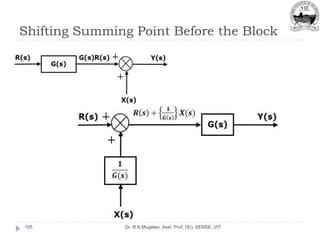
 Compare Equation 3 and Equation 4,
 In order to get the second term also same, we require one
more block
1
𝐺(𝑠)
, which will be having X(s).
Shifting Summing Point Before the Block
Dr. R.K.Mugelan, Asst. Prof. (Sr), SENSE, VIT
105
Block Diagram Algebra for Take-off Points
Dr. R.K.Mugelan, Asst. Prof. (Sr), SENSE, VIT
106
 There are two possibilities of shifting the take-off points
with respect to blocks −
 Shifting take-off point after the block
 Shifting take-off point before the block
 Let us now see what kind of arrangements are to be done
in the above two cases, one by one.
Shifting Take-off Point After the Block
Dr. R.K.Mugelan, Asst. Prof. (Sr), SENSE, VIT
107
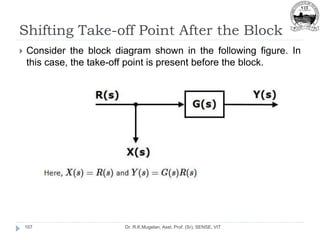
 Consider the block diagram shown in the following figure. In
this case, the take-off point is present before the block.
Shifting Take-off Point After the Block
Dr. R.K.Mugelan, Asst. Prof. (Sr), SENSE, VIT
108
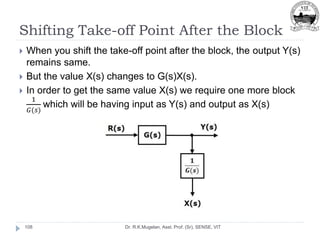
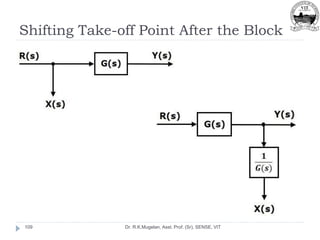
 When you shift the take-off point after the block, the output Y(s)
remains same.
 But the value X(s) changes to G(s)X(s).
 In order to get the same value X(s) we require one more block
1
𝐺(𝑠)
which will be having input as Y(s) and output as X(s)
Shifting Take-off Point After the Block
Dr. R.K.Mugelan, Asst. Prof. (Sr), SENSE, VIT
109
Shifting Take-off Point Before the Block
Dr. R.K.Mugelan, Asst. Prof. (Sr), SENSE, VIT
110
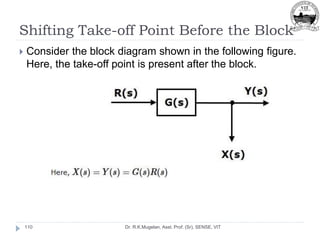
 Consider the block diagram shown in the following figure.
Here, the take-off point is present after the block.
Shifting Take-off Point Before the Block
Dr. R.K.Mugelan, Asst. Prof. (Sr), SENSE, VIT
111
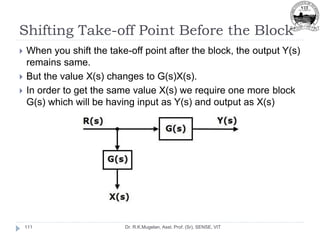
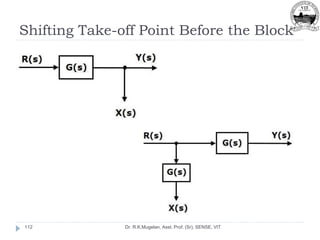
 When you shift the take-off point after the block, the output Y(s)
remains same.
 But the value X(s) changes to G(s)X(s).
 In order to get the same value X(s) we require one more block
G(s) which will be having input as Y(s) and output as X(s)
Shifting Take-off Point Before the Block
Dr. R.K.Mugelan, Asst. Prof. (Sr), SENSE, VIT
112
Block Diagram Reduction Rules
Dr. R.K.Mugelan, Asst. Prof. (Sr), SENSE, VIT
113
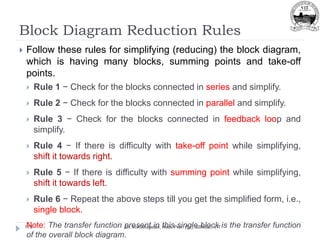
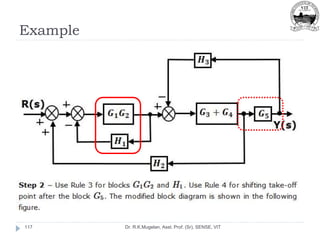
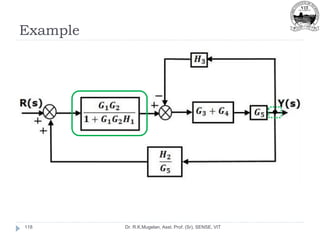
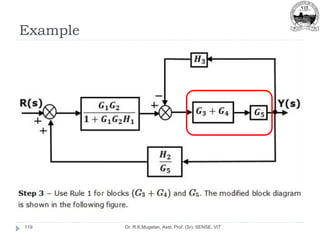
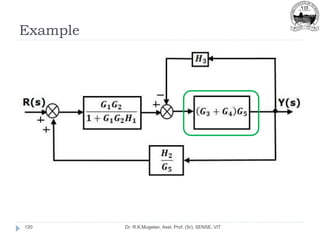
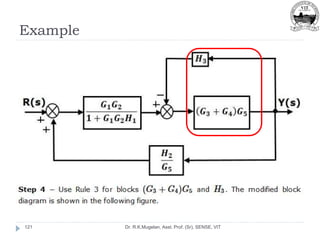
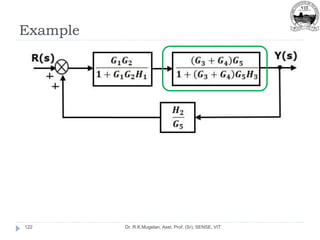
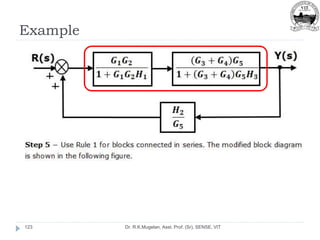
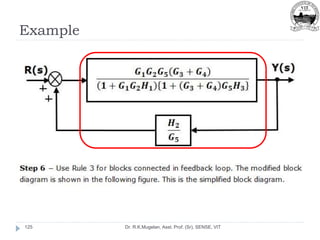
 Follow these rules for simplifying (reducing) the block diagram,
which is having many blocks, summing points and take-off
points.
 Rule 1 − Check for the blocks connected in series and simplify.
 Rule 2 − Check for the blocks connected in parallel and simplify.
 Rule 3 − Check for the blocks connected in feedback loop and
simplify.
 Rule 4 − If there is difficulty with take-off point while simplifying,
shift it towards right.
 Rule 5 − If there is difficulty with summing point while simplifying,
shift it towards left.
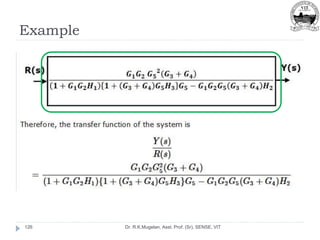
 Rule 6 − Repeat the above steps till you get the simplified form, i.e.,
single block.
Note: The transfer function present in this single block is the transfer function
of the overall block diagram.
Example
Dr. R.K.Mugelan, Asst. Prof. (Sr), SENSE, VIT
114
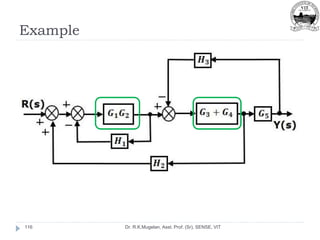
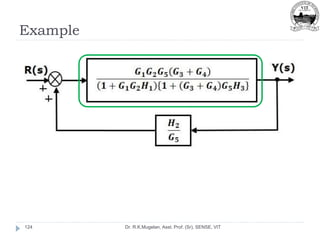
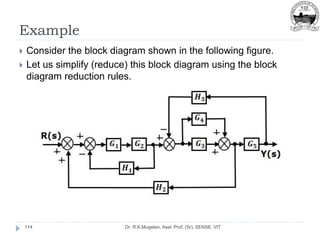
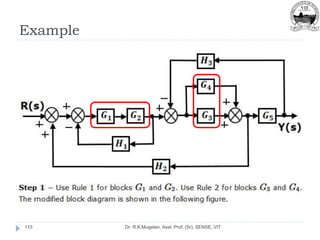
 Consider the block diagram shown in the following figure.
 Let us simplify (reduce) this block diagram using the block
diagram reduction rules.
Example
Dr. R.K.Mugelan, Asst. Prof. (Sr), SENSE, VIT
115
Example
Dr. R.K.Mugelan, Asst. Prof. (Sr), SENSE, VIT
116
Example
Dr. R.K.Mugelan, Asst. Prof. (Sr), SENSE, VIT
117
Example
Dr. R.K.Mugelan, Asst. Prof. (Sr), SENSE, VIT
118
Example
Dr. R.K.Mugelan, Asst. Prof. (Sr), SENSE, VIT
119
Example
Dr. R.K.Mugelan, Asst. Prof. (Sr), SENSE, VIT
120
Example
Dr. R.K.Mugelan, Asst. Prof. (Sr), SENSE, VIT
121
Example
Dr. R.K.Mugelan, Asst. Prof. (Sr), SENSE, VIT
122
Example
Dr. R.K.Mugelan, Asst. Prof. (Sr), SENSE, VIT
123
Example
Dr. R.K.Mugelan, Asst. Prof. (Sr), SENSE, VIT
124
Example
Dr. R.K.Mugelan, Asst. Prof. (Sr), SENSE, VIT
125
Example
Dr. R.K.Mugelan, Asst. Prof. (Sr), SENSE, VIT
126
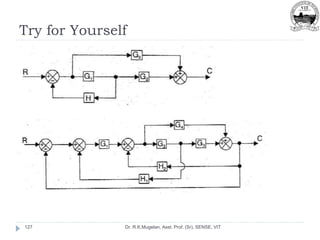
Try for Yourself
Dr. R.K.Mugelan, Asst. Prof. (Sr), SENSE, VIT
127
Signal Flow Graph
Dr. R.K.Mugelan, Asst. Prof. (Sr), SENSE, VIT
128
 Signal flow graph is a graphical representation of
algebraic equations.
 Let us discuss the basic concepts related signal flow
graph and also learn how to draw signal flow graphs.
 Nodes and branches are the basic elements of signal
flow graph.
Node
Dr. R.K.Mugelan, Asst. Prof. (Sr), SENSE, VIT
129
 Node is a point which represents either a variable or a
signal.
 There are three types of nodes — input node, output
node and mixed node.
 Input Node − It is a node, which has only outgoing branches.
 Output Node − It is a node, which has only incoming branches.
 Mixed Node − It is a node, which has both incoming and outgoing
branches.
Node : Example
Dr. R.K.Mugelan, Asst. Prof. (Sr), SENSE, VIT
130
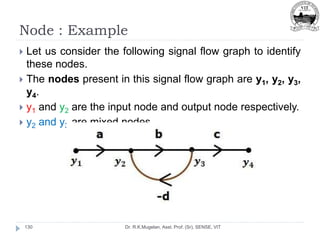
 Let us consider the following signal flow graph to identify
these nodes.
 The nodes present in this signal flow graph are y1, y2, y3,
y4.
 y1 and y2 are the input node and output node respectively.
 y2 and y3 are mixed nodes
Branch
Dr. R.K.Mugelan, Asst. Prof. (Sr), SENSE, VIT
131
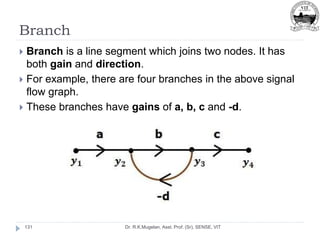
 Branch is a line segment which joins two nodes. It has
both gain and direction.
 For example, there are four branches in the above signal
flow graph.
 These branches have gains of a, b, c and -d.
Construction of Signal Flow Graph
Dr. R.K.Mugelan, Asst. Prof. (Sr), SENSE, VIT
132
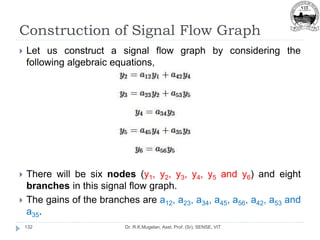
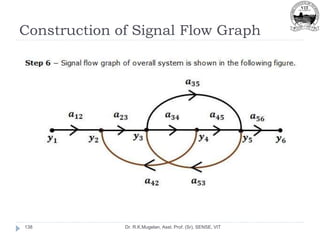
 Let us construct a signal flow graph by considering the
following algebraic equations,
 There will be six nodes (y1, y2, y3, y4, y5 and y6) and eight
branches in this signal flow graph.
 The gains of the branches are a12, a23, a34, a45, a56, a42, a53 and
a35.
Construction of Signal Flow Graph
Dr. R.K.Mugelan, Asst. Prof. (Sr), SENSE, VIT
133
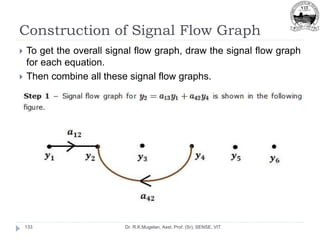
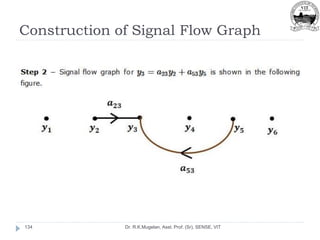
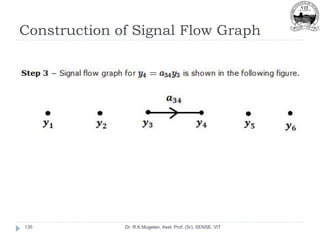
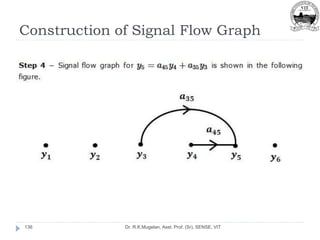
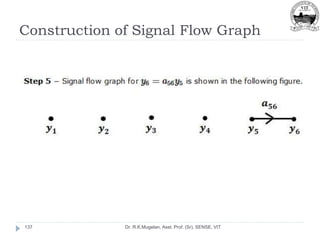
 To get the overall signal flow graph, draw the signal flow graph
for each equation.
 Then combine all these signal flow graphs.
Construction of Signal Flow Graph
Dr. R.K.Mugelan, Asst. Prof. (Sr), SENSE, VIT
134
Construction of Signal Flow Graph
Dr. R.K.Mugelan, Asst. Prof. (Sr), SENSE, VIT
135
Construction of Signal Flow Graph
Dr. R.K.Mugelan, Asst. Prof. (Sr), SENSE, VIT
136
Construction of Signal Flow Graph
Dr. R.K.Mugelan, Asst. Prof. (Sr), SENSE, VIT
137
Construction of Signal Flow Graph
Dr. R.K.Mugelan, Asst. Prof. (Sr), SENSE, VIT
138
Conversion of Block Diagrams into
Signal Flow Graphs : Steps
Dr. R.K.Mugelan, Asst. Prof. (Sr), SENSE, VIT
139
1. Represent all the signals, variables, summing points and
take-off points of block diagram as nodes in signal flow
graph.
2. Represent the blocks of block diagram as branches in signal
flow graph.
3. Represent the transfer functions inside the blocks of block
diagram as gains of the branches in signal flow graph.
4. Connect the nodes as per the block diagram. If there is
connection between two nodes (but there is no block in
between), then represent the gain of the branch as one.
For example, between summing points, between
summing point and takeoff point, between input and summing
point, between take-off point and output.
Example
Dr. R.K.Mugelan, Asst. Prof. (Sr), SENSE, VIT
140
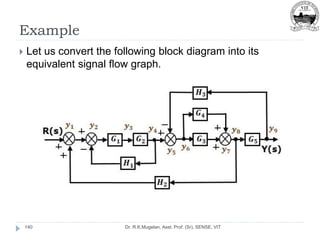
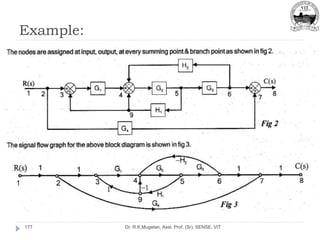
 Let us convert the following block diagram into its
equivalent signal flow graph.
Example
Dr. R.K.Mugelan, Asst. Prof. (Sr), SENSE, VIT
141
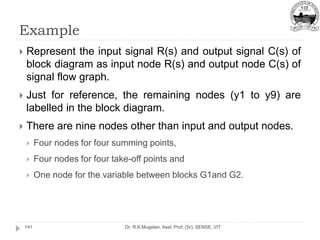
 Represent the input signal R(s) and output signal C(s) of
block diagram as input node R(s) and output node C(s) of
signal flow graph.
 Just for reference, the remaining nodes (y1 to y9) are
labelled in the block diagram.
 There are nine nodes other than input and output nodes.
 Four nodes for four summing points,
 Four nodes for four take-off points and
 One node for the variable between blocks G1and G2.
Example
Dr. R.K.Mugelan, Asst. Prof. (Sr), SENSE, VIT
142
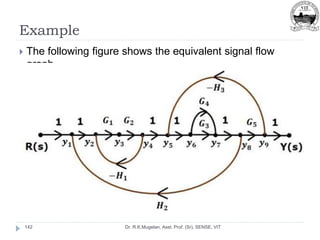
 The following figure shows the equivalent signal flow
graph.
Note:
Dr. R.K.Mugelan, Asst. Prof. (Sr), SENSE, VIT
143
 With the help of Mason’s gain formula (discussed in the
next slide), you can calculate the transfer function of this
signal flow graph.
 This is the advantage of signal flow graphs.
 Here, we no need to simplify (reduce) the signal flow
graphs for calculating the transfer function.
Mason’s gain formula
Dr. R.K.Mugelan, Asst. Prof. (Sr), SENSE, VIT
144
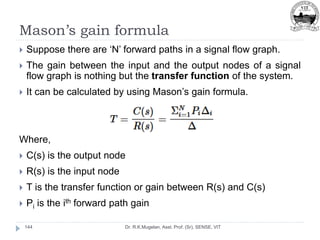
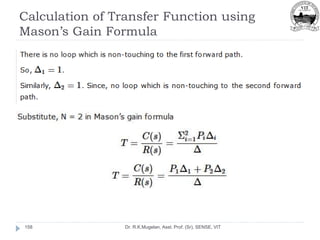
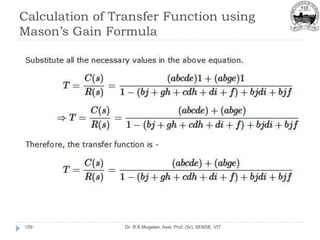
 Suppose there are ‘N’ forward paths in a signal flow graph.
 The gain between the input and the output nodes of a signal
flow graph is nothing but the transfer function of the system.
 It can be calculated by using Mason’s gain formula.
Where,
 C(s) is the output node
 R(s) is the input node
 T is the transfer function or gain between R(s) and C(s)
 Pi is the ith forward path gain
Mason’s gain formula
Dr. R.K.Mugelan, Asst. Prof. (Sr), SENSE, VIT
145
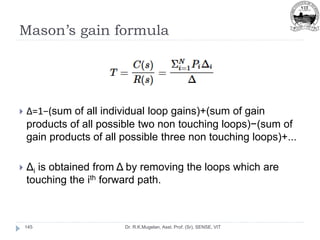
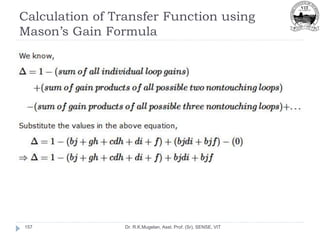
 Δ=1−(sum of all individual loop gains)+(sum of gain
products of all possible two non touching loops)−(sum of
gain products of all possible three non touching loops)+...
 Δi is obtained from Δ by removing the loops which are
touching the ith forward path.
Terminologies
Dr. R.K.Mugelan, Asst. Prof. (Sr), SENSE, VIT
146
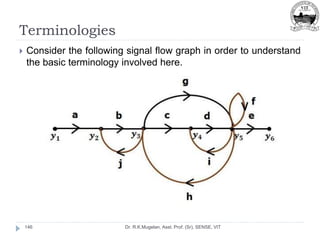
 Consider the following signal flow graph in order to understand
the basic terminology involved here.
Terminologies
Dr. R.K.Mugelan, Asst. Prof. (Sr), SENSE, VIT
147
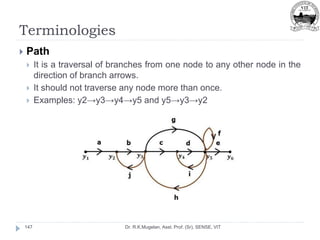
 Path
 It is a traversal of branches from one node to any other node in the
direction of branch arrows.
 It should not traverse any node more than once.
 Examples: y2→y3→y4→y5 and y5→y3→y2
Terminologies
Dr. R.K.Mugelan, Asst. Prof. (Sr), SENSE, VIT
148
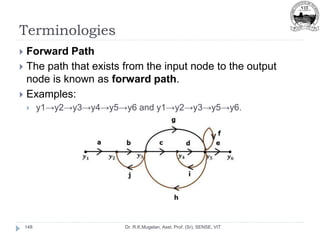
 Forward Path
 The path that exists from the input node to the output
node is known as forward path.
 Examples:
 y1→y2→y3→y4→y5→y6 and y1→y2→y3→y5→y6.
Terminologies
Dr. R.K.Mugelan, Asst. Prof. (Sr), SENSE, VIT
149
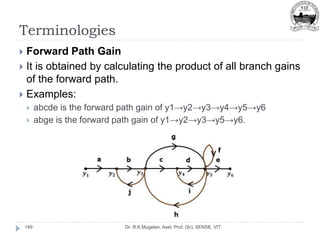
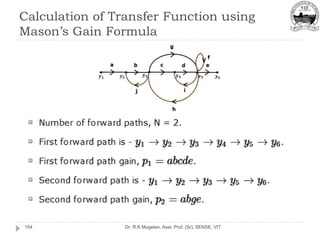
 Forward Path Gain
 It is obtained by calculating the product of all branch gains
of the forward path.
 Examples:
 abcde is the forward path gain of y1→y2→y3→y4→y5→y6
 abge is the forward path gain of y1→y2→y3→y5→y6.
Terminologies
Dr. R.K.Mugelan, Asst. Prof. (Sr), SENSE, VIT
150
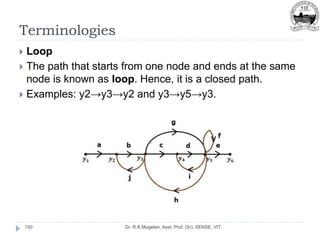
 Loop
 The path that starts from one node and ends at the same
node is known as loop. Hence, it is a closed path.
 Examples: y2→y3→y2 and y3→y5→y3.
Terminologies
Dr. R.K.Mugelan, Asst. Prof. (Sr), SENSE, VIT
151
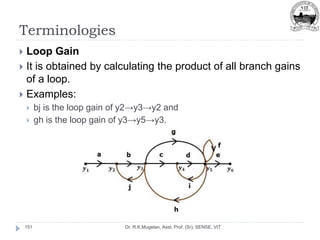
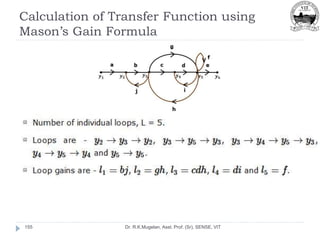
 Loop Gain
 It is obtained by calculating the product of all branch gains
of a loop.
 Examples:
 bj is the loop gain of y2→y3→y2 and
 gh is the loop gain of y3→y5→y3.
Terminologies
Dr. R.K.Mugelan, Asst. Prof. (Sr), SENSE, VIT
152
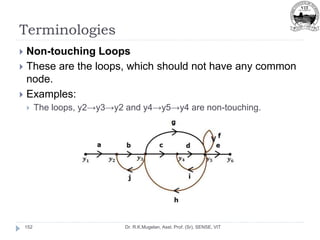
 Non-touching Loops
 These are the loops, which should not have any common
node.
 Examples:
 The loops, y2→y3→y2 and y4→y5→y4 are non-touching.
Calculation of Transfer Function using
Mason’s Gain Formula
Dr. R.K.Mugelan, Asst. Prof. (Sr), SENSE, VIT
153
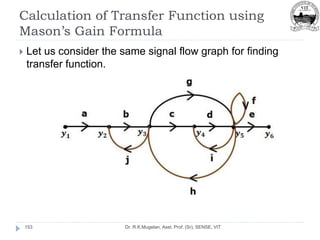
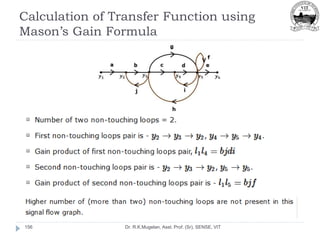
 Let us consider the same signal flow graph for finding
transfer function.
Calculation of Transfer Function using
Mason’s Gain Formula
Dr. R.K.Mugelan, Asst. Prof. (Sr), SENSE, VIT
154
Calculation of Transfer Function using
Mason’s Gain Formula
Dr. R.K.Mugelan, Asst. Prof. (Sr), SENSE, VIT
155
Calculation of Transfer Function using
Mason’s Gain Formula
Dr. R.K.Mugelan, Asst. Prof. (Sr), SENSE, VIT
156
Calculation of Transfer Function using
Mason’s Gain Formula
Dr. R.K.Mugelan, Asst. Prof. (Sr), SENSE, VIT
157
Calculation of Transfer Function using
Mason’s Gain Formula
Dr. R.K.Mugelan, Asst. Prof. (Sr), SENSE, VIT
158
Calculation of Transfer Function using
Mason’s Gain Formula
Dr. R.K.Mugelan, Asst. Prof. (Sr), SENSE, VIT
159
Example:
Dr. R.K.Mugelan, Asst. Prof. (Sr), SENSE, VIT
160
Example:
Dr. R.K.Mugelan, Asst. Prof. (Sr), SENSE, VIT
161
Example:
Dr. R.K.Mugelan, Asst. Prof. (Sr), SENSE, VIT
162
Example:
Dr. R.K.Mugelan, Asst. Prof. (Sr), SENSE, VIT
163
Example:
Dr. R.K.Mugelan, Asst. Prof. (Sr), SENSE, VIT
164
Example:
Dr. R.K.Mugelan, Asst. Prof. (Sr), SENSE, VIT
165
Example:
Dr. R.K.Mugelan, Asst. Prof. (Sr), SENSE, VIT
166
Example:
Dr. R.K.Mugelan, Asst. Prof. (Sr), SENSE, VIT
167
Example:
Dr. R.K.Mugelan, Asst. Prof. (Sr), SENSE, VIT
168
Example:
Dr. R.K.Mugelan, Asst. Prof. (Sr), SENSE, VIT
169
Example:
Dr. R.K.Mugelan, Asst. Prof. (Sr), SENSE, VIT
170
Example:
Dr. R.K.Mugelan, Asst. Prof. (Sr), SENSE, VIT
171
Example:
Dr. R.K.Mugelan, Asst. Prof. (Sr), SENSE, VIT
172
Example:
Dr. R.K.Mugelan, Asst. Prof. (Sr), SENSE, VIT
173
Example:
Dr. R.K.Mugelan, Asst. Prof. (Sr), SENSE, VIT
174
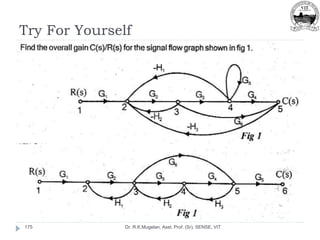
Try For Yourself
Dr. R.K.Mugelan, Asst. Prof. (Sr), SENSE, VIT
175
Example:
Dr. R.K.Mugelan, Asst. Prof. (Sr), SENSE, VIT
176
Example:
Dr. R.K.Mugelan, Asst. Prof. (Sr), SENSE, VIT
177
DC Motor
Dr. R.K.Mugelan, Asst. Prof. (Sr), SENSE, VIT
178
 A motor is an actuator, converting electrical energy in to
rotational mechanical energy.
 Motor requiring DC supply for operation is termed as DC
motor.
 DC motors are widely used in control applications like
robotics, tape drives, machines and many more.
 Separately excited DC motors are suitable for control
applications because of separate field and armature
circuit.
 Two ways to control DC separately excited motors are:
 1. Armature Control.
 2. Field Control.
Armature Controlled DC Motor
Dr. R.K.Mugelan, Asst. Prof. (Sr), SENSE, VIT
179
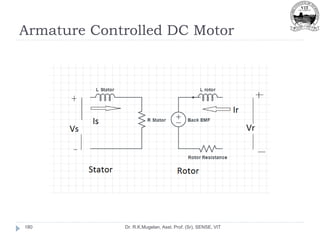
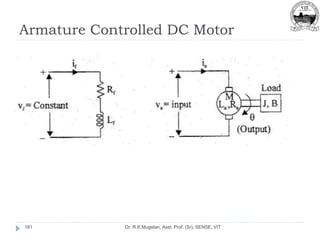
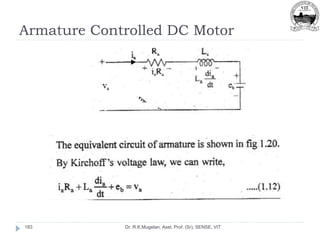
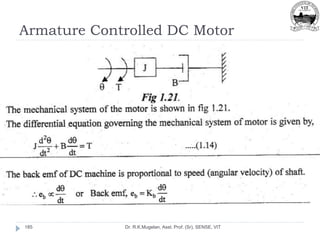
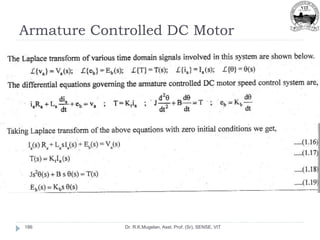
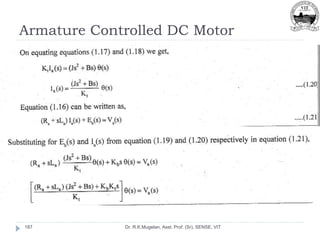
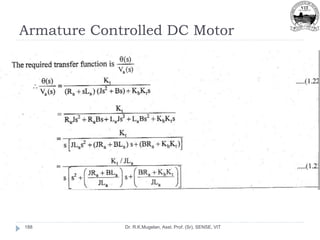
 DC motor consists of two parts i.e. rotor and stator.
 Stator consists of field winding while rotor (also called
armature) consists of armature winding.
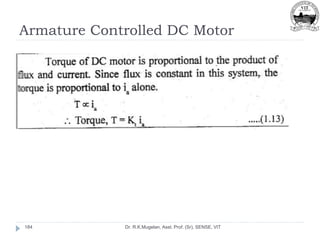
 When both armature and field are excited by DC supply,
current flows through windings and magnetic flux
proportional to the current is produced.
 When the flux of field interacts with the flux of armature, it
results in motion of the rotor.
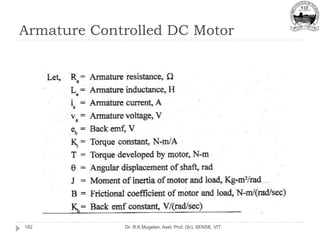
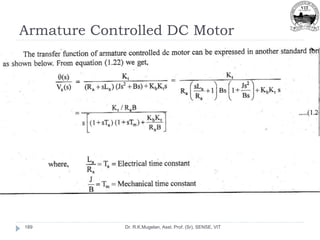
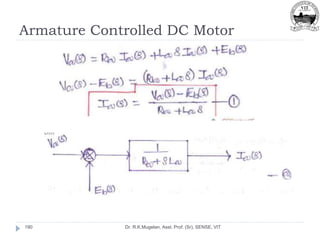
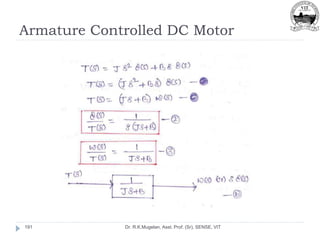
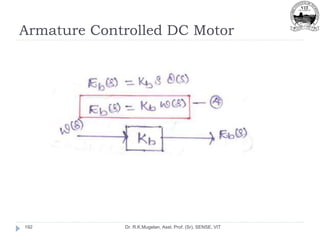
 Armature control is the most common control technique
for DC motors.
 In order to implement this control, the flux is required to
be kept constant. .
Armature Controlled DC Motor
Dr. R.K.Mugelan, Asst. Prof. (Sr), SENSE, VIT
180
Armature Controlled DC Motor
Dr. R.K.Mugelan, Asst. Prof. (Sr), SENSE, VIT
181
Armature Controlled DC Motor
Dr. R.K.Mugelan, Asst. Prof. (Sr), SENSE, VIT
182
Armature Controlled DC Motor
Dr. R.K.Mugelan, Asst. Prof. (Sr), SENSE, VIT
183
Armature Controlled DC Motor
Dr. R.K.Mugelan, Asst. Prof. (Sr), SENSE, VIT
184
Armature Controlled DC Motor
Dr. R.K.Mugelan, Asst. Prof. (Sr), SENSE, VIT
185
Armature Controlled DC Motor
Dr. R.K.Mugelan, Asst. Prof. (Sr), SENSE, VIT
186
Armature Controlled DC Motor
Dr. R.K.Mugelan, Asst. Prof. (Sr), SENSE, VIT
187
Armature Controlled DC Motor
Dr. R.K.Mugelan, Asst. Prof. (Sr), SENSE, VIT
188
Armature Controlled DC Motor
Dr. R.K.Mugelan, Asst. Prof. (Sr), SENSE, VIT
189
Armature Controlled DC Motor
Dr. R.K.Mugelan, Asst. Prof. (Sr), SENSE, VIT
190
Armature Controlled DC Motor
Dr. R.K.Mugelan, Asst. Prof. (Sr), SENSE, VIT
191
Armature Controlled DC Motor
Dr. R.K.Mugelan, Asst. Prof. (Sr), SENSE, VIT
192
Armature Controlled DC Motor
Dr. R.K.Mugelan, Asst. Prof. (Sr), SENSE, VIT
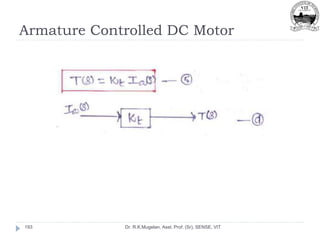
193
Armature Controlled DC Motor
Dr. R.K.Mugelan, Asst. Prof. (Sr), SENSE, VIT
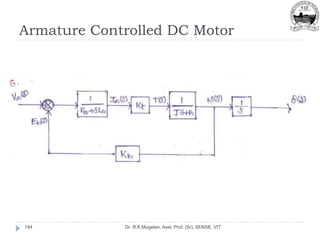
194
Field Controlled DC Motor
Dr. R.K.Mugelan, Asst. Prof. (Sr), SENSE, VIT
195
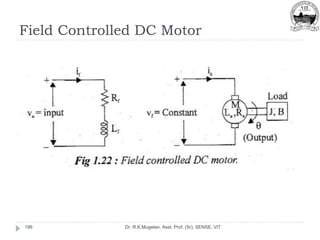
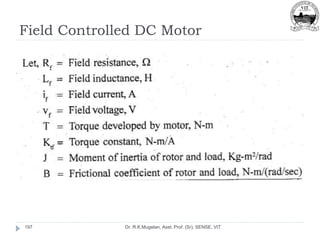
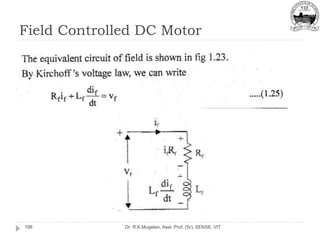
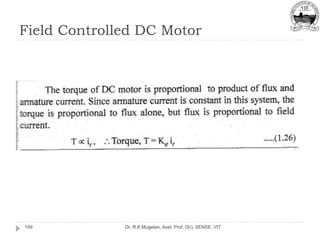
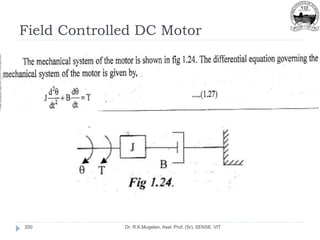
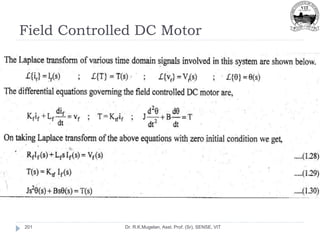
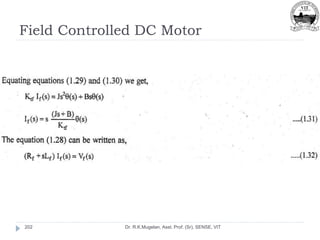
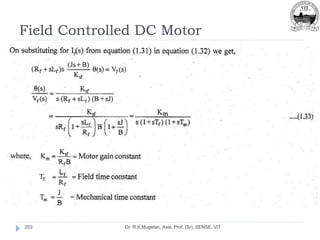
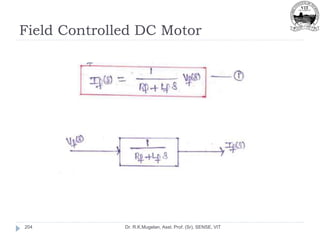
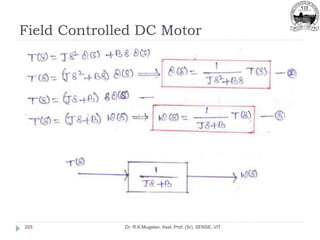
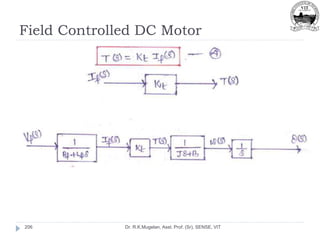
 Basically in a field controlled dc motor, the armature
current is kept constant (via some constant voltage
source)
 While the field current is varied which will vary the field
flux and interacts with the armature of motor and produce
rotation.
Field Controlled DC Motor
Dr. R.K.Mugelan, Asst. Prof. (Sr), SENSE, VIT
196
Field Controlled DC Motor
Dr. R.K.Mugelan, Asst. Prof. (Sr), SENSE, VIT
197
Field Controlled DC Motor
Dr. R.K.Mugelan, Asst. Prof. (Sr), SENSE, VIT
198
Field Controlled DC Motor
Dr. R.K.Mugelan, Asst. Prof. (Sr), SENSE, VIT
199
Field Controlled DC Motor
Dr. R.K.Mugelan, Asst. Prof. (Sr), SENSE, VIT
200
Field Controlled DC Motor
Dr. R.K.Mugelan, Asst. Prof. (Sr), SENSE, VIT
201
Field Controlled DC Motor
Dr. R.K.Mugelan, Asst. Prof. (Sr), SENSE, VIT
202
Field Controlled DC Motor
Dr. R.K.Mugelan, Asst. Prof. (Sr), SENSE, VIT
203
Field Controlled DC Motor
Dr. R.K.Mugelan, Asst. Prof. (Sr), SENSE, VIT
204
Field Controlled DC Motor
Dr. R.K.Mugelan, Asst. Prof. (Sr), SENSE, VIT
205
Field Controlled DC Motor
Dr. R.K.Mugelan, Asst. Prof. (Sr), SENSE, VIT
206

Module-2.pptx

  • 1.
    Mathematical Modeling ofPhysical Systems Module-2
  • 2.
    Outline Dr. R.K.Mugelan, Asst.Prof. (Sr), SENSE, VIT 2  Differential equation, Difference equation, and State variable representations.  Mathematical modelling of electrical and mechanical systems  Equivalence between the elements of different types of systems  Transfer function, Block diagram – Manipulation of block diagrams  Open loop transfer function and closed loop transfer function  Signal flow graph.
  • 3.
    Mathematical Model Dr. R.K.Mugelan,Asst. Prof. (Sr), SENSE, VIT 3  The control systems can be represented with a set of mathematical equations known as mathematical model.  Useful for analysis and design of control systems.  Analysis of control system means finding the output when we know the input and mathematical model.  Design of control system means finding the mathematical model when we know the input and the output.
  • 4.
    Dr. R.K.Mugelan, Asst.Prof. (Sr), SENSE, VIT 4  The following mathematical models are mostly used.  Differential equation model  Transfer function model  State space model  Let us discuss the first two models in this module.
  • 5.
    Differential Equation Model Dr.R.K.Mugelan, Asst. Prof. (Sr), SENSE, VIT 5  It is a time domain mathematical model of control systems (Continuous Time Control Systems).  Follow these steps for differential equation model.  Apply basic laws to the given control system.  Get the differential equation in terms of input and output by eliminating the intermediate variable(s).
  • 6.
    Differential Equation Model Dr.R.K.Mugelan, Asst. Prof. (Sr), SENSE, VIT 6  Consider the following electrical system  Applying Mesh analysis
  • 7.
    Differential Equation Model Dr.R.K.Mugelan, Asst. Prof. (Sr), SENSE, VIT 7  Substitute, the current passing through capacitor  The above equation is called second order differential equation.
  • 8.
    Transfer Function Model Dr.R.K.Mugelan, Asst. Prof. (Sr), SENSE, VIT 8  Transfer function model is an s-domain mathematical model of control systems.  The Transfer function of a Linear Time Invariant (LTI) system is defined as the ratio of Laplace transform of output and Laplace transform of input by assuming all the initial conditions are zero. If x(t) and y(t) are the input and output of an LTI system, then the corresponding Laplace transforms are X(S) and Y(S)
  • 9.
    Transfer Function Model Dr.R.K.Mugelan, Asst. Prof. (Sr), SENSE, VIT 9  Consider the following electrical system  Applying Mesh analysis and performing manipulation towards differential equation we get,
  • 10.
    Transfer Function Model Dr.R.K.Mugelan, Asst. Prof. (Sr), SENSE, VIT 10  The differential equation of an electrical system as  Applying Laplace Transform on both sides,
  • 11.
    Transfer Function Model Dr.R.K.Mugelan, Asst. Prof. (Sr), SENSE, VIT 11  Where,  Vi(S) is the Laplace Transform of vi  Vo(S) is the Laplace Transform of vo  The above equation is a transfer function of the second order electrical system.
  • 12.
    Modelling of MechanicalSystems Dr. R.K.Mugelan, Asst. Prof. (Sr), SENSE, VIT 12  There are two types of mechanical systems based on the type of motion.  Translational mechanical systems  Rotational mechanical systems
  • 13.
    Translational Mechanical Systems(TMS) Dr. R.K.Mugelan, Asst. Prof. (Sr), SENSE, VIT 13  Translational mechanical systems move along a straight line.  These systems mainly consist of three basic elements.  Mass  Spring  Dashpot or Damper  If a force is applied to a translational mechanical system, then it is opposed by opposing forces  Due to mass, elasticity and friction of the system.  Since the applied force and the opposing forces are in opposite directions, the algebraic sum of the forces acting on the system is zero.
  • 14.
    TMS: Mass Dr. R.K.Mugelan,Asst. Prof. (Sr), SENSE, VIT 14  Mass is the property of a body, which stores kinetic energy.  The opposing force due to mass. (Assume elasticity and friction are negligible.)  This opposing force is proportional to the acceleration of the body.
  • 15.
    TMS: Spring Dr. R.K.Mugelan,Asst. Prof. (Sr), SENSE, VIT 15  Spring is an element, which stores potential energy.  The opposing force due to elasticity of spring (Assume mass and friction are negligible.).  This opposing force is proportional to the displacement of the spring.
  • 16.
    TMS: Dashpot orDamper Dr. R.K.Mugelan, Asst. Prof. (Sr), SENSE, VIT 16  If a force is applied on dashpot B, then it is opposed by an opposing force due to friction of the dashpot.  This opposing force is proportional to the velocity of the body (Assume mass and elasticity are negligible.).
  • 17.
    Rotational Mechanical Systems(RMS) Dr. R.K.Mugelan, Asst. Prof. (Sr), SENSE, VIT 17  Rotational mechanical systems move about a fixed axis.  These systems mainly consist of three basic elements.  Moment of inertia  Torsional spring  Dashpot.  If a torque is applied to a RMS, then it is opposed by opposing torques due to moment of inertia, elasticity and friction of the system.  Since the applied torque and the opposing torques are in opposite directions, the algebraic sum of torques acting on the system is zero.
  • 18.
    RMS: Moment ofInertia Dr. R.K.Mugelan, Asst. Prof. (Sr), SENSE, VIT 18  Moment of inertia stores kinetic energy.  If a torque is applied on a body having moment of inertia J, then it is opposed by an opposing torque due to the moment of inertia.  This opposing torque is proportional to angular acceleration of the body. (Assume elasticity and friction are negligible.)
  • 19.
    RMS: Torsional Spring Dr.R.K.Mugelan, Asst. Prof. (Sr), SENSE, VIT 19  Torsional spring stores potential energy.  Opposed by an opposing torque due to the elasticity of torsional spring.  This opposing torque is proportional to the angular displacement of the torsional spring. (Assume that the moment of inertia and friction are negligible.)
  • 20.
    RMS: Dashpot orDamper Dr. R.K.Mugelan, Asst. Prof. (Sr), SENSE, VIT 20  Opposed by an opposing torque due to the rotational friction of the dashpot.  This opposing torque is proportional to the angular velocity of the body. (Assume the moment of inertia and elasticity are negligible.)
  • 21.
    Analogy between Elec.& Mech. Sys. Dr. R.K.Mugelan, Asst. Prof. (Sr), SENSE, VIT 21  Two systems are said to be analogous to each other if the following two conditions are satisfied.  The two systems are physically different  Differential equation modelling of these two systems are same  Electrical systems and mechanical systems are two physically different systems.  There are two types of electrical analogies of translational mechanical systems.  Force voltage analogy.  Force current analogy.
  • 22.
    Force Voltage Analogy Dr.R.K.Mugelan, Asst. Prof. (Sr), SENSE, VIT 22  The mathematical equations of translational mechanical system are compared with mesh equations of the electrical system.  Consider the following TMS system  The force balanced equation for this system is
  • 23.
    Force Voltage Analogy Dr.R.K.Mugelan, Asst. Prof. (Sr), SENSE, VIT 23  Consider the following electrical system, with an input voltage ‘V’ volts and a current flow of ‘i’ amps,  Mesh equation for the circuit is,  Substitute, 𝑖 = 𝑑𝑞 𝑑𝑡 in above expression  Comparing equation 1 with 3 we get,
  • 24.
    Force Voltage Analogy Dr.R.K.Mugelan, Asst. Prof. (Sr), SENSE, VIT 24  By comparing (equation 1) and (equation 3) we will get the analogous quantities of TMS and Electrical system as,
  • 25.
    Torque Voltage Analogy Dr.R.K.Mugelan, Asst. Prof. (Sr), SENSE, VIT 25  The mathematical equations of rotational mechanical system are compared with mesh equations of the electrical system.  Consider a RMS as,  The torque balanced equation is given as,
  • 26.
    Torque Voltage Analogy Dr.R.K.Mugelan, Asst. Prof. (Sr), SENSE, VIT 26  Comparing equation 4 and 3 we get,
  • 27.
    Force Current Analogy Dr.R.K.Mugelan, Asst. Prof. (Sr), SENSE, VIT 27  The mathematical equations of the translational mechanical system are compared with the nodal equations of the electrical system.  Consider the following electrical system  The nodal equation is,
  • 28.
    Force Current Analogy Dr.R.K.Mugelan, Asst. Prof. (Sr), SENSE, VIT 28  Comparing equation 1 and 6
  • 29.
    Torque Current Analogy Dr.R.K.Mugelan, Asst. Prof. (Sr), SENSE, VIT 29  The mathematical equations of the rotational mechanical system are compared with the nodal mesh equations of the electrical system.  By comparing Equation 4 and Equation 6,
  • 30.
    Guidelines to determineTransfer Function Dr. R.K.Mugelan, Asst. Prof. (Sr), SENSE, VIT 30 1. Obtain the differential equation governing system using force balance equation at nodes (meeting point of elements). 2. Assign displacement to each Mass (Node) 3. Draw free body diagram for each Mass (Node) 4. Derive one differential equation by equating sum of applied forces to the sum of opposing forces. 5. Take Laplace transform of differential equations to convert them to algebraic equations. 6. Rearrange the s domain equations to obtain the ratio between output and input variable.
  • 31.
    Example for TMS Dr.R.K.Mugelan, Asst. Prof. (Sr), SENSE, VIT 31  Write the differential equations governing the mechanical system and determine the transfer function.
  • 32.
    Dr. R.K.Mugelan, Asst.Prof. (Sr), SENSE, VIT 32
  • 33.
    Dr. R.K.Mugelan, Asst.Prof. (Sr), SENSE, VIT 33
  • 34.
    Dr. R.K.Mugelan, Asst.Prof. (Sr), SENSE, VIT 34
  • 35.
    Dr. R.K.Mugelan, Asst.Prof. (Sr), SENSE, VIT 35
  • 36.
    Example for RMS Dr.R.K.Mugelan, Asst. Prof. (Sr), SENSE, VIT 36  Write the differential equations governing the mechanical system and determine the transfer function.
  • 37.
    Dr. R.K.Mugelan, Asst.Prof. (Sr), SENSE, VIT 37
  • 38.
    Dr. R.K.Mugelan, Asst.Prof. (Sr), SENSE, VIT 38
  • 39.
    Dr. R.K.Mugelan, Asst.Prof. (Sr), SENSE, VIT 39
  • 40.
    Dr. R.K.Mugelan, Asst.Prof. (Sr), SENSE, VIT 40
  • 41.
    Dr. R.K.Mugelan, Asst.Prof. (Sr), SENSE, VIT 41
  • 42.
    Example for ElectricalSystem Dr. R.K.Mugelan, Asst. Prof. (Sr), SENSE, VIT 42  Obtain the Transfer Function for the following Electrical System.
  • 43.
    Dr. R.K.Mugelan, Asst.Prof. (Sr), SENSE, VIT 43
  • 44.
    Transforming the voltagesource in series with R1 into equivalent current source as shown below Dr. R.K.Mugelan, Asst. Prof. (Sr), SENSE, VIT 44
  • 45.
    Dr. R.K.Mugelan, Asst.Prof. (Sr), SENSE, VIT 45
  • 46.
    Dr. R.K.Mugelan, Asst.Prof. (Sr), SENSE, VIT 46
  • 47.
    Dr. R.K.Mugelan, Asst.Prof. (Sr), SENSE, VIT 47
  • 48.
    Try Yourself..!! Dr. R.K.Mugelan,Asst. Prof. (Sr), SENSE, VIT 48  1.  2  3
  • 49.
    Try Yourself..!! Dr. R.K.Mugelan,Asst. Prof. (Sr), SENSE, VIT 49  1
  • 50.
    Example for AnalogousSystems Dr. R.K.Mugelan, Asst. Prof. (Sr), SENSE, VIT 50  Guidelines for Force Voltage Analogy
  • 51.
    Example for AnalogousSystems Dr. R.K.Mugelan, Asst. Prof. (Sr), SENSE, VIT 51  Guidelines for Force Current Analogy
  • 52.
    Example for AnalogousSystems Dr. R.K.Mugelan, Asst. Prof. (Sr), SENSE, VIT 52  Write the differential equation governing the mechanical system shown below. Draw the force-voltage and Force- current electrical analogous circuits and verify by writing mesh and node equations
  • 53.
    Dr. R.K.Mugelan, Asst.Prof. (Sr), SENSE, VIT 53
  • 54.
    Dr. R.K.Mugelan, Asst.Prof. (Sr), SENSE, VIT 54
  • 55.
    Force voltage Analogy Dr.R.K.Mugelan, Asst. Prof. (Sr), SENSE, VIT 55
  • 56.
    Force voltage Analogy Dr.R.K.Mugelan, Asst. Prof. (Sr), SENSE, VIT 56
  • 57.
    Force Current Analogy Dr.R.K.Mugelan, Asst. Prof. (Sr), SENSE, VIT 57
  • 58.
    Force Current Analogy Dr.R.K.Mugelan, Asst. Prof. (Sr), SENSE, VIT 58
  • 59.
    Solution Dr. R.K.Mugelan, Asst.Prof. (Sr), SENSE, VIT 59  On comparing equations (3) and (4) [Mechanical System] with expressions (5), (6)[Force Voltage Analogy] and expressions (6), (7) [Force Current Analogy]
  • 60.
    Try for Yourself..! Dr.R.K.Mugelan, Asst. Prof. (Sr), SENSE, VIT 60  Write the differential equation governing the mechanical system shown below. Draw the force-voltage and Force- current electrical analogous circuits and verify by writing mesh and node equations
  • 61.
    Example for AnalogousSystems Dr. R.K.Mugelan, Asst. Prof. (Sr), SENSE, VIT 61  Guidelines for Torque Voltage Analogy
  • 62.
    Example for AnalogousSystems Dr. R.K.Mugelan, Asst. Prof. (Sr), SENSE, VIT 62  Guidelines for Torque Current Analogy
  • 63.
    Example for AnalogousSystems Dr. R.K.Mugelan, Asst. Prof. (Sr), SENSE, VIT 63  Write the differential equation governing the mechanical system shown below. Draw the Torque-voltage and Torque-current electrical analogous circuits and verify by writing mesh and node equations
  • 64.
    Dr. R.K.Mugelan, Asst.Prof. (Sr), SENSE, VIT 64
  • 65.
    Dr. R.K.Mugelan, Asst.Prof. (Sr), SENSE, VIT 65
  • 66.
    Torque Voltage Analogy Dr.R.K.Mugelan, Asst. Prof. (Sr), SENSE, VIT 66
  • 67.
    Torque Voltage Analogy Dr.R.K.Mugelan, Asst. Prof. (Sr), SENSE, VIT 67
  • 68.
    Torque Current Analogy Dr.R.K.Mugelan, Asst. Prof. (Sr), SENSE, VIT 68
  • 69.
    Torque Current Analogy Dr.R.K.Mugelan, Asst. Prof. (Sr), SENSE, VIT 69
  • 70.
    Solution Dr. R.K.Mugelan, Asst.Prof. (Sr), SENSE, VIT 70  On comparing equations (3) and (4) [Mechanical System] with expressions (5), (6)[Torque Voltage Analogy] and expressions (6), (7) [Torque Current Analogy]
  • 71.
    Try for Yourself.!! Dr.R.K.Mugelan, Asst. Prof. (Sr), SENSE, VIT 71  Write the differential equation governing the mechanical system shown below. Draw the Torque-voltage and Torque-current electrical analogous circuits and verify by writing mesh and node equations
  • 72.
    BLOCK DIAGRAM Dr. R.K.Mugelan,Asst. Prof. (Sr), SENSE, VIT 72  Block diagrams consist of a single block or a combination of blocks which are used to represent the control systems in pictorial form.  Basic elements of Block Diagram  Block  Summing Point  Take-off Point  Arrows indicate the direction of the flow of signals.
  • 73.
    BLOCK Dr. R.K.Mugelan, Asst.Prof. (Sr), SENSE, VIT 73  The transfer function of a component is represented by a block.  Block has single input and single output.  The following figure shows a block having input X(s), output Y(s) and the transfer function G(s).  Output of the block is obtained by multiplying transfer function of the block with input.
  • 74.
    Summing Point Dr. R.K.Mugelan,Asst. Prof. (Sr), SENSE, VIT 74  The summing point is represented with a circle having cross (X) inside it.  It has two or more inputs and single output. It produces the algebraic sum of the inputs.  It also performs the summation or subtraction or combination of summation and subtraction of the inputs based on the polarity of the inputs.
  • 75.
    Summing Point Dr. R.K.Mugelan,Asst. Prof. (Sr), SENSE, VIT 75  The following figure shows the summing point with two inputs (A, B) and one output (Y).  Here, the inputs A and B have a positive sign.  So, the summing point produces the output, Y as sum of A and B. [Y=A+B]
  • 76.
    Summing Point Dr. R.K.Mugelan,Asst. Prof. (Sr), SENSE, VIT 76  The following figure shows the summing point with two inputs (A, B) and one output (Y).  Here, the inputs A and B are having opposite signs, i.e., A is having positive sign and B is having negative sign.  So, the summing point produces the output Y as the difference of A and B. [Y=A+(-B)=A-B]
  • 77.
    Summing Point Dr. R.K.Mugelan,Asst. Prof. (Sr), SENSE, VIT 77  The following figure shows the summing point with three inputs (A, B, C) and one output (Y).  Here, the inputs A and B are having positive signs and C is having a negative sign.  So, the summing point produces the output Y as  Y = A + B + (−C) = A + B − C.
  • 78.
    Take-off Point Dr. R.K.Mugelan,Asst. Prof. (Sr), SENSE, VIT 78  The take-off point is a point from which the same input signal can be passed through more than one branch.  That means with the help of take-off point, we can apply the same input to one or more blocks, summing points.
  • 79.
    Take-off Point Dr. R.K.Mugelan,Asst. Prof. (Sr), SENSE, VIT 79  In the following figure, the take-off point is used to connect the same input, R(s) to two more blocks.
  • 80.
    Take-off Point Dr. R.K.Mugelan,Asst. Prof. (Sr), SENSE, VIT 80  In the following figure, the take-off point is used to connect the output C(s), as one of the inputs to the summing point.
  • 81.
    Block Diagram Representationof Electrical Systems Dr. R.K.Mugelan, Asst. Prof. (Sr), SENSE, VIT 81  Electrical systems contain mainly three basic elements: resistor, inductor and capacitor.  Consider a series of RLC circuit as shown in the following figure.  Where, Vi(t) and Vo(t) are the input and output voltages.  Let i(t) be the current passing through the circuit.  This circuit is in time domain.
  • 82.
    Block Diagram Representationof Electrical Systems Dr. R.K.Mugelan, Asst. Prof. (Sr), SENSE, VIT 82  By applying the Laplace transform to this circuit, will get the circuit in s-domain.
  • 83.
    Block Diagram Representationof Electrical Systems Dr. R.K.Mugelan, Asst. Prof. (Sr), SENSE, VIT 83  From the s domain circuit, we can write  Let us now draw the block diagrams for these two equations individually.  And then combine those block diagrams properly in order to get the overall block diagram of series of RLC Circuit (s- domain).
  • 84.
    Block Diagram Representationof Electrical Systems Dr. R.K.Mugelan, Asst. Prof. (Sr), SENSE, VIT 84  Equation 1 can be implemented with a block having the transfer function, 1 𝑅+𝑠𝐿  The input and output of this block are 𝑉𝑖 𝑠 − 𝑉 𝑜(𝑠) and 𝐼(𝑠)  We require a summing point to get 𝑉𝑖 𝑠 − 𝑉 𝑜(𝑠)
  • 85.
    Block Diagram Representationof Electrical Systems Dr. R.K.Mugelan, Asst. Prof. (Sr), SENSE, VIT 85  Equation 2 can be implemented with a block having transfer function, 1 𝑠𝐶  The input and output of this block are 𝐼(𝑠) and 𝑉 𝑜(𝑠)
  • 86.
    Block Diagram Representationof Electrical Systems Dr. R.K.Mugelan, Asst. Prof. (Sr), SENSE, VIT 86  The overall block diagram of the series of RLC Circuit (s- domain) is shown in the following figure.
  • 87.
    Block Diagram Representationof Electrical Systems Dr. R.K.Mugelan, Asst. Prof. (Sr), SENSE, VIT 87  Procedure to obtain Block Diagram for any electrical system  Convert the time domain electrical circuit into an s- domain electrical circuit by applying Laplace transform.  Write down the equations for the current passing through all series branch elements and voltage across all shunt branches.  Draw the block diagrams for all the above equations individually.  Combine all these block diagrams properly in order to get the overall block diagram of the electrical circuit (s- domain).
  • 88.
    Basic Connections forBlocks Dr. R.K.Mugelan, Asst. Prof. (Sr), SENSE, VIT 88  There are three basic types of connections between two blocks,  Series Connection  Parallel Connection  Feedback Connection
  • 89.
    Series Connection Dr. R.K.Mugelan,Asst. Prof. (Sr), SENSE, VIT 89  Series connection is also called cascade connection.  In the following figure, two blocks having transfer functions G1(s) and G2(s) are connected in series.
  • 90.
    Series Connection Dr. R.K.Mugelan,Asst. Prof. (Sr), SENSE, VIT 90  Compare this equation with the standard form of the output equation,  That means we can represent the series connection of two blocks with a single block.  The transfer function of this single block is the product of the transfer functions of those two blocks.  The equivalent block diagram is shown below.
  • 91.
    Parallel Connection Dr. R.K.Mugelan,Asst. Prof. (Sr), SENSE, VIT 91  The blocks which are connected in parallel will have the same input.  In the following figure, two blocks having transfer functions G1(s) and G2(s) are connected in parallel.  The outputs of these two blocks are connected to the summing point.
  • 92.
    Parallel Connection Dr. R.K.Mugelan,Asst. Prof. (Sr), SENSE, VIT 92
  • 93.
    Parallel Connection Dr. R.K.Mugelan,Asst. Prof. (Sr), SENSE, VIT 93  Compare this equation with the standard form of the output equation,  That means we can represent the parallel connection of two blocks with a single block.  The transfer function of this single block is the sum of the transfer functions of those two blocks.  The equivalent block diagram is shown below.
  • 94.
    Feedback Connection Dr. R.K.Mugelan,Asst. Prof. (Sr), SENSE, VIT 94  The following figure shows negative feedback control system.  Here, two blocks having transfer functions G(s) and H(s) form a closed loop.
  • 95.
    Feedback Connection Dr. R.K.Mugelan,Asst. Prof. (Sr), SENSE, VIT 95
  • 96.
    Feedback Connection Dr. R.K.Mugelan,Asst. Prof. (Sr), SENSE, VIT 96  This means we can represent the negative feedback connection of two blocks with a single block.  The transfer function of this single block is the closed loop transfer function of the negative feedback.  The equivalent block diagram is shown below.  Similarly, you can represent the positive feedback connection of two blocks with a single block.  The transfer function of this single block is the closed loop transfer function of the positive feedback,
  • 97.
    Block Diagram Algebrafor Summing Points Dr. R.K.Mugelan, Asst. Prof. (Sr), SENSE, VIT 97  There are two possibilities of shifting summing points with respect to blocks −  Shifting summing point after the block  Shifting summing point before the block  Let us now see what kind of arrangements need to be done in the above two cases one by one.
  • 98.
    Shifting Summing PointAfter the Block Dr. R.K.Mugelan, Asst. Prof. (Sr), SENSE, VIT 98  Consider the block diagram shown in the following figure. Here, the summing point is present before the block.  Summing point has two inputs R(s) and X(s), giving an output of {R(s)+X(s)}.  So the input to the block G(s) is {R(s)+X(s)} and the output will be,
  • 99.
    Shifting Summing PointAfter the Block Dr. R.K.Mugelan, Asst. Prof. (Sr), SENSE, VIT 99  Now, shift the summing point after the block.  Now the output of the block G(s) will be G(s)R(s).  Out put of the summing point will be  Comparing with equation (1)  There is a difference in the second term.
  • 100.
    Shifting Summing PointAfter the Block Dr. R.K.Mugelan, Asst. Prof. (Sr), SENSE, VIT 100  In order to get the second term also same, we require one more block G(s).  This G(s) block will have X(s) as input giving G(s)X(s) as output which in turn will be given to summing point.
  • 101.
    Shifting Summing PointAfter the Block Dr. R.K.Mugelan, Asst. Prof. (Sr), SENSE, VIT 101
  • 102.
    Shifting Summing PointBefore the Block Dr. R.K.Mugelan, Asst. Prof. (Sr), SENSE, VIT 102  Consider the block diagram shown in the following figure.
  • 103.
    Shifting Summing PointBefore the Block Dr. R.K.Mugelan, Asst. Prof. (Sr), SENSE, VIT 103  Now, shift the summing point before the block.
  • 104.
    Shifting Summing PointBefore the Block Dr. R.K.Mugelan, Asst. Prof. (Sr), SENSE, VIT 104  Compare Equation 3 and Equation 4,  In order to get the second term also same, we require one more block 1 𝐺(𝑠) , which will be having X(s).
  • 105.
    Shifting Summing PointBefore the Block Dr. R.K.Mugelan, Asst. Prof. (Sr), SENSE, VIT 105
  • 106.
    Block Diagram Algebrafor Take-off Points Dr. R.K.Mugelan, Asst. Prof. (Sr), SENSE, VIT 106  There are two possibilities of shifting the take-off points with respect to blocks −  Shifting take-off point after the block  Shifting take-off point before the block  Let us now see what kind of arrangements are to be done in the above two cases, one by one.
  • 107.
    Shifting Take-off PointAfter the Block Dr. R.K.Mugelan, Asst. Prof. (Sr), SENSE, VIT 107  Consider the block diagram shown in the following figure. In this case, the take-off point is present before the block.
  • 108.
    Shifting Take-off PointAfter the Block Dr. R.K.Mugelan, Asst. Prof. (Sr), SENSE, VIT 108  When you shift the take-off point after the block, the output Y(s) remains same.  But the value X(s) changes to G(s)X(s).  In order to get the same value X(s) we require one more block 1 𝐺(𝑠) which will be having input as Y(s) and output as X(s)
  • 109.
    Shifting Take-off PointAfter the Block Dr. R.K.Mugelan, Asst. Prof. (Sr), SENSE, VIT 109
  • 110.
    Shifting Take-off PointBefore the Block Dr. R.K.Mugelan, Asst. Prof. (Sr), SENSE, VIT 110  Consider the block diagram shown in the following figure. Here, the take-off point is present after the block.
  • 111.
    Shifting Take-off PointBefore the Block Dr. R.K.Mugelan, Asst. Prof. (Sr), SENSE, VIT 111  When you shift the take-off point after the block, the output Y(s) remains same.  But the value X(s) changes to G(s)X(s).  In order to get the same value X(s) we require one more block G(s) which will be having input as Y(s) and output as X(s)
  • 112.
    Shifting Take-off PointBefore the Block Dr. R.K.Mugelan, Asst. Prof. (Sr), SENSE, VIT 112
  • 113.
    Block Diagram ReductionRules Dr. R.K.Mugelan, Asst. Prof. (Sr), SENSE, VIT 113  Follow these rules for simplifying (reducing) the block diagram, which is having many blocks, summing points and take-off points.  Rule 1 − Check for the blocks connected in series and simplify.  Rule 2 − Check for the blocks connected in parallel and simplify.  Rule 3 − Check for the blocks connected in feedback loop and simplify.  Rule 4 − If there is difficulty with take-off point while simplifying, shift it towards right.  Rule 5 − If there is difficulty with summing point while simplifying, shift it towards left.  Rule 6 − Repeat the above steps till you get the simplified form, i.e., single block. Note: The transfer function present in this single block is the transfer function of the overall block diagram.
  • 114.
    Example Dr. R.K.Mugelan, Asst.Prof. (Sr), SENSE, VIT 114  Consider the block diagram shown in the following figure.  Let us simplify (reduce) this block diagram using the block diagram reduction rules.
  • 115.
    Example Dr. R.K.Mugelan, Asst.Prof. (Sr), SENSE, VIT 115
  • 116.
    Example Dr. R.K.Mugelan, Asst.Prof. (Sr), SENSE, VIT 116
  • 117.
    Example Dr. R.K.Mugelan, Asst.Prof. (Sr), SENSE, VIT 117
  • 118.
    Example Dr. R.K.Mugelan, Asst.Prof. (Sr), SENSE, VIT 118
  • 119.
    Example Dr. R.K.Mugelan, Asst.Prof. (Sr), SENSE, VIT 119
  • 120.
    Example Dr. R.K.Mugelan, Asst.Prof. (Sr), SENSE, VIT 120
  • 121.
    Example Dr. R.K.Mugelan, Asst.Prof. (Sr), SENSE, VIT 121
  • 122.
    Example Dr. R.K.Mugelan, Asst.Prof. (Sr), SENSE, VIT 122
  • 123.
    Example Dr. R.K.Mugelan, Asst.Prof. (Sr), SENSE, VIT 123
  • 124.
    Example Dr. R.K.Mugelan, Asst.Prof. (Sr), SENSE, VIT 124
  • 125.
    Example Dr. R.K.Mugelan, Asst.Prof. (Sr), SENSE, VIT 125
  • 126.
    Example Dr. R.K.Mugelan, Asst.Prof. (Sr), SENSE, VIT 126
  • 127.
    Try for Yourself Dr.R.K.Mugelan, Asst. Prof. (Sr), SENSE, VIT 127
  • 128.
    Signal Flow Graph Dr.R.K.Mugelan, Asst. Prof. (Sr), SENSE, VIT 128  Signal flow graph is a graphical representation of algebraic equations.  Let us discuss the basic concepts related signal flow graph and also learn how to draw signal flow graphs.  Nodes and branches are the basic elements of signal flow graph.
  • 129.
    Node Dr. R.K.Mugelan, Asst.Prof. (Sr), SENSE, VIT 129  Node is a point which represents either a variable or a signal.  There are three types of nodes — input node, output node and mixed node.  Input Node − It is a node, which has only outgoing branches.  Output Node − It is a node, which has only incoming branches.  Mixed Node − It is a node, which has both incoming and outgoing branches.
  • 130.
    Node : Example Dr.R.K.Mugelan, Asst. Prof. (Sr), SENSE, VIT 130  Let us consider the following signal flow graph to identify these nodes.  The nodes present in this signal flow graph are y1, y2, y3, y4.  y1 and y2 are the input node and output node respectively.  y2 and y3 are mixed nodes
  • 131.
    Branch Dr. R.K.Mugelan, Asst.Prof. (Sr), SENSE, VIT 131  Branch is a line segment which joins two nodes. It has both gain and direction.  For example, there are four branches in the above signal flow graph.  These branches have gains of a, b, c and -d.
  • 132.
    Construction of SignalFlow Graph Dr. R.K.Mugelan, Asst. Prof. (Sr), SENSE, VIT 132  Let us construct a signal flow graph by considering the following algebraic equations,  There will be six nodes (y1, y2, y3, y4, y5 and y6) and eight branches in this signal flow graph.  The gains of the branches are a12, a23, a34, a45, a56, a42, a53 and a35.
  • 133.
    Construction of SignalFlow Graph Dr. R.K.Mugelan, Asst. Prof. (Sr), SENSE, VIT 133  To get the overall signal flow graph, draw the signal flow graph for each equation.  Then combine all these signal flow graphs.
  • 134.
    Construction of SignalFlow Graph Dr. R.K.Mugelan, Asst. Prof. (Sr), SENSE, VIT 134
  • 135.
    Construction of SignalFlow Graph Dr. R.K.Mugelan, Asst. Prof. (Sr), SENSE, VIT 135
  • 136.
    Construction of SignalFlow Graph Dr. R.K.Mugelan, Asst. Prof. (Sr), SENSE, VIT 136
  • 137.
    Construction of SignalFlow Graph Dr. R.K.Mugelan, Asst. Prof. (Sr), SENSE, VIT 137
  • 138.
    Construction of SignalFlow Graph Dr. R.K.Mugelan, Asst. Prof. (Sr), SENSE, VIT 138
  • 139.
    Conversion of BlockDiagrams into Signal Flow Graphs : Steps Dr. R.K.Mugelan, Asst. Prof. (Sr), SENSE, VIT 139 1. Represent all the signals, variables, summing points and take-off points of block diagram as nodes in signal flow graph. 2. Represent the blocks of block diagram as branches in signal flow graph. 3. Represent the transfer functions inside the blocks of block diagram as gains of the branches in signal flow graph. 4. Connect the nodes as per the block diagram. If there is connection between two nodes (but there is no block in between), then represent the gain of the branch as one. For example, between summing points, between summing point and takeoff point, between input and summing point, between take-off point and output.
  • 140.
    Example Dr. R.K.Mugelan, Asst.Prof. (Sr), SENSE, VIT 140  Let us convert the following block diagram into its equivalent signal flow graph.
  • 141.
    Example Dr. R.K.Mugelan, Asst.Prof. (Sr), SENSE, VIT 141  Represent the input signal R(s) and output signal C(s) of block diagram as input node R(s) and output node C(s) of signal flow graph.  Just for reference, the remaining nodes (y1 to y9) are labelled in the block diagram.  There are nine nodes other than input and output nodes.  Four nodes for four summing points,  Four nodes for four take-off points and  One node for the variable between blocks G1and G2.
  • 142.
    Example Dr. R.K.Mugelan, Asst.Prof. (Sr), SENSE, VIT 142  The following figure shows the equivalent signal flow graph.
  • 143.
    Note: Dr. R.K.Mugelan, Asst.Prof. (Sr), SENSE, VIT 143  With the help of Mason’s gain formula (discussed in the next slide), you can calculate the transfer function of this signal flow graph.  This is the advantage of signal flow graphs.  Here, we no need to simplify (reduce) the signal flow graphs for calculating the transfer function.
  • 144.
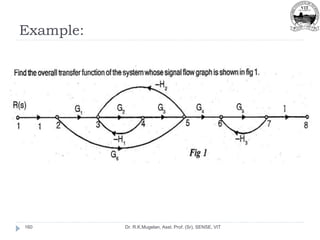
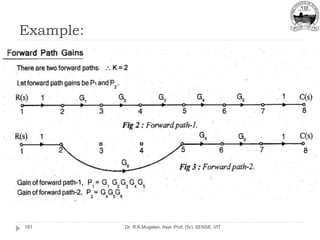
    Mason’s gain formula Dr.R.K.Mugelan, Asst. Prof. (Sr), SENSE, VIT 144  Suppose there are ‘N’ forward paths in a signal flow graph.  The gain between the input and the output nodes of a signal flow graph is nothing but the transfer function of the system.  It can be calculated by using Mason’s gain formula. Where,  C(s) is the output node  R(s) is the input node  T is the transfer function or gain between R(s) and C(s)  Pi is the ith forward path gain
  • 145.
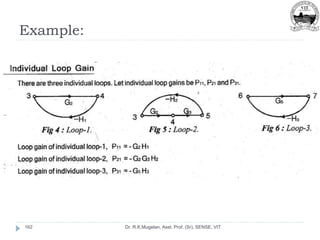
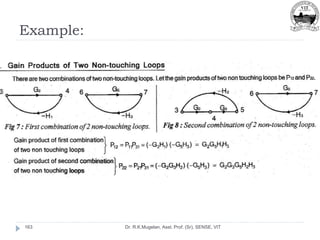
    Mason’s gain formula Dr.R.K.Mugelan, Asst. Prof. (Sr), SENSE, VIT 145  Δ=1−(sum of all individual loop gains)+(sum of gain products of all possible two non touching loops)−(sum of gain products of all possible three non touching loops)+...  Δi is obtained from Δ by removing the loops which are touching the ith forward path.
  • 146.
    Terminologies Dr. R.K.Mugelan, Asst.Prof. (Sr), SENSE, VIT 146  Consider the following signal flow graph in order to understand the basic terminology involved here.
  • 147.
    Terminologies Dr. R.K.Mugelan, Asst.Prof. (Sr), SENSE, VIT 147  Path  It is a traversal of branches from one node to any other node in the direction of branch arrows.  It should not traverse any node more than once.  Examples: y2→y3→y4→y5 and y5→y3→y2
  • 148.
    Terminologies Dr. R.K.Mugelan, Asst.Prof. (Sr), SENSE, VIT 148  Forward Path  The path that exists from the input node to the output node is known as forward path.  Examples:  y1→y2→y3→y4→y5→y6 and y1→y2→y3→y5→y6.
  • 149.
    Terminologies Dr. R.K.Mugelan, Asst.Prof. (Sr), SENSE, VIT 149  Forward Path Gain  It is obtained by calculating the product of all branch gains of the forward path.  Examples:  abcde is the forward path gain of y1→y2→y3→y4→y5→y6  abge is the forward path gain of y1→y2→y3→y5→y6.
  • 150.
    Terminologies Dr. R.K.Mugelan, Asst.Prof. (Sr), SENSE, VIT 150  Loop  The path that starts from one node and ends at the same node is known as loop. Hence, it is a closed path.  Examples: y2→y3→y2 and y3→y5→y3.
  • 151.
    Terminologies Dr. R.K.Mugelan, Asst.Prof. (Sr), SENSE, VIT 151  Loop Gain  It is obtained by calculating the product of all branch gains of a loop.  Examples:  bj is the loop gain of y2→y3→y2 and  gh is the loop gain of y3→y5→y3.
  • 152.
    Terminologies Dr. R.K.Mugelan, Asst.Prof. (Sr), SENSE, VIT 152  Non-touching Loops  These are the loops, which should not have any common node.  Examples:  The loops, y2→y3→y2 and y4→y5→y4 are non-touching.
  • 153.
    Calculation of TransferFunction using Mason’s Gain Formula Dr. R.K.Mugelan, Asst. Prof. (Sr), SENSE, VIT 153  Let us consider the same signal flow graph for finding transfer function.
  • 154.
    Calculation of TransferFunction using Mason’s Gain Formula Dr. R.K.Mugelan, Asst. Prof. (Sr), SENSE, VIT 154
  • 155.
    Calculation of TransferFunction using Mason’s Gain Formula Dr. R.K.Mugelan, Asst. Prof. (Sr), SENSE, VIT 155
  • 156.
    Calculation of TransferFunction using Mason’s Gain Formula Dr. R.K.Mugelan, Asst. Prof. (Sr), SENSE, VIT 156
  • 157.
    Calculation of TransferFunction using Mason’s Gain Formula Dr. R.K.Mugelan, Asst. Prof. (Sr), SENSE, VIT 157
  • 158.
    Calculation of TransferFunction using Mason’s Gain Formula Dr. R.K.Mugelan, Asst. Prof. (Sr), SENSE, VIT 158
  • 159.
    Calculation of TransferFunction using Mason’s Gain Formula Dr. R.K.Mugelan, Asst. Prof. (Sr), SENSE, VIT 159
  • 160.
    Example: Dr. R.K.Mugelan, Asst.Prof. (Sr), SENSE, VIT 160
  • 161.
    Example: Dr. R.K.Mugelan, Asst.Prof. (Sr), SENSE, VIT 161
  • 162.
    Example: Dr. R.K.Mugelan, Asst.Prof. (Sr), SENSE, VIT 162
  • 163.
    Example: Dr. R.K.Mugelan, Asst.Prof. (Sr), SENSE, VIT 163
  • 164.
    Example: Dr. R.K.Mugelan, Asst.Prof. (Sr), SENSE, VIT 164
  • 165.
    Example: Dr. R.K.Mugelan, Asst.Prof. (Sr), SENSE, VIT 165
  • 166.
    Example: Dr. R.K.Mugelan, Asst.Prof. (Sr), SENSE, VIT 166
  • 167.
    Example: Dr. R.K.Mugelan, Asst.Prof. (Sr), SENSE, VIT 167
  • 168.
    Example: Dr. R.K.Mugelan, Asst.Prof. (Sr), SENSE, VIT 168
  • 169.
    Example: Dr. R.K.Mugelan, Asst.Prof. (Sr), SENSE, VIT 169
  • 170.
    Example: Dr. R.K.Mugelan, Asst.Prof. (Sr), SENSE, VIT 170
  • 171.
    Example: Dr. R.K.Mugelan, Asst.Prof. (Sr), SENSE, VIT 171
  • 172.
    Example: Dr. R.K.Mugelan, Asst.Prof. (Sr), SENSE, VIT 172
  • 173.
    Example: Dr. R.K.Mugelan, Asst.Prof. (Sr), SENSE, VIT 173
  • 174.
    Example: Dr. R.K.Mugelan, Asst.Prof. (Sr), SENSE, VIT 174
  • 175.
    Try For Yourself Dr.R.K.Mugelan, Asst. Prof. (Sr), SENSE, VIT 175
  • 176.
    Example: Dr. R.K.Mugelan, Asst.Prof. (Sr), SENSE, VIT 176
  • 177.
    Example: Dr. R.K.Mugelan, Asst.Prof. (Sr), SENSE, VIT 177
  • 178.
    DC Motor Dr. R.K.Mugelan,Asst. Prof. (Sr), SENSE, VIT 178  A motor is an actuator, converting electrical energy in to rotational mechanical energy.  Motor requiring DC supply for operation is termed as DC motor.  DC motors are widely used in control applications like robotics, tape drives, machines and many more.  Separately excited DC motors are suitable for control applications because of separate field and armature circuit.  Two ways to control DC separately excited motors are:  1. Armature Control.  2. Field Control.
  • 179.
    Armature Controlled DCMotor Dr. R.K.Mugelan, Asst. Prof. (Sr), SENSE, VIT 179  DC motor consists of two parts i.e. rotor and stator.  Stator consists of field winding while rotor (also called armature) consists of armature winding.  When both armature and field are excited by DC supply, current flows through windings and magnetic flux proportional to the current is produced.  When the flux of field interacts with the flux of armature, it results in motion of the rotor.  Armature control is the most common control technique for DC motors.  In order to implement this control, the flux is required to be kept constant. .
  • 180.
    Armature Controlled DCMotor Dr. R.K.Mugelan, Asst. Prof. (Sr), SENSE, VIT 180
  • 181.
    Armature Controlled DCMotor Dr. R.K.Mugelan, Asst. Prof. (Sr), SENSE, VIT 181
  • 182.
    Armature Controlled DCMotor Dr. R.K.Mugelan, Asst. Prof. (Sr), SENSE, VIT 182
  • 183.
    Armature Controlled DCMotor Dr. R.K.Mugelan, Asst. Prof. (Sr), SENSE, VIT 183
  • 184.
    Armature Controlled DCMotor Dr. R.K.Mugelan, Asst. Prof. (Sr), SENSE, VIT 184
  • 185.
    Armature Controlled DCMotor Dr. R.K.Mugelan, Asst. Prof. (Sr), SENSE, VIT 185
  • 186.
    Armature Controlled DCMotor Dr. R.K.Mugelan, Asst. Prof. (Sr), SENSE, VIT 186
  • 187.
    Armature Controlled DCMotor Dr. R.K.Mugelan, Asst. Prof. (Sr), SENSE, VIT 187
  • 188.
    Armature Controlled DCMotor Dr. R.K.Mugelan, Asst. Prof. (Sr), SENSE, VIT 188
  • 189.
    Armature Controlled DCMotor Dr. R.K.Mugelan, Asst. Prof. (Sr), SENSE, VIT 189
  • 190.
    Armature Controlled DCMotor Dr. R.K.Mugelan, Asst. Prof. (Sr), SENSE, VIT 190
  • 191.
    Armature Controlled DCMotor Dr. R.K.Mugelan, Asst. Prof. (Sr), SENSE, VIT 191
  • 192.
    Armature Controlled DCMotor Dr. R.K.Mugelan, Asst. Prof. (Sr), SENSE, VIT 192
  • 193.
    Armature Controlled DCMotor Dr. R.K.Mugelan, Asst. Prof. (Sr), SENSE, VIT 193
  • 194.
    Armature Controlled DCMotor Dr. R.K.Mugelan, Asst. Prof. (Sr), SENSE, VIT 194
  • 195.
    Field Controlled DCMotor Dr. R.K.Mugelan, Asst. Prof. (Sr), SENSE, VIT 195  Basically in a field controlled dc motor, the armature current is kept constant (via some constant voltage source)  While the field current is varied which will vary the field flux and interacts with the armature of motor and produce rotation.
  • 196.
    Field Controlled DCMotor Dr. R.K.Mugelan, Asst. Prof. (Sr), SENSE, VIT 196
  • 197.
    Field Controlled DCMotor Dr. R.K.Mugelan, Asst. Prof. (Sr), SENSE, VIT 197
  • 198.
    Field Controlled DCMotor Dr. R.K.Mugelan, Asst. Prof. (Sr), SENSE, VIT 198
  • 199.
    Field Controlled DCMotor Dr. R.K.Mugelan, Asst. Prof. (Sr), SENSE, VIT 199
  • 200.
    Field Controlled DCMotor Dr. R.K.Mugelan, Asst. Prof. (Sr), SENSE, VIT 200
  • 201.
    Field Controlled DCMotor Dr. R.K.Mugelan, Asst. Prof. (Sr), SENSE, VIT 201
  • 202.
    Field Controlled DCMotor Dr. R.K.Mugelan, Asst. Prof. (Sr), SENSE, VIT 202
  • 203.
    Field Controlled DCMotor Dr. R.K.Mugelan, Asst. Prof. (Sr), SENSE, VIT 203
  • 204.
    Field Controlled DCMotor Dr. R.K.Mugelan, Asst. Prof. (Sr), SENSE, VIT 204
  • 205.
    Field Controlled DCMotor Dr. R.K.Mugelan, Asst. Prof. (Sr), SENSE, VIT 205
  • 206.
    Field Controlled DCMotor Dr. R.K.Mugelan, Asst. Prof. (Sr), SENSE, VIT 206