EE3503 – CONTROL SYSTEMS
UNIT - I
CONTROL SYSTEM; TERMINOLOGY AND
BASIC STRUCTURE
2
System
Group of components are connected in a
sequence to perform a specific function,
the group thus formed is called a system.
CONTROL SYSTEM; TERMINOLOGY AND
BASIC STRUCTURE
3
⚫Control
system
⚫In a system ,when
the
controlled by varying
the
outpu
t
input
quantity
is
quantity,
the
system is called control
system
OPEN LOOP SYSTEM
⚫Any physical system which does not
automatically correct the variation in its
output is called an open loop system
4
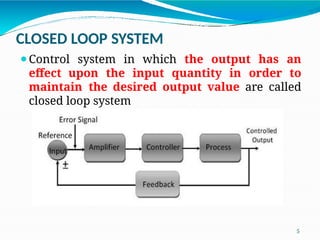
CLOSED LOOP SYSTEM
⚫Control system in which the output has an
effect upon the input quantity in order to
maintain the desired output value are called
closed loop system
5
6
CLOSED LOOP SYSTEM- CAR DRIVING
7
DIFFERENCE BETWEEN OPEN LOOP AND
CLOSED LOOP CONTROL SYSTEM
8
Open Loop Control
System
⚫ The controlled action
is free from the
output
⚫ Non feedback
control system
⚫ The construction of
this system is simple
⚫ The consistency is
non-
reliable
Closed-Loop Control
System
⚫ The output mainly
depends on the
controlled act of the
system.
⚫ Feedback control
system
⚫ The construction of
this system is complex
⚫ The consistency is
reliable
SAMPLE CONTROL SYSTEM
9
FEEDFORWARD CONTROL
Control element responds to change in
command or
measured disturbance in a pre-defined way
10
IMPLIMENTATION OF FEEDFORWARD
⚫ Ideally consists of exact inverse model of the plant
⚫ Can compensate for known plant dynamics, delays
(before you get errors)
⚫ No sensors needed
⚫ System response must be predictable
11
LIMITATIONS OF FEEDFORWARD
12
⚫Effects of disturbance or command input
must be predictable
⚫May not generalize to other conditions
⚫Will not be accurate if the system changes
FEEDBACK CONTROL
Plant- System to be controlled
Reference -Desired value of output (also ‘set
point’) Controller -Computes compensatory
command to the plant based on error
Sensor- (implied)
13
FEATURES OF FEEDBACK
⚫Reactive / Error-driven
⚫Automatically compensatesfor disturbances
(controller acts on error)
⚫Automatically follows change in desired state (set
point can
change)
⚫Can improve undesirable properties of system/plant
⚫Can be very simple 14
COMBINING FEEDBACK AND FEEDFORWARD
⚫Feed forward component provides rapid
response
⚫Feedback component fills in the rest of
the response accurately, compensating for
errors in the model
15
ELECTRICAL AND MECHANICAL TRANSFER
FUNCTION MODELS
16
⚫The control systems can be represented with a
set of mathematical equations known as
mathematical model.
⚫These models are useful for analysis and
design of control systems.
ELECTRICAL AND MECHANICAL TRANSFER
FUNCTION MODELS
17
⚫Analysis of control system means finding the
output when we know the input and
mathematical model.
⚫Design of control system means finding
the mathematical model when we know the
input and the output
ELECTRICAL AND MECHANICAL TRANSFER
FUNCTION MODELS
9/29/2022 DrNSR/AP/ECE/PSNACET/
EC3351
18
⚫The following mathematical models are mostly
used.
⚫1. Differential equation model
⚫2. Transfer function model
⚫3. State space model
DIFFERENTIAL EQUATION MODEL
19
Differential equation model is a time
domain mathematical model of control systems.
RLC series electrical
system
Mesh equation for this circuit
is
20
⚫Substitute, the current passing through
capacitor
The above equation is a second order differential
equation.
21
TRANSFER FUNCTION MODEL
22
⚫Transfer function model is an s-domain
mathematical model of control systems.
TRANSFER FUNCTION MODEL
⚫The Transfer function of a Linear Time
Invariant (LTI) system is defined as the
ratio of Laplace transform of output and
Laplace transform of input by assuming all
the initial conditions are zero.
transfer function
model
23
TRANSFER FUNCTION OF RLC SERIES ELECTRICAL
SYSTEM
RLC series
circuit
Transfer function model
of
RLC series
circuit
second order electrical system
with a block having the transfer
function inside it. And this block has
an input Vi(s) & an output Vo(s).
24
THE DIFFERENTIAL EQUATION MODELING OF
MECHANICAL SYSTEMS.
25
⚫There are two types of mechanical systems
based on the type of motion.
⚫1. Translational mechanical systems
⚫2.Rotational mechanical systems
MODELING OF TRANSLATIONAL MECHANICAL
SYSTEMS
26
⚫Translational mechanical systems move along
a straight line
consist of three
basic
⚫These systems
mainly
elements.
⚫Mass,
⚫Spring
⚫Dashpot or damper.
MASS
BLOCK DIAGRAM OF
MASS
27
MASS
28
⚫Mass is the property of a body,
⚫which stores kinetic energy.
⚫If a force is applied on a body having mass M,
then it is opposed by an opposing force due to
mass.
⚫This opposing force is proportional to
the acceleration of the body.
⚫Assume elasticity and frictions are negligible.
29
⚫Where,
⚫ F is the applied force
⚫ Fm is the opposing force due to
mass
⚫ M is mass
⚫ a is acceleration
⚫ x is displacement
30
SPRING
BLOCK DIAGRAM OF
SPRING
31
⚫Spring is an element,
⚫which stores potential energy.
⚫If a force is applied on spring K, then it is
opposed by an opposing force due to elasticity
of spring.
32
to
the
⚫This opposing force is
proportional displacement of the
spring.
⚫Assume mass and friction are
negligible.
⚫Where,
⚫F is the applied
force
⚫Fk is the opposing
force due to
elasticity of spring
⚫K is spring constant
⚫ x is displacement
33
DASHPOT
BLOCK DIAGRAM OF
FRICTION
34
⚫If a force is applied on dashpot B,
⚫then it is opposed by an opposing force
due to friction of the dashpot.
⚫This opposing force is proportional to the
velocity of the body.
⚫Assume mass and elasticity are negligible.
35
⚫Where,
⚫Fb is the opposing
force due to friction
of dashpot
⚫B is the
frictional
coefficient
⚫v is velocity
⚫ x is
displacement
36
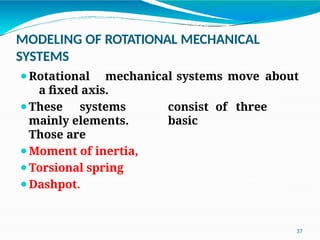
MODELING OF ROTATIONAL MECHANICAL
SYSTEMS
37
⚫Rotational mechanical systems move about
a fixed axis.
consist of three
basic
⚫These systems
mainly elements.
Those are
⚫Moment of inertia,
⚫Torsional spring
⚫Dashpot.
Moment of Inertia
BLOCK DIAGRAM OF MOMENT OF
INERTIA
38
⚫If a torque is applied to a rotational
mechanical system,
⚫then it is opposed by opposing torques due
to moment of inertia, elasticity and friction
of the system.
⚫Since the applied torque and the
opposing torques are in opposite directions,
⚫the algebraic sum of torques acting on the
system is zero.
39
Where,
⚫ T is the applied torque
⚫Tj is the opposing
torque due to
moment of inertia
⚫J is moment of inertia
⚫ α is angular
acceleration
⚫θ is angular
displacemen
t
40
Torsional spring
41
⚫Rotational mechanical system, torsional
spring stores potential energy.
⚫If a torque is applied on torsional spring K,
then it is opposed by an opposing torque
due to the elasticity of torsional spring.
⚫This opposing torque is proportional to
the angular displacement of the torsional
spring.
⚫Assume that the moment of inertia and
friction are negligible.
42
⚫Where,
⚫ T is the applied
torque
⚫Tk is the opposing
torque due to
elasticity of
torsional spring
⚫K is the
torsional
spring constant
⚫ θ is 43
Dashpot
44
⚫If a torque is applied on dashpot B, then it
is opposed by an opposing torque due to
the rotational friction of the dashpot.
⚫This opposing torque is proportional to
the angular velocity of the body.
⚫Assume the moment of inertia and elasticity
are negligible.
45
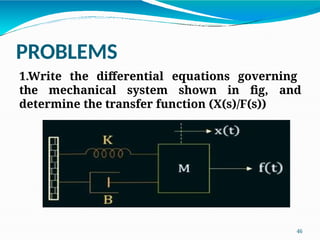
PROBLEMS
1.Write the differential equations governing
the mechanical system shown in fig, and
determine the transfer function (X(s)/F(s))
46
47
48
49
50
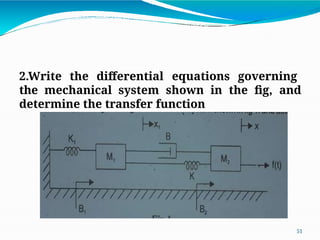
2.Write the differential equations governing
the mechanical system shown in the fig, and
determine the transfer function
51
52
53
54
55
56
57
58
59
Substituting X1(S) from
node 1
60
61
MULTIVARIABLE CONTROL SYSTEM
62
⚫Multivariable control system in which
the variable interacts strongly.
⚫This kind of system must have more than
one input and more than one output.
⚫ A disturbancein any input causes a change
of response from at least one output.
MULTIVARIABLE CONTROL SYSTEM
63
MULTIVARIABLE CONTROL SYSTEM
64
⚫This kind of system have as many inputs
and outputs as needed to control the process.
⚫Asystem with an equal number of inputs
and outputs is said to be square.
APPLICATIONS
65
⚫A heated liquid tank where both the level and
the temperature shall be controlled.
⚫A distillation column where the top and
bottom concentration shall be controlled.
⚫Arobot manipulator where the
positions of the manipulators
(arms)shall be controlled.
⚫Achemical reactor where the concentration
and the temperature shall be controlled.
SIGNAL FLOW GRAPH MODELS
⚫Signal flow graph is used to represent the
control system graphically
⚫Signal flow graph is a diagram which
represents a set of simultaneous equations
66
SIGNAL FLOW GRAPH MODELS
67
⚫Signal flow graph of control system is
further simplification of block diagram of
control system
⚫Blocks of transfer function, summing
symbols and take off points are eliminated
by branches and nodes.
Terms used in Signal Flow Graph
68
⚫Node
⚫Input node or
source
⚫Output node or
sink
⚫Mixed node
⚫ Branch
⚫Transmittance
⚫Forward path
⚫Feedback loop
⚫Self-loop
⚫Path gain
⚫ Loop gain
⚫Non-touching
loops:
69
BLOCK DIAGRAM AND SIGNAL FLOW
GRAPH
70
Properties of signal flow graph
71
⚫The signal from a node to other flows through
the branch in the direction of arrowhead.
⚫The graphical method is valid only for linear
time- invariant systems.
⚫The signal flowing through a branch is
multiplied by the gain or transmittance of that
branch. This product is equivalent to the
node where that branch is terminating.
SFG from system equations
72
73
SFG from Block Diagram
74
75
Mason’s Gain Formula
76
⚫Suppose there are ‘N’ forward paths in a
signal flow graph. The gain between the
input and the output nodes of a signal flow
graph is nothing but the transfer function of
the system.
⚫It can be calculated by using Mason’s
gain formula.
Mason’s Gain Formula
77
Mason’s Gain Formula
78
Block
diagram
A Block diagram is basically modelling of any simple or complex system.
It Consists of multiple Blocks connected together to represent a system to
explain how it is functioning
Transfer Function: Ratio between transformation of output to the
transformation of input when all the initial conditions are zero.
G2 G3
G1
G4
H1
H2
Y
(s)
G(s)
C(s)
R(s) G(s)=C(s)/R(s)
Simple
system:
Complex
System:
R(s)
• It is normally required to reduce
multiple blocks into single block or
for convenient understanding it
may sometimes required to rearrange
the blocks from its original order.
• For the calculation of Transfer
function its required to be reduced.
NEED FOR BLOCK
DIAGRAM REDUCTION
Block Diagram Reduction
techniques
G2
G1 G1G2
2. Moving a summing point behind a
block
G G
G
G1
G2
G1  G2
1. Combining blocks which are in cascade or in
parallel
5. Moving a pickoff point ahead of a
block
G G
G G
1
G
G
3. Moving a summing point ahead of a
block
G G
1
G
4. Moving a pickoff point behind a
block
6. Eliminating a feedback
loop
G
H
G
1∓ GH
7. Swapping with two adjacent summing
points
A
B A
B
G
H 1
G
1∓ G
1−Check for the blocks connected in series and
RULE NO-1
simplify.
2−Check for the blocks connected in parallel
feedback
and simplify. RULE NO-1
3−Check for the blocks connected
in loop and simplify. RULE NO-6
4− If there is difficulty with take-off
point while simplifying, shift it towards
right. RULE NO-4,5
5−If there is difficulty with summing point
while simplifying, shift it towards left. RULE NO-2,3
6-Repeat the above steps till you get the
simplified form, i.e., single block.
Example
1
Find the transfer function of the following block
diagrams
G2 G3
G1
G4
H1
H2
Y
(s)
R(s)
(a)
2. Eliminate loop I & simplify
as
G4  G2G3
B
G1
H2
Y
(s)
G4
G2
H1
A
B
3
G
G2
R(s)
I
Solution:
1. Apply the rule that Moving pickoff/takeoff point ahead of
block
G2
3. Moving pickoff point B behind
block
G4  G2G3
G1
B
R(s)
H1G2
H2
Y
(s)
1/(G4  G2G3 )
II
G1
B
R(s) C
G4  G2G3
H2
Y
(s)
H1G2
G4
A
G2
G3
G4  G2G3
4. Eliminate loop
III
R(s) G1 (G4  G2G3 )
1 G1G2 H1  H2 (G4  G2G3 )
Y
(s)
G1 (G4  G2G3 )
1 G1G2 H1  H2 (G4  G2G3 )  G1 (G4  G2G3 )
T (s) 
Y (s)

R(s)
R(s)
G1
C
G2 H1
G4  G2G3
Y
(s)
C
G4  G2G3
H2
G4  G2G3
1 H2 (G4  G2G3 )
Using rule
6
G2
1
G
H1
H2
R(s) Y
(s)
H3
(b) Find the transfer function of the following block
diagram
Solution
:
1. Eliminate loop
I
2. Moving pickoff point A behind
block
G2
1 G2 H 2
G1
H1
R(s) Y
(s)
H3
B
A G2
1 G2 H 2
1 G2 H 2
G2
G1
H1
R(s) Y
(s)
H3
B
A
II
I
G
2
H2
G
2
1 G2 H2
Not a feedback
loop
2
3
G
1 G2 H 2
)
H  H1 (
3. Eliminate loop
II
R(s) Y
(s)
G1G2
1 G2 H 2
2
3
H 
H1 (1 G2 H 2 )
G
G1G2
1 G2 H2  G1G2 H3  G1H1  G1G2 H1H2
T (s) 
Y (s)

R(s)
Using rule
6
G2 G4
G1
H4
H2
H3
Y
(s)
R(s)
G3
H1
(c) Find the transfer function of the following block
diagrams
Solution
:
G2 G4
G1
H4
Y
(s)
G3
H1
R(s)
A B
1
H
3
G 4
1
H
2
G 4
I
1. Moving pickoff point A behind
block
G4
H 3
G4
H 2
G4
Solution
:
G2 G4
G1
H4
Y
(s)
G3
H1
R(s)
A B
1
H
3
G 4
1
H
2
G 4
I
1. Moving pickoff point A behind
block
G4
H 3
G4
H 2
G4
Solution
:
G2
G1
H4
Y
(s)
4
3
G G
H1
R(s)
B
1
H
3
G 4
1
H
2
G 4
I
1. Moving pickoff point A behind
block
G4
H 3
G4
H 2
G4
Solution
:
G2
G1
Y
(s)
H1
R(s)
B
1
H
3
G 4
1
H
2
G 4
I
1. Moving pickoff point A behind
block
G4
H 3
G4
H 2
G4
G3 G4
1  G3 G4 H 4
2. Eliminate loop I and
Simplify
II
III
G2G3G4
1 G3G4 H 4
G1
Y
(s)
H1
B
H 2
G4
R(s)
H 3
G4
II
G2G3G4
1 G3G4 H 4  G2 G3 H3
III
G4
H 2  G4 H1
Not
feedback
feedbac
k
R(s) Y
(s)
H 2  G4 H1
G4
G1G2G3G4
1 G3G4 H 4  G2 G3 H3
3. Eliminate loop II &
III
G1G2G3G4
1 G2G3 H3  G3G4 H4  G1G2G3 H2  G1G2G3G4 H1
T (s) 
Y (s)

R(s)
Using rule
6
3
G
G1
H1
H2
R(s) Y
(s)
G4
G2
A
B
(d)
Find the transfer function of the following block
diagram
Solution
:
1. Moving pickoff point A behind
block
G3
I
H1
3
1
G
Y
(s)
G1
H1
H2
R(s)
G4
G2
A B
1
G3
G3
2. Eliminate loop I &
Simplify
G3
H1
G2
B
1
G3
H2
G2G3
B
2
3
H1
 H
G
G1
R(s) Y
(s)
G4
H1
G3
G2G3
1 G2 H1  G2G3 H 2
II
R(s) Y
(s)
G1G2G3
1 G2 H1  G2 G3 H 2  G1G2 H1
3. Eliminate loop
II
4
G1G2G
3
R(s
)
1 G2 H1  G2G3 H2  G1G2 H1
T (s) 
Y (s)
 G
G4
Find the transfer function of the following block
diagram
Step 1 − Use Rule 1 for blocks G1and G2. Use Rule 2
for blocks G3 and G4. The modified block diagram is shown
in the following figure.
Step 2 − Use Rule 3 for blocks G1G2 and H1. Use Rule 4
for shifting take-off point after the block G5.
The modified block diagram is shown in the following
figure.
Step 3 − Use Rule 1 for blocks (G3+G4) and
G5. The modified block diagram is shown in
the following figure.
Step 4 − Use Rule 3 for blocks (G3+G4)G5 and H3.
The modified block diagram is shown in the
following figure.
Step 5 − Use Rule 1 for blocks connected
in series. The modified block diagram is
shown in the following figure.
Step 6 − Use Rule 3 for blocks connected
in feedback loop. The modified block
diagram is shown in the following figure.
This is the simplified block diagram.

UNIT 1.pptx control system modeling in control

  • 1.
    EE3503 – CONTROLSYSTEMS UNIT - I
  • 2.
    CONTROL SYSTEM; TERMINOLOGYAND BASIC STRUCTURE 2 System Group of components are connected in a sequence to perform a specific function, the group thus formed is called a system.
  • 3.
    CONTROL SYSTEM; TERMINOLOGYAND BASIC STRUCTURE 3 ⚫Control system ⚫In a system ,when the controlled by varying the outpu t input quantity is quantity, the system is called control system
  • 4.
    OPEN LOOP SYSTEM ⚫Anyphysical system which does not automatically correct the variation in its output is called an open loop system 4
  • 5.
    CLOSED LOOP SYSTEM ⚫Controlsystem in which the output has an effect upon the input quantity in order to maintain the desired output value are called closed loop system 5
  • 6.
  • 7.
    CLOSED LOOP SYSTEM-CAR DRIVING 7
  • 8.
    DIFFERENCE BETWEEN OPENLOOP AND CLOSED LOOP CONTROL SYSTEM 8 Open Loop Control System ⚫ The controlled action is free from the output ⚫ Non feedback control system ⚫ The construction of this system is simple ⚫ The consistency is non- reliable Closed-Loop Control System ⚫ The output mainly depends on the controlled act of the system. ⚫ Feedback control system ⚫ The construction of this system is complex ⚫ The consistency is reliable
  • 9.
  • 10.
    FEEDFORWARD CONTROL Control elementresponds to change in command or measured disturbance in a pre-defined way 10
  • 11.
    IMPLIMENTATION OF FEEDFORWARD ⚫Ideally consists of exact inverse model of the plant ⚫ Can compensate for known plant dynamics, delays (before you get errors) ⚫ No sensors needed ⚫ System response must be predictable 11
  • 12.
    LIMITATIONS OF FEEDFORWARD 12 ⚫Effectsof disturbance or command input must be predictable ⚫May not generalize to other conditions ⚫Will not be accurate if the system changes
  • 13.
    FEEDBACK CONTROL Plant- Systemto be controlled Reference -Desired value of output (also ‘set point’) Controller -Computes compensatory command to the plant based on error Sensor- (implied) 13
  • 14.
    FEATURES OF FEEDBACK ⚫Reactive/ Error-driven ⚫Automatically compensatesfor disturbances (controller acts on error) ⚫Automatically follows change in desired state (set point can change) ⚫Can improve undesirable properties of system/plant ⚫Can be very simple 14
  • 15.
    COMBINING FEEDBACK ANDFEEDFORWARD ⚫Feed forward component provides rapid response ⚫Feedback component fills in the rest of the response accurately, compensating for errors in the model 15
  • 16.
    ELECTRICAL AND MECHANICALTRANSFER FUNCTION MODELS 16 ⚫The control systems can be represented with a set of mathematical equations known as mathematical model. ⚫These models are useful for analysis and design of control systems.
  • 17.
    ELECTRICAL AND MECHANICALTRANSFER FUNCTION MODELS 17 ⚫Analysis of control system means finding the output when we know the input and mathematical model. ⚫Design of control system means finding the mathematical model when we know the input and the output
  • 18.
    ELECTRICAL AND MECHANICALTRANSFER FUNCTION MODELS 9/29/2022 DrNSR/AP/ECE/PSNACET/ EC3351 18 ⚫The following mathematical models are mostly used. ⚫1. Differential equation model ⚫2. Transfer function model ⚫3. State space model
  • 19.
    DIFFERENTIAL EQUATION MODEL 19 Differentialequation model is a time domain mathematical model of control systems.
  • 20.
    RLC series electrical system Meshequation for this circuit is 20
  • 21.
    ⚫Substitute, the currentpassing through capacitor The above equation is a second order differential equation. 21
  • 22.
    TRANSFER FUNCTION MODEL 22 ⚫Transferfunction model is an s-domain mathematical model of control systems.
  • 23.
    TRANSFER FUNCTION MODEL ⚫TheTransfer function of a Linear Time Invariant (LTI) system is defined as the ratio of Laplace transform of output and Laplace transform of input by assuming all the initial conditions are zero. transfer function model 23
  • 24.
    TRANSFER FUNCTION OFRLC SERIES ELECTRICAL SYSTEM RLC series circuit Transfer function model of RLC series circuit second order electrical system with a block having the transfer function inside it. And this block has an input Vi(s) & an output Vo(s). 24
  • 25.
    THE DIFFERENTIAL EQUATIONMODELING OF MECHANICAL SYSTEMS. 25 ⚫There are two types of mechanical systems based on the type of motion. ⚫1. Translational mechanical systems ⚫2.Rotational mechanical systems
  • 26.
    MODELING OF TRANSLATIONALMECHANICAL SYSTEMS 26 ⚫Translational mechanical systems move along a straight line consist of three basic ⚫These systems mainly elements. ⚫Mass, ⚫Spring ⚫Dashpot or damper.
  • 27.
  • 28.
    MASS 28 ⚫Mass is theproperty of a body, ⚫which stores kinetic energy. ⚫If a force is applied on a body having mass M, then it is opposed by an opposing force due to mass. ⚫This opposing force is proportional to the acceleration of the body. ⚫Assume elasticity and frictions are negligible.
  • 29.
  • 30.
    ⚫Where, ⚫ F isthe applied force ⚫ Fm is the opposing force due to mass ⚫ M is mass ⚫ a is acceleration ⚫ x is displacement 30
  • 31.
  • 32.
    ⚫Spring is anelement, ⚫which stores potential energy. ⚫If a force is applied on spring K, then it is opposed by an opposing force due to elasticity of spring. 32 to the ⚫This opposing force is proportional displacement of the spring. ⚫Assume mass and friction are negligible.
  • 33.
    ⚫Where, ⚫F is theapplied force ⚫Fk is the opposing force due to elasticity of spring ⚫K is spring constant ⚫ x is displacement 33
  • 34.
  • 35.
    ⚫If a forceis applied on dashpot B, ⚫then it is opposed by an opposing force due to friction of the dashpot. ⚫This opposing force is proportional to the velocity of the body. ⚫Assume mass and elasticity are negligible. 35
  • 36.
    ⚫Where, ⚫Fb is theopposing force due to friction of dashpot ⚫B is the frictional coefficient ⚫v is velocity ⚫ x is displacement 36
  • 37.
    MODELING OF ROTATIONALMECHANICAL SYSTEMS 37 ⚫Rotational mechanical systems move about a fixed axis. consist of three basic ⚫These systems mainly elements. Those are ⚫Moment of inertia, ⚫Torsional spring ⚫Dashpot.
  • 38.
    Moment of Inertia BLOCKDIAGRAM OF MOMENT OF INERTIA 38
  • 39.
    ⚫If a torqueis applied to a rotational mechanical system, ⚫then it is opposed by opposing torques due to moment of inertia, elasticity and friction of the system. ⚫Since the applied torque and the opposing torques are in opposite directions, ⚫the algebraic sum of torques acting on the system is zero. 39
  • 40.
    Where, ⚫ T isthe applied torque ⚫Tj is the opposing torque due to moment of inertia ⚫J is moment of inertia ⚫ α is angular acceleration ⚫θ is angular displacemen t 40
  • 41.
  • 42.
    ⚫Rotational mechanical system,torsional spring stores potential energy. ⚫If a torque is applied on torsional spring K, then it is opposed by an opposing torque due to the elasticity of torsional spring. ⚫This opposing torque is proportional to the angular displacement of the torsional spring. ⚫Assume that the moment of inertia and friction are negligible. 42
  • 43.
    ⚫Where, ⚫ T isthe applied torque ⚫Tk is the opposing torque due to elasticity of torsional spring ⚫K is the torsional spring constant ⚫ θ is 43
  • 44.
  • 45.
    ⚫If a torqueis applied on dashpot B, then it is opposed by an opposing torque due to the rotational friction of the dashpot. ⚫This opposing torque is proportional to the angular velocity of the body. ⚫Assume the moment of inertia and elasticity are negligible. 45
  • 46.
    PROBLEMS 1.Write the differentialequations governing the mechanical system shown in fig, and determine the transfer function (X(s)/F(s)) 46
  • 47.
  • 48.
  • 49.
  • 50.
  • 51.
    2.Write the differentialequations governing the mechanical system shown in the fig, and determine the transfer function 51
  • 52.
  • 53.
  • 54.
  • 55.
  • 56.
  • 57.
  • 58.
  • 59.
  • 60.
  • 61.
  • 62.
    MULTIVARIABLE CONTROL SYSTEM 62 ⚫Multivariablecontrol system in which the variable interacts strongly. ⚫This kind of system must have more than one input and more than one output. ⚫ A disturbancein any input causes a change of response from at least one output.
  • 63.
  • 64.
    MULTIVARIABLE CONTROL SYSTEM 64 ⚫Thiskind of system have as many inputs and outputs as needed to control the process. ⚫Asystem with an equal number of inputs and outputs is said to be square.
  • 65.
    APPLICATIONS 65 ⚫A heated liquidtank where both the level and the temperature shall be controlled. ⚫A distillation column where the top and bottom concentration shall be controlled. ⚫Arobot manipulator where the positions of the manipulators (arms)shall be controlled. ⚫Achemical reactor where the concentration and the temperature shall be controlled.
  • 66.
    SIGNAL FLOW GRAPHMODELS ⚫Signal flow graph is used to represent the control system graphically ⚫Signal flow graph is a diagram which represents a set of simultaneous equations 66
  • 67.
    SIGNAL FLOW GRAPHMODELS 67 ⚫Signal flow graph of control system is further simplification of block diagram of control system ⚫Blocks of transfer function, summing symbols and take off points are eliminated by branches and nodes.
  • 68.
    Terms used inSignal Flow Graph 68 ⚫Node ⚫Input node or source ⚫Output node or sink ⚫Mixed node ⚫ Branch ⚫Transmittance ⚫Forward path ⚫Feedback loop
  • 69.
    ⚫Self-loop ⚫Path gain ⚫ Loopgain ⚫Non-touching loops: 69
  • 70.
    BLOCK DIAGRAM ANDSIGNAL FLOW GRAPH 70
  • 71.
    Properties of signalflow graph 71 ⚫The signal from a node to other flows through the branch in the direction of arrowhead. ⚫The graphical method is valid only for linear time- invariant systems. ⚫The signal flowing through a branch is multiplied by the gain or transmittance of that branch. This product is equivalent to the node where that branch is terminating.
  • 72.
    SFG from systemequations 72
  • 73.
  • 74.
    SFG from BlockDiagram 74
  • 75.
  • 76.
    Mason’s Gain Formula 76 ⚫Supposethere are ‘N’ forward paths in a signal flow graph. The gain between the input and the output nodes of a signal flow graph is nothing but the transfer function of the system. ⚫It can be calculated by using Mason’s gain formula.
  • 77.
  • 78.
  • 80.
    Block diagram A Block diagramis basically modelling of any simple or complex system. It Consists of multiple Blocks connected together to represent a system to explain how it is functioning Transfer Function: Ratio between transformation of output to the transformation of input when all the initial conditions are zero. G2 G3 G1 G4 H1 H2 Y (s) G(s) C(s) R(s) G(s)=C(s)/R(s) Simple system: Complex System: R(s)
  • 81.
    • It isnormally required to reduce multiple blocks into single block or for convenient understanding it may sometimes required to rearrange the blocks from its original order. • For the calculation of Transfer function its required to be reduced. NEED FOR BLOCK DIAGRAM REDUCTION
  • 82.
    Block Diagram Reduction techniques G2 G1G1G2 2. Moving a summing point behind a block G G G G1 G2 G1  G2 1. Combining blocks which are in cascade or in parallel
  • 83.
    5. Moving apickoff point ahead of a block G G G G 1 G G 3. Moving a summing point ahead of a block G G 1 G 4. Moving a pickoff point behind a block
  • 84.
    6. Eliminating afeedback loop G H G 1∓ GH 7. Swapping with two adjacent summing points A B A B G H 1 G 1∓ G
  • 85.
    1−Check for theblocks connected in series and RULE NO-1 simplify. 2−Check for the blocks connected in parallel feedback and simplify. RULE NO-1 3−Check for the blocks connected in loop and simplify. RULE NO-6 4− If there is difficulty with take-off point while simplifying, shift it towards right. RULE NO-4,5 5−If there is difficulty with summing point while simplifying, shift it towards left. RULE NO-2,3 6-Repeat the above steps till you get the simplified form, i.e., single block.
  • 86.
    Example 1 Find the transferfunction of the following block diagrams G2 G3 G1 G4 H1 H2 Y (s) R(s) (a)
  • 87.
    2. Eliminate loopI & simplify as G4  G2G3 B G1 H2 Y (s) G4 G2 H1 A B 3 G G2 R(s) I Solution: 1. Apply the rule that Moving pickoff/takeoff point ahead of block G2
  • 88.
    3. Moving pickoffpoint B behind block G4  G2G3 G1 B R(s) H1G2 H2 Y (s) 1/(G4  G2G3 ) II G1 B R(s) C G4  G2G3 H2 Y (s) H1G2 G4 A G2 G3 G4  G2G3
  • 89.
    4. Eliminate loop III R(s)G1 (G4  G2G3 ) 1 G1G2 H1  H2 (G4  G2G3 ) Y (s) G1 (G4  G2G3 ) 1 G1G2 H1  H2 (G4  G2G3 )  G1 (G4  G2G3 ) T (s)  Y (s)  R(s) R(s) G1 C G2 H1 G4  G2G3 Y (s) C G4  G2G3 H2 G4  G2G3 1 H2 (G4  G2G3 ) Using rule 6
  • 90.
    G2 1 G H1 H2 R(s) Y (s) H3 (b) Findthe transfer function of the following block diagram
  • 91.
    Solution : 1. Eliminate loop I 2.Moving pickoff point A behind block G2 1 G2 H 2 G1 H1 R(s) Y (s) H3 B A G2 1 G2 H 2 1 G2 H 2 G2 G1 H1 R(s) Y (s) H3 B A II I G 2 H2 G 2 1 G2 H2 Not a feedback loop 2 3 G 1 G2 H 2 ) H  H1 (
  • 92.
    3. Eliminate loop II R(s)Y (s) G1G2 1 G2 H 2 2 3 H  H1 (1 G2 H 2 ) G G1G2 1 G2 H2  G1G2 H3  G1H1  G1G2 H1H2 T (s)  Y (s)  R(s) Using rule 6
  • 93.
    G2 G4 G1 H4 H2 H3 Y (s) R(s) G3 H1 (c) Findthe transfer function of the following block diagrams
  • 94.
    Solution : G2 G4 G1 H4 Y (s) G3 H1 R(s) A B 1 H 3 G4 1 H 2 G 4 I 1. Moving pickoff point A behind block G4 H 3 G4 H 2 G4
  • 95.
    Solution : G2 G4 G1 H4 Y (s) G3 H1 R(s) A B 1 H 3 G4 1 H 2 G 4 I 1. Moving pickoff point A behind block G4 H 3 G4 H 2 G4
  • 96.
    Solution : G2 G1 H4 Y (s) 4 3 G G H1 R(s) B 1 H 3 G 4 1 H 2 G4 I 1. Moving pickoff point A behind block G4 H 3 G4 H 2 G4
  • 97.
    Solution : G2 G1 Y (s) H1 R(s) B 1 H 3 G 4 1 H 2 G 4 I 1.Moving pickoff point A behind block G4 H 3 G4 H 2 G4 G3 G4 1  G3 G4 H 4
  • 98.
    2. Eliminate loopI and Simplify II III G2G3G4 1 G3G4 H 4 G1 Y (s) H1 B H 2 G4 R(s) H 3 G4 II G2G3G4 1 G3G4 H 4  G2 G3 H3 III G4 H 2  G4 H1 Not feedback feedbac k
  • 99.
    R(s) Y (s) H 2 G4 H1 G4 G1G2G3G4 1 G3G4 H 4  G2 G3 H3 3. Eliminate loop II & III G1G2G3G4 1 G2G3 H3  G3G4 H4  G1G2G3 H2  G1G2G3G4 H1 T (s)  Y (s)  R(s) Using rule 6
  • 100.
    3 G G1 H1 H2 R(s) Y (s) G4 G2 A B (d) Find thetransfer function of the following block diagram
  • 101.
    Solution : 1. Moving pickoffpoint A behind block G3 I H1 3 1 G Y (s) G1 H1 H2 R(s) G4 G2 A B 1 G3 G3
  • 102.
    2. Eliminate loopI & Simplify G3 H1 G2 B 1 G3 H2 G2G3 B 2 3 H1  H G G1 R(s) Y (s) G4 H1 G3 G2G3 1 G2 H1  G2G3 H 2 II
  • 103.
    R(s) Y (s) G1G2G3 1 G2H1  G2 G3 H 2  G1G2 H1 3. Eliminate loop II 4 G1G2G 3 R(s ) 1 G2 H1  G2G3 H2  G1G2 H1 T (s)  Y (s)  G G4
  • 104.
    Find the transferfunction of the following block diagram
  • 105.
    Step 1 −Use Rule 1 for blocks G1and G2. Use Rule 2 for blocks G3 and G4. The modified block diagram is shown in the following figure.
  • 106.
    Step 2 −Use Rule 3 for blocks G1G2 and H1. Use Rule 4 for shifting take-off point after the block G5. The modified block diagram is shown in the following figure.
  • 107.
    Step 3 −Use Rule 1 for blocks (G3+G4) and G5. The modified block diagram is shown in the following figure.
  • 108.
    Step 4 −Use Rule 3 for blocks (G3+G4)G5 and H3. The modified block diagram is shown in the following figure.
  • 109.
    Step 5 −Use Rule 1 for blocks connected in series. The modified block diagram is shown in the following figure.
  • 110.
    Step 6 −Use Rule 3 for blocks connected in feedback loop. The modified block diagram is shown in the following figure. This is the simplified block diagram.