Basic Concepts in Optimization – Part I
Benoˆıt Chachuat <benoit@mcmaster.ca>
McMaster University
Department of Chemical Engineering
ChE 4G03: Optimization in Chemical Engineering
Benoˆıt Chachuat (McMaster University) Basic Concepts in Optimization – Part I 4G03 1 / 23
Outline
1 Local and Global Optima
2 Numerical Methods: Improving Search
3 Notions of Convexity
Benoˆıt Chachuat (McMaster University) Basic Concepts in Optimization – Part I 4G03 2 / 23
Local Optima
Neighborhood
The neighborhood Nδ(x◦) of a point x◦ consists of all nearby points; that
is, all points within a small distance δ > 0 of x◦:
Nδ(x◦
)
∆
= {x : x − x◦
< δ}
Local Optimum
A point x∗ is a [strict] local minimum for the function f : IRn
→ IR on the
set S if it is feasible (x∗ ∈ S) and if sufficiently small neighborhoods
surrounding it contain no points that are both feasible and [strictly] lower
in objective value:
∃δ > 0 : f (x∗
) ≤ f (x), ∀x ∈ S ∩ Nδ(x∗
)
[ ∃δ > 0 : f (x∗
) < f (x), ∀x ∈ S ∩ Nδ(x∗
)  {x∗
} ]
Benoˆıt Chachuat (McMaster University) Basic Concepts in Optimization – Part I 4G03 3 / 23
Illustration of a (Strict) Local Minimum, x∗
δ
S
xx
Nδ(x∗)
f (x)
x∗
f (x∗)
f (x∗) < f (x), ∀x ∈ S ∩ Nδ(x∗)  {x∗}
Benoˆıt Chachuat (McMaster University) Basic Concepts in Optimization – Part I 4G03 4 / 23
Global Optima
Global Optimum
A point x∗ is a [strict] global minimum for the function f : IRn
→ IR on the
set S if it is feasible (x∗ ∈ S) and if no other feasible solution has [strictly]
lower objective value:
f (x∗
) ≤ f (x), ∀x ∈ S
[ f (x∗
) < f (x), ∀x ∈ S  {x∗
} ]
Remarks:
1 Global minima are always local minima
2 Local minima may not be global minima
3 Analog definitions hold for local/global optima to maximize problems
Benoˆıt Chachuat (McMaster University) Basic Concepts in Optimization – Part I 4G03 5 / 23
Illustration of a (Strict) Global Minimum, x∗
f (x∗)
S
x
x∗
f (x∗) < f (x), ∀x ∈ S  {x∗}
f (x)
Benoˆıt Chachuat (McMaster University) Basic Concepts in Optimization – Part I 4G03 6 / 23
Global vs. Local Optima
Class Exercise: Identify the various types of minima and maxima for f on
S
∆
= [xmin, xmax]
f (x)
xmin xmax
x1 x2 x3 x4 x5
Benoˆıt Chachuat (McMaster University) Basic Concepts in Optimization – Part I 4G03 7 / 23
How to Find Optima?
Review: Three Methods for Optimization
1 Graphical Solutions
Great display + see multiple optima
But impractical for nearly all practical problems
2 Analytical Solutions (e.g., Newton, Euler, etc.)
Exact solution + easy analysis for changes in (uncertain) parameters
But not possible for most practical problems
3 Numerical Solutions
The only practical method for complex models!
But only guarantees local optima + challenges in finding effects of
(uncertain) parameters
Benoˆıt Chachuat (McMaster University) Basic Concepts in Optimization – Part I 4G03 8 / 23
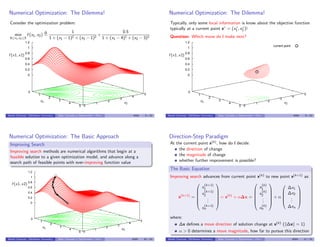
Numerical Optimization: The Dilemma!
Consider the optimization problem:
min
0≤x1,x2≤5
f (x1, x2)
∆
=
1
1 + (x1 − 1)2 + (x2 − 1)2
+
0.5
1 + (x1 − 4)2 + (x2 − 3)2
0
1
2
3
4
5 0
1
2
3
4
5
0
0.2
0.4
0.6
0.8
1
1.2
f (x1, x2)
x1 x2
Benoˆıt Chachuat (McMaster University) Basic Concepts in Optimization – Part I 4G03 9 / 23
Numerical Optimization: The Dilemma!
Typically, only some local information is know about the objective function
typically at a current point x◦ = (x◦
1 , x◦
2 )!
Question: Which move do I make next?
current point
0
1
2
3
4
5 0
1
2
3
4
5
0
0.2
0.4
0.6
0.8
1
1.2
f (x1, x2)
x1 x2
Benoˆıt Chachuat (McMaster University) Basic Concepts in Optimization – Part I 4G03 9 / 23
Numerical Optimization: The Basic Approach
Improving Search
Improving search methods are numerical algorithms that begin at a
feasible solution to a given optimization model, and advance along a
search path of feasible points with ever-improving function value
0
1
2
3
4
5 0
1
2
3
4
5
0
0.2
0.4
0.6
0.8
1
1.2
f (x1, x2)
x1 x2
Benoˆıt Chachuat (McMaster University) Basic Concepts in Optimization – Part I 4G03 10 / 23
Direction-Step Paradigm
At the current point x(k), how do I decide:
the direction of change
the magnitude of change
whether further improvement is possible?
The Basic Equation
Improving search advances from current point x(k) to new point x(k+1) as:
x(k+1)
=






x
(k+1)
1
x
(k+1)
2
...
x
(k+1)
n






= x(k)
+ α∆x =






x
(k)
1
x
(k)
2
...
x
(k)
n






+ α





∆x1
∆x2
...
∆xn





where:
∆x defines a move direction of solution change at x(k) ( ∆x = 1)
α > 0 determines a move magnitude, how far to pursue this direction
Benoˆıt Chachuat (McMaster University) Basic Concepts in Optimization – Part I 4G03 11 / 23
Direction of Change, ∆x
Improving Directions
Vector ∆x ∈ IRn
is an improving direction at current point x(k) if the
objective function value at x(k) + α∆x is superior to that of x(k), for all
α > 0 sufficiently small
(maximize problem) ∃¯α > 0 : f (x(k)
+ α∆x) > f (x(k)
), ∀α ∈ (0, ¯α]
0
1
2
3
4
5 0
1
2
3
4
5
0
0.2
0.4
0.6
0.8
1
1.2
f (x1, x2)
x1 x2
current point
∆x, improving direction
Benoˆıt Chachuat (McMaster University) Basic Concepts in Optimization – Part I 4G03 12 / 23
Direction of Change, ∆x
Improving Directions
Vector ∆x ∈ IRn
is an improving direction at current point x(k) if the
objective function value at x(k) + α∆x is superior to that of x(k), for all
α > 0 sufficiently small
(maximize problem) ∃¯α > 0 : f (x(k)
+ α∆x) > f (x(k)
), ∀α ∈ (0, ¯α]
x(k)
x(k+1)
x1
x2
set of improving directions at x(k)
set of improving directions at x(k+1)
Benoˆıt Chachuat (McMaster University) Basic Concepts in Optimization – Part I 4G03 12 / 23
Direction of Change, ∆x (cont’d)
Feasible Directions
Vector ∆x ∈ IRn
is an feasible direction at current point x(k) if point
x(k) + α∆x violates no model constraint for all α > 0 sufficiently small
∃¯α > 0 : x(k)
+ α∆x ∈ S, ∀α ∈ (0, ¯α]
x(k)
x1x1
x2
set of feasible directions at x(k)
Benoˆıt Chachuat (McMaster University) Basic Concepts in Optimization – Part I 4G03 13 / 23
Optimality Criterion
Necessary Condition of Optimality (NCO)
No optimization model solution at which an improving feasible direction is
available can be a local optimum
x∗
x1
x2
set of feasible directions at x∗
set of improving directions at x∗
Benoˆıt Chachuat (McMaster University) Basic Concepts in Optimization – Part I 4G03 14 / 23
Continuous Improving Search Algorithm
Step 0: Initialization.
◮ Choose any starting feasible point x(0)
and let index k ← 0.
Step 1: Move Direction.
◮ If no improving feasible direction ∆x exists at current point x(k)
, stop.
◮ Otherwise, construct an improving feasible direction at x(k)
as ∆x(k+1)
.
Step 2: Step Size.
◮ If there is no limit on step sizes for which direction ∆x(k+1)
continues
to both improve the objective function and retain feasibility, stop —
The model is unbounded.
◮ Otherwise, choose the largest step size α(k+1)
.
Step 3: Update.
◮ x(k+1)
← x(k)
+ α(k+1)
∆x(k+1)
◮ Increment index k ← k + 1 and return to step 1.
Remarks:
This basic algorithm may terminate at a suboptimal point
Moreover, it does not distinguish between local and global optima
Benoˆıt Chachuat (McMaster University) Basic Concepts in Optimization – Part I 4G03 15 / 23
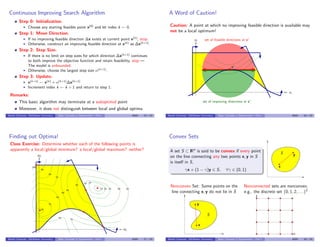
A Word of Caution!
Caution: A point at which no improving feasible direction is available may
not be a local optimum!
x∗
x1
x2 set of feasible directions at x∗
set of improving directions at x∗
Benoˆıt Chachuat (McMaster University) Basic Concepts in Optimization – Part I 4G03 16 / 23
Finding out Optima!
Class Exercise: Determine whether each of the following points is
apparently a local/global minimum? a local/global maximum? neither?
10 20 30 40
30
40
20
60
40
50
50
50
60
90
60
70
100
70
80
x1
x2
Benoˆıt Chachuat (McMaster University) Basic Concepts in Optimization – Part I 4G03 17 / 23
Convex Sets
A set S ⊂ IRn
is said to be convex if every point
on the line connecting any two points x, y in S
is itself in S,
γx + (1 − γ)y ∈ S, ∀γ ∈ (0, 1)
x
yS
Nonconvex Set: Some points on the
line connecting x, y do not lie in S
S
x
y
Nonconnected sets are nonconvex;
e.g., the discrete set {0, 1, 2, . . .}2
Benoˆıt Chachuat (McMaster University) Basic Concepts in Optimization – Part I 4G03 18 / 23
Convex and Concave Functions
Convex Functions
A function f : S → IR, defined on a convex set S ⊂ IRn
, is said to be
convex on S if the line segment connecting f (x) and f (y) at any two
points x, y ∈ S lies above the function between x and y,
f (γx + (1 − γ)y) ≤ γf (x) + (1 − γ)f (y), ∀γ ∈ (0, 1)
Strict convexity:
f (γx + (1 − γ)y) < γf (x) + (1 − γ)f (y), ∀x, y ∈ S, ∀γ ∈ (0, 1)
Concave Functions
f is said to be [strictly] concave on S if (−f ) is [strictly] convex on S,
f (γx + (1 − γ)y) ≥ [>]γf (x) + (1 − γ)f (y), ∀x, y ∈ S, ∀γ ∈ (0, 1)
Benoˆıt Chachuat (McMaster University) Basic Concepts in Optimization – Part I 4G03 19 / 23
Convex and Concave Functions (cont’d)
Case of a strictly convex function
on the convex set S
Case of a nonconvex function on S,
yet convex on the convex set S′
SS
S′
γx1 + (1 − γ)x2
f (γx1 + (1 − γ)x2)
γf (x1) + (1 − γ)f (x2)
x1 x1x2 x2
f (x)f (x)
Benoˆıt Chachuat (McMaster University) Basic Concepts in Optimization – Part I 4G03 20 / 23
Sets Defined by Constraints
Define the set S
∆
= {x ∈ IRn
: g(x) ≤ 0}, with g a
convex function on IRn
. Then, S is a convex set
Why?
g(x) = 0
S
Consider any two points x, y ∈ S. By the convexity of g,
g(γx + (1 − γ)y) ≤ γg(x) + (1 − γ)g(y), ∀γ ∈ (0, 1)
Since g(x) ≤ 0 and g(y) ≤ 0,
g(x) + (1 − γ)g(y) ≤ 0, ∀γ ∈ (0, 1)
Therefore, γx + (1 − γ)y ∈ S for every γ ∈ (0, 1); i.e., S is convex
Class Exercise: Give a condition on g for the following set to be convex:
S
∆
= {x ∈ IRn
: g(x) ≥ 0}
Benoˆıt Chachuat (McMaster University) Basic Concepts in Optimization – Part I 4G03 21 / 23
Sets Defined by Constraints (cont’d)
What is the condition on h for the following
set to be convex:
S
∆
= {x ∈ IRn
: h(x) = 0}
The set S is convex if and only if h is affine
x
y h(x) = 0
S
points not in S
Convex Sets Defined by Constraints
Consider the set
S
∆
= {x ∈ IRn
: g1(x) ≤ 0, . . . , gm(x) ≤ 0, h1(x) = 0, . . . , hp(x) = 0}
Then, S is convex if:
g1, . . . , gm are convex on IRn
h1, . . . , hp are affine
Benoˆıt Chachuat (McMaster University) Basic Concepts in Optimization – Part I 4G03 22 / 23
Convexity and Global Optimality
Consider the constrained program:
max
x
f (x)
s.t. gj (x) ≤ 0, j = 1, . . . , m
hj (x) = 0, j = 1, . . . , p
If f and g1, . . . , gm are convex on IRn
, and h1, . . . , hp are affine, then
this program is said to be a convex program
Sufficient Condition for Global Optimality
A [strict] local minimum to a convex program is also a [strict] global
minimum
On the other hand, a nonconvex program may or may not have local
optima that are not global optima
Benoˆıt Chachuat (McMaster University) Basic Concepts in Optimization – Part I 4G03 23 / 23

02 basics i-handout

  • 1.
    Basic Concepts inOptimization – Part I Benoˆıt Chachuat <benoit@mcmaster.ca> McMaster University Department of Chemical Engineering ChE 4G03: Optimization in Chemical Engineering Benoˆıt Chachuat (McMaster University) Basic Concepts in Optimization – Part I 4G03 1 / 23 Outline 1 Local and Global Optima 2 Numerical Methods: Improving Search 3 Notions of Convexity Benoˆıt Chachuat (McMaster University) Basic Concepts in Optimization – Part I 4G03 2 / 23 Local Optima Neighborhood The neighborhood Nδ(x◦) of a point x◦ consists of all nearby points; that is, all points within a small distance δ > 0 of x◦: Nδ(x◦ ) ∆ = {x : x − x◦ < δ} Local Optimum A point x∗ is a [strict] local minimum for the function f : IRn → IR on the set S if it is feasible (x∗ ∈ S) and if sufficiently small neighborhoods surrounding it contain no points that are both feasible and [strictly] lower in objective value: ∃δ > 0 : f (x∗ ) ≤ f (x), ∀x ∈ S ∩ Nδ(x∗ ) [ ∃δ > 0 : f (x∗ ) < f (x), ∀x ∈ S ∩ Nδ(x∗ ) {x∗ } ] Benoˆıt Chachuat (McMaster University) Basic Concepts in Optimization – Part I 4G03 3 / 23 Illustration of a (Strict) Local Minimum, x∗ δ S xx Nδ(x∗) f (x) x∗ f (x∗) f (x∗) < f (x), ∀x ∈ S ∩ Nδ(x∗) {x∗} Benoˆıt Chachuat (McMaster University) Basic Concepts in Optimization – Part I 4G03 4 / 23
  • 2.
    Global Optima Global Optimum Apoint x∗ is a [strict] global minimum for the function f : IRn → IR on the set S if it is feasible (x∗ ∈ S) and if no other feasible solution has [strictly] lower objective value: f (x∗ ) ≤ f (x), ∀x ∈ S [ f (x∗ ) < f (x), ∀x ∈ S {x∗ } ] Remarks: 1 Global minima are always local minima 2 Local minima may not be global minima 3 Analog definitions hold for local/global optima to maximize problems Benoˆıt Chachuat (McMaster University) Basic Concepts in Optimization – Part I 4G03 5 / 23 Illustration of a (Strict) Global Minimum, x∗ f (x∗) S x x∗ f (x∗) < f (x), ∀x ∈ S {x∗} f (x) Benoˆıt Chachuat (McMaster University) Basic Concepts in Optimization – Part I 4G03 6 / 23 Global vs. Local Optima Class Exercise: Identify the various types of minima and maxima for f on S ∆ = [xmin, xmax] f (x) xmin xmax x1 x2 x3 x4 x5 Benoˆıt Chachuat (McMaster University) Basic Concepts in Optimization – Part I 4G03 7 / 23 How to Find Optima? Review: Three Methods for Optimization 1 Graphical Solutions Great display + see multiple optima But impractical for nearly all practical problems 2 Analytical Solutions (e.g., Newton, Euler, etc.) Exact solution + easy analysis for changes in (uncertain) parameters But not possible for most practical problems 3 Numerical Solutions The only practical method for complex models! But only guarantees local optima + challenges in finding effects of (uncertain) parameters Benoˆıt Chachuat (McMaster University) Basic Concepts in Optimization – Part I 4G03 8 / 23
  • 3.
    Numerical Optimization: TheDilemma! Consider the optimization problem: min 0≤x1,x2≤5 f (x1, x2) ∆ = 1 1 + (x1 − 1)2 + (x2 − 1)2 + 0.5 1 + (x1 − 4)2 + (x2 − 3)2 0 1 2 3 4 5 0 1 2 3 4 5 0 0.2 0.4 0.6 0.8 1 1.2 f (x1, x2) x1 x2 Benoˆıt Chachuat (McMaster University) Basic Concepts in Optimization – Part I 4G03 9 / 23 Numerical Optimization: The Dilemma! Typically, only some local information is know about the objective function typically at a current point x◦ = (x◦ 1 , x◦ 2 )! Question: Which move do I make next? current point 0 1 2 3 4 5 0 1 2 3 4 5 0 0.2 0.4 0.6 0.8 1 1.2 f (x1, x2) x1 x2 Benoˆıt Chachuat (McMaster University) Basic Concepts in Optimization – Part I 4G03 9 / 23 Numerical Optimization: The Basic Approach Improving Search Improving search methods are numerical algorithms that begin at a feasible solution to a given optimization model, and advance along a search path of feasible points with ever-improving function value 0 1 2 3 4 5 0 1 2 3 4 5 0 0.2 0.4 0.6 0.8 1 1.2 f (x1, x2) x1 x2 Benoˆıt Chachuat (McMaster University) Basic Concepts in Optimization – Part I 4G03 10 / 23 Direction-Step Paradigm At the current point x(k), how do I decide: the direction of change the magnitude of change whether further improvement is possible? The Basic Equation Improving search advances from current point x(k) to new point x(k+1) as: x(k+1) =       x (k+1) 1 x (k+1) 2 ... x (k+1) n       = x(k) + α∆x =       x (k) 1 x (k) 2 ... x (k) n       + α      ∆x1 ∆x2 ... ∆xn      where: ∆x defines a move direction of solution change at x(k) ( ∆x = 1) α > 0 determines a move magnitude, how far to pursue this direction Benoˆıt Chachuat (McMaster University) Basic Concepts in Optimization – Part I 4G03 11 / 23
  • 4.
    Direction of Change,∆x Improving Directions Vector ∆x ∈ IRn is an improving direction at current point x(k) if the objective function value at x(k) + α∆x is superior to that of x(k), for all α > 0 sufficiently small (maximize problem) ∃¯α > 0 : f (x(k) + α∆x) > f (x(k) ), ∀α ∈ (0, ¯α] 0 1 2 3 4 5 0 1 2 3 4 5 0 0.2 0.4 0.6 0.8 1 1.2 f (x1, x2) x1 x2 current point ∆x, improving direction Benoˆıt Chachuat (McMaster University) Basic Concepts in Optimization – Part I 4G03 12 / 23 Direction of Change, ∆x Improving Directions Vector ∆x ∈ IRn is an improving direction at current point x(k) if the objective function value at x(k) + α∆x is superior to that of x(k), for all α > 0 sufficiently small (maximize problem) ∃¯α > 0 : f (x(k) + α∆x) > f (x(k) ), ∀α ∈ (0, ¯α] x(k) x(k+1) x1 x2 set of improving directions at x(k) set of improving directions at x(k+1) Benoˆıt Chachuat (McMaster University) Basic Concepts in Optimization – Part I 4G03 12 / 23 Direction of Change, ∆x (cont’d) Feasible Directions Vector ∆x ∈ IRn is an feasible direction at current point x(k) if point x(k) + α∆x violates no model constraint for all α > 0 sufficiently small ∃¯α > 0 : x(k) + α∆x ∈ S, ∀α ∈ (0, ¯α] x(k) x1x1 x2 set of feasible directions at x(k) Benoˆıt Chachuat (McMaster University) Basic Concepts in Optimization – Part I 4G03 13 / 23 Optimality Criterion Necessary Condition of Optimality (NCO) No optimization model solution at which an improving feasible direction is available can be a local optimum x∗ x1 x2 set of feasible directions at x∗ set of improving directions at x∗ Benoˆıt Chachuat (McMaster University) Basic Concepts in Optimization – Part I 4G03 14 / 23
  • 5.
    Continuous Improving SearchAlgorithm Step 0: Initialization. ◮ Choose any starting feasible point x(0) and let index k ← 0. Step 1: Move Direction. ◮ If no improving feasible direction ∆x exists at current point x(k) , stop. ◮ Otherwise, construct an improving feasible direction at x(k) as ∆x(k+1) . Step 2: Step Size. ◮ If there is no limit on step sizes for which direction ∆x(k+1) continues to both improve the objective function and retain feasibility, stop — The model is unbounded. ◮ Otherwise, choose the largest step size α(k+1) . Step 3: Update. ◮ x(k+1) ← x(k) + α(k+1) ∆x(k+1) ◮ Increment index k ← k + 1 and return to step 1. Remarks: This basic algorithm may terminate at a suboptimal point Moreover, it does not distinguish between local and global optima Benoˆıt Chachuat (McMaster University) Basic Concepts in Optimization – Part I 4G03 15 / 23 A Word of Caution! Caution: A point at which no improving feasible direction is available may not be a local optimum! x∗ x1 x2 set of feasible directions at x∗ set of improving directions at x∗ Benoˆıt Chachuat (McMaster University) Basic Concepts in Optimization – Part I 4G03 16 / 23 Finding out Optima! Class Exercise: Determine whether each of the following points is apparently a local/global minimum? a local/global maximum? neither? 10 20 30 40 30 40 20 60 40 50 50 50 60 90 60 70 100 70 80 x1 x2 Benoˆıt Chachuat (McMaster University) Basic Concepts in Optimization – Part I 4G03 17 / 23 Convex Sets A set S ⊂ IRn is said to be convex if every point on the line connecting any two points x, y in S is itself in S, γx + (1 − γ)y ∈ S, ∀γ ∈ (0, 1) x yS Nonconvex Set: Some points on the line connecting x, y do not lie in S S x y Nonconnected sets are nonconvex; e.g., the discrete set {0, 1, 2, . . .}2 Benoˆıt Chachuat (McMaster University) Basic Concepts in Optimization – Part I 4G03 18 / 23
  • 6.
    Convex and ConcaveFunctions Convex Functions A function f : S → IR, defined on a convex set S ⊂ IRn , is said to be convex on S if the line segment connecting f (x) and f (y) at any two points x, y ∈ S lies above the function between x and y, f (γx + (1 − γ)y) ≤ γf (x) + (1 − γ)f (y), ∀γ ∈ (0, 1) Strict convexity: f (γx + (1 − γ)y) < γf (x) + (1 − γ)f (y), ∀x, y ∈ S, ∀γ ∈ (0, 1) Concave Functions f is said to be [strictly] concave on S if (−f ) is [strictly] convex on S, f (γx + (1 − γ)y) ≥ [>]γf (x) + (1 − γ)f (y), ∀x, y ∈ S, ∀γ ∈ (0, 1) Benoˆıt Chachuat (McMaster University) Basic Concepts in Optimization – Part I 4G03 19 / 23 Convex and Concave Functions (cont’d) Case of a strictly convex function on the convex set S Case of a nonconvex function on S, yet convex on the convex set S′ SS S′ γx1 + (1 − γ)x2 f (γx1 + (1 − γ)x2) γf (x1) + (1 − γ)f (x2) x1 x1x2 x2 f (x)f (x) Benoˆıt Chachuat (McMaster University) Basic Concepts in Optimization – Part I 4G03 20 / 23 Sets Defined by Constraints Define the set S ∆ = {x ∈ IRn : g(x) ≤ 0}, with g a convex function on IRn . Then, S is a convex set Why? g(x) = 0 S Consider any two points x, y ∈ S. By the convexity of g, g(γx + (1 − γ)y) ≤ γg(x) + (1 − γ)g(y), ∀γ ∈ (0, 1) Since g(x) ≤ 0 and g(y) ≤ 0, g(x) + (1 − γ)g(y) ≤ 0, ∀γ ∈ (0, 1) Therefore, γx + (1 − γ)y ∈ S for every γ ∈ (0, 1); i.e., S is convex Class Exercise: Give a condition on g for the following set to be convex: S ∆ = {x ∈ IRn : g(x) ≥ 0} Benoˆıt Chachuat (McMaster University) Basic Concepts in Optimization – Part I 4G03 21 / 23 Sets Defined by Constraints (cont’d) What is the condition on h for the following set to be convex: S ∆ = {x ∈ IRn : h(x) = 0} The set S is convex if and only if h is affine x y h(x) = 0 S points not in S Convex Sets Defined by Constraints Consider the set S ∆ = {x ∈ IRn : g1(x) ≤ 0, . . . , gm(x) ≤ 0, h1(x) = 0, . . . , hp(x) = 0} Then, S is convex if: g1, . . . , gm are convex on IRn h1, . . . , hp are affine Benoˆıt Chachuat (McMaster University) Basic Concepts in Optimization – Part I 4G03 22 / 23
  • 7.
    Convexity and GlobalOptimality Consider the constrained program: max x f (x) s.t. gj (x) ≤ 0, j = 1, . . . , m hj (x) = 0, j = 1, . . . , p If f and g1, . . . , gm are convex on IRn , and h1, . . . , hp are affine, then this program is said to be a convex program Sufficient Condition for Global Optimality A [strict] local minimum to a convex program is also a [strict] global minimum On the other hand, a nonconvex program may or may not have local optima that are not global optima Benoˆıt Chachuat (McMaster University) Basic Concepts in Optimization – Part I 4G03 23 / 23