Kingdom Archaebacteria
DEE M. BARRETO – SST-1
Archaebacteria are the oldest organism living
on Earth. They are unicellular prokaryotes -
microbes without cell nucleus and any other
membrane-bound organelles in their cells -
and belong to the kingdom, Archaea. They
were first discovered in 1977 by Carl Woose
and George E. Fox and classified as bacteria.
Most archaebacteria appear like bacteria,
when observed under the microscope.
However, they are quite different from
bacteria and eukaryotes.
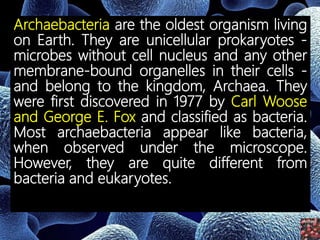
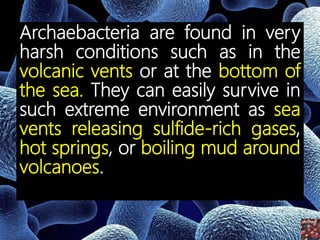
Archaebacteria are found in very
harsh conditions such as in the
volcanic vents or at the bottom of
the sea. They can easily survive in
such extreme environment as sea
vents releasing sulfide-rich gases,
hot springs, or boiling mud around
volcanoes.
The word archae came
from the Greek word
Arkhaion, which means
ancient. Archae is also
the Latin name for
prokaryotic cells.
A single individual or species from the
Archaebacteria domain is called
archaeon (sometimes spelled
"archeon".) They have no cell nucleus
and no other membrane bound
organelles within their cells. In the past
these rare forms were known as
Archaebacteria but Archean have an
independent evolutionary history and
have shown many differences in their
biochemistry.
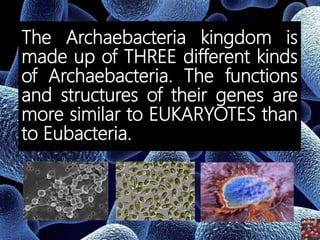
The Archaebacteria kingdom is
made up of THREE different kinds
of Archaebacteria. The functions
and structures of their genes are
more similar to EUKARYOTES than
to Eubacteria.
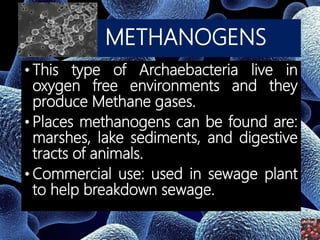
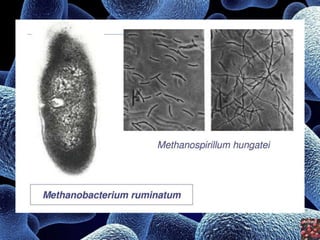
METHANOGENS
• This type of Archaebacteria live in
oxygen free environments and they
produce Methane gases.
• Places methanogens can be found are:
marshes, lake sediments, and digestive
tracts of animals.
• Commercial use: used in sewage plant
to help breakdown sewage.
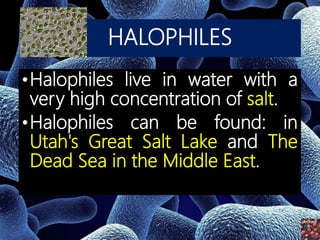
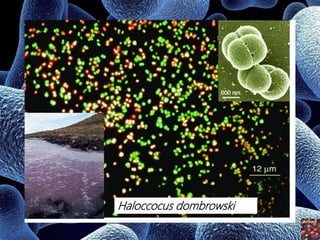
HALOPHILES
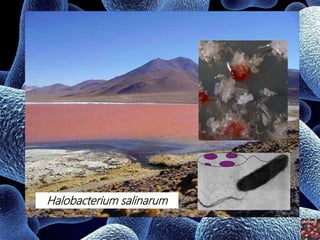
•Halophiles live in water with a
very high concentration of salt.
•Halophiles can be found: in
Utah's Great Salt Lake and The
Dead Sea in the Middle East.
Haloccocus dombrowski
Halobacterium salinarum
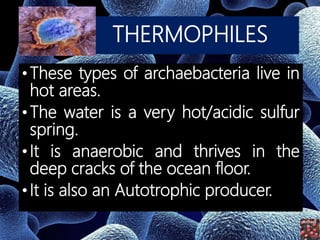
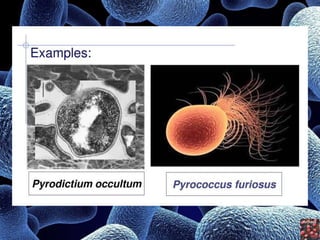
THERMOPHILES
•These types of archaebacteria live in
hot areas.
•The water is a very hot/acidic sulfur
spring.
•It is anaerobic and thrives in the
deep cracks of the ocean floor.
•It is also an Autotrophic producer.
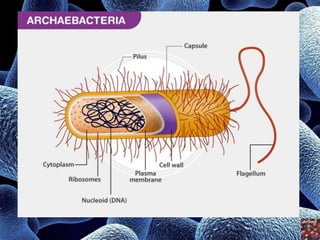
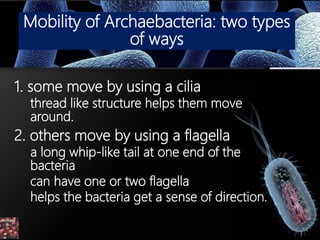
Mobility of Archaebacteria: two types
of ways
1. some move by using a cilia
thread like structure helps them move
around.
2. others move by using a flagella
a long whip-like tail at one end of the
bacteria
can have one or two flagella
helps the bacteria get a sense of direction.
KINGDOM ARCHAEBACTERIA

KINGDOM ARCHAEBACTERIA

  • 1.
  • 2.
    Archaebacteria are theoldest organism living on Earth. They are unicellular prokaryotes - microbes without cell nucleus and any other membrane-bound organelles in their cells - and belong to the kingdom, Archaea. They were first discovered in 1977 by Carl Woose and George E. Fox and classified as bacteria. Most archaebacteria appear like bacteria, when observed under the microscope. However, they are quite different from bacteria and eukaryotes.
  • 3.
    Archaebacteria are foundin very harsh conditions such as in the volcanic vents or at the bottom of the sea. They can easily survive in such extreme environment as sea vents releasing sulfide-rich gases, hot springs, or boiling mud around volcanoes.
  • 4.
    The word archaecame from the Greek word Arkhaion, which means ancient. Archae is also the Latin name for prokaryotic cells.
  • 5.
    A single individualor species from the Archaebacteria domain is called archaeon (sometimes spelled "archeon".) They have no cell nucleus and no other membrane bound organelles within their cells. In the past these rare forms were known as Archaebacteria but Archean have an independent evolutionary history and have shown many differences in their biochemistry.
  • 7.
    The Archaebacteria kingdomis made up of THREE different kinds of Archaebacteria. The functions and structures of their genes are more similar to EUKARYOTES than to Eubacteria.
  • 8.
    METHANOGENS • This typeof Archaebacteria live in oxygen free environments and they produce Methane gases. • Places methanogens can be found are: marshes, lake sediments, and digestive tracts of animals. • Commercial use: used in sewage plant to help breakdown sewage.
  • 10.
    HALOPHILES •Halophiles live inwater with a very high concentration of salt. •Halophiles can be found: in Utah's Great Salt Lake and The Dead Sea in the Middle East.
  • 11.
  • 12.
  • 13.
    THERMOPHILES •These types ofarchaebacteria live in hot areas. •The water is a very hot/acidic sulfur spring. •It is anaerobic and thrives in the deep cracks of the ocean floor. •It is also an Autotrophic producer.
  • 15.
    Mobility of Archaebacteria:two types of ways 1. some move by using a cilia thread like structure helps them move around. 2. others move by using a flagella a long whip-like tail at one end of the bacteria can have one or two flagella helps the bacteria get a sense of direction.