Youtube Video Link:
• Audio / Video Presentation (Language – English)
– Link: https://youtu.be/WuQRkti11mU
• Audio / Video Presentation (Language – Hindi)
– Link: https://youtu.be/EiMOnWiHOP4
Why Learn This Stuff?
• Indispensable Technology
• Buying a PC
• Do it Yourself
• Learn Latest stuff
• Be able to talk to Friends & Grandchildren
• Favorite Pastime - Millions of Activities
• Gyansagar – Google
• Explore more about your hobbies – cooking, dancing,
reading, singing, gardening, health & Fitness
• In short - It’s Fun
Uses of a Computer
• Simplification of Work – Calculations
• Write, Design, Paint
• Database Management
• Spreadsheets
• Word Processing
• Presentations
• Communication
• Finance
• Education
• Entertainment – Movies, Music, Games
• News and Information
OBJECTIVES
• Learn Computer Terminologies & Components
• Why a computer is a powerful tool
• Difference Between Hardware and Software
• Understanding Computer
• Recognize the difference between installing and running
a program
• Discuss computer applications in society
• Practical use and basics of Computer
Tips for Beginners
• Explore Your Computer
• Mistakes won’t Kill You
• EDIT/ UNDO is your Friend
• Be persistent
• Have patience
• Apply what you Learn
• Don’t try to learn too fast
• Have Fun
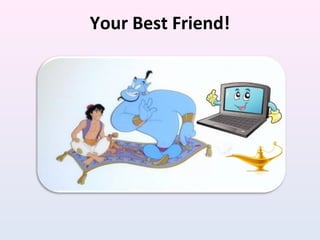
Your Best Friend!
What is a Computer?
Computer.. Latin word.. Compute
• A device that computes, especially a
programmable electronic machine that
performs high-speed mathematical or logical
operations or that assembles, stores,
correlates, or otherwise processes
information.
– Performs computations and makes logical decisions
– Millions / billions times faster than human beings
• Smart Machine for Smarter Life!
History Of Computers
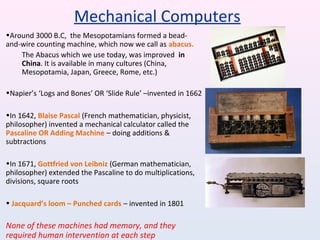
•Around 3000 B.C, the Mesopotamians formed a bead-
and-wire counting machine, which now we call as abacus.
The Abacus which we use today, was improved in
China. It is available in many cultures (China,
Mesopotamia, Japan, Greece, Rome, etc.)
•Napier’s ‘Logs and Bones’ OR ‘Slide Rule’ –invented in 1662
•In 1642, Blaise Pascal (French mathematician, physicist,
philosopher) invented a mechanical calculator called the
Pascaline OR Adding Machine – doing additions &
subtractions
•In 1671, Gottfried von Leibniz (German mathematician,
philosopher) extended the Pascaline to do multiplications,
divisions, square roots
• Jacquard’s loom – Punched cards – invented in 1801
None of these machines had memory, and they
required human intervention at each step
Mechanical Computers
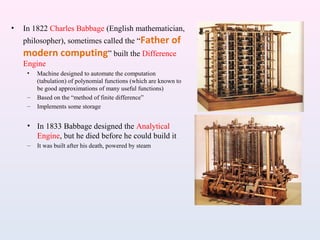
• In 1822 Charles Babbage (English mathematician,
philosopher), sometimes called the “Father of
modern computing” built the Difference
Engine
• Machine designed to automate the computation
(tabulation) of polynomial functions (which are known to
be good approximations of many useful functions)
– Based on the “method of finite difference”
– Implements some storage
• In 1833 Babbage designed the Analytical
Engine, but he died before he could build it
– It was built after his death, powered by steam
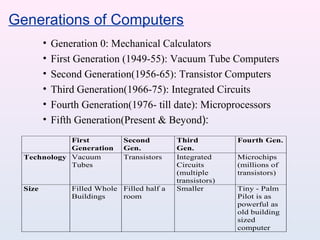
Generations of Computers
• Generation 0: Mechanical Calculators
• First Generation (1949-55): Vacuum Tube Computers
• Second Generation(1956-65): Transistor Computers
• Third Generation(1966-75): Integrated Circuits
• Fourth Generation(1976- till date): Microprocessors
• Fifth Generation(Present & Beyond):
First
Generation
Second
Gen.
Third
Gen.
Fourth Gen.
Technology Vacuum
Tubes
Transistors Integrated
Circuits
(multiple
transistors)
Microchips
(millions of
transistors)
Size Filled Whole
Buildings
Filled half a
room
Smaller Tiny - Palm
Pilot is as
powerful as
old building
sized
computer
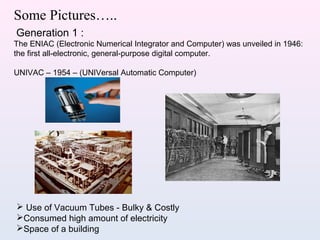
Generation 1 :
The ENIAC (Electronic Numerical Integrator and Computer) was unveiled in 1946:
the first all-electronic, general-purpose digital computer.
UNIVAC – 1954 – (UNIVersal Automatic Computer)
Some Pictures…..
 Use of Vacuum Tubes - Bulky & Costly
Consumed high amount of electricity
Space of a building
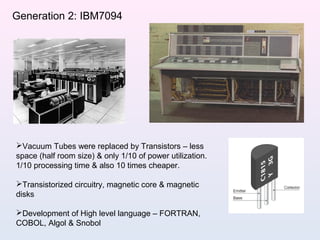
Generation 2: IBM7094
Vacuum Tubes were replaced by Transistors – less
space (half room size) & only 1/10 of power utilization.
1/10 processing time & also 10 times cheaper.
Transistorized circuitry, magnetic core & magnetic
disks
Development of High level language – FORTRAN,
COBOL, Algol & Snobol
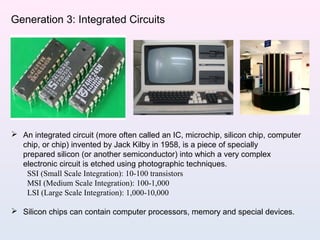
Generation 3: Integrated Circuits
 An integrated circuit (more often called an IC, microchip, silicon chip, computer
chip, or chip) invented by Jack Kilby in 1958, is a piece of specially
prepared silicon (or another semiconductor) into which a very complex
electronic circuit is etched using photographic techniques.
SSI (Small Scale Integration): 10-100 transistors
MSI (Medium Scale Integration): 100-1,000
LSI (Large Scale Integration): 1,000-10,000
 Silicon chips can contain computer processors, memory and special devices.
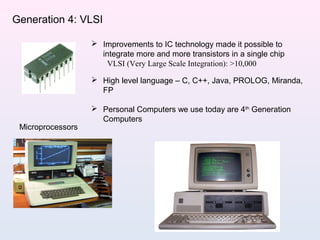
Generation 4: VLSI
 Improvements to IC technology made it possible to
integrate more and more transistors in a single chip
VLSI (Very Large Scale Integration): >10,000
 High level language – C, C++, Java, PROLOG, Miranda,
FP
 Personal Computers we use today are 4th
Generation
Computers
Microprocessors
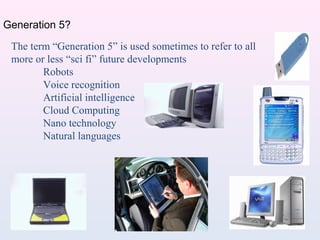
Generation 5?
The term “Generation 5” is used sometimes to refer to all
more or less “sci fi” future developments
Robots
Voice recognition
Artificial intelligence
Cloud Computing
Nano technology
Natural languages
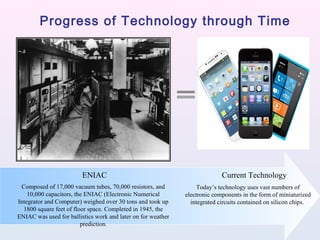
Progress of Technology through Time
ENIAC Current Technology
Composed of 17,000 vacuum tubes, 70,000 resistors, and
10,000 capacitors, the ENIAC (Electronic Numerical
Integrator and Computer) weighed over 30 tons and took up
1800 square feet of floor space. Completed in 1945, the
ENIAC was used for ballistics work and later on for weather
prediction.
Today’s technology uses vast numbers of
electronic components in the form of miniaturized
integrated circuits contained on silicon chips.
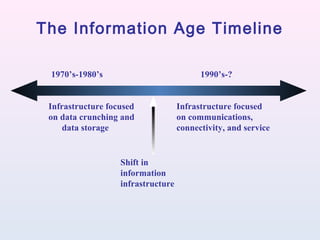
Shift in
information
infrastructure
1970’s-1980’s 1990’s-?
Infrastructure focused
on data crunching and
data storage
Infrastructure focused
on communications,
connectivity, and service
The Information Age Timeline
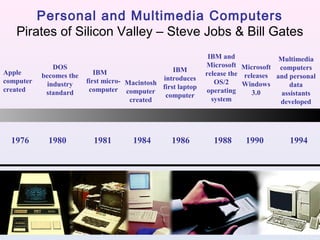
Apple
computer
created
1976
IBM
first micro-
computer
1981
Macintosh
computer
created
1984 1994
Multimedia
computers
and personal
data
assistants
developed
Personal and Multimedia Computers
Pirates of Silicon Valley – Steve Jobs & Bill Gates
1980 1986 1988 1990
DOS
becomes the
industry
standard
Microsoft
releases
Windows
3.0
IBM
introduces
first laptop
computer
IBM and
Microsoft
release the
OS/2
operating
system
Next:
Types of Computers
Thank You

Introduction to computer - History - Generation

  • 2.
    Youtube Video Link: •Audio / Video Presentation (Language – English) – Link: https://youtu.be/WuQRkti11mU • Audio / Video Presentation (Language – Hindi) – Link: https://youtu.be/EiMOnWiHOP4
  • 3.
    Why Learn ThisStuff? • Indispensable Technology • Buying a PC • Do it Yourself • Learn Latest stuff • Be able to talk to Friends & Grandchildren • Favorite Pastime - Millions of Activities • Gyansagar – Google • Explore more about your hobbies – cooking, dancing, reading, singing, gardening, health & Fitness • In short - It’s Fun
  • 4.
    Uses of aComputer • Simplification of Work – Calculations • Write, Design, Paint • Database Management • Spreadsheets • Word Processing • Presentations • Communication • Finance • Education • Entertainment – Movies, Music, Games • News and Information
  • 5.
    OBJECTIVES • Learn ComputerTerminologies & Components • Why a computer is a powerful tool • Difference Between Hardware and Software • Understanding Computer • Recognize the difference between installing and running a program • Discuss computer applications in society • Practical use and basics of Computer
  • 6.
    Tips for Beginners •Explore Your Computer • Mistakes won’t Kill You • EDIT/ UNDO is your Friend • Be persistent • Have patience • Apply what you Learn • Don’t try to learn too fast • Have Fun
  • 7.
  • 8.
    What is aComputer? Computer.. Latin word.. Compute • A device that computes, especially a programmable electronic machine that performs high-speed mathematical or logical operations or that assembles, stores, correlates, or otherwise processes information. – Performs computations and makes logical decisions – Millions / billions times faster than human beings • Smart Machine for Smarter Life!
  • 9.
  • 10.
    •Around 3000 B.C,the Mesopotamians formed a bead- and-wire counting machine, which now we call as abacus. The Abacus which we use today, was improved in China. It is available in many cultures (China, Mesopotamia, Japan, Greece, Rome, etc.) •Napier’s ‘Logs and Bones’ OR ‘Slide Rule’ –invented in 1662 •In 1642, Blaise Pascal (French mathematician, physicist, philosopher) invented a mechanical calculator called the Pascaline OR Adding Machine – doing additions & subtractions •In 1671, Gottfried von Leibniz (German mathematician, philosopher) extended the Pascaline to do multiplications, divisions, square roots • Jacquard’s loom – Punched cards – invented in 1801 None of these machines had memory, and they required human intervention at each step Mechanical Computers
  • 11.
    • In 1822Charles Babbage (English mathematician, philosopher), sometimes called the “Father of modern computing” built the Difference Engine • Machine designed to automate the computation (tabulation) of polynomial functions (which are known to be good approximations of many useful functions) – Based on the “method of finite difference” – Implements some storage • In 1833 Babbage designed the Analytical Engine, but he died before he could build it – It was built after his death, powered by steam
  • 12.
  • 13.
    Generations of Computers •Generation 0: Mechanical Calculators • First Generation (1949-55): Vacuum Tube Computers • Second Generation(1956-65): Transistor Computers • Third Generation(1966-75): Integrated Circuits • Fourth Generation(1976- till date): Microprocessors • Fifth Generation(Present & Beyond): First Generation Second Gen. Third Gen. Fourth Gen. Technology Vacuum Tubes Transistors Integrated Circuits (multiple transistors) Microchips (millions of transistors) Size Filled Whole Buildings Filled half a room Smaller Tiny - Palm Pilot is as powerful as old building sized computer
  • 14.
    Generation 1 : TheENIAC (Electronic Numerical Integrator and Computer) was unveiled in 1946: the first all-electronic, general-purpose digital computer. UNIVAC – 1954 – (UNIVersal Automatic Computer) Some Pictures…..  Use of Vacuum Tubes - Bulky & Costly Consumed high amount of electricity Space of a building
  • 15.
    Generation 2: IBM7094 VacuumTubes were replaced by Transistors – less space (half room size) & only 1/10 of power utilization. 1/10 processing time & also 10 times cheaper. Transistorized circuitry, magnetic core & magnetic disks Development of High level language – FORTRAN, COBOL, Algol & Snobol
  • 16.
    Generation 3: IntegratedCircuits  An integrated circuit (more often called an IC, microchip, silicon chip, computer chip, or chip) invented by Jack Kilby in 1958, is a piece of specially prepared silicon (or another semiconductor) into which a very complex electronic circuit is etched using photographic techniques. SSI (Small Scale Integration): 10-100 transistors MSI (Medium Scale Integration): 100-1,000 LSI (Large Scale Integration): 1,000-10,000  Silicon chips can contain computer processors, memory and special devices.
  • 17.
    Generation 4: VLSI Improvements to IC technology made it possible to integrate more and more transistors in a single chip VLSI (Very Large Scale Integration): >10,000  High level language – C, C++, Java, PROLOG, Miranda, FP  Personal Computers we use today are 4th Generation Computers Microprocessors
  • 18.
    Generation 5? The term“Generation 5” is used sometimes to refer to all more or less “sci fi” future developments Robots Voice recognition Artificial intelligence Cloud Computing Nano technology Natural languages
  • 19.
    Progress of Technologythrough Time ENIAC Current Technology Composed of 17,000 vacuum tubes, 70,000 resistors, and 10,000 capacitors, the ENIAC (Electronic Numerical Integrator and Computer) weighed over 30 tons and took up 1800 square feet of floor space. Completed in 1945, the ENIAC was used for ballistics work and later on for weather prediction. Today’s technology uses vast numbers of electronic components in the form of miniaturized integrated circuits contained on silicon chips.
  • 20.
    Shift in information infrastructure 1970’s-1980’s 1990’s-? Infrastructurefocused on data crunching and data storage Infrastructure focused on communications, connectivity, and service The Information Age Timeline
  • 21.
    Apple computer created 1976 IBM first micro- computer 1981 Macintosh computer created 1984 1994 Multimedia computers andpersonal data assistants developed Personal and Multimedia Computers Pirates of Silicon Valley – Steve Jobs & Bill Gates 1980 1986 1988 1990 DOS becomes the industry standard Microsoft releases Windows 3.0 IBM introduces first laptop computer IBM and Microsoft release the OS/2 operating system
  • 22.
  • 23.

Editor's Notes

  • #6 In Short – Session 1 before switching On computer Session 2 post Computer is switched On