HISTORY OF COMPUTERS &
GENERATIONS
Computer Meaning & Significance
Computer is a Latin word which mean to compute or in other
words we can say that it’s a machine which can perform
computations millions and billions time faster than a human.
It a device which can process data into useful information.
The things which make computer different from other electronic
device are;
Accuracy; e.g. password
High processing speed; e.g. card reader
Versatility
Input and output (which other devices don’t have)
Impacts In Society
Today we find computers every where like for instance in daily lifes
automobiles ,thermostats ,wristwatches ,microwave ovens and
many others so computer have covered all our modern society .
Computers are mostly used to access data and information and
other applications that are used computer are as follow:
Controlling space flight
Landing air planes
Tracking inventory
Turning on lights at a specific time
Checking out groceries at the check out counter
History Of Computers
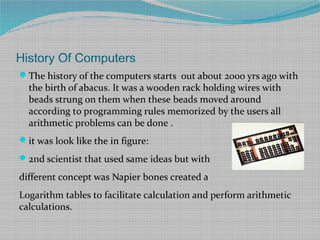
The history of the computers starts out about 2000 yrs ago with
the birth of abacus. It was a wooden rack holding wires with
beads strung on them when these beads moved around
according to programming rules memorized by the users all
arithmetic problems can be done .
it was look like the in figure:
2nd scientist that used same ideas but with
different concept was Napier bones created a
Logarithm tables to facilitate calculation and perform arithmetic
calculations.
History Of Computers
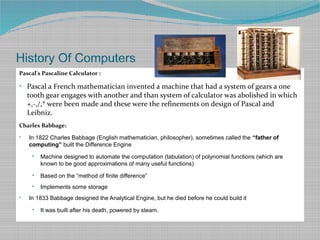
Pascal's Pascaline Calculator :
• Pascal a French mathematician invented a machine that had a system of gears a one
tooth gear engages with another and than system of calculator was abolished in which
+,-,/,* were been made and these were the refinements on design of Pascal and
Leibniz.
Charles Babbage:
• In 1822 Charles Babbage (English mathematician, philosopher), sometimes called the “father of
computing” built the Difference Engine
• Machine designed to automate the computation (tabulation) of polynomial functions (which are
known to be good approximations of many useful functions)
• Based on the “method of finite difference”
• Implements some storage
• In 1833 Babbage designed the Analytical Engine, but he died before he could build it
• It was built after his death, powered by steam.
Advancement in 1950s – 1960s
In early 1950s two important engineering discoveries changed
the image of the computer fields these discoveries were
magnetic core memories and transistors circuit elements .
These computers very expensive and complicated to operate
such computers were found in computer centre and other
research laborites.
More Recent Advancements
As the time passed during 1970s moving towards single purpose
computers to the wide range of computer systems. New application
were designed and made more available for controlling a great
range of manufacturing processes in which a revolution in computer
hardware was made which allowed the size of computer to reduced.
In 1980s (VLSI)was developed in which hundreds of thousands of
transistors were placed in a single chip and become more common.
After this introduction to personal computers (pc) was abolished and
the size was smaller in size and was affordable to the users.
So we say that the size of a computer is shrinking but the thing are
same and can be experience at any level.
(Now moving to computer generations)
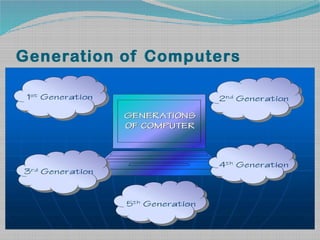
Generation of Computers
• Computer generation are divided into 5 types :
– First Generation (Vacuum Tubes)
– Second Generation(Transistors)
– Third Generation(Integrated Circuit)
– Fourth Generation(Microprocessors)
– Fifth Generation(Artificial Intelligence)
First Generation (Vacuum Tubes)
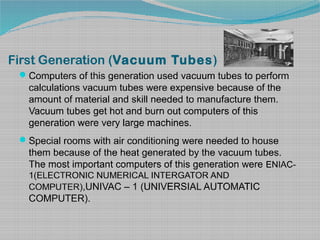
Computers of this generation used vacuum tubes to perform
calculations vacuum tubes were expensive because of the
amount of material and skill needed to manufacture them.
Vacuum tubes get hot and burn out computers of this
generation were very large machines.
Special rooms with air conditioning were needed to house
them because of the heat generated by the vacuum tubes.
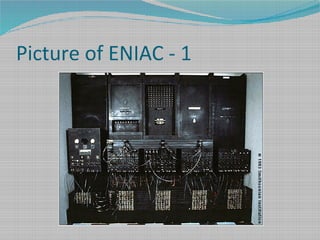
The most important computers of this generation were ENIAC-
1(ELECTRONIC NUMERICAL INTERGATOR AND
COMPUTER),UNIVAC – 1 (UNIVERSIAL AUTOMATIC
COMPUTER).
Picture of ENIAC - 1
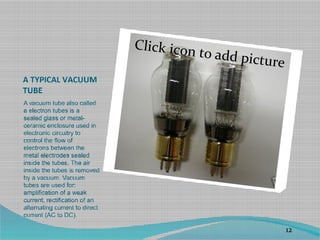
A TYPICAL VACUUM
TUBE
A vacuum tube also called
a electron tubes is a
sealed glass or metal-
ceramic enclosure used in
electronic circuitry to
control the flow of
electrons between the
metal electrodes sealed
inside the tubes. The air
inside the tubes is removed
by a vacuum. Vacuum
tubes are used for:
amplification of a weak
current, rectification of an
alternating current to direct
current (AC to DC).
12
Click icon to add picture
●
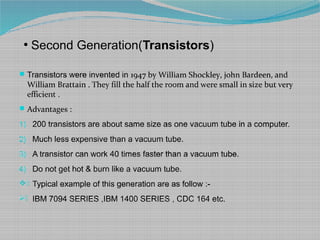
Second Generation(Transistors)
Transistors were invented in 1947 by William Shockley, john Bardeen, and
William Brattain . They fill the half the room and were small in size but very
efficient .
Advantages :
1) 200 transistors are about same size as one vacuum tube in a computer.
2) Much less expensive than a vacuum tube.
3) A transistor can work 40 times faster than a vacuum tube.
4) Do not get hot & burn like a vacuum tube.
) Typical example of this generation are as follow :-
) IBM 7094 SERIES ,IBM 1400 SERIES , CDC 164 etc.
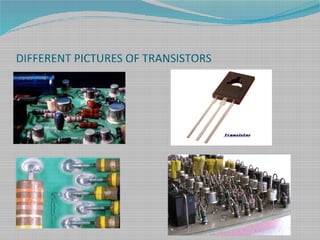
DIFFERENT PICTURES OF TRANSISTORS
●
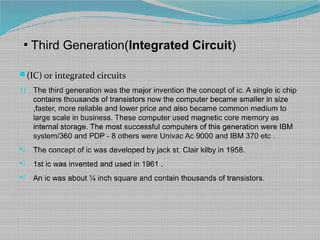
Third Generation(Integrated Circuit)
(IC) or integrated circuits
1) The third generation was the major invention the concept of ic. A single ic chip
contains thousands of transistors now the computer became smaller in size
,faster, more reliable and lower price and also became common medium to
large scale in business. These computer used magnetic core memory as
internal storage. The most successful computers of this generation were IBM
system/360 and PDP - 8 others were Univac Ac 9000 and IBM 370 etc .
) The concept of ic was developed by jack st. Clair kilby in 1958.
) 1st ic was invented and used in 1961 .
) An ic was about ¼ inch square and contain thousands of transistors.
FURTHER DEFINATION
An integrated circuit (IC), sometimes called a chip or microchip, is
a semiconductor wafer on which thousands or millions of tiny
resistors, capacitors, and transistors are fabricated. An IC can
function as an amplifier, oscillator, timer, counter, computer memory,
or microprocessor. A particular IC is categorized as either linear
(analog) or digital, depending on its intended application.
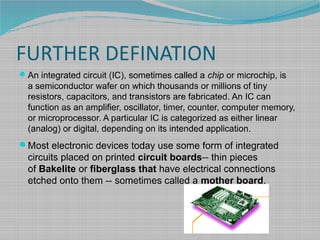
Most electronic devices today use some form of integrated
circuits placed on printed circuit boards-- thin pieces
of Bakelite or fiberglass that have electrical connections
etched onto them -- sometimes called a mother board.
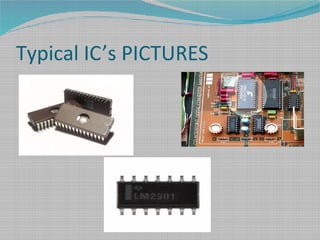
Typical IC’s PICTURES
●
Fourth Generation(Microprocessors)
The invention of the microprocessor (a single chip that could do all the processing of a full-
scale computer). By putting millions of transistors onto one single chip more calculation and
faster speeds could be reached by computers. Because electricity travels about a foot in a
billionth of a second, the smaller the distance the greater the speed of computers.
 However what really triggered the tremendous growth of computers and its significant
impact on our lives is the invention of the microprocessor. Ted Hoff, employed
by Intel invented a chip named 4004 the size of a pencil eraser that could do all the computing
and logic work of a computer. The microprocessor was made to be used in calculators, not
computers. It led, however, to the invention of personal computers, or microcomputers. And
microprocessor are based on very large scale integration (VLSI).
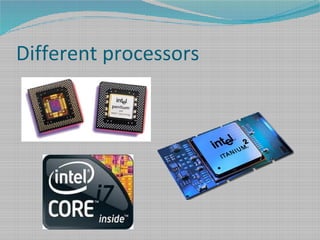
Different processors
Fifth Generation(Artificial Intelligence)
The Fifth generations computers are only in the minds of
advance research scientists still to be developed and being
tested out in the laboratories. These computers will be
under Artificial Intelligence(AI), They will be able to take
commands in a audio visual way and carry out
instructions. Many of the operations which requires low
human intelligence will be performed by these computers.
Parallel Processing is coming and showing the possibility
that the power of many CPU's can be used side by side,
and computers will be more powerful than those under
central processing.
Fifth Generation(Artificial Intelligence)
Characteristics:
 Combinations of some or all of the following technologies:
 -extremely large scale integration
 -parallel processing
 -high speed logic and memory chips
 -high performance, micro-miniaturization
 -voice/data integration; knowledge-based platforms
 -artificial intelligence, expert systems
 -virtual reality generation
 Satellite links
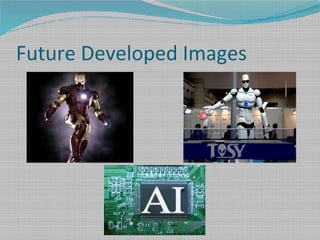
Future Developed Images

Ch 1

  • 1.
    HISTORY OF COMPUTERS& GENERATIONS
  • 2.
    Computer Meaning &Significance Computer is a Latin word which mean to compute or in other words we can say that it’s a machine which can perform computations millions and billions time faster than a human. It a device which can process data into useful information. The things which make computer different from other electronic device are; Accuracy; e.g. password High processing speed; e.g. card reader Versatility Input and output (which other devices don’t have)
  • 3.
    Impacts In Society Todaywe find computers every where like for instance in daily lifes automobiles ,thermostats ,wristwatches ,microwave ovens and many others so computer have covered all our modern society . Computers are mostly used to access data and information and other applications that are used computer are as follow: Controlling space flight Landing air planes Tracking inventory Turning on lights at a specific time Checking out groceries at the check out counter
  • 4.
    History Of Computers Thehistory of the computers starts out about 2000 yrs ago with the birth of abacus. It was a wooden rack holding wires with beads strung on them when these beads moved around according to programming rules memorized by the users all arithmetic problems can be done . it was look like the in figure: 2nd scientist that used same ideas but with different concept was Napier bones created a Logarithm tables to facilitate calculation and perform arithmetic calculations.
  • 5.
    History Of Computers Pascal'sPascaline Calculator : • Pascal a French mathematician invented a machine that had a system of gears a one tooth gear engages with another and than system of calculator was abolished in which +,-,/,* were been made and these were the refinements on design of Pascal and Leibniz. Charles Babbage: • In 1822 Charles Babbage (English mathematician, philosopher), sometimes called the “father of computing” built the Difference Engine • Machine designed to automate the computation (tabulation) of polynomial functions (which are known to be good approximations of many useful functions) • Based on the “method of finite difference” • Implements some storage • In 1833 Babbage designed the Analytical Engine, but he died before he could build it • It was built after his death, powered by steam.
  • 6.
    Advancement in 1950s– 1960s In early 1950s two important engineering discoveries changed the image of the computer fields these discoveries were magnetic core memories and transistors circuit elements . These computers very expensive and complicated to operate such computers were found in computer centre and other research laborites.
  • 7.
    More Recent Advancements Asthe time passed during 1970s moving towards single purpose computers to the wide range of computer systems. New application were designed and made more available for controlling a great range of manufacturing processes in which a revolution in computer hardware was made which allowed the size of computer to reduced. In 1980s (VLSI)was developed in which hundreds of thousands of transistors were placed in a single chip and become more common. After this introduction to personal computers (pc) was abolished and the size was smaller in size and was affordable to the users. So we say that the size of a computer is shrinking but the thing are same and can be experience at any level. (Now moving to computer generations)
  • 8.
  • 9.
    Generation of Computers •Computer generation are divided into 5 types : – First Generation (Vacuum Tubes) – Second Generation(Transistors) – Third Generation(Integrated Circuit) – Fourth Generation(Microprocessors) – Fifth Generation(Artificial Intelligence)
  • 10.
    First Generation (VacuumTubes) Computers of this generation used vacuum tubes to perform calculations vacuum tubes were expensive because of the amount of material and skill needed to manufacture them. Vacuum tubes get hot and burn out computers of this generation were very large machines. Special rooms with air conditioning were needed to house them because of the heat generated by the vacuum tubes. The most important computers of this generation were ENIAC- 1(ELECTRONIC NUMERICAL INTERGATOR AND COMPUTER),UNIVAC – 1 (UNIVERSIAL AUTOMATIC COMPUTER).
  • 11.
  • 12.
    A TYPICAL VACUUM TUBE Avacuum tube also called a electron tubes is a sealed glass or metal- ceramic enclosure used in electronic circuitry to control the flow of electrons between the metal electrodes sealed inside the tubes. The air inside the tubes is removed by a vacuum. Vacuum tubes are used for: amplification of a weak current, rectification of an alternating current to direct current (AC to DC). 12 Click icon to add picture
  • 13.
    ● Second Generation(Transistors) Transistors wereinvented in 1947 by William Shockley, john Bardeen, and William Brattain . They fill the half the room and were small in size but very efficient . Advantages : 1) 200 transistors are about same size as one vacuum tube in a computer. 2) Much less expensive than a vacuum tube. 3) A transistor can work 40 times faster than a vacuum tube. 4) Do not get hot & burn like a vacuum tube. ) Typical example of this generation are as follow :- ) IBM 7094 SERIES ,IBM 1400 SERIES , CDC 164 etc.
  • 14.
  • 15.
    ● Third Generation(Integrated Circuit) (IC)or integrated circuits 1) The third generation was the major invention the concept of ic. A single ic chip contains thousands of transistors now the computer became smaller in size ,faster, more reliable and lower price and also became common medium to large scale in business. These computer used magnetic core memory as internal storage. The most successful computers of this generation were IBM system/360 and PDP - 8 others were Univac Ac 9000 and IBM 370 etc . ) The concept of ic was developed by jack st. Clair kilby in 1958. ) 1st ic was invented and used in 1961 . ) An ic was about ¼ inch square and contain thousands of transistors.
  • 16.
    FURTHER DEFINATION An integratedcircuit (IC), sometimes called a chip or microchip, is a semiconductor wafer on which thousands or millions of tiny resistors, capacitors, and transistors are fabricated. An IC can function as an amplifier, oscillator, timer, counter, computer memory, or microprocessor. A particular IC is categorized as either linear (analog) or digital, depending on its intended application. Most electronic devices today use some form of integrated circuits placed on printed circuit boards-- thin pieces of Bakelite or fiberglass that have electrical connections etched onto them -- sometimes called a mother board.
  • 17.
  • 18.
    ● Fourth Generation(Microprocessors) The inventionof the microprocessor (a single chip that could do all the processing of a full- scale computer). By putting millions of transistors onto one single chip more calculation and faster speeds could be reached by computers. Because electricity travels about a foot in a billionth of a second, the smaller the distance the greater the speed of computers.  However what really triggered the tremendous growth of computers and its significant impact on our lives is the invention of the microprocessor. Ted Hoff, employed by Intel invented a chip named 4004 the size of a pencil eraser that could do all the computing and logic work of a computer. The microprocessor was made to be used in calculators, not computers. It led, however, to the invention of personal computers, or microcomputers. And microprocessor are based on very large scale integration (VLSI).
  • 19.
  • 20.
    Fifth Generation(Artificial Intelligence) TheFifth generations computers are only in the minds of advance research scientists still to be developed and being tested out in the laboratories. These computers will be under Artificial Intelligence(AI), They will be able to take commands in a audio visual way and carry out instructions. Many of the operations which requires low human intelligence will be performed by these computers. Parallel Processing is coming and showing the possibility that the power of many CPU's can be used side by side, and computers will be more powerful than those under central processing.
  • 21.
    Fifth Generation(Artificial Intelligence) Characteristics: Combinations of some or all of the following technologies:  -extremely large scale integration  -parallel processing  -high speed logic and memory chips  -high performance, micro-miniaturization  -voice/data integration; knowledge-based platforms  -artificial intelligence, expert systems  -virtual reality generation  Satellite links
  • 22.